
When a loved one comes home with a disease that no longer heals, the first question is almost never medical. It is practical, immediate, human. Who comes to see it, at what time, who notes the medications, who calls if the pain changes, and how to avoid everything resting on one person already exhausted.
The palliative care at home responds to this reality. It does not change the gravity of the situation, but it often allows us to maintain comfort, benchmarks and a form of continuity in a very fragile period. In France, the home remains a major place of end of life: about 25% of deaths occur there (figure 2022 attributed to Public Health France), or more than 150 000 people per year. At the same time, the public authorities estimate that about 60% of end of life situations would require palliative support, or 311,000 people per year. Many needs exist, and not all are yet covered by a specialized system.
Having access to care is not enough: you must also be able to organize it without losing information. At home, comfort depends as much on the treatment as on the quality of the transmissions, the identification of alert signs and the place given to the relatives. The home then becomes a real place of care, provided that it is coordinated with precision. This article proposes a simple protocol to get there: who to contact and in what order, who to note what, what to do at night, at night and at weekends.
Contents
- Understanding Home Palliative Care and its Issues
- The three levels of palliative care
- The actors involved in home accompaniment
- Step-by-step implementation of home palliative care
- Coordinate stakeholders and secure communications
- Manage symptoms and ensure patient comfort
- Support family caregivers in the long term
- Practical resources and tools to go further
Understanding Home Palliative Care and its Issues
A girl once told me, in front of the table in the living room turned into a coordinating station, that she no longer knew whether she was still a girl or already a planning chef. The doctor passed in the morning, the nurse later, the home helper changed the linen, and each gave different oral instructions. The discomfort did not come from a lack of will. It came from the difficulty of holding together scattered gestures, instructions that cross each other and a reliable trace of what was done.
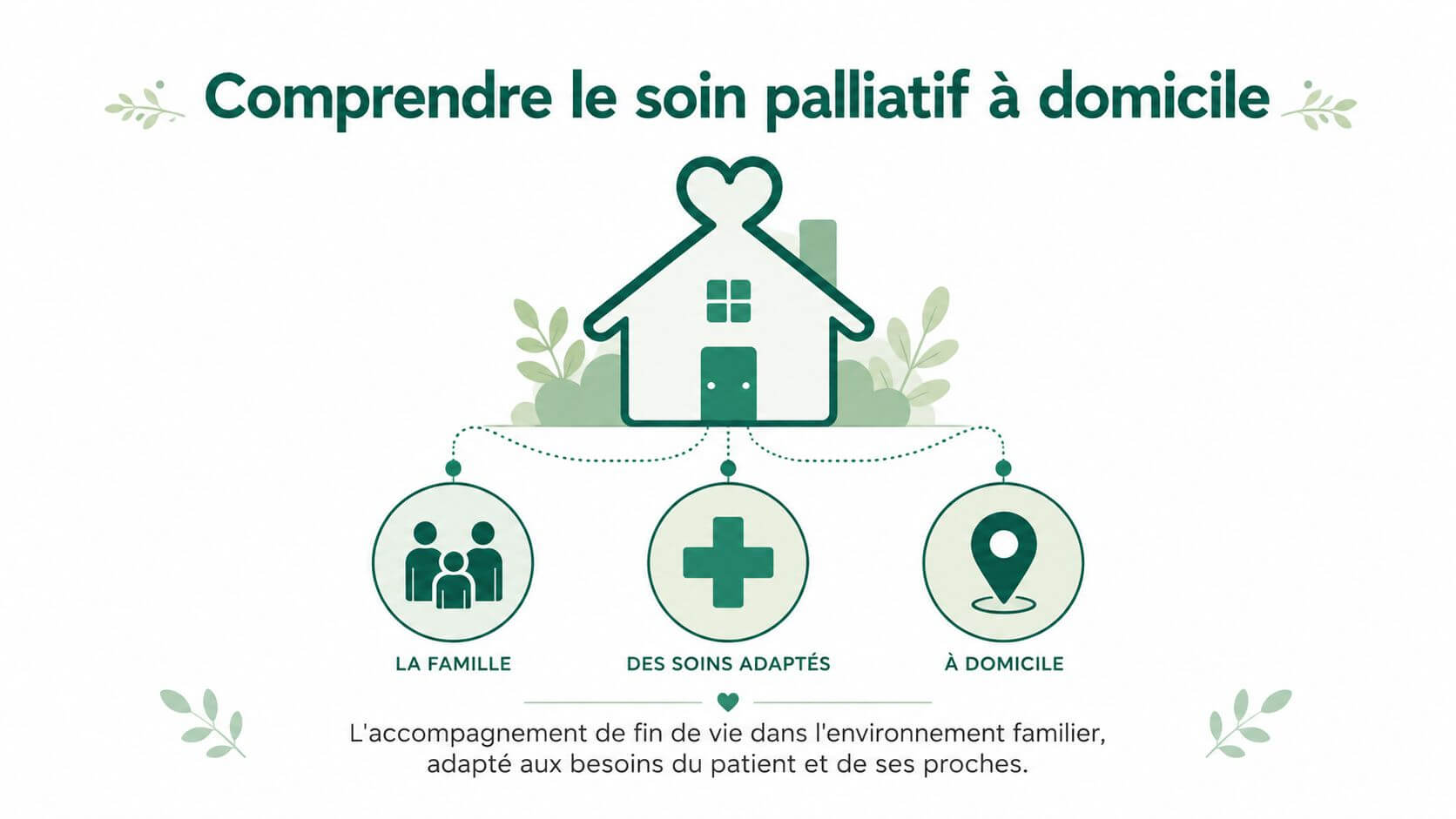
What the palliative approach really covers
Palliative care does not mean "no more to do". The goal changes: first, we seek relief, quality of life, dignity and respect for the patient's wishes. The goal of curative care is to treat the disease. Palliative care accompanies the person when the disease becomes progressive, heavy or advanced, and care continues.
At home, this can involve very different situations: advanced cancer, severe organ failure, significant neurological dependence. The common thing is that the patient's needs go beyond the mere presence of the family without necessarily justifying permanent hospital maintenance.
The care project serves as a guiding thread. It brings together advance decisions on treatments, comfort, passages of caregivers and the behaviour to be maintained if the state changes, and it re-evaluates itself at every turn. Two notions are often associated with it. Advance instructions are the patient's written wishes on his or her end of life, in case he or she could no longer express himself or herself. The person of trust is the person whom he or she designates to be consulted and to carry out his or her word. It is better to speak about it early, before an emergency forces to improvise.
Why Home Matters So Much
Home is not a secondary place. It is often the place where the patient feels the most spotted, the freest, sometimes the most appeased. However, this comfort requires a real organization: care must follow the real daily life of the person, not theoretical hours.
The public reports on the end of life recall that a large proportion of palliative needs appear at home, or return to it after hospitalization, while coordination remains uneven. The orders of magnitude mentioned above (25% of deaths at home according to Public Health France in 2022, 60% of end-of-life situations requiring palliative care) say the same thing: the home carries an important burden of care, and the traceability of gestures, decisions and alerts often remains the fragile link.
This is where digital tools take their place. A shared folder, a timed transmission, a clear list of monitored symptoms, a space where we note who called who, when and with what instructions: all this changes the continuity of care. Instead of a salon where the information is scattered, everyone sees what has already been done, what is waiting for an answer and what needs to be reported without delay.
Simple benchmark: if the family has to repeat the same information to several stakeholders, coordination is not yet secure.
The three levels of palliative care
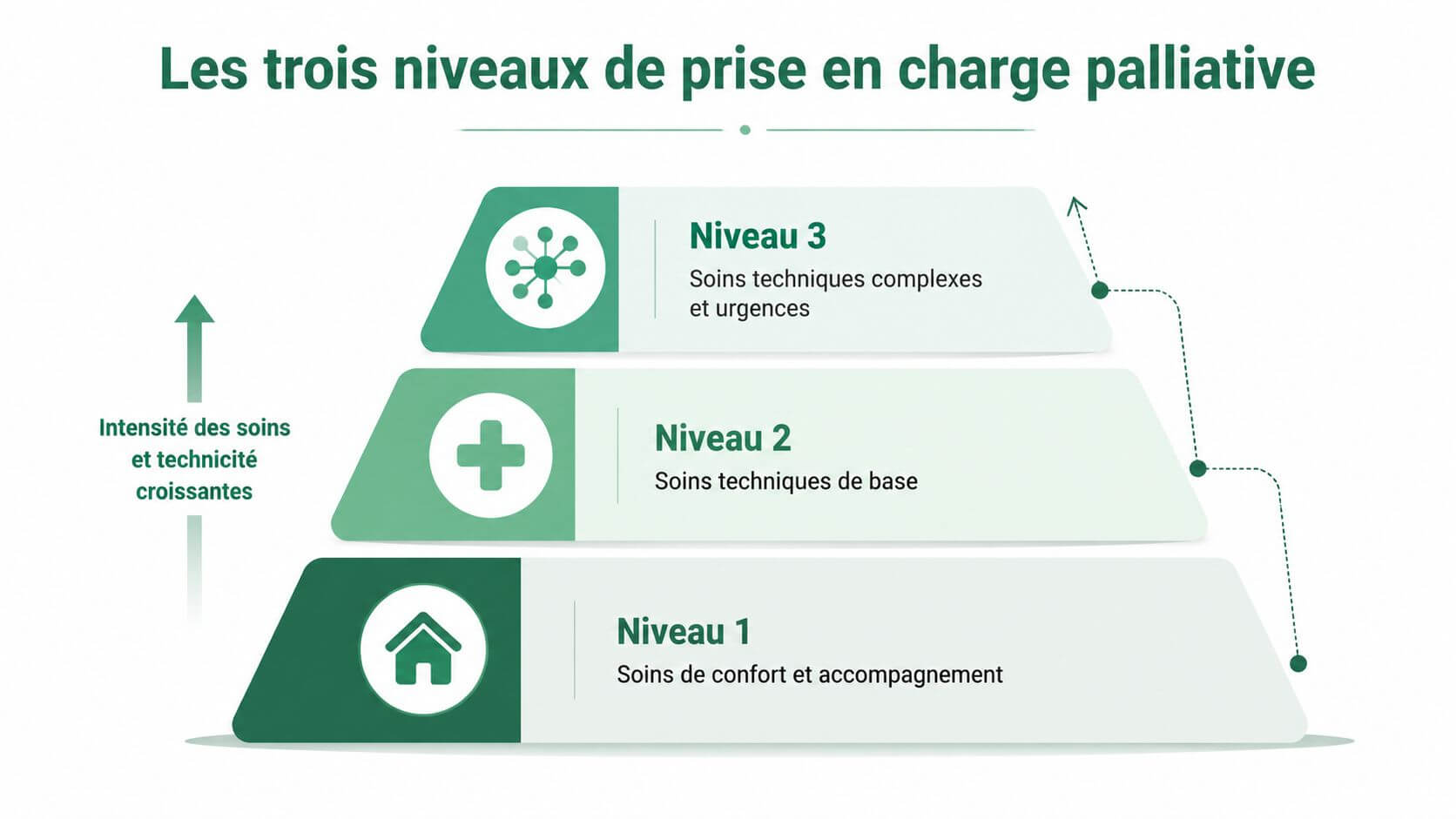
At home, the right level of care depends mainly on what needs to be monitored, transmitted and adjusted on a daily basis. A situation can remain simple for several days and then change quickly. For families, these benchmarks avoid confusing a mild follow-up with an organization that already requires close coordination.
Level 1 when the situation remains legible
Level 1 corresponds to non-complex situations. The primary follow-up can be provided by the attending physician, a Independent Nurse (IDEL), sometimes a geriatrician or an SSIAD (home nursing service). It includes comfort care, regular clinical monitoring, adjusted prescriptions and simple transmissions.
In concrete terms, the patient still eats a little bit, works with help, and the pain remains contained with a stable protocol. The home holds if the visits are regular and if everyone knows what to rate, what to report and to whom to transmit. The main risk lies less in the technique than in the blur between two passages, or in information left unmarked.
Levels 2 and 3 when care becomes continuous
Levels 2 and 3 relate to more complex situations: heavier technical needs, close surveillance, continuous treatment or specific equipment. Home hospitalisation (HAD) becomes central. In Île-de-France, palliative care accounts for 20% of the main mode of care in HAD in 2022 according to ARS Île-de-France, which shows the place of this device in demanding situations.
The difference between the two levels is due to the intensity of the need, not the will of the family. A respiratory worsening, a pain difficult to stabilize or a situation that changes quickly can change the management. The right reflex is to anticipate the transition from one level to another with the care team, without waiting for everything to overflow, keeping clear and time-bound transmissions. the role of the home care worker, allow to keep a common trace of who did what, when and with what instructions.
| Level | Situation | Traditional speakers |
|---|---|---|
| Level 1 | comfort care and stable monitoring | treating physician, IDEL, close relatives |
| Level 2 | more regular technical requirements | HAD, IDEL, mobile team |
| Level 3 | ongoing care, enhanced surveillance | HAD, specialists, close coordination |
The actors involved in home accompaniment
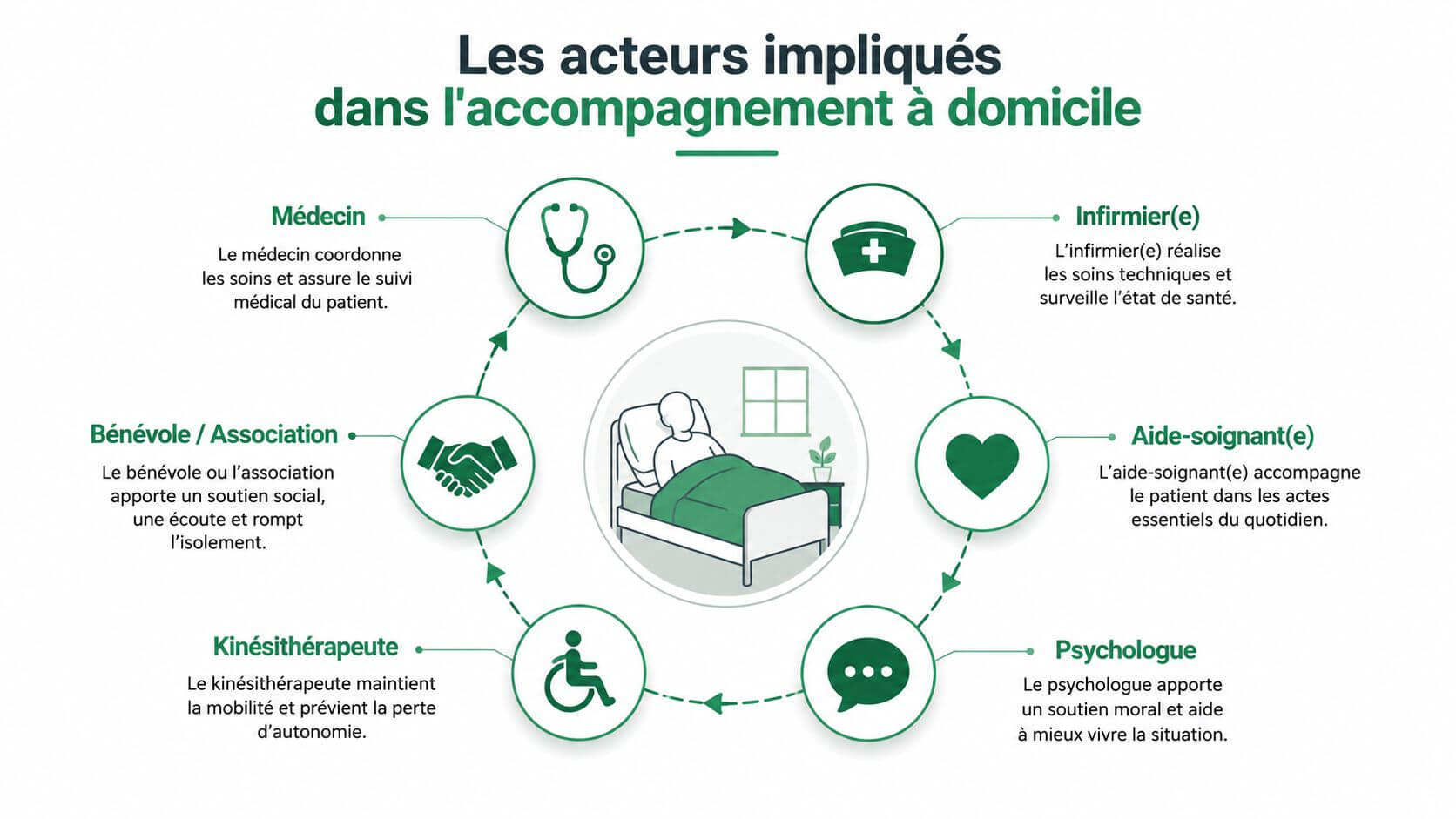
At home, no one cares alone. The patient is in the center, but around him gravitate professionals who have neither the same role nor the same level of emergency. When their place is clear, the days are more fluid. When it is not, the family compensates, recalls, revives and often ends up exhausting.
The Medical and Caregiver Core
The attending physician remains the anchor. He lays down the prescriptions, adjusts the treatments, triggers the specialized relays and keeps the overall view. The independent nurse performs the daily care, monitors the evolution, administers the prescribed treatments and raises the signs that change. The physiotherapist intervenes for the comfort, mobilization and prevention of the stiffeners when this remains useful. The SSIAD can supplement, on prescription, with hygiene and nursing care for certain elderly or disabled people.
The HAD takes over when the technique becomes too heavy for a simple organization. It provides a hospital setting at home, with coordination, equipment and closer follow-up. Mobile Palliative Care Teams (MSPs) provide specialized support: help decide, reassure loved ones, support field caregivers. Their availability varies depending on the territory, and it is most often the medical team that asks for them. To find out what exists near you, the treating physician, the RSA or the coordination support device (DAC) of your department can guide.
In practice, the course consists of four stages:
- The attending physician assesses the situation and sets up the care project.
- The Independent Nurse (and SSIAD if necessary) ensures daily life.
- HAD is considered when care becomes technical or very close.
- The mobile team is asked when a complex decision or a difficult symptom requires specialized advice.
If the condition changes abruptly: in case of immediate distress or danger, call 15 or 112. Otherwise, the first call goes to the referent team indicated on the emergency file (treatment doctor, HAD or call number of the palliative team if it exists). Then note the event in the shared space so that each one can see it.
The daily's relatives and trades
Caregiver relatives are more than just being there. They observe, transmit, reassure, record changes and maintain the habits that matter to the patient. Auxiliaries of life often play an undervalued role: they keep the daily life, the toilet, the discreet presence, repetitive gestures and the monitoring of small alert signals.
When the doubt arises, you have to go back to a simple rule: who calls first, who notes what, who decides a change. An array like this can stick to the fridge or copy to the shared space:
| Who | How often | What we note | Who to Alert |
|---|---|---|---|
| Close Helper | each visit | sleep, appetite, expressed pain, mood | nurse or referent doctor |
| Aides of life | at each passage | meals, toilet, mobility, unusual signs | close coordinator, then nurse |
| Independent Nurse | at each passage | care, treatment given, evolution | treating physician |
| Treating physician | each change in prescription | decision, new directive, supervision requested | nurse, pharmacy, family |
| HAD or mobile team | according to the care plan | opinion, protocol, action to be taken | reference team |
That's also whya digital link book becomes useful when the passages follow on and the information circulates poorly.
The quality of the home depends less on the number of stakeholders than on the clarity of their roles.
Step-by-step implementation of home palliative care
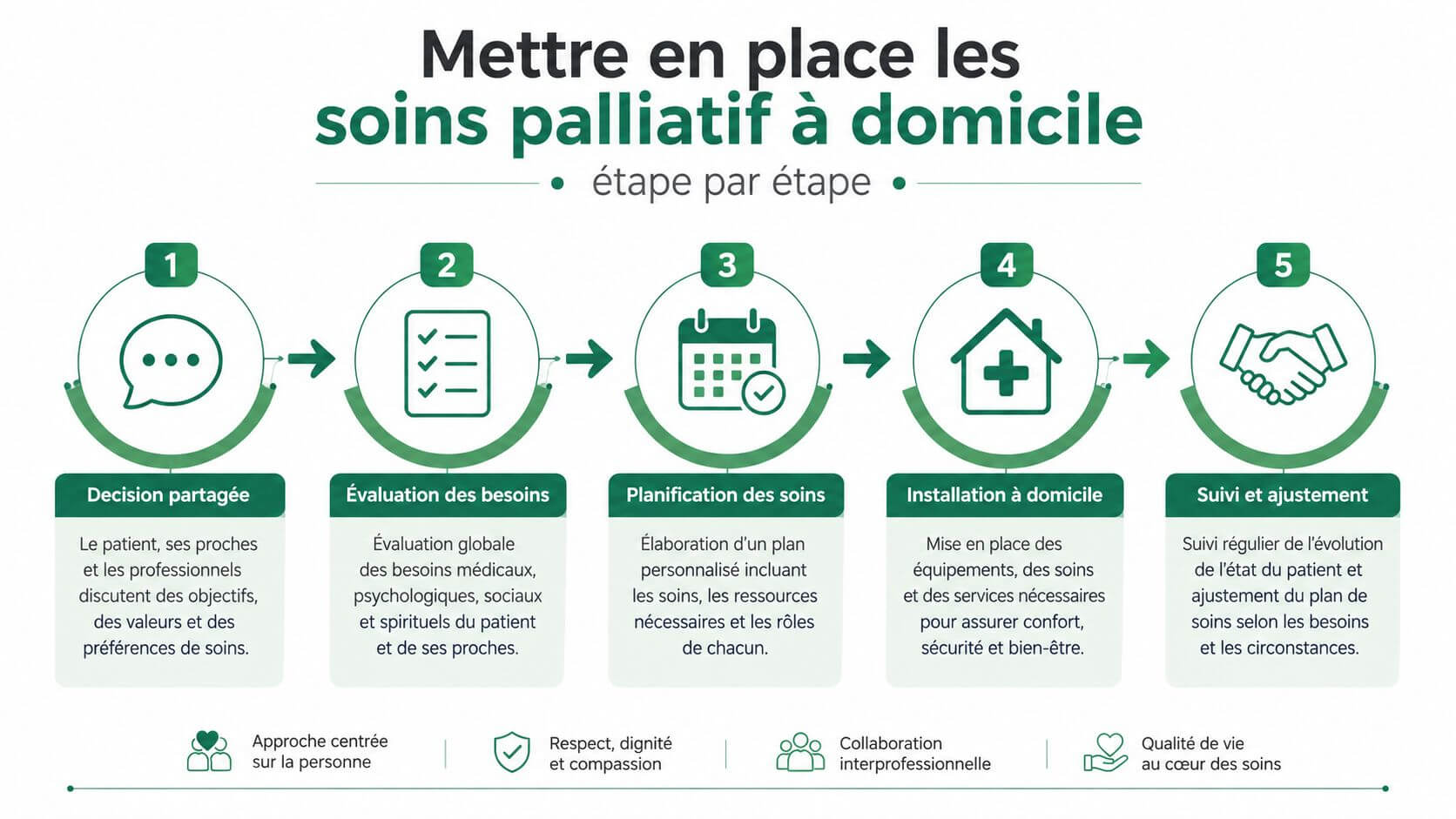
The implementation rarely succeeds in a single decision. It moves in sequence, with documents to prepare, relays to call and choices to stabilize. The earlier it starts, the more the family keeps the margin when the patient's condition changes.
Prepare decision and clarify needs
The first step is a decision shared between the patient, the loved ones and the doctor. You have to say things clearly: what is desired at home, what is not, and what will have to be reassessed if the situation changes. Advance directives, the person of trust and the care project are valuable, because they avoid improvising in the emergency.
Next comes the needs assessment. Is there a need for medical equipment, increased human assistance, a suitable bed, more frequent nursing passages, or a HAD? At this stage, the medical team can focus on the right devices, depending on the real complexity and not just the family's feelings.
Install home and lock backrests
Once the decision is made, it is necessary to organize the planning of the care: to set the timetables for the passage, to plan the treatment, to designate the main contact person and to ensure that everyone works from the same information. The layout of the accommodation also counts, with equipment adapted to comfort and safety.
The home facility is not limited to a medical move. You need to know who contacts who if a prescription changes, who recovers the medication, who reports a worsening. The last link is the follow-up and adjustment: a plan that never moves does not correspond to the real end of life. Needs move, sometimes quickly, and the home must be able to follow.
Here's a seven-day frame to check on.
Days 0 to 2, prepare the file:
- group orders, written instructions and reference documents;
- record the contact information (physician, nurse, HAD, pharmacy, close relatives);
- find the advance instructions and the name of the trusted person, if they exist;
- order equipment (bed, protections, technical aids) before saturation.
Days 2 to 4, organize the passages:
- planning visits and designating a lead contact;
- ask the medical team what signs call immediate contact, and note it;
- check who calls in case of change of prescription.
Days 4 to 7, stabilize:
- pose follow-up of morning, noon and evening medicines;
- test the transmission circuit for night and weekend;
- Re-start with the nurse and doctor about what works and what gets stuck.
If everything starts in the emergency, start with three gestures: the list of coordinates, the ordinances in one place, and a shared space where each passage leaves a dated note. The rest will come next.
Coordinate stakeholders and secure communications
This is often the case. A patient can have the right care, the right prescriptions and the right professionals, and remain poorly monitored if the information is lost between two calls or two passages. The Court of Auditors states that the billing data of the liberal professionals do not allow for the precise identification of patients in palliative care, and that only HAD care is fully documented. Local coordination must therefore compensate for the lack of a comprehensive national vision. To go further on this point, you can read our article on coordination of home care.
The Three Most Frequent Breaks
The first break concerns the traceability of catches. A drug given in the morning, then forgotten in the evening transmission, is enough to create unnecessary doubt. The second is the duplication of passages, when two speakers do the same thing without knowing it. The third is transmission between schedules, especially at night, at night or at weekends, when decisions must be made quickly.
Two scenarios show what a clear organization is changing.
First scenario, the pain that changes in the evening. At 7:00 p.m., the home care worker noticed that the patient grimace as soon as he was turned. The nurse passed at 6:00 p.m. and saw nothing. Without a common trace, the girl called the nurse, then the doctor, and then her brother. With a timestamped note and the escalation protocol inscribed on the emergency card, the assistant wrote the observation, called the reference team number and everyone saw the answer. If the situation becomes a distress, the 15 remained the right call.
Second scenario: a late instruction. The doctor changes an instruction by telephone with the nurse at 18:30. Another care worker arrives the following morning without knowing about it. If the nurse records the instruction in the shared space and the family confirms it briefly, no one acts on the old version.
The goal is to prevent the family from becoming the mini-coordination structure of everyone. For a close relative who lives far away, this is also what makes it possible to consult the history of the passages without calling anyone each time.
Practical rule: if important information is not written anywhere, it does not exist for the next team.
What digital tools really change
A time-bound digital link book lets you see who noted what, what time, and with what observation. A shared calendar avoids duplicates and missed appointments. A structured follow-up of medications reduces forgetfulness and gives the doctor a clear reading of what has been administered.
This is the type of use that Tribulys allows, with a shared link book, an agenda, a follow-up of drugs and a centralized emergency card. In a context of end of life at home, it helps to make continuity of care reliable. For a concrete framework of transmissions, this guide on the transmission book illustrates the logic of shared monitoring.
To choose a tool, four criteria are sufficient: its simplicity (the family must adopt it without training), its access on mobile, its level of confidentiality of health data, and the possibility of sharing it by role (the close by distance, the nurse and the assistant do not need the same access). Sophistication matters little. What counts is to make gestures, alerts and decisions visible to all concerned, without forcing the family to repeat everything.
Manage symptoms and ensure patient comfort
The pain often attracts all the attention, but it is only one of the signals to watch. The aim is not to medicalize everything more. It is to spot early what is bothering, what is tired, what is worried, and then to transmit usefully. At home, an ill-rated symptom quickly becomes an ill-treated symptom.
Observe without dramatizing
For pain, the important thing is to note what the patient feels, when it appears, what appeases it, what wakes it up and if the treatment has been effective. For anxiety and agitation, it is necessary to spot moments of tension, disturbed sleep and any unusual behavior. For confusion, note when, and if it is new. For respiratory disorders, caregivers need to know whether the patient is speaking less, is running out quickly, changing position to better breathe or seems anxious to lack air.
Nausea, escarres and discomforts of mouth or skin also require regular vigilance. The consistency of the observations helps more than perfection. A brief note, dated and transmitted at the right time is better than a long imprecise narrative.
Know when to alert
There are certain situations that warrant warning without waiting for the next passage, either the referent team or the 15 if the situation is urgent:
- a new, stronger pain or pain that does not give in despite the intended treatment;
- a respiratory discomfort that settles or worsens;
- new confusion or drowsiness;
- an unusual agitation that does not calm down;
- a fall, with or without apparent injury;
- vomiting that prevents treatment, or a new difficulty swallowing;
- a doubt about a dose (forget, duplicate, bad dose);
- a comfort that falls despite the treatments in place.
The home works well when everyone knows their limit of action. Caregivers should not improvise alone what is part of a medical adjustment. Keep in hand the advance instructions given by the team, they already say who to call for each of these cases.
For families accompanying a cancer patient, this guide on Home Cancer Palliative Care provides benchmarks on comfort, treatment and surveillance. The logic remains the same for other diseases: observing, tracing, alerting, adjusting.
A symptom accurately described allows for a faster, and often fairer, decision.
Support family caregivers in the long term
The burden of caregivers is not always visible, but it structures everything else. They manage calls, passages, drugs, night worries, decisions to many and often their own fatigue in silence. When it becomes too heavy, home maintenance loses stability.
Divide to avoid wear and tear
The first protection is the clear division of tasks. A relative can manage appointments, another the races, a third the pharmacy or the transmissions. This avoids that only one person bears the memory of everything, which is one of the most frequent causes of exhaustion. A relative who lives far away can also take part: add an appointment to the calendar, follow the transmissions, take care of the steps. coordination of family carers details this distribution.
The right to respite and relay solutions (day reception, temporary accommodation, enhanced home help) exist to prevent the main caregiver from collapsing. Conditions and aids vary: check with Service-Public.fr, the CNSA or your department. Psychological support also counts, because the accompaniment at the end of life mobilizes a lot of emotions, even when the family wants to stay strong. It is better to ask for help early than to end up at the edge of the break.
Finally, plan a relief plan: who takes over if the primary caregiver falls ill or is unavailable, and where the information is needed.
Protecting the relationship before logistics
Good coordination also leaves room for the link. If each visit becomes a moment of shopping, paperwork or verification, the relationship is reduced to management. The family does not have to become a mini-care service: its role is human, stable, and must remain breathable.
Shared tools reduce mental load because they limit repetitions, scattered messages and doubts about "who did what". They don't replace the carers, they avoid wearing everything alone. When the information is visible, the family can become a family more easily.
Practical resources and tools to go further
One evening, the nurse passes, the pharmacy calls to confirm a delivery, and a loved one asks if the pain has been noted in the notebook. On that day, the most useful is not to add information, but to keep them in the same place, with the right people at the right time.
The first benchmark remains the treating physician, then the HAD if the situation becomes more technical, then the mobile palliative care team if specialized support is needed. The pharmacy, IDELs and relatives must have the same useful contact information, otherwise each one works with an incomplete version of the situation.
Checklist to keep in hand:
- up-to-date contact information: doctor, nurse, HAD, pharmacy, relatives and emergency number;
- consolidated documents: orders, instructions, advance instructions, the name of the trusted person and identification documents;
- visible follow-up: catches, passages, symptoms and alerts noted in a single space;
- defined roles: everyone knows who alerts, who transports, who notes and who coordinates;
- digital relay: a shared tool that centralizes care journal, agenda, medicines and emergency card.
A useful piece of information is that which is quickly found, without searching through several messages or reconstructing memory events. Public reports on home coordination often point to the same frailties: scattered transmissions, instructions that circulate poorly, uneven traceability.
Tribulys responds to this specific point. The app, available on the web, the App Store and Google Play brings together the family and professionals in a common space: liaison book with timed entries and author's name, followed by morning, noon and evening medicines with alert in case of missed dose, shared calendar, assigned tasks, emergency card accessible to authorized members, safe of medical documents and PDF export of file and transmissions. It does not replace the advice of a caregiver or a care facility: it keeps a common record of what has been done.
If you coordinate home support, you can discover Tribulys to see how to organize these exchanges more simply, without lost SMS, without scattered notebooks and without conflicting instructions.
Put this organisation into practice with Tribulys
Keep your care journal, shared calendar, tasks, medication tracking and emergency information together. Start for free and invite the relatives and professionals involved in your loved one’s care.