
At 8:30 a.m., a helping girl's phone is already ringing. Her mother is waiting for a nurse for a treatment, the home care worker finishes the toilet, a physiotherapist has to come by shortly after and the doctor has just changed a prescription. Yet, no one knows exactly who received the information, who read it and who has to act.
This scenario is nothing unusual. The SMS, calls, notebook in the kitchen and the memory of everyone all contain part of the situation, but no one has the complete view. coordination of home care Therefore, it is not a matter of adding further steps. It is used to link existing ones, so that the family and professionals move forward on the basis of common, recent and understandable information.
Contents
- An ordinary day that derails the home
- Understanding Home Care Coordination
- The actors who work around the helped loved one
- Linkbook and structured transmissions
- Digital tools for coordination
- Good practices to avoid duplicates and missed appointments
- Concrete benefits for family and professionals
An ordinary day that derails the home
Mrs. Renard is 82 years old. This morning her daughter arrives with breakfast while the home care worker finishes the toilet. The nurse must come for an injection of anticoagulant, and the physiotherapist has scheduled a session at 9 a.m. The house is active, everyone knows his role, but no one has the same logbook.
At 7 a.m., the attending physician changed the prescription. The girl received a call, the nurse looked for the care journal in the kitchen, and the attendant thought that the usual instructions remained valid. The physiotherapist sounded when the nurse tried to check the new treatment. The session was finally cancelled, the injection was delayed and the prescription was only re-read after several workers had left.
The problem is not the lack of goodwill; it is the absence of a common point of reference.
However, everyone did what they thought was right. The girl passed on the information as she could, the assistant continued the intended actions, the nurse wanted to secure the act and the physiotherapist kept her schedule. But their information was scattered between a telephone conversation, a message, a paper document and different memories.
This fragmentation weighs in an area where there are many relays. In France, personal services accounted for EUR 22.8 billion in turnover in 2024, 82,776 organizations as at 1 January 2025 and 884 million hours worked in 2024, according to official portal for personal services. In home care, the Court of Auditors recorded 2,125 services in 2022, which illustrates the multiplicity of interlocutors to be synchronized.
A day like Mrs. Renard's shows the real difficulty. It is not enough to convey a new one. We need to know. who does what, when, with what instructions and what confirmation. Without this chain, an appointment can be forgotten, a task can be done twice or important information can come too late.
Understanding Home Care Coordination
The coordination is like a conductor. The nurse, the assistant of life, the doctor, the physiotherapist and the family each play their score. The conductor does not do their work in their place. He ensures that everyone knows the tempo, the entries of the others and the sequence of the song.
At home, coordination goes beyond a simple sharing of information. Saying "the person ate less" is a transmission. Specifying who monitors the diet, when the next of kin will be recalled and in what situation the doctor should be contacted is a matter of coordination.
The three elements to be connected
A reliable organization is based on three complementary mechanisms:
- Structured transmissionwith factual information, dated, assigned and intended for the persons concerned.
- A Synchronised Calendarwhich indicates visits, appointments, relays and changes.
- A loop back, which confirms that a task has been performed, that a directive has been understood or that an alert has been processed.
In an institution, professionals often have a common file, meetings or transmissions organized. At home, these markers are scattered. Coordination must therefore be based on simple tools, searchable at the right time, by a relative as well as by a professional.
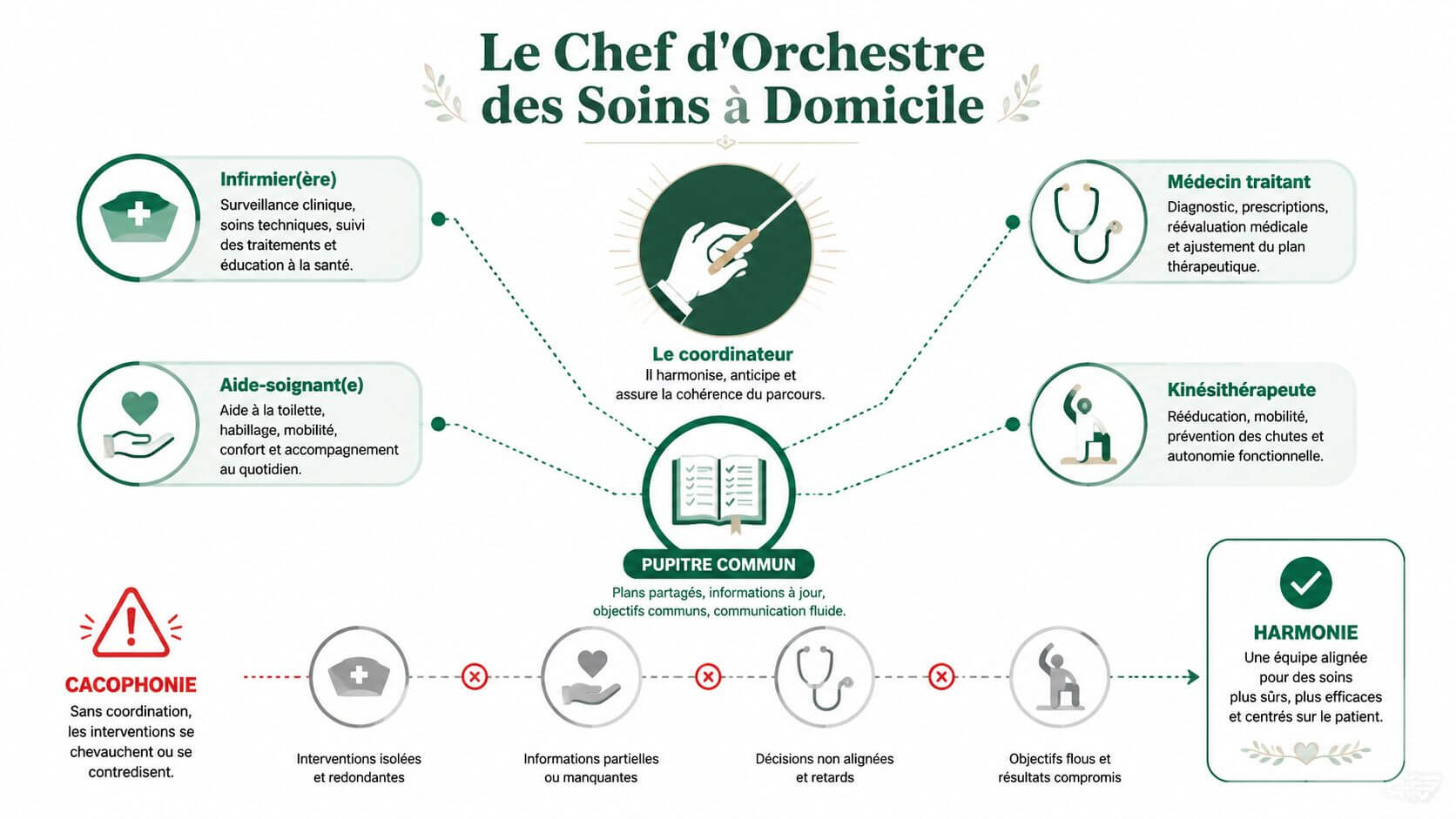
The Home maintenance becomes more readable when each speaker can find the same information, rather than reconstructing the story from separate messages. This does not mean that everyone has to access everything. The right question is rather: What information does this person need to know in order to act properly in his or her role?
The French framework specifically covers the sharing of information between professionals involved in the same care. strictly necessary coordination, continuity of care or medico-social and social follow-up, within the scope of each individual's missions, as specified the Public Health Code. The person must as far as possible be informed of the shared data, the recipients and the purpose.
The actors who work around the helped loved one
Effective coordination begins with a realistic mapping. It is necessary to identify the people involved, but also to understand their constraints. A caring relative can be available in the morning and evening, while working during the day. A life helper knows the habits of the person, but does not necessarily have access to all the medical information. A independent nurse chains the homes and has little time to go through a confused history.
The attending physician retains a medical reference function, even if he or she often intervenes in the firm. The aid or care services organize their own teams, while the physiotherapists, speech therapists and other paramedics intervene at one-time rhythms. Coordination must make dialogue between these logics without asking everyone to use the same vocabulary or to fill in the same headings.
The same person, different missions
| Actor | Main mission | Hourly constraint | Need for coordination |
|---|---|---|---|
| Close Helper | Organize daily life and make practical decisions with the person | Variable availability, sometimes remote | See tasks, appointments and alerts at the same place |
| Aides of life | Helping for everyday actions and observing lifestyles | Crossing over a defined range | Transmit observed changes without encroaching on the medical diagnosis |
| Caregiver | Participate in hygiene care and comfort according to its intervention framework | Scheduled tours | Know useful instructions and report developments |
| Independent Nurse | Perform prescribed care, monitor and alert | Short and traveling tours | Access to recent treatments, observations and transmissions |
| Treating physician | Evaluate, prescribe and adjust medical care | Consultation with the firm or organized visit | Receive a reliable synthesis before deciding |
| Kinesitherapist or other paramedic | Re-education, prevention or specialized support | One-time appointments | Know what has changed and coordinate objectives |
| Support or care service | Organize the interventions of its teams | Collective planning | Articulate internal passages with family and outside professionals |
France also accounted for 570 000 home helpers in 2024, according to the official sources relayed by the government and presented in this Synthesis on Home Help. This volume recalls that informal exchange is not always enough to ensure continuity.
The nurse may observe a change in the general condition, the assistant may notice a loss of appetite, the family may notice unusual fatigue and the doctor may have to link these signs to a treatment. The useful transmission does not erase these differences. It makes them compatible.
Linkbook and structured transmissions
The link book can be used as a spine. In its simplest form, it is a single support, kept in the same place, where each speaker notes what he or she has observed, what he or she has done and what needs to follow. care journal for home services recalls the importance of day-to-day exchanges between actors.
A good notebook is not a diary. It must allow a person who arrives later to quickly understand the situation.
What deserves to be written
Depending on the role of each person and the care instructions, the headings may relate to:
- Comments, such as reported pain, unusual fatigue or difficulty in moving around.
- The follow-up, such as hydration, feeding or certain expected constants.
- Treatments, with the confirmed catch, the oblivion observed or the instructions to be checked.
- Actions carried out, such as a toilet, exercise, care or call made.
- The expected outcome, with the next visit, the person to be notified or the point to be monitored.
A useful note remains factual and dated. "Ms. D. drank little this morning, a glass of water proposed and accepted" helps the next speaker. "Ms. D. is not good, as usual" leaves room for too many interpretations. Judgments, suppositions and long narratives make critical information more difficult to spot.
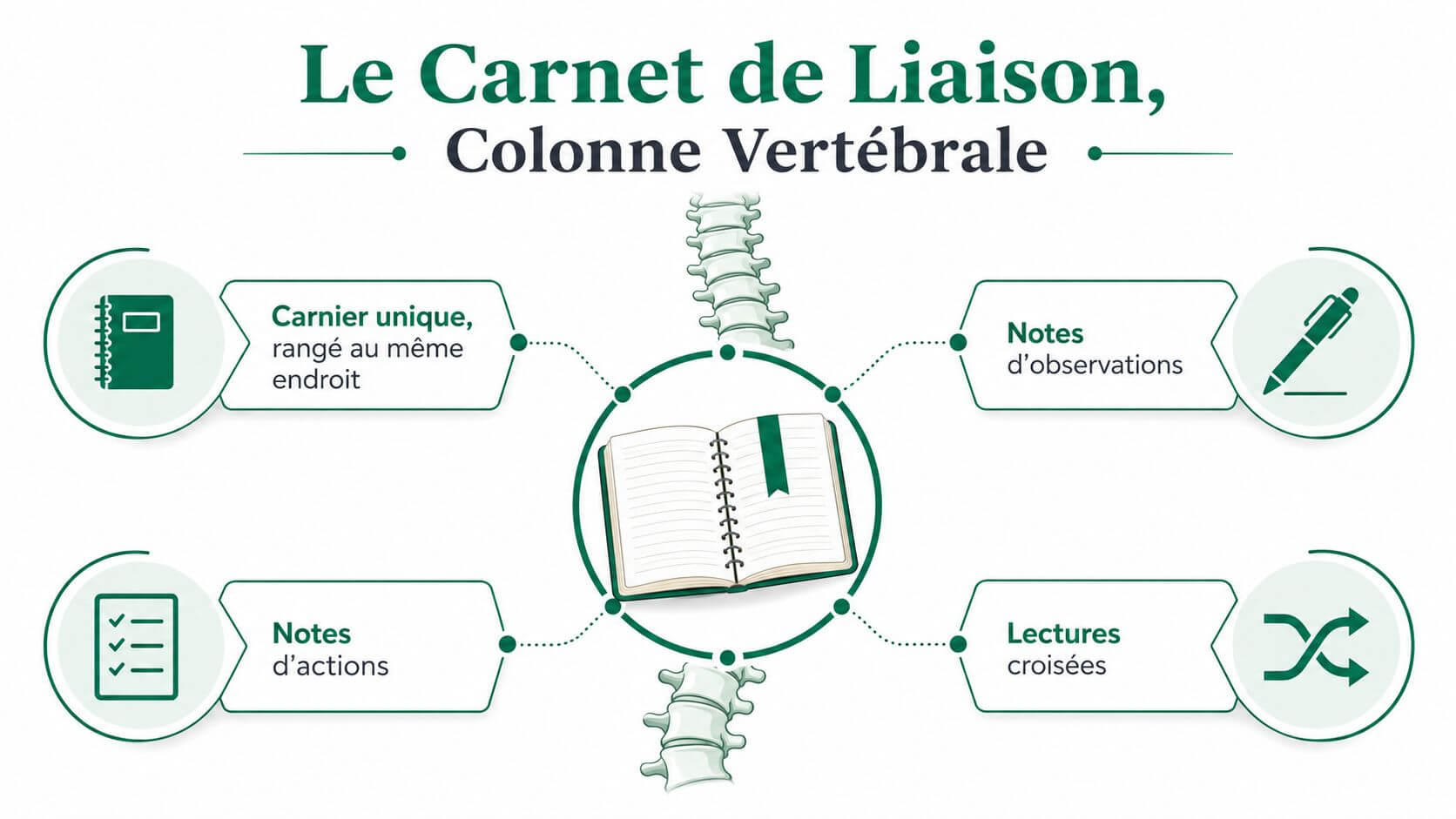
The primary link book An oral transmission may be completed, but it must not replace the written trace. In a succession, a short structure is sufficient: current situation, action carried out, point of vigilance, next step.
Errors often come from very concrete details. A page is ripped off, the notebook stays in a car, a note is written on the back of a prescription or a statement is repeated in several places. A shared support, timed and searchable by authorized persons reduces these breaks, provided that everyone adopts the common rule.
Digital tools for coordination
At home, information can circulate through several channels without ever forming a common view. A text message warns of a change, a call brings a precision and the notebook keeps a trace. Yet, not everyone sees the same version, at the moment when it has to act.
The paper format remains accessible in the home, without connection or learning. Remotely, its consultation becomes difficult. Emails alert quickly, but a message can disappear in the conversation, without clearly designated maintainer or visible update for the entire team.
Compare before choosing
| Criterion | Paper booklet | General public messaging | Structured coordination application |
|---|---|---|---|
| Remote access | Very limited | Easy, depending on the group | Scheduled for authorized users |
| Background | Present but dependent on support | Difficult to exploit when messages accumulate | Organized by date, person and type of information |
| Tasks and appointments | Note manually | Often drowned in conversations | Agenda, tasks and reminders combined |
| Traceability | Possible signature, unverified reading | Reading and responsibility sometimes blurred | Recognising actions, transmissions and status |
| Confidentiality | Physical support to be protected | Risk of mixing with personal life | Access rights and dedicated space |
| Offline utility | Strong | Variable | Possible for certain functions depending on the solution |
The table shows a difference in structure. A dedicated digital tool is not only used to transmit faster. It links information to a person, a date and an expected action. The question then becomes readable for each trade: Who writes, who reads and who needs to be alerted?
The useful functions follow this need: shared calendar, assigned tasks, emergency file, medical documents and targeted transmissions. They avoid searching for a set in several threads of discussion. Thus, a caregiver can find the point to watch, while a relative sees the task that falls to him, without interpreting all the exchanges.
To go further, check out our guide dedicated to the application for family caregivers.
Tribulys offers a coordination solution that brings together a shared notebook, a calendar, the follow-up of drugs, tasks and transmissions. Accesses can be differentiated between family and professionals. Some functions remain offline and then synchronize when the network returns.
The application does not replace professional judgment or direct exchange where the situation so requires. Rather, it serves as a common benchmark, provided that authorized persons adopt the same rules of seizure and consultation.
Good practices to avoid duplicates and missed appointments
The first rule reads as follows: only one calendar must be authentic. All medical and non-medical appointments, intervenor passages, important calls and family relays must be included as soon as they are scheduled. Keeping certain events in a personal agenda creates blind spots, especially when several people think they can arrange the same trip.
A task must also have a clearly identified official. "Preparing the appointment" is too vague. "Paul brings the medical documents and confirms the transport" allows to know who is acting and what remains to be done.
The operational minimum
- Single agenda, with the time, place, motive, persons concerned and changes reported.
- Nominal tasks, associated with a deadline and status such as "to be done", "in progress" or "completed".
- Confirmation of passages, to prevent a cancelled visit from being registered as if it had taken place.
- Useful alerts, sent early enough to allow a reaction, rather than a notification at the last moment.
- Updated contingency plan, with key contacts, allergies, treatments, treating physician and information useful to rescue.
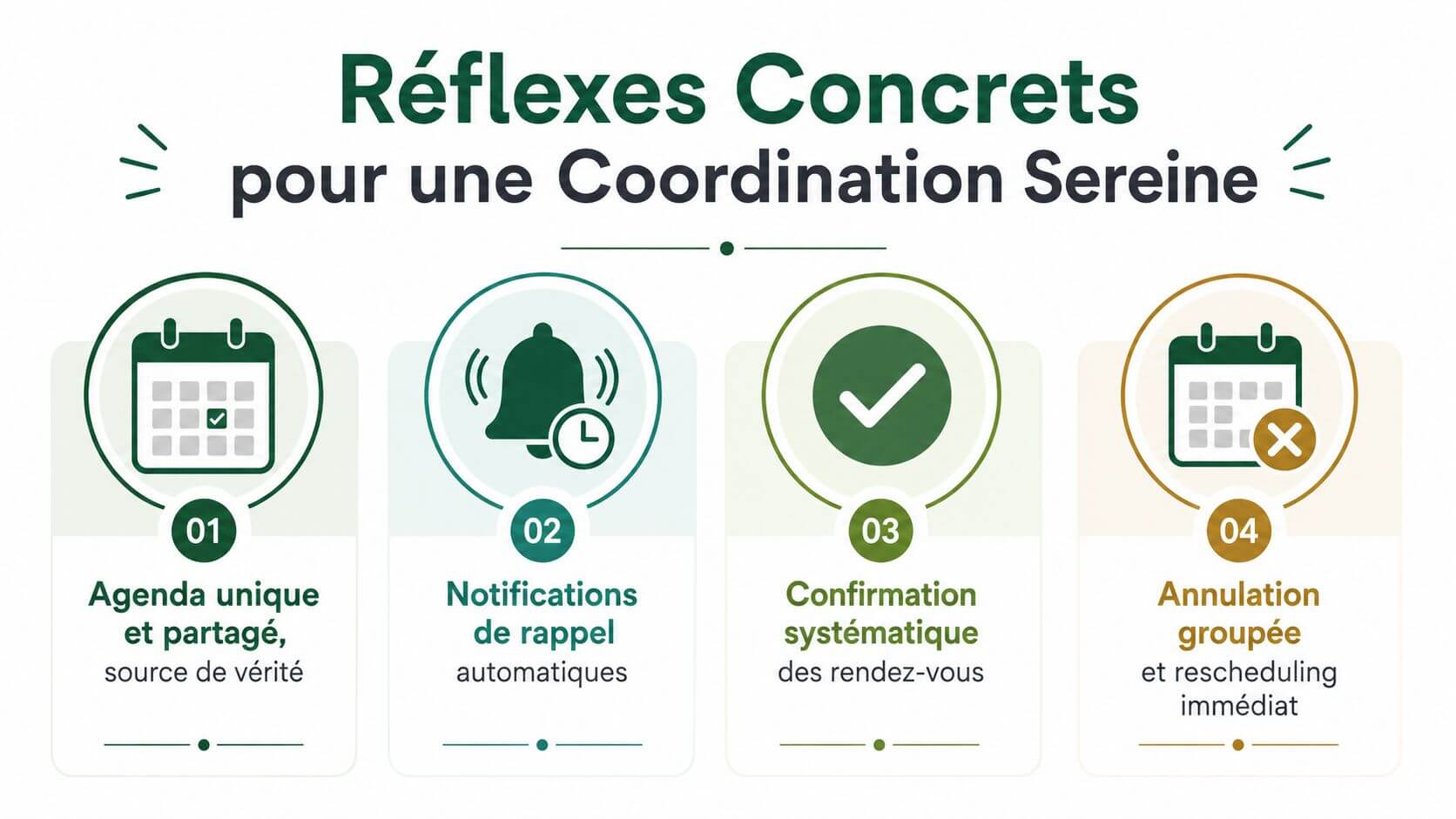
A short review between caregivers then helps to identify inconsistencies. Who is going by tomorrow? What appointment needs to be confirmed? What task has no responsibility? This check prevents problems from remaining invisible until the critical moment.
Doublons are rarely intentional. Two people can prepare the medication because no confirmation appears. A physiotherapist can come while another appointment has been added. A cancelled visit may never be postponed. Each time, the remedy is the same: an action, a person responsible, a status and a trace.
The emergency file deserves special attention. It must remain legible, accessible and consistent with the information in the shared folder. If a processing change occurs, the old version must be removed or clearly replaced so that an intervener does not mistakenly choose an outdated document.
Concrete benefits for family and professionals
Coordination brings concrete benefits when it changes daily gestures. A shared calendar does not remove appointments. It avoids the family having to remember them or ask several times who will be present. A timed transmission alone does not guarantee a medical decision, but it shows what has been observed, by whom and when.
For relatives, this organization reduces the mental burden associated with repetitive questions. The child helper can consult the notebook instead of reminding each worker. The person living far away can follow the authorized information without depending on an improvised summary. In case of emergency, an updated card gives a more reliable starting point than a search in several telephones.
What the mechanism really changes
- shared calendar clarifies relays, because passages and appointments appear in the same view.
- Tasks assigned reduce grey areas, because everyone knows what to do and what has already been closed.
- Dated transmissions strengthen continuity, as the next professional can distinguish a recent observation from an old information.
- Access rights protect confidentiality, as each person receives information relevant to his or her role.
- Warnings of capture or oblivion attract attention, without turning each relative into an archivist of the journey.
For professionals, organized information facilitates the preparation of a visit and limits pure coordination calls, like "you did? "or" can someone come by? " It also makes the relay between the nurse, home helper, physiotherapist, doctor and family more legible.
Users' expectations confirm the importance of these interfaces. A survey published in 2024 by France Assos Santé and BVA indicates that 85 % respondents were satisfied with the coordination among home care professionals, 79 % coordination between these professionals and those on the journey who do not move to the home, and 75 % of coordination between health professionals and home help, according to the results published in Home Care SurveyThe same work shows that coordination between health care and home help remains the most fragile point, with only a quarter of the persons concerned who are very satisfied.
Digital technology can support this continuity when it links clinical data, treatments, appointments and transmissions. The department describes telemonitoring as the remote interpretation of data collected at the place of life, while home health care providers also coordinate with the prescriber, institutions and liberal professionals, as outlined in this report. publication on the coordination of home care.
The CNSA also described a platform for the exchange of real-time data between people who surround or accompany an elderly person, for medical follow-up, medico-social assistance and entourage, in this area. presentation of a coordination platform at home. The Linking Life Habits File It brings together the contact details of professionals and relatives, useful data in an emergency and life habits. These examples converge towards a simple idea: the tool has value only if the information remains up-to-date, targeted and exploitable.
To start with, choose a single point of reference, define the authorized persons, and then agree on a short transmission format. Add known appointments, assign tasks and check regularly that the sensitive information still corresponds to the actual situation. A serene coordination is not based on a complicated tool, but on a collective habit maintained over time.
Tribulys offers caregivers and professionals a shared space to centralize the home's liaison care journal, schedule, treatments, tasks and transmissions. To structure the relays around your loved one and give everyone an up-to-date view, discover Tribulys and choose how to work for your organization.
Put this organisation into practice with Tribulys
Keep your care journal, shared calendar, tasks, medication tracking and emergency information together. Start for free and invite the relatives and professionals involved in your loved one’s care.