
You have three people passing, two conflicting WhatsApp messages, a relative calling to find out if the meal was taken, and an IDEL looking for the last useful information before entering your parent's home. It is exactly in this daily bazaar that the electronic link book becomes useful, provided you are properly configured from the start.
The right reflex is not to fill the tool. pose immediately the right circle, the right roles, then the right discipline of seizure. If you miss this base, you only get one more space of notes, not a common memory.
France has already installed this principle on a large scale with My Health Space, thought as a personal notebook, shared, secure and accessible, free and non-mandatory, with a public deployment committed in 2016 and a massive adoption in 2024 (Ministry of Health and Doctrine of Exchange, deployment and use benchmark) For the home, the logic is the same, but more concrete, tighter, more operational.
Contents
- Why an e-care journal changes home coordination
- Create the family circle and assign roles
- Structure entries with time stamping, signature and typology
- Workflow Ma Visit for duplicateless transmissions
- Permissions, differentiated access and offline operation
- Priority alerts and seizure discipline
- First week action plan and alert points
Why an e-care journal changes home coordination
A coordinated home rarely looks like a well-ordered file. A home helper passes in the morning, an IDEL arrives later, the kine takes over in the afternoon, then a relative still calls to see if everything has gone well. Without a common space, everyone keeps a piece of information, and the helper ends up repeating the same to everyone.
The electronic link book restores order by creating a shared record and a single place for handover notes. The home care worker writes for the independent nurse (IDEL), the nurse leaves a record the doctor can use, and the family can read it without interrupting anyone. The Liaison Workbook ANS describes this logic of exchange between an initiator system and a target system, with timed notes, creating, updating, deleting and searching for transmissions related to a supported person (ANS, Liaison Workbook).
Simple rule. If the information is used for the next one, it must be written once, in the right place, in a readable format in a few seconds.
The gains are immediate. You reduce unnecessary phone calls, you keep traceable transmissions, and you save the person helped to have to repeat everything. The French public framework goes in the same direction, with organized access, strong confidentiality and exchange thought out of need, not by accumulation of documents (My Health Space Doctrine).
The first setting that counts is the family circle. As long as it is not set, you don't know who sees what, or who can act on what. Then come the roles, then the types of entries, the closure of visits, the access rights, the alerts and the routine of the first week.
Create the family circle and assign roles
Start with the family circle. As long as it's not created, you're tying up blind access, and that's where mistakes are set up. An electronic link book works properly when each person sees what they need to see, and only that.
In Tribulys, the circle serves as the basis for the visibility of the notebook, alerts and transmissions. close reference carries the widest view and manages the entrances, the Near secondary follows reading and alerts,IDEL seized and closed his visits, the doctor consults with relevant transmissions for follow-up, andexternal helper remains on an operational entry adapted to its perimeter. This access organization avoids blurred access and wild fixes.
The good order, I see it everywhere on the ground, is simple. First the person receiving care, if he can participate, then the close referent, then the professionals one by one. Only then you control the visibility of the sensitive elements, like the type alert, medical transmissions and the ability to close a visit.
A poorly configured circle is quickly visible, and it costs time from the start. For example, a secondary relative who sees everything but does not know how to distinguish an alert from an ordinary transmission will restart for nothing. IDEL Without the right to close leaves incomplete visits, and the family finds themselves correcting by hand what was to be traced cleanly.
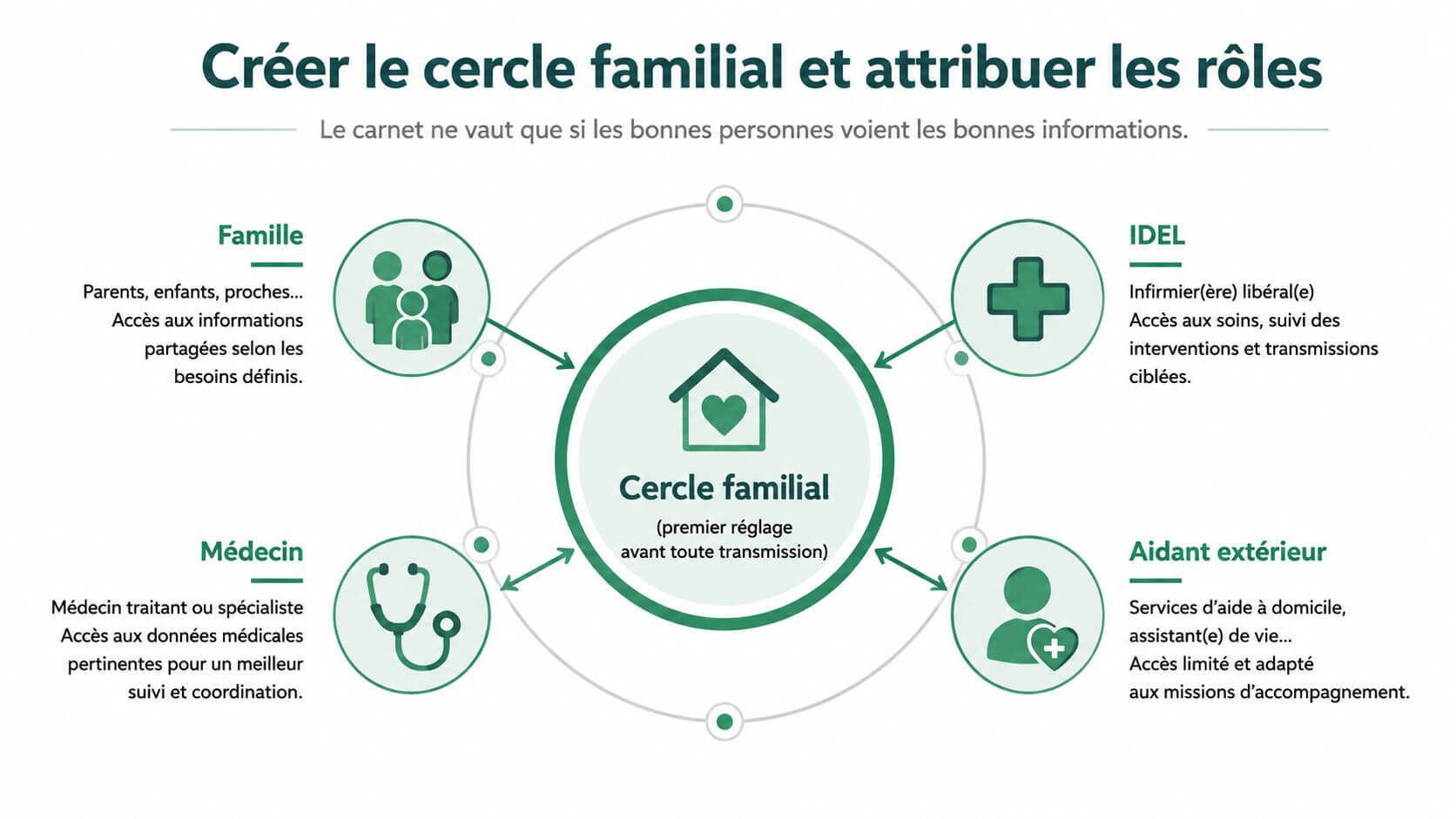
The right circle at the beginning avoids endless explanations after.
In home coordination practices, the real subject is not to add people. limit exposure to what everyone really needs to seeThe CNIL recalls that health data are sensitive, that access must be based on distinct profiles, granularity by role and strong authentication (CNIL on empowerments) This is exactly the logic to reproduce in an electronic link book.
Structure entries with time stamping, signature and typology
A useful note holds in few words and leaves a clear trace. As soon as it becomes blurred, it loses its value, especially when several speakers reread the history of the weeks later. The standard to apply is simple, identified author, automatic time stamping, signature when the act is professional, and clearly chosen type of input.
The idea is not theoretical.Government time stamping recalls that a file can be associated with a token of trust to prove that it existed on a given date and that its integrity has not been changed since its signature. At home, this is a very concrete rule, each transmission must answer a simple question, who wrote what, when, and with what status.
| Field | Role | Example |
|---|---|---|
| Author | Identify the speaker | IDEL, close referent, outside helper |
| Time stamping | Locate the action over time | 0812, end of visit |
| Signature | Validating a professional act | visit closed by the IDEL |
| Type of input | Sort Note | transmission, alert, observation, action |
The rule of seizure is in four words, which, what, when, result. A vague transmission of the "complicated day" type is of no use. A useful note says instead, "IDEL, refusal to take treatment at 10:05 am, restless patient, close informed", and everyone knows what to do next.
Field council. A clean notebook is read in 30 seconds. A talkable notebook is no longer read, so it no longer serves.
The difference counts as soon as a disagreement arises. trace assigned and timed becomes the factual basis, not a half-told memory. If you want to deepen the logic of standardized transmission, the closest point of support remains that transmission logbook, but keep a rule in mind, the style must remain dry, concrete, exploitable.
Workflow Ma Visit for duplicateless transmissions
The right workflow is the one everyone does the same. My Visit For this purpose, a checklist of gestures in the home, opened at the beginning of the passage, filled in order, then closed with a gesture to freeze the sequence. You thus cut off the double reports between the IDEL, the auxiliary and the family.
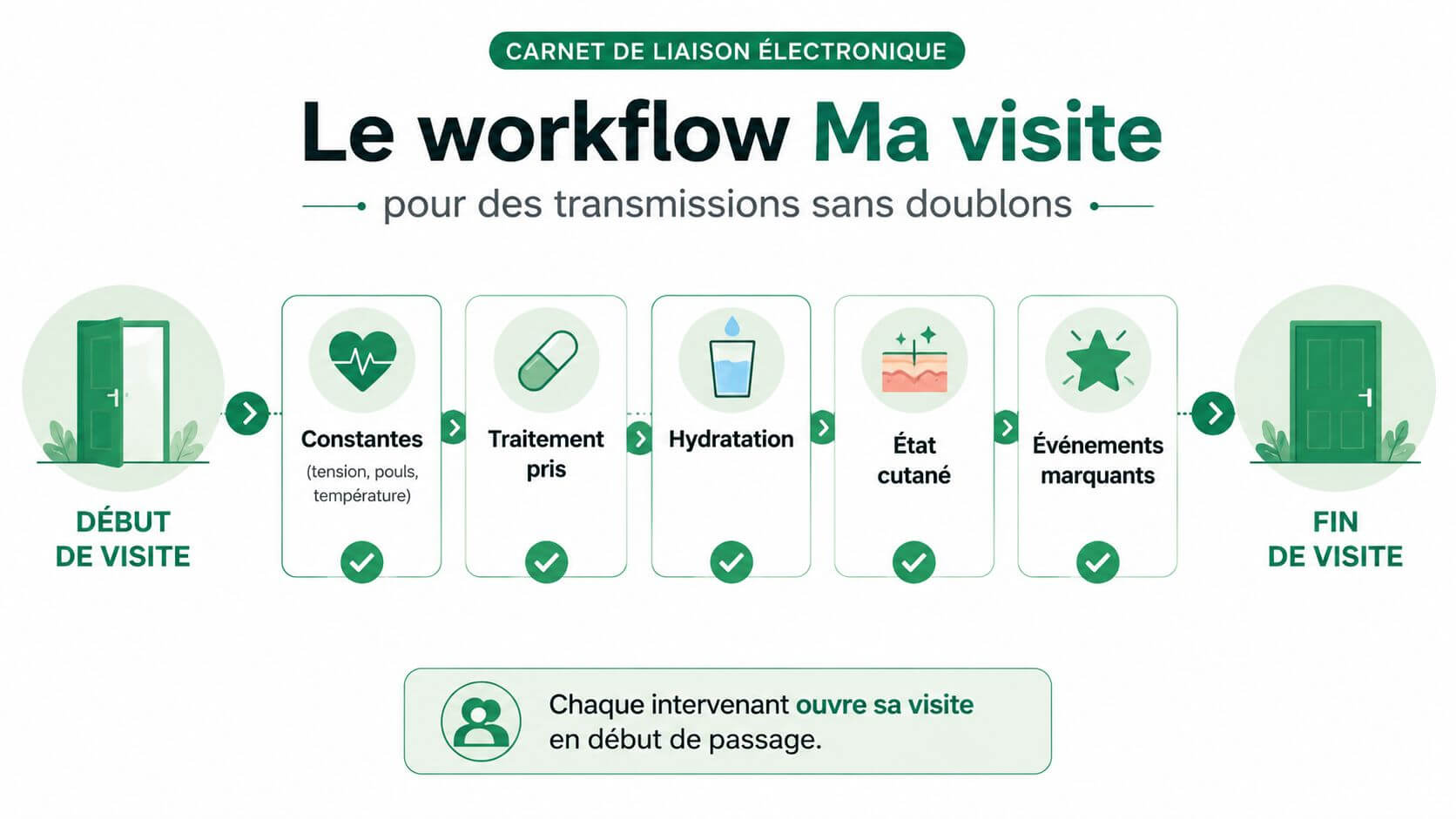
Open the visit, then carry out the gestures
The passage begins with the opening of the visit. The speaker checks or then captures the elements of the moment, constants, treatment taken, hydration, skin condition, significant event. The flow must remain chronological. Otherwise, the reading loses its logic and the next one no longer knows what was done before.
Report the anomaly without drowning the rest
As soon as an element comes out of the frame, it must be noted in the same sequence, without writing a novel. An anomaly must come out clearly, not disappear in the middle of three paragraphs. This avoids turning a visit into a redundant report.
Close to make the transmission exploitable
The fence counts as much as the seizure. As long as the visit is not frozen, the transmission remains open and its signal circulates less well. A closed visit says to the rest of the tribe, "it is done, it is attributed, it is searchable".
The basic principle is simple. cumulative legacy, not a race against the clock. Everyone picks up the wire where the previous one left it, without rewriting what already exists. If you are looking for a solution to structure this logic, Tribulys proposes this mode of transmission, with notebook, roles and My Visit in the same environment.
Permissions, differentiated access and offline operation
The right setting of the rights quickly removes the noise. The family keeps the history and controls the circle, the IDEL captures and closes the visits, the doctor reads the timed transmissions by reading only. This distribution cuts off the parasitic interventions and limits the last minute corrections.
The subject of security is also played in sharing tools. Secure health messaging is used to convey what must remain between good interlocutors, without spreading information at random. In the notebook, this logic must remain simple, with partial views, access by need and exports limited to the strictly necessary. The Mon Espace Santé doctrine recalls the framework HDS, GDPR and CNIL, with confidentiality and non-marketing of data.
| Role | Reading | Seizure | Closure of visit | Circle management |
|---|---|---|---|---|
| Family | Full history | Based on authorization | No | Yes |
| IDEL | Useful visits and alerts | Yes | Yes | No |
| Doctor | Targeted transmissions | Depending on usage | No | No |
| External Helper | Field data | Yes, according to role | No | No |
To assign a role, leave the circle, choose the person, and then set the access and entry perimeter. To remove an access, do the reverse operation in the circle management, not by separate messages or oral instructions. Clear rights and a consistent trace guarantee security, without relying on the memory of the stakeholders.
Offline operation also counts. In poorly covered homes, the notebook and My Visit The data are stored locally and then synchronized with the reconnexion, without technical manipulation. After an off-grid pass, simply check that the visit appears time-bound, assigned, and then visible to the other members as soon as the connection returns.
The right reflex is to separate vision, seizure and closure. If a role sees too much, you create noise. If it sees too little, you break the relay.
Priority alerts and seizure discipline
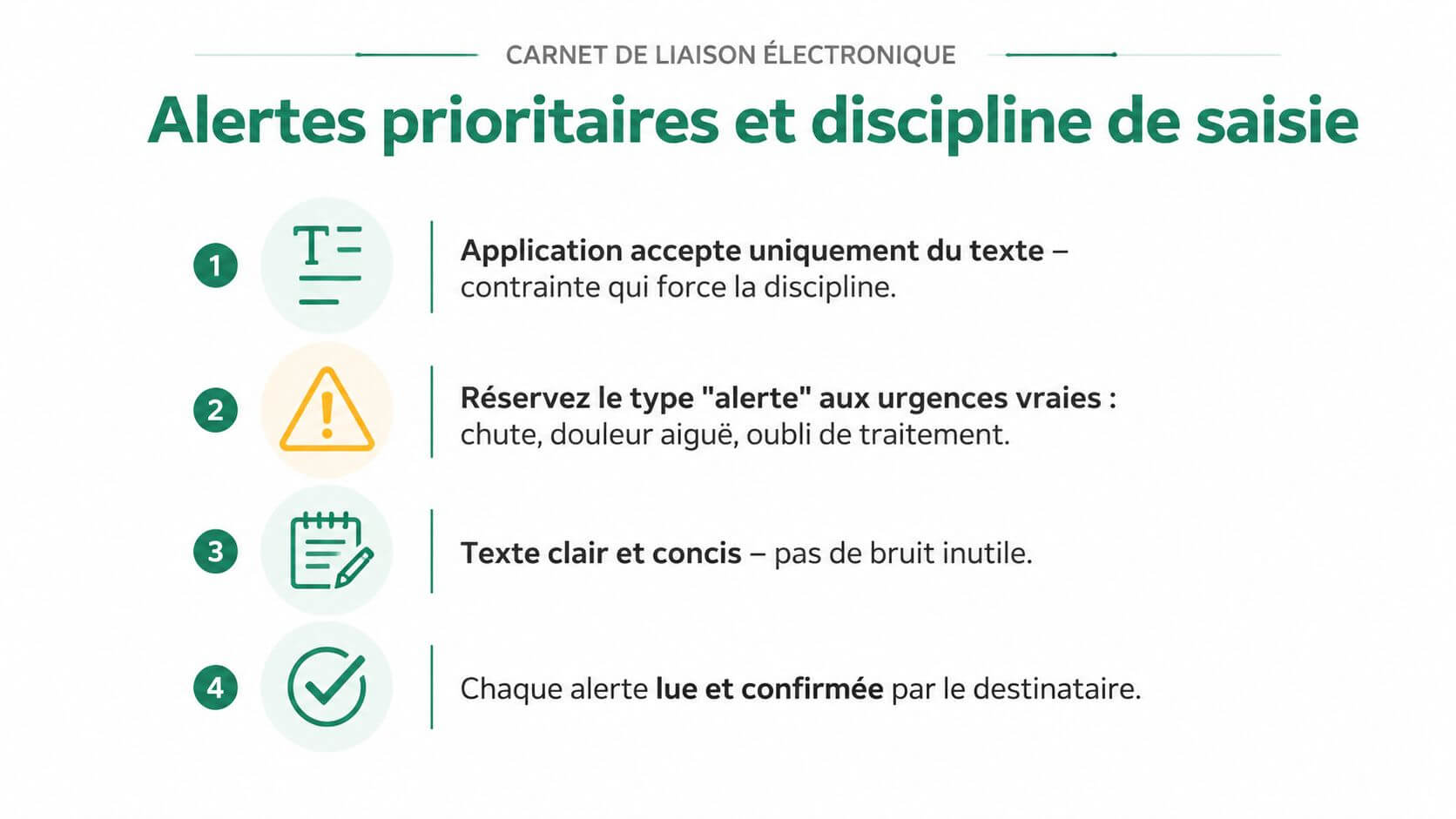
The alert must remain a rare signal. It is used for situations that require immediate reaction, fall, acute pain, oblivion of a critical treatment, change of net behavior. Everything else grabs as a standard note in My Visit. Otherwise, the alert loses its strength and sorting becomes useless.
A well-written alert holds in one sentence. It names the person, indicates the moment, describes the observed fact and specifies the action taken immediately. Details, blurred impressions and too long narratives have no place here.
Useful practice. If three people can read the note without hesitation, the entry is clear.
The discipline of seizure starts from the need of the next, not from the desire to tell. The message must first tell what changes the continuation of the care. For the traceability framework, the public service Connect Helpers also reminds that connections are traced and hijacked, which goes in the same direction as a notebook where each entry remains assigned.
Keep a simple rule in the circle. An alert never becomes a conversation. Non-essential notifications remain cut off. Too long a note returns to standard transmission. It is this sort that protects the reliability of the notebook on a daily basis.
First week action plan and alert points
A useful first week does not try to do everything. first family circle, then locks the roles, input types and input rules. It is this base that then determines the quality of transmissions, alerts and offline pick-up.
Day 1, you create the family circle and you invite the first members. Day 2, you assign the accesses, family, IDEL, doctor, outside helper, then you check that everyone sees only what they need to see.
Day 3, you normalize three types of entries, info, action, alert, then you test the time stamping and attribution. Day 4, you form the IDEL at workflow My Visit and you make a complete transmission, without duplicate or unnecessary detour. Day 5, you cut the Wi-Fi, you check the offline entry, and then you control the reconnection recovery.
Day 6, you write a short, factual, assigned capture charter. Day 7, you take stock with the tribe, correct the drifts, and then you remove everything that's wrong. If you still hesitate between several tools, the comparison of the 2026 solutions helps to situate the approaches, but the real sorting is done at home, with the first circle already set.
The three points of vigilance not to be let go
- Do not dilute the alert. An alert must remain rare and urgent, otherwise it loses its effect.
- Keep a primary contact person. A transmission must have a clear pilot, otherwise the corrections disperse.
- Cut the digital noise. Non-essential notifications tire everyone and end up ignored.
The right result is simple, fewer duplicates, legible traceability, and a circle that absorbs unforeseen events without losing information. the circle, roles and types of entries coordination becomes much more fluid, even when the home is complicated to cover or the relays are quickly linked.
Put this organisation into practice with Tribulys
Keep your care journal, shared calendar, tasks, medication tracking and emergency information together. Start for free and invite the relatives and professionals involved in your loved one’s care.