
At 7:30 PM, you return from work, and your phone starts ringing. Your mother has taken her medication, but you don't know if the home care assistant has come. Your brother, who lives far away, asks for the date of the next appointment. The doctor is waiting for information regarding a blood pressure reading taken the previous week. You search through your texts, call your mother, open a paper agenda, and then jot down a note in a care journal that no one might consult.
You are already a family caregiver, even if you have never used that term. The issue is not just about good intentions or emotional presence. You need to understand the definition, identify rights, organize support, and make information accessible to those who actually intervene. A centralized tool can then link these two dimensions—administrative and daily—rather than leaving them to function separately.
Table of Contents
- An Ordinary Evening That Changes Everything
- Family Caregiver: A Useful Definition
- What Daily Burden Really Involves
- Rights in France: What You Can Truly Assert
- APA, PCH, Home Care, and Relief Solutions
- Organizing When You Work or Live Far Away
- Tribulys and Digital Coordination, Without Over-Promising
An Ordinary Evening That Changes Everything
At 8:15 PM, dinner is getting cold while the phone keeps ringing. The medical office is requesting a prescription, your sister wants to know who is accompanying tomorrow, the home care assistant has postponed her visit, and your parent can no longer remember if they took their medication. In just a few days, you are no longer just providing assistance. You are managing the household, the care, the appointments, and the paperwork together.
The shift often begins like this. A fall, a hospital discharge, a treatment that has become difficult to follow, or an overlooked administrative letter. Then the 'temporary' actions start to settle in. You call the nurse, check the medication, inform the family, accompany the patient to the specialist, and search for information in scattered messages. In the evening, everything relies on the person who knows where the right document is, who said what, and what needs to be done tomorrow.
France has 11 million people who regularly help a dependent relative, according to the CNSA. The DREES estimated that there were 9.3 million family caregivers in 2021, of which 56% were women. Definitions vary, but the practical point for a family is simple: this reality is common, burdensome, and rarely organized in time.
The first problem is often the absence of a system that clearly shows who does what, when and with what information.
A family caregiver thus manages two aspects at once. It is necessary to assert rights, request aid, understand a status, and plan for respite. Coordination of medication, visits, handover notes, unexpected events, and support is also required. A centralized tool like Tribulys makes these two aspects compatible, instead of allowing the administrative side to remain separate from daily life.
Family Caregiver: A Useful Definition
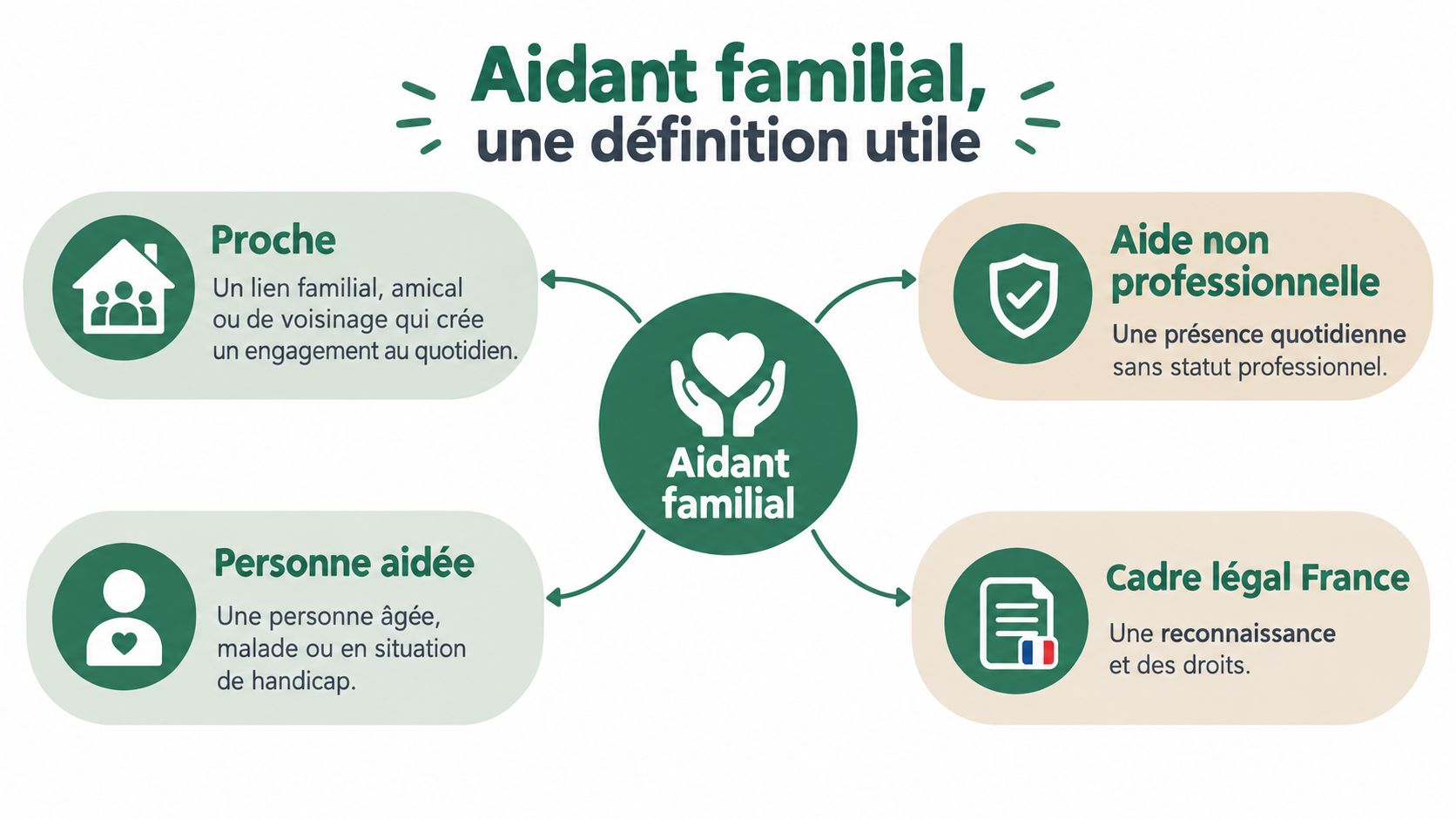
A family caregiver is a relative who regularly helps, without being paid for it, an elderly, sick, disabled, or dependent person. This assistance is not limited to visible acts. It also includes administrative tasks, appointments, monitoring, communication with professionals, and everything that ensures that an important detail does not get lost.
The scope is broader than you might think. The caregiver is not just the daughter accompanying her mother or the son managing his father's paperwork. A spouse, a brother, a sister, another family member, a friend, or a neighbor can play this role. What matters is not the title within the family, but the actual share of support and coordination that you take on.
The Moment the Role Begins
The role rarely starts with a clear announcement. It settles in gradually. First, it’s accompanying to an appointment, then managing prescription renewals, making calls, retrieving documents, relaying instructions. After hospitalization, a diagnosis, or a fall, the shift becomes evident. The person who occasionally helped becomes the one who holds the thread of life at home.
It is also necessary to separate this role from that of a professional caregiver. The nurse, the home care assistant, or the home care service operates within a defined framework, with specific tasks. The relative acts because they are present, because they know the person, and because they fill in the gaps between two interventions.
This distinction is crucial for making correct decisions. A relative can observe, alert, organize, follow up, and verify that a visit has indeed occurred. They are not supposed to make a medical decision in place of a professional. For a family, the appropriate approach is simple. The relative coordinates and relays information; the professional assesses and performs what falls under their competence.
Why Recognize Yourself as a Caregiver
Recognizing oneself as a caregiver is not just about vocabulary. It is a concrete starting point. You can then request the right information, assert rights, review a leave, look at AJPA, APA, or PCH, and organize relief before reaching saturation.
Many loved ones help without naming themselves as such and therefore miss out on useful support. This is precisely what complicates everything. Without a clear qualification, the administrative remains vague, and daily coordination relies on the memory of the most available person. A centralized tool like Tribulys helps connect these two aspects. On one side, the procedures, documents, and contacts. On the other, the visits, instructions, and daily handover notes.
To know if you are really in this role, use a test that is decisive:
- Regularity: do you intervene every week, or several times a month, to help this loved one?
- Responsibility: are you the person who confirms appointments, follows treatments, responds to professionals, or follows up on a process?
- Concrete test of continuity: if you were unreachable for a week, who would know how to find the schedules, useful instructions, and the right contact in case of a problem?
- Impact: does this help change your days, your work, your travel, your sleep, or your mental load?
If several answers are yes, do not minimize the situation. You are already a family caregiver. Recognizing it early allows for organizing, distributing, and requesting what needs to be done, before everything relies on one person.
What the daily load really encompasses
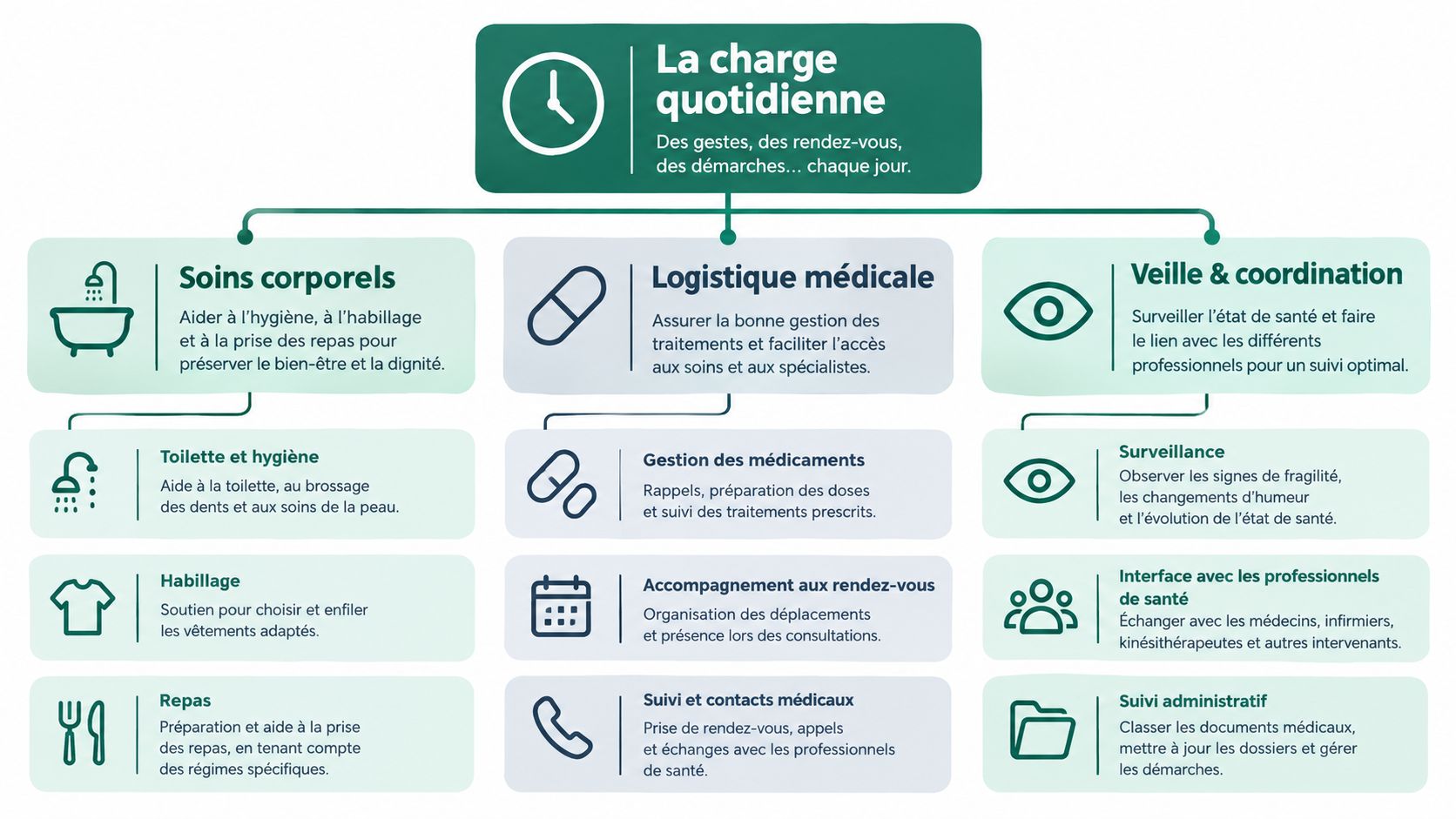
The load of a family caregiver is not limited to visible gestures. There is personal hygiene, dressing, meals, and travel, but also everything that allows these moments to unfold without incident. You must check a prescription, confirm a dosage, prepare for an appointment, find a document, respond to a professional, and inform a sibling living in another region.
The DREES estimates that in mainland France, 7.1 million people are family caregivers and support 5.0 million people living at home. The same source indicates that 58% of caregivers work, study, or seek employment, a proportion that reaches 78% among those of working age. Hence, the professional schedule and that of care structurally overlap.
The three layers of the load
Daily care requires a tangible presence. The caregiver can prepare a suitable meal, assist with dressing, secure a journey, or check that the person has what they need.
Medical logistics demands precision. Appointments, prescriptions, renewals, treatments, and documents must remain coherent, even when multiple professionals are involved.
Monitoring and coordination often consume the most mental energy. The caregiver needs to know if a visit took place, if an instruction was understood, if a constant is evolving, and if a change must be reported.
The problem arises when this information remains in one person's memory. The primary caregiver thus becomes the telephone operator, the calendar, the informal medical file, and the family alert system. A work delay or a switched-off phone is enough to create a blind spot.
The right method is to transform invisible tasks into observable elements:
- A named responsibility, for example, accompanying to an appointment.
- A deadline, such as the date and time of the appointment.
- A handover note, with a clear instruction and an identified author.
- A confirmation, indicating that the action has been executed.
- An alert, if no one confirms or if unusual information arises.
This mapping does not replace human presence. It prevents the family from confusing memory, intention, and completed action.
A shared planning tool is only valuable if it also shows handovers and absences. The goal is not to control every gesture but to allow the remote caregiver to quickly understand the status of care without systematically calling the present person.
Rights in France, what you can really claim
Rights exist, but they do not activate automatically. The first reflex is to separate three questions: can I reduce or suspend my activity, what compensation is possible, and what consequences will this decision have on my income and retirement?
The caregiver leave allows you to request a break or adjustment of your professional activity to accompany a loved one, depending on the applicable conditions. In the public service, specific rules also govern the position of the caregiver. Do not rely on a verbal promise. Verify the conditions with your employer, your HR department, or the competent organization.
The AJPA, the daily allowance for caregivers, concerns periods when activity is reduced or interrupted within the framework provided by the system. Since January 1, 2025, it can be renewed up to three times during a career to support several loved ones, with a maximum duration increased to 264 days, while the utilization of caregiver rights remains below 50% according to data reported by the parliamentary question published in the Senate.
The process that avoids unpleasant surprises
Start by gathering the documents that describe the situation of the person being cared for, the supporting documents required by the intended system, and the elements related to your professional activity. Note down the dates, planned absence periods, and exchanges with the administrations.
Then, have the arrangement checked before modifying your work. A reduction in activity can ensure your presence, but it can also decrease your income. A leave can respond to an emergency, but it must be compatible with the compensation conditions. Retirement rights should also be examined regarding your situation.
Do not choose a right because it exists. Choose a combination of rights because it holds money and maintains the continuity of the aid.
The right to respite must be studied at the same time. A professional relay, a temporary reception or a solution at home do not meet the same need as an allowance. Therefore, it is necessary to identify what is really lacking, time, money, daily presence or reliable coordination.
| Law | Who is concerned | Duration or benchmark amount | Effect on income |
|---|---|---|---|
| Caregiver leave | Employee or agent accompanying a relative, subject to applicable conditions | Period defined with employer and legal framework | Suspension or possible reduction of income |
| AJPA | Assistive person who reduces or ceases to be active within the intended framework | Renewable up to three times for several relatives, maximum duration of 264 days | Partial compensation for compensable days |
| Work organisation | Helper whose employer can adapt the organization | To be negotiated according to position and situation | Maintenance of activity, with different organization |
| Pension rights | Helper whose situation opens up specific mechanisms | To be checked with the competent bodies | Effect to be considered before any decision is taken |
To further explore the issue of income and avoid confusing allowances, wages and compensation, see this guide on the family caregiver's salary. In all cases, first contact your employer or HR department, then the CAF or the body responsible for the proposed allowance, and finally the departmental council or the CDMH when the situation falls within the scope of autonomy or disability.
APA, PCH, home help and relay solutions
The real subject is not to find help. You have to connect the right right one, the right one and the right way of organizing at home. Without this sorting, families stack up requests, waste time and end up with partial answers.
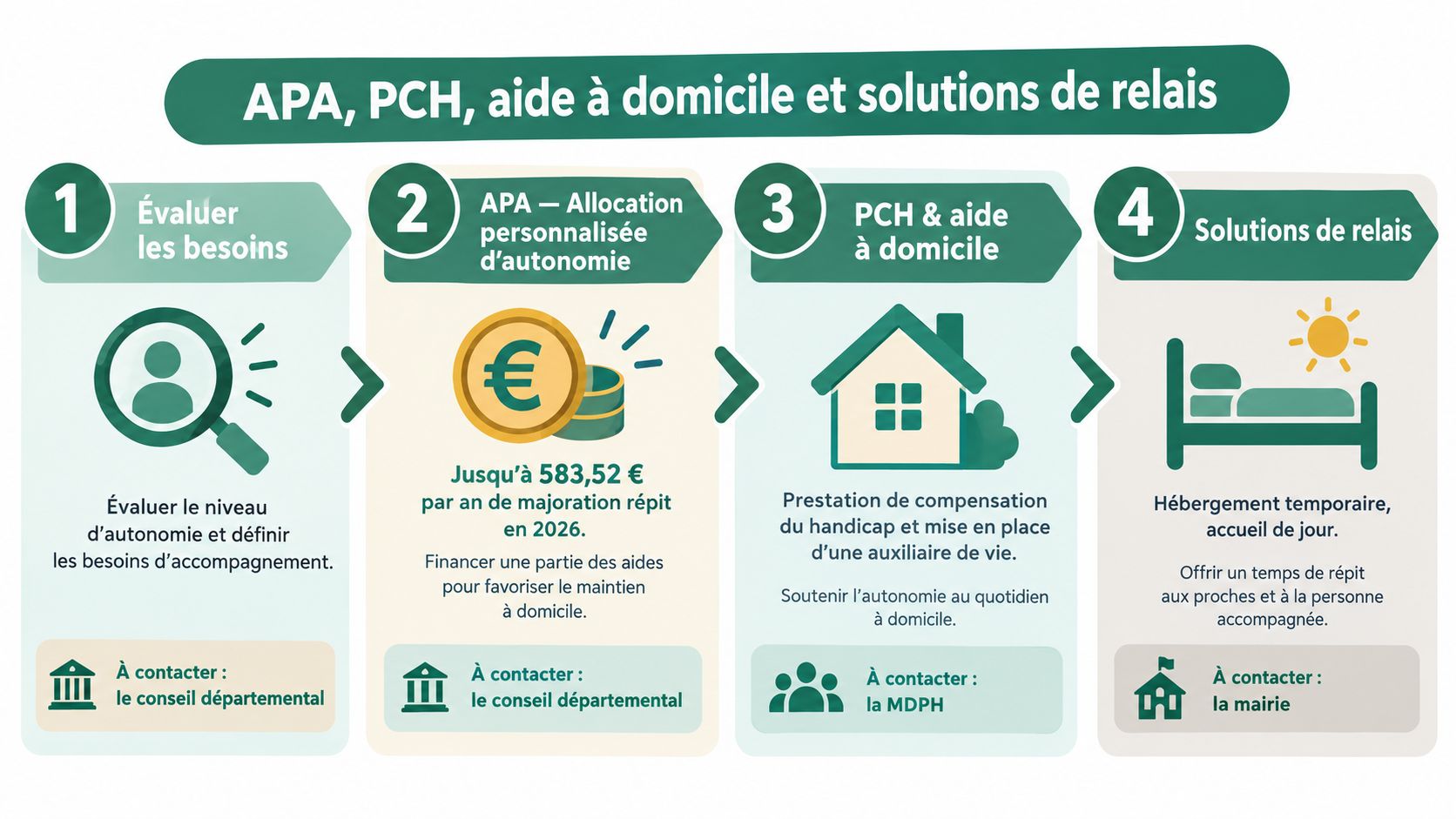
I-I-IAPA responds to age-related loss of autonomy. PCH meets a disability situation and assessed compensation needs. Home help, however, may be the responsibility of the departmental council, a pension fund or a mutual fund depending on the situation. Retain a simple rule, start with the primary need of the person receiving care, and then make a specific request.
Select the first contact person
| Dominant position | First contact | Need for formulation |
|---|---|---|
| Age-related loss of autonomy | Departmental Council | Assessment and Assistance Plan APA |
| Disability or need for compensation | CDMH | PCH needs assessment and request |
| Need for home presence | Local service, pension or mutual fund | Aid hours and funding conditions |
| Exhaustion of the Helper | Accompaniment and Respite Platform | Relay, listen, welcome or temporary solution |
The APA may include a supplement dedicated to the respite. 2026, it can reach €583.52 per year when the aid plan ceiling is reached, according to the applicable conditions. This amount helps, but it is never enough alone. It must be backed up by a schedule, a really available stakeholder and clear instructions so that the absence of the caregiver does not disrupt everything.
Accompaniment and respite platforms are useful when fatigue becomes too heavy or when a relay has to be found quickly. Ask for four things immediately, which can be organized at home, the proofs to be provided, the funds mobilized and the name of the relay during the absence. You will save days. CNSA lists approximately 320 platforms in 2025 and aims to cover all departments by 2027.
The Decree of 19 August 2025 has also extended, under conditions, home replacement and assisted rest periods. The same professional can intervene until six consecutive days. For a family, it is concrete. A professional absence, a short hospitalisation or a few days of recovery become more manageable if treatments, habits and alerts are already centralized.
It is here that the administrative and the daily must finally work together. To structure a reusable set of instructions, families can draw on methods designed to automate customer service with IA, then adapt this principle to family coordination. Organized information accelerates exchanges, even if the social or medical assessment remains the responsibility of the professionals. Tribulys then takes its place at the right level, centralizing documents, instructions and relays so that open rights really serve to keep the home.
Arrange when you work or live far away
An active or remote caregiver cannot rely on improvised calls. It needs a stable pace, visible responsibilities and a clear rule for unusual situations.
The DREES reports that 47% of caregivers aged 60 years or older report at least one consequence of the help on their healthThese consequences relate to physical health and 19 % and mental health for 37 %. Coordination must therefore protect the caregiver, not only improve the follow-up of the loved one.
The weekly ritual
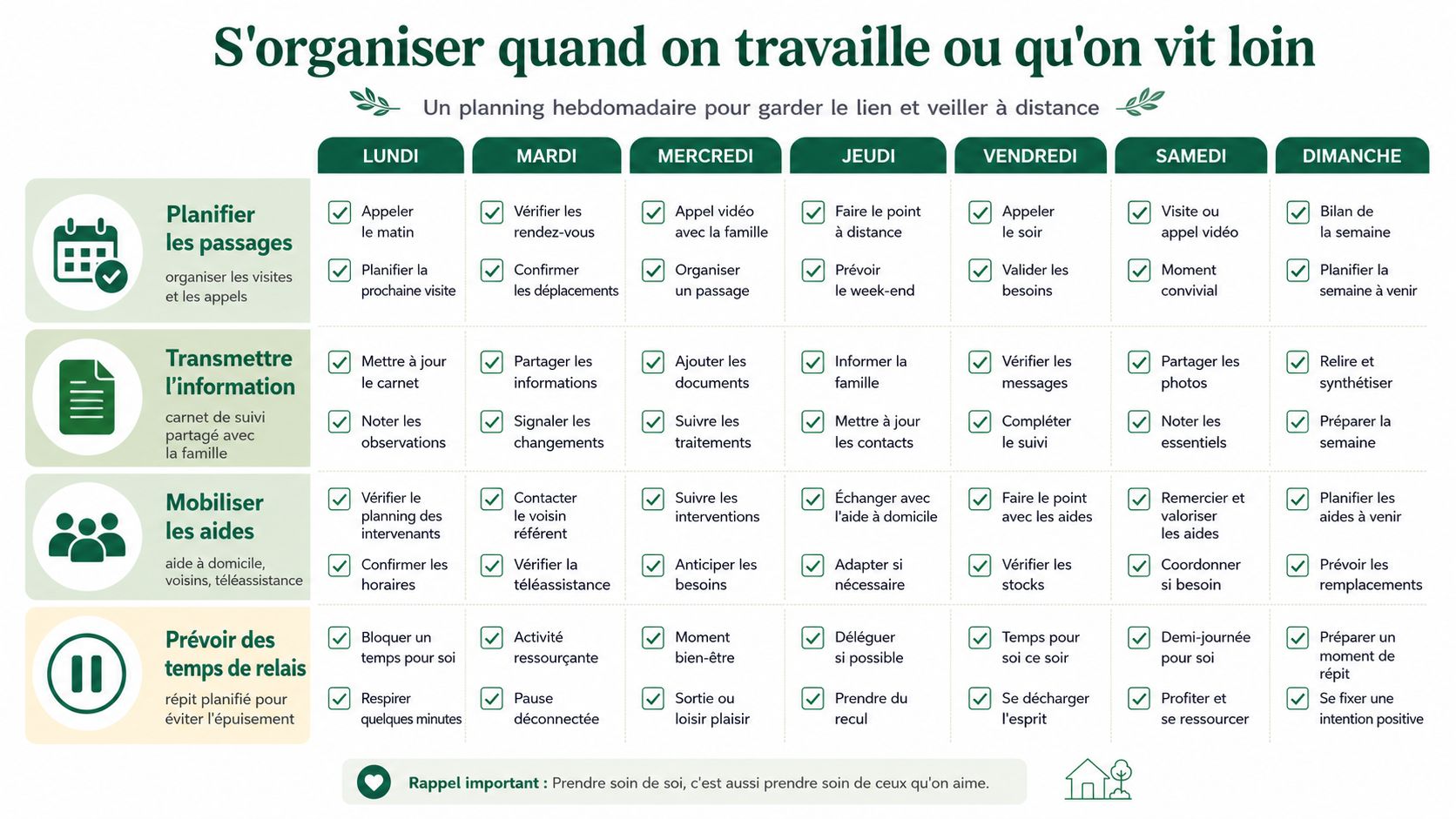
Early week, record passages, calls, appointments and administrative tasks. Each task must have one person in charge, not just a group of "informed" people.
Before each visit, prepare a short checklist: treatments to be confirmed, diet, hydration, environment, mail, appointment and unusual observation. A useful checklist holds in the phone and can be followed even when the connection is weak.
After the visit, pass on what has actually been done. Note the date, author, context and any measured value. For a constant such as weight, temperature or tension, the trend provides more information than an isolated value.
Weekend, produce a synthesis. Who intervened ? What remains to be done ? What appointment happens ? What instructions have not been confirmed ? This synthesis allows the caregiver who lives far away to resume the follow-up without interrogating five people.
An unreported absence becomes a risk. A planned absence becomes a exploitable information.
Also provide an alert threshold. An unusual silence, unconfirmed take or new observation must trigger an action defined in advance, e.g. call the next of kin present, contact the speaker or ask for a professional opinion. This rule avoids debate in an emergency.
For caregivers who work at a distance, these tips for teleworking in the wild This may help to reflect on the working environment, but no arrangement compensates for improvised family coordination. Follow-up must remain accessible from the location of the caregiver, including during a working day.
One Family organization tool for caregivers can serve as a common basis, provided that the family first defines its transmission rules. The technology then supports a collectively decided organization.
Tribulys and digital coordination, without oversales
A digital tool does not create availability and does not make a medical decision. However, it can remove a major source of confusion, the dispersal of information between calls, SMS, notebooks and isolated documents.
Tribulys is a web and mobile application designed to coordinate family caregivers and healthcare professionals around a loved one kept at home, with HDS-certified accommodation in France and GDPR compliance, as presented the site of Tribulys. Its operational interest depends on how the family uses it.
What centralization changes
A timed link book gives a history of the observations. A shared calendar gathers the passages and appointments. The follow-up of the drugs allows to confirm the intakes and to spot an omission. An emergency card gathers important contacts.
The constants can be recorded with their date, author and context. A visit checklist guides the speaker, including offline. The tasks make visible the distribution between relatives, while the documents and orders remain in a common space rather than in the personal messaging of a single helper.
The main difference lies in the traceability. Each information can be linked to an author and at one time. Authorized members have access in real time, which reduces dependency on the caregiver who holds the entire memory of the file.
What the tool does not replace
Tribulys does not replace the doctor, the dialogue between relatives, or the necessary authorization for certain procedures. He does not transform a family divided into a coordinated team. To function, one must choose the authorized persons, define the emergency rules and ask each one to confirm the actions assigned to him.
Simplicity remains crucial. If the application requires too much effort, the relatives who do not use the digital will give up. So we must start with some concrete uses, the planning, the transmissions, the medicines and the emergency card, and then expand only when the routine is installed.
Tribulys centralizes the planning, transmissions, treatments, documents and tasks around the helped loved one, so that each helper knows what to do without dependent on a single contact person. To structure your family coordination now, discover Tribulys and establish a common space suitable for relatives and authorized professionals.
Put this organisation into practice with Tribulys
Keep your care journal, shared calendar, tasks, medication tracking and emergency information together. Start for free and invite the relatives and professionals involved in your loved one’s care.