
You may have already experienced this scene. The auxiliary of life notes something by hand before leaving. The nurse passes later, opens the notebook placed on the table, does not understand the writing, looks for whether the morning treatment was taken, then calls the patient's daughter. The girl does not know. She in turn calls the kine, then the neighbor who opened the door in the morning. In a few minutes, everyone is wasting time, nobody is sure of the information, and the vulnerable person at home finds himself at the center of a preventable blur.
This is precisely where the transmission logbook takes on all its importance. Not as an additional administrative formality, but as a common benchmark. When he is well held, he reduces the shades. When he is mistreated, he creates the illusion of a follow-up while he lets the essentials pass.
In the field, the problem is not just the lack of information. It is fragmentation. One part remains in the paper book, another in the text messages, another in the memory of everyone. For a loved one already under pressure, this dispersal is used quickly. For a caregiver, it complicates decisions that should be based on simple and verifiable facts. If you are looking for benchmarks to better organize this coordination in daily life, this guide on the co-ordination between caregivers and home care workers completes this reflection well.
Contents
- Introduction of the often broken information chain
- What is a transmission book and what is it for?
- The legal and regulatory obligations of the transmission book
- Good practices for clear and effective transmissions
- Paper book vs digital comparison to choose well
- Set up a digital transmission book the checklist
- Concrete examples of successful transmissions
- Frequently asked questions about the transmission book
Introduction of the often broken information chain
At home, the news channel rarely breaks with a break. It breaks in silence. An unfilled box. An hour absent. An observation written too late. A forgotten signature. Then another speaker arrives and has to reconstitute the situation from incomplete clues.
In real life, it looks like this. A relative asks if the meal was taken. The home helper answers that she left a note. The nurse is bedtime average day, to be watched without details. The kine would have needed to know whether the person got up, whether she drank, whether she complained of pain, or whether a denial of care took place earlier. Without this continuity, everyone acts in her corridor.
The transmission book is used to avoid this detective work. It gathers useful facts, in a single chronological thread. It gives the next speaker what he needs to act correctly, without starting from scratch. For families, it mainly brings something very concrete. Fewer cross-calls, less assumptions, less mental load.
A badly held transmission book does not reassure anyone. It just gives a false impression of follow-up.
The most difficult thing is not to understand its usefulness. The most difficult thing is to adopt a discipline that is simple, shared by all. As long as everyone writes in their own way, the notebook remains a medium. It does not yet become a coordination tool.
What is a transmission book and what is it for?
The transmission logbook is the collective memory of the team that surrounds a person kept at home. Family, home care worker, independent nurse, kine, sometimes treating doctor according to the organization set up. Everyone sees only a moment of the day. The notebook connects these moments.
The most accurate picture is that of a logbook. On a ship, each member of the crew notes what he or she has observed and done to keep the rest of the journey safe. At home, it's the same. If the information is not clearly recorded, he or she leaves the care chain as soon as the person leaves the room.
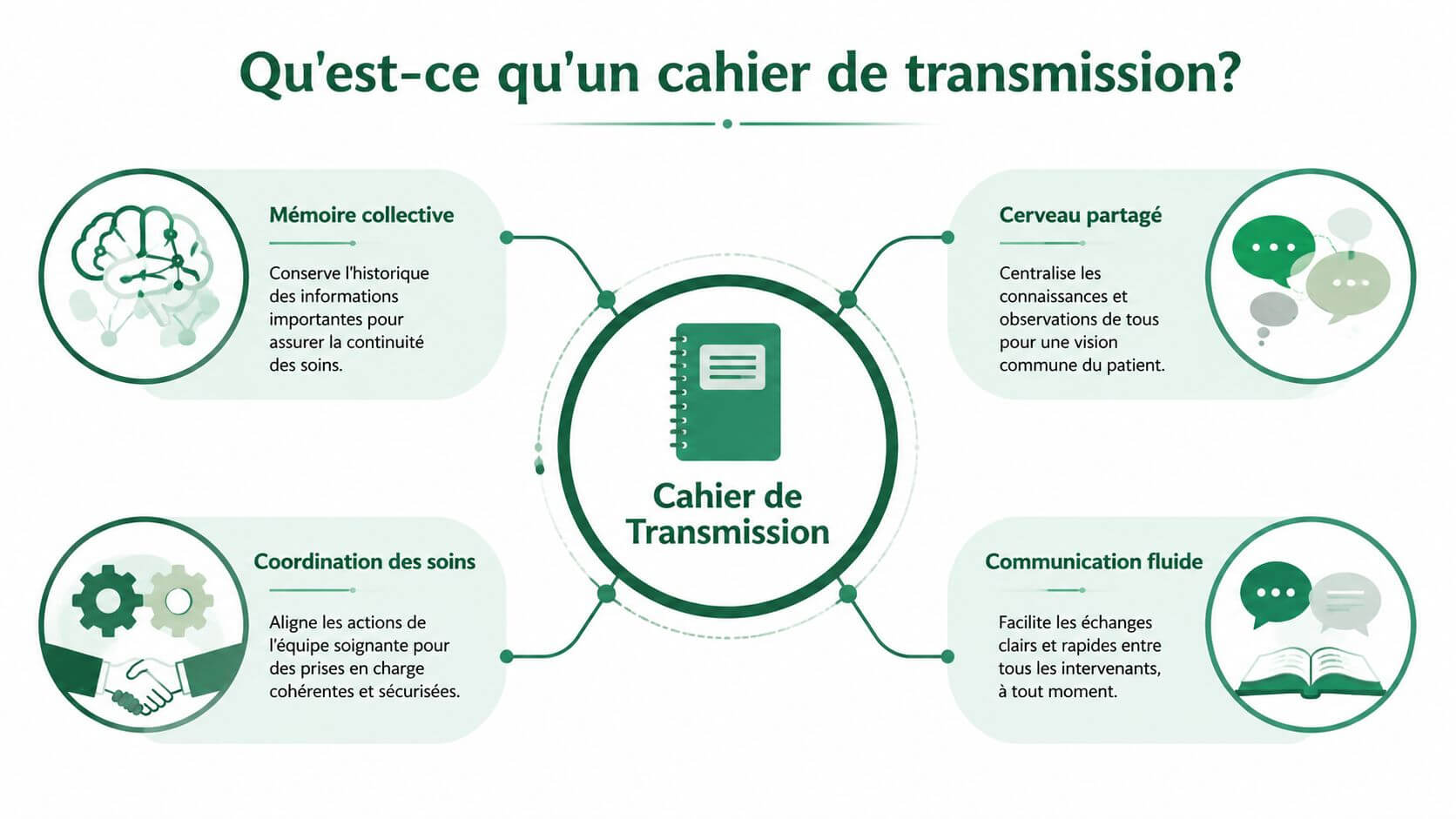
A common memory to avoid blind spots
A good transmission book meets three specific needs.
- Ensuring continuity of care. The next speaker knows what happened before his passage.
- Trace acts and observations. We distinguish what has been done, what has been refused, which must be monitored.
- Centralize useful communication. Important information is no longer scattered between calls, flying papers and isolated messages.
This common memory function is particularly valuable when several people work at different times. The home does not have a central post as a hospital service. The notebook plays this role.
Who has to write there
Many families think that the notebook is reserved for professionals. In practice, it works better when everyone remains in their role but participates in the same information circuit.
The caregiver may note a change observed between two visits, such as a meal refusal, a restless night or a loss of morale. The professional, on the other hand, tracks the actions performed, the useful clinical observations and the follow-up elements that make up the follow-up of the care. The important difference is not between the family and the caregiver. useful observation and blurred comment.
Simple benchmark: what helps the next speaker understand the situation and decide what to do.
What a good notebook changes every day
When well used, the transmission book fluidizes the work without increasing the number of rounds. It helps to detect a deterioration earlier, avoid duplications, and limit misunderstandings between relatives and professionals.
On the other hand, a notebook filled with vague formulas such as "ça va", "RAS" or "fatigued" does not fulfil its function. It reassures on the form, not on the background.
The legal and regulatory obligations of the transmission book
The transmission book is not a simple practical medium. In many situations, it is a part of a professional obligation of traceability. And this obligation is not the same in terms of home help or care provided by health care professionals.

Home help
In the case of home helpers in France, the care journal or transmission book constitutes a legal proof of benefit. The expected content should include the date,start and end time of the intervention, acts of daily life carried out as toilets, meals or cleaning, as well as compulsory signature of the claimant at each departure, as the official portal on the care journal for home help services.
The most often underestimated point is this one. Without a timed signature, the intervention cannot be validated for financing or billing in accordance with the same official framework. On the ground, it changes everything. An incomplete notebook is not only "less well held". It weakens the proof of passage.
For Home Caregiver
In terms of care, the requirements relate primarily to therapeutic safety. In the context of targeted home transmission, Directive DGOS/R4/DGCS/3A/2018/136 imposes a minimum structure including the identification of the patient, the care provided with their accurate frequency, the drug treatment prescribed and delivered, and a summary of the Personalized care plan, as indicated in the official text of the instruction on pilot projects for health pathways.
The absence of these elements is not neutral. If the frequency of intake is not noted, the next treating physician or nurse cannot properly secure follow-up. The practical risk is duplicates, omissions, or incomplete reading of the patient's progress.
The digital framework
The transition to digital technology is part of a broader framework. In France, it is part of a national strategy to transform home care. 85% of transmissions are still on paper, which maintains the risk of medication errors and loss of critical information for 2.8 million caregivers and 1.2 million home health professionals. This context also concerns 400,000 home support facilities and care services subject to timed and signed traceability requirements, in compliance with the GDPR and the hosting of health data in France or in the European Union, as presented by the beta.gouv page on digital transformation of the transmission book.
If you are already working with clinical coordination tools, the shared medical record guide helps to locate the transmission book in the broader set of documents that are useful for follow-up.
The law requires a thing simple to understand and difficult to maintain in the long term. To be able to prove who did what, when, and on what basis.
What most often exposes
In home accompaniment, problems often come in the same form.
- Absent time stamping. Could not put the information back in the actual timeline of the day.
- Forgotten signature. Delivery or intervention becomes questionable.
- Imprecise observation"Has been tired" does not help to assess a risk.
- Misdirected medicineIt is no longer known what has been prescribed, given, refused or postponed.
The notebook protects the patient. It also protects the practitioner.
Good practices for clear and effective transmissions
A useful transmission book is read quickly and understands itself without interpretation. The best reflex is to write for the person who passes after you, not to relieve you from having put a word.
What to do
The most reliable transmissions have very concrete commonalities.
- Remaining factual. Write lunches refused rather than difficult patient.
- Clarify context. Pain, refusal, agitation or drowsiness take on another meaning if the time and situation are indicated.
- Name the action performed. If you have hydrated, installed, recalled a statement, contacted a relative or passed on to the nurse, you must write it down.
- Note what's changing. Stable information does not need to be repeated at every passage. On the other hand, any change deserves a clear trace.
- Use simple vocabulary. A note must remain understandable by all authorized stakeholders.
What to Avoid
Transmittal errors are not always due to a lack of goodwill. They often come from unhelpful habits.
- Value judgements"Capricious," "aggressive," "confus," "without associated facts" create bias.
- Too long notesWhen everything is important, nothing is.
- The blurred formulations"To watch" is useless if you don't say what to watch.
- Personal abbreviations. If only one who writes understands, the information is lost.
- Delayed transmissions. The later you write, the more memory and observation you mix.
A good transmission describes a fact, an action, and then what to remember for the future.
A simple method that works
Logic Data, Actions, Results remains very useful at home, even in light version.
| Element | Note |
|---|---|
| Data | What You Observe Objectively |
| Actions | What you have done or passed on |
| Results | What's changed, or what's left to watch |
Brief example. Donated: "patient hasn't finished breakfast." Action: "Proposed hydration, installation in the chair, information transmitted to the next of kin". As a result, "drinked, remains unparticipative, to be re-evaluated in the next passage".
The right level of precision
It is not a question of writing a clinical novel at every visit. It is a question of writing enough to secure the continuation. If the note does not help to understand the situation, to justify the act, or to anticipate the next visit, it is too poor.
On the other hand, a notebook saturated with secondary details discourages reading. Good transmission goes right to the useful fact.
Paper book vs digital comparison to choose well
The paper book has an obvious advantage. It is simple to place on a table and does not require any technical control. That is why it remains so present at home. But as soon as there are several workers, remote caregivers, fine tracking needs or traceability requirements, its limits quickly appear.
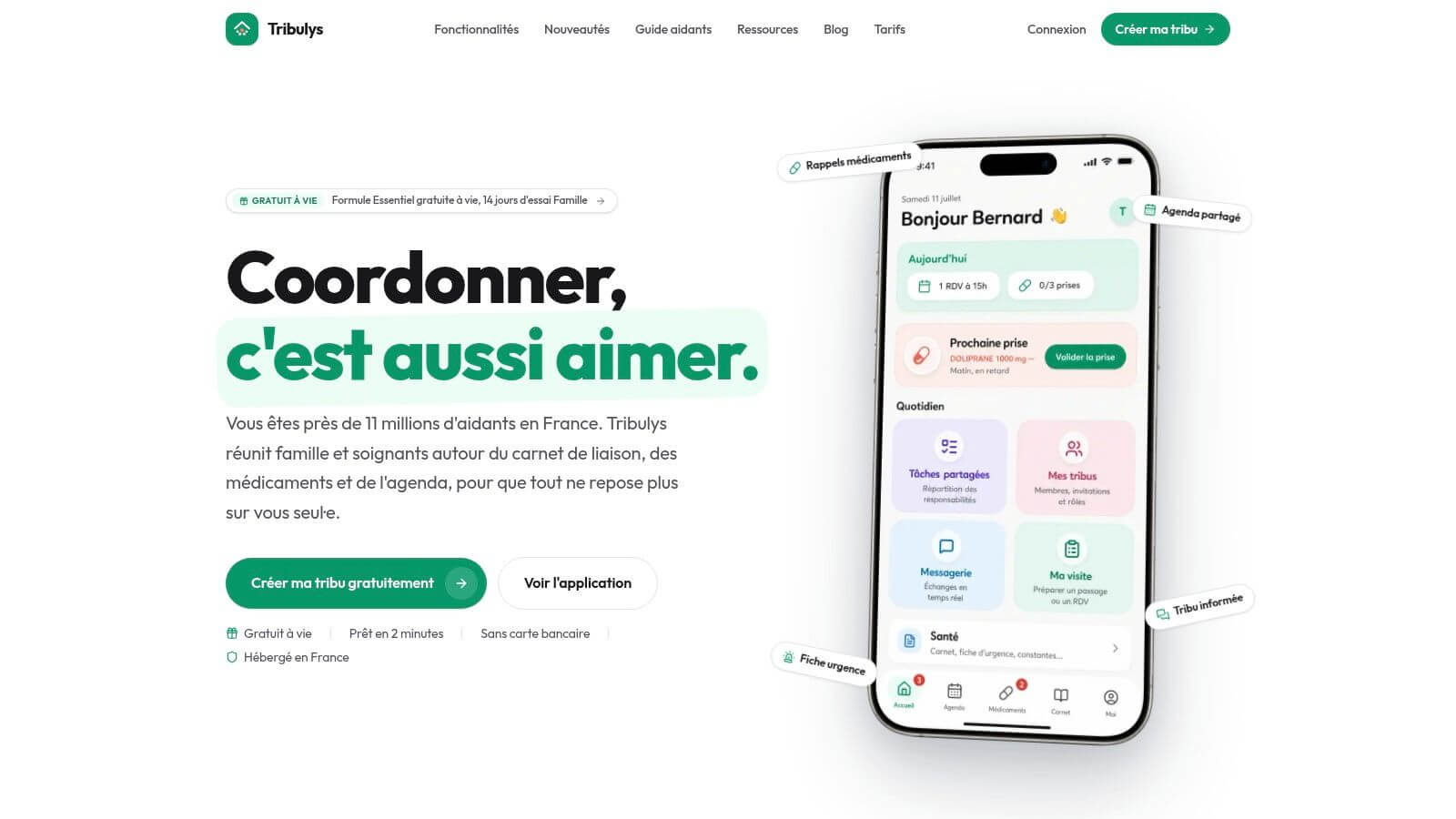
What paper still does correctly
The paper remains acceptable when the organization is very simple. Only one person intervenes, or almost one person. The home is the unique place of consultation. And everyone has the same habit of writing.
Within this limited framework, it may be sufficient. But this is no longer the most common configuration as soon as families, liberal caregivers and helpers cross over within the week.
What digital really changes
Digital does not only bring comfort. It changes the availability of information. A transmission can be viewed remotely, dated, connected to an identified stakeholder, and shared without depending on the physical presence of the notebook at home.
Another major difference is security. In a well-designed tool, accesses are managed, rights are segmented, and hosting meets health data requirements. For a more complete view of this format, you can consult this resource on the home support digital care journal.
Comparatif Paper Transmission Paper vs Digital
| Criterion | Paper | Digital Cahier (ex: Tribulys) |
|---|---|---|
| Accessibility | Available at home only | Consultable according to rights granted, including distance |
| Lisibility | Depends on each person's writing and rigor | Standardized, easier to read |
| Traceability | Manual signature and sometimes incomplete schedule | Timed entries, author ID according to the tool |
| Sharing | Slow circulation, often limited | Quickly visible information by authorized persons |
| Alerts | No native alert | Possibility of alerts and reminders according to the features |
| Data security | Home-based support | Stronger framework if tool complies with GDPR and adapted hosting |
| Follow-up continuity | Depends on the physical presence of the notebook | Centralized history, easier to find |
Paper is practical as long as coordination remains simple. As soon as the organization becomes more complex, it becomes a point of friction.
The real criterion of choice
The question is not paper or digital in the abstract sense. The right question is more concrete. Who needs to read the information, when, and with what level of reliability?
If only two responders take care of themselves without a particular emergency, the paper may hold for some time. If the family lives far away, if the drug intakes have to be followed, if several professionals intervene, or if the mental load rests on one person, digital often becomes the most coherent choice.
Set up a digital transmission book the checklist
The switch to digital rarely fails because of the tool itself. It fails when no one has defined the rules of use, access, and the expected level of requirement. Successful implementation remains simple if it is done in the correct order.
To visualize the approach, this infographic summarizes the useful path.
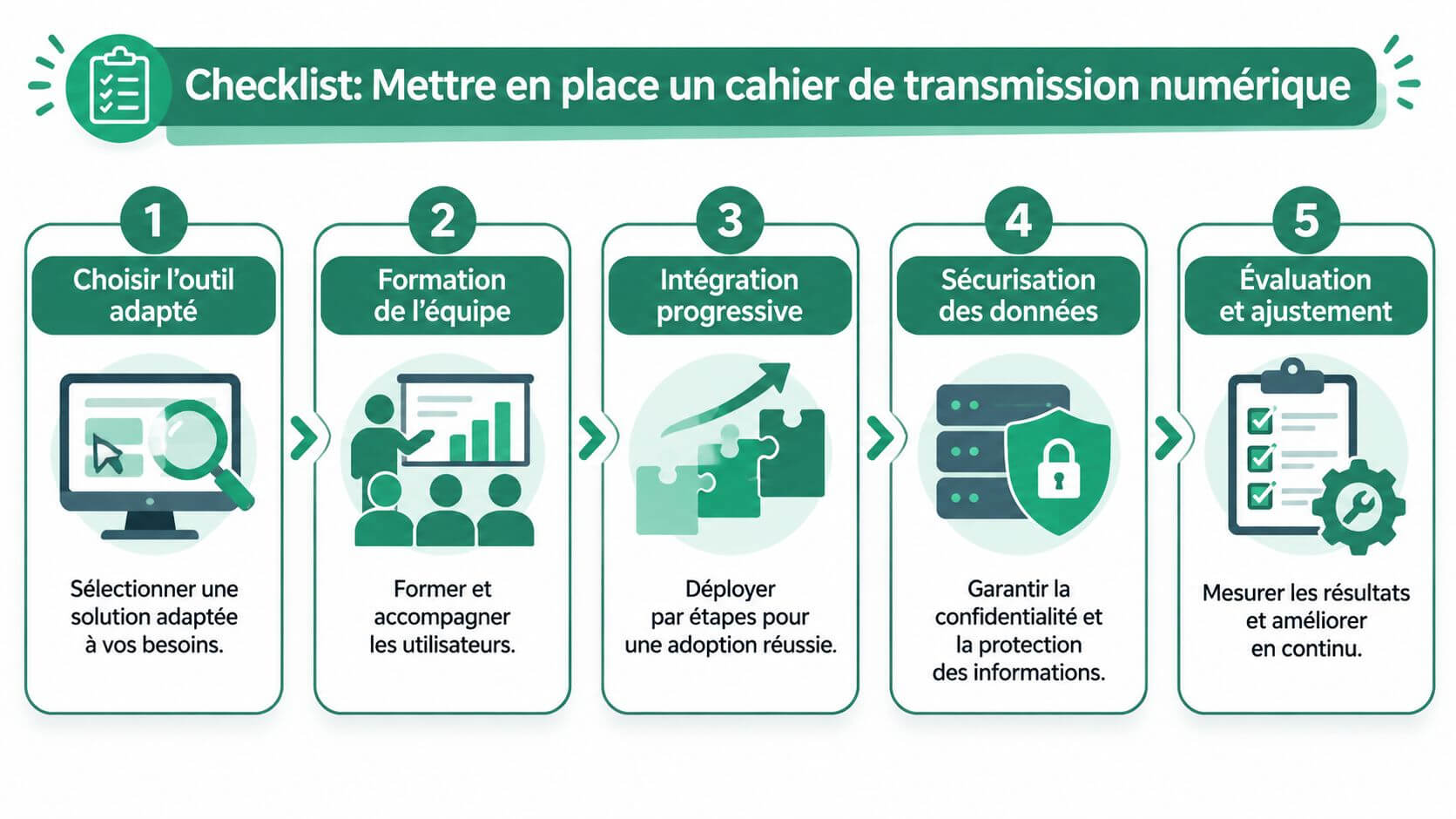
1. Choosing a home-friendly tool
The first criterion is not the number of functions. It is the fit to the real daily. It requires a readable tool, quick to inform, usable on mobile, and sufficiently structured to avoid unnecessary notes.
Also check non-negotiable points. Role management, differentiated access, traceability, hosting according to GDPR, and ability to integrate the most common uses such as transmissions, appointments and treatments.
2. Designate a reference
A team without reference quickly produces holes in the follow-up. It takes a person who invites members, validates access, recalls the rules, and settles practical questions.
This referent can be a close helper very involved, a coordinator, or the person in charge of a service. Its role is not to do everything. Its role is to keep the frame.
3. Invite the right speakers
Not everyone needs to see the same thing. A good deployment starts with simple user mapping.
- Near family. Access to information useful for daily coordination.
- Health professionals. Access to the transmissions necessary for clinical follow-up.
- Home aids. Access to what is useful for their intervention and traceability.
- Remote Helpers. Targeted visibility to avoid cascade calls.
4. Set the rules of use
Even before the first week, you have to answer a few questions in black and white. When do you write? What do you write systematically? What do you do in case of an error? Who triggers an alert? What kind of information should you not leave in informal messaging?
This video provides a practical overview of the subject and helps project usage in a real organization.
5. Briefly form and adjust
A short grip is better than a long document never read. Show how to create a transmission, correct an error, report an important point and find the history. Then, observe the first days of real use.
To be monitored on startup: If the transmissions still leave by SMS or call while the tool exists, it is because the rules are not yet shared.
The best settings come after the first week of concrete use, not before.
Concrete examples of successful transmissions
Good transmissions can be seen right away. They allow the next person to understand the situation without calling three people to complete.
Example 1
A vague version on paper: Ms. Dupont tired today.
Actionable version: “Refused to get up until late morning. Ate little breakfast. Fluids offered and accepted. Less engaged than usual. Reassess at the next visit.”
In the second version, we know what has been observed, what has been done, and what deserves vigilance.
Example 2
Wave version: Redness to watch.
Useful version: Redness observed at the sacrum during the toilet aid. Unopened area. Revisited installation to limit the prolonged support. Information transmitted to the nurse.
Here, the information serves immediately. The next speaker knows where to look, what to compare, and what action has already been taken.
Example 3
Vague version: “Medication taken.”
Reassuring version: “Morning dose confirmed. Patient reported refusing the midday dose. Stated reason: nausea. Information passed on for reassessment.”
This formulation is much more useful than a global validation. It distinguishes what was given from what was refused.
The common point between these examples is simple. They do not tell the day. They document the continuation of the care.
Frequently asked questions about the transmission book
Who can read the transmission book
Only legitimate persons in the accompaniment must access it. At home, this includes authorized professionals and relatives involved in the coordination, depending on the organization chosen and the rights defined. In digital terms, one must give priority to access by role rather than equal access for all.
What to do if I'm wrong writing
On paper, do not erase so as to remove the trace. Correct cleanly, legibly, keeping the history of what has been noted. In digital, use the function provided by the tool to modify or complete without blurring traceability.
Do you have to write it down?
No. Note what is useful for continuity, security and evidence of intervention. Redundant or too vague information encumbers more than it helps.
Can the attending physician have access to it?
Yes, if the organisation set up provides for it and if access is relevant for monitoring. The point of the notebook is precisely to better share useful information between authorized actors, not to accumulate invisible notes.
How long to keep the notebook
The length of storage depends on the framework in which it is used, the type of intervention and the obligations of the structure or professional. In practice, you must follow the documentary policy and the requirements applicable to your activity. If there is any doubt, you should ask for an organizational or legal opinion rather than keep it at random.
Can a close helper write in it
Yes, provided you remain on useful, dated and understandable observations. The notebook must not become a space of opinion or family tension. It must remain a tool of coordination.
When coordination is based on calls, scattered messages and a notebook placed at the show, information fatigue rises very quickly. Tribulys brings together liaison books, drug tracking, agendas and exchanges in the same area, with timed entries, role management and data hosting in France or the EU. If you are looking for a concrete way to make transmissions more reliable and to relieve the mental burden of relatives and caregivers, this is a serious option to test.
Put this organisation into practice with Tribulys
Keep your care journal, shared calendar, tasks, medication tracking and emergency information together. Start for free and invite the relatives and professionals involved in your loved one’s care.