
When a loved one with cancer comes home with the question of palliative care, the scene is often the same. There are prescriptions, calls to pass, the bed to be delivered, the hours of nurses to understand, and in the midst of all this a family that simply wonders where to start.
The most difficult, at the beginning, is not always medical care. It is the organization. Who to call first? How to avoid forgetfulness? What to do if pain changes at night? How to help without exhaustion? These questions are normal. They do not mean that you are late or out of date. They show above all that you take seriously the comfort of the sick person.
The palliative care home cancer are not just a phase close to the end of life. They correspond to a way of care centered on comfort, quality of life, relief of symptoms and respect for the patient's wishes. At home, this approach can be deeply soothing, provided it is well coordinated.
This guide was thought of as concrete support. Here you will find simple landmarks, examples of everyday life, practical solutions to organize stakeholders, equipment, treatments and support for loved ones. The idea is not to do everything alone. The idea is to make home maintenance more readable, safer and more humane.
Contents
- Introduction Organize the return home in complete serenity
- Understanding Palliative Home Care
- The care team essential collaboration
- Manage symptoms to improve comfort
- Coordination of care the central role of the caregiver
- Administrative aspects and support for relatives
- Practical checklist for organizing palliative care at home
Introduction Organize the return home in complete serenity
Returning home can be an immense relief. The patient regains his or her landmarks, armchair, habits, sometimes his or her garden or the continued presence of his or her own. But this return requires more than family goodwill. Clear Care Project, identified professionals, suitable equipment and reliable flow of information.
Many families still associate palliative care with cessation. In practice, it is the opposite. It is an active approach that seeks to live better with the disease when it becomes advanced, by treating pain, shortness of breath, anxiety, fatigue, eating disorders or mobility difficulties.
The right starting point
The first useful landmark is simple. You don't start by buying equipment or calling everyone at the same time. You start with a conversation with the patient, if his condition permits, and then with the doctor who follows the situation.
This discussion is intended to answer four questions:
- What the sick person wants. Stay home, avoid some round trips, prefer comfort, receive loved ones.
- What is medically feasibleSome care is easy to organize at home, others require enhanced support.
- What needs to be monitored. Pain, breathing, restlessness, difficulty swallowing, major fatigue.
- Who will do what every day. Family, nurse, treating physician, pharmacist, physiotherapist, specialized team.
Useful benchmark
A return home is better when everyone knows their role before the first night at home.
Quality of life logic
In home cancer palliative care, the central question is not just "what treatment?". It's also "what helps this person to be the best possible today?" For one, it'll calm down bone pain. For the other, it will be a successful toilet without exhaustion. For another family, it will avoid ten conflicting calls on the same day.
This logic of quality of life changes a lot. It puts the person in the centre, not to mention the relatives, who often make the link between all the stakeholders.
Understanding Palliative Home Care
Palliative home care is often misunderstood. Some see it only in the last days. Others think they're all about pain. In fact, it is a much broader management.
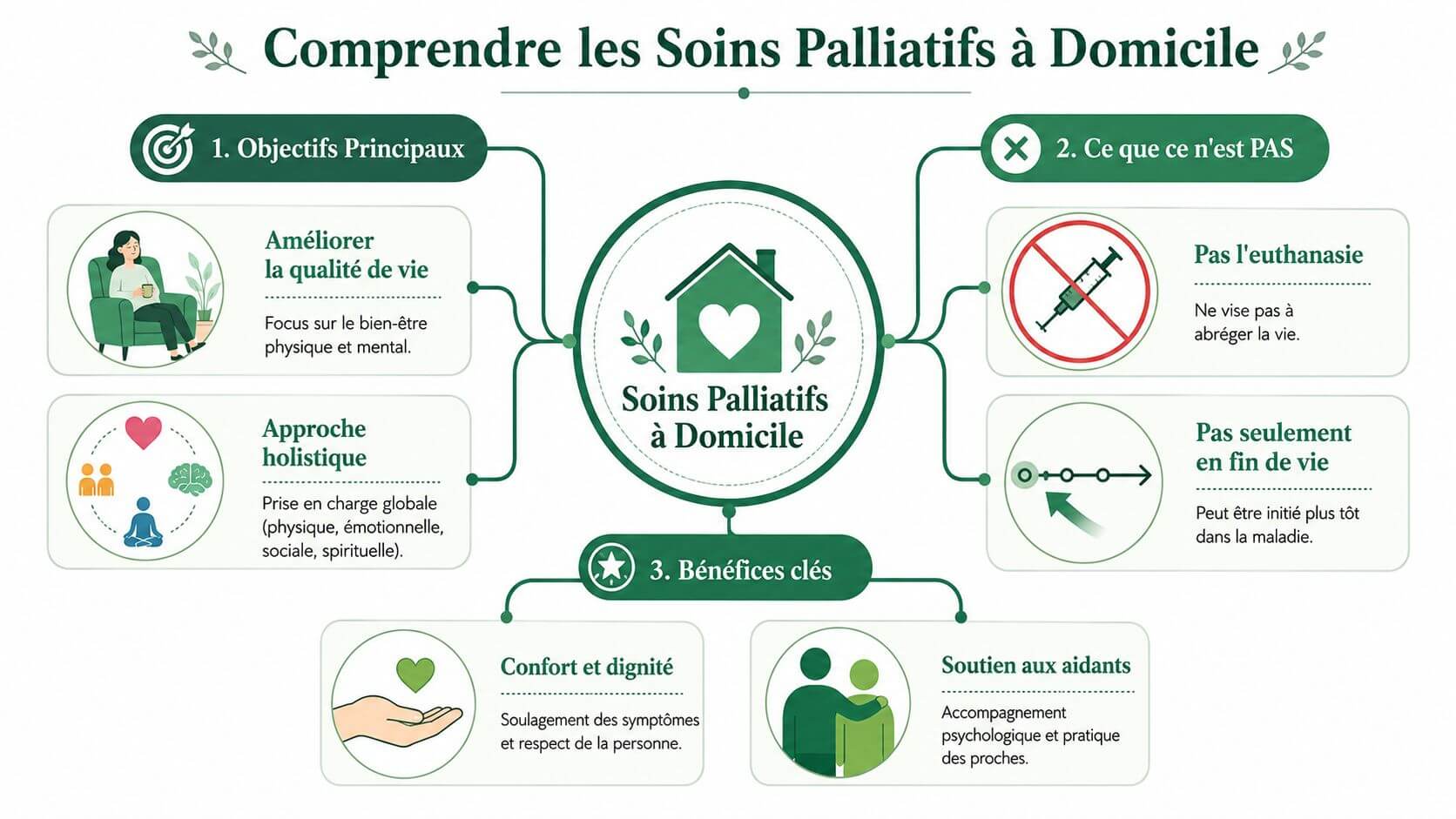
What the palliative approach really covers
Palliative care is primarily aimed at improving the quality of life. This includes the relief of physical symptoms, but also psychological, social and sometimes spiritual accompaniment. At home, this approach has a very concrete advantage. It adapts to the real rhythm of the person, not only to the rhythm of a hospital service.
There must also be a common misunderstanding. Palliative care doesn't mean we don't do anything anymore. We continue to treat, but with another priority. We choose what brings comfort, dignity and meaning, rather than heavy gestures that no longer bring real benefit to the patient.
Concrete benefits at home
At home, this care often helps to better respect habits. The patient can sleep in bed, see the loved ones in a familiar setting, eat when he wants it rather than at a fixed time, listen to his music, keep little rituals.
The benefit also exists for the entourage. When the roles are well organized, the relatives know to whom to report pain, who renews the prescriptions, who contacts the pharmacy, and who must be called if the condition changes.
Families often find the most useful:
- A personalized project. The care is adjusted to the reality of the patient, not to a standard scheme.
- A comprehensive approach. We do not only treat pain. We also take into account anxiety, sleep, skin, fatigue and the environment.
- Support for loved ones. Caregivers also need reference points, relays and listening.
Families are often reassured when they understand that the palliative approach seeks first to avoid unnecessary suffering and to preserve daily life as much as possible.
Another point deserves to be made clear. only 25% of deaths occur at home, partly because of the fragmentation between community professionals and specialised teams, even though the 5th national plan aims to generalize access to sedative practices at home (data from the Espace de réflexion éthique Hauts-de-France on palliative care) This shows that the subject is not only medical. It is also organizational.
The care team essential collaboration
Successful home care rarely resembles the action of a single professional. Rather, it resembles a small team that learns to work together around the same person.
Let us take a simple example. Mr. L. has an advanced cancer. He has a pain in his back, eats little, gets tired quickly and needs help with the transfer of bed to the chair. If the doctor adjusts the pain medication but no one anticipates the medical bed, the pain increases during the mobilizations. If the nurse observes a worsening but the information does not reach the doctor, the treatment delays being changed. If the family does not dare to report that it is not sleeping, the whole balance becomes weakened.
The treating physician and the Independent nurse at the forefront
The treating physician It often remains the main point of reference. It prescribes, re-evaluates, coordinates, requests reinforcements if necessary and helps to set the realistic limits of home retention. It is also the key interlocutor when relatives feel that something changes without knowing how to name it yet.
I-I-IIndependent nurse, or IDEL, very often becomes the pivot of everyday life. She does the care, monitors symptoms, observes signs of discomfort, identifies difficulties of skin, diet or vigilance. Above all, she makes the link between what she sees in the patient and what the doctor needs to know quickly.
The other relays that change everyday life
The physiotherapist, the home care worker, the pharmacist and the specialized teams do not intervene at the same time or for the same reasons. Yet, everyone can avoid complication or exhaustion.
The physiotherapist can help during mobilizations, positioning or respiratory congestion. The home care worker supports everyday gestures, often in very sensitive moments such as the toilet or meal. The pharmacist secures delivery, explains the proper use of treatments and sometimes facilitates logistics. Specialized mobile teams provide expert support, especially when symptoms become complex or when decisions are difficult.
| Actor | Main role | Mode of intervention |
|---|---|---|
| Treating physician | Prescribing, reassessing, coordinating | Consultations, visits, exchanges with other caregivers |
| Nurse Liberal | Daily care, surveillance, transmission | Crossings at home as required |
| Pharmaceuticals | Issuance, explanations, security of treatment | Officine, advice, sometimes logistical preparation |
| Physiotherapist | Mobilization, postural comfort, respiratory aid depending on the situation | Prescribed home sessions |
| Aides of life | Helping the gestures of daily life | Regular attendance at home |
| Mobile Palliative Care Team | Specialist opinion, professional and family support | One-time intervention in support |
| Caregivers | Presence, observation, practical coordination | Home Daily |
Field Council
When several professionals intervene, untransmitted information is often worth lost information. A unique place is needed to record what changes.
On an ordinary day, this collaboration becomes very concrete. In the morning, the IDEL finds a greater pain in changing position. At noon, the family observes that the patient drinks less. In the afternoon, the physiotherapist notices a transfer becoming too difficult. If these elements are grouped and shared, the doctor can quickly adjust the comfort strategy.
Manage symptoms to improve comfort
Families often fear three situations. The pain that increases. The shortness of breath that impresses. The loss of appetite that gives the impression of letting the close one go. These moments are trying, but they can be accompanied with method.
Pain breath appetite
The pain It should be reported early, even if it seems to be bearable. Waiting to do so often makes relief difficult. At home, we monitor what changes. Pain at movement, grimace during the toilet, wake up at night, refusal to be mobilized, unusual agitation. Every detail can help the doctor and nurse adjust the treatments.
The dyspnoea, or breathing difficulty, sometimes calms down with several levers combined. The posture counts. An airy room, a more seated position, slow gestures, a calm presence and the care prescribed by the team can reduce the distress. The entourage often needs to learn to observe without panic. The patient immediately feels the tension around him.
The loss of appetite It is worth a gentle approach. Force to eat often creates fatigue and guilt. It is better to offer small quantities, easy textures, favorite foods when possible and short meal times. Comfort counts more than nutritional performance.
Quickly get the right material
The comfort also depends on the equipment. For cancer patients at the end of life followed at home, one in two people finally dies in hospital, often due to a breakdown in follow-up, and the recommendations recall the importance of a systematic assessment of mobility as well as early adaptation of the bed and mattress (analysis published on ScienceDirect about continuity of home care).
In concrete terms, if the patient slides into the bed, has a pain in the pelvis, blushes on the support points or struggles to turn around, it is necessary to talk about it without delay. The right initial contact is often the IDEL or the attending doctor. Then comes the prescription, the medical equipment provider and the adjustment to the home.
Think about asking:
- The medicalized bed if transfers become painful or dangerous.
- The suitable mattress if the risk of escarre increases.
- The wardrobe chair or pierced chair If it gets too hard to get to the bathroom.
- Aid for treatment to avoid mistakes. Pillier morning night to better secure the organization of medicines can be useful when several people take turns.
The sooner the material arrives, the less the family compensates with its own back, sleep and strength.
Coordination of care the central role of the caregiver
The heart of home care is often played here. Not in an isolated prescription, but in the ability to circulate the right information at the right time.
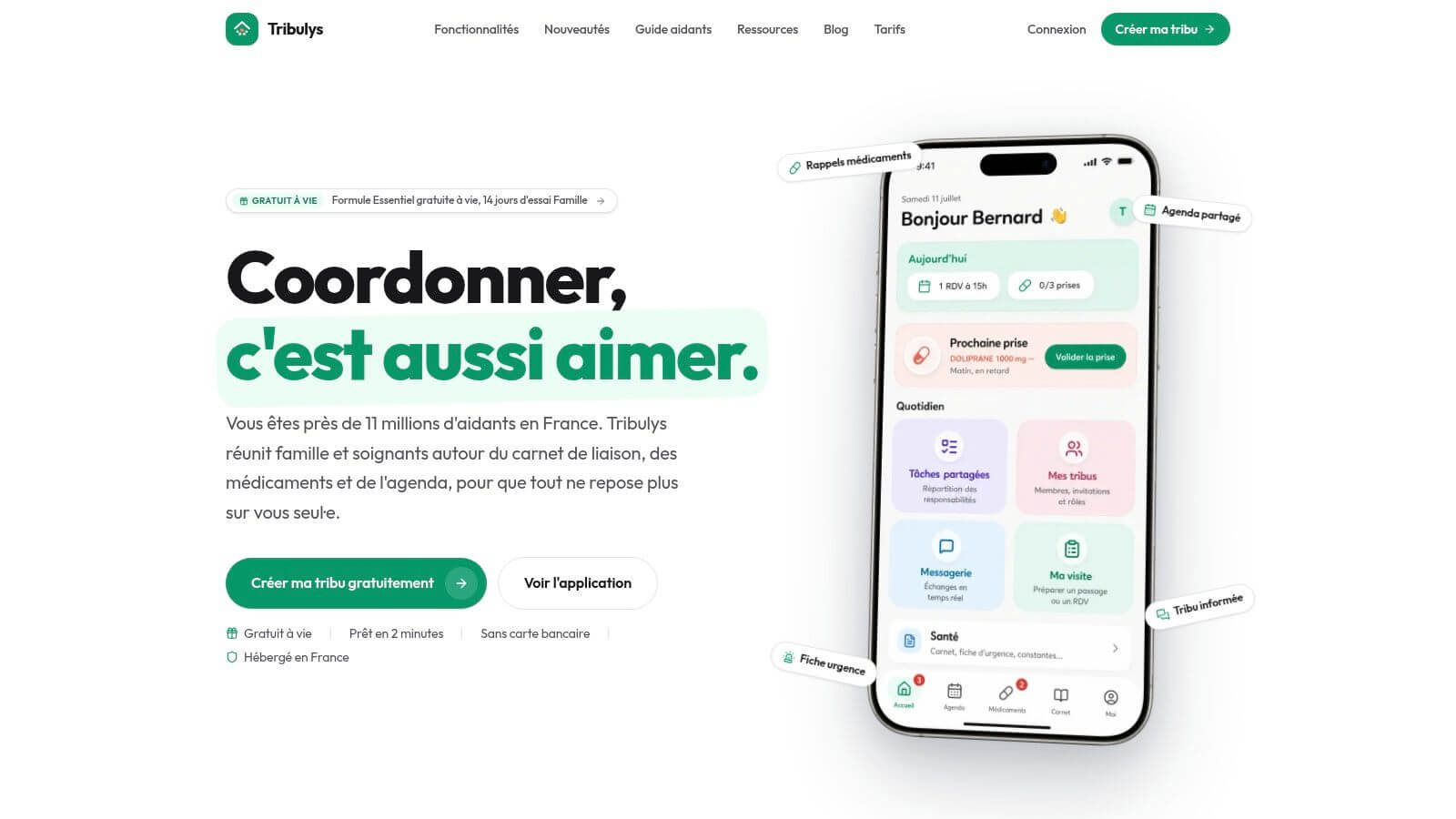
Why coordination gets so complicated
At first, everything seems manageable. Then the actors multiply. The doctor passes, the nurse calls, the pharmacist confirms a delivery, a brother remotely asks for news, a girl manages the appointments, a home helper comes in the afternoon. Within a few days, the information is scattered between paper notebooks, SMS, calls, photos of prescriptions and memory of each one.
It is precisely there that the principal caregiver finds himself in the centre. He responds, reformulates, recalls, transmits, checks. This mental charge is often invisible. Yet, it weighs as much as certain physical gestures.
When this coordination becomes fragile, the consequences are very concrete:
- An ill-transmitted symptom. Morning pain only arrives at the doctor at the end of the day.
- Uncertain treatment. No one knows if the dose has already been given.
- A confused appointment. Two speakers meet, or no one comes.
- Growing Family FatigueEveryone thinks they're helping, but no one has the same information.
Tools that really relieve the mental load
A good coordination tool does not need to be complicated. It must mainly centralize what matters. Transmissions, medicines, appointments, tasks, alerts and emergency information.
A shared link book allows you to note that a patient has been drinking less, slept only in episodes, or a redness appears on the heel. A common agenda avoids duplication and forgetfulness. A follow-up of drug intakes limits the doubt, especially when several relatives relay. A dedicated email avoids that important information is lost in personal conversations.
For families looking for a more stable method of work, a practical guide for coordination between carers can already help lay the foundation before choosing a tool.
The issue is far from secondary. The difficulty of coordination is one of the major obstacles to home maintenance. It is part of a context where the home remains less accessible than it should, not because of lack of family attachment, but because the relays remain too fragmented, as mentioned above.
When several people help the same relative, the information must belong to the collective, not to the primary caregiver's memory alone.
Administrative aspects and support for relatives
The administration often happens when the family is already tired. Yet, clarify this point quickly relieves. It avoids unnecessary expenses, better ask for help and does not carry alone what falls within the care system.
What is supported
For cancer cared for in ALD, social security covers 90 to 100% of home palliative care costs, but there is no no direct financial assistance explicitly foreseen to cover the coordination provided by the carers, whether it is time spent or organizational tools (Detailed explanation of care for palliative care in the home).
This point changes the outlook on many situations. Care can be reimbursed, but the day-to-day management of calls, scheduling, transmissions and relays is still largely based on the family.
In practice, it is necessary to check quickly:
- ALD status. It conditions the enhanced management of cancer-related care.
- Current requirements. Equipment, nursing, physiotherapy, technical aids.
- Administrative interlocutors. Health insurance fund, mutual insurance, social service if necessary.
- The rights of the caregiver. Leave, relay solutions, local support.
To deepen these approaches without losing yourself in the acronyms, this guide on home helpers' rights and assistance can serve as a practical benchmark.
Preserving the Principal Helper
Keeping at home is often because of a person who manages everything. This is precisely the situation to watch. An exhausted caregiver forgets more easily, sleeps less, eats badly, isolates himself and feels guilty of asking for a relay.
Warning signals are simple. Unusual irritability, feeling of never dropping out, fear of leaving the house even for an hour, difficulty concentrating on treatments, frequent tears or persistent fatigue.
Some measures really help:
- Provide designated relays. Not someone will pass, but Paul comes Tuesday morning, Sophie Thursday night.
- Record the essential instructionsThis avoids saying anything again when another relative takes over.
- Accepting external assistanceProfessionals do not replace the family. They support it.
- Seeking psychological support If the emotional load becomes too heavy.
Asking for a relay is not an abandonment. It is a condition to keep in time with accuracy.
Practical checklist for organizing palliative care at home
When emotion is strong, a simple list is better than a big speech. Keeping a road map visible helps transform anxiety into concrete actions.
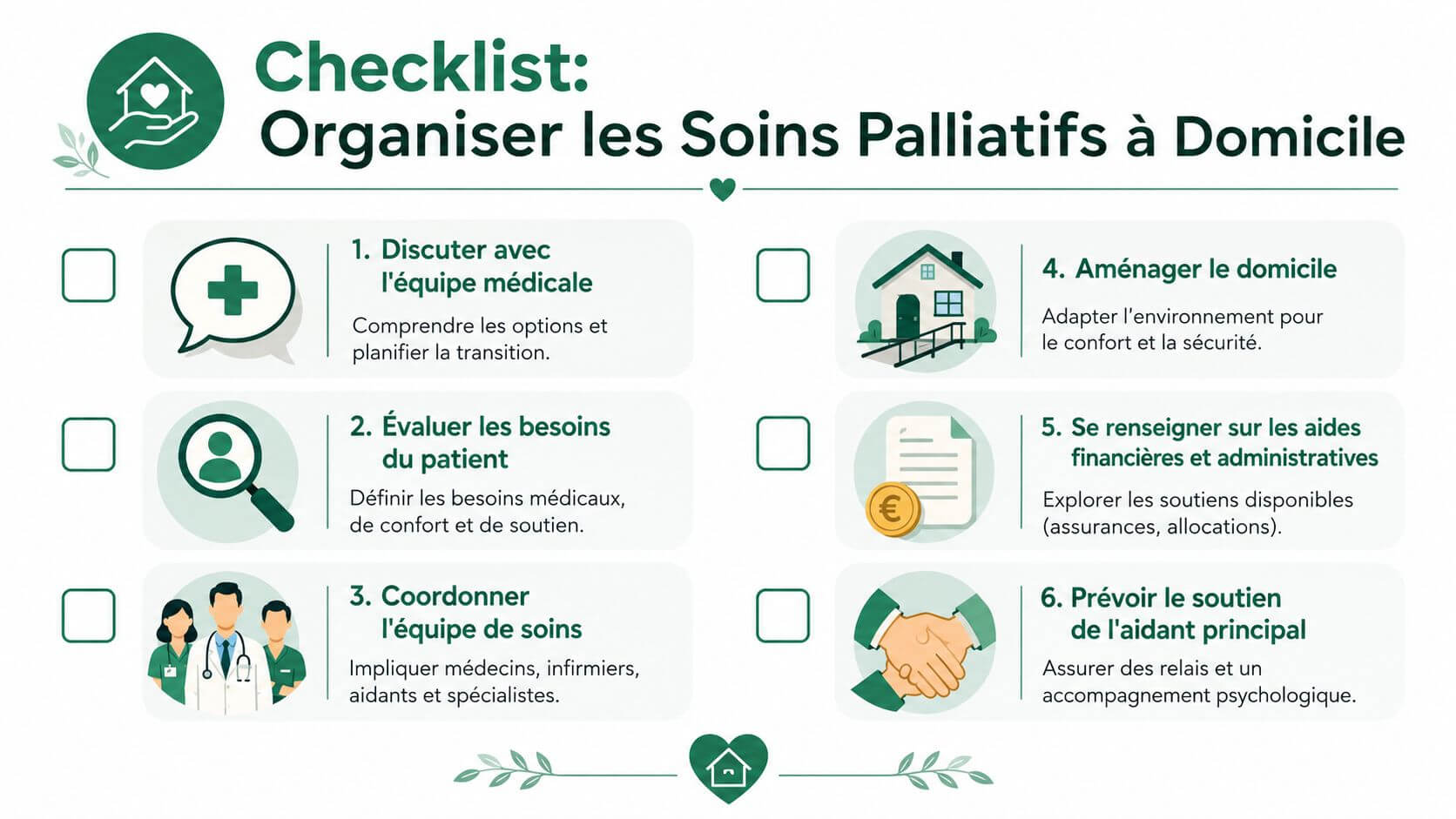
The road map to be kept in hand
Start with the most important. Clarify the care project with the patient and the medical team. As long as this framework is not set, everything else becomes blurred.
Then move in that order:
Talking to the treating physician
Check what can be done at home, the symptoms to be monitored and the prescriptions to be started quickly.Identifying daily stakeholders
Note the names, numbers and roles of the IDEL, pharmacist, physiotherapist and other useful professionals.Delivering equipment without delay
If mobility declines, anticipate the bed, mattress, chair or transfer aids before the emergency.Set up a single coordination medium
Choose a single place for transmissions, schedules, medication and tasks.Sort essential documents
Orders, reports, Vital card, contact details of professionals, treatment in progress, emergency instructions.Provide Family Relays
Divide the presences, even short ones. A well-organized hour of break can avoid a lot of exhaustion.Checking fees and aid
Make sure that the administrative care follows the reality of the home.Re-evaluate every week
What went on three days ago may no longer be enough today. The home must adapt to the patient, not the other way around.
A good organization does not eliminate the penalty. On the other hand, it reduces preventable contingencies, misunderstandings and the feeling of being alone in the face of everything.
If you are looking for a concrete tool to centralise the care journal, the follow-up of medicines, the shared calendar and the exchanges between close caregivers and professionals, Tribulys can help you organize home maintenance in a clearer and more serene way.
Put this organisation into practice with Tribulys
Keep your care journal, shared calendar, tasks, medication tracking and emergency information together. Start for free and invite the relatives and professionals involved in your loved one’s care.