
In France, a home nursing assistant is a health professional holding the State Diploma in Nursing Assistance who provides hygiene and comfort care within a prescribed and coordinated framework. This differs from a home care worker, whose main role is everyday and household assistance. In 2026, approximately 71 740 jobseekers search for this profession, 141 020 tenders submitted over 12 months.
At 7:30 a.m., a patient's daughter calls the caregiver because her father did not take her treatment. The home care worker claims to have left a message on the table, the nurse looks for the last tension in his SMS and the attending physician waits for specific information before changing the prescription. Each one did his share, but no one has the same version of the situation.
It is in these moments that the difference between the workers becomes concrete. A caregiver does not replace a nurse, and a home care worker does not carry out the same acts. The quality of home care therefore depends as much on the competence of each professional as on the way in which information circulates.
Contents
- Introduction to the Home Caregiver Job
- Day-to-day missions and required skills
- Differences with Auxiliary and Nurse
- Salary, costs and recruitment context
- How to recruit and evaluate a home care worker
- Daily organization and coordination tools
- Conclusion and next steps
Introduction to the Home Caregiver Job
The title of care giver corresponds to a State diploma. Home intervention is usually part of a prescribed care path, with work related to a nursing team and other professionals involved. official professional framework of the caregiving profession recalls that the caregiver can intervene at home, while a large part of the professionals work in institutions.
This distinction is important for the family. A health care worker is involved in hygiene, comfort, observation and accompaniment related to the state of health. She does not simply come to clean up or prepare a meal. She does not decide on a treatment alone and does not replace her nurse for acts falling under her responsibility.

A care path, not a simple comfort service
The confusion often comes from the word "help". A life helper can accompany a person for meals, shopping, home maintenance or certain gestures of daily life. A health care worker more closely observes the general condition, contributes to hygiene care and transmits useful elements to the care team.
Access to home care usually requires a prescription and an appropriate organization, often within a home nursing service. The family must therefore begin by talking to the treating physician, the relevant department or the professional who is already following the patient. Seeking an intervenor alone without clarifying the framework can create an impossible expectation, including on authorized acts and reimbursement.
The history of the sector shows why several structures coexist.ADMR presents the steps for structuring home care and assistancethe creation of its national union in 1946, the formal recognition of the home-help profession in 1988 and the development of SSIADs from 1980. The home is therefore not an improvised sector, but an environment in which several trades have to work together.
Practical rule: Before looking for a person, write down what is the responsibility of the care, what is the responsibility of daily help, and what should be passed on to the nurse or physician.
Day-to-day missions and required skills
A successful visit is not limited to a toilet done in time. The caregiver enters an environment that she does not always know, with family habits, sometimes poorly tidy equipment and a state of health likely to evolve from one passage to another.
It starts by checking the patient's condition and the available instructions. It then adapts its accompaniment, respects privacy, prevents risks and notes useful observations. The gesture counts, but the trace left after the gesture allows the team to understand what happened.
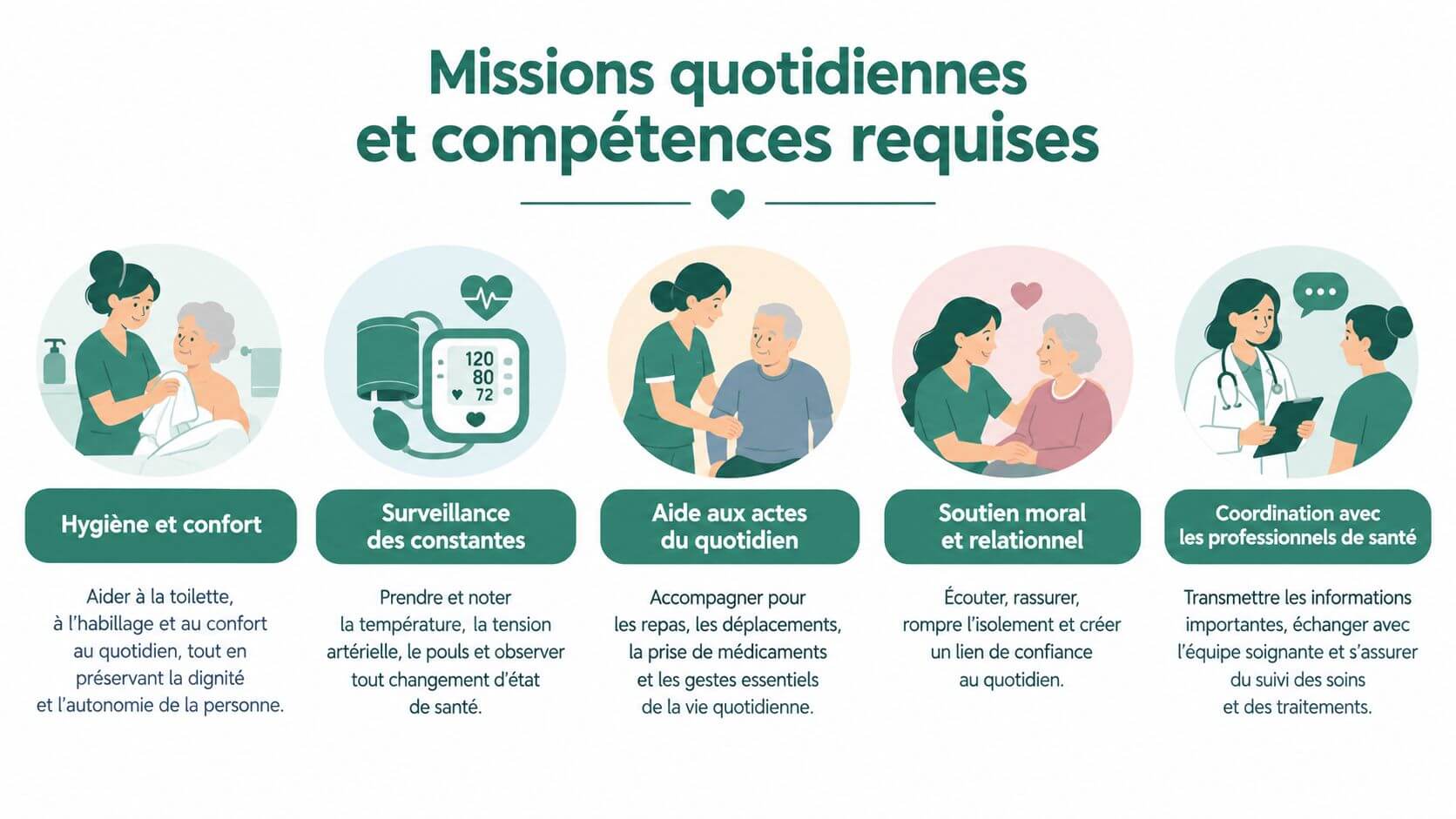
What happens during a visit
The missions are organized around several families of activities:
- Hygiene and comfort. Washing aid, installation, discomfort prevention and skin observation require gentleness and method. Redness, unusual pain or marked fatigue can justify rapid transmission.
- Monitoring. Depending on the framework and instructions of the team, the caregiver observes certain elements of the general condition and may report to the expected constants. It does not make a diagnosis alone, but it identifies and reports a change.
- Day-to-day coaching. The installation in the chair, the help with mobilization, the meal or the preparation of the environment promote the remaining autonomy. The aim is not to make it systematic in place of the person.
- Relationship. The home is an intimate place. The caregiver must gain confidence without becoming a family member, listen without promising what she does not control and remain professional in emotional situations.
- Transmission. Useful information sets out what has been observed, when, under what circumstances, and what has been done next. "Weary patient" helps little. "Unusual fatigue at rising, little meal consumed, nurse warned" allows for a decision.
The the training of caregivers and their opportunities It can help to understand the skills expected, but the degree is not enough to ensure good coordination. The professional must also know how to use the transmission tools of the structure, respect confidentiality and ask for help when a situation exceeds his/her role.
Skills that avoid break-ups
Work at home requires a quick reading of the situation. The accommodation can change, a relative can give an adversarial oral order and the patient can refuse a treatment. A good professional does not force the passage. It explains, secures, documents the refusal and alerts the referent according to the procedure.
Strictness becomes even more important when several people intervene. Documents must remain up-to-date, instructions must be understandable and changes must be dated. Paperbooks can work in a small disciplined team, but they become fragile when information multiplys or when the principal caregiver lives far away.
Differences with Auxiliary and Nurse
The best way to choose the right provider is by using the real need, not the title found in an advertisement. A family that asks for a carer for a household may pay for an inappropriate service. Conversely, a home care worker should not be placed in a situation where it is expected to be a carer.
| Profile | Nature of acts | Prescriptive framework | Typical coordination |
|---|---|---|---|
| Caregiver | Hygiene and comfort care, support and observation within the framework of its competences | Prescribed Care Pathway, with Nursing Responsibility and Coordination | Care Team, Nurse, Physician and Family |
| Aides of life | Support for meals, mobility, shopping, maintenance and daily activities | Support and support service, according to the plan defined with the person and his or her relatives | Family, home help service, coordinator |
| Nurse | Nursing and technical acts within its jurisdiction | Prescription when required, with clinical assessment | Physician, caregiver, pharmacy, other professionals |
The SSIAD and SAAD do not meet the same need
The SSIAD organizes home care with a care team. SAAD organises mainly assistance and support services. Some services combine several activities, but the family must always ask who is involved, for what mission and with whom in case of a problem.
The funding also follows this difference. The care is part of a health path and can be covered within the framework provided by the Sickness Insurance. The personal assistance benefits respond to other devices, such as the APA, the CESU or the aids specific to certain organizations. The patient's situation and the status of the service must be checked before concluding.
The question of home presence also deserves to be distinguished from a difference between a session in the centre and at home. In the home, the professional works within the real life framework of the patient, with his or her housing constraints, relatives and habits. This proximity provides useful information, but it requires more limitations and coordination.
The borders that must not be crossed
A caregiver should not take the place of the nurse alone. A home care worker should not administer treatment because a relative orally asks him to do so. The family, for its part, should not turn an observation into a medical order.
When the doubt arises, the correct answer is to suspend the interpretation, note the fact and contact the intended referent. This discipline avoids parallel decisions and protects the patient as well as the professionals.
Salary, costs and recruitment context
The salary and cost of an intervention do not refer to the same thing. The gross salary corresponds to the remuneration of the professional. The cost for a structure or family may include contributions, travel, coordination, leave and expenses related to the method of employment.
In France, 80% of home help offers have a monthly gross salary of between €1,802 and €2,500, according to compensation benchmark published by France Travail. This benchmark refers to a set of home help offers and does not constitute a wage promise for each caregiver involved in an individual's care.
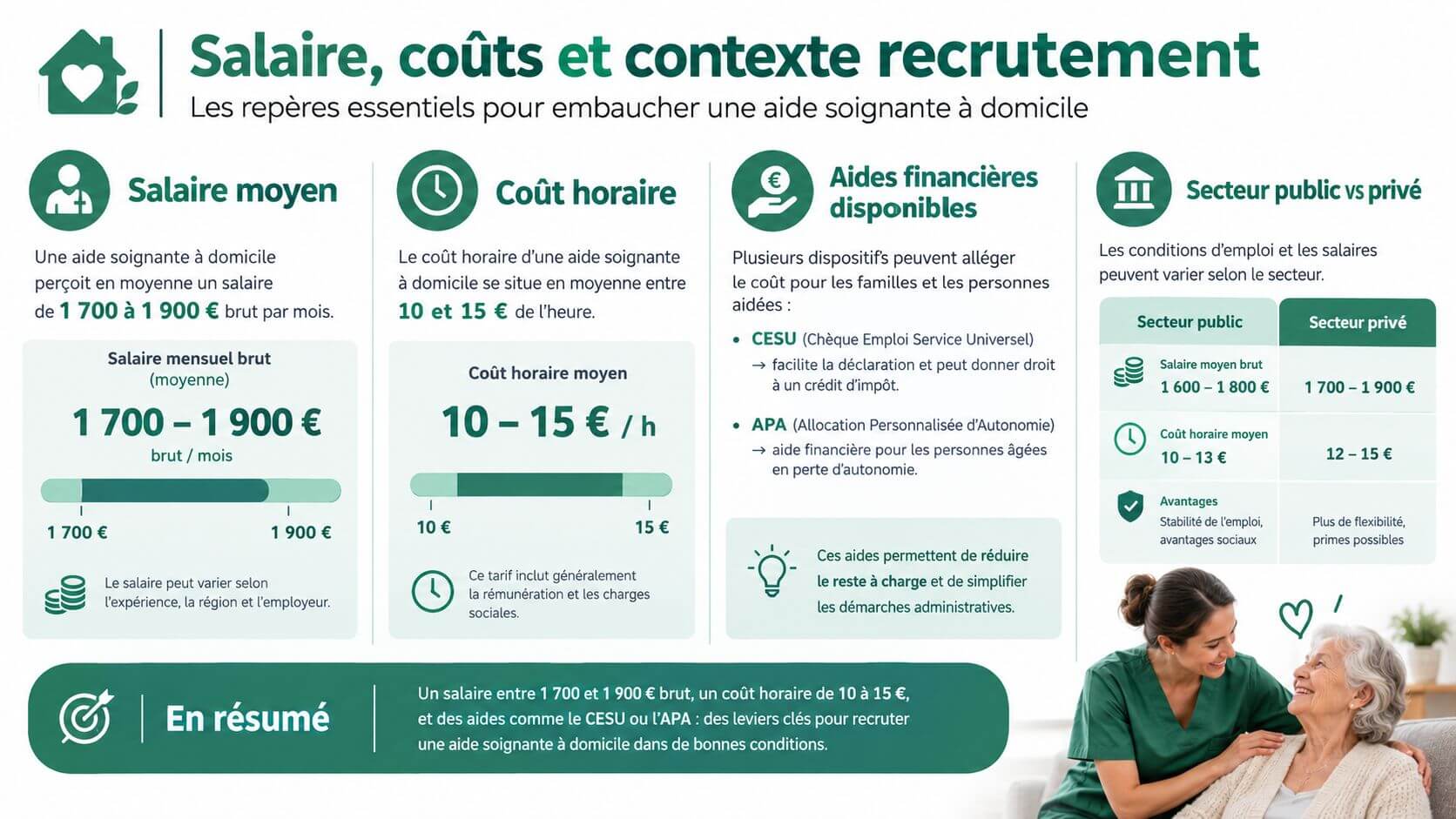
Three modes of intervention, three arbitrations
A care structure provides a framework, planning and organizational continuity. In return, the family depends on the available slots and the organization of the service. Direct employment can give more visibility to the person present, but it transfers administrative obligations and the management of absences to the employer.
The use of a home care worker for a non-medical mission can meet the daily need without mobilizing a care professional. It is often more consistent when the main difficulty concerns meals, shopping or maintenance. The bad arbitration consists in choosing the most medical title when the need has not been defined.
In order to properly frame a job, the contract, schedules, responsibilities, insurance and applicable rules must be verified. Statutory obligations HR explained can serve as a starting point for employing families and small structures.
A Tension That Fragiles Touring
France Travail announces 69 500 home helpers and life helpers to be filled in 2026 and also lists several thousand health-care workers in BMO 2026, as detailed in stress analysis in home help. Services must therefore arbitrate between visit coverage, travel times, available skills and patient continuity.
This tension does not justify hasty recruitment. Rather, it requires that the post be readable, that reliable transmissions be provided and that a solution be maintained in case of absence. A team that compensates for each departure with scattered messages will eventually lose critical information.
How to recruit and evaluate a home care worker
Recruitment must start with a need card, not with an impression during the first exchange. Note the desired hours, the nature of the care, the constraints of the accommodation, the available interlocutors and the situations that require an immediate call.
A six-check selection
Check the degree. Apply for the State Caregiver Diploma and confirm the proposed exercise framework. A home helper experience does not replace the degree required to practice as a caregiver.
Describe a real situation. Ask how the candidate would react to a denial of a toilet, a fall without apparent injury or an adversarial family order. The answer must show that she secures, observes, transmits and respects her limitations.
Test the transmission. Present a simple change, such as unusual fatigue and an unfinished meal. Ask what she would rate and who she would prevent. You will assess her ability to distinguish between fact, interpretation and action.
Ask for professional references. With the agreement of the candidate, contact a former employer or a service manager. Search for specific information on punctuality, maintenance of transmissions and response to unforeseen events.
Clarify the administrative framework. The contract, insurance, schedules, travel and persons authorized to receive the information must be defined before the first passage. For a structure, internal procedures must be accessible upon arrival.
Organize a period of observation. It should be used to check the adequacy of patient needs, professional skills and the quality of interaction with the team. Assess the facts, not just the feelings of the family.
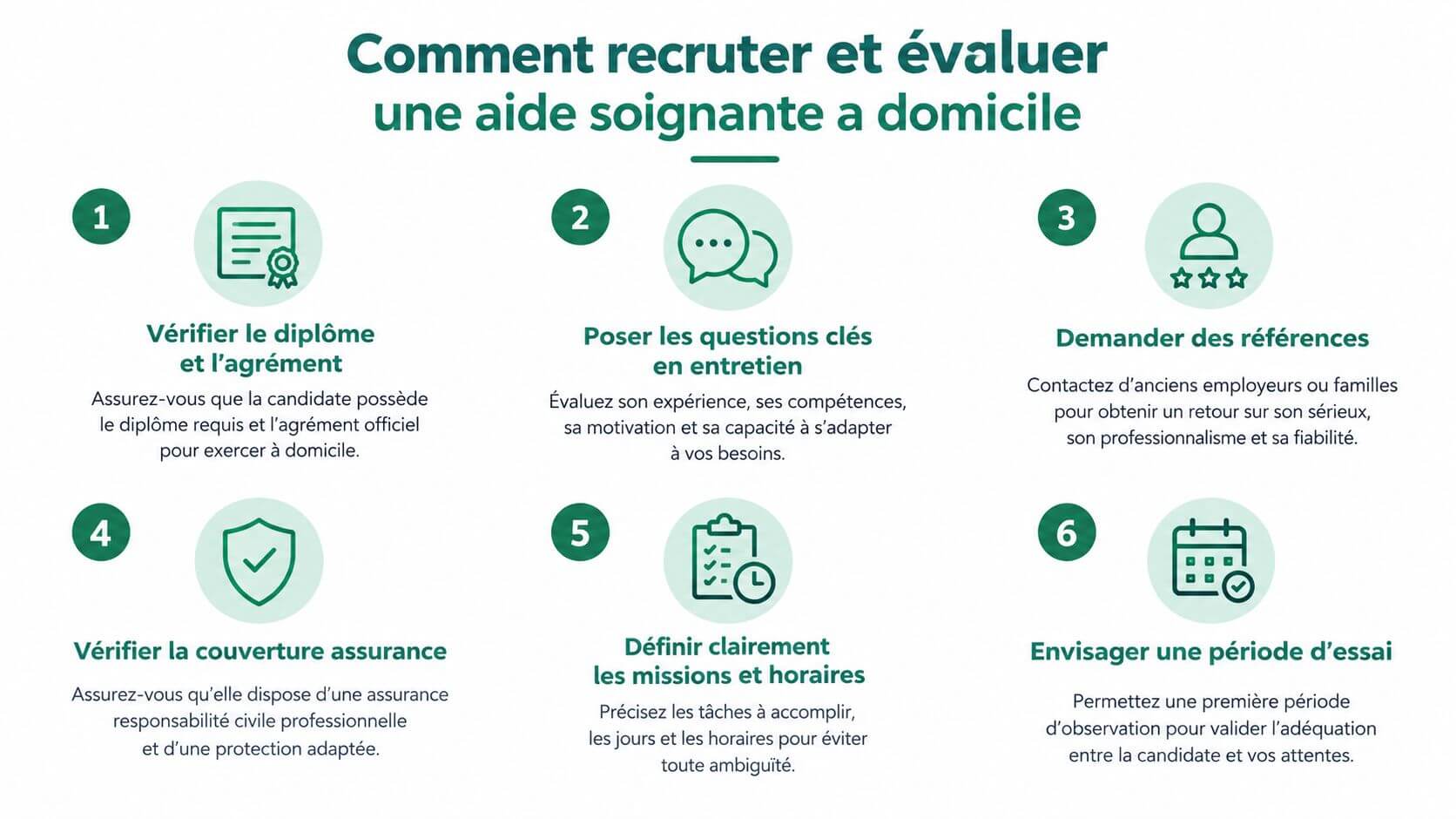
After hiring, take stock of the transmissions, delays, denials of care, observed changes and calls required. A professional may be competent but poorly integrated into a confused organization. Therefore, follow-up must assess the work done and the environment that allows or prevents it from being carried out properly.
Daily organization and coordination tools
The most common problem is not the lack of information, but its dispersion. A text message mentions an appointment, a notebook contains an observation, a family call reports a fall and a recent order remains in an envelope. The professional who arrives the next day must reconstitute the story before being able to act properly.
An organized week begins with a unique reference area. The schedule indicates the passages, appointments and responsible persons. The link book keeps the observations dated. Useful documents remain accessible with validated instructions, while alerts are reserved for situations that require action.
Example of organization over a week
On Mondays, the coordinator checks the intended passages and medical appointments. The caregiver notes the observed state of fatigue, the difficulties during mobilization and any changes reported by the patient. She does not copy an entire conversation, she transmits the facts that can change the management.
On Tuesday, the home care worker confirms the meal aid and reports that the refrigerator is almost empty. The family receives the information in the same space and distributes the race. On Wednesday, the nurse consults the last observations before her passage and adds her own transmission, without looking for several versions in a discussion group.
A coordination tool like Tribulys can bring together Timed care journal, Shared Calendar, Medication Tracking, Emergency Fact Sheet, Constants, Tasks and Documents in an area accessible to authorised members. The "My Visit" function structures the checklist and transmission, including when the connection is not available, while the authors and schedules allow to find the origin of information. The presentation of an application dedicated to healthcare workers allows us to examine this type of use.
What works, and what fails
SMS groups are fast, but they often mix emergency, family conversation and medical information. The paper book is useful at home, but it is not always suitable for remote caregivers or teams who need to consult history in several places.
A reliable organization applies four simple rules:
- A unique location. Validated instructions and important documents should not be distributed across multiple telephones.
- Factual transmission. Each note shall indicate the observation, timing and action carried out or requested.
- Visible responsibilities. A task must have a responsible person and a deadline, even when it seems obvious.
- A proportionate alert. An urgent situation triggers a call according to the procedure. Follow-up information remains in the notebook.
Technology does not replace clinical judgment or human relationship. Above all, it prevents the most available person from becoming, by default, the only memory of the home.
Conclusion and next steps
Home care is provided within a specific care setting. It does not replace the nurse or home care worker, and the family must identify the need before choosing the professional. The prescription, the diploma, the competent department and the rules of care must be checked from the start.
The quality of the coordination is then the key to home retention. A dated transmission is better than a forgotten message, a shared schedule is better than a succession of calls and a clearly assigned responsibility is better than a supposed instruction.
In the next few days, proceed as follows:
- Ask for an assessment of the need the attending physician or the department concerned.
- Separate Care and Daily Help Missions in a concrete list.
- Check the degree, the framework and the references professional.
- Prepare documents, contacts and emergency instructions before the first passage.
- Centralize visits, treatments, observations and tasks in a space accessible to authorised persons.
- Make a point after the first visits to correct forgotten and blurred areas of responsibility.
To structure the follow-up of a loved one, Tribulys brings together transmissions, planning, drugs, documents and responsibilities in a space shared between caregivers and professionals. Discover Tribulys and put in place clear coordination before the scattered information causes a new oversight.
Put this organisation into practice with Tribulys
Keep your care journal, shared calendar, tasks, medication tracking and emergency information together. Start for free and invite the relatives and professionals involved in your loved one’s care.