
The most popular advice about stem cell treatment is to compare success rates and find the clinic with the most advanced cells. That advice breaks at the first step, because it lumps together two services that share a name and nothing else.
A transplant program rebuilds a patient's blood and immune system after high-dose chemotherapy or radiation, using cells that are licensed, tested, and given inside a protocol a regulator has reviewed. A private clinic injecting stem cells for arthritis, back pain, or fatigue is selling a different product under the same word. The FDA consumer alert on regenerative medicine products draws the line plainly: as of its current guidance, the only stem-cell products approved for use in the United States are blood-forming hematopoietic progenitor cells derived from umbilical cord blood, and that approval covers disorders affecting the hematopoietic system, not arthritis, neurological disease, chronic pain, autism, or cosmetic treatments.
So this list stays narrow. It covers established, accredited transplant programs, where the donor process, the evidence, and the follow-up are defined, plus one licensed regenerative medicine center working under a different national framework. Each entry ends with what to verify with the program directly: where you'd be treated, which donor options exist, how long follow-up runs, and what the caregiver takes on.
Table of Contents
- 1. Longevity Medical Institute
- 2. Mayo Clinic Bone Marrow Transplant Program
- 3. UT MD Anderson Stem Cell Transplantation and Cellular Therapy Center
- 4. Stanford Health Care Blood and Bone Marrow Transplantation & Cell Therapy
- 5. Fred Hutch Cancer Center Blood and Marrow Transplant Program
- 6. Dana-Farber Cancer Institute Adult Stem Cell Transplant Program
- 7. Memorial Sloan Kettering Cancer Center (MSK) Stem Cell Transplant Program
- 8. City of Hope Stem Cell Transplant Program
- How the Seven Transplant Programs Compare at a Glance
- Turning This Shortlist Into a Confident Decision
- About Tribulys
1. Longevity Medical Institute
Longevity Medical Institute is the exception on this list. It's a physician-led regenerative medicine center in San José del Cabo, Mexico, and it answers a question the transplant programs don't: what you do when the problem is a joint, a recovery curve, or a set of biomarkers rather than a blood cancer.
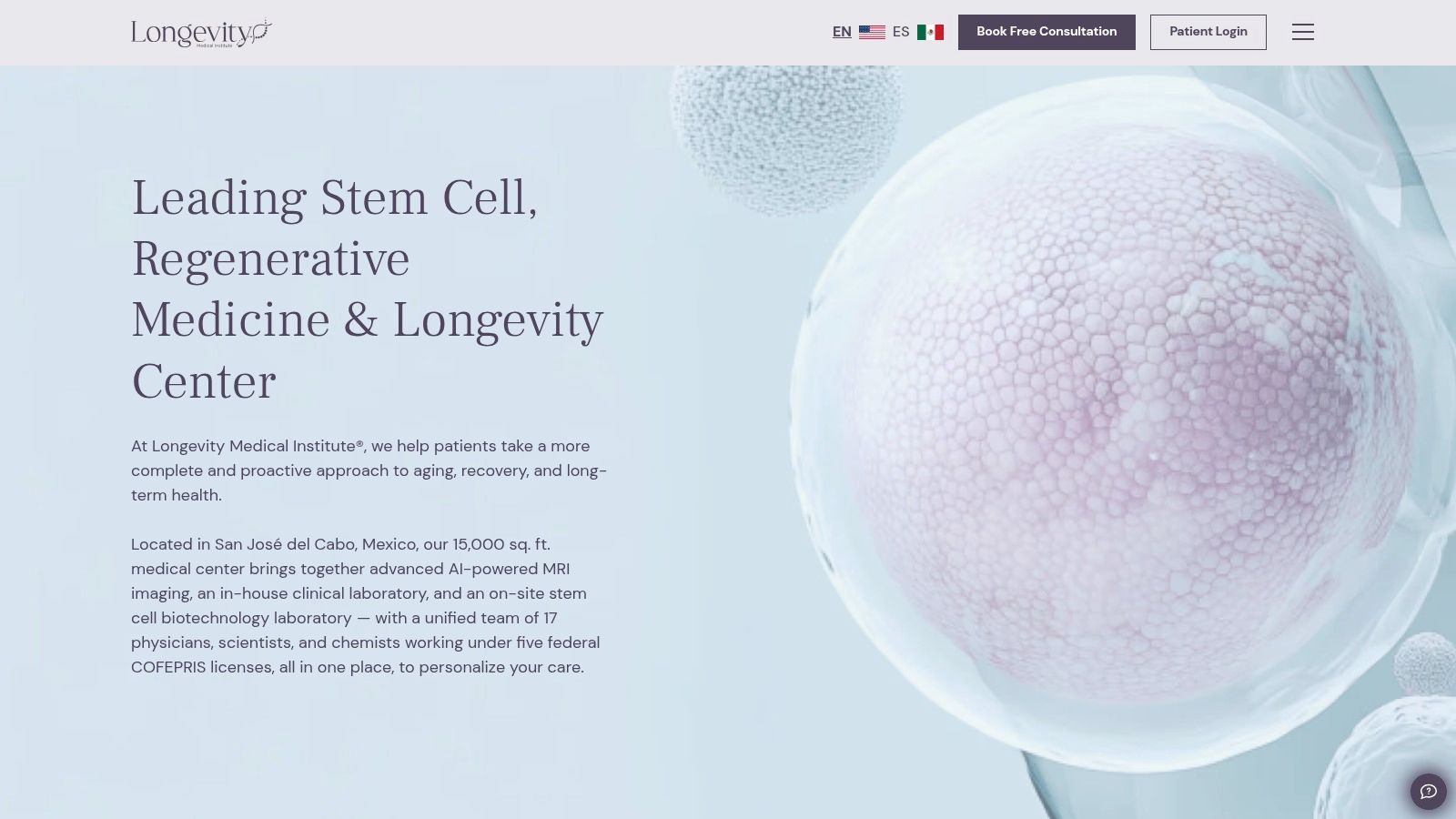
Stem cell and exosome therapies sit alongside NK cell and peptide protocols, IV and nutraceutical infusions, and hyperbaric oxygen therapy, with targeted joint injections, regenerative dentistry, physical medicine, and sports medicine. The diagnostics are the differentiator. An in-house clinical laboratory, AI-enhanced full-body MRI, cardiac assessments, and ultrasound-guided procedures put the imaging, the lab that prepared the material, and the person doing the injection in the same building.
On its stem cell therapy page, the clinic describes a COFEPRIS-licensed, ISO-certified biotechnology lab and an on-site surgical center, plus dermatology, hair restoration, body sculpting, and sexual wellness services for programs that include aesthetics. Concierge accommodation and private travel options are arranged around the treatment dates.
Where it earns a place on a shortlist
Cross-border care usually fragments. Imaging happens at one facility, the procedure at another, and follow-up arrives by email from someone who never saw the scan. Here one team of physicians, scientists, and clinicians covers prevention, recovery, and performance work under one roof. If you'd rather spend one block of time abroad than three separate trips, that consolidation is the practical argument.
What to confirm before you book
Mexico's COFEPRIS framework isn't FDA approval, and a licensed laboratory is a manufacturing credential rather than proof that a given injection helps a given diagnosis. Three layers tell you whether a private clinic can deliver what it sells: regulatory compliance at the product level, practitioner qualifications, and the organization's clinical infrastructure. Ask for four things in writing.
- Cell source and release criteria. Where the cells come from, how they're screened, and what the release testing covers.
- Route and dose. Intravenous, intra-articular, or both, with the cell count per dose written down.
- Outcome data with a denominator. How many patients with your indication were treated, and how many improved on a defined measure.
- Follow-up and adverse events. Who you contact at week six, and how complications are recorded and reported.
Ask this first. Name the product, the authorization that covers it, and the indication that authorization names. A vague answer is an answer.
A setup like this suits a patient who wants one team, the diagnostics and the procedure in the same building, and who is ready to treat the consultation as a medical evaluation rather than a booking. If a program can't answer the four questions above, the building and the concierge don't matter.
2. Mayo Clinic Bone Marrow Transplant Program
Mayo is the reference point on this list, and the reason is regulatory as much as clinical. The FDA's patient information on regenerative medicine therapies notes that a product coming from your own body, or from another person, doesn't by itself make it approved or legally suitable for your disease. Mayo works inside the pathway where product, indication, and oversight line up: adult and pediatric transplants at campuses in Arizona, Florida, and Minnesota, for cancerous and noncancerous blood and marrow diseases.
Donor approaches run across autologous, donor, and cord-blood transplants. Multidisciplinary teams and trial networks help when a patient arrives with several active problems, and some eligible patients get outpatient transplant care instead of a long inpatient stay. That outpatient option is worth pressing on, because it shifts daily monitoring to you and your caregiver rather than a ward.
What to verify with the program
- Which campus. Arizona, Florida, and Minnesota run different teams and different lodging situations.
- Donor route. Ask what's available for your diagnosis before you assume a family member can donate.
- Outpatient eligibility. It isn't open to everyone, and it still means daily monitoring and a caregiver nearby.
- The caregiver plan. Travel and a local stay are usually required. Line up coordination of care at home before admission, with named people for transport, prescription pickup, and appointment escorting.
- Cost and insurance. Coverage varies by patient and treatment, and no program page will tell you your number.
A shared calendar and a timestamped care journal carry part of that load. That's what we built Tribulys for, and it's the piece families underestimate most.
3. UT MD Anderson Stem Cell Transplantation and Cellular Therapy Center
A matched sibling donor falling through changes the question fast. In Houston, MD Anderson is worth a look when the search has to widen beyond family.
The center runs transplant and cellular therapy for adults and children, with matched unrelated donor, haploidentical donor and cord-blood approaches, so there is often a next route when a fully matched relative is unavailable. Cell collection and processing happen on site, which can matter when timing, chain-of-custody questions and treatment scheduling sit on the same calendar.
The parts that matter after the infusion
Do not judge this program only on the day cells go in. Ask how graft-versus-host disease follow-up is organized after an allogeneic transplant: who sees the patient, how often, and which changes trigger urgent review. GVHD shapes the first year for many allogeneic patients, and the practical difference is between a rash handled with topical care and one that needs systemic therapy.
Ask the same way about survivorship. Vaccines, return to work and late-effect screening need an owner, a schedule and a route back to the center if something looks wrong. Clinical trials may be open to eligible patients when standard options run short.
What to verify before you commit
- Travel and local support. Treatment happens in Houston, and you will need housing plus a caregiver nearby for several weeks.
- Eligibility and insurance. Public descriptions say nothing about whether transplant is right for you; only an evaluation does.
- Whether a trial fits. Ask which open studies match your diagnosis and stage, and what the consent document requires of you.
- Who owns follow-up. Confirm what gets sent to your local hematologist, in what format, and when.
- The backup donor plan. If the first route falls apart, ask what changes, how fast the team can pivot and who explains the new timeline.
For an uncommon diagnosis or a failed first-line approach, the breadth of donor routes is the argument. For a straightforward case far from Texas, the trip may be the price.
4. Stanford Health Care Blood and Bone Marrow Transplantation & Cell Therapy
If you live in Northern California, the first question isn't which program is best in the abstract. It's which one you can reach for weekly follow-up without wrecking your family's schedule. Stanford Health Care holds FACT accreditation for its blood and marrow transplant and cell therapy work, and it takes part in the National Cancer Institute's Blood and Marrow Transplant Clinical Trials Network.
That membership earns its own sentence. A program inside a national transplant trials network runs and joins studies on transplant methods, so when standard approaches run out there may be a protocol to discuss. It doesn't mean a trial is right for you, and eligibility rules are strict.
What a combined service gives you
The unit evaluates blood and marrow transplant alongside cellular therapies, which matters when the question is which pathway fits rather than whether one exists. A patient weighing two directions gets both assessed by the same team, and that removes a round of referral ping-pong.
The questions worth asking on the first call
Start with your own case. Ask how many patients with your specific disease and stage the team treated last year, and what their complications looked like. Program-wide totals won't answer that; disease-specific experience will.
Travel planning comes next. Patients outside the Bay Area need somewhere to stay and someone with them through the intensive phase, so ask what Stanford handles, what your local oncologist handles, and how records move between the two. Then ask for costs by transplant type, since autologous and allogeneic differ sharply, and request the billing codes your insurer needs before you commit to anything.
5. Fred Hutch Cancer Center Blood and Marrow Transplant Program
Fred Hutch states a requirement most roundups skip. Transplant patients need a caregiver, and many need to stay near the Seattle center through recovery. Read that before you read anything about outcomes, because it reshapes the whole plan.
The program offers autologous and donor transplants, including haploidentical approaches, and keeps patients in long-term follow-up after the acute phase. The team is built for the practical side of that: physicians, nurses, pharmacists, dietitians, coordinators, and social workers. Cord-blood transplant research and services run alongside the clinical work.
A caregiver isn't a formality in transplant planning. Programs build eligibility, discharge, and lodging decisions around having one.
Planning the Seattle stay
Temporary medical lodging exists in the city, subject to availability and cost, and it isn't something to leave until the week before admission.
- Length of stay. Ask for a realistic window, then add a buffer for complications.
- Caregiver duties. Driving, medication management, food safety, and knowing when to call the clinic at night.
- Work and money. A caregiver who takes leave needs that arranged with an employer early.
- The handover home. Who monitors the patient once they're back, and which records travel with them.
Where the limits sit
The center isn't a local option for most U.S. residents. Travel, lodging, and a months-long caregiver commitment can cost more than families budget for, and no procedure volume answers whether transplant is the right treatment for a given disease.
6. Dana-Farber Cancer Institute Adult Stem Cell Transplant Program
Dana-Farber's adult program in Boston treats blood cancers, marrow-failure syndromes, and some inherited or congenital blood disorders. That third category is worth noticing, because many programs focus on malignancy alone.
Approaches cover autologous and allogeneic transplant, with related, unrelated, haploidentical, and cord-blood donor options. The program reports FACT accreditation and provides outpatient transplant care for selected patients. A separate pediatric program runs with Boston Children's, which helps families who need adult and child services in one city.
The record problem nobody plans for
Transplant patients accumulate paper. Donor workups, chimerism results, drug levels, discharge summaries. When care splits between Boston and a hematologist three hours away, that file is the handover. Ask how records move, in what format, and how fast. Keeping a shared medical file the local team can read saves repeated calls and lost results, and in our Family plan the medical file and handovers export to PDF for exactly this kind of transfer.
What to ask about a remote second opinion
The center's international patient services include remote second opinions, according to the center. If you use one, do it properly.
- Send the right records. Pathology report, imaging discs, cytogenetics, and the current medication list.
- Ask a specific question. Whether to have a transplant, and when, gets a better answer than a general request for options.
- Confirm what the opinion covers. A written summary you can hand to your local team beats a phone call.
- Check eligibility and cost. Outpatient transplant isn't suitable for every patient and still requires intensive monitoring.
7. Memorial Sloan Kettering Cancer Center (MSK) Stem Cell Transplant Program
MSK reports more than 10,000 transplants since its program began, and that volume shows in how the service is organized. Transplants are primarily for blood cancers and selected blood or genetic conditions, with autologous and donor approaches, delivered inpatient or outpatient depending on the case.
The support team reaches beyond transplant physicians. Rehabilitation and psychosocial specialists are part of the plan, which matters for a treatment that can bring weeks of isolation, muscle loss, and a shaken sense of self.
Research aimed at complications
MSK describes research intended to reduce complications and widen access to transplant. For a patient whose other conditions make a standard transplant risky, that's a concrete question: is there a modified regimen or a study that fits my situation.
The New York calculation
Manhattan lodging near the hospital for a month or more is a budget line of its own. Ask which visits must happen at MSK and which can happen closer to home, what rehabilitation and psychosocial support include, and what they cost. A weakened immune system for months changes daily life, from crowded trains to salad bars, and that's a planning item rather than a footnote.
This suits a patient in the New York region who wants a specialist evaluation at a high-volume center and has a caregiver able to be present through the outpatient or inpatient phase. It is not an appropriate treatment for everyone, and travel, housing, and side effects are real considerations.
8. City of Hope Stem Cell Transplant Program
A transplant program spread across three metro areas changes the math for patients who cannot relocate for months. City of Hope runs programs in Southern California, Phoenix, and the Chicago area, treating blood cancers and certain blood disorders with autologous and donor transplants.
The center describes support coordinating evaluation, donor searches, treatment, and follow-up, plus help with travel and lodging at some locations. Clinical trials may be available to eligible patients. Ask which apply to your diagnosis before assuming a slot exists.
Confirm which campus does what
Network care has one classic failure mode: you assume the campus near you handles the part you need. Services vary by location, so ask which center performs the evaluation, which one does the collection and transplant, and which one owns follow-up. Get that answer in writing before you plan anything.
Lodging help exists at some locations, not all. Confirm whether the campus treating you is one of them, and how many weeks of help it covers.
The screening test to apply anywhere
Before paying for any add-on offered outside the transplant plan, ask whether its evidence has been published in peer-reviewed journals, whether an independent ethics committee has weighed its risks against possible benefits, and whether the provider can point to studies that match your indication.
- Trial registration or authorization. Ask for the number, not a brochure.
- The consent document. Read what it says about alternatives and complications.
- Total cost. Including donor search, lodging, and complication management.
- Post-treatment contact. Who answers at two in the morning in week three, and how.
Two programs that both say they can treat you are not the same offer. Compare the written answers, not the warmth of the call.
How the Seven Transplant Programs Compare at a Glance
One entry below reports no hematopoietic transplant options at all. Longevity Medical Institute is a private clinic offering stem cell and exosome therapies, and it sits in this table so the difference between a clinic selling injections and an established transplant program stays visible. The remaining seven rows are the programs worth a call.
| Item | Main Location | Transplant Options Reported | Accreditation or Program Scope |
|---|---|---|---|
| Longevity Medical Institute | San José del Cabo, Mexico | Stem cell and exosome therapies; no hematopoietic transplant options specified | COFEPRIS-licensed, ISO-certified biotechnology lab |
| Mayo Clinic Bone Marrow Transplant Program | Arizona, Florida, and Minnesota, United States | Autologous, donor, and cord-blood transplants | FACT-certified and NMDP-accredited |
| UT MD Anderson Stem Cell Transplantation and Cellular Therapy Center | Houston, Texas, United States | Matched and partially matched donor, and cord-blood transplants | Dedicated stem cell transplantation and cellular therapy center |
| Stanford Health Care Blood and Bone Marrow Transplantation & Cell Therapy | San Francisco Bay Area, California, United States | Blood and bone marrow transplants and cellular therapies | FACT-accredited |
| Fred Hutch Cancer Center Blood and Marrow Transplant Program | Seattle, Washington, United States | Autologous, allogeneic, and haploidentical transplants | Blood and marrow transplant program within a dedicated cancer center |
| Dana-Farber Cancer Institute Adult Stem Cell Transplant Program | Boston, Massachusetts, United States | Autologous and allogeneic; related, unrelated, haploidentical, and cord-blood options | FACT-accredited |
| Memorial Sloan Kettering Cancer Center (MSK) Stem Cell Transplant Program | New York City, New York, United States | Autologous and donor transplants | Stem cell transplant program within a dedicated cancer center |
| City of Hope Stem Cell Transplant Program | Southern California, Phoenix, and Chicago area, United States | Autologous and donor transplants | Transplant program operating across several U.S. locations |
Read the donor-options column as a starting filter. A program that lists cord blood or haploidentical donors still decides eligibility case by case, and accreditation status can change between the day you read this table and the day you call.
Turning This Shortlist Into a Confident Decision
The list above is short on purpose. The market around it isn't. A 2021 estimate cited in a 2026 medical-policy article on U.S. stem-cell clinics counted approximately 2,750 U.S. stem-cell clinics offering unapproved adult stem-cell injections. That number is why decisions made on reviews, price, or a friend's recommendation go wrong so often.
Start with three things in writing: the diagnosis exactly as it appears in the pathology or clinic letter, the questions your current team has already answered, and the ones still open. Then ask every program the same questions, in the same order, so the answers can be compared side by side.
The five answers worth collecting before you call
- Location and length of stay. Which campus, how many weeks near the center, and when the patient can realistically go home.
- Donor options. Autologous, matched unrelated, haploidentical, cord blood, and the fallback if the first choice fails.
- Money in full. What the quote includes, what it excludes (lodging, donor search, complications), and which insurers are accepted.
- Caregiver requirements. Whether one is mandatory, what they must do, and whether the center helps with lodging.
- Follow-up and handover. Who monitors the patient at day 100 and at one year, and what gets sent to the local doctor.
Keeping the answers usable
Three programs, five answers each, plus appointment dates and a medication list, becomes a second job. Put it somewhere the whole care circle can read. A shared record with dates and named authors beats a folder of screenshots in a group chat, because anyone can see who wrote what and when. The cousin driving to appointments needs the same information as the person on the phone with the insurer.
Before you commit. Get the authorization, the consent document, the total cost, and the complication plan in writing, and store them where your family can find them at midnight.
None of this removes the hard parts of transplant: the waiting, the isolation, the weeks when the patient feels worse before feeling better. What it removes is the confusion about who is doing what, and when.
If you're the one holding the logistics, Tribulys keeps the care journal, medication record, appointments, and documents in one private space, with health data hosted in France on HDS-certified infrastructure. The Essentiel plan covers health measurements such as blood pressure, weight, and temperature. The Famille plan adds a weekly coordination summary, PDF export of the medical file and handovers, and offline recording in Ma visite for home visits. The Famille subscription funds the service, with no advertising. Set up the tribe before the first consultation and invite the people who will be doing the driving.
About Tribulys
Tribulys is a coordination tool for the circle around one person living at home: families, nurses, doctors and home care workers. It makes no medical promises. The value is practical: timestamped journal entries with the author's name, medication records and missed-dose alerts, appointments in one calendar, documents, assigned tasks and a structured emergency sheet.
Each group is a tribu, so a spouse, adult children, a sibling abroad and paid professionals can read the same record. Health measurements such as blood pressure, weight and temperature are dated for history and appointment preparation, without diagnosis. My Visit adds guided checklists and structured handovers for home visits.
Health data is hosted in France on HDS-certified infrastructure, and Tribulys states GDPR compliance. The Essentiel plan covers tracking for blood pressure, weight and temperature. Famille adds a weekly coordination summary, PDF export of the medical file and handovers, and offline recording for My Visit; that subscription funds the service without advertising. It runs on web, iOS and Android.