
One morning, the nurse arrives at your loved one's home and asks if the evening treatment has been taken. You hesitate. The cell phone is open, a text message indicates that your sister has passed, but no one knows exactly what was given. At the same time, the attending doctor is waiting for the last check-up, stored in a family mail box to which he does not have access.
This type of situation shows why the shared medical record It is not just a matter of paperwork. It can give access to important medical documents, but it does not necessarily answer all the questions of the daily: who has passed, what instructions have been given, what take has been confirmed or what task remains to be done.
Contents
- The shared medical record in practice for caregivers
- Understanding the ecosystem of the digital health record in France
- DMP versus coordination tool, what essential difference
- Security, confidentiality and hosting of health data
- Access the file and put in place effective coordination
- Why DMP is not always enough to keep at home
- Putting in place a hybrid strategy to secure monitoring
The shared medical record in practice for caregivers
In a family, the information often circulates in small pieces. A relative calls after a consultation, a home care worker leaves a note on the table, a nurse transmits an observation by telephone and a report remains in the file downloaded by another member of the family. As long as the state of health remains stable, this organization seems to be bearable. On the day when a symptom appears, it becomes a source of uncertainty.
The Shared medical record, or DMP, provides a reference point for health documents. A hospital report, a prescription or a liaison letter can be placed there and consulted by authorized persons. For the caregiver, the interest is concrete: to find reference medical information without having to search in several conversations or remind each practitioner.
The document does not replace the action
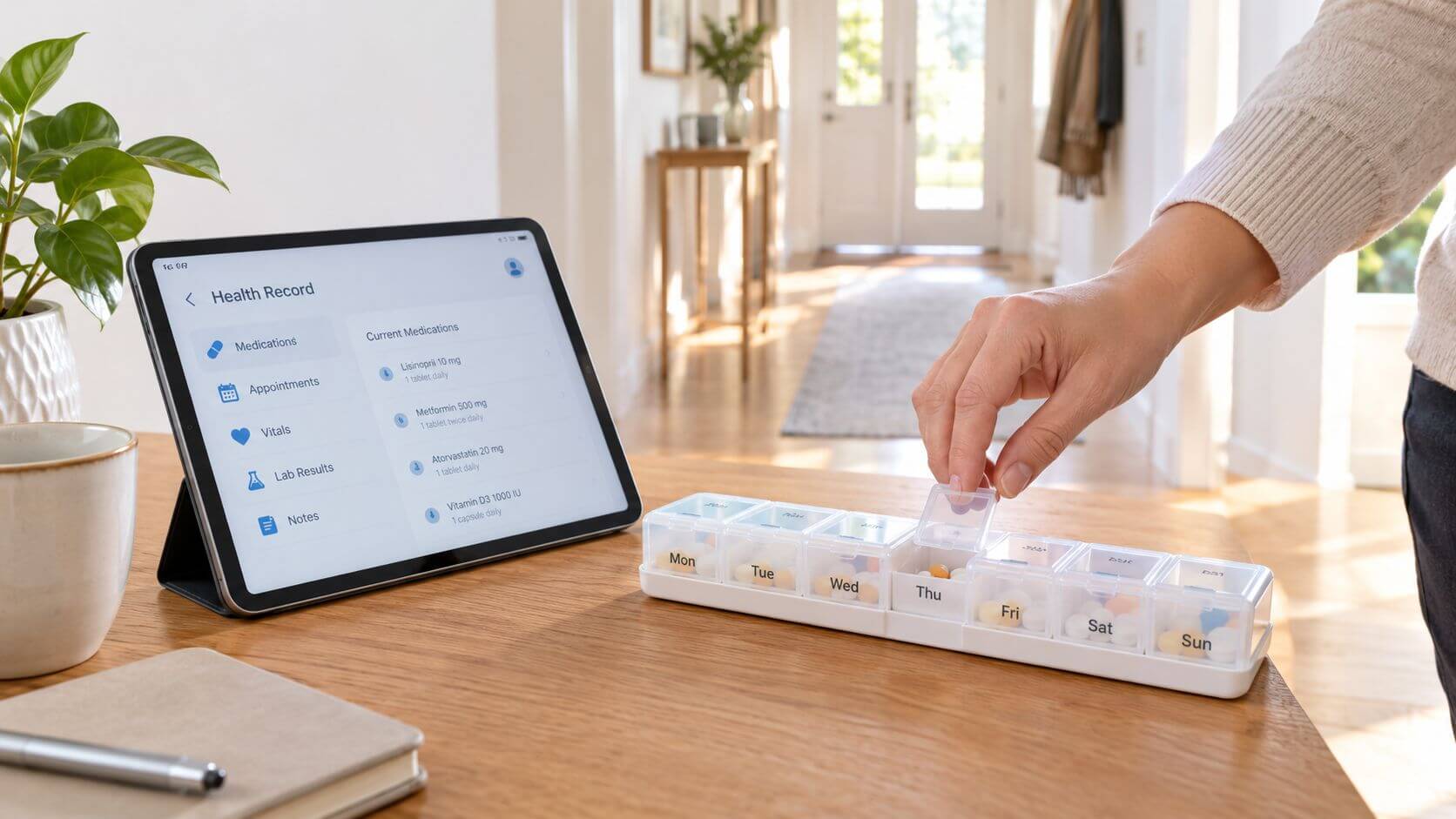
Let's take a simple example. The DMP may contain an updated prescription. It does not necessarily say whether the morning dose was given, whether your loved one refused treatment or if the scheduled practitioner did not come. Medical information and operational coordination is essential to avoid asking the wrong tool what it was not designed to do.
The DMP can therefore be used as a reference when a professional is looking for a document, when a caregiver accompanies his or her loved one to the emergency room, or when a team needs to know the medical elements available. It is not, on its own, a dashboard of passages, tasks, alerts and family responsibilities.
Practical benchmark: Use the DMP to find the medical documents that refer. To find out what happened at home today, provide a complementary coordination space.
This distinction also protects the caregiver against a false security impression. A well-filled file can improve the flow of documents, but continuity at home also depends on accurate, dated and assigned transmissions to a person.
Understanding the ecosystem of the digital health record in France
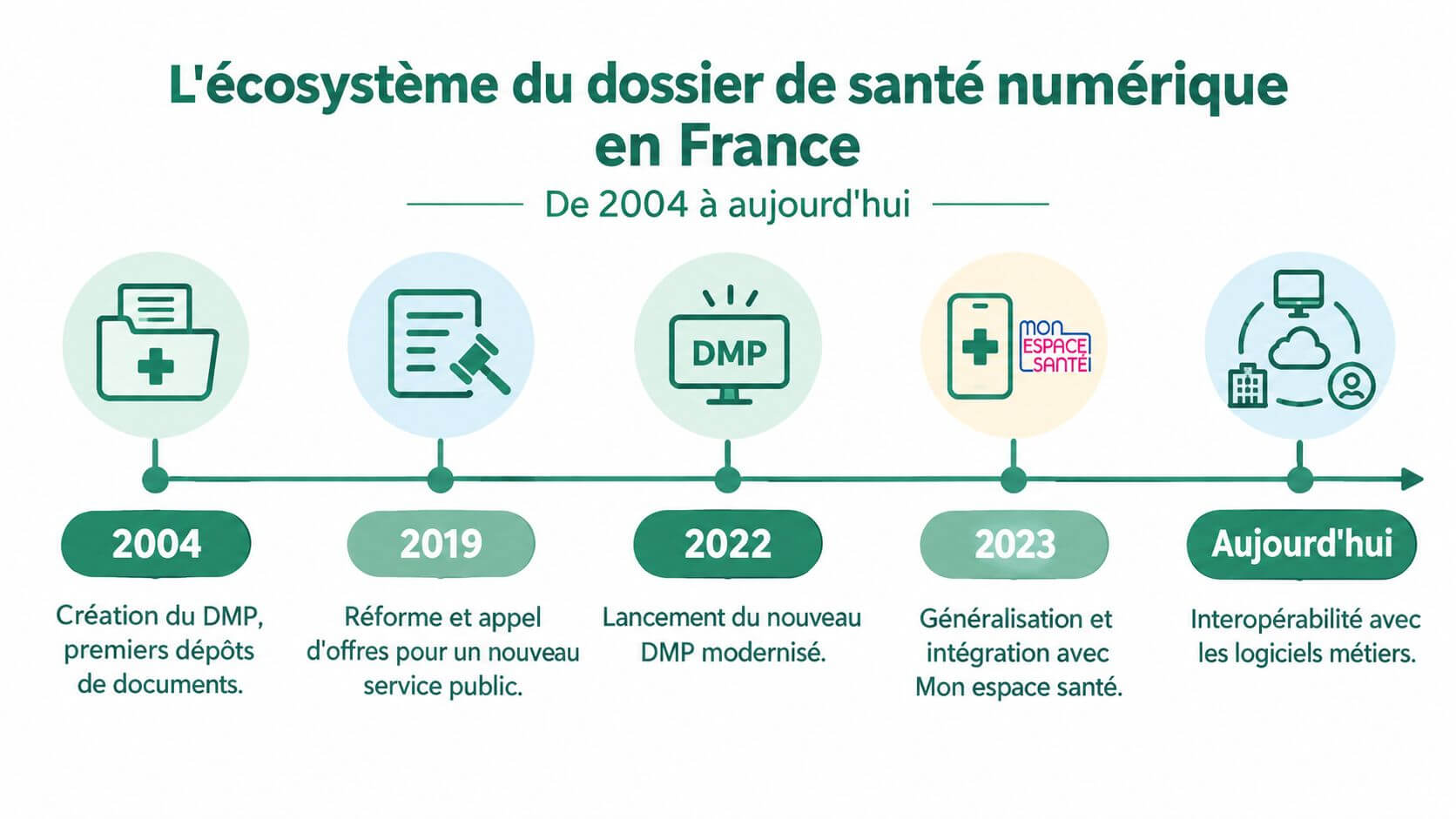
The DMP did not appear to be an isolated application. It is part of the progressive construction of the French digital health record. The device was created legally under the name Personal medical records in 2004, then renamed shared medical record on the entry into force of the law of 1 January 2017It has been extended to cover all social security insured persons. 2018, according to the chronology presented by Public Life on the Evolution of the DMP to My Health Space.
Experiments carried out in nine departments had already reached about 10,000 files created per week in April 2017, a higher rate of 40 % in 2012, according to the same source. The load climb continued with 5 million people who opened a DMP in mid-April 2019then 9.3 million files created in June 2020By mid-2021, CNAM had recorded close to 10 million open DMP, representing more 10% of the adult population.
From autonomous DMP to My Health Space
Since 1 July 2021, it is no longer possible to create a new isolated DMP. The existing folders remain searchable and feedable. 2022, the DMP has been integrated into My health area, which now constitutes its access environment for French insured persons.
For a caregiver, this evolution changes the way in which the service is sought. It is not necessarily necessary to look for an old independent application. Access is done in the My Health Area ecosystem, with the devices provided for the insured and, where possible, the delegations granted to a relative.
A national infrastructure, not a family group
The aim of the DMP is to support the continuity and coordination of care pathways through the sharing of medical documents. Institutional data show a change in scale: more than 221 million documents were automatically fed into the DMP in 2023, close to 300 million additional documents have been deposited in My Health Space in 2024, then more than 420 million in 2025, depending on Institutional presentation of the service.
This automated power supply is based in particular on professional software referenced in the framework of the Ségur du numérique en santé. national repository of documents than a conversation between caregivers. This architecture is useful for finding medical parts, but it does not automatically create a daily organization around the nearest.
DMP versus coordination tool, what essential difference
The confusion often comes from the word "share". Sharing a medical document and coordinating a day of care are two different operations.
| Concrete need | DMP integrated into My Health Space | Dedicated coordination tool |
|---|---|---|
| Find a Liaison Letter | Suitable for sharing medical documents | Possible in a complementary documentary space |
| Confirm treatment | It's not his central function. | Follow-up, reminder, confirmation and history by tool |
| Know who accompanies to an appointment | Not designed as a family agenda of tasks | shared calendar and division of responsibilities |
| Forwarding a home observation | Can accommodate a document, depending on the framework used | Link diary, comment, author and time stamping |
| Report an oversight or absence | Not a daily control device | Alerts and notifications planned for the organisation |
The DMP serves mainly as the medical documentary base. It gathers information produced by professionals and institutions within a defined access framework. The coordination tool is used to turn information into action: a person receives a task, confirms a passage, adds an observation or reports a change.
A scenario to choose the right space
Suppose your father gets out of the hospital with a modified prescription. The record and order have their place in the DMP. Your sister can then check that the document is available to the attending doctor. But the question "who prepares the pill organiser tonight? " is part of another circuit. It requires a task, a manager, confirmation and, if no one responds, an alert.
The same principle applies to constants. A value measured at home is not only a document to be archived. It may require an observation, a comment, a comparison with previous days and a decision to contact a professional.
A safe keeps the important rooms. Daily coordination organizes the gestures that take place between two consultations.
A dedicated tool should not seek to replace the regulatory DMP. Complementarity is clearer when each has a specific role: Medical reference documents on one side, actions, transmissions and responsibilities on the other.
Security, confidentiality and hosting of health data
Health information should not be stored in any digital space. Before choosing a complementary solution, check where the data is hosted, who can view it, how access is removed and whether each action leaves an understandable trace.
For the DMP, the national safety and interoperability framework framework the rules of access for professionals and institutions. The identification of the patient is based on name, first name, date of birth, sex and, when available, the NSI. These requirements limit the risk of assigning a document to the wrong person.
What acronyms change for the family
The GDPR the protection of personal data, in particular the information of persons, the limitation of uses and the management of rights. The hosting of health data, often designated by HDSrefers to a specific framework for providers who store this type of information. For a family, these concepts are not merely legal: they must be translated into controlled access and a clear organization.
The General safety reference adds digital trust requirements. In practice, look for a solution that distinguishes roles, limits access only to authorized individuals, and maintains a history of consultations or modifications.
Traceability also protects the quality of monitoring
A useful note should answer three questions: who wrote, when and what. An observation without author or date may become difficult to interpret, especially when several people intervene with the same relative.
Coordination data should therefore be structured, attributed to an author, timed and exportable in documented formats. This discipline facilitates their re-use with health software in accordance with the national framework, without confusing an operational coordination logbook with the regulatory DMP.
The aim is not to multiply controls to complicate the lives of caregivers. It is a matter of reducing ambiguities: a dated transmission makes it possible to distinguish a fact observed yesterday from older medical information, while limited access avoids the dissemination of data sensitive to a whole family conversation.
Access the file and put in place effective coordination
Start by identifying the right point of entry. For the existing shared medical record, access is now through My health area. The insured person may then examine the available documents and verify the possibilities of sharing or delegation provided for authorized persons.
A three-step routine
First time, secure access. Help your loved one open his space with his own means of authentication. Do not mechanically share his identifiers with the whole family. Determine who needs to consult the documents and in what role.
Second time, classify usages. The minutes, orders and liaison letters must remain within the documentary space provided for this purpose. Practical information, such as the passage of a home care worker, the confirmation of a catch or a statement to be transmitted, needs a separate coordination space.
Third time, set up a synthesis meeting. One person can check the new medical information, while another follows the tasks of the daily. A regular synthesis avoids having each participant read the entire exchange and allows the health professional to trace the really useful elements.
To deepen this organization, consult the guide for the coordination of carersIt helps to reflect on the distribution of roles, transmissions and information to be kept.
Avoid Message Millsheet
A text message can quickly warn of a delay, but it becomes difficult to find a few days later. A call allows you to discuss, but it does not always leave a shared history. A mail group can reunite the family, without clearly distinguishing the person responsible for the action.
The correct routine is to reserve each channel for a specific use. The DMP keeps the medical reference documents. A complementary space records the daily actions. The phone remains useful for an emergency or a decision that cannot wait, then the important information is transcribed in the appropriate space.
Why DMP is not always enough to keep at home
After a hospitalisation on a Friday, the family can have the report in the DMP, while the weekend starts without clear instructions for home workers. The home care worker who spends Saturdays does not necessarily belong to the care team and does not necessarily have access to this file. However, she must know what to monitor, who to prevent and what information to transmit to the next person.
The DMP answers a documentary question: which authorized medical documents are available to the patient and the professionals concerned? At home, the difficulty moves towards the practical flow of information between relatives, home helpers and social workers. The family then becomes the relay, with the risk of seeking a prescription, transcribing a directive or repeating the same information several times.
The gap between two documents
A report may confirm that treatment is prescribed. It does not prove that the dose was administered today. Similarly, a liaison letter summarizes hospitalization, but does not provide history of passages, observations or tasks performed during the weekend.
The delegation of access to a caregiver facilitates consultation with the DMP. However, it does not create a shared space with non-care providers, nor does it provide a follow-up of daily transmissions, alerts and responsibilities. The comparative table in the previous section specifies this difference in function.
To examine the role of a dedicated tool, see this presentation of a home maintenance software. The DMP remains the documentary benchmark of the care path. A complementary organization reduces the gap between two documents, giving each person information adapted to his or her role.
Putting in place a hybrid strategy to secure monitoring
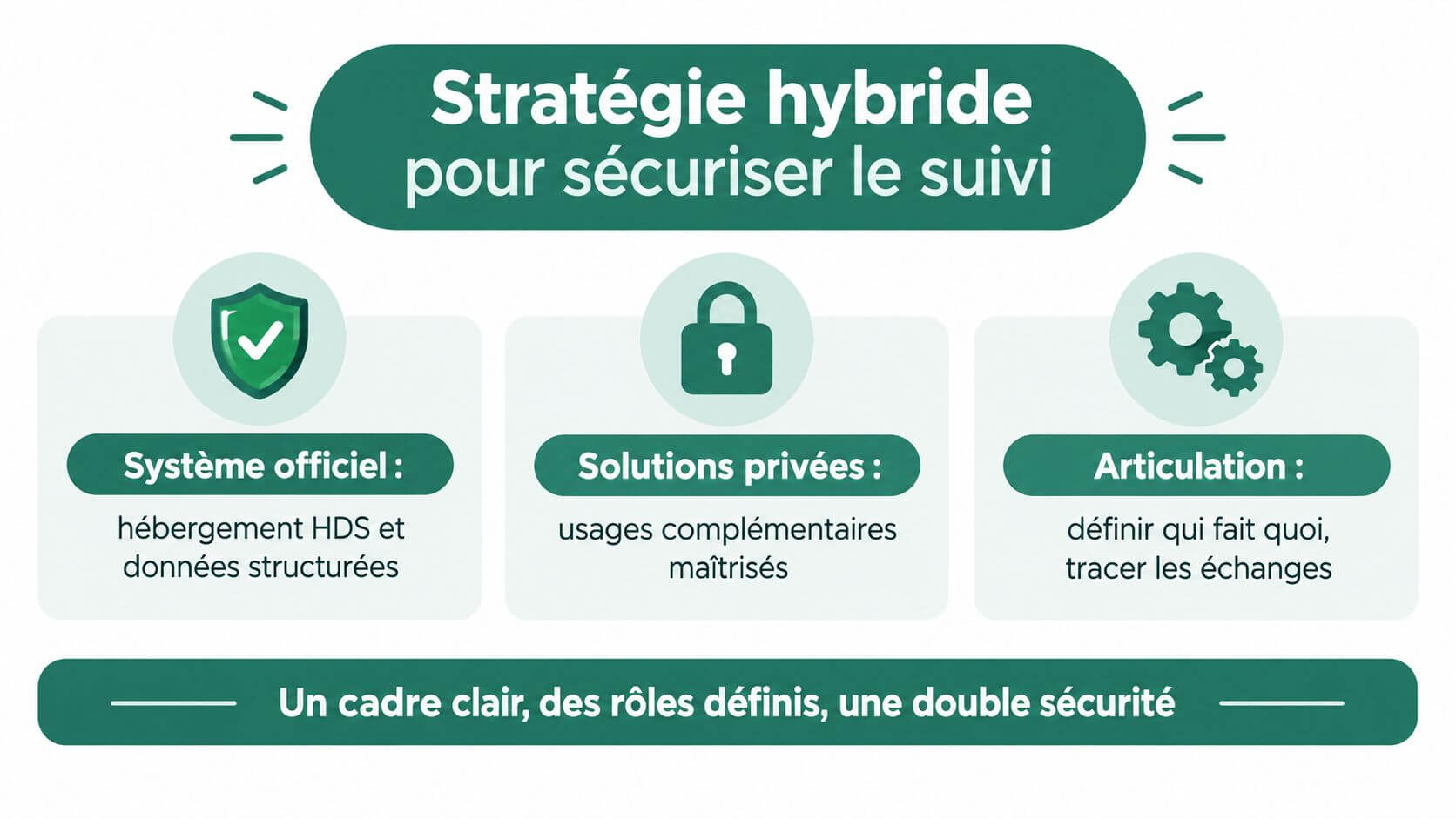
A well-designed organization does not necessarily require a choice between the national service and a complementary solution. It begins with a clear separation of responsibilities.
The DMP provides medical reference documents: records, prescriptions, liaison letters and other documents produced in the care path. A coordination tool can then gather planning, transmissions, tasks, home observations and confirmations useful to the family.
The family setting
Before inviting stakeholders, write a few simple rules:
- Medical documents: the DMP is used as a reference for medical parts intended for patients and authorised professionals.
- Daily life: passages, treatments, constants and observations are entered in the chosen coordination space.
- Responsibilities: each major task has an identifiable manager and a deadline.
- Emergencies: critical information is accessible to authorised persons, with a dedicated sheet and up-to-date contacts.
- Synthesis: the exchanges are regularly summarized so that professionals have readable information, without being drowned in the messages.
In this model, technology does not replace medical judgment or dialogue with caregivers. It simply makes visible what has been done, what remains to be done and what needs to be reported. The result depends mainly on shared rules, identifiable authors and a history that everyone can consult.
Tribulys centralizes transmissions, planning, tasks, follow-up of medicines and useful documents around a loved one kept at home, with access reserved for authorised members and traceability of exchanges. To complete the shared medical file with concrete coordination of daily life, discover Tribulys and begin to structure the follow-up of your loved one.
Put this organisation into practice with Tribulys
Keep your care journal, shared calendar, tasks, medication tracking and emergency information together. Start for free and invite the relatives and professionals involved in your loved one’s care.