
The Annual Wellness Visit itself costs $0 under Original Medicare when the provider accepts assignment, but a same day problem visit or added tests can bring Part B deductible and coinsurance charges, and the first visit is available only after 12 months of Part B. If you're booking for a parent or spouse, what part of this Medicare wellness exam is yours to do?
Most explainers list what the clinician checks. They rarely explain what you should gather, write down, and track afterward. That's the gap that matters, because a good prevention plan depends on details from daily life that the patient may forget, minimize, or not notice changing.
Table of Contents
- Who Qualifies for a Medicare Wellness Exam and When
- What the Visit Covers and What It Does Not Replace
- What You Could Pay for a Medicare Wellness Exam
- Getting a Medicare Wellness Exam at Home With Life Primary Care
- Booking the Visit When Access Is Limited
- Prepare Records and Caregiver Notes Before the Visit
- Book the Next Visit and Track Every Follow-Up
Who Qualifies for a Medicare Wellness Exam and When
Original Medicare covers one Annual Wellness Visit every 12 months for people with Part B, and the first one is available only after the first 12 months of Part B coverage. During that first year, the one time Welcome to Medicare visit applies instead.
That Welcome visit is formally the Initial Preventive Physical Examination, or IPPE. It sets a baseline. It doesn't count as an Annual Wellness Visit, and you don't need to have had it to qualify later.
| Situation | When it is available | Billing code |
|---|---|---|
| Within first 12 months of Part B | Welcome to Medicare visit (IPPE) instead, once only | G0402 |
| First AWV after 12 months of Part B | Any time once 12 months of Part B have passed | G0438 |
| Next AWV after a prior AWV | At least 11 full months after the month of the last AWV | G0439 |
| Medicare Advantage member | Same frequency rules, confirm the schedule with the plan | G0438 or G0439 |
The Annual Wellness Visit was established by Section 4103 of the Affordable Care Act and became available on January 1, 2011, according to the CMS prevention report. That policy eliminated Part B cost sharing for the visit under Original Medicare and framed it around a health risk assessment and a personalized prevention plan.
How the 11 Full Month Rule Works
For later visits, count 11 full months after the month of the last Annual Wellness Visit. Say the last visit was in March 2025. The next one is due from March 2026, not a few weeks after March 2025 and not whenever the calendar year changes.
Practical rule: Write down two dates before you call, the Part B start date and the date of the last wellness visit. The office can place you in the right row of the table in seconds.
You'll find the Part B start date on the Medicare card, in the online Medicare account, or in the Social Security enrollment letter. If your loved one has Medicare Advantage, the plan must cover the visit, but it follows the same frequency rules plus its own network terms, so confirm with the plan first.
What the Visit Covers and What It Does Not Replace
Think of the visit as a planning appointment. It's closer to drawing a route map than doing a full inspection. The clinician reviews what the patient reports, measures basic vitals, checks risks, and writes a prevention plan you can act on over the next year.
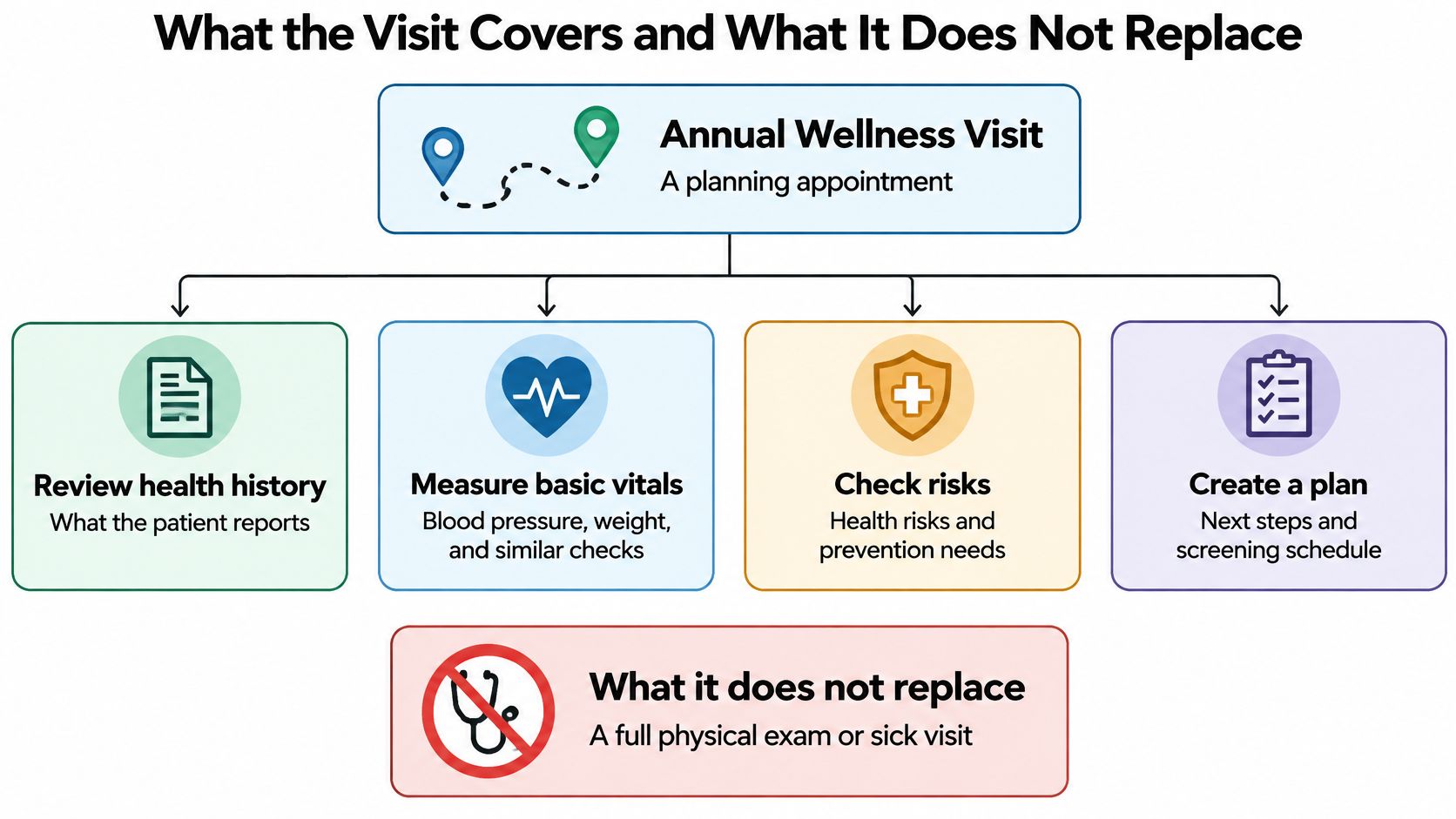
The Medicare.gov page on yearly wellness visits describes it as a structured prevention planning encounter, not a conventional head to toe physical examination, beginning with a Health Risk Assessment. From there it typically covers height, weight, blood pressure, medical and family history, current prescriptions, preventive service status, health advice, and a written personalized prevention plan.
| Component | What the clinician does | Why it matters |
|---|---|---|
| Health risk assessment | Reviews a questionnaire on health, habits, mood and safety | Sets the agenda for the visit |
| Medical and family history | Reviews conditions, surgeries and relatives' illnesses | Guides screening decisions |
| Vitals and measurements | Records height, weight or BMI, and blood pressure | Gives a baseline for later comparison |
| Medications and providers | Reviews current prescriptions and the list of providers | Catches duplicates and conflicts |
| Cognitive check | Observes the patient and uses a brief structured assessment | Flags possible memory concerns for follow up |
| Depression risk review | Asks mood screening questions | Starts a further evaluation if needed |
| Functional and safety review | Covers daily activities, falls, hearing and home safety | Shapes fall prevention and support |
| Substance use review | Checks opioid use and alcohol or tobacco use | Identifies risks that need counselling or referral |
| Screening and vaccination schedule | Lists which preventive services are due and when | Shows what to book next |
| Personalized prevention plan | Writes out the plan, referrals and health advice | The main document the patient keeps |
What It Does Not Replace
This visit doesn't replace a physical exam for a new symptom, diagnostic testing, a visit to manage a chronic condition, or a specialist review. Those are different kinds of care with different billing.
Say your spouse mentions new dizziness during the wellness visit. The clinician can listen, note it in the risk review, and book a separate problem visit to examine the cause, order tests, or adjust medication. That's appropriate care. It just isn't part of the wellness benefit itself.
What You Could Pay for a Medicare Wellness Exam
A wellness visit isn't always free from start to finish. Under Original Medicare, the Annual Wellness Visit itself has no cost to the patient when the provider accepts assignment, and the Part B deductible doesn't apply to it. Costs appear when other services join the same appointment.
| Scenario | Usually pays under Original Medicare | Ask before the visit |
|---|---|---|
| AWV only, provider accepts assignment | No cost, no coinsurance or deductible | Confirm the office accepts assignment |
| AWV plus a problem focused visit the same day | Deductible and coinsurance may apply to the separate problem service | Ask whether it will be billed separately |
| Lab test or screening ordered during the visit | Coinsurance may apply unless it is a covered preventive service | Ask for the billing code and expected cost |
| Provider does not accept assignment | Possibly higher charges, up to the limiting charge | Ask before booking |
| Medicare Advantage plan | Plan copays and network rules apply | Check network status and the plan summary |
| Optional advance care planning | No added cost when billed as part of the AWV, separate billing may bring deductible and coinsurance | Ask whether it is part of the AWV or a separate visit |
Why a New Complaint Changes the Bill
A routine wellness visit looks ahead. A problem focused visit investigates something specific, like knee pain, dizziness, or a rash. When both happen on the same day, the office bills them as two services, and the problem portion can bring the Part B deductible and coinsurance.
The same logic applies to tests. A lab test or screening ordered during the visit may carry coinsurance unless it's itself a covered preventive service. A Medigap policy may cover some of these amounts. Medicare Advantage plans use their own copays and network rules instead.
Ask two questions before you book. First, does the provider accept assignment? Second, if a problem comes up, will that part be billed separately?
Medicare deductibles and premiums change each year. Check the current year figures before you assume any amount.
Getting a Medicare Wellness Exam at Home With Life Primary Care
For some patients, the hardest part isn't eligibility or cost. It's getting to the office at all. Mobility limits, oxygen use, dementia, or no reliable ride can turn a simple planning visit into a half day ordeal for the whole family.
Life Primary Care is a house call primary care practice serving northern and central New Jersey, across Morris, Essex, Union, Somerset, Passaic, and Bergen counties. Clinicians deliver care in private homes, apartments, and assisted living communities, while a coordination office in East Hanover handles scheduling, insurance verification, and follow up by phone.
A Medicare wellness exam there happens at the kitchen table, and the setting does real work. The clinician can check the actual medication bottles instead of a printed list, and can see the stairs and bathroom setup a safety review is meant to cover. The practice also provides chronic disease management, post hospital transitional care, in home labs and EKGs, urgent same day visits for established patients, and telehealth follow ups between visits.
When the visit comes to the home, your job shifts from driving and waiting to being present. If you can, be in the home during the exam. Show the clinician where medications are kept, point out the spots that worry you, and describe changes you have noticed since the last appointment. Those details are hard to capture in an office.
Before booking, call the East Hanover office to confirm the practice's current Medicare acceptance, any fees that may apply, and how soon appointments are available.
This model fits best when travel is the main barrier, when the medication list comes from several prescribers, or when a caregiver can't take time off to drive and wait. If your loved one reaches appointments easily and likes their current practice, a regular office visit may suit them just fine.
Booking the Visit When Access Is Limited
Use of the Annual Wellness Visit remains uneven, and access barriers such as transportation, language and digital access often prevent patients from booking it, while the CMS Medicare Learning Network compliance tips on Annual Wellness Visits explain the billing and documentation rules.
Gaps in use usually reflect logistics, not motivation. Getting a ride, taking a workday off, reaching someone by phone, or moving a recommendation into a booked follow up are the steps where a visit falls through. Here a family member earns their place in the workflow: you handle the calls and calendar so the patient only has to answer the door.
Questions That Remove Barriers
- Ask about format: Is the visit offered in person, by video, or by audio only? Telehealth rules have changed and can differ by year and location, so confirm what this practice offers now.
- Ask about language and print: Request an interpreter or large print materials when you book, not when you arrive. Offices need lead time to arrange this.
- Check the network: If there's a Medicare Advantage plan, confirm the practice is in network before choosing a date. One call to the insurer beats a surprise bill.
- Plan the ride early: Local area agencies on aging and community programs sometimes help with transportation. Confirm what's available near you before committing to a date.
If you live far away, send your observations in writing before the visit and ask whether you can join by phone. Don't build the plan around reliable broadband, English fluency, or one nearby relative if none of those are true for your family.
Then ask for a written summary you can share with siblings and other relatives. One shared document prevents three different versions of what the clinician said.
Prepare Records and Caregiver Notes Before the Visit
Start with consent. The patient decides who attends and what gets shared. A caregiver can usually attend if the patient agrees, and the patient can sign an authorization letting the office discuss their health with a named family member.
Ask the practice whether it uses its own release form or a designated representative form. Ask who will receive follow up instructions. Sort this out before the appointment, while there's time to sign paperwork calmly.
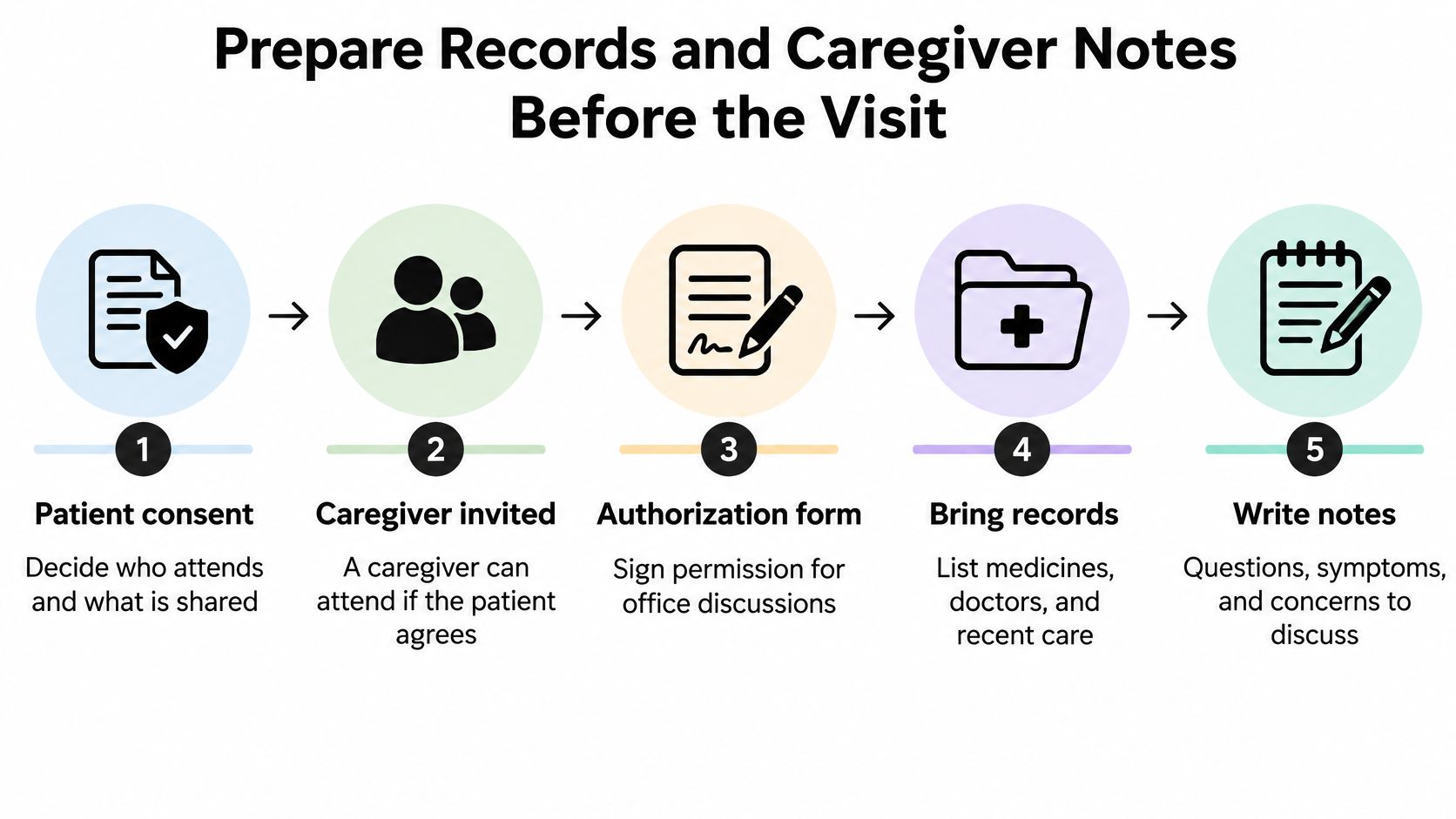
The CMS page on the Annual Wellness Visit lists required elements including medical and family history, height, weight or BMI, blood pressure, functional ability, fall risk, hearing, and home and community safety. Much of that information lives outside the clinic, in what you've seen at home.
Seven Things to Prepare in Order
- Write the medication list: Include each drug name, dose, frequency, pharmacy, and every supplement or over the counter product. This is how duplicates and conflicts get caught.
- Note family history: Record conditions in parents and siblings, such as heart disease, diabetes, cancer, stroke, or dementia. Add rough ages at diagnosis if you know them.
- Collect screening and vaccine dates: Look up flu, shingles, and tetanus shots, plus colonoscopy and mammogram dates. Guessing wastes visit time and can lead to repeat orders.
- Record falls and daily changes: Write down falls, near falls, dizziness, and trouble with bathing, dressing, or driving, each with a date. Patterns matter more than single events.
- Note hearing, vision, and aids: Mention hearing aids, glasses, walkers, or canes, and whether they're used. A hearing aid sitting in a drawer is useful information.
- Rank your questions: Choose the two or three most important ones and put them in priority order. Long unranked lists rarely get finished.
- Bring cards and confirm the visit type: Carry the Medicare card and photo ID, and confirm the booking is an Annual Wellness Visit so the office uses the correct code.
Send steps one through four through the patient portal or by fax before the visit if the office allows it. The clinician can read them in advance, and the appointment can start with answers instead of data entry. If you're organizing this for the first time, a structured approach to preparing an appointment for an ageing parent helps you decide what belongs on paper and what can wait.
Your Role During the Visit
Help the patient state concerns in their own words. Add your dated observations when the clinician reaches the relevant review, and avoid speaking over the person the visit is about. Your notes support their voice. They don't replace it.
Here's a labelled hypothetical example. A daughter notices her father has stopped driving at night and had two near falls on the stairs in March. She writes both down with dates. During the safety review, the clinician uses those notes to discuss lighting, a handrail check, and whether a vision review is due.
Write observations down with dates as they happen. A note that says "seems unsteady lately" gives the clinician far less to work with than two dated near falls.
Also note practical risks the questionnaire may only touch lightly. Transportation barriers, trouble affording or organizing medications, and advance care preferences all shape whether the prevention plan is realistic. Say plainly if a recommended screening is hard to reach or schedule.
Before you leave, ask for a printed copy of the prevention plan. Confirm which items need booking, which need a referral, and which require watch and wait. That single page is the product of the whole visit.
Book the Next Visit and Track Every Follow-Up
You can make the main decision today. If the Welcome to Medicare visit has been used and 12 months of Part B have passed, book the first Annual Wellness Visit. If one is already done, set a reminder for 11 full months after the month of the last one.
The photo below shows the kind of simple desk review that keeps dates and documents in one place.
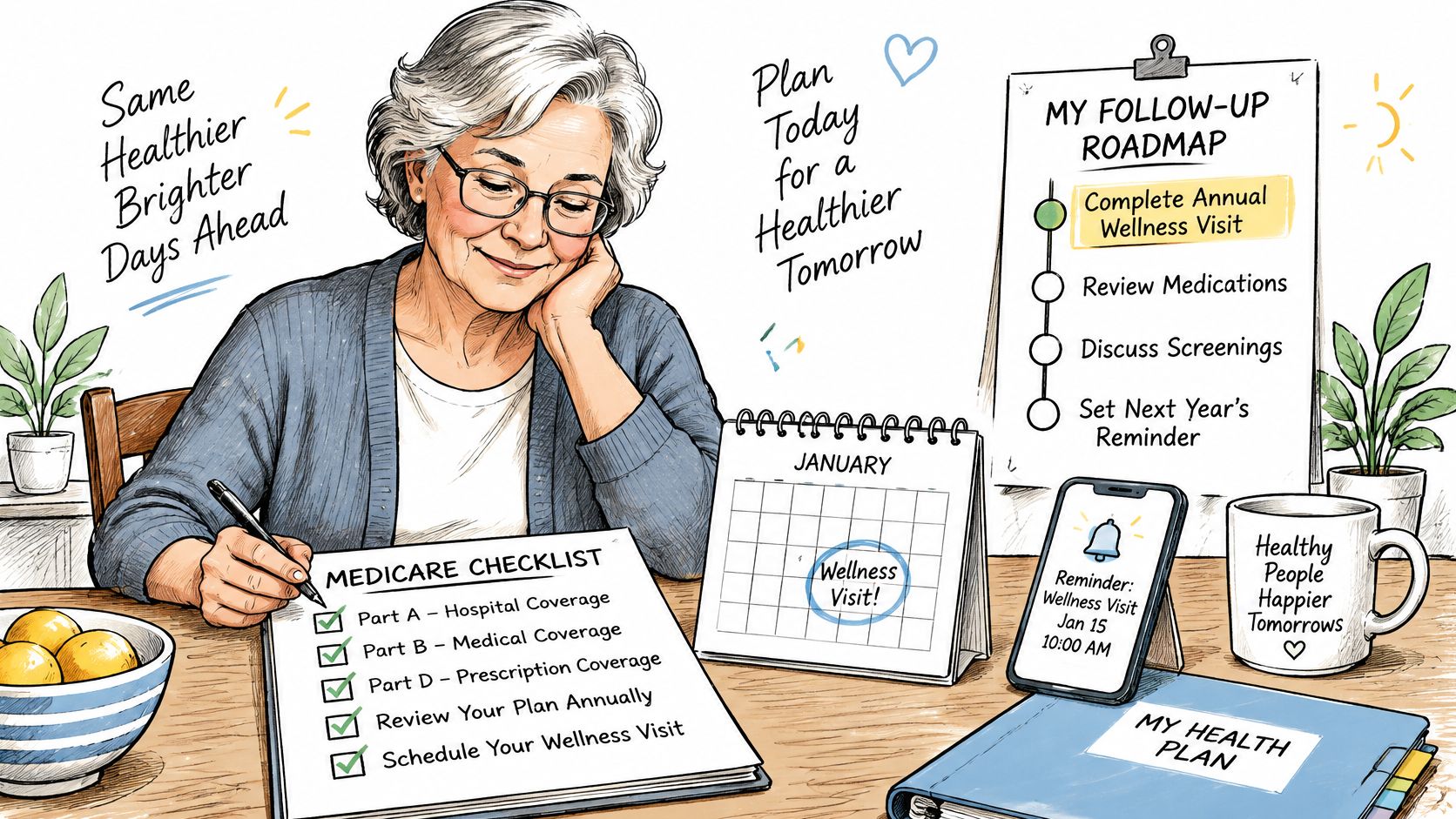
Make sure the written prevention plan is in hand before you leave the office, or in the patient portal within a few days. Then turn every item into a task with one owner, a due date, and a status.
Turning the Plan Into Tasks
- Screening referral: Owned by the patient, booked this week, appointment date recorded.
- Medication review: Owned by a daughter, who calls the pharmacy and confirms the updated list.
- Home safety change: Owned by a spouse, who arranges the handrail or lighting fix and marks it done.
Tasks with no owner are the ones most likely to be missed. A shared list that everyone can see, such as a caregiver calendar for coordinating appointments and tasks, keeps one relative from carrying the whole plan in their head.
Ask the office which items are optional and which are due soon, so your family works in the right order. The short video below walks through the visit in plain language if you want to share it with relatives who couldn't attend.
Then call the office. Confirm the visit is an Annual Wellness Visit with the correct billing code, confirm the cost answers, and put the date on the shared calendar the same day.
Don't let a good prevention plan sit in a drawer. Create a free Tribulys tribe for your loved one, add the visit date and the written plan, assign each follow up to one named person, and invite the family members who help, near or far. You'll spend less time chasing updates and more time getting the screenings, referrals, and home safety changes done.