
In France, about 70% of people with rheumatism report a change in their pain depending on the weather, while available data indicate that weather parameters account for only a very small proportion of the variability in symptoms, sometimes less than 1 %. Data relayed by Doctissimo and the analyses cited by Progress So they do not necessarily contradict each other. They describe two different realities, experience on the one hand, and the measured causality on the other.
Understanding this nuance changes the way you act. The cold does not "create" a rheumatism, but it can make an already sensitive joint stiffer, change the habits of movement and increase the painful perception. At home, a few simple measures can help, while an unusual pain must lead to a medical opinion.
Contents
- When the cold wakes the joints
- Understanding rheumatism without getting lost in jargon
- Mechanisms that explain winter pain
- What science confirms and challenges
- Good everyday gestures to limit the impact of cold
- Coordinate home care when winter lasts
- Benchmarks for deciding when to view or alert
- Frequently asked questions about rheumatism and cold
When the cold wakes the joints
Every November, 74-year-old Marc comes out with his kettle before he even lights up the heater. When he wakes up, his knees seem stiffer. His fingers get numb when he goes out to get the bread, and his joints sometimes crack by threading his sweater. For him, the link between rheumatism and cold Seems obvious, because the same scenario comes back as soon as temperatures drop.
This experience is common, but it is not enough to establish a cause. Patients describe seasonal worsening, while studies separately evaluate the actual share of the weather in pain. These two levels do not measure the same thing. The feeling therefore deserves to be taken seriously without automatically turning the cold into a single person responsible.
To be noted: A more present pain in winter may reflect a sensitive joint, more contracted muscles, less movement or disturbed sleep. It is not imaginary, but it often results from several factors that strengthen.
The cold can thus make a usual discomfort more visible, such as a light that brings out an irregularity already present. Staying still longer, stiffening to keep its heat or reducing its activities also changes the sensations. These elements can increase the painful perception without creating rheumatism.
France counts more than 16.8 million people affected by rheumatism and musculoskeletal diseases, according to estimates from the Global Burden of Disease relayed by the Arthritis Foundation. The stakes are therefore not limited to winter discomfort. It is necessary to distinguish between comfort, which requires monitoring and what is outside the usual framework.
Understanding rheumatism without getting lost in jargon
The word rheumatism is a group of very different diseases. Before you look for the effect of the cold, you have to identify the type of pain you're talking about.
Osteoarthritis as a hinge become less fluid
In osteoarthritis, the functioning is similar to that of a hinge whose gond is used gradually. The joint remains usable, but it becomes less flexible and more sensitive to stress. The pain often appears during the effort or after a busy day, with a stiffness usually short at the start.
Osteoarthritis frequently affects knees, hips, hands or feet. The cold can be experienced as a stiffness factor, especially when the person remains motionless for a long time or overly protects the joint.
Inflammatory rheumatism changes the picture
In rheumatoid arthritis or spondyloarthritis, inflammation plays a central role. The joint is not only a mechanic that works less well, it is also the seat of an inflammatory reaction that can cause swelling, local heat, fatigue and rest pain.
Prolonged morning jamming, night waking or unusual fatigue deserve medical evaluation. The cold may change comfort, but it must not automatically cause an inflammatory thrust to be attributed to the season.
Microcrystalline diseases cause different crises
The drop belongs to the rheumatism microcrystalline. Crystals trigger often sudden seizures, with intense pain, swollen joint and sometimes red. This profile does not look like a simple stiffness of the fingers when coming out of a cold room.
To better understand the differences between these families and the relief options, Tribulys guide on rheumatism can serve as a starting point. It does not replace a diagnosis, as the same painful joint may have very different causes.
| Pain profile | What Is Improving | What the cold does not allow to conclude |
|---|---|---|
| Mechanical | Movement-related pain, starting stiffness | It does not prove a worsening of the disease |
| Flammatory | Prolonged stiffness, rest pain, fatigue or swelling | He doesn't explain a push alone. |
| Microcrystalline | Brutal crisis, very painful and swollen joint | It is not enough to identify the drop |
Mechanisms that explain winter pain
The cold can make movements less comfortable without being the main cause of the disorder. Several plausible mechanisms overlap, and none is enough to explain all winter pains. This distinction brings together two findings that seem contradictory: the feeling of patients deserves to be heard, while studies attribute a very limited part of the symptoms to the weather.
Less fluid synovial fluid
The synovial fluid lubricates the joint. With the cold, it can become more viscous, like oil thickened by a low temperature. The movement then seems less flexible, especially when awakening or after sitting.
This hypothesis mainly concerns non-inflammatory rheumatism. It explains an impression of a "rapid" joint without meaning that the disease has progressed suddenly. However, immobility prolongs stiffness: a few regular movements, adapted to each person's abilities, can help maintain mobility.
Muscles that contract
The body reacts to the cold by contracting certain muscles and tissues around the joints. A raised shoulder, tight hands or knees held in a rigid position reduce the amplitude of the movements. The sense of blocking then also comes from the muscular environment, not only from the joint.
Wind and humidity increase heat loss. A person who cools quickly can get out less often, walk less long or avoid stairs. This decrease in activity maintains stiffness, even if the weather did not directly affect the disease.
Atmospheric pressure, a path to be relativized
Some people connect their thrusts to changes in pressure or humidity. Press analysis already cited on pain, cold and humidity reports associations between certain meteorological parameters and pain, without establishing that only one factor dominates.
Analyses reported by the health press suggest that weather variables would account for a very small proportion of the variability in symptoms, less than 1 % in some analyses. Sleep, physical activity, stress, fatigue and the natural evolution of the disease often weigh more on daily comfort. Cold can alter the perception of pain, but it is not a sufficient explanation alone.
What science confirms and challenges
The rheumatism and cold often oppose two findings which seem incompatible. 70% of patients They feel more pain in cold weather, while studies attribute a very small part of the variation in symptoms to the weather. The feeling is worth hearing, but it is not enough to establish a cause.
Cold doesn't create rheumatism
An osteoarthritis or inflammatory disease exists before winter. The cold can change the stiffness, mobility and tolerance to pain, without turning a healthy joint into a rheumatism joint. However, the French estimates give an idea of the collective extent of rheumatism and musculoskeletal diseases, which represent 10.9 % of the overall burden of disease in Franceaccording to the estimates of the Arthritis Foundation already mentioned.
Heat relieves without repairing
A kettle or heater can relax the tissues and make movement more comfortable. It acts as a comfort parenthesis, not as a treatment of the cause. Heat does not repair cartilage and does not replace a background treatment when an inflammatory disease requires it.
The therapeutic cold depends on the context
A cold pocket can be offered for localised swelling or inflammation, but its interest varies depending on the situation. It is therefore not automatically adapted to any winter pain. A stiffness due to cooling sometimes calls for a different approach to a warm and swollen joint.
| Idea received | What studies say | Level of evidence |
|---|---|---|
| Cold creates rheumatism | It may alter the feeling of a disease already present, without direct causality demonstrated | Causality not established |
| Weather explains all the pain | Its measured contribution remains very low, sometimes less than 1 % Variability | Low effect |
| Heat heals osteoarthritis | It mainly improves comfort and flexibility in the short term | Symptom relief |
| Therapeutic cold is suitable for everyone | It may have a targeted place, but its use must be adapted | Use to be individualised |
Recognizing pain does not mean validating each explanation. A careful assessment distinguishes the possible effect of cold, the factors that maintain symptoms and the signs of inflammation, infection or other problems.
Good everyday gestures to limit the impact of cold
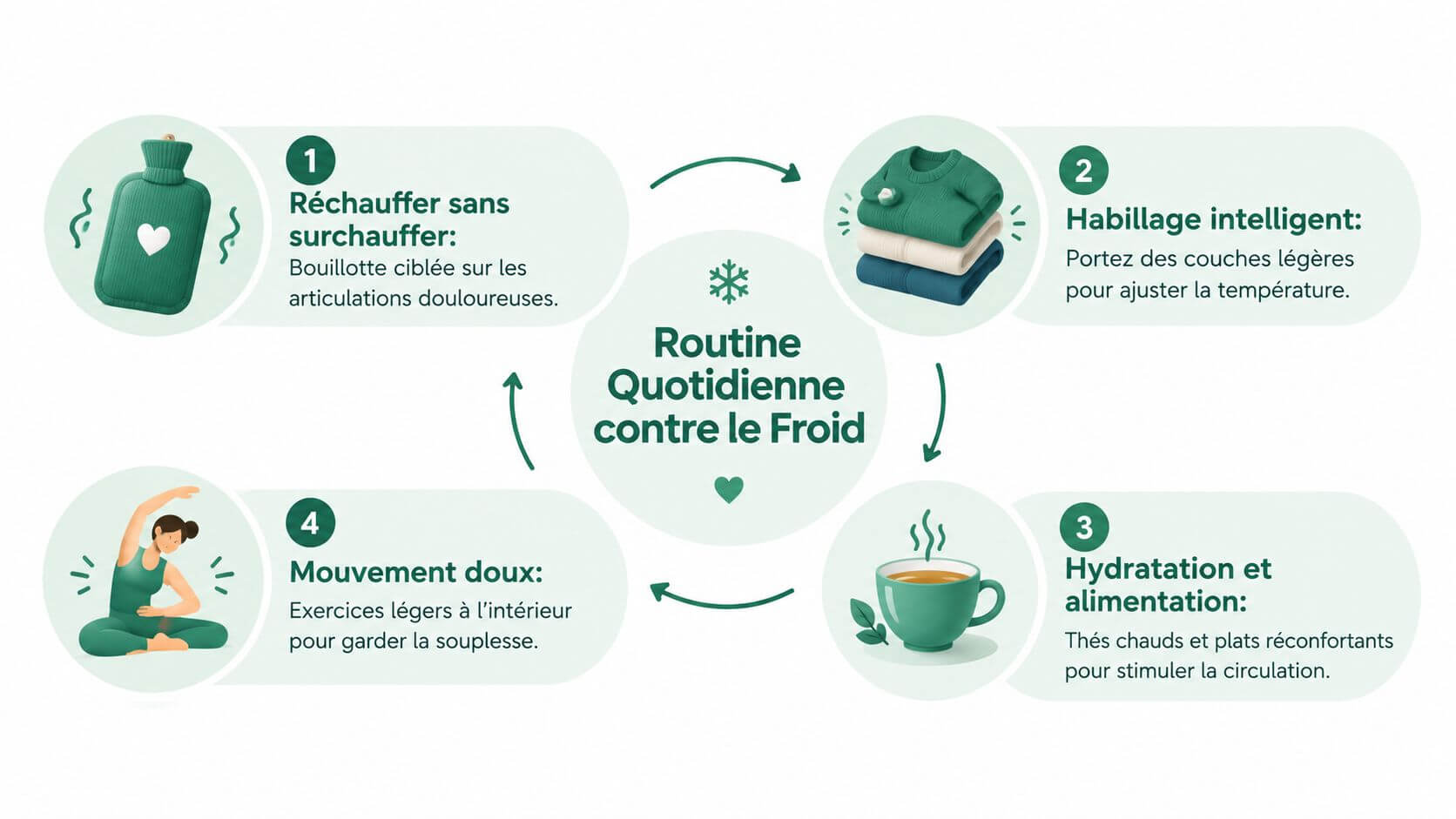
A useful winter routine combines several simple gestures. It aims to make movements more comfortable and to limit prolonged cooling, without turning heat or activity into treatment of the cause.
Reheat without burning
Place a bottle or heater on the painful area during 15 to 20 minutes, by interposing a tissue between the heat source and the skin. Regularly control the temperature, especially in an elderly person, diabetic or whose sensitivity is diminished. The heat must provide a relaxation, without persistent redness or burning sensation.
Once the joint is warmed up, mobilize it slowly. A few flexions of the fingers, ankle movements or a walk in the housing can restore ease. These gestures act as a progressive start, not as a repair of the joint.
Move regularly
The aim is to keep a smooth and adapted activity, with about 30 minutes of activity several days a week, according to the recommendations of adapted physical activity. Walking inside, exercise prescribed by a physiotherapist, and progressive stretching are better suited to a stiff joint than a rough effort. If a movement significantly increases the pain, reduce its amplitude or interrupt it.
Maintain a comfortable temperature
Overlay light layers rather than wear a very tight garment. Protect hands, feet, neck and knees while maintaining freedom of movement. Inside, spot cold rooms and air currents, especially for fragile people.
Moisture and sleep support this routine. A varied diet, including sources of omega-3, can contribute to a balanced hygiene of life, but no food is a substitute for a prescribed treatment. To organize the intakes and limit forgetfulness, Therapeutic follow-up of medicines with Tribulys can complete the usual medical logbook.
Coordinate home care when winter lasts
Winter sometimes complicates travel, appointments and relays between relatives. A person suffering from knees can cancel a physiotherapy session because he or she fears ice. A remote caregiver may not know that pain has increased. A nurse may not know the latest change in treatment. The risk then comes not only from cold, but from scattered information.
A shared notebook to follow the evolution
A digital link book is used to record pain, stiffness, swelling, treatments and adverse reactions. The dated and identified entries give the treating physician or physiotherapist a more reliable vision than a reconstructed memory after several weeks.
This continuity also helps to identify changes. A pain only present after a cold exit does not call for the same reflection as a new swelling, fever or loss of mobility. The follow-up does not pose the diagnosis, but it makes the observations more exploitable.
An agenda that protects appointments
A shared calendar can bring together consultations, re-education sessions and nursing passages. Families see who is involved and when, which limits forgetfulness and duplication when winter conditions disturb habits.
Coordination of home care also takes into account concrete tasks, such as preparing warm clothes, checking access to the accommodation or accompanying an exit. These details have a direct influence on mobility and safety.

An accessible emergency card
The emergency record must include allergies, treatments, useful contacts and important instructions. It facilitates transmission if a fall, malaise or fever occurs, especially in a person receiving biotherapy.
Tribulys centralizes these elements in a space shared between caregivers and licensed professionals, with a liaison care journal, schedule, tasks, catch tracking and an emergency log searchable according to the intended access. This tool does not replace the doctor, Samu, or the judgment of a caregiver. It is used to maintain up-to-date information when several people participate in home care.
Clinical caution: pain drawn and transmitted does not automatically become more benign. It becomes easier to compare, explain and orientate.
Benchmarks for deciding when to view or alert
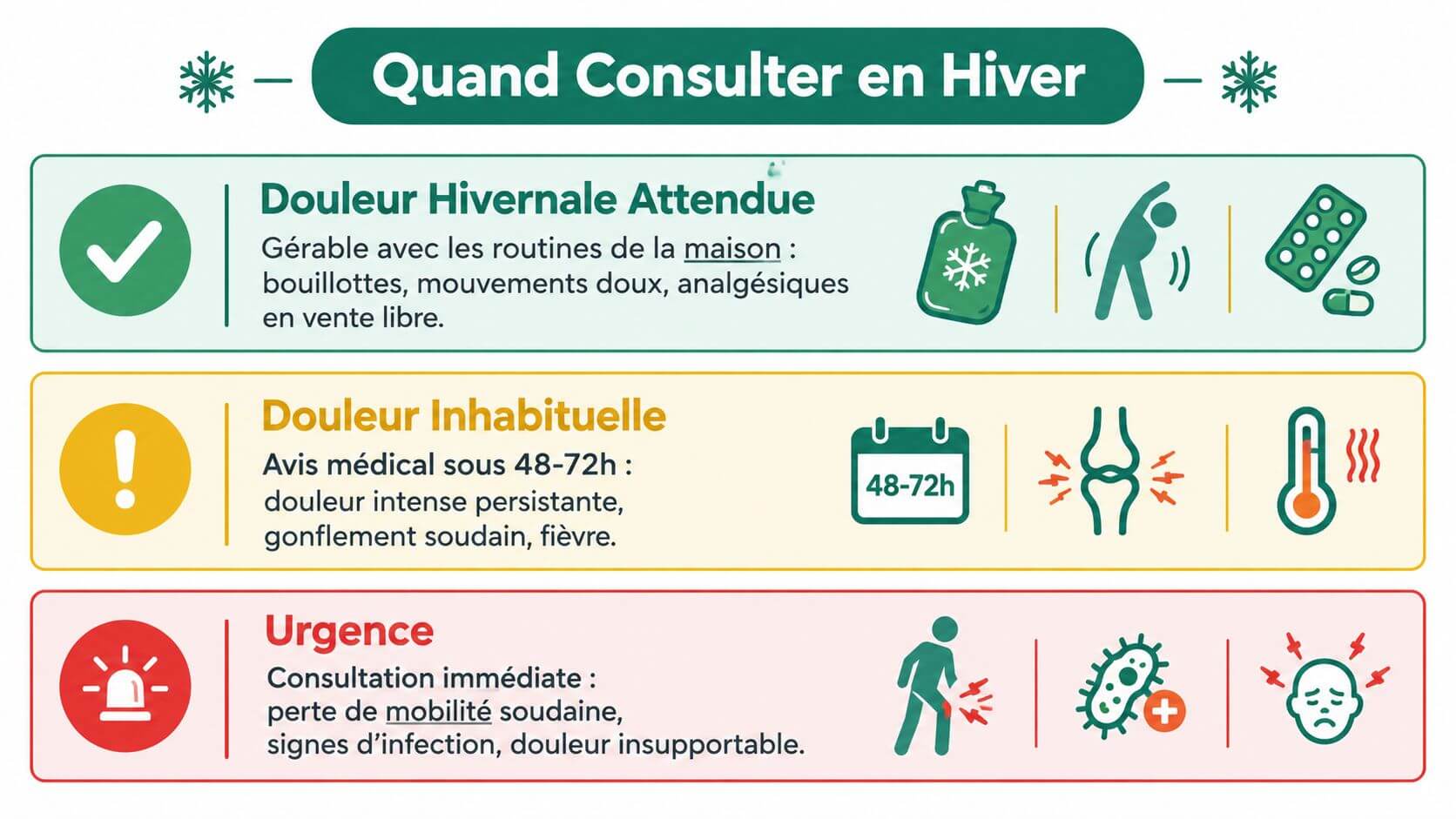
One-off discomfort, without swelling or general symptoms, which improves with mild heat and movement, can often be monitored at home. Unusual pain, persistent or accompanied by sudden swelling, warrants medical advice, especially if it does not resemble previous episodes.
A morning stiffness that lasts more than an hour, a pain that wakes up at night or a gradual loss of mobility deserve a quick consultation with the treating physician. The latter may organise the use of rheumatologist if necessary.
Call him. 15 in cases of chest pain, shortness of breath, malaise, confusion, unexplained fall or fever in a context of concern. This question sheet may help the helpers structure the information, but it must never delay the call for help.
Frequently asked questions about rheumatism and cold
Should we move or rest when the cold hurts?
It is better to avoid complete immobility. Gently warm the joint, then make a few slow movements or a suitable activity, without forcing on acute pain.
Is going to a warmer area enough for the winter?
A milder climate can improve the comfort of some people, but it does not deal with the cause of rheumatism. Housing, habits of movement, sleep and continuity of care are equally important.
When to consult a rheumatologist?
Start with your treating doctor if the pain changes, lasts, inflates or limits the activities. It will refer to a rheumatologist when the picture evokes an inflammatory disease, an unusual evolution or a need for specialized advice.
How can I recognize a pain that is not rheumatismal?
Thoracic pain, shortness of breath, malaise, confusion, fever or unexplained fall should not be attributed to cold or joints. In case of serious doubt, call 15. These advices complement medical follow-up and do not replace an individualized opinion, especially in people who are polymedic or isolated.
Tribulys helps caregivers and professionals to share the link book, medication intakes, schedule and emergency information of a close home follow-up. To better organize pain monitoring and continuity of care during the winter, discover Tribulys.
Put this organisation into practice with Tribulys
Keep your care journal, shared calendar, tasks, medication tracking and emergency information together. Start for free and invite the relatives and professionals involved in your loved one’s care.