
At 11:15 p.m., a fall alert came on the phone of a helping girl. Her mother lives alone. The bracelet detected an impact, but no one knows yet whether the person is injured, asleep or simply separated from his device. Between the call to the relatives, the movement on the spot and the call to help, each decision counts.
This is precisely the role ofa waiver of doubt. It transforms a raw signal into an understood situation and then into adapted action. At home, this verification rarely relies on a single centre. Rather, it involves caregivers, neighbours, nurses, home care workers and, when gravity dictates it, emergency services. Without a common organisation, an alert can produce anxiety, conflicting calls and unnecessary travel.
Contents
- Why the lifting of doubt changes everything at home
- Definition and legal framework of the lifting of doubt in France
- Standard protocol for checking a home alert
- When the doubt persists and relief is needed
- Coordinate and trace the lifting of doubt with Tribulys
- The right reflexes to avoid false movements
Why the lifting of doubt changes everything at home
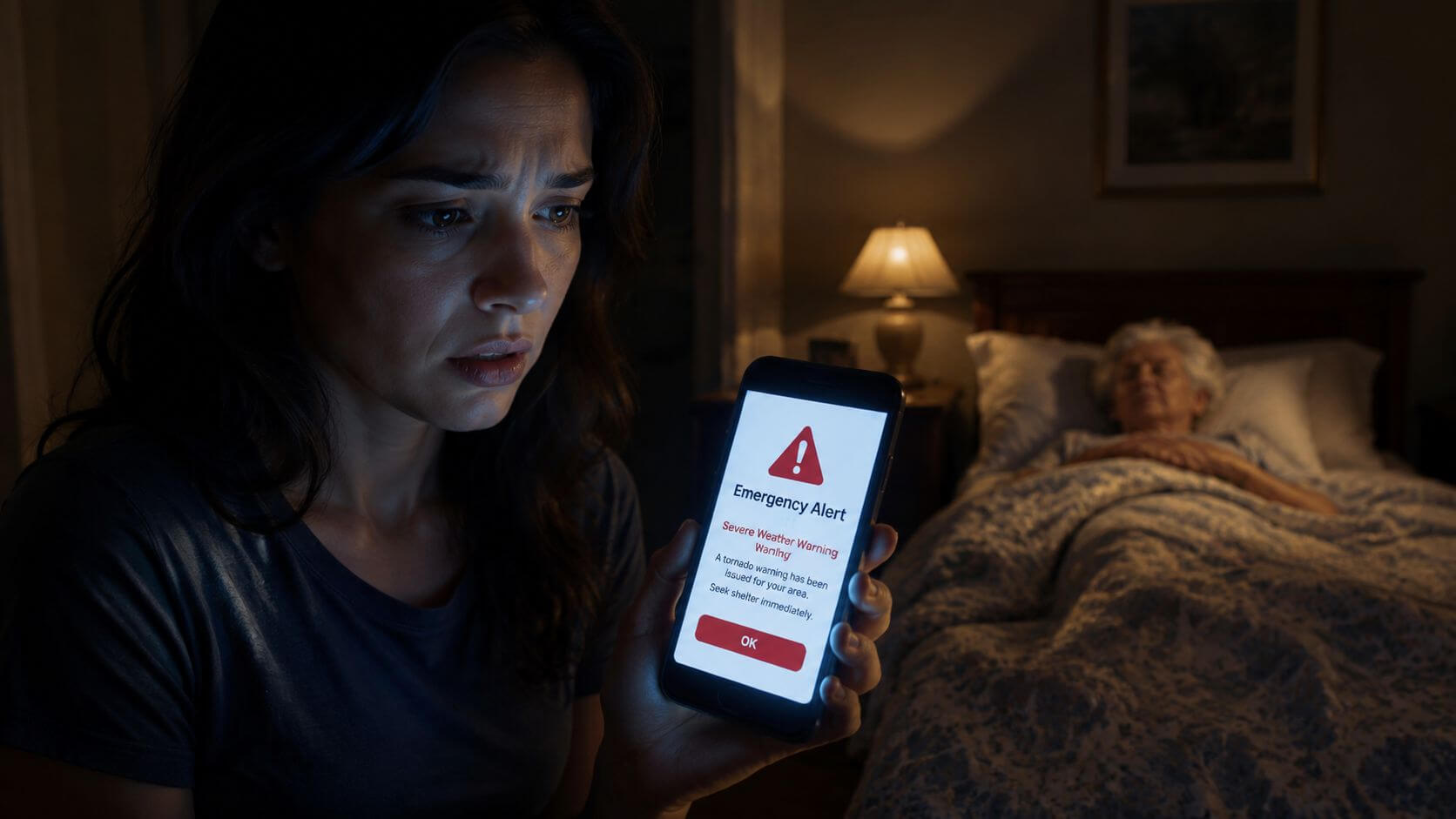
A fall alert is not yet proof of an emergency. A bracelet may have slipped, a button may have been pressed by mistake, or a person may have triggered a call without being able to explain what is going on. Conversely, a lack of response does not make it possible to conclude that everything is okay.
The first error is therefore to treat each signal as complete information. An alert indicates that an event deserves verification. It does not automatically say who is in danger, what is the seriousness of the situation or who should intervene.
Gross alert is not enough
The data of the AFRICATA illustrate the operational issue. In France, its members process about 2.5 million calls per yearof which: 2.26 million do not require intervention and 240,000 give rise to intervention According to the exploitation report cited by the AFRICATA. 1.5% of calls lead to the use of emergency services such as firefighters or UAS, according to the same source.
These figures do not mean that an alert must be minimized. the verification usually precedes the climbing. At home, this step can take the form of a call, a listening, a message to a relative or a physical passage. The choice depends on the alert, the known state of the person and the relays available.
Practical rule: An alert must trigger an organized sequence, not a series of panicked calls.
Technology does not replace coordination
The number of people involved makes this organisation indispensable. ARFATA accounts for about 122,000 falls per year and estimates about 400 000 the number of elderly people who subscribe to tele-assistance at a given point in the measurement cycle presented in its operating report. Another sector data estimate that the French fleet is 750,000 beneficiaries in 2024, up by 4% year-on-year, or about 10% of people aged 75 and over sectoral data on tele-assistance.
These volumes describe a system already widely used, but they do not guarantee that relatives know what to do when the alert arrives. The technical device detects or transmits. The lifting of doubt, however, depends on persons identified, reachable and able to share the same information.
Definition and legal framework of the lifting of doubt in France
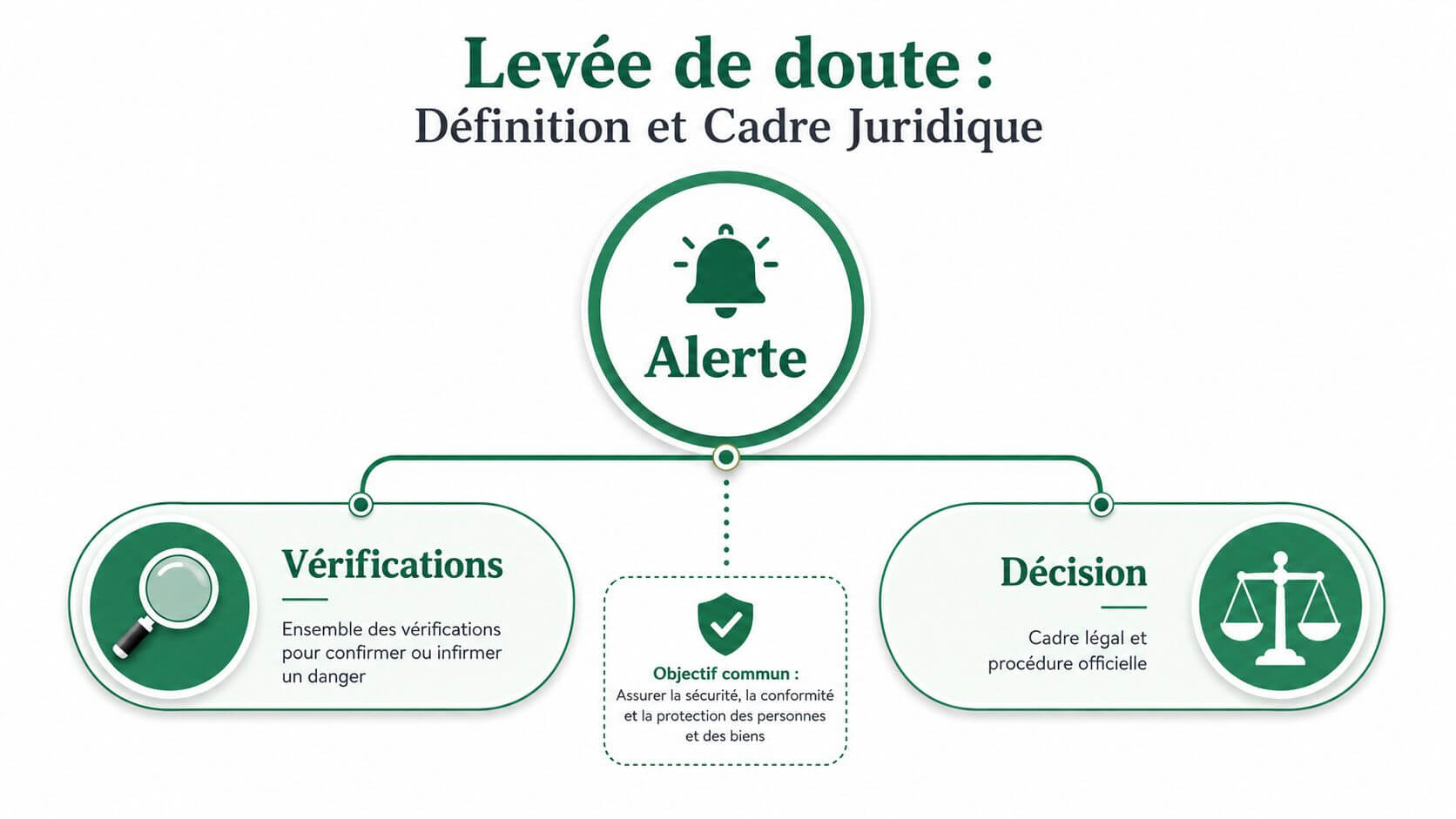
A fall alert comes to a loved one, but no one knows who should call, who can enter the housing or when to prevent rescue. waiver of doubt is specifically used to organize this audit. It is not a question of waiting for perfect certainty, but of gathering reliable evidence before deciding on the future.
In France, the L613-6 of the Code of Internal Security defines the lifting of doubt as a "audit package" to establish the materiality of an infringement before the intervention of the law enforcement authorities Ministerial circular on the lifting of doubtThis concept appears in a historical context dating back to Law No. 83-629 of 12 July 1983, and was then taken up in the current law.
The definition first concerns private security and remote surveillance. It remains useful at home, provided it is adapted. An alert is a signal. A lifting of doubt is the process that seeks concrete elements to confirm, invalidate or qualify this signal.
A structuring framework, but not a family protocol
The French circular seeks to limit the unjustified intervention of the law enforcement agencies and the risk of sanctions for telemonitoring companies. In a professional device, the verification can combine voice call, listening to places, video control, code identification and sending an agent if remote control is not enough presentation of the question raised in telemonitoring.
A family does not always have these tools or a written procedure. However, it can clearly divide the roles. The caregiver coordinates the calls and transmits the information. The health care professional appreciates the situation within the framework of his/her skills. A neighbour or trusted relative physically checks the accommodation, whether that person is available and whether conditions of access have been provided. Relief takes place when the danger seems immediate or the doubt concerns a serious medical risk.
Traceability allows the sequence to be reconstructed: which alert was received, at what time, by whom, with what response and what decision. Even without dedicated software, a shared table or dated report is sufficient to avoid duplicate calls and conflicting information.
Private security and medical emergency do not confuse
A procedure designed for an intrusion or a safety alarm does not automatically translate into an unusual fall, malaise or silence. For health, the priority is to assess the possible severity of the person's condition, not just to confirm the technical trigger.
In case of doubt as to the seriousness, the Regional Health Agency recommends calling the 15. The 114 is provided for deaf or hard of hearing persons ARS Ile-de-France landmarks.
The verification must therefore remain proportionate and rapid. If the information collected raises concerns about an emergency, the call for help is preceded by the search for additional confirmation.
Standard protocol for checking a home alert
A useful protocol must be precise enough to guide a stressed person, but flexible enough to adapt to the type of alert. Above all, it must assign actions to identified persons. Without distribution, everyone thinks that someone else will call, move or inform the doctor.
The six steps to follow
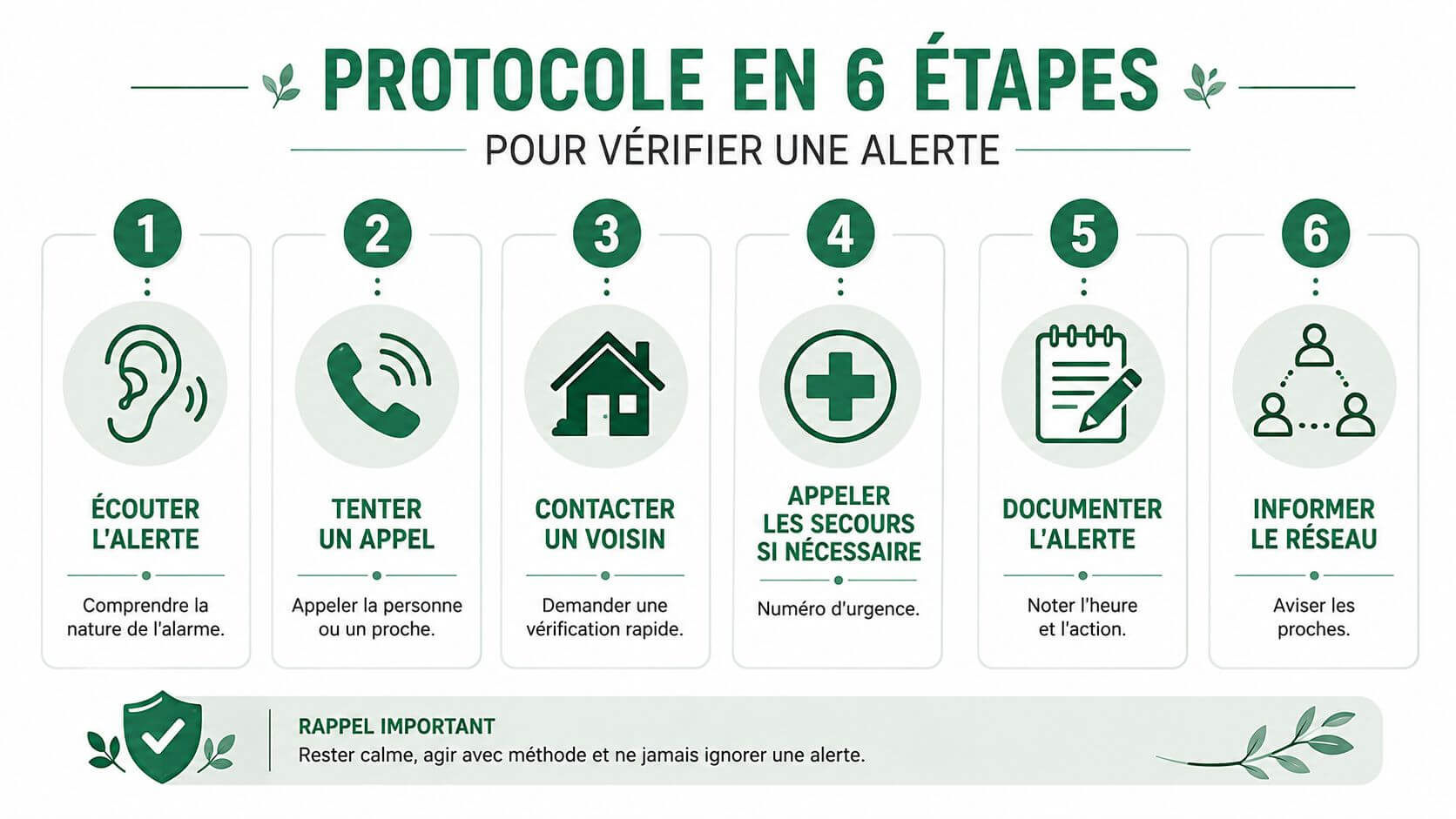
Identify the alert. Note the nature of the signal: fall detected, call SOS, absence of movement or message from a speaker. Raise the time and source of the alert. An automatic fall does not treat itself exactly as a voluntary request for help.
Try to get in touch. Call the person on the phone or via the available device. Ask simple questions: "Are you on the ground? ", "Can you talk? "Are you hurting? " If a video conferencing already exists in the family environment, it may complement the voice call, but it must not delay the call for help in the presence of worrying signs.
Mobilize a close relay. If no one answers, contact the neighbour, trusted relative or professional who can access the accommodation. The designated person must know where the keys are and the conditions for entering.
Evaluate without exceeding its role. In situ, a relative can observe consciousness, apparent breathing, expressed pain or immediate danger. A caregiver can perform the assessment corresponding to his/her skills. A remote caregiver must not turn a telephone conversation into a diagnosis.
Document every attempt. Enter the time of the call, the number used, the answer obtained, the name of the person contacted and the action decided. A statement such as "no response, neighbour asked" is more exploitable than a simple "treaty alert".
Decide and inform. If the situation is reassuring, clearly indicate the fence. If the doubt persists or if a medical hazard appears, call the rescue and transmit the items already collected. Then inform the network to avoid duplicate movements.
Divide roles before incident
The primary caregiver may maintain coordination, but it must not be the only failure point. The network is better equipped with a main relay, a secondary relay and a person able to intervene physically. The caregiver is not a family-friendly caregiver, and the neighbour must not discover at the time of the alert that he or she is supposed to have the keys.
| Role | Priority action |
|---|---|
| Coordinator | Receives information, launches calls and records actions |
| Close confidence | Checks on-site access and situation |
| Caregiver | Transmits clinical observation within the scope of its competence |
| Relief | Whenever the gravity or doubt so requires |
To prepare for this operation, the full guide to senior tele-assistance can serve as a forum for discussion with family and professionals. If a video check is envisaged in a dwelling, it is also necessary to examine the installation, positioning of the equipment and respect for privacy. One BSP certified camera installer can provide technical lighting on this point, without transforming the camera into a substitute for human presence.
When the doubt persists and relief is needed
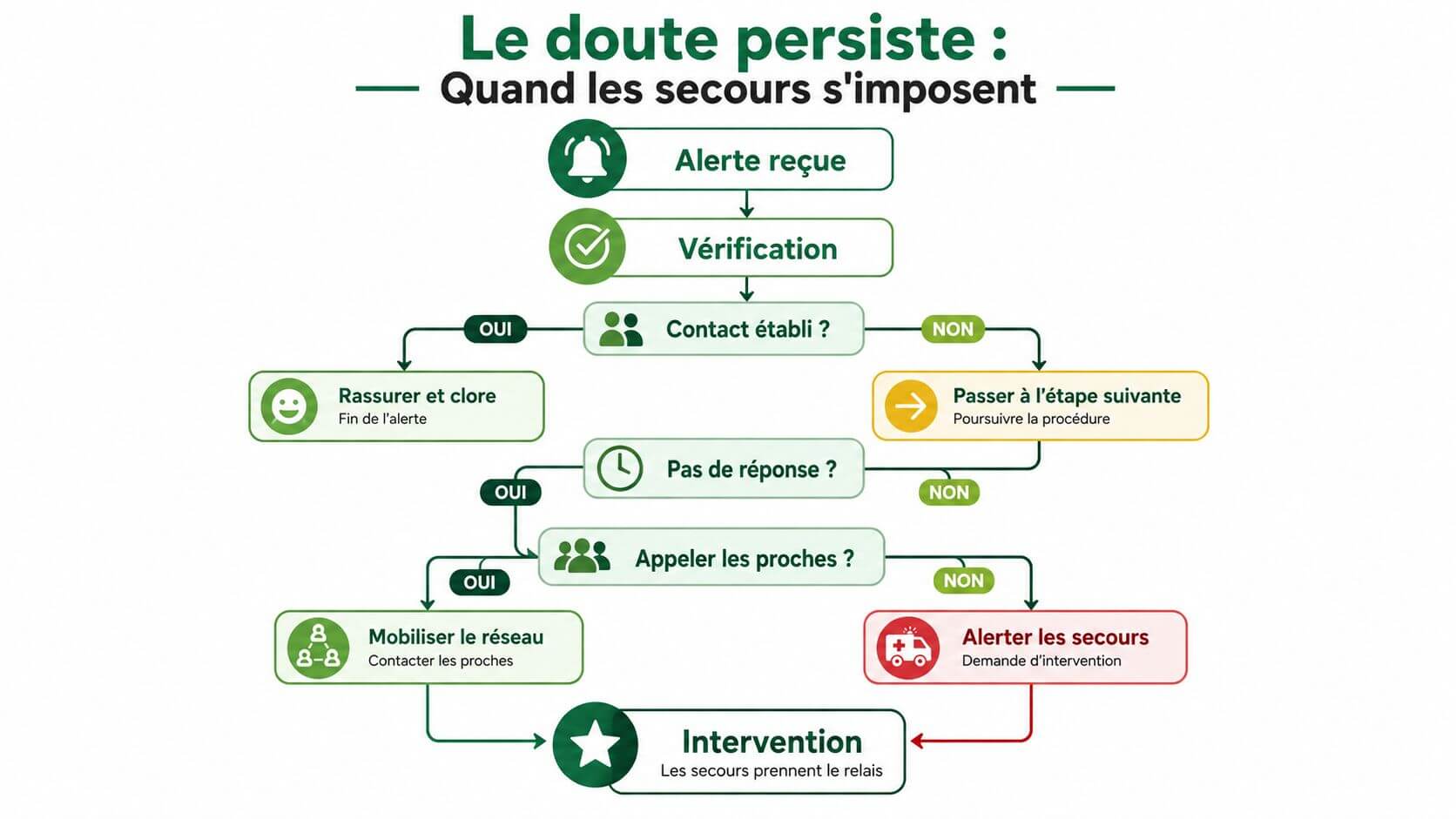
The first contact failure must not lead to an indefinite expectation. A person who does not respond may sleep, not hear his phone, fall out of reach or be unable to speak. The right decision depends on the context, but lack of response becomes a concern when combined with credible alert or unusual elements.
A known medical history, an alert at an unusual hour, a disturbing noise, an inaccessible door or a close relative who reports sudden change must raise the level of vigilance. Indicatives such as light extinguished during the day or accumulated mail do not prove anything in isolation. However, they can supplement the context transmitted to the rescue.
Do not confuse verification with delay
The lifting of doubt is not about seeking perfect certainty. It is used to quickly collect the available elements and to select the appropriate relay. If the person does not respond, no one can open quickly and the alert leaves a medical problem to be feared, the caregiver must call the 15In the event of a danger arising from a firefighter's intervention, the fire brigade shall: 18 may be requested.
The call must remain factual. Indicate the address, the identity of the person, the nature of the alert, the time of receipt, the calls already attempted, the possible existence of keys and the medical information available. The emergency card, allergies and known treatments can help the rescuers to understand the situation quickly.
What protects the caregiver is a reasonable and documented decision, not a prolonged wait to eliminate any doubt.
The emergency plan for a senior must anticipate this shift before an alert occurs. A written procedure can specify the contacts, access, information to be transmitted and the conditions that justify a direct call to rescue. It reduces the mental burden at a time when the family has little time to think.
Document failure as information
Each unsuccessful attempt brings a useful element. Note the unanswered call, the message left, the missing neighbour, the unopened door or the loss of network. The helpers receive a chronology rather than a confused impression.
Good faith does not dispense with acting, but it is expressed in a coherent approach: to check what can be safe, not to enter by force, not to move an injured person without necessity, and then to ask for help when the risk can no longer be ruled out.
Coordinate and trace the lifting of doubt with Tribulys
Daily coordination does not always require a specialized button to produce an exploitable trace. It needs a common place, identified entries and a rule of writing understood by all. It is the difference between an isolated message and a history that allows the family and professionals to reconstruct the sequence.
Tribulys does not currently offer a formalised product definition of doubt relief. The application allows to post an alert in the notebook, read by the tribe, but it does not include a dedicated pre-action verification step. Nor does it offer an integrated audio, video conferencing or phone call to directly control the situation.
Use the logbook as a verification log
In this context, the method is to distinguish the initial alert from the actions that follow. The alert itself is historyd with its content, author and date. Attempts to contact must then be added as separate entries, with a short and constant formulation.
A scenario can be documented as follows:
- Alert received at 2:00 p.m. Detection or message specifying the known pattern.
- Call at 2:05 p.m. The girl calls, no answer.
- Relays requested. The nurse is informed and confirms her next visit.
- Check at 2.30 p.m. The nurse reports that the person is safe.
- Closing. The caregiver indicates that the alert is verified and that no further mobilization is required.
This chronology does not transform the notebook into a remote surveillance centre. However, it gives each authorized member a common vision of what has been done. The electronic link book can serve as a reference for defining writing rules, signatures and transmissions between relatives and caregivers.
Avoid silo and duplicates
A tele-assistance platform can receive the signal and apply its own circuit. Family coordination must then know what happened, especially when several speakers take turns. A shared history limits repeated calls, simultaneous movements and conflicting information.
Roles and permissions make it possible to differentiate access according to the functions. The relative follows the alert and tasks. The caregiver transmits his observation. The doctor consults the relevant information when it is shared with him. The offline mode of the notebook can also allow a transmission during a networkless visit, with synchronization to the reconnection.
Geolocation does not replace this chronology. It can help track a vehicle or understand the availability of a stakeholder, but its use must be framed and proportionate. operation of vehicle geolocationLogistical follow-up should be distinguished from surveillance of the person receiving care.
The right reflexes to avoid false movements
An effective lifting of doubt is based on simple, pre-prepared actions:
- Call firstunless there is an obvious sign of danger or medical emergency.
- Preventing a loved one before moving, so that everyone knows who intervenes.
- Record each attempt, including when the alert proves to be of no consequence.
- Set Accesses the housing, the available keys and the proximity relays.
- Go to the rescue without guilt where gravity cannot be ruled out.
- Explicitly close alert, so that no one unnecessarily revives the same intervention.
Conventional tele-assistance platforms can manage the reception of a signal, while human verification often depends on the network of relatives. A co-ordination application does not replace an operator, caregiver or rescue. However, it can centralize transmissions, assign tasks and retain the timing of decisions.
The desired result is not to remove all false alerts. It is to ensure that each alert receives an understandable, proportionate and traceable response. This organization protects the vulnerable person, but also the caregivers who need to decide quickly with incomplete information.
Tribulys centralizes the care journal, alerts, tasks, schedule and transmissions between relatives and professionals, so that everyone knows what has been tried and what remains to be done. To structure your home coordination and visit Tribulys, first organize the roles and alert protocol of your tribe.
Put this organisation into practice with Tribulys
Keep your care journal, shared calendar, tasks, medication tracking and emergency information together. Start for free and invite the relatives and professionals involved in your loved one’s care.