
In many families, the same scenario comes back. On Sundays, a girl fills the drumstick while her brother takes over during the week, a husband manages the renewals, and the mother, she, cumulates several treatments since the prescription extended. At that time, the real question is not just what medication was prescribed, but what was prescribed? who gave it, when, and how the rest of the family knows it.
The therapeutic monitoring of medicinal products It covers two very different realities. On the one hand, the clinical framework of the pharmacological therapeutic follow-up, focusing on blood dosages and medical adjustment. On the other hand, the day-to-day security of home grabs, where forgetfulness, duplication and last-minute changes slip into the routine. In France, the TPS is based on the measurement of blood concentrations to check if exposure is too low, adequate or excessive, and then adjust the dosage to optimize the benefit-risk ratio and reduce toxicity, with an activity mainly carried out by CHU pharmacology/toxicology laboratories, and sometimes by private laboratories. scientific source.
Contents
- Why the therapeutic follow-up of drugs becomes central in 2026
- Two faces of therapeutic drug follow-up
- The three issues that families really face on a daily basis
- When several caregivers take turns, oblivion becomes collective
- Indicators and signals to be monitored week after week
- Three settings to make treatment reminders reliable
- From withdrawal to traceability useful to the caregiver
- Three gestures to put in place this week
Why the therapeutic follow-up of drugs becomes central in 2026
The subject takes place because the treatments no longer live only in the hospital. A large part of the care continues at home, with longer prescriptions, several prescribers, and relatives who take turns to prevent the catch falling into the holes of the calendar. When coordination is blurred, the risk is not theoretical, it becomes concrete at the time of dinner, a busy weekend, or a renewal of the box.
The French framework also goes in this direction. ANSM collects and analyses adverse reactions, and the pharmaceutical accompaniment system explicitly targets certain chronic patients, notably under oral anticoagulants, oral anticancer treatments, inhaled corticosteroids or in polymedication ANSM source. In other words, the catch monitoring It's not administrative comfort, it's a security brick.
The right reflex to adopt
Useful practice, If more than one person intervenes around the same treatment, one needs a common space where the taking of the day becomes visible, instead of staying in the head of each person.
The most important point to remember is the difference between measure and secure. The blood dosage adjusts the dose, family coordination prevents a correct dose from being forgotten, doubled or staggered. It is this joint that changes life at home, especially when a complex prescription has to become a readable routine for everyone.
Two faces of therapeutic drug follow-up
The word "follower" often creates confusion, because it covers two practices that do not resemble each other. pharmacological therapeutic follow-up is subject to special care. follow-up of home takings Rather, it concerns families, carers and city carers, with a logic of transmission and continuity.
| Criterion | Clinical STP (CHU/hospital) | Catch monitoring (domicile) |
|---|---|---|
| Actors | Hospital team, pharmacology, toxicology | Family, carers, nurses, pharmacist |
| Location | Hospital, laboratory | Home, home, journey, family relays |
| Tools | Blood samples, plasma assays | Pillar, reminders, catch log |
| Purpose | Adjust dose and reduce toxicity | Verify that the catch has taken place and that the information is circulating |
The first face is clinical, the second is organizational. Both are complementary, because a good dosage does not protect against a missed dose, and a very rigorous recall does not alone correct an inappropriate dose. For families, therefore, the right question is simple: "Am I in a situation that requires a medical dosage, daily coordination, or both?"
Know where we are
When a doctor talks about STP, he thinks of a laboratory act and a therapeutic decision. When a girl asks "he took it well this morning?", she talks about a problem of relay, confirmation and trace. This distinction helps to ask the right questions in consultation, without mixing the language of the CHU with that of the home.
The three issues that families really face on a daily basis
The first issue isCompliance. A forgotten tablet, a duplicate taken for safety or an advanced take to leave earlier may be sufficient to destabilize a fragile treatment, especially when the therapeutic margin is narrow. The idea is not to blame, but to understand that in the home, error often arises from a banal gesture, not from negligence.
The second issue is the risk ofinteraction. A self-medication added without warning, a grapefruit juice, or a new prescriber who does not see all the treatments, and the situation becomes less legible. The right reflex remains to keep a referent pharmacist, for someone to have a coherent vision of the whole.
The third issue is the side effects. New sleepiness, unusual fall, gingival bleeding or loss of appetite are not necessarily serious in isolation, but they make sense when they are dated and described. A vague impression becomes usable information as soon as we notice the time, context, and intensity.
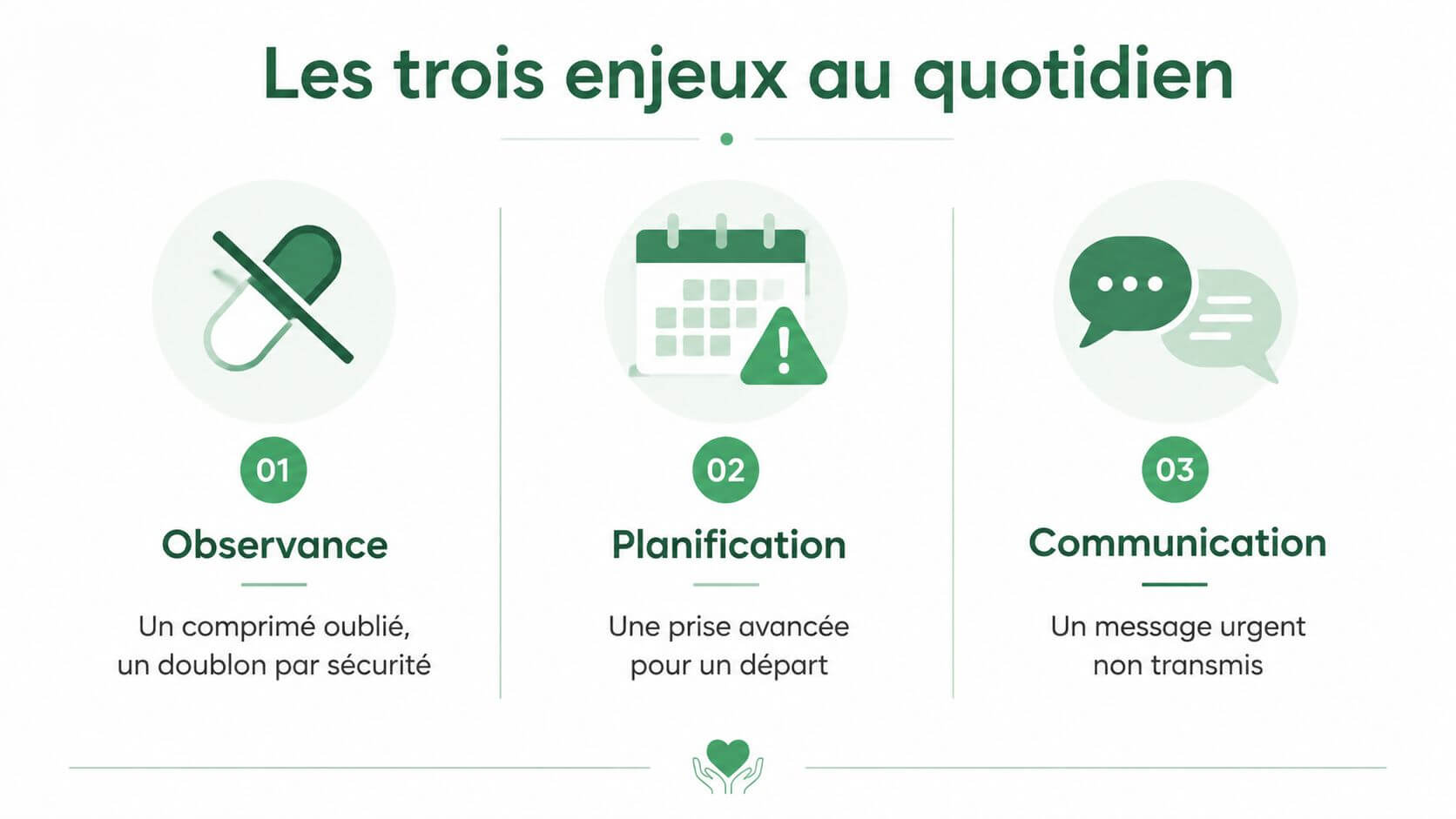
The WHO has traditionally retained a benchmark of compliance around the 80 % This threshold never replaces the analysis of the clinical context. A vital treatment does not have the same level of tolerance as a comfort treatment, and that is precisely why the follow-up must remain individualized.
Transforming a feeling into useful information
Record the date, time, and condition of the person, often this allows the physician to understand whether the problem comes from the medication, disease, or from a bad relay.
When several caregivers take turns, oblivion becomes collective
A father under anticoagulant can very well be surrounded, and yet remain exposed. His daughter runs on weeknights, his son spends the weekend, and a home helper sometimes takes over in the afternoon. If no one confirms the evening take, each one often thinks that the other has already given it.
This is where the risk changes in nature. Without written transmission, a tablet can be given twice, or not at all, simply because two people assumed that the right box was already checked. So the problem is not just individual forgetfulness, it becomes collective as soon as no trace is shared.
Families often talk in verbal mode, it's good, he took it. This formula reassures at the moment, but it does not protect against a medical decision based on inaccurate information. From the outside, the caregiver then sees only part of the story, and he has to deal with a fragmented narrative.
For those who organize the speech around the home, the SpeakMeeters World Helper Guide It is useful to recall that a message is useful only if it is understood by all stakeholders. In the same spirit, a catch history readable by several caregivers reduces misunderstandings before they become incidents.
The key point is simple, an unconfirmed dose must not remain invisible. When a family relay exists, the follow-up is not only used to memorize, it is used to make the catch verifiable by the whole tribe, instead of relying on the memory of each. To structure this type of relay, a tool like https://tribulys.fr/guide-coordination-aiders can help frame the roles and flow of information.
Indicators and signals to be monitored week after week
The most useful surveillance is not complicated, it is regular. Every week, it is better to look at both the stock, Pillier, the confirmed and a few simple signs at home. The goal is not to measure everything, but to quickly spot what's messing up.
What Caregivers Can Check
- Stock and duplicates, Count the remaining tablets, spot a box in duplicate, check if the Sunday pill fits the current prescription.
- Compliance, follow the ratio of prescribed to confirmed doses over seven days, without waiting for the following month to act.
- Simple constants, Note the weight, tension, temperature and any unusual drowsiness when this is already part of the home's habits.
- Low signals, monitor new confusion, loss of appetite, falls and transit disorders, especially if several of these signs come together.
When follow-up of confirmed doses passes under 80% over seven days, call the pharmacist. If two falls occur within 15 days, the message must go back to the doctor without delay ameli source.
The French home recommendations also emphasize very concrete indications, absence of piles, medicines dispersed in several rooms, several cans of the same drug started, large reserve, or irregularly taken with improper use of piles source Omedit Bretagne. These details seem modest, but they often say more about the actual safety of the treatment than just a little bit goes well.
Simple benchmark, If the stock is no longer sticking to the expected pace, the cause must be sought before changing the dose or resetting a box.
Three settings to make treatment reminders reliable
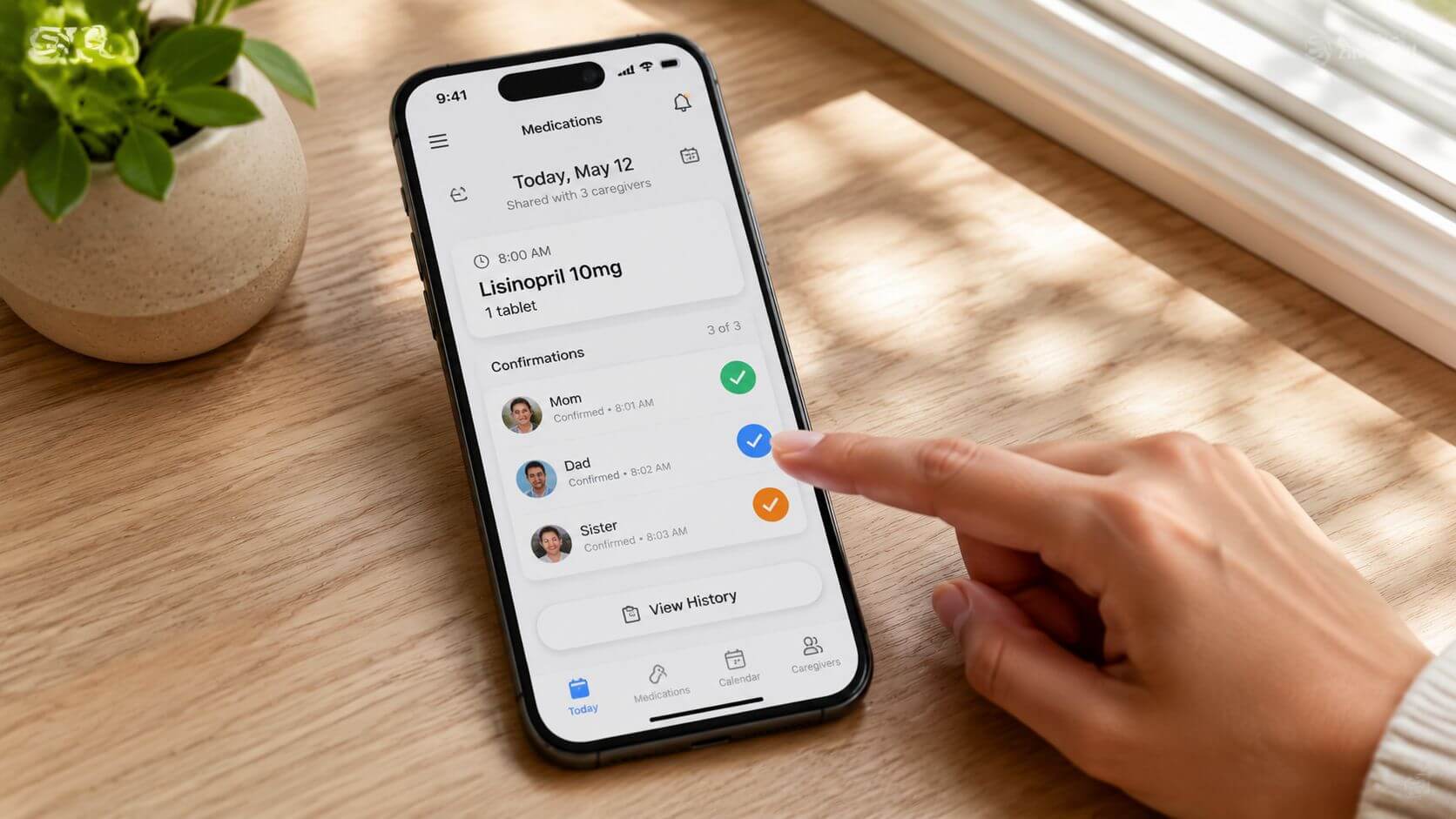
The first adjustment is the shared recall between several carers. With individual confirmation, the evening take no longer depends on a message read too late or a missed call. The recall comes to the right person, at the right time, and everyone knows if the dose has been confirmed.
The second setting is the mode I confirm, you're.... The primary caregiver sees in real time what has already been administered by another member of the family, which limits double doses and silent oblivion. In this type of coordination, Tribulys offers a follow-up of home medicines that centralizes confirmations and shared history, as well as a digital link book and a common agenda.
The third setting is the oneexportable history of the last seven days. It becomes useful at the time of a renewal, a change in dosage, or an exchange with the doctor, because it shows the actual taken and observed deviations. To go further on the logic of transmission, https://tribulys.fr/blog/application-prise-de-mediamente provides a practical framework for recall and coordination.
| Adjustment | Concrete effect |
|---|---|
| Shared reminder | The catch is no longer dependent on a single person |
| Visible confirmation | Duplicates and forgetfulness become detectable |
| Exportable history | Caregiver has an exploitable trace |
The useful parameters are simple, but they count, separate notifications for helper and helper, tolerance zone, confirmation code. Without these settings, an alert remains an alert. With them, it becomes a verifiable coordination loop.
From withdrawal to traceability useful to the caregiver
One Timed catch log Looks like a logbook. It does not replace the gesture of taking a drug, but it keeps a clear record of what was done, at the right time, by the right person. This is also what links home to clinical follow-up. With this in mind, the digital care journal helps to circulate useful information between caregivers, without depending on each person's memory, as explained by this electronic link book.
The doctor or pharmacist does not only need to know that treatment has been followed. It needs precise facts, the actual time of the dose, a missed dose, a avoided duplicate, a felt effect noted the same day, or a picture of the stacker. These elements weigh more than an approximate narrative, especially when several medications are added or treatment changes. They are also used to prepare drug reconciliation after hospitalization and to better understand the exchanges of the liaison file.
| Registered data | Usefulness for the caregiver |
|---|---|
| Time taken | Check for regularity and real rhythm |
| Sautéed dose | Identify a risk of oblivion or rupture |
| Duplicate avoided | Understanding a potential accident |
| Effect felt timed | Connecting a symptom to a specific dose |
| Photo of the pill organiser | Control the organisation of the treatment |
The framework remains that of confidentiality. Sharing should be limited to the circle of care, with rules of GDPR and dHDS hosting when the tool hosts health data. The challenge is not to show everything, but to circulate what really helps, between the right people and at the right time.
A catch schedule becomes really useful when it speaks the language of care, not just the language of reminder.
Three gestures to put in place this week
The first move is to open up a shared catch book, digital or paper, and enter for each drug the name, dosage, time, route and pattern. Even simple, this database already avoids ambiguities between two similar boxes or two different instructions given by two professionals.
The second move is to name a Helper referent per hour and one reference pharmacist, then to write the rule of doubt, who to call, and within what time. This clarity makes gain in serenity, because it avoids improvised decisions at a time when no one is completely sure of what has already been done.
The third move is to program three journals, seven days, one month and three months, to look together at compliance, tolerance and stock. It is also the right time to review shortages, substitutions, and signals that must trigger a call to 15 or to the attending physician rather than a random search on the Internet.
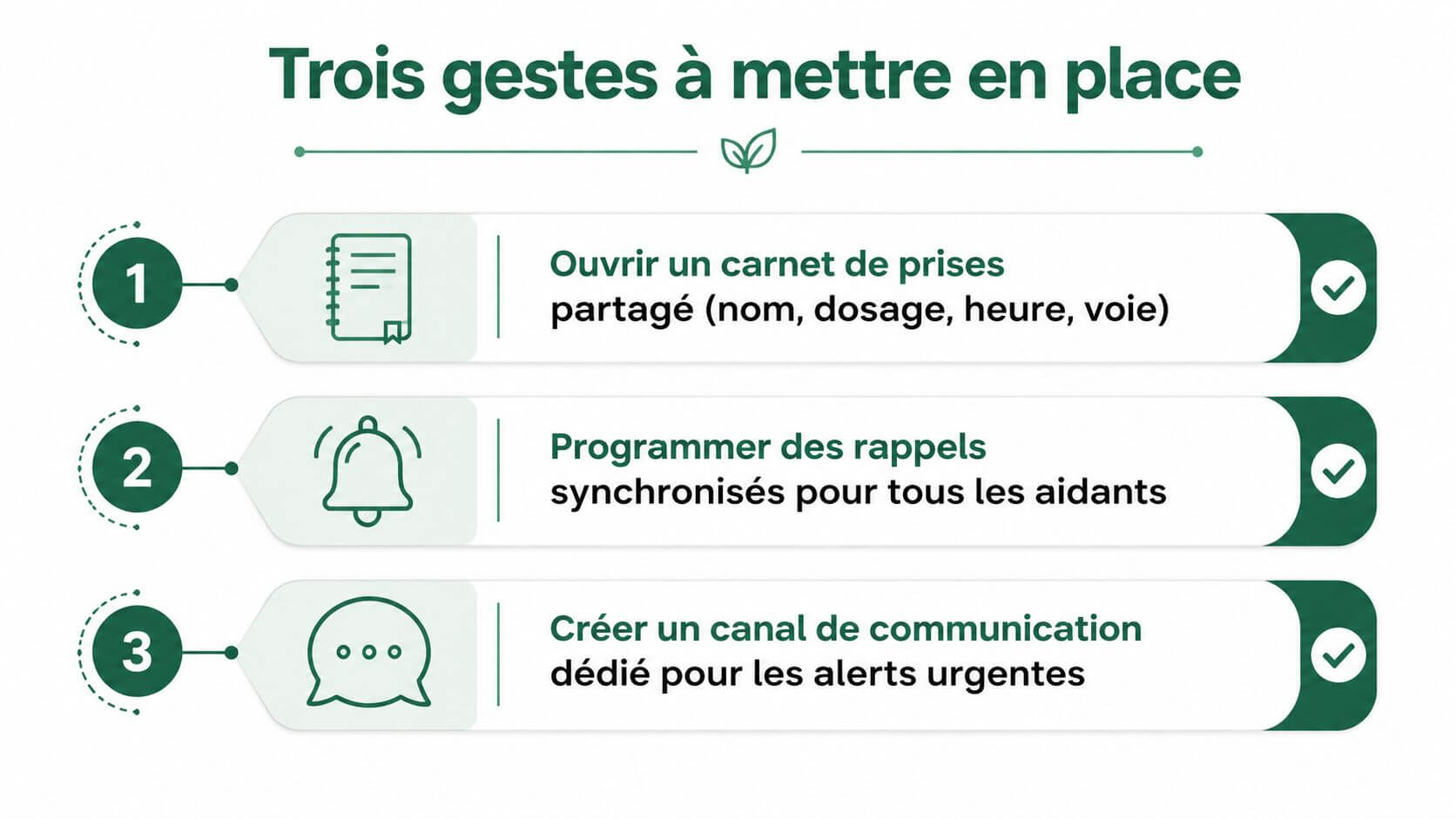
The most reliable method remains the simplest, a single medium, an identified official, and a review date already set. When these three elements are in place, the house moves from a series of fragmented exchanges to a coordination that holds in time.
If you're looking to organize taking a loved one without losing the information between two caregivers, Tribulys centralizes the care journal, drug recalls and shared history. You can see how this coordination works in practice on Tribulys, especially when several people take turns and an unconfirmed take must no longer remain invisible.
Put this organisation into practice with Tribulys
Keep your care journal, shared calendar, tasks, medication tracking and emergency information together. Start for free and invite the relatives and professionals involved in your loved one’s care.