
A pain in the knee wakes you up, then the day is organized around what it will prevent you from doing. A close friend prepares the medicines, the nurse passes, the physiotherapist gives exercises, but each one does not always have the same information. Between a forgotten take, an inappropriate appointment and a session that has become too difficult, the relief of rheumatism often depends as much on the continuity of the follow-up as on the treatment itself.
In France, rheumatism and musculoskeletal diseases concern more than 16.8 million people, that is a little less than one in three French, and represent 10.9% of the overall burden of disease in the country, according to the estimates presented by the Arthritis Foundation. The answer must therefore go beyond the reflex "what medicine to take ? " It must combine diagnostics, adapted motion, secure environment, observation and reliable transmissions.
Contents
- Why rheumatism relief goes beyond simple medication
- Understanding the different rheumatic diseases and their management
- Exercises and physical activity adapted to reduce joint pain
- Drug management and treatment by type of rheumatism
- Technical assistance and adaptation of housing to preserve autonomy
- Coordination of care between family caregivers and health professionals
- Action courses and answers to questions from caregivers
Why rheumatism relief goes beyond simple medication
Martine lives with an osteoarthritis of the knee. Her daughter knows the treatment schedule, her nurse observes the difficulties during the toilet and her physiotherapist follows mobility. Yet, for several days, no one knows that Martine walks less, sleeps badly and avoids the stairs. Each professional sees part of the problem, while the pain settles in the daily.
This situation is common on home trips. A prescription can reduce pain, but it does not correct a chair too low, a fear of moving, a poor division of tasks or information that remains in a text message. The treatment of rheumatism must integrate the person, his or her caregivers, his or her habits and the professionals who accompany him or her.
Practical rule: persistent pain deserves to be described in its context, not only as "stronger" or "less strong".
Data relayed byInserm the extent of the need. 93% of French people had already suffered joint pain and thatOne in two Frenchmen suffered at the time of the investigation. These benchmarks explain why lack of treatment, missed appointments and incomplete transmissions have concrete consequences.
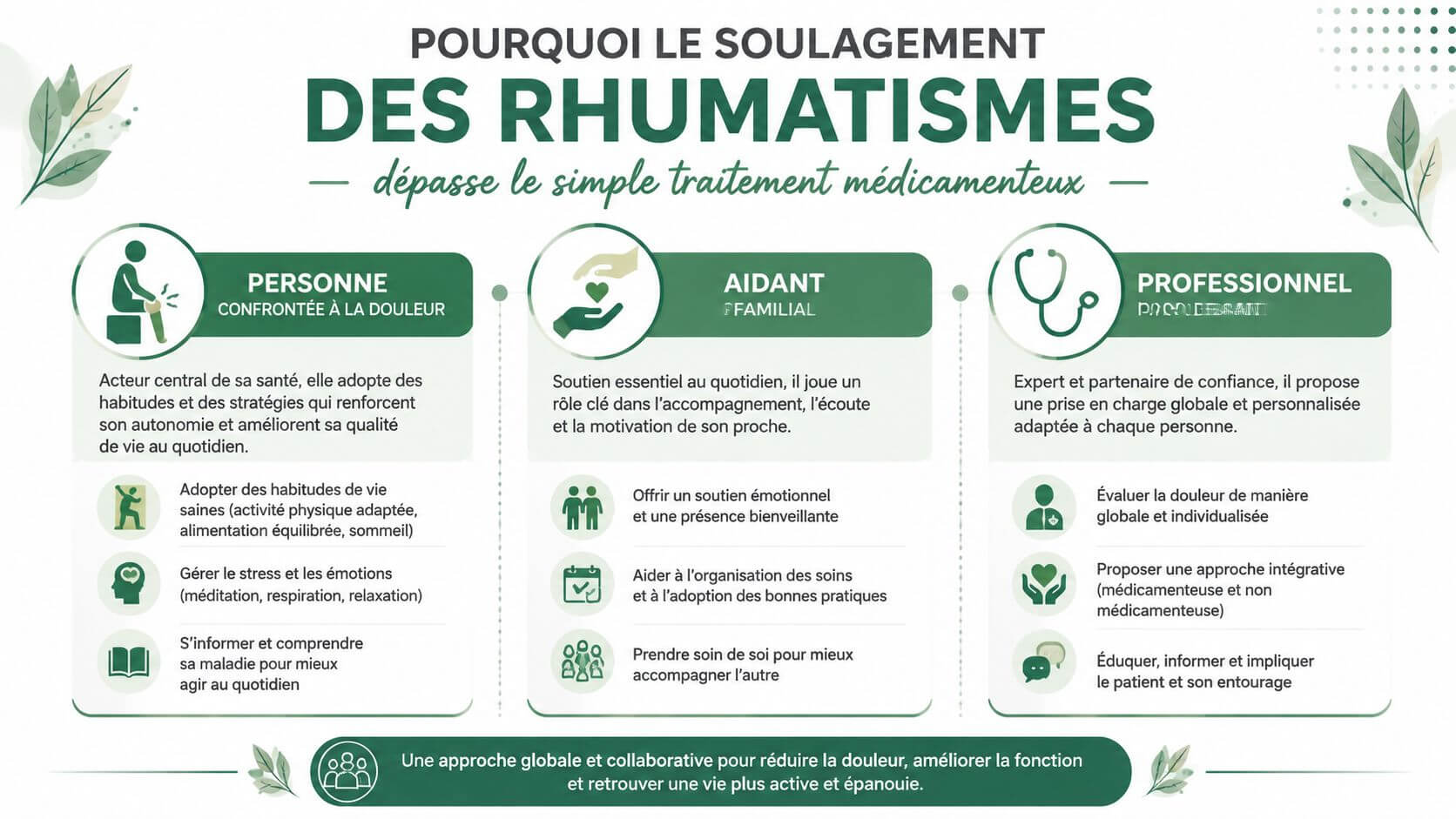
At home, useful actions are complementary:
- Observe pain: Note its moment of appearance, triggering gestures, stiffness and swelling.
- Maintain movement: prefer an appropriate activity rather than prolonged immobility.
- Secure gestures: changing the environment before each move becomes a test.
- Share information: communicate the changes to the nurse, physiotherapist and physician.
- Re-evaluate: do not pursue an ineffective strategy without talking to the prescriber.
The relief becomes stronger when the team around the person pursues the same goals. The caregiver does not have to become a doctor, and the professional cannot guess what happened between two visits. Clear and dated information allows everyone to act at the right time.
Understanding the different rheumatic diseases and their management
At home, a person can walk with knee pain, wake up with swollen hands or limit his or her movements for fear of worsening his or her condition. These situations do not come under the same mechanisms. The word "rheumatism" brings together different pathologies, and the diagnosis made must guide the activities, treatments and alerts to be transmitted.
Osteoarthritis includes knee, hip, fingers or spine. Pain often increases during stress and is accompanied by a functional discomfort. Management combines adapted movement, reinforcement, rehabilitation and analgesic treatments chosen with the doctor. The aim is to preserve function and reduce discomfort, rather than rely on a single solution.
Rheumatoid arthritis and spondyloarthritis belong to inflammatory rheumatism. Inflated or hot joints, severe morning stiffness and unusual fatigue should be reported. Background treatments seek to control the activity of the disease. Their effectiveness therefore depends on the regularity of the intakes, medical follow-up and precise transmission of observed changes.
The French figures confirm that these diseases affect a large number of people. 2012 and 2016The number of people taking care of rheumatoid arthritis and related diseases has increased on average by 3.7% per year. The number of people followed for spondyloarthritis and related diseases increased by 6.3% per year, depending on Arthritis Foundation.
A table to guide the first questions
| Pathology | Main origin | Typical pain | Preferred care |
|---|---|---|---|
| Osteoarthritis | Mechanical and degenerative joint damage | Harness to effort, stiffness, progressive limitation | Adapted physical activity, rehabilitation, gesture adaptation and symptomatic treatment |
| Rheumatoid arthritis | Chronic inflammatory disease | Pain with swelling, heat and stiffness | Substantive treatment, rheumatological follow-up, adapted activity and monitoring |
| Spondylitis | Inflammatory rheumatism affecting particularly the spine and peripheral joints | Rider and variable inflammatory pain | Substantive treatment, maintenance of mobility and medical follow-up |
| Juvenile idiopathic arthritis | Inflammatory illness of children | Pain, stiffness and limitation according to joints | Specialized paediatric follow-up, adapted treatment and family support |
This table serves as a benchmark, not a diagnosis. The caregiver can record schedules, difficult gestures, swelling and adverse reactions, and then transmit these to the nurse, physiotherapist and physician. This coordination avoids that important information stays between visits and helps the team adjust their decisions.
A sudden very hot, red and painful joint, fever or rapid loss of function require rapid medical advice. The same vigilance is required in the face of unusual worsening in a person who has already been followed.
Exercises and physical activity adapted to reduce joint pain
The immobility seems reassuring during a crisis, but it can make gestures more difficult when it continues. In osteoarthritis, the French recommendations place adapted physical activity with first intent, with a reduction in sedentaryness, as the White Paper on rheumatology 2025. Good exercise is not the one that forces, it is the one that the person can repeat without degrading his condition.
A simple routine to build
Start with slow, seated or elongated mobilization. Drag the foot to fold and then stretch the knee in a comfortable amplitude, open and close your hands without tightening, then make some ankle movements. The goal is to wake up mobility, not cause acute pain.
Then add a soft reinforcement, after validation by the professional who follows the person. A sitting knee extension, a controlled chair lift or a brief contraction of the thigh can be gradually integrated. For the hands, pressing a soft sponge may be preferable to a hard ball if the joints are sensitive.
- During the year: breathing must remain regular and movement controlled.
- After exercise: Monitor the course of pain and swelling in the following hours.
- In the event of an inflammatory outbreak: Reduce the intensity and ask for advice rather than automatically maintain the routine.
- For the caregiver: accompany, but never shoot a painful limb and do not replace the physiotherapist's instructions.
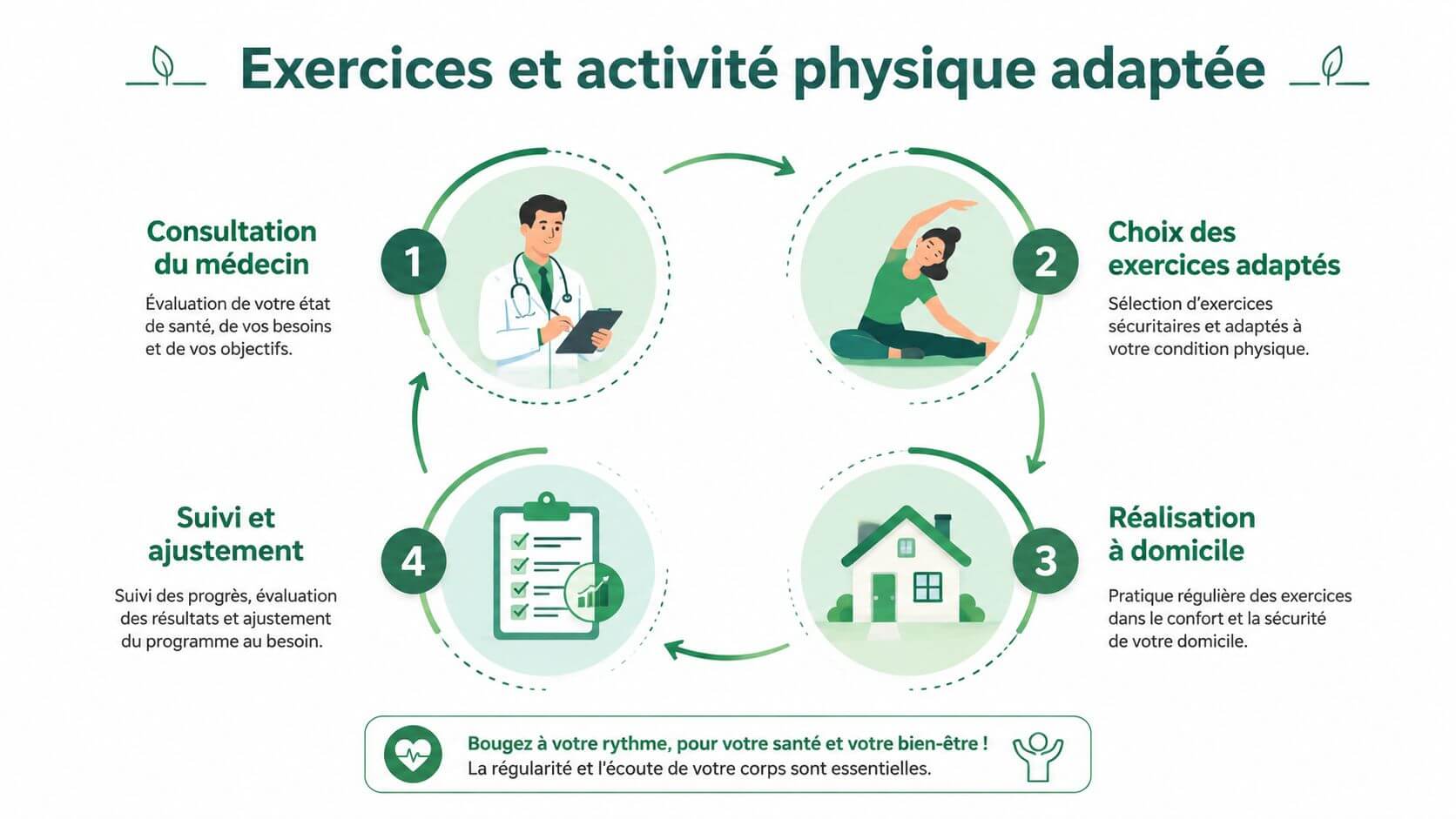
A session with a physiotherapist also serves to learn the dosage. Walking, gentle cycling or exercises in the water may be suitable for some people, but pathology, balance, fatigue and treatments change the indications. A slow and documented progression is better than an intense effort followed by several days of stopping.
For foot comfort, posture and support, a specialist opinion can complete the follow-up. Discover the useful references in this guide dedicated to the podologist at home and at the comfort of the feet.
A thermal cure can be a structured complement, not a replacement of the medical path. In the multicentre trial Thermormarthrose, 462 patients with gonarthritis were followed in three thermal centres, with 18 days of thermo-mineral treatment associated with usual treatment or standard treatment alone. 6 months, 50,8 % patients showed clinically significant improvement in pain and mobility, 36,4 % in the control group. 9 months, the results remained superior among the curists, 53.8% versus 35.8%, according to Report of the Thermormarthrose trial.
These results do not mean that the cure is suitable for everyone. The French recommendations reported by theNational Academy of Medicine focus on the selection of stable patients, a cure for 18 to 21 days, then a remote re-evaluation with functional scores such as WOMAC or Lequesne index.
Drug management and treatment by type of rheumatism
The treatment that relieves knee osteoarthritis does not have the same role as the one that controls rheumatoid arthritis. This distinction avoids two opposite errors, taking a medication unsuitable for the situation or waiting for an analgesic to control an inflammatory disease.
For knee osteoarthritis,Assurance Maladie indicates that paracetamol may remain a first-line option. NSAIDs should be used in a short and targeted manner, with particular attention to history, other treatments and contraindications. Prolonged self-medication is not a bottom-up strategy.
In inflammatory rheumatism, basic treatments have a different function. They aim to control the activity of the disease and require regular prescription, monitoring and observation. An improvement felt does not justify stopping or modifying treatment without exchange with the doctor.
Compare before taking action
| Pathology | First-line treatment | Recommended duration | Points of vigilance |
|---|---|---|---|
| Arthritis of the knee | Paracetamol according to medical assessment, adapted activity and rehabilitation | Use according to prescription, with re-evaluation | Respect prescribed doses and limit NSAIDs to targeted situations |
| Osteoarthritis with painful thrust | Physician-adjusted symptomatic treatment | Short period if NSAID is retained | Digestive, cardiovascular, renal and interaction history |
| Rheumatoid arthritis | Substantive treatment and specialized follow-up | Long-term follow-up by disease activity | Do not interrupt alone, report side effects and infections |
| Spondylitis | Substantive treatment, adapted movement and medical follow-up | Regular review | Distinguish inflammatory thrust, fatigue and associated mechanical pain |
The caregiver can secure the frame without interpreting the prescription. He checks the intended intake, notes an adverse reaction, reports a difficulty in swallowing or detects a change in behaviour. A medication application can help maintain this trace, provided the data remain consistent with the prescription and are discussed with the professional.
The management of home drug intakes becomes particularly important when several people take turns. A clear confirmation is better than an uncertain message of the type "I think it's done".
Technical assistance and adaptation of housing to preserve autonomy
A poorly adapted home transforms moderate pain into a succession of efforts. A person who recovers from a wheelchair that is too low asks more for his knees and hips. A fine handle, a tap that is difficult to turn or an object that is stored too high impose repeated gestures on the hands that eventually discourage autonomy.
The adaptation begins with observation. Ask the person to perform a usual gesture, without correcting it immediately. Find out what causes a twist, a loss of balance, a forced take or a need for help. The occupational therapist can then propose a proportionate solution, sometimes without important work.

Part-by-part modifications
In the bathroom, a stable shower seat, a properly fixed hold bar and a non-slip mat reduce effort and risk. In the kitchen, large handle utensils, jar openers and frequently used objects at an accessible height avoid difficult sockets. In the bedroom, a suitable bed height facilitates transfer, while sufficient lighting secures the lift.
For knees and hips, a chair with armrests can make lifting more fluid. For hands, it is better to distribute loads, use both hands and avoid maintaining a heavy object for a long time at the end of the arm. These adjustments do not remove the disease, but they reduce unnecessary stresses.
Outside travel also requires preparation. travel adapted to disability can help anticipate access, breaks and equipment needed during a stay.
Technical assistance must remain useful, not cumbersome. A fall detector can complement a safety organization when the balance is fragile, as presented in this guide on the Fall detector at home. It does not, however, replace the layout of the passages or the presence of a relative where the situation so requires.
The physiotherapist observes mobility, the occupational therapist analyses gestures and the caregiver describes the actual difficulties. The housing then becomes part of the daily treatment, as well as the exercises and the follow-up of the prescription.
Coordination of care between family caregivers and health professionals
Chronic pain rarely causes a unique problem. It changes sleep, walking, mood, meals, appointments and the caregiver's ability to hold on. If each practitioner keeps his/her information in a different channel, the doctor sometimes receives an incomplete picture and the family repeats the same requests.
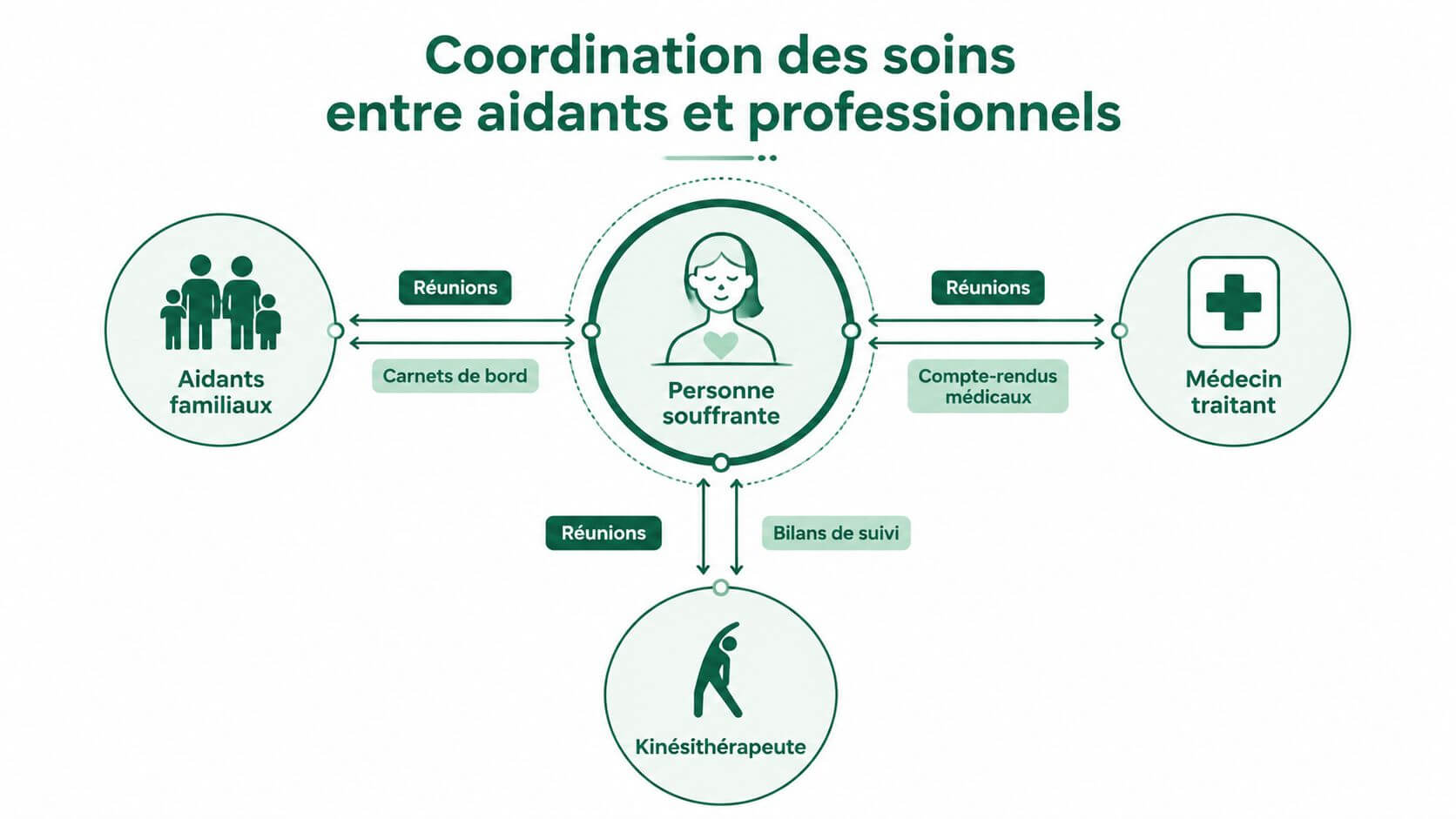
Structured coordination responds to this lack of continuity. The caregiver can note the observed evolution, the nurse transmits a difficulty during a treatment, the physiotherapist specifies the exercise actually performed and the doctor decides on a re-evaluation. This circulation is not intended to multiply the messages, but to make the information usable.
What to Transmit
A good transmission answers simple questions:
- What's changed? Pain at rest, shorter walking, swelling, tiredness or disturbed sleep.
- When did this happen? A date and a time make it possible to bring the symptom closer to a treatment, an effort or a dose.
- What action has been taken? Exercise, rest, accommodation adjustment or prescribed medicine.
- What was the result? Improvement, lack of effect, new discomfort or worsening.
- Who's got to act? Helper, nurse, physiotherapist or doctor, depending on the nature of the signal.
This method reduces the risk of duplication and prevents a professional from continuing an intervention that has become inappropriate for lack of information. It also protects the caregiver, who no longer has to bear the memory of the journey alone.
To be transmitted to the doctor: a dated evolution, actual intakes and observed functional capacity are often more useful than a general appreciation of pain.
A shared notebook, timed entries and clearly defined roles make the relays more reliable. The nurse can confirm a care, the physiotherapist inform the tolerance of an exercise and the family follow the appointments without creating several versions of the same information. The person suffering remains the center of the decision, even when several stakeholders contribute to his or her accompaniment.
Action courses and answers to questions from caregivers
Start by having the diagnosis and warning signs confirmed with the doctor. Then note the pain, pain and functional difficulties, then have a routine of movement validated by the physiotherapist. Adapt the accommodation to the most painful gestures and share the observations with the workers.
Should we stop the exercises if the pain increases? Reduce the intensity and ask for advice if the worsening persists, especially in case of swelling or heat.
Who should be informed of a drug forgetfulness? Report it according to established instructions, without doubling the take of your own initiative.
When can I ask for a re-evaluation? As soon as pain changes sharply, a joint loses function or treatment no longer seems appropriate.
How to relieve rheumatism without exhausting the caregiver? Divide tasks, formalize transmissions and clearly identify the person responsible for each action.
Tribulys centralizes the link book, drug intakes, schedule and transmissions between caregivers and home professionals. Visit Tribulys to organise a shared follow-up, to limit forgetfulness and to give each stakeholder an updated view of the situation.
Put this organisation into practice with Tribulys
Keep your care journal, shared calendar, tasks, medication tracking and emergency information together. Start for free and invite the relatives and professionals involved in your loved one’s care.