
At 7:30 a.m., the girl called the home care worker to see if her father had taken her treatment. The attendant was looking for information in a notebook placed near the phone. The nurse left a note in a text message sent the day before, while the son who lives at a distance consults with another messaging group. Everyone does their part, but no one has exactly the same information.
It is in these small gaps that the home becomes fragile. An inappropriate visit, an unconfirmed take, an oral statement or an unavailable mobile network is enough to create a silence. The problem does not always come from a lack of involvement. It often comes from successive relays, with people who have neither the same role, nor the same schedules, nor the same access to information.
Contents
- Introduction to home retention software
- Understanding what home support software is
- Essential Features for Coordinating Home
- Practical benefits for caregivers and professionals
- How to choose the right home maintenance software
- Daily use cases and multi-stakeholder coordination
- Deploy and adopt the software without weighing the daily
Introduction to home retention software
At 8 a.m., a home care worker discovers that an order has changed. The daughter of the accompanied person sent her the day before, the nurse did not consult the same exchange and the close relative who lives far away is still waiting for confirmation. Everyone intervenes at his time. The home then functions as a discontinuous environment, where every silence or missed relay can delay the right decision.
This coordination brings together relatives, a independent nurse, a home care worker, a treating doctor and sometimes a home help service. Interventions are chained up, but the information does not always circulate with them. A home support software is used to reduce this hidden cost without adding a heavy task to the caregivers. It gathers the useful elements, makes the responsibilities visible and limits calls intended solely to verify.
In France, 82,776 personal service organizations were identified as of January 1, 2025, after an increase of 18% between 2024 and 2025, while 884 million hours worked were recorded in 2024 by the official data of the personal services sectorThese volumes illustrate the number of passages, replacements and transmissions to be synchronized.
The need also concerns families. Two million older people need help at home, a volume announced as likely to reach 2.7 million in the coming years. For them, the tool must make the information understandable without imposing a constant presence on the phone.
The hidden cost of coordinationThese are calls to check, repeated messages, forgotten appointments and decisions made with incomplete information.
The guide will examine the functions of such a tool, then their effects on caregivers and professionals. It will also discuss the criteria of choice and everyday situations. Tribulys will serve as a red thread around the care journal, drugs, schedule and access roles. To broaden the reflection on the living environment, you can assess the canopy of a neighbourhoodA further presentation is given in this guide on the Home maintenance.
Understanding what home support software is
Home support software looks like a shared control tower. The tower does not do the work of the aircraft, pilot or weather. It gathers useful information, indicates who intervenes, reports changes and keeps track of what happened. At home, the software does not replace the nurse, the assistant, or the family. It gives everyone an organized view of the situation.
The operation can be understood in four movements:
- Prepare, with the necessary agenda, tasks, processing and documentation.
- Transmit, thanks to the care journal and a courier gathered at the same place.
- Reportby means of reminders, alerts and notifications.
- Tracing, with dated entries, identified comments and a searchable history.
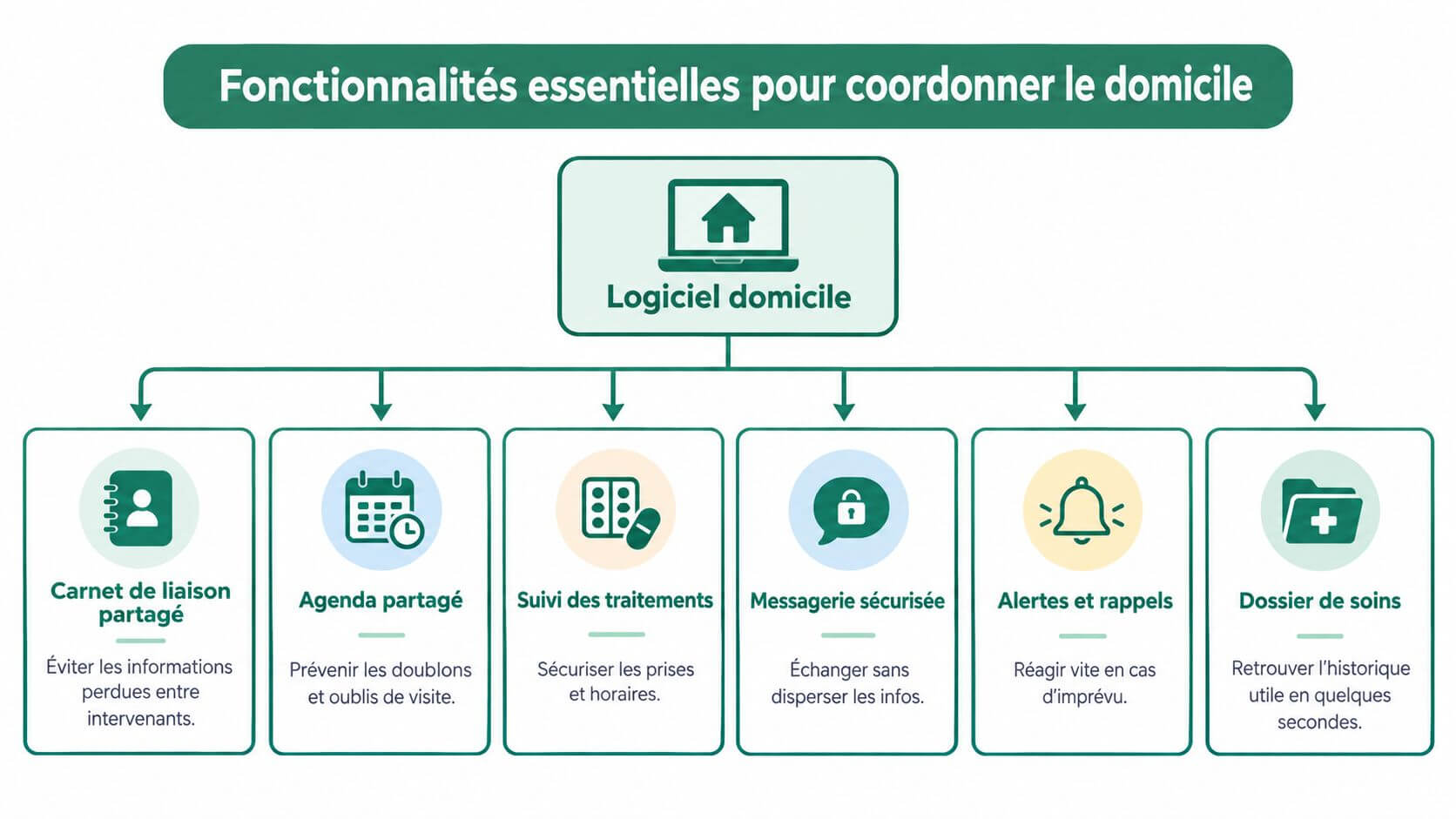
The difference with a messaging group is that structure. In a group, important information can be found between several exchanges, without clear status or confirmation of useful reading. A paper book sometimes keeps a trace, but it remains inaccessible to the person who lives far away and does not always allow to distinguish an old one from a recent observation.
The question of access rights is just as important. A relative may need to see the schedule and general transmissions. A nurse may consult the elements necessary for his intervention. A doctor may seek a history of treatment or a evolution of constants. So the right organization is not to give everything to everyone, but to assign to each role. the relevant level of information.
The timed traceability adds an answer to the misunderstandings. A note indicates who created it, when it was added and, depending on the tool, if a task has been closed or commented on. The synchronization then allows to share this update as soon as the connection is available. For families who wish to deepen the role of an application with relatives, this Guide on the Family Caregiver Application provides another light. Digital subjects may seem far removed from a blog on energy renewal, but both affect the same reality, a home must remain understandable and practical for its occupants.
Essential Features for Coordinating Home
A feature has value only if it removes an identifiable difficulty. The right software does not seek to multiply the screens. It organizes the information when a player needs it, sometimes in seconds between visits.
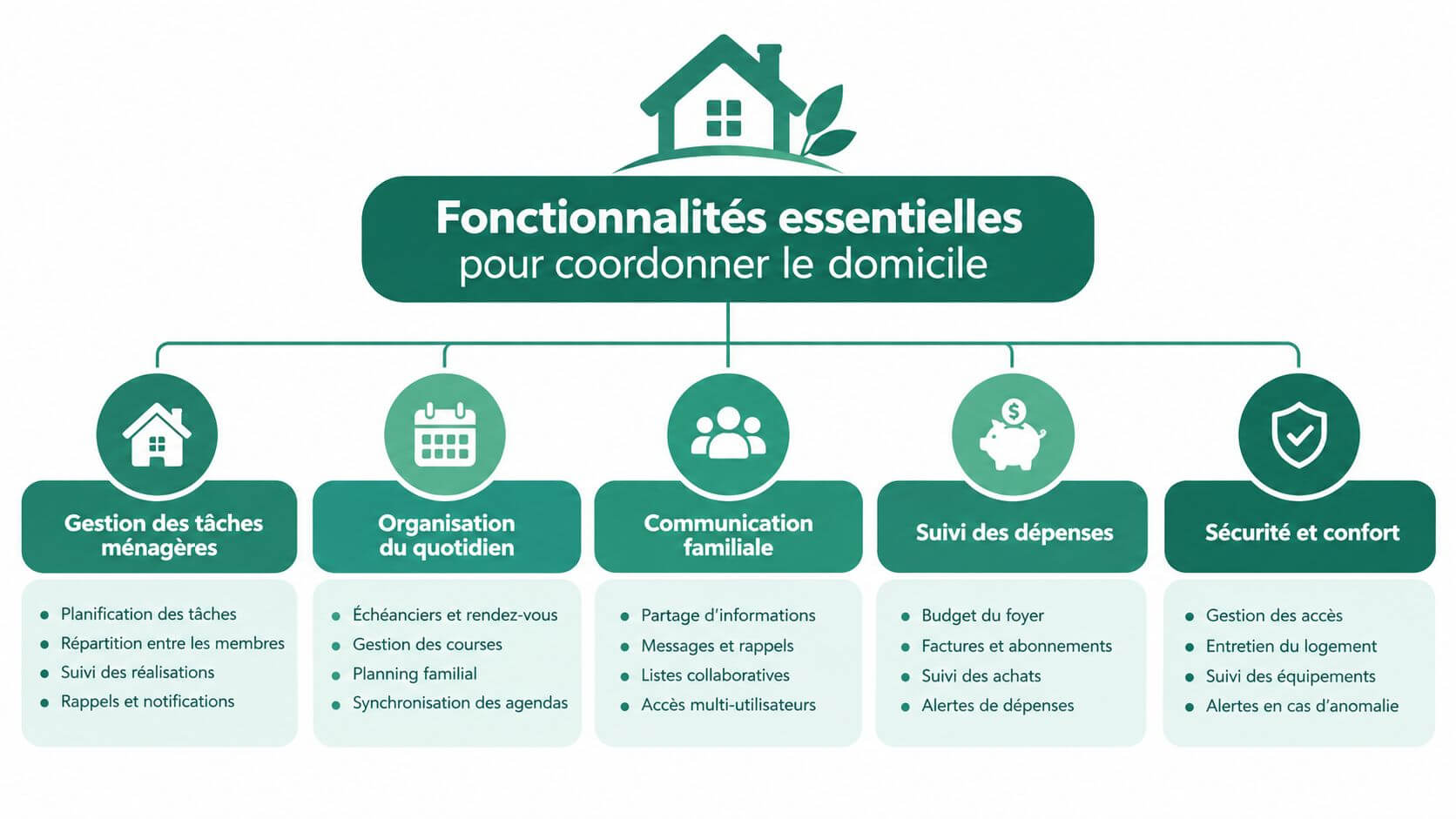
The shared link book
The notebook collects important observations, instructions and events. An auxiliary may report unusual fatigue. A relative may indicate that an appointment has been moved. A professional may add a statement to check during the next visit. Timed entries avoid confusing recent information with an old note.
The notebook should also allow for priority comments and alerts. A general comment does not require the same reaction as an anomaly to be dealt with quickly. Effective software therefore helps to distinguish what simply needs to be read, what needs to be confirmed and what requires action.
The unified agenda and assigned tasks
A single calendar brings together medical appointments, passages and family deadlines. It reduces the risk that two people will run the same race or that a visit will be moved without the next relay knowing it.
The tasks make responsibility visible. "Buying equipment" becomes a task assigned to a person, with a deadline and a condition. The family no longer depends on a promise made on the phone, without knowing whether it has been fulfilled.
Monitoring of medicines
The treatments require more than just a list. You must be able to display the schedules, confirm a dose and identify a lack of confirmation. A reminder helps the person present. An alert can attract the attention of the next of kin in charge of the relay. The history then gives a clearer basis for discussing with the doctor.
The software does not decide in place of the healthcare professional and does not replace a prescription. outline the planned organization and what has been confirmed, which reduces uncertainty during stakeholder changes.
Emergency form and offline mode
In an emergency situation, looking for an allergy, treatment or key contact in several documents is a waste of time. An emergency card collects these elements in a short view, with access suitable for authorized persons.
The off-line solution addresses a very concrete problem. A tour can take place in a building, a rural area or a room where the network goes badly. The speaker must be able to view the planned card, inform his visit and synchronize the information as soon as the connection returns.
Secure constants, documents and exchanges
Tension, weight, pulse or saturation can be recorded in a history when a professional requests this follow-up. Curves facilitate the reading of evolutions, without turning the application into a diagnostic tool.
A document safe avoids dispersing useful orders, records and documents. Private messaging, for its part, keeps exchanges in the coordination space rather than in a succession of personal conversations. Teams who want to visualize the role of the digital notebook can consult this resource on the electronic link book.
The timing and automatic forwarding of data to coordinators is a logic already used by French remote management solutions for home support and support services, as described above. the presentation of Domatel. Entering, synchronizing, and sharing history narrows the gap between what has been done and what is plotted.
A video demonstration can help visualize the place of a tool in daily organization:
Practical benefits for caregivers and professionals
The main benefit is not measured by the number of buttons available. It can be seen when a person resumes coordination after an absence and immediately understands what has happened. It also appears when a professional does not need to call to obtain information already transmitted.
The situation of caregivers makes this continuity particularly important. Three out of ten caregivers accompany their loved ones alone and six out of ten are active or students, according to the elements attributed to the DREES in the available sectoral data. For them, the software must compensate for absence at home, not add a new permanence to be provided.

For the near present
The next of kin who regularly passes by can inform an observation without writing a long report. He confirms a task, adds a photo of a document if the organization allows it and leaves information legible for the person who comes next. The mental burden decreases because he no longer has to remember every detail to transmit it later.
For the helper at a distance
The distant caregiver does not only see if someone has come. He can follow the authorized events, consult the calendar, identify an unfinished task and prepare a call with specific questions. This visibility avoids repeated check calls, while respecting the role of professionals.
For the nurse and home care worker
The professional has access to information ordered before or during his or her visit. He or she can follow a checklist, record a useful item and close the visit without producing a disproportionate account of the time available. Roles and permissions limit the exposure to information that does not concern his or her mission.
Coordination then becomes a human interoperability. It is not just a matter of having software communicated. It is necessary to allow people of different status to understand each other, with simple words, an expected action and a searchable trace.
For the attending physician
The doctor does not need to go through every family exchange. A summary, a history of the intakes or a evolution of constants can help him to reconstruct the context presented by the patient or his entourage. This information remains a follow-up element, they do not replace the clinical examination or the medical decision.
The right question isn't who sent the message? ", but" who must act now, and how will the relay be confirmed? "
To deepen everyone's place in the journey, check out this content on the coordination of home care. The stakes go beyond digital ease. 2025, EUR 43.3 billion is spent on self-sufficiency aidof which: EUR 5 billion for home help in its annual report. Home maintenance is therefore part of an important social and medico-social organization, where continuity and traceability are structural needs.
How to choose the right home maintenance software
The choice must start from the ruptures observed in your home. If the main problem comes from unconfirmed passages, the calendar and the tour close pass before a sophisticated documentary function. If the principal caregiver lives far away, notifications, access roles and offline mode become priority.
Do not only compare the feature lists. Ask to see the full course of a situation, from the addition of a record to its reading, execution, commentary and history.
The decision grid
| Criterion | Why is it decisive? | To be verified in practice |
|---|---|---|
| Security and accommodation | Health data require adequate protection | Check HDS certified hosting, data location, encryption and backups |
| Roles and permissions | Each actor should see only the necessary information | Test Family, Nurse, Physician and Auxiliary Profiles |
| Offline mode | A visit must not become silent when the network disappears | View, enter and synchronize a visit without a connection |
| Booklet and traceability | A transmission must remain dated and assigned | Control author, time, comments and history |
| Agenda and alerts | Relays depend on visible information at the right time | Create an appointment, assign a task and check the notification |
| Simplicity of use | An overly complex tool will be bypassed | Asking a low tech user to make a visit |
| Human interoperability | Family and professionals do not have the same habits | Check if screens and instructions remain understandable for each role |
| Access model | Cost and limits must remain legible | Examine included members, frozen functions and conditions of evolution |
In France, the hosting of health data is supervised by HDS certification. The strengthened framework provides that: physical accommodation is carried out exclusively in the European Economic Area, which concerns cloud architecture, backups and providers involved according to the Health Digital Agency regulatory sheet. So do not just check the location of the main server. Ask what happens to backups, notifications, messaging, analytics tools and subcontractors.
Warning signs
Beware of an application that centralizes the data without explaining access rights. The absence of an activity log, synchronization after an offline period or a clear data recovery procedure must also make you hesitate.
Finally test the tool with a real situation, without starting to import everything. Create an appointment, add a task, simulate a catch forget, write a transmission and ask each actor to find only what concerns him. If this sequence requires too many steps, adoption may remain fragile.
Daily use cases and multi-stakeholder coordination
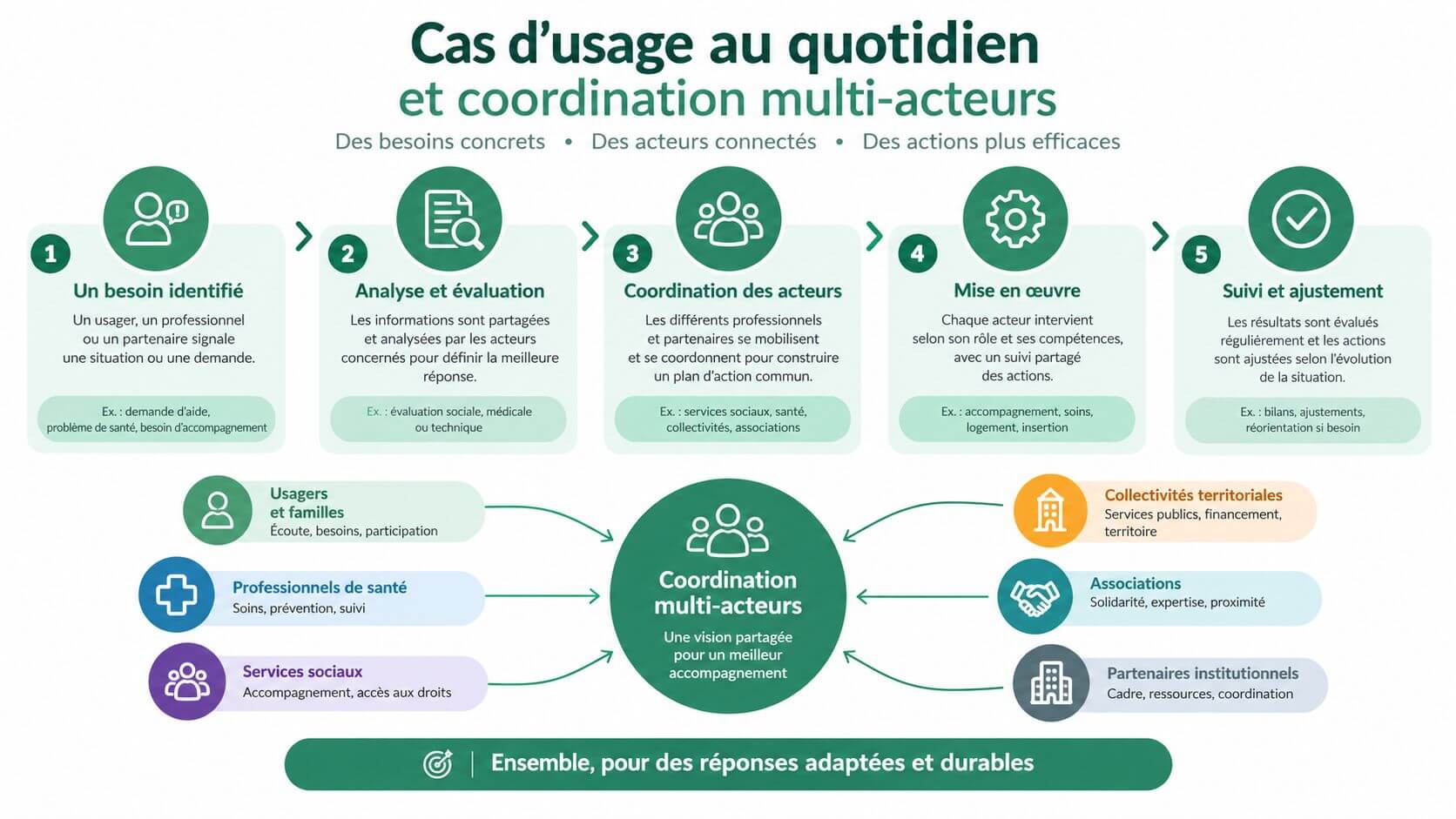
The home changes over the course of the day. A person can be accompanied in the morning by a relative, at noon by an assistant and later by a nurse. Continuity then depends less on the permanent presence of a coordinator than on the quality of the relays.
Weekend Family Relay
The sister who accompanies the relative on Saturday adds the scheduled appointment to the calendar and assigns to her brother the purchase of an administrative document. She also indicates an observation in the notebook. The brother receives the task, realizes it, and then the closing. On Sunday, another member of the family sees the history without asking each one to summarize the previous exchanges.
The value does not come from an additional message. It comes from the fact that the action, its person in charge and its condition are visible in the same place.
The distant caregiver and the catch
The son who lives in another region cannot directly check the treatment. He consults the authorized confirmations, receives an alert when a catch is not informed and contacts the person present with a targeted question. If the absence of confirmation corresponds to an omission, a difficulty can be reported. If it simply comes from a missing seizure, the speaker completes the trace.
This function distinguishes between a silence to check It avoids turning every uncertainty into a series of calls.
The networkless nursing tour
The nurse consults the relevant instructions before entering, then completes the checklist and notes the transmission during the visit. The network disappears in the home. She continues the offline entry, closes the passage, and then the data synchronizes when the phone finds the network.
The next professional then receives dated information, rather than a later report of memory. The physician may consult a synthesis adapted to his or her rights, while the family does not necessarily receive details that fall outside his or her role.
A secure relay does not mean that everyone sees everything. It means that the right person receives the right information when they can act.
These three situations show why human interoperability must guide the choice. The family thinks about responsibilities and availability. The nurse thinks in passing and in transmission. The doctor is looking for an understandable evolution. The software must link these uses without forcing everyone to adopt the vocabulary or habits of others.
Deploy and adopt the software without weighing the daily
A successful deployment begins small. It is better to solve a concrete break, like evening transmissions, before adding all the documents and tasks of the home.
A road map in four weeks
Week 1, prepare. Enter members, define roles and select information that must be visible to each. Set a simple rule, operational information must be added in the shared space rather than in a new personal channel.
Week 2, structure. Add rendezvous, treatments and recurring tasks. Check schedules with people who actually use them. A data that is wrong at first quickly creates mistrust.
Week 3, test. Make a full visit, add a transmission, simulate an alert and try offline mode. Ask a remote relative to find information without assistance.
Week 4, generalize. Extend the usage to the professionals concerned, keeping short instructions. A daily point by e-mail, a visit checklist and a one-step fence are often enough to install a lasting routine.
Rules that encourage adoption
- Write for next relay, with facts, expected action and a deadline.
- Close what's finished, in order to distinguish the past from the remaining work.
- Avoid parallel channels, which recreate silences and duplicates.
- Review Accesses, when an intervenor leaves the home organization.
- Observe usages, by looking at whether check calls decrease and whether transmissions become easier to find.
A tool like Tribulys can be part of this step-by-step approach with a link book, an agenda, a follow-up of drugs, tasks, differentiated roles and offline operation. The solution announces accommodation in France and an organization of access adapted to families and professionals. To start without disrupting habits, choose a single typical day, test it with the people concerned and adjust the rules before expanding.
If you are looking to reduce silence between caregivers and professionals, Tribulys centralizes the link book, schedule, processing and transmissions in a shared space. Visit the site to discover a progressive organization of home maintenance and check if its off-line roles, alerts and tools match your daily life.
Put this organisation into practice with Tribulys
Keep your care journal, shared calendar, tasks, medication tracking and emergency information together. Start for free and invite the relatives and professionals involved in your loved one’s care.