
That morning, everyone did their job well, and yet the day goes off. The assistant of life arrives, the nurse later spends with another drumstick, a child calls from the other end of France, and each has a different version of the same situation. That's exactly where a child calls from the other end of France. application of family caregivers becomes useful, not as an extra gadget, but as a tool of transmission between people who do not always meet at the same time.
In practice, the subject isn't a "app?", but how to prevent information from breaking between relays. In France, the reality of helping is massive, with 9.3 million persons reporting regular assistance to a relative in 2021, i.e. 14,8 % of the population living in France, according to DREES (DREES infographic on caregivers). When you look at the field, the need is not theoretical. It is daily, fragmented, and often urgent.
Contents
- A day of coordination that derails
- What is really an app for family caregivers
- Features that change everyday life
- How to choose the right application
- Two tribes, two concrete uses
- Deploy the tool in your care tribe
- Ideas Received on Helpers' Apps
- Your checklist for a close-up coordination
A day of coordination that derails
Mrs R. is 84 years old, she lives alone in Lyon, and her family is doing its best to maintain a stable organization. This Tuesday morning, the home care worker arrives at 8 am without knowing that the younger daughter changed the take of Pantoprazole the night before. At 10 a.m., the Independent nurse passed by with a pill organisery different from that prepared by the principal caregiver. At 11:30 a.m., the son, on a mission to Lille, received an alarming text message from tele-assistance and telephone panic.
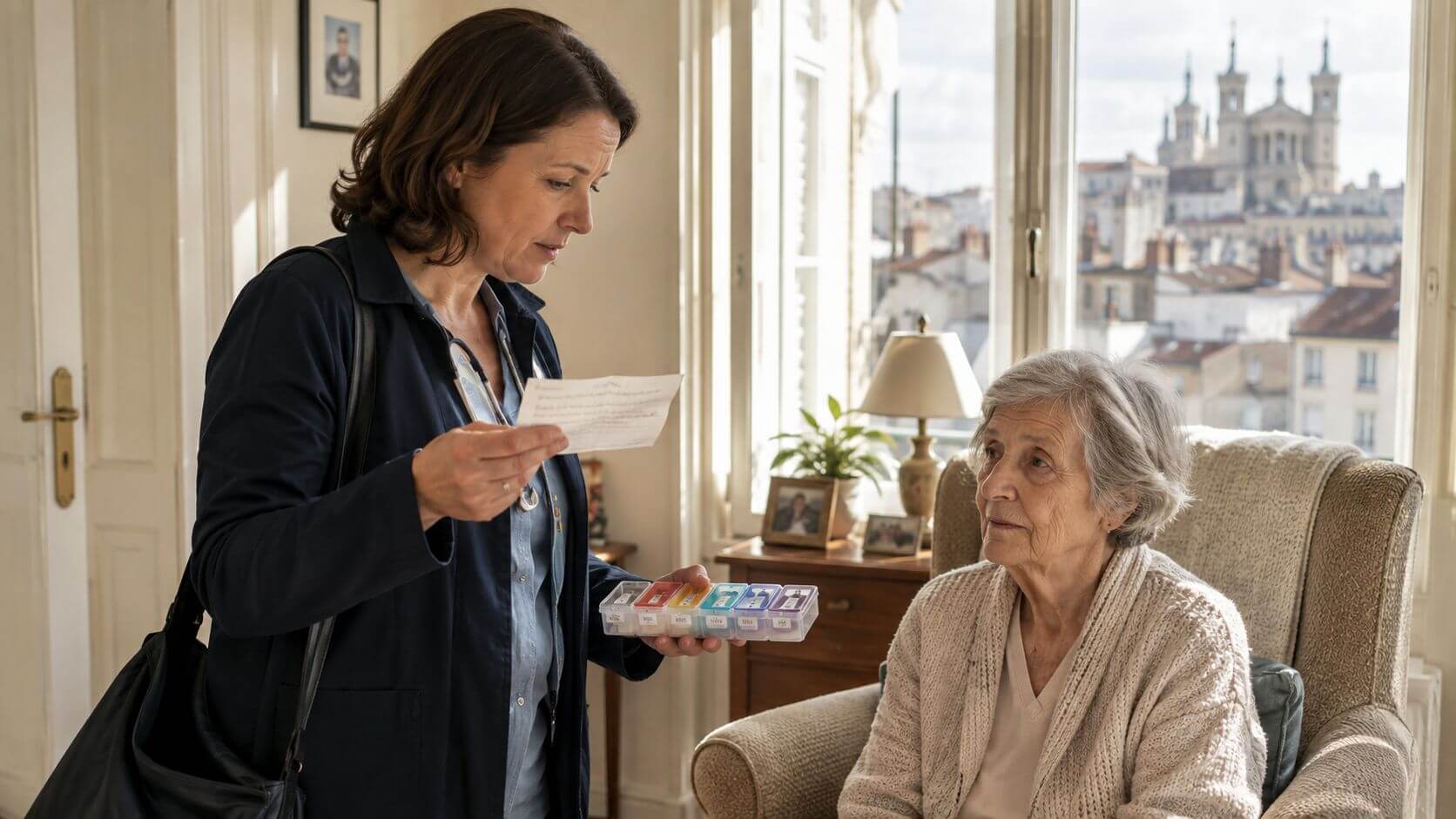
The problem is not the lack of good will. same information at the same time. The slight fall reported on Sunday was not resumed, the cardiology appointment was moved without diffusion, and the catch was doubled because no common support played its part of shared memory. For a family, this type of day uses more than it seems, because each call becomes an attempt to reconstitute the puzzle by hand.
One application of family caregivers First of all, it is used to break this logic of permanent catching up. It brings together useful transmissions, agendas, treatments and contacts in a common space, so that coordination no longer depends on a single tired brain. If you are looking for a field logic on home maintenance, the guide on how to coordinate the care of a loved one kept at home completes this approach well.
Simple rule, If the information is to be repeated three times over the telephone, it is not yet coordinated.
What is really an app for family caregivers
An app for family caregivers is neither a simple schedule, nor a regulated medical record, nor a platform to get people in touch. shared tool which replaces the fragile trio paper notebook, scattered SMS, group calls. Its value lies in the articulation of three bricks, because in a family, help is never just a list of appointments.
The digital link book as common memory
The digital link book collects the person's useful history, allergies, contacts, instructions and processing changes. In a family kitchen, it's recipe we're keeping in our hands so we don't miss the dish. Without this foundation, each stakeholder reinvents the situation from scratches, and this is where transmission errors settle.
The shared calendar as a service plan
The shared calendar indicates who is passing, when, and for what to do. Table of stoves. The auxiliary of life, the IDEL, the kine, the children, the doctor, everyone sees what concerns him without having to revive three people to check if the niche has moved.
Transmissions as a relay table
Structured transmissions are used to tell what has happened, what has changed, and what deserves vigilance. service table. There is an unusual tension, a refused power supply, a slight fall, a change in behaviour, and then the next relay reads, understands, and acts without starting from scratch.
What reassures the principal caregiver most is not just to centralize everything. no longer carry everything in his head. A good app tracks decisions, keeps history and avoids that the most exposed relative is also the only custodian of family memory. The electronic link book then becomes a concrete support point, not another layer in chaos.
Features that change everyday life
A useful tool does not judge itself on his list of functions, but on the friction point he's taking it off. When I see a family adopting an app, I first look at what it stops doing by hand. If medication, home visits and instructions become clearer, the tool has already gained its place.
Medicines, to avoid duplicating and blind spots
The follow-up of medicines must answer a simple question, which did what, when, and on what basis. timed take plan, non-take alerts and visibility on prescription changes prevent a stacker from being prepared on an old set. When the pharmacy, the IDEL and the family do not have the same support, the risk is not abstract, it is mechanical.
Unified agenda, to see holes before they turn into a problem
The shared calendar is used for recurrent interventions as well as for ad hoc appointments. The home care worker, the kine, the orthophonist, the visiting children and medical consultations must be visible in the same space. Otherwise, the family discovers too late that a niche has been forgotten or that a duplicate was created by a last-minute change.
Short transmissions, to replace the notebook on the table
The paper book has an obvious limit, it is not read at the right time. A message dated, in short, signed, consulted at night or at the time of the relay, changes the quality of continuity. The right format is not a novel, it is a usable information, written in the right place. It is precisely the interest of a electronic link book.
Emergency cards and offline access
Allergies, treatments, contact details and sensitive instructions are included in the emergency cards. They must remain accessible quickly, including in the event of unforeseen hospitalization. Offline mode also counts a lot, because some visits take place in places where the connection is not stable, and the application must be able to continue to serve even without a network.
A function is really useful when it removes a useless call, not when it adds a nice screen.
Notifications targeted by role
The often misunderstood point is role management. The home care worker does not need the same alert as the physician, and the son who coordinates at a distance does not have the same level of detail as the nurse. A good application avoids obesity, because too many alerts end up missing the essentials.
How to choose the right application
A good application is not chosen on a brochure. On the ground, the real question is simple, which will transmit the information, which will read it again, and which will act without getting lost in scattered messages. When several relatives participate in the coordination, sometimes with very different numerical habits, you have to decide with a grid that starts from the actual use.
The criteria that really matter
- Data hosting. The subject is not just technical. It touches on the trust that the family can give to the tool, especially when health information circulates.
- Effective GDPR compliance. There is a need for a clear framework, an identified manager and a readable policy. Without this, relatives hesitate and return to the paper.
- Fine role management. If everyone sees everything, the application quickly becomes noisy. If the rights are too rigid, it no longer serves much.
- Offline operation. When the connection jumps, coordination must continue.
- Transparent economic model. A family must understand what it pays for, for whom and for what. To go further on the checkpoints to keep in mind, you can also choose the right coordination tool with a wider grid.
- Interoperability. The more the application integrates with existing health uses, the less double seizures it creates.
| Criterion | Why is it decisive? | Positive signal | Alert signal |
|---|---|---|---|
| Data hosting | It determines trust and governance | The editor clearly explains where the data are going | Unsure or technical answers when asking the question |
| GDPR | It protects the family and professionals | A readable, documented, assumed framework | Unobtainable or vague legal statements |
| Roles | It avoids information overload | Accesses can be configured by profile | Everyone gets everything. |
| Offline | It secures visits and relays | The data synchronize when the network returns | App becomes unusable without connection |
| Economic model | He avoids bad surprises | Access conditions are clear | Hidden costs or an unreadable promise |
| Interoperability | It limits double seizures | Existing uses are taken into account | The tool creates one more silo |
Among the market options, Tribulys It offers a link book, a shared calendar, transmissions, reminders of treatments, differentiated roles and an offline mode depending on the offer. On paper, this responds to several common frictions. In practice, the right test remains the same for all solutions, that of Tribe test. Try the tool in real-life conditions for a month, then remove it if the less comfortable person in the family can't open it without help.
Two tribes, two concrete uses
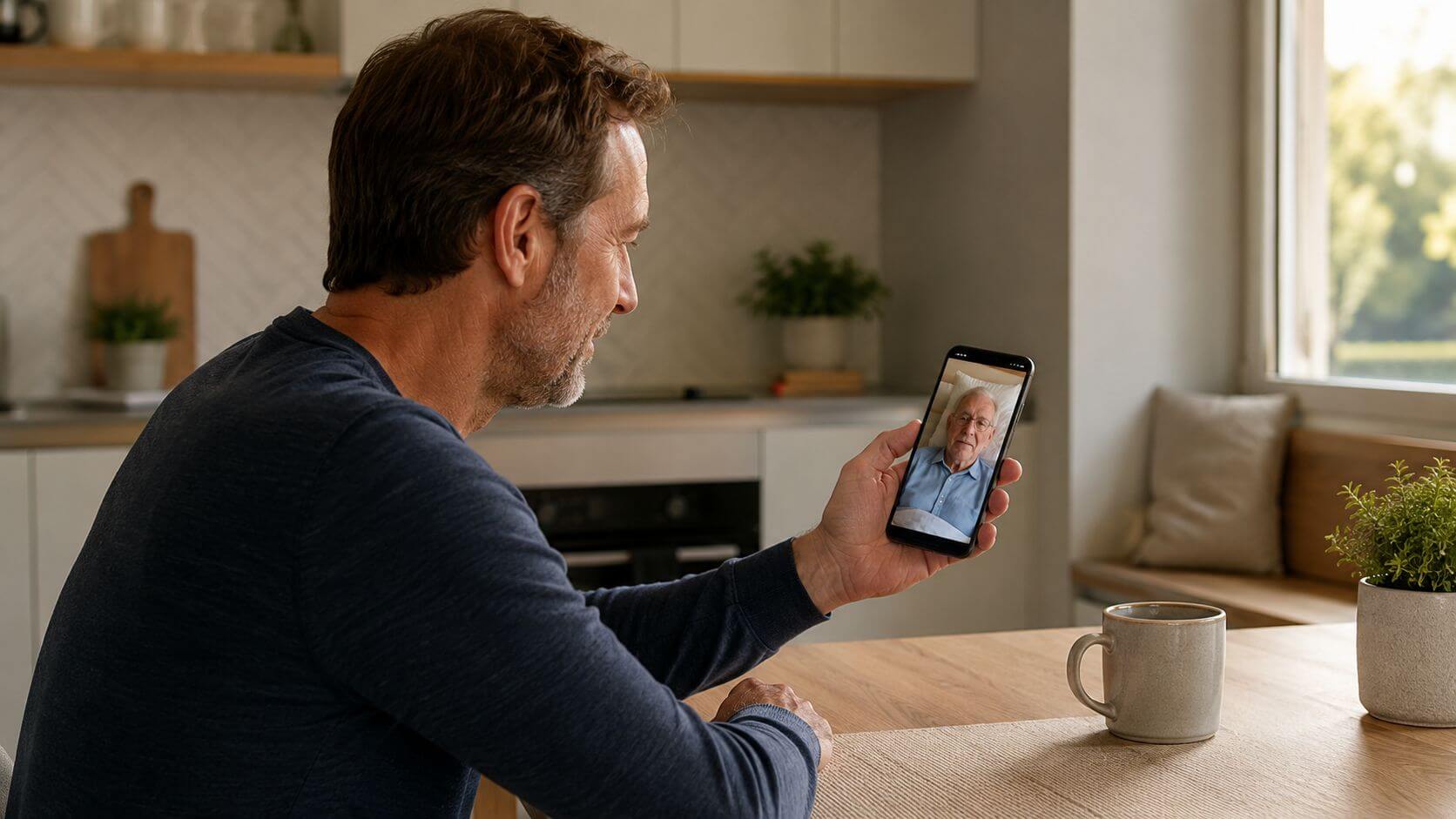
Marc, 52 years old, coordinates his father's end of life at a distance from Lyon, while the liberal IDEL and an auxiliary take over in Alsace. Before the app, the instructions passed by SMS, then were lost in a shared painting never up to date. The real gain was not to digitize everything, but to fix a single place for transmissions and processing changes.
When a directive changes, the family no longer has to reconstruct the information. The person who edits the info writes it once, the others read it in the same place. The shared notebook then serves as a common trace, more reliable than a simple thread of messages, because it keeps the context, not just the bits. This reduces the misunderstandings between relatives, caregivers and stakeholders.
The Diallo family works differently. Four children coordinate their mother, who has Alzheimer's as a beginner, with two home helpers who relay. Each one does not have the same level of access, and it's normal, not everyone needs to see the whole file. Emergency contact cards remain visible to the entire tribe, to avoid hesitations when it's necessary to act quickly.
In this second case, the transmission history is used to detect a fall, unusual fatigue or a series of small signals which, taken separately, appear minor. The application does not simplify the situation too much, it makes it shareable which was scattered. On the ground, it is often there that tension decreases, because we stop discussing blurred memories to work on a common trace.
Deploy the tool in your care tribe
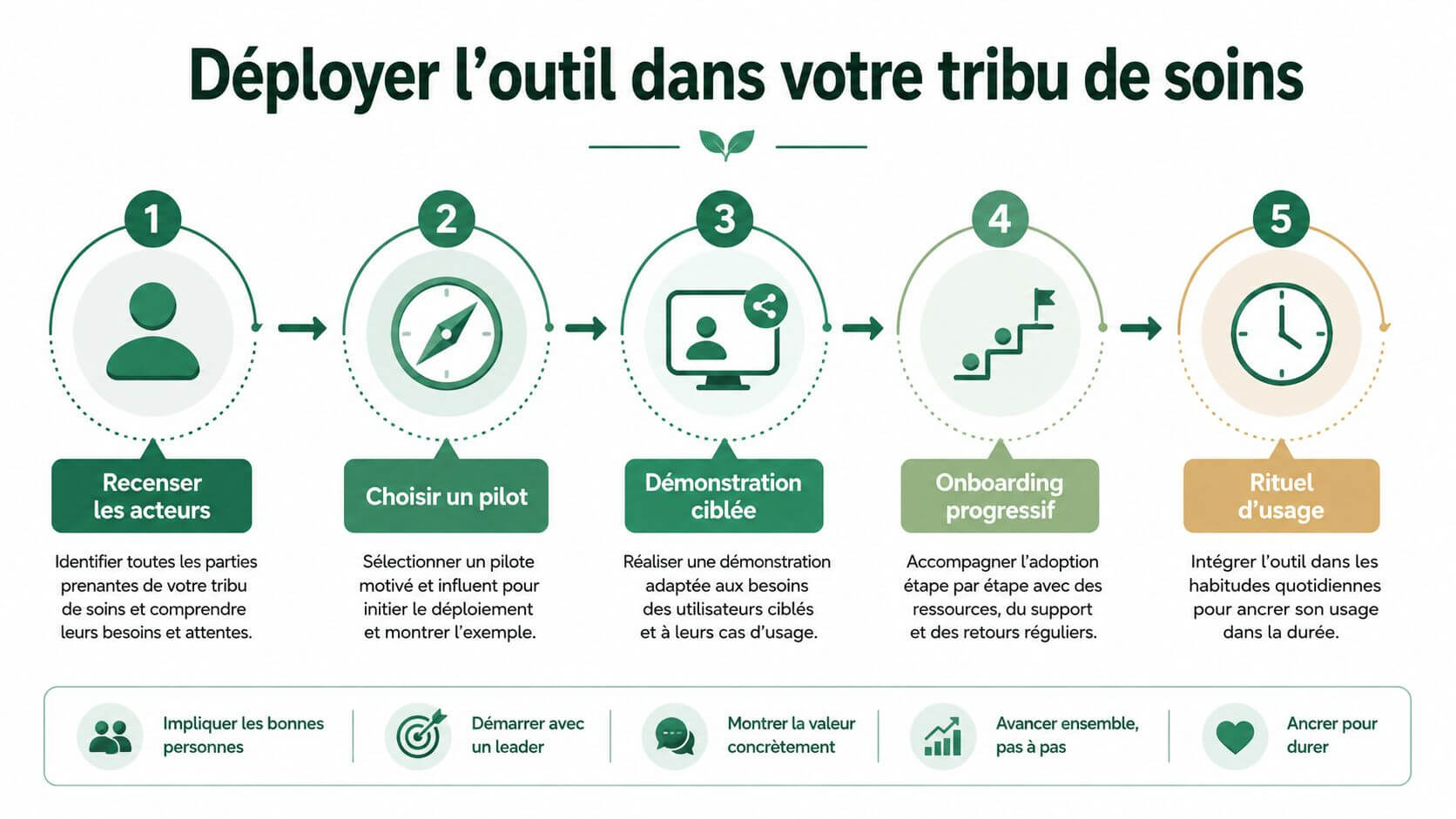
The main blockage is not the tool, it is the fear of adding one more layer to relatives already under tension. On the ground, the right entry consists of starting from a visible need, then showing that each one finds the same information in the same place. The speech holds in a simple idea, one does not change the gestures of care, one reduces the deviations of transmission.
Start with people and not with screens
Start by mapping the actors, the principal caregiver, the close active ones, the professionals, the treating doctor. Not everyone needs the same level of access to the start, and this is often where the resistance calms. Then designate a pilot person, comfortable with the smartphone, to open the way without forcing the rest of the group.
Create three uses instead of opening everything at once
The classic error is to deploy everything from the outset. It is better to open only the recall of medication, the daily transmission and the emergency contact, because it is the points that avoid the cascade calls and the lost information. This entry by concrete use joins approaches presented in resources like the case of IA use for non-tech, where adoption starts from the real need, not from the catalogue of functions.
Install a simple speech rhythm
Define who writes what, when, and how to report a technical blockage. In the first few weeks, a short review between the main caregivers is sufficient to identify the incomprehensions before they settle. Then, the interval can be spaced. An adoption that holds is mainly based on this discreet regularity.
If the family waits for everything to be perfect before the first transmission, nothing starts.
Ideas Received on Helpers' Apps
We often hear the same objections on the ground, and they rarely come from a rejection of principle. They mostly reflect the fear of adding an extra mental burden. On the other hand, we have to answer without jargon.
"You have to be comfortable with tech"
No. In most families, real use is limited to opening the app, reading an info and typing a short note. The rest, reminders, backup, history, must run without visible effort. If the tool requires heavy training, it has already lost its interest.
"It's going to dehumanize accompaniment"
It's the other way around. The application does not replace the visit or the coffee, it avoids duplicate calls and misunderstandings about treatment. It renders relational time by removing organizational microtensions that weary everyone.
"We don't have time to configure it"
The real question is not the time, it is the profitability of the initial setting. A simple start is better than permanent DIY. What is then gained in clarity is seen very quickly, especially when there are several speakers.
"Data are on display"
A notebook that circulates in the kitchen, a lost text message or a poorly controlled discussion group are not safer by nature. A structured solution, with GDPR framework and access management, offers at least a real control logic. The risk is not to use a tool, the risk is to use several channels that do not talk to each other.
"It's only for single caregivers"
Neither. Welded families also find there a useful written record, especially if hospitalization occurs without warning. The tool does not create the rhythm of the family, it documents the one that already exists.
Your checklist for a close-up coordination
An app really works when it becomes almost invisible, because coordination runs better. Look at four simple things. If they improve, the tool plays its role. If they regress over a month, you have to adjust the roles or setting, not throw the application away.
- Coordination. Less redundant calls, more spontaneous written transmissions, and everyone knows what to do without re-launching.
- Medicines. Prescriptions are found quickly, stock alerts serve, and reported omissions disappear from routine.
- Contingency. Evening, night or weekend relays no longer create information gaps.
- Serenity. The principal caregiver dares to be absent, the family anticipates, and the outside professionals find the right document at first glance.
Coordination is a muscle. application of family caregivers then serves as a shared training book, not a temporary crutch. When the tool is well placed, it does not do everything, but it avoids that family energy goes into misunderstandings, repetitions and avoidable emergencies.
If you're already coordinating a loved one at home, take the time to test Tribulys with your family and the people who really come to you. The goal is not to digitize everything at once, it's to make the transmissions clearer, the relays more reliable and the drugs easier to follow. You can see how the tool fits into your organization on Tribulys.
Put this organisation into practice with Tribulys
Keep your care journal, shared calendar, tasks, medication tracking and emergency information together. Start for free and invite the relatives and professionals involved in your loved one’s care.