
You already know the scene. A parent is getting older, he wants to stay at home, the family agrees, then the first alert falls and everything goes all the way. A home helper leaves a message, a nurse sends a text message, a neighbor reports a common detail, and you're recomposing the situation as an investigator while you're at work, in a meeting, or simply exhausted.
The real problem is not the lack of goodwill. common view, of clear decision and reliable relays. In Home maintenanceThese three points make the difference between an organization that is strong and a family that is scattered.
Contents
- An ordinary day that derails
- Understanding Home Care in 2026
- The three pillars that make the difference
- Financial assistance and APA home plan
- Dispersed or centralized coordination
- When a simple tension curve avoids urgency
- Divide roles into tribe and pros
- Taking action this week
An ordinary day that derails
Nadia is 52 years old. She lives two hours from her mother's home, 82 years old, returning home after a fall without gravity. Nothing dramatic on the paper, just enough to trigger the usual machine, and everything that families know too well.
The morning begins with a call from the household worker. Ten minutes later, the nurse sends a text message to say that the tension is low. Before noon, a neighbour calls because the mailbox has been overflowing for two days. Nadia takes six calls in two hours, crosses the head information, shifts a customer appointment, then contacts her brother, who had not received any clear instructions.
Simple rule, If the information is to be told three times, it is already getting lost.
The bottom of the problem is there. Everyone has a useful piece, but no one has the complete picture. The primary caregiver becomes a telephone standard, the stakeholders work without shared memory, and the decision is made in an emergency rather than being prepared. That's exactly what the problem is. Senior emergency plan must avoid, especially when a benign event can quickly destabilize the entire organization, as this practical guide shows on the senior contingency plan.
Home care is not only a problem at the time of falling or fever. It is played in the following hour, when you need to know who calls the doctor, who visits the home, who warns siblings, and who confirms what has really been done. Without it, the family improvises, and improvisation often ends up costing expensive energy, money, and sometimes preventable hospitalization.
Understanding Home Care in 2026
The Home maintenance It is not a matter of receiving care at home. It is a fundamental organisation, with human help, care, material adaptations, and daily arbitrations that take place at the home of a person who loses autonomy. In France, it is not a peripheral subject, it is the daily life of millions of households.
According to INSEE, 96% of people aged 65 or over lived at home in 2018. Even at very advanced ages, this reality remains strong, but it becomes much weaker among centenarians, where the share remaining at home falls around half. As of January 1, 2022, INSEE had 14.2 million people aged 65 or over, either 21.0% of the population INSEE source. The message is clear. Home remains the frame of reference, including when autonomy declines.
What we confuse all too often
The first reflex of families is often to mix everything, SAAD, the SSIAD,Hospitalization in Home and respite solutions. It's an error. Each device responds to a different logic, with a separate decision maker, rhythm and level of coordination.
| Device | Perimeter | Principal decision-maker | Coordination |
|---|---|---|---|
| Home care | Daily life, human assistance, care, housing security | Family with professionals | Central and shared |
| SAAD, SSIAD | Help with everyday gestures, technical care | Prescriptor and local organization | Operational, day-to-day |
| HAD | Heavy curative protocols at home | Coordinated medical team | Formal, medical |
| Day reception, temporary accommodation | Transition or Respite Solution | Family and medical and social guidance | Punctual |
This distinction counts becauseAPA at home It is not used to finance an abstract principle, but a concrete plan built after evaluation by the departmental council. It targets people aged 60 and over who are losing autonomy, with a logic of aid adapted to the real situation, not a uniform package. DREES data on ABS Let me remind you of that point. The real issue is not just to get help, it is to know who organizes it, who follows it and who slices it when the situation changes.
Home is not a passive place. It is a distributed care system, with people moving on to different times and decisions to make together.
This is why the Home maintenance play first on the organization. When no one connects the interventions, information and arbitrations, the family eventually improvises. And in this area, improvising costs fast in terms of energy, money and security.
The three pillars that make the difference
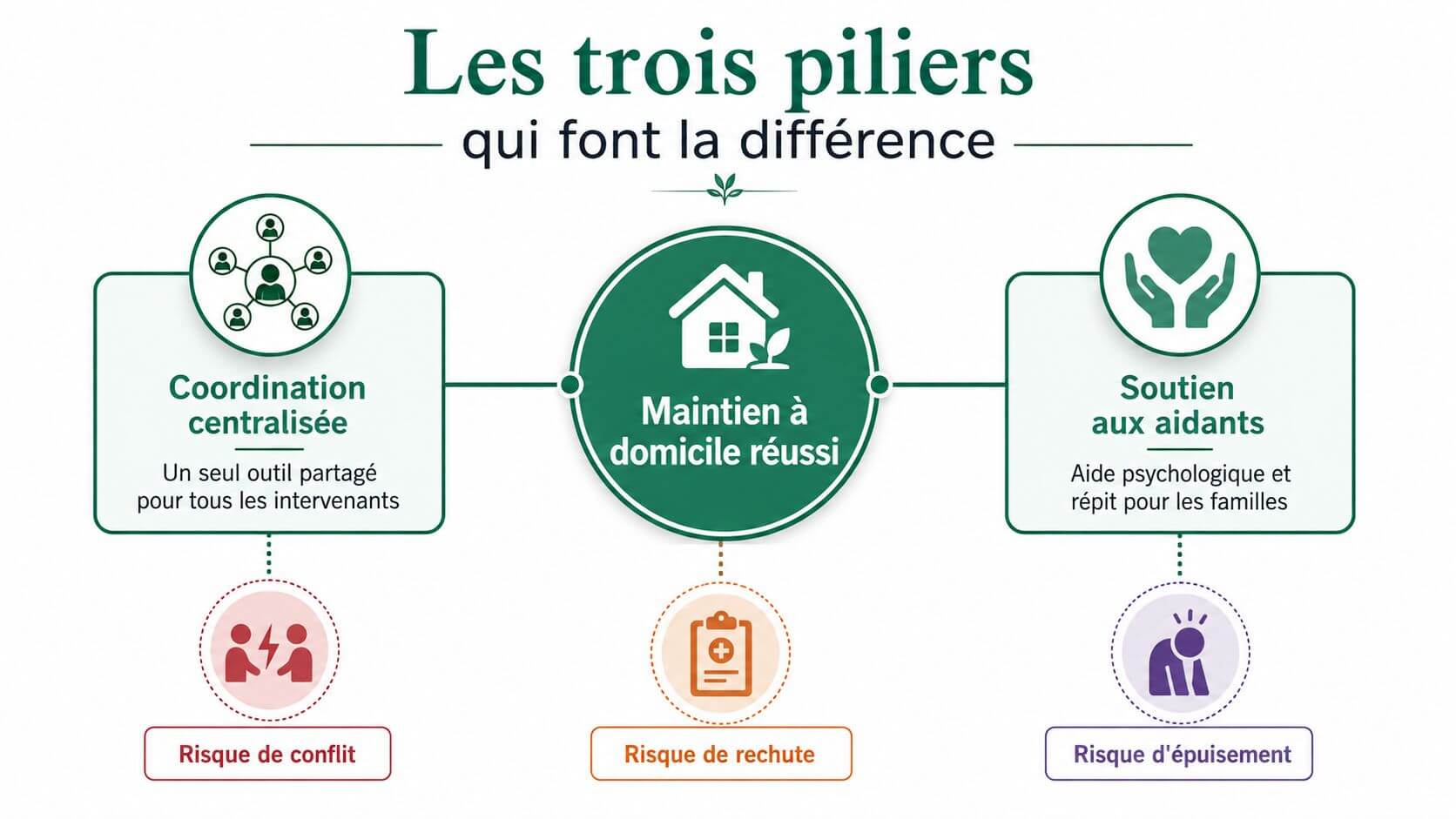
Most families think first of the hours of help, the material, or the steps. Bad reflex. The real hard point is to make three things hold together that quickly disorganize, the Coordination, the medical continuity and the responsiveness.
Centralized coordination
When the morning attendant, the evening nurse, the family and the physiotherapist do not write in the same place, the information is fragmented. official care journal or a shared tool makes sense because it keeps transmissions at home, dated and signed, at the service of continuity. Without common memory, duplicates and forgetfulness become the norm.
A good benchmark is to centralize what really matters, done passage, unusual observation, medication taken or not, call to expect. If you add a home surveillance medium, such as a video surveillance solution for residences, it does not replace human coordination, but it can complement vigilance on the living environment when physical security becomes a concern. The key point remains the same, a single source of truth.
Medical continuity
HAS recalls that the home focuses a particular risk due to the multiplicity of responders and the drug circuit HAS synthesis on the administration of HAD drugs. Clearly, the problem is not just whether the treatment exists. You need to know who gives it, who stores it, who controls it, and who takes over the relay after an exit or a change of way.
The attending physician must remain the pivot. Not because it's elegant on paper, but because it's the only way to prevent a change of provider from breaking the logic of care. A family that secures home pharmacy and recovery protocol reduces blind spots.
Reactivity
Reactivity isn't just running faster. It is based on predetermined thresholds, constants followed over time, and a clear procedure to call according to gravity. For tension, Health Insurance provides a home self-measurement benchmark of 135/85 mmHg on average Ameli, and the French recommendations on severe HTA provide for an immediate call to 15 if a tension of at least 180/120 mmHg is accompanied by warning symptoms reference severe hypertension.
The right reflex is simple. Define the thresholds before the crisis, not during. Reactivity is useful only if someone knows what to do from the first signal.
Financial assistance and APA home plan
Money doesn't fix everything, but it sets the tempo. Without a budget set, home maintenance moves ahead with emergency, with arbitrations taken too late.APA at home funds the needs assessed by the departmental council according to a aid plan individualised, not according to an automatic repayment logic. In other words, it is necessary to decide quickly who intervenes, on what, and at what rate.
The plan must remain concrete. It covers human assistance, life support, meal porting, light accommodation adaptation or tele-assistance. It does not cover everything. Large work without technical framing and nursing is covered by other circuits. The proper reading of the APA is therefore to transform an envelope into precise, useful and monitored passages. For the organization's details, see this guide on the APA at home and the organization of the aid plan.
Standard distribution of a monthly APA plan
The right reflex is to reason in actual hours and safety margin. The first family arbitration is on the human base, the second on the unforeseen. If everything goes into the planned passages, the following month becomes fragile. If a portion remains available, an absence, a discharge from hospital or a one-time increase in needs is managed without breaking the whole.
| Expenditure item | Share of plan | Hebdo volume |
|---|---|---|
| Planned human aid | Priority | Variable as required |
| Technical support and small adaptations | Targeted | Punctual |
| Tele-assistance or surveillance | Complementary | Continue |
| Security margin | Reserved | Available in case of unforeseen |
I prefer a family that secures fewer hours but keeps the air, rather than a family that consumes its entire budget and discovers that it no longer has a relay.
Practical advice, the real subject is not to finance everything. It is to know who pays what, who validates the passages, and who keeps his hand when a need changes.
Supplements also exist, such as relief from respite, the tax credit for the employment of an employee at home, or the support of the pension fund for persons not eligible for APA. But the arbitration remains the same. How many hours, what passages, and which confirms that everything has been done well.
Dispersed or centralized coordination
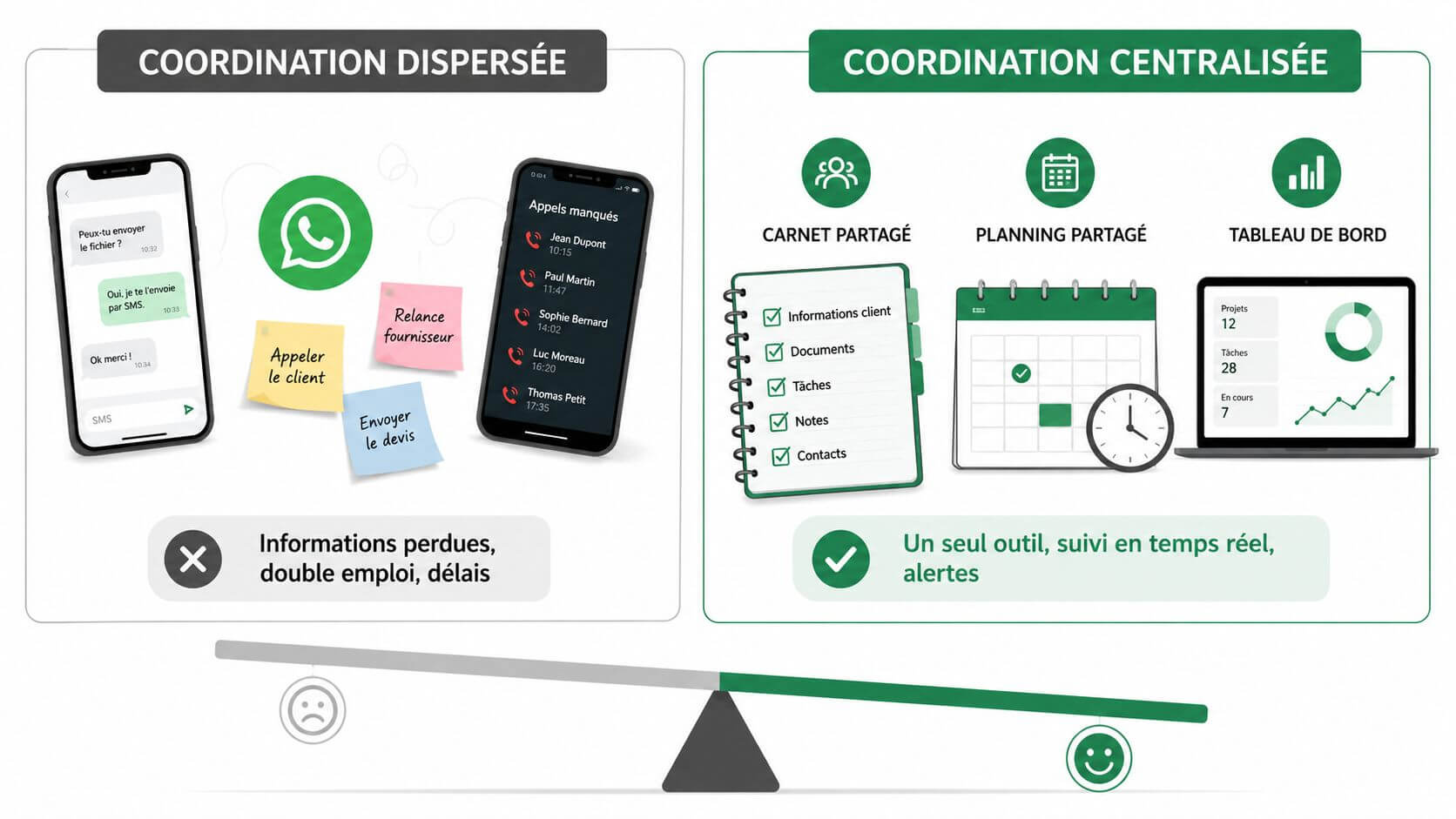
The SMS and the focus groups reassure at the beginning. We have the impression that everything is being followed. In practice, everyone keeps a piece of the information, and no one has the version up to date.
What Dispersed Coordination Loses
The messages are accumulating, but the decisions don't hold up. A record stays in the thread of a single brother, an appointment changes without reaching the help at home, a nurse passes without knowing that a point has been moved. The main caregiver ends up reading everything to fill the holes.
What is gained by centralized coordination
With a shared tool, the family works on a common memory, a unique calendar and alerts visible to all. We stop looking who warned who, we read the transmission. Stakeholders rely on the same decision point, which limits the duplication and arbitrations taken in the emergency.
The digital link book or the shared dashboard is not used to make pretty. They are used to know, at every moment, what has been observed, what has been done, and what still needs to be validated. A tool like Tribulys can enter this discussion, because it centralizes care journal, agenda, drugs, tasks and alerts in a space shared between relatives and professionals. To choose a suitable coordination tool, consult this guide on the criteria for choosing the right coordination tool.
The verdict
Without a shared tool, home support is almost always based on one person. This person becomes the point of entry of all information, then the point of exit of all emergencies. The exhaustion of the primary caregiver often ends up before the parent's crisis, because the organization overload undermines the quality of the follow-up.
The IGAS report points out that older people assisted at home are, on average, 1.7 person for a weekly hourly rate of IGAS report. The plurality of caregivers is therefore the norm. Without central coordination, it becomes noise.
When a simple tension curve avoids urgency
Mrs. R. is 84 years old. She lives alone at home and, for a few weeks, her tension passes from 13/8 to 16/9, then to 18/10. Every morning, the home helper measures it and notes it in the liaison book. Nothing extraordinary about an isolated survey, but the curve speaks.
The attending physician sees the progression before the hypertensive episode. He adjusts the treatment without waiting for the arrival to the cardiac emergencies. The difference does not come from a sophisticated device. It comes from a routine and a single channel where the numbers are not lost.
What to follow according to profile
The logic is the same for other situations, even if the parameters change. For a person with COPD, oxygen saturation is monitored. For a diabetic, blood sugar. For a heart failure, weight. For a post-operative patient, temperature.
Home-based prevention relies less on miracle technology than on the discipline of writing. If the data is not traced, transmitted and read, it does not protect anyone. If it is, it becomes a workable alert before degradation.
A good curve is better than a long speech, because it shows the trend before the breaking point.
This is also why constant monitoring must remain readable by all useful actors. The doctor cannot guess what the family has seen, and the principal caregiver must not bear the responsibility for interpretation alone.
Divide roles into tribe and pros
The family must stop working with instinct. It takes a simple matrix, known to all, and kept up to date. Otherwise, each one does a little bit of everything, and no one really takes control of it.
Who does what in everyday life
| Tasks | Principal Helper | Extended family | Vocational assistance | Treating physician |
|---|---|---|---|---|
| Daily | Check the key information | Relay alerts | Executes passages | Validates the medical framework |
| Weekly | Consolidate monitoring | Take the spot relay | Updating the comments | Adjust if necessary |
| Crisis | Resolves climbing | Prevents and supports | Report immediately | Orients the course to be held |
| Administrative | Centralise | Assistance in the process | Notes the useful elements | Writes the requirements |
The triggers to attach black to white
- Constant temperature, if it exceeds 38.5 °C for more than 48 hoursWe call the nurse.
- Fall without visible trauma, we note, we observe, and we warn the health care provider.
- Repeated neglect of treatment, We don't make up for it alone, centralize the information and alert the doctor.
- Shortness of breath, chest pain, or neurological sign, We're following the emergency procedure.
The real benefit is not bureaucratic. It is to prevent the primary caregiver from becoming the permanent telephone standard of the entire organization.
Three weeks to set the order
Week 1, the actual needs are identified. Week 2, the roles are assigned unambiguously. Week 3, the first experiment is made and what is not right is corrected. It's short, but it's enough to get out of the blur.
Taking action this week
We don't need ten construction sites. It takes five, well laid, and thrown in the right order. The goal is not to reinvent everything, but to secure the home before the next alert does it for you.
Week 1 Action Plan to Secure Home Maintenance
| Action | Time required | Estimated cost | First Deliverable |
|---|---|---|---|
| Rapid home check | 30 minutes | Low | List of drop points and risks |
| Audit of the ABS | Some steps | Variable | Clear vision of the aid plan |
| Implementation of a centralized tool | 1 hour | Depending on the chosen tool | A unique shared space |
| Meet the attending doctor | 20 to 30 minutes | None to low | Basic medical protocol |
| Family breakdown meeting | 45 minutes | None | Validated roles and triggers |
Start with the audit, because an unsecured home makes all other efforts more expensive. Then, lock the coordination, then the medical continuity, then the reactivity. It is the order that avoids false departures.
Home care is not about good will alone. It is about clarity of roles, the flow of information and pre-crisis decisions. If you want a concrete working basis for organizing these exchanges, Tribulys centralizes the care journal, medicines, agenda, tasks and alerts so that the family and professionals finally move in the same direction.
Put this organisation into practice with Tribulys
Keep your care journal, shared calendar, tasks, medication tracking and emergency information together. Start for free and invite the relatives and professionals involved in your loved one’s care.