
You find red plaques on your partner's torso after a weekend, with no apparent fever and no new laundry, cream or food to explain it. The first reaction is often to look for a common cause, such as an allergy, stress or a seasonal virus. However, if exposure to HIV is possible, an unexplained rash deserves medical advice, even when it seems moderate.
The term "AIDS skin rash" is commonly sought, but it covers very different situations. An rash may occur during the first HIV infection, be caused by antiretroviral therapy, or reveal another skin disease in a person whose immune defences are weakened. The aspect alone never makes it possible to make a diagnosis.
Contents
- When a rash has to make you think about AIDS
- Understanding what an HIV-related rash is
- Recognize the typical signs of HIV exanthema
- Distinguish first infection, drug effect and other causes
- Observe and record what you see
- Why Medical Consultation Is Needed
- Conduct and useful resources in France
When a rash has to make you think about AIDS
After an unprotected report, sharing of injection equipment or exposure to blood, a person may see plaques or small buttons appear a few weeks later. However, they may feel relatively well and attribute these redness to heat, laundry or stress. Waiting for them to disappear may delay a useful medical opinion.
The First HIV infection usually occurs two to six weeks after contamination, according to French dermatology recommendations on Primary HIV Infection. The rash can be accompanied by fever, lymph nodes, severe fatigue or benignness. However, these signs are common to many infections.
The skin as the first visible window
The skin can act as a sign on a dashboard. It indicates that a check is necessary, without alone indicating the cause of the problem. During a first infection, the rash often takes the form of a Maculo-papulous exanthema, composed of spots and small elevations, mainly on the trunk, neck and shoulders.
French sources indicate that an eruption is observed in 60-70% of symptomatic cases of primary HIV infection Dermato-Info. This proportion applies to people with symptomatic primary infection, not to all people living with HIV. Therefore, rash-free skin does not exclude infection.
Human observation remains useful here. Noteing the evolution in a care journal can help to compare days, identify a change, and provide accurate information to the health care professional. This does not replace examination or screening.
To be noted: an rash after possible exposure to HIV does not confirm an infection. It does, however, justify seeking prompt advice and discussing appropriate screening.
An allergy, dermatitis, viral infection, or irritation can produce similar redness. Conversely, a first infection may be accompanied by a discrete rash. Note the date of onset, the affected areas, the associated symptoms and recently taken medications, including antiretroviral treatment, and then communicate these to the doctor.
Understanding what an HIV-related rash is
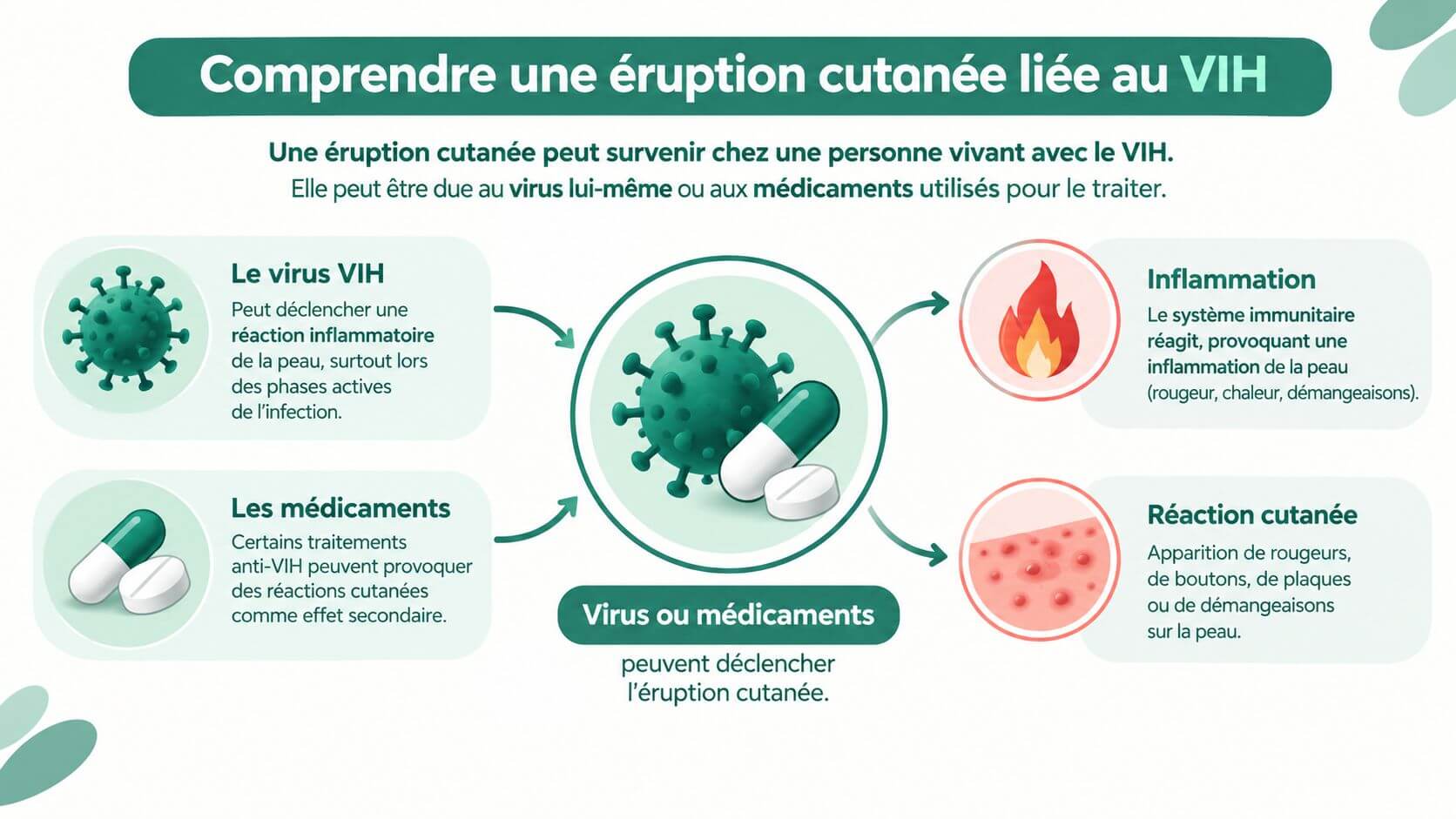
One HIV-related rash refers to a visible change in the skin in a context where the virus, treatment or immune frailty may occur. The term describes a sign, not a single disease. The skin shows that a process is in progress, but the eruption alone does not identify the cause.
Three mechanisms can look like each other
During the primary infection, the immune system reacts to the recent presence of the virus. The rash often occurs transiently, after general signs such as fever or unusual fatigue. It is generally described as maculo-papulous, not painful and not very pruriginous, with a predominance on the trunk, neck and shoulders.
At a later stage, HIV can promote different skin or mucous membranes. They may appear at several times of infection, but their interpretation depends on the general condition, medical examination and immune status. A persistent, unusual or evolutionary lesion cannot be reliably identified from a photograph found online.
One drug exanthema is another possibility. It may occur after the introduction of antiretroviral therapy, especially in patients with First 15 days and not later than the first month Assurance Maladie. Some molecules, including efavirenz and nevirapine, are among the treatments that can cause this type of reaction. The chronology becomes a particularly useful clue to pass on to the doctor.
An alert, not a conclusion
An rash indicates that a process is underway, without distinguishing a viral, drug, infectious or inflammatory origin. The health care professional approaches its aspect to the date of onset, the medications taken, the other symptoms and the necessary examinations.
Simple reactions often regress spontaneously. Aggravation accompanied by fever, high fatigue, bubbles or mucous membrane damage, however, requires a rapid assessment to avoid a serious drug reaction, although rare AIDS Info Plus.
Recognize the typical signs of HIV exanthema
A first-infection exanthema may seem, at first glance, comparable to a simple redness. To observe it correctly, one must describe what one sees rather than looking for a perfect correspondence with a photograph. The eruption is often diffuse and rather symmetrical, with some macules and papules. A macule changes the colour of the skin without marked relief. A papule forms a small elevation, like a discrete grain under the finger.
The colour can range from rosé to red, with thin contours when the lesions join together. Note whether the skin appears uniform or if some areas have more marked lesions. This visual description helps the doctor compare the evolution between two moments, without turning the observation into a diagnosis.
Look at the skin as a map
Start by identifying the affected areas, then compare both sides of the body with natural light. A relatively balanced distribution provides information different from an isolated plate, strictly limited to a contact area. Also observe the edges of the eruption, its possible extension and the appearance of new lesions.
The palm of the hands and the soles of the feet deserve a separate observation. Their damage can lead to several causes, including syphilis, but it does not lead to a conclusion of HIV infection. Similarly, vesicles, bubbles, marked pain, significant desquamation or lesions that bleed describe a different picture and justify a medical opinion.
The general signs give a context, without replacing the examination of the skin. Fever, fatigue, ganglions, curvature or ulcerations of the mouth and genitals should be recorded separately, with their date of appearance. This chronology forms a kind of clinical logbook. It also helps to distinguish an rash that occurs during the first infection from a reaction that appeared after an antiretroviral medication.
An intense pruritus, rapid progression or mucous membrane damage requires rapid assessment. Human observation remains more useful than an automatic tool that would classify an image without knowing the symptoms, treatments and evolution.
Distinguish first infection, drug effect and other causes
Two people can say "buttons" to describe very different phenomena. To distinguish them, the aspect counts, but the starting question remains When did the eruption appear? A recent sexual exposure and the introduction of treatment refer to two different hypotheses.
During a first HIV infection, rash may occur after general signs within weeks of possible contamination. Rather, a drug reaction begins after the introduction of a product, often in the First 15 days and no later than the first month. Common dermatosis may also be related to irritant contact, mycosis, eczema or infection unrelated to HIV.
| Criterion | First HIV infection | Antiretroviral effect | Common dermatosis |
|---|---|---|---|
| Trigger to search | Possible exposure to HIV | New medicine or recent change in treatment | Contact, irritation, allergy, mycosis or common infection |
| Time of apparition | A few weeks after possible contamination | Especially in the first 15 days, at the latest in the first month | Variable by cause |
| Possible aspect | Maculo-papulous diffuse exanthema | Variable exanthema, sometimes rapid worsening | Plates, hives, squams, vesicles or localised lesions |
| Associated signs | Fever, fatigue, ganglions, curvature, ulcerations | Fever, fatigue, bubbles or mucous membranes in severe forms | Itching, burning or signs of dermatosis |
| Driving | Screening and medical assessment | Do not stop treatment on your own unless advised to do so urgently, contact a professional quickly. | Medical advice if persistence, extension or doubt |
This table is used to organize the clues, not to make a diagnosis. A rash under treatment does not automatically mean that the drug is the cause. It is also necessary to consider common infections, allergies and skin diseases.
Palms and plants can be affected in several infections, including syphilis. Their observation can therefore guide the questions to be asked, without making it possible to conclude that an HIV infection is present.
A skin reaction after a common drug can be compared to the markers described in side effects of amoxicillinThe practical rule remains the same: chronology and warning signs count as much as the appearance of the skin. In case of bubbles, mucous membrane damage, rapid progression or malaise, contact a professional quickly and do not change antiretroviral therapy alone.
Observe and record what you see
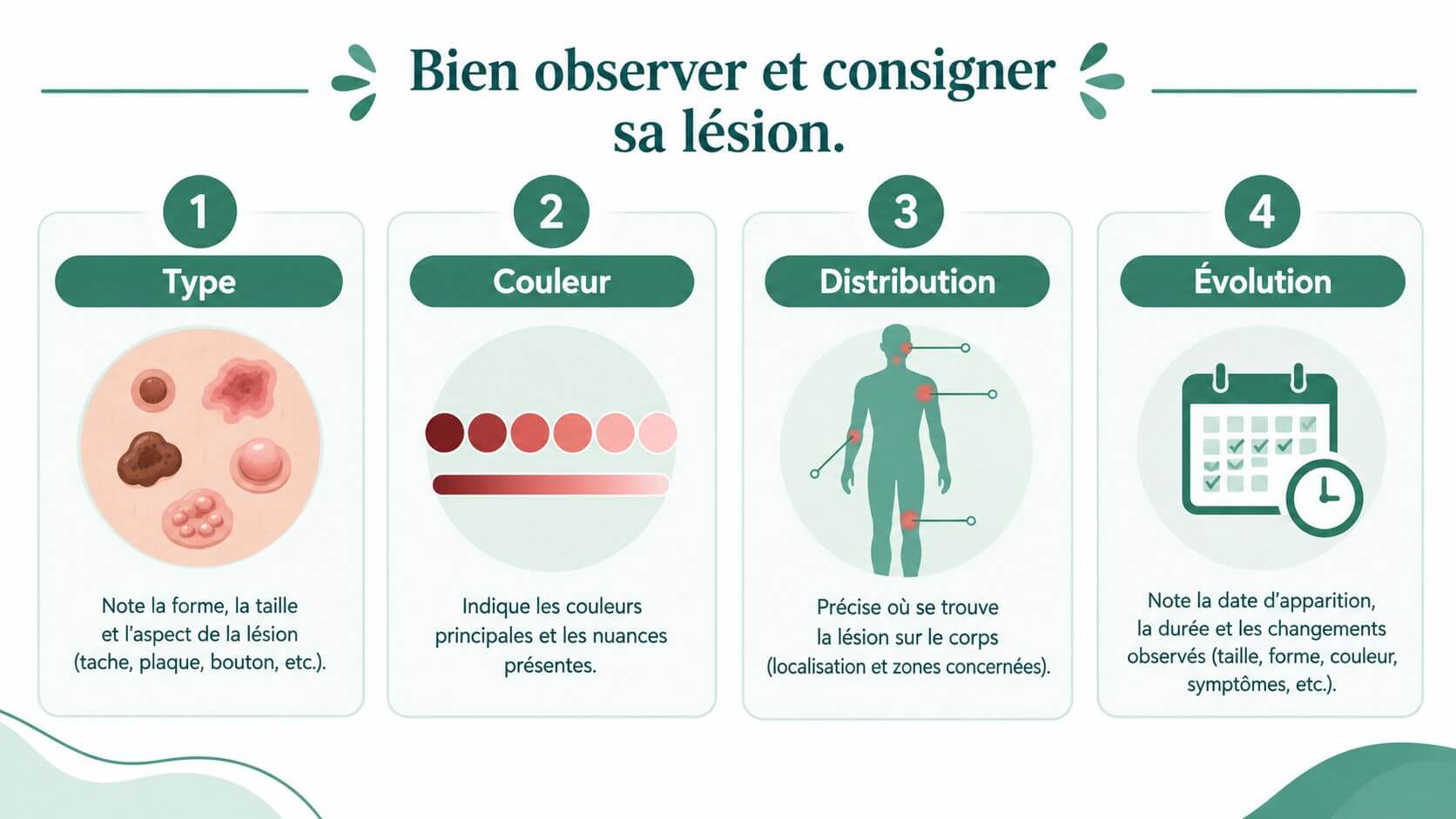
A precise observation helps more than a judgment like "it looks serious". A caregiver can turn his or her concern into concrete information, without seeking to name the disease. The doctor will then be able to compare the description with the actual examination and decide on the follow-up.
Describe rather than interpret
Note first what is visible : flat spots, relief buttons, vesicles, pustules or bubbles. Add color, location and possible symmetry. Then describe the evolution on 48 - 72 hours, without deducing a cause.
A photograph can complete the text. Take it with a coin or other size marker, add the date and time, and blur the face if the area requires it. If you estimate the extent, use an understandable indication, keeping in mind that the palm of the hand represents about 1 % of body surface area, practical cue to discuss with a professional.
A readable chronology
The link book can accommodate a free-text note: "Rosé plates appeared this morning on the top of the back, extension to the neck tonight, itching absent". The caregiver may include associated symptoms such as ciphered fever, curvature, neck or armpit lymph nodes, burn, or damage to the mouth and genitals.
It is also important to note the date of potential risk exposure and recent medications. A shared notebook makes the change visible to the family and the authorized professionals, but It's a human observation, not an automatic diagnosis.. Tribulys does not set a skin threshold: an alert is triggered manually by the person who observes something unusual.
Useful method: Write where, since when and how the lesion evolves. Reserve the "alert" type to what requires a quick reaction from the rest of the tribe.
To organize these transmissions, you can consult this guide on the care journal for home help.
Here is additional video support to review the principles of compliance:
Why Medical Consultation Is Needed
A rash does not make it possible to cut between a primary HIV infection, secondary syphilis, a reaction to cotrimoxazole, inflammatory dermatosis or other infection. These situations can be similar to the first glance, while their management differs. The doctor places the skin in the entire narrative, with exposures, medications, fever and general condition.
Screening may require Fourth generation HIV serology, viral load or blood tests, including blood count and liver check. The relevance and interpretation of these tests depends on the time of exposure, symptoms and treatments. An isolated result or image does not replace this clinical exchange.
Signs that change the degree of urgency
Some demonstrations must not wait for an ordinary appointment. A general rash with a fever greater than 38.5 °C, bubbles, damage to the mouth or genitals, oedema of the face or respiratory discomfort may evoke a severe drug reaction, including Stevens-Johnson syndrome or hypersensitivity to abacavir.
In this context, contact the emergency room or the appropriate medical department quickly. Do not stop or take an antiretroviral alone without instructions, unless a professional gives you immediate instruction as part of a serious reaction.
Digital resources can improve transmission between relatives, but they do not decide on diagnosis or therapeutic adjustment. To structure a request for advice and share useful information, you can use a freeing of doubt organized, while keeping the health professional at the centre of the decision.
Conduct and useful resources in France
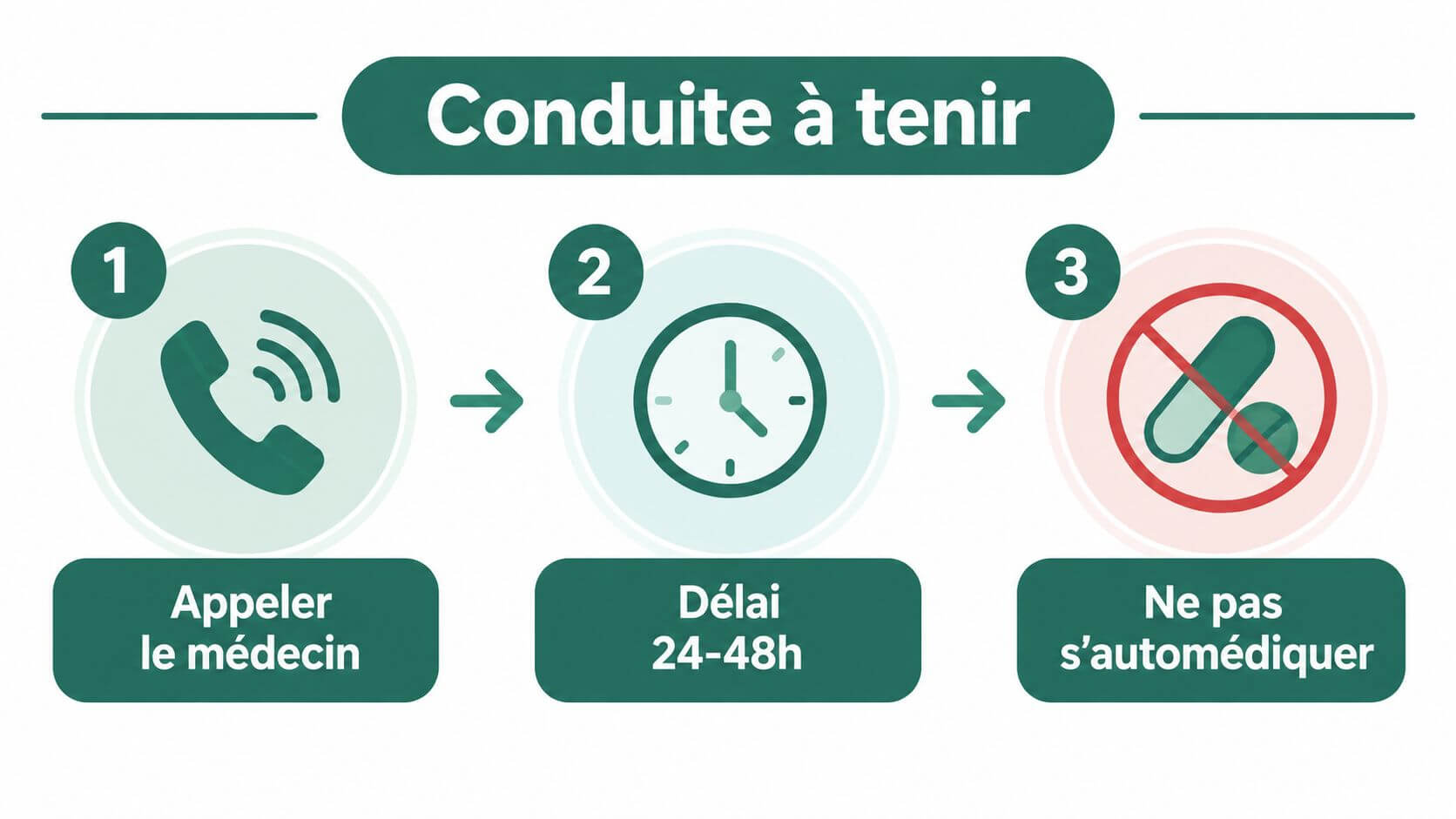
In the event of an unexplained rash and possible exposure to HIV, contact your treating doctor or a medical department within a period of 24 to 48 hours. Prepare essential information: date of onset, progression, temperature, associated symptoms, possible exposure, recent travels and list of medicines or products recently started.
Do not apply corticosteroids or antihistamines on your own initiative to mask the table prior to medical advice. These products may alter symptoms and complicate observation. A cream or medication already prescribed should only be used in accordance with the instructions received.
Available interlocutors
In France, several structures can orient a person according to their situation:
- CeGIDD: These centres offer free anonymous HIV testing.
- Physician treating: it coordinates the initial evaluation and the orientation towards a specialised consultation.
- Hospital services: dermatology or infectious disease consultations can take over where the eruption or context warrants it.
- AIDS Info Service: on 0 800 840 800 offers listening and orientation.
- Associations and regional lines: structures such as AIDS can accompany approaches, screening issues and access to care.
The link book can help a relative to record an observation and make it visible to the right person. It does not replace an examination, test or prescription. Similarly, a therapeutic follow-up tool can centralize the information, but it should not be used to modify an antiretroviral without a medical decision. To better understand this principle, consult this content on the therapeutic monitoring of medicinal products.
Tribulys helps families and professionals to share dating observations, transmissions and useful information around a loved one, without turning a note into a diagnosis. To centralize a skin change, a list of medications or a medical prescription in a common space, discover Tribulys.
Put this organisation into practice with Tribulys
Keep your care journal, shared calendar, tasks, medication tracking and emergency information together. Start for free and invite the relatives and professionals involved in your loved one’s care.