
An amoxicillin cure often starts in the noise of everyday life, with a prescription placed on the kitchen table, an open box next to a glass of water, and a loved one wondering if fatigue, a stunned belly or a redness on the skin are part of the normal decor. When you accompany someone at home, you don't try to dramatize, you mainly want to know what to observe, what to rate, and when to tell the doctor or call the rescue. It's exactly the right reflex, because the doctor's reaction to the problem is that he or she is not a doctor. side effects antibiotics amoxicillin most often digestive or skin, but some signs require a rapid reaction.
Contents
- Contents
- Understand what happens when you take amoxicillin
- Common side effects by frequency
- Accepted ideas about antibiotics and amoxicillin
- Recognise signs that must alert immediately
- Risk factors and interactions to be monitored
- Organize home follow-up with relatives and caregivers
- Key reflexes to keep in mind during and after cure
Contents
- Understand what happens when you take amoxicillin
- Common side effects by frequency
- Accepted ideas about antibiotics and amoxicillin
- Recognise signs that must alert immediately
- Risk factors and interactions to be monitored
- Organize home follow-up with relatives and caregivers
- Key reflexes to keep in mind during and after cure
Understand what happens when you take amoxicillin
Amoxicillin is one of the most widely used penicillins in France, and it is precisely this very common place that requires a clear understanding of its side effects. It acts on bacteria by preventing their wall from building properly, which helps the body to reverse the infection. At the same time, it can also disrupt body balances that are not supposed to be affected, especially the intestine, the skin and, more rarely, the immune system.
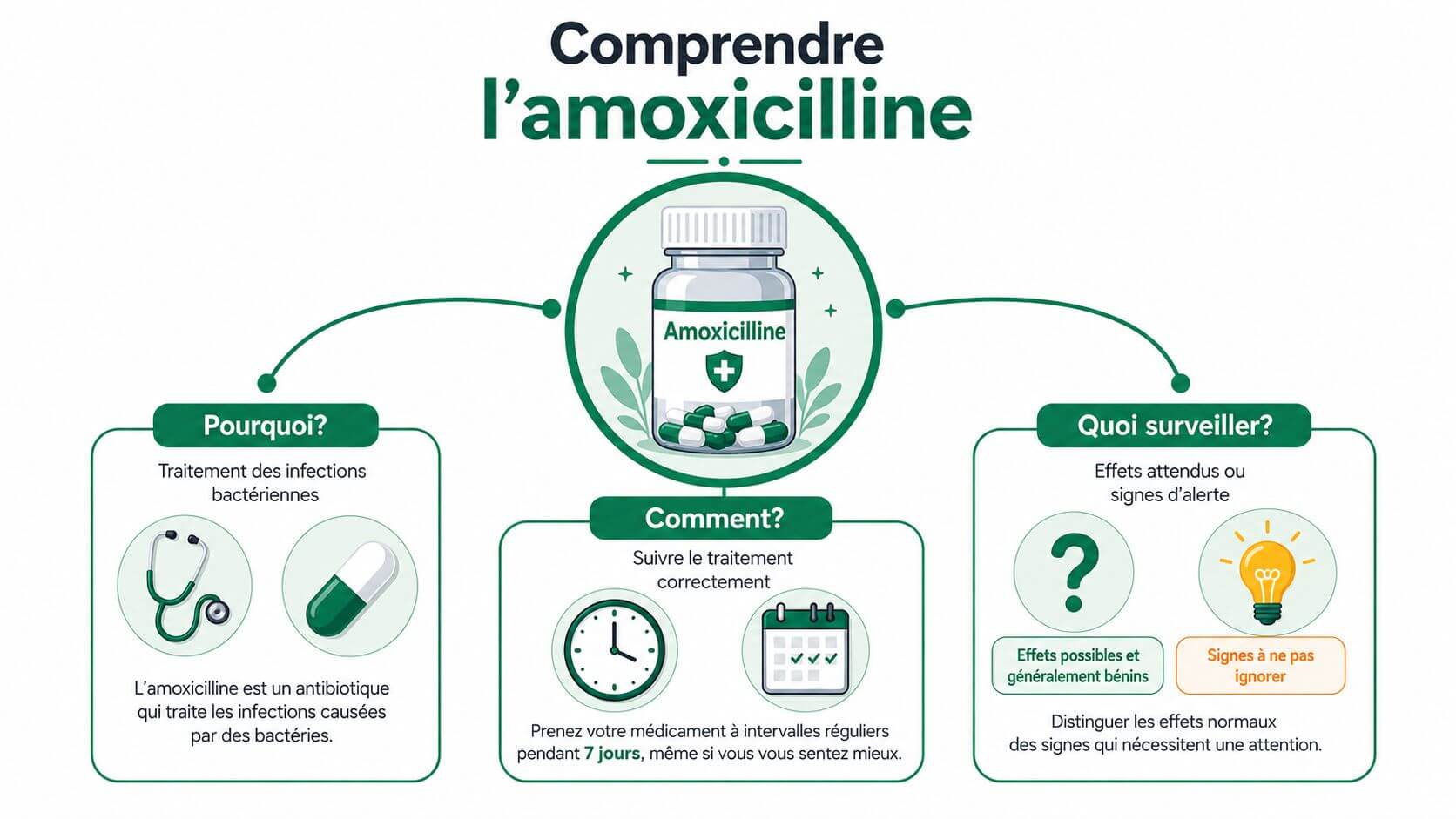
At home, the caregiver often sees the first changes before everyone else. A nausea after taking, a more liquid stool, a red plate on the chest, or an unusual scratch, it is often these details that make the difference between a simple surveillance and a call to the doctor. The good point is to distinguish what remains expected from an antibiotic from what looks like an allergy or complication.
Practical rule. The more a sign touches the breathing, face, mucous membranes or general condition, the faster you have to act.
The role of the home care provider or the relative is not to make a diagnosis. It consists of observing the chronology, describing precisely what has changed, and passing on the right elements. With this way of doing things, the family avoids two frequent traps, trivialize a real warning signal or stop too quickly a useful treatment without medical advice.
Common side effects by frequency
At home, undesirable effects are often found first in the small gestures of everyday life. A meal left behind, a more liquid saddle, a complaint of stomach, a redness that extends, are often these signs that give the first clue to the close care giver or to the IDEL. French data converge towards a core of very frequent effects and easy to recognize, with the nausea, diarrhoea and rashes and the impact of the 1 to 10% of patients according to the national portal Sante.frThis hierarchy helps not to confuse a common digestive disorder with a more rare one.
What comes back most often
Digestive disorders dominate. Diarrhoea, nausea and abdominal pain are the complaints that the loved ones report most spontaneously, because they see themselves quickly in the diet, comfort and transit. They correspond to the transient disturbance of the intestinal flora, a bit like a balance that deranges and then recovers after a few take. Skin rashes also happen regularly, with a profile that ranges from the simple diffuse rash to plates that are more evocative of an allergic reaction, which justifies careful visual surveillance of the skin, but also of the lips, eyes and breathing.
The French summaries also point out that some reactions are less commonplace than they seem. rash in 5 to 10 % of cases, diarrhoea around 2 % in some analyses, and an association of the candidiasis with penicillins, with a OR of 7.77 In a meta-analysis of 3 trials, give a concrete idea of what to look for. Candidiasis is therefore not a mysterious phenomenon, it is part of the effects to be known, especially if the mouth or the genital sphere becomes uncomfortable, with a burning sensation, whitish deposits or itching that must be reported to the caregiver.
Which is less frequent but deserves control
Some biological abnormalities exist without being in the forefront for most patients. The French references refer to: increased liver enzymes as uncommon, while events such asAST or ALT increased, the granulopenia orhypoprothrombinaemia are classified very rare. Vidal also reports rarer attacks such as the crystallization, the interstitial nephrite, the neutropenia and Coombs positive test Vidal form.
| Frequency | Adverse reactions | Potential gravity |
|---|---|---|
| Very common to common | Nausea, diarrhoea, rash | Mostly moderate, to be monitored |
| Uncommon | Increased liver enzymes | Requires medical advice if confirmed |
| Very rare | AST, increased ALT, granulopenia, hypoprothrombinaemia | May require an assessed balance sheet and judgment |
| Rare to very rare | Cristalluria, interstitial nephritis, neutropenia, positive Coombs test | Enhanced surveillance, especially if associated symptoms |
For the family, the most useful marker remains simple. The most reported side effects are digestive or skin effects, while liver or haematological damage exists but remains significantly less frequent. This explains why a doctor sometimes requires a blood test, especially when the clinical context or the field requires more caution.
Accepted ideas about antibiotics and amoxicillin
At home, a rash that appears under amoxicillin quickly worries the loved ones. The first reflex is often to think of an allergy, while it is not always the case. A redness or rash that occurs after several doses may also correspond to a non-allergic skin reaction, especially when the infection itself favors this type of manifestation.
An rash is not always an allergy
The French literature recalls that a rash occurs in 5 to 10 per cent of cases in some analyses, whileanaphylaxis remains a serious reaction, but exceptional scientific source of synthesis. For the caregiver, the useful marker is simple. Buttons alone are not enough to conclude a lifetime allergy.
The context counts as much as the appearance. The delay of appearance, the extent of the lesions, the presence or absence of fever, itching, swelling or respiratory discomfort or discomfort direct the interpretation. The IEL can help to describe these elements accurately to the doctor, as the parts of a file are completed before drawing a conclusion.
The liver is not damaged
Another accepted idea is that any antibiotic severely fatigues the liver. With amoxicillin alone, liver damage exists but remains rare, and serious biological abnormalities are very uncommon according to French data Vidal form. Serious liver damage is therefore unlikely with this treatment taken alone, but yellowing, unusual fatigue or general symptoms should be transmitted without delay.
It is also understood that candidiasis would be inevitable, or that you should stop as soon as you feel better. These two ideas are misleading. Candidiasis may occur, but it does not occur systematically, and interrupting treatment without medical advice exposes you to an incomplete take of the infection.
Support point for the caregiver. An isolated redness, without respiratory discomfort or swelling, does not have the same meaning as an hives with malaise.
Another useful reflex is to ask yourself a very concrete question. Is this an expected discomfort, a side effect to report, or a picture that evokes an immediate allergy? This way of sorting avoids hasty decisions and helps to prevent the right person at the right time. In case of doubt with a serious sign, the emergency call button may recall that it is necessary to react without delay and then pass on the relevant information to the caregiver who coordinates the follow-up.
Recognise signs that must alert immediately
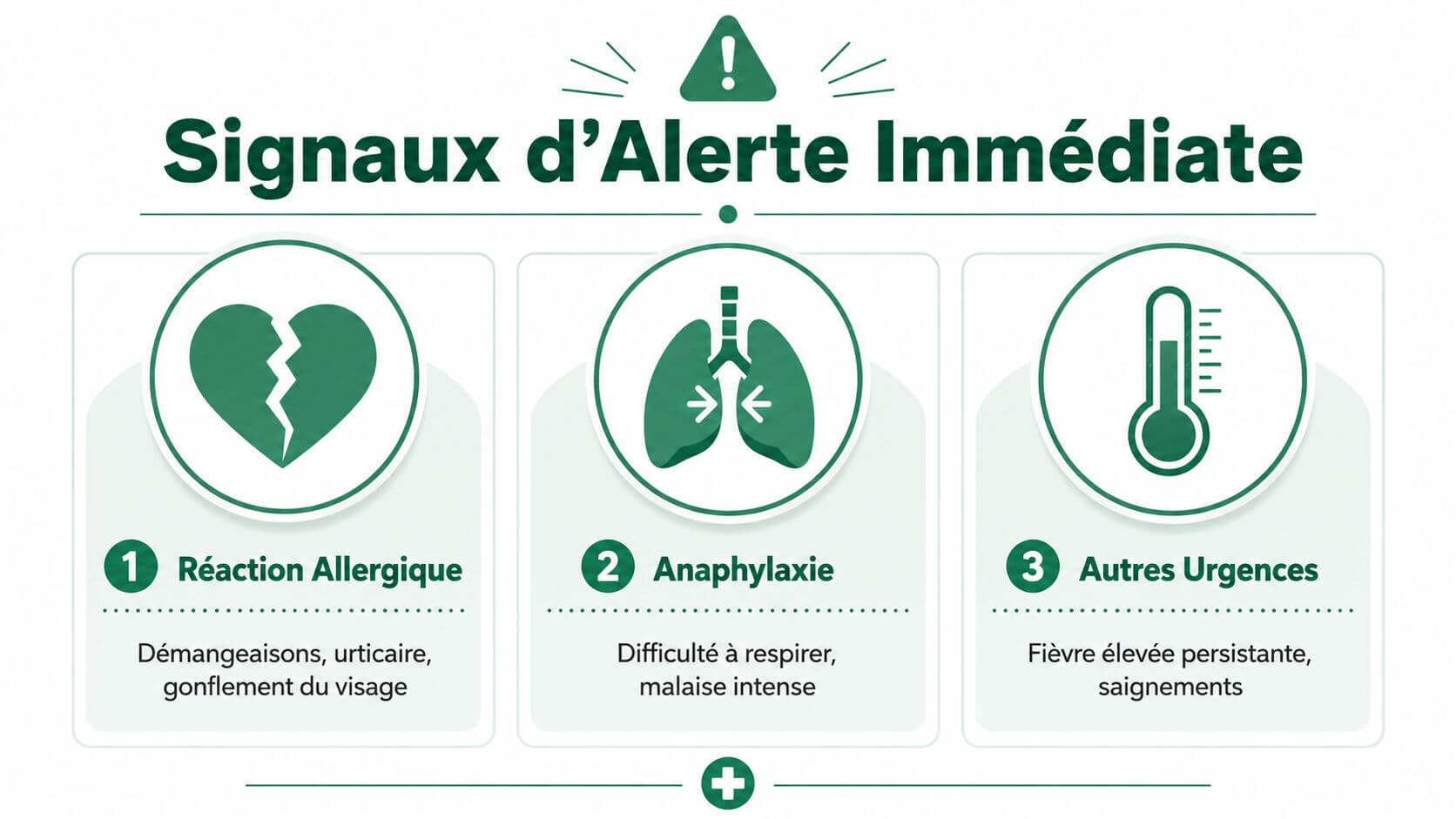
When a patient on amoxicillin has a worrying sign, the priority is not to wait until you see. You have to look at the breathing, skin, mucous membranes, and then the general condition. Serious reactions are rare, but they must be noticed without hesitation, because they can evolve quickly.
Immediate allergic reaction and anaphylaxis
The signs that suggest an immediate allergy are the itching,urticaria, swelling of the facelips or eyelids, and especially all difficulty breathing. If the person has trouble speaking, breathes faster, seems pale or has a malaise, you should call the 15 The list of allergic reactions published by Qare points out that reactions can be immediate or delayed, but that forms with respiratory discomfort and malaise are urgent. Allergological benchmarks.
Severe rashes, fever and mucous membranes affected
An extended rash with fever, blisters, mouth or eye damage, suggests a serious skin syndrome, such as the Stevens-Johnson or Lyell, which Vidal ranks among the exceptional amoxicillin syndromes Vidal form. This type of table does not wait until the next day. You must stop taking it and go to the emergency room or contact the doctor immediately according to the severity of the signs.
Severe diarrhoea and candidiasis not to be trivialised
Significant, persistent diarrhea, especially if accompanied by fever or marked weakening, must prompt medical advice. Oral or genital candidiasis, however, is not a vital emergency, but it must be transmitted to the doctor or pharmacist to adjust the management. At home, the right reflex is to describe the intensity, time of onset, number of stools, and whether or not there is itching, plaques or pain.
To find out what to say to the rescue or doctor, keep the following sequence in mind.
- Describe the medicine. Give the name, the time of the last dose, and if a dose has been missed.
- Describe visible signs. Urticaria, swelling, diffuse redness, blisters, diarrhoea, vomiting, fever.
- Describe breathing and general condition. Difficulty speaking, shortness of breath, malaise, drowsiness, confusion.
- Transmit context. Known allergies, other treatments, renal failure, similar old episode.
For a single relative in the face of a severe reaction, the right call marks remain the same as those detailed in this practical guide on the emergency call button. This preparation saves time, and in terms of allergy, every minute counts.
Risk factors and interactions to be monitored
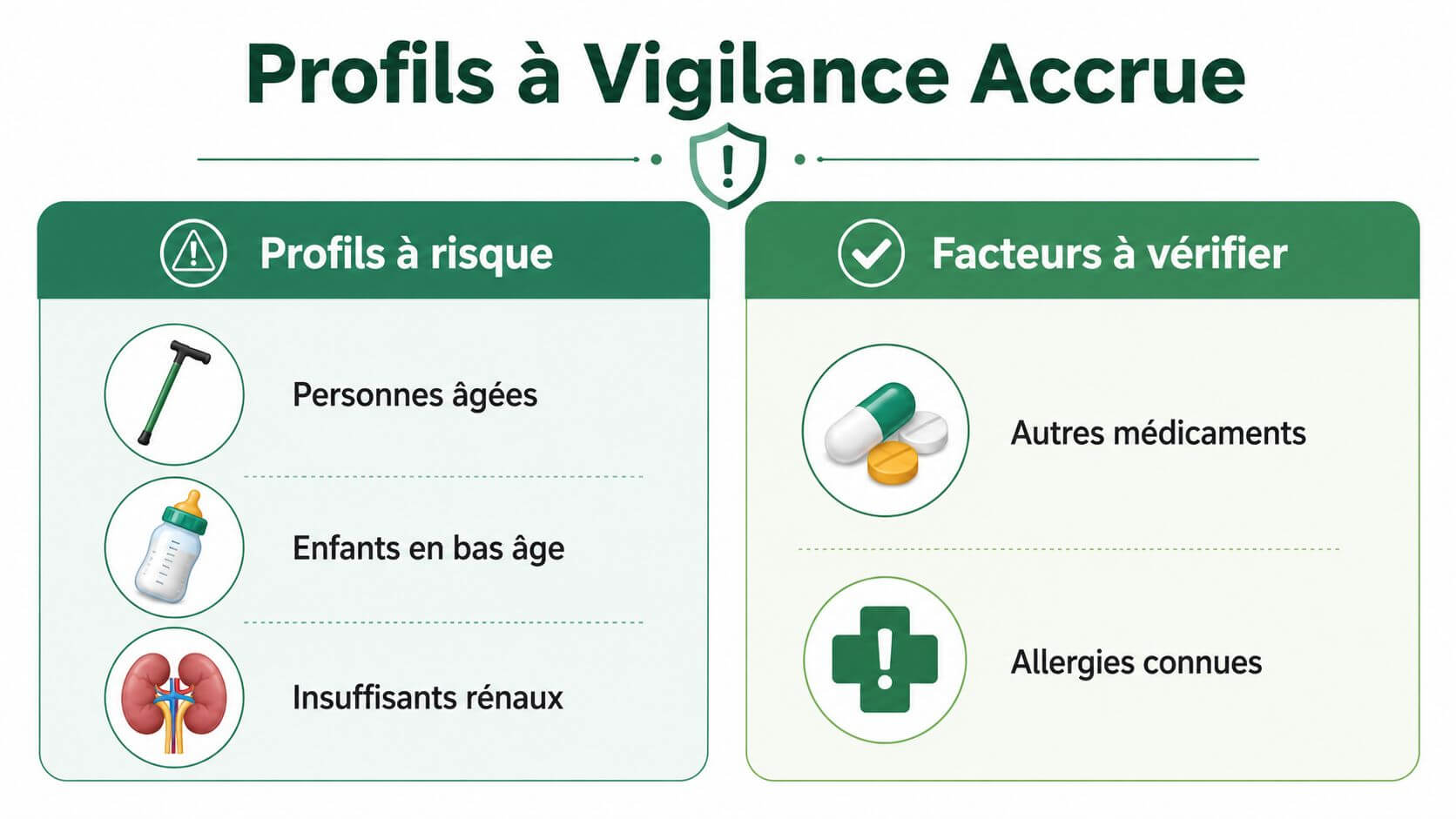
Not all patients leave with the same level of vigilance. Most tolerate amoxicillin well, but some situations require closer observation, either because the body removes the medication less well or because another treatment may alter the risk of reaction. The work of the caregiver is then to check the right points with the doctor or pharmacist before the start of the cure.
Profiles that deserve increased attention
Elderly people, young children, patients with renal or hepatic impairment, and those who have already had an allergy to beta-lactams require increased vigilance. In them, monitoring of symptoms and intakes must be more rigorous, as a common side effect can increase or be more difficult to describe. In practice, the close one notes more, observes more often, and transmits faster in case of doubt.
Medicinal products to be checked before starting
Some treatments modify the necessary level of caution. Anticoagulants, hormonal contraception, methotrexate andallopurinol are among the associations to be reported before taking. The French fact sheets also remind that supplements or probiotics can be discussed with the healthcare professional according to the context, but the essential thing remains to avoid improvised decisions in the middle of the cure.
- Anticoagulants to be declared. The doctor may request closer supervision.
- Methotrexate to report. The association requires a true medical check.
- Allopurinol to be mentioned. The risk of rash should be taken seriously.
- Hormonal contraception to discuss if vomiting or diarrhoea. The problem comes mainly from disturbed absorption, not from an automatic direct effect.
What to check with the professional
Before leaving home, the relative can check four simple points. Is there a known allergy? Is there a chronic treatment at risk of interaction? Does the person drink enough, especially if they have fever? Does renal function impose special caution? These questions do not replace the medical advice, but they avoid much of the forgetfulness when the antibiotic box arrives at home.
Organize home follow-up with relatives and caregivers
The real issue at home is not just knowing the side effects, it's not losing the information between a text message, a short call, an IDEL pass and a hastily given instructions. A clear follow-up reassures the family, and it gives the doctor a more reliable view of what happens day after day. When the observation is shared, the patient does not have to repeat the same details to each practitioner.
What needs to be traced daily
The simplest is to note the time of each dose, the name of the medication, and the symptoms observed during the day. One line is enough for diarrhea, another for nausea, another for the skin, with if possible the location, appearance and moment of appearance. The useful constants, when followed at home, are the temperature and, if necessary, the elements requested by the doctor or the IDEL.
Good reflex. A well-kept care journal is better than a long oral exchange that we forget when evening comes.
What the health care team needs to be able to find quickly
The emergency report It must be accessible to all authorized relatives and caregivers, even out of connection if possible. It contains allergies, ongoing treatments, contacts to call and, if necessary, specific instructions given by the doctor. Structured transmission book helps to spread the same information between family and professionals.
Which relieves the mental burden of caregivers
A shared calendar avoids duplication, a recall reduces forgetfulness, and a written history helps to identify what comes back several days in a row. It is particularly useful when several people talk to the patient, because everyone sees the same version of the facts. The important thing is not to document everything, it is to document what really changes and what needs to be transmitted without delay.
Key reflexes to keep in mind during and after cure
An amoxicillin cure looks like a route that is followed to the end, unless otherwise instructed by the doctor. If nausea occurs, taking at the beginning of a meal can make the passage easier for the stomach. Regular hydration also helps to limit the urinary complications already mentioned. As soon as the skin, stools or breathing change, you leave the simple surveillance and transmit the information without delay.
Keep under your hand
- Drinking regularlyThe goal is to keep urine thinner and reduce the risk of crystalluria.
- Watch the stools. Diarrhoea that settles, intensifies or changes its appearance should be reported, especially if it fatigues the person or disturbs hydration.
- Look at the skin and mouth. Redness, plaques, hives, blisters or mucous membrane damage are not passively monitored, they are quickly passed on to the healthcare team.
- Do not stop treatment alone. If the person is not able to cope with the cure, the stoppage will be discussed with the doctor or pharmacist, not improvised at home.
- To prevent unusual effects. The caregiver decides on the next step, but he needs a clear description of the moment of appearance, the evolution and the context.
- Keep a simple trace of the catch. Visual monitoring of catches, such as that proposed by a connected pill box, reduces forgetfulness and facilitates transmission to caregivers.
Family Mini FAQ
Can we give a probiotic? This can be seen with the pharmacist or doctor depending on the field, especially if the intestine is already fragile or if the stools have already changed.
What to do with a missed dose? Follow the advice of the prescriber or pharmacist. Do not automatically double the next dose, as this makes it difficult to read the effects.
Is amoxicillin compatible with alcohol in small quantities? In practice, it is best to avoid it if the person has nausea, fatigue or ill-tolerated treatment. The aim is not to mix signs that are already difficult to interpret.
How long do we stay alert after the stop? We remain vigilant for a few days if digestive, skin or allergic symptoms have appeared during the cure. The helping loved one and the IDEL then keep the same reflex, note, observe, transmit.
If you are coordinating treatment at home, Tribulys can help you keep a clear track of useful doses, symptoms and instructions, without losing information between messages. For a more serene follow-up of medications, appointments and transmissions, discover Tribulys and see how to centralize the essentials around the patient.
Put this organisation into practice with Tribulys
Keep your care journal, shared calendar, tasks, medication tracking and emergency information together. Start for free and invite the relatives and professionals involved in your loved one’s care.