
You arrive at Mrs. Martin's home after the passage of the home care worker. She tells you that the lunch went well, but there is no indication if the intended treatment has been taken. The nurse has to come by later, the girl has been calling since her work, and everyone has some of the information. home help link book PDF well organized avoids assumptions and allows the next speaker to quickly understand what really happened.
However, the ready-to-print model alone is not enough. where to write, what to write, how to date and how to sign. Here you will find a simple structure, examples of useful entries, the formulations to avoid, and a comparison with the shared digital notebook.
Contents
- Why the book changes the daily life at home
- What the care journal is and why it is framed
- Anatomy of the PDF model to print
- Write a time stamp entry that really serves
- Paper or shared digital notebook
- Disseminating and archiving the notebook safely
- Your start-up plan in a week
Why the book changes the daily life at home
At 10 a.m., the assistant of life finished her passage. She found that Mr. Bernard had eaten little and seemed more tired than usual, but she had to leave before the nurse arrived. At noon, the nurse discovered only an almost intact plate and wondered. Mr. Bernard's daughter, notified by telephone, thought that her father had already reported her unease. In reality, no one left a precise transmission.
The care journal creates a common point of reference. The assistant can write what she has observed, the nurse can add the elements relevant to her intervention, and the family can consult useful information without reconstructing the day from scattered messages.
Field reflex: a transmission does not need to be long. It must allow the next person to know what has been done, what has been found and what needs to be monitored.
The document becomes particularly useful when the workers do not cross. A home helper, a nurse, a physiotherapist and a close friend can take turns at the same home with different times. Without common support, forgetfulness, duplication and interpretation can easily settle down.
A print-ready PDF template helps you start with identified headings. You will also learn how to fill each line in a way Factual, readable, dated and signed, then choose between the paper and a digital notebook depending on the situation of the person receiving care and his entourage.
What the care journal is and why it is framed
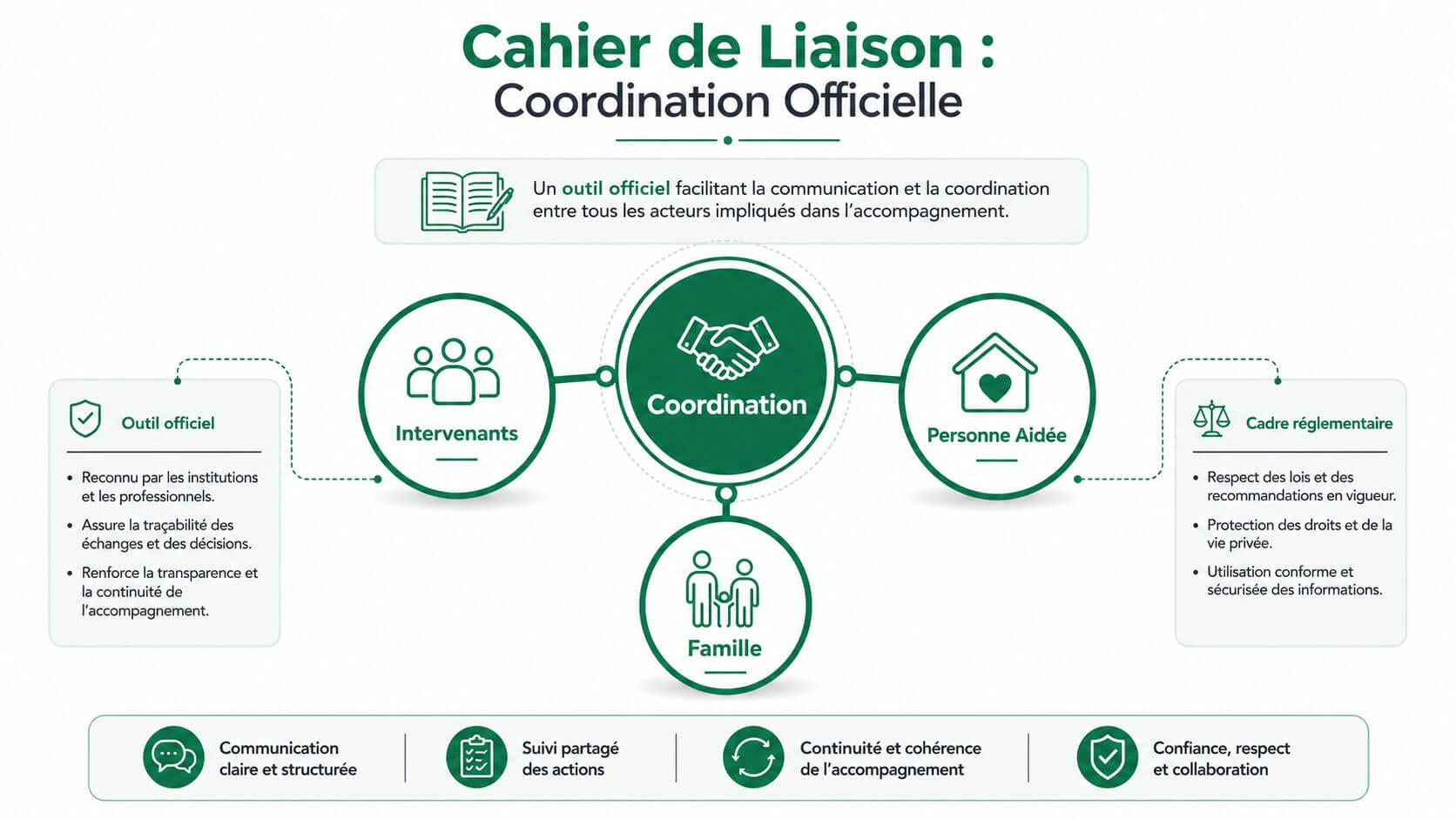
The care journal is a coordination medium kept at the home of the person receiving care. official portal for personal services It is presented as a tool for the coordination of daily life between stakeholders, the person receiving care and his or her family. dated and signed by the author.
This rule gives each transmission an identity and context. A sentence such as "weary this morning" is not of the same value if it is not known when it was written, who observed it and in what function it was involved. The date, time, signature and function allow the reader to understand the origin of the information and to contact the right contact person if necessary.
In France, the liaison book is also attached to the minimum technical conditions for organising home support and support services. So this is not just a family notebook. In the case of recurrent benefits for the elderly and disabled, it is a reference medium for organising the continuity of interventions. The regulatory and practical presentation of the liaison workbook recalls the importance of a factual document, readable and usable by different professionals.
A tool adapted to a fragmented sector
The need is far from marginal. 475 000 home helpers in 2021of which: 93 per cent women. These data show the extent of the network of stakeholders involved in home transmission.
The booklet may contain contact details of the partners, the persons to be notified, the useful elements about the person assisted and the follow-up information. It therefore serves as both an organizational and a daily memory, provided that each person complies with the same writing rules.
To further coordinate between professionals, you can consult this guide on the Nurse transmission software. The principle remains the same on paper or in a digital tool, an event must be found, understood and attributed unambiguously.
Anatomy of the PDF model to print
A good model of home help link book PDF does not leave the speaker in front of a blank page. It offers stable locations, always presented in the same order. This organization reduces the hesitations and facilitates the reading of a person who discovers the notebook for the first time.
Start with a cover page placed immediately inside the cover. It must identify the home and key interlocutors without going through all the pages.
The guard page
Enter the information that is useful for coordination:
- Helped person: name, first name and contact details of the home.
- Speakers: Aide de vie, service d'aide, nurse, physiotherapist or other partner concerned.
- Persons to be prevented: close referent, trusted person or designated contact.
- General instructions: access to housing and important precautions.
Do not overload this page with scalable comments. A treatment change or clinical observation should be included in the appropriate section, with its date and author.
Fixed items
The model can then provide separate spaces for the health alerts, changes in condition, transmissions of care and safety instructions. Also add daily activities, meals and observations useful to accompany.
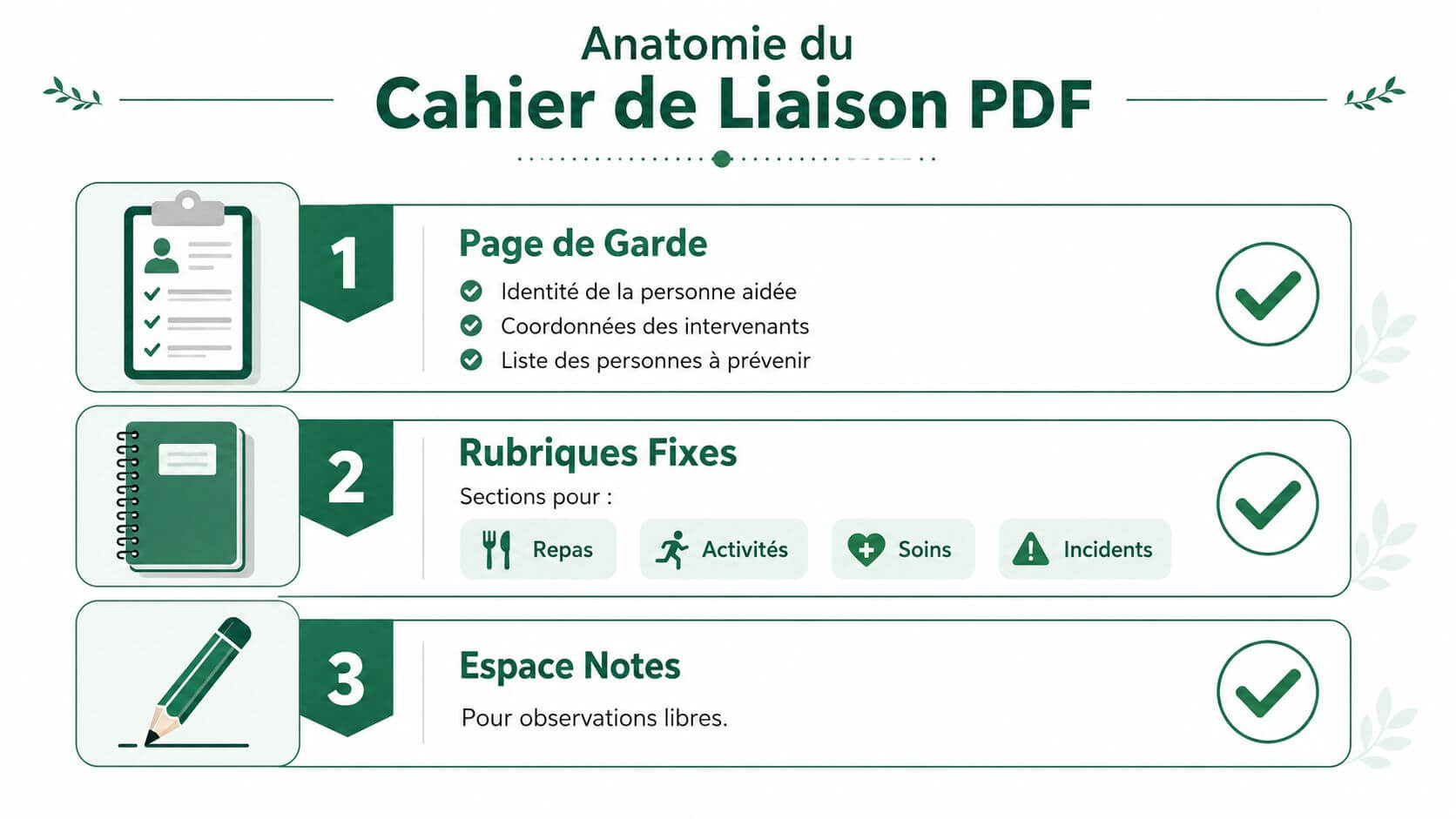
A "meal" section includes, for example, the amount consumed or the refusal of a dish. A "activities" section allows you to record an outing, exercise session or proposed activity. Care and incidents require even more rigorous writing, as they may be of interest to several professionals.
Keep a note box free, but use it for information that does not fit in the box. If a free note becomes repetitive, it is a sign that a new fixed entry would be clearer.
Write a time stamp entry that really serves
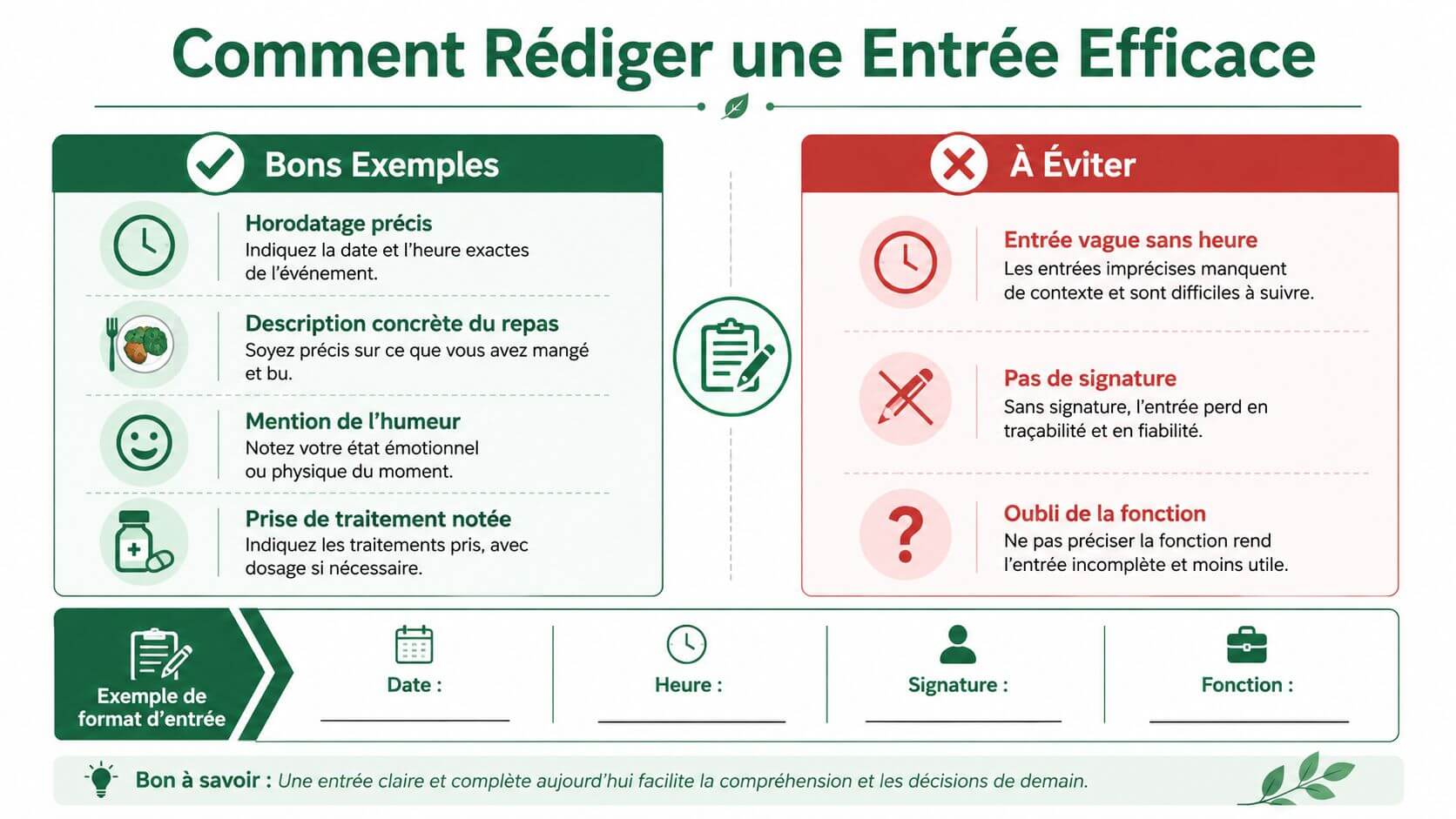
The quality of the notebook depends less on the written quantity than on the accuracy of each entry. A useful transmission answers several simple questions: when, who, What have we done?, what has been observed and What action should be taken? ?
The four-benchmark method
Write first the date and time of the passage. Then describe the observable facts, without diagnosis or judgment. Finish with the action performed or the information transmitted, then add your signature and your function.
Here is an example for a meal:
12/03, 12:15. Lunch proposed: soup and yogurt. Mrs. Martin consumed half of the soup and yogurt, refused the main dish. Water proposed and left within reach. Signature: L. Moreau, home care worker.
The wording "does not eat anything" is too vague. It does not allow the next stakeholder to distinguish a complete refusal, a small quantity or a food preference.
For mood, prefer a concrete observation:
- Avoid: "Mr. Bernard is depressed today."
- To be written: 14/03, 9:40 a.m. Mr. Bernard answers questions, sits in his chair and says he feels very tired. No other changes observed during the passage. Signature, function. "
The first statement interprets the psychological state. The second relates observable words and behaviours, without assigning a diagnosis.
Treatment and incidents
Do not note "made drugs" if you do not know exactly what has been verified. A more exploitable entry may indicate:
15/03, 08:05. Morning pill organiser presented to Mrs Martin. The person receiving care confirmed taking the medication. No missed dose noted. Signature: A. Petit, home care worker.
If the catch did not take place, write it clearly and indicate the transmission performed:
15/03, 8.10 p.m. Evening treatment was not confirmed, Ms. Martin said she did not want to take treatment before dinner, and close contact was informed by telephone at 8:15 p.m. Signature: A. Petit, home care worker.
For an incident, always separate the fact, the action and the report:
16/03, 4:30 p.m. Sliding in the bathroom indicated by Ms. Martin. No fall to the ground according to her statements. Pain not reported, travel accompanied to the chair. Nurse notified at 4:40 p.m. Signature: C. Roy, home helper.
The video on good transmission practices can be used as a support during a team briefing.
Paper or shared digital notebook
Paper remains relevant when people at home can easily view the notebook. It does not require any connection, device, or particular learning. On the other hand, a close relative who lives far away does not see the new entries before a worker gives him or her the information.
Digital solutions to this challenge by centralizing transmissions. It can offer timed and signed entries, separate rights depending on the role, offline operation and synchronization when the network returns. However, these functions must be verified in the chosen solution, such as hosting conditions and health data management.
| Criterion | Paperbook PDF | Shared digital notebook |
|---|---|---|
| Access to home | Available on site | Available from an authorized device |
| Update | Reading while passing | Synchronization between users |
| Traceability | Date, time and handwritten signature | History, time stamping and identification |
| Remote access | Limited | Adapted to remote caregivers |
| Confidentiality | Physical control of the notebook | Accounts, roles and permissions to set |
| Networkless continuity | Always accessible | Depends on an offline mode |
| Archiving | Page Classification | Export or retention in the application |
One electronic link book It is more appropriate when several people need to consult the same information without being at home. A very present family can stay on paper, while an organization coordinating several stakeholders will have an interest in examining roles, history and alerting functions.
The choice must not contrast modernity and simplicity. The right support is that which each data subject actually uses, with common rules of writing and limited access to the necessary information.
Disseminating and archiving the notebook safely
The paper book must remain at the home of the person receiving care, in a place known to the stakeholders but not exposed to visitors. Avoid leaving it open on a table when health information is visible. The contact person must explain his/her location to each new worker from the first passage.
Organize completed pages in chronological order. Do not remove a page because it contains an error. Trace the correction legibly, without deleting the initial information, then add your initials or signature according to the rules chosen by the service.
A simple protocol for relays
- Upon arrival of an intervenor: present the location of the notebook and the entries to be used.
- Each time: read the latest useful transmissions before taking action.
- In case of alert: notify the professional or relative concerned, and then note this transmission.
- When a change of provider occurs: provide the useful history and keep the pages as directed by the service.
- For the attending physician: prepare a legible synthesis rather than transmit photocopies without classification.

Scanning requires the same caution. A page photo sent to a messaging group can circulate beyond authorized people. Use a secure channel, check recipients and limit copies to the necessary information. Health data should not be treated as a simple practical message.
Your start-up plan in a week
The notebook takes its place in the routine in small steps. Provide a fixed location, accessible to authorized stakeholders, and then prepare the useful contact information and the home page. The goal is that everyone knows where to find the information and how to transmit a relay without interrupting the next visit.
A seven-day calendar
- Day 1: Print the template, complete the on-call page and enter the persons authorized to consult the notebook.
- Day 2: Give it to the home care worker and explain the use of the headings with a concrete example.
- Day 3: ask for a first transmission after the visit, even short.
- Day 4: Reread this entry with the speaker and correct only what is missing to understand it.
- Day 5: involve a relative, who consults with the transmission and then indicates the action it plans to take.
- Day 6: check that important relays are found without multiplying calls.
- Day 7: bring together the people involved and set the rules for keeping, consulting and climbing alerts.
A role play makes the directive concrete. The relative asks, "What did you write after the visit? "The assistant said, "I noted, "Tuesday morning, Mrs. L. ate half of his lunch, then refused dessert. She seemed more tired than Monday. Observation transmitted to his daughter at 11.30 a.m. Initials: AB. This formulation allows the next speaker to understand the situation without turning an impression into a diagnosis.
On the fourth day, look for formulations that block continuity: "Nothing to report", "worse behavior" or "to see" do not give context or follow-up. Replace them with a precise observation and, if necessary, with the recipient of the information.
If the carers are distant or take turns without crossing each other, a Coordination application for relatives can complete or replace the paper according to the rules of the team. Tribulys centralizes the link book, timed transmissions, schedule, tasks and follow-up of medicines in a space shared between the family and the authorized professionals. Tribulys to choose the support adapted to the organization of the home.
Put this organisation into practice with Tribulys
Keep your care journal, shared calendar, tasks, medication tracking and emergency information together. Start for free and invite the relatives and professionals involved in your loved one’s care.