
End-of-life accompanying leave, now referred to as family solidarity leave, allows any employee or public official to be absent until three months, renewable once, to accompany a loved one whose life-threatening prognosis is engaged. In case of absolute emergency found in writing by a doctor, he can start without waiting for the usual delay.
The phone rings. The hospital tells Claire that her father's condition has worsened sharply. She must arrange a home presence, notify her employer, find a doctor available and understand within a few hours what resources can compensate for her absence. She does not need a theoretical presentation. She must know what to send, to whom, and in what order.
It is precisely in this moment of rocking that the family solidarity leave becomes useful. However, the law remains difficult to mobilize when the situation deteriorates rapidly. The information is dispersed between the employer, the doctor, the administration and the CPAM, while the caregiver must make decisions under pressure.
The French system has been in existence since Act No. 99-477 of 9 June 1999, which had created the accompanying leave of a person at the end of life. It was then transformed into a family solidarity leave, then extended to the public sector. The rule is clear on paper. The use of it requires a method.
Contents
- When life changes and rights become urgent
- Understanding family solidarity leave in plain language
- Step-by-step approaches to the employer and the CAF
- Staff member or emergency cases the differences which count
- The AJAP and the CAPM component what you will really touch
- Why so many caregivers do not use this right and how to remedy it
- Coordinate daily accompaniment with method
When life changes and rights become urgent
The phone rings after a sudden worsening. The doctor announces that Claire's father's condition requires a close presence. She works full-time, her brother lives far away and her sister can only come on time. In a few hours, Claire has to organize the care, notify her employer and check how to compensate for her absence.
The questions go on: Can she stop working immediately? Can the employer refuse? Should she ask for paid leave? What certification must the doctor provide? Who will pay the allowance? And if her father's condition improves, can she resume her activity?
Priority reflex: If the relative's condition deteriorates rapidly, ask for a written medical certificate from the first exchange with the doctor. Send it to the employer or the competent department to base the application on specific elements.
The family solidarity leave It applies not only when the death appears imminent. It also concerns a relative whose pathology is life-threatening or who is in an advanced or terminal phase of a serious and incurable condition. The medical situation must be established by an adapted document. Without this document, the right remains difficult to assert in the emergency.
The rule is provided for both the private sector and the public service. It allows for a maximum of three months, renewable once, depending on the framework set out in the reference document on family solidarity leave. This time can be used to organize care, distribute attendance and maintain the home. In practice, the effectiveness of the device depends mainly on the coordination between the doctor, the employer and the CPAM.
What to do in the early hours
Act in this order:
- Physician or health care team: request a medical certificate corresponding to the condition of the relative and the emergency.
- Employer, HR Service or Administration: Report the situation in writing without delay. A call may warn, but the written record leaves a trace of the request.
- Close to: allocate visits, nights and relays to prevent the entire charge being placed on a single person.
- SPAM: ask for a list of the proofs necessary for the allowance and check the methods of transmission.
One Report of the National Assembly indicated that in 2005, 47% of respondents reported having already accompanied a close relative at the end of their life for less than three months. The accompaniment therefore concerns many families, often over a short and difficult period.
Two errors come back in the real situations: waiting for the employer to measure the seriousness of the facts alone and to believe that the allowance will be paid automatically. Notify each contact person, provide the required proofs and keep the exchanges. The right exists, but its application depends on a quick and properly documented approach.
Understanding family solidarity leave in plain language
The family solidarity leave is the former accompanying leave of a person at the end of his or her life. It is intended for the private sector employee and the public official who must accompany a relative with a pathology which is life-threatening or in the advanced or terminal phase of a serious and incurable condition.
The next of kin can be an ascendant, a descendant, the spouse, the partner bound by a PACS, a brother or a sister. The device can also concern a person of trust in the conditions provided by the texts. The decisive point is not the degree of dependence on daily life, but the medical situation attested.
The maximum duration shall be three months, renewable once, i.e. a total possibility of six months. Leave may be taken on a continuous basis, divided or converted into a part-time period. For the employee, the conversion into a part-time period may extend to an activity limited to 50%, without the employer being able to impose a refusal when the conditions are met.
Do not confuse three devices
Family solidarity leave responds to an end-of-life situation. Parental attendance leave concerns a child who is seriously ill, disabled or injured. Bereavement leave occurs after death and meets another logic, that of the time it takes to cope with the loss and the steps that follow.
| Criterion | Family solidarity leave | Parental leave | Bereavement leave |
|---|---|---|---|
| Situation | Accompanied by a life-threatening or advanced- or terminal-phase relative | Care for a child who is seriously ill, disabled or injured | Facing the death of a loved one |
| Person concerned | Family closeness or person within the scope of the scheme | Dependent child | Near deceased under applicable conditions |
| Organization | Continuous, split or part-time leave | Organisational absences according to the needs of the child | Absence due to period of mourning |
| Main justification | Certification or medical certificate | Medical grounds for the child's condition | Justification for the death and the link concerned |
| Purpose | Allow end-of-life support | Ensuring a presence with a sick child | Allow collection and post-death procedures |
To deepen the difference between rights and situations of assistance, see the Tribulys guide on the Caregiver statusThis distinction avoids asking for the wrong device at the wrong time.
Point of vigilance: family solidarity leave suspends work, but does not constitute leave paid by the employer. The right to absence and the issue of income must therefore be dealt with separately.
The insured jobseeker may also fall within the scope of the allowance according to his/her situation. In all cases, medical certification and the consistency of the periods requested remain essential.
Step-by-step approaches to the employer and the CAF
The procedure becomes simpler if you treat it as a chain of four actions. Each step produces a useful piece for the next one.
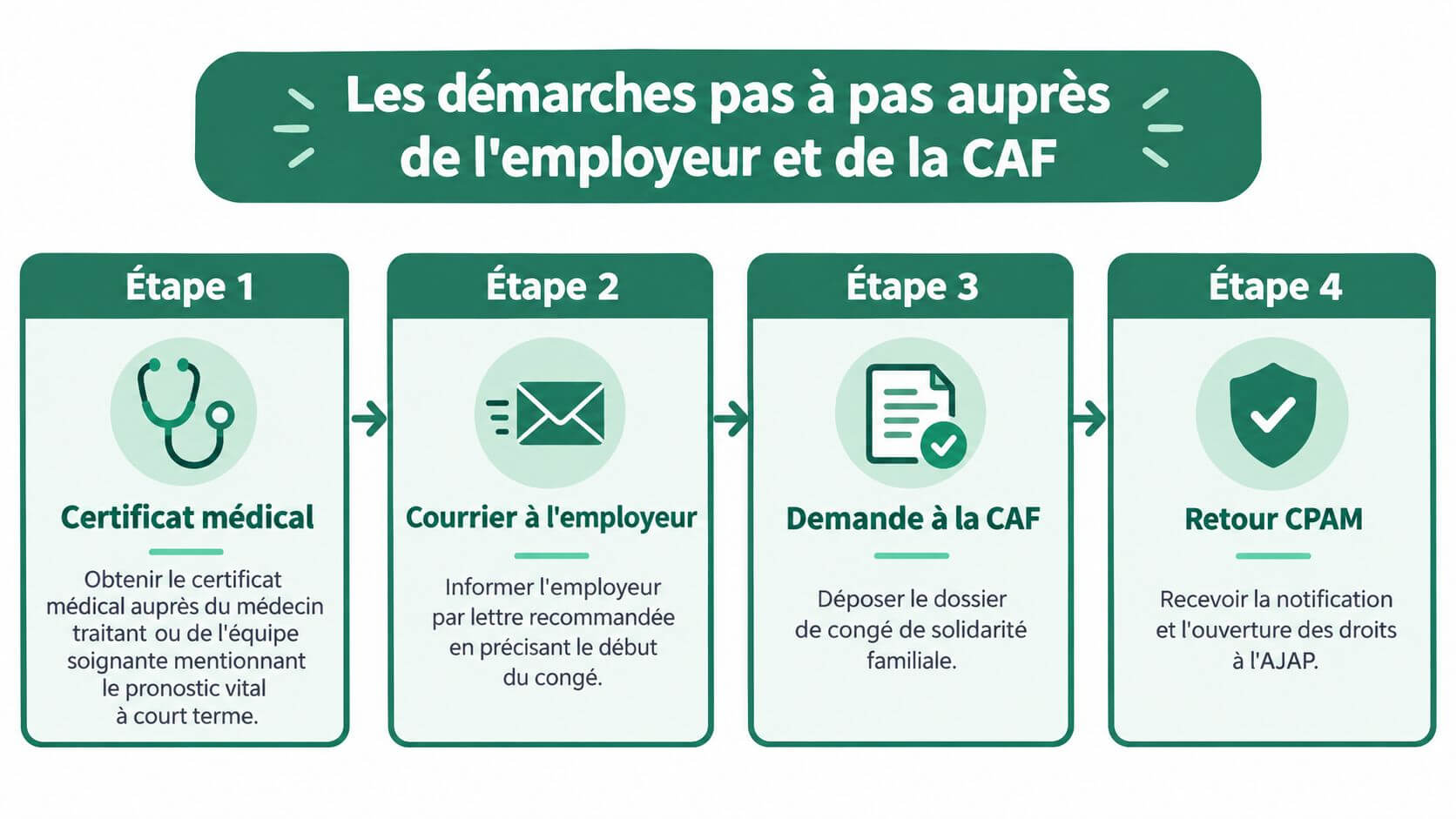
1. Obtain medical certification
Ask the treating physician, hospital physician or family care team for a document stating that the pathology is life-threatening or that the person is in an advanced or terminal phase of a serious and incurable condition. The document does not need to tell the whole medical history. It must be used to justify the leave.
In the event of an absolute emergency, make this emergency clear in writing. Sudden aggravation, sudden hospitalization or an end-of-life situation requiring immediate presence can justify a departure without waiting for the usual delay.
2. Inform the employer
In principle, the employee informs the employer at least 15 days before the start of the leave, by registered letter or by a written means to prove the date of dispatch. The message must indicate the intended period, the chosen form, continuous leave, split or part-time activity, and attach the medical evidence.
For a public official, the request is addressed to the appropriate administration or service, according to the community or institution's rules. Do not just call a phone call. Call to notify, then confirm by email to leave a trace.
3. File the claim for an allowance
The daily support allowance for a person at the end of his or her life, or AJAP, asks the competent body with the dedicated form. Prepare the attestation of the employer or the administration, the medical certificate and the proof of the link with the person accompanied.
The CAF intervenes in the payment of the allowance on the intended route. The CPAM intervenes on the sickness component and the training of the elements covered by the Sickness Insurance. Check the recipient organization indicated on the form, as an error of orientation can slow down the treatment.
4. Treating the emergency without delay
As a matter of absolute urgency, the 15-day period can be ruled out in writing by a doctor. Inform the employer as soon as possible, explain that the request is based on a medical emergency and attach the document as soon as it is received.
Parts to be prepared
- Medical certificate or certificate: document prepared by the physician or health care team.
- Written request to employer: period, modality and desired start date.
- Employer or Administration Certification: document relevant to the allocation file.
- Linking rationale: document establishing the relationship with the relative.
- Allowance form: verified, signed and completed without any outstanding entries.
The right of absence and the opening of the allowance are two linked but distinct steps. Do not assume that the employer's agreement automatically triggers the payment.
Staff member or emergency cases the differences which count
The principle remains the same, but the point of contact changes. In the private sector, the employee applies to the HR service or to his employer. In the public service, the agent files his application with his administration, with the time limits and documents prescribed by his statute and the internal procedures.
The ordinary law period is: 15 days. In the event of an absolute emergency found in writing by a doctor, the leave can begin without waiting for this delay. The important point is the medical proof of the emergency, not only the impression of the family that the situation is critical.
| Situation | Time limit for informing the employer | Possibility of splitting | Recognised emergency |
|---|---|---|---|
| Private employee | 15 days in principle, unless medically determined absolute urgency | Yes, as planned | Written medical attestation justifying immediate departure |
| Public official | Time limit provided by the administration, with request addressed to the competent department | Yes, according to applicable rules | Emergency medical situation established in writing |
| Planned support | Advance information and file prepared | Yes, if the periods are defined | No exception without emergency medical element |
| Brutal aggravation at home or in hospital | Immediate information, then written formalization | Yes, if the organization allows | Pronostic vital committed in the very short term or absolute urgency observed |
Splitting is useful when several relatives take turns. Part time can also avoid a complete break with the job, but it must be organized with precision. Specify the days or slots involved and confirm the period in writing.
The unused days, the possible postponement and the procedure for resuming must be clarified with the employer or the administration. Do not leave these points in an informal conversation. Written confirmation reduces misunderstandings, especially when the condition of the next of kin changes rapidly.
In order to prepare the organization of care and the relays at home, also use the reference points in the guide on Palliative Home Care. The treating physician and mobile palliative care team can help document the evolution of the situation and coordinate care.
The AJAP and the CAPM component what you will really touch
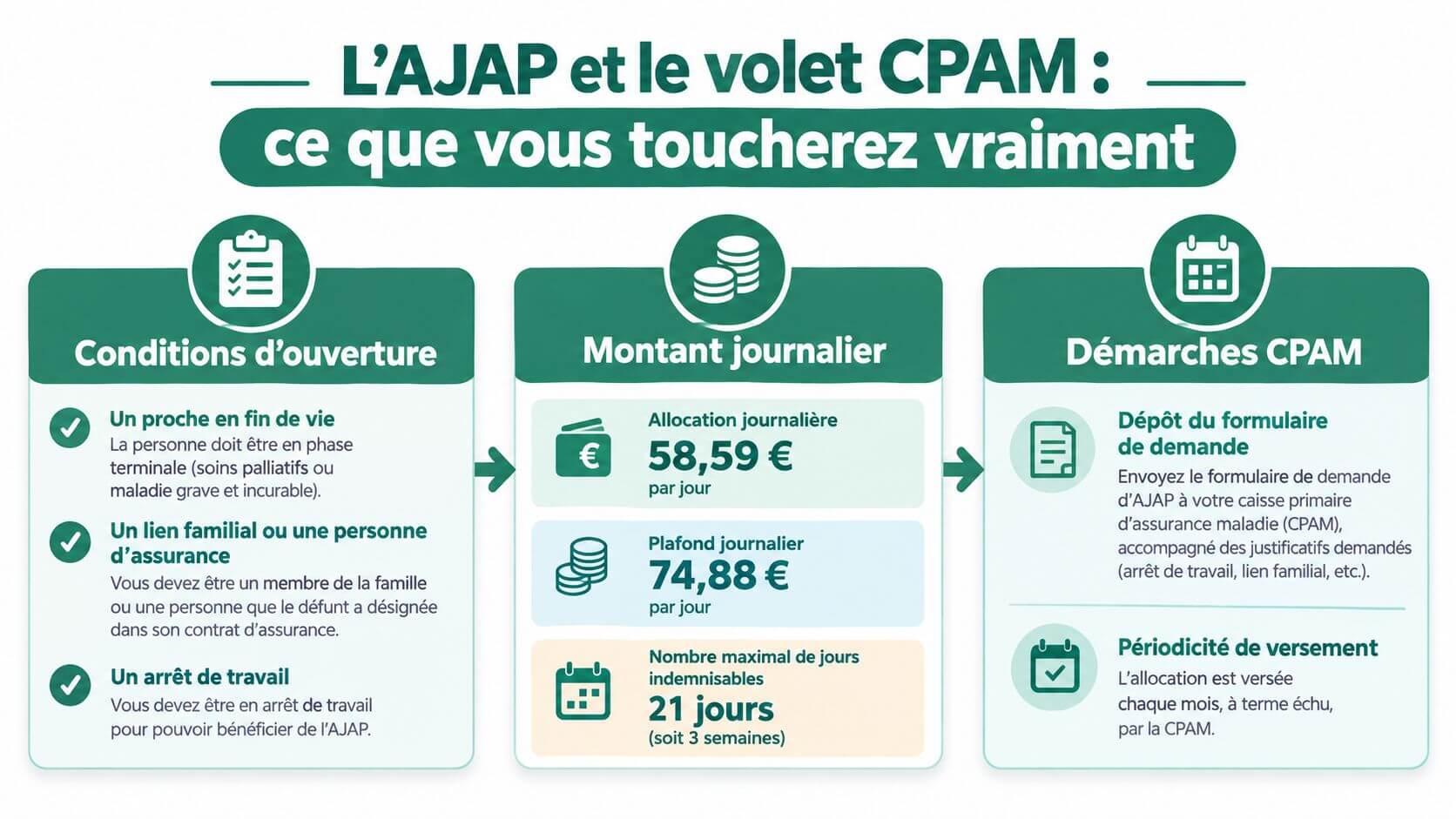
The AJAP is an allowance designed to partially compensate for the loss of income associated with accompanying a person at the end of his or her life. It does not automatically replace the salary and does not transform the leave into an absence paid by the employer.
The file must correspond to the period actually requested. A frequent error is the transmission of an incomplete medical certificate, an unsigned employer certificate or a form that does not correspond to the chosen method. The organization can then apply for supplements, which delays the payment at the time the family has already lost working time.
What the file must demonstrate
The file must relate three elements: the medical situation of the relative, the relationship or connection allowing for the accompaniment, and the interruption or reduction of the professional activity. The employer or the administration confirms the period of absence or part-time work. The doctor confirms the seriousness of the situation.
Before sending, check the information most exposed to errors:
- Identity of the next of kin: it must be identical on the various documents.
- Period requested: the dates must correspond to the actual leave taken.
- Mode chosen: full-time, split-up or part-time.
- Signature and contact information: no essential parts shall be transmitted without validation.
- Recipient organization: Follow the instructions on the filing form.
Accompaniment of 21 full-time days It may be a difficult financial period, but it is impossible to calculate a reliable amount from the only information available here. The daily amount, ceiling and maximum number of compensable days depend on the applicable rules and the reported situation. Ask your CPAM for a simulation or written confirmation before building your budget.
Do not confuse the AJAP with the daily allowance of the caregiver, which meets other conditions. guide on the daily allowance of the caregiver helps to distinguish devices.
An exchange with the CPAM can also avoid a bad surprise about the periodicity of the payment. Keep a full copy of the file and note the filing date, attachments and contact name.
Financial Board: Do not leave your position thinking that the allowance will necessarily cover your income. First, check the amount expected, the compensable duration and any improvements provided for in your collective agreement.
Why so many caregivers do not use this right and how to remedy it
The gap between the existence of the law and its actual use is difficult to ignore. An evaluation report cited in the field literature indicates that in 2021, 535 persons received the associated allowance for 529 persons accompanied, 8,476 full-time allowances and 3,094 part-time allowances, according to the elements presented by Factorial on Family Solidarity LeaveThese data show a low use in relation to the reality of family accompaniment.
Several brakes combine. Some employees are not familiar with the scheme. Others are afraid of weakening their position in the company, especially when the manager has never dealt with this type of request. Many cannot completely stop their activity because the allowance does not fully compensate for their income.
The procedure itself discourages. It is necessary to obtain a medical certificate, formalize the application with the employer, identify the correct form and submit the supporting documents to the competent body. In a period of palliative care, each missing piece becomes an additional burden.
The levers that really work
- Ask for a social worker: the hospital, clinic or social service sector can help identify rights and interlocutors.
- Talk to the manager early: an upstream discussion facilitates the continuity of the activity and limits guilt at the time of departure.
- Read the collective agreement: it may provide for provisions which are more favourable than the legal basis.
- Review the donation of days: colleagues can sometimes contribute to an internal mechanism to support the caregiver.
- Prepare for return: set a forecast date, an interlocutor and the information to be transmitted during the absence.
The leave must not be presented as a abandonment of the position. It is a temporary, supervised period that allows for a major family responsibility. The employer has an interest in obtaining a structured request rather than a succession of unpredictable absences.
Coordinate daily accompaniment with method
When the condition of a loved one deteriorates rapidly, calls multiply and decisions must be taken without delay. Family solidarity leave gives time, but it does not create an organization. Without precise relays, the caregiver remains asked for every order, appointment and change of schedule.
Organize a readable week
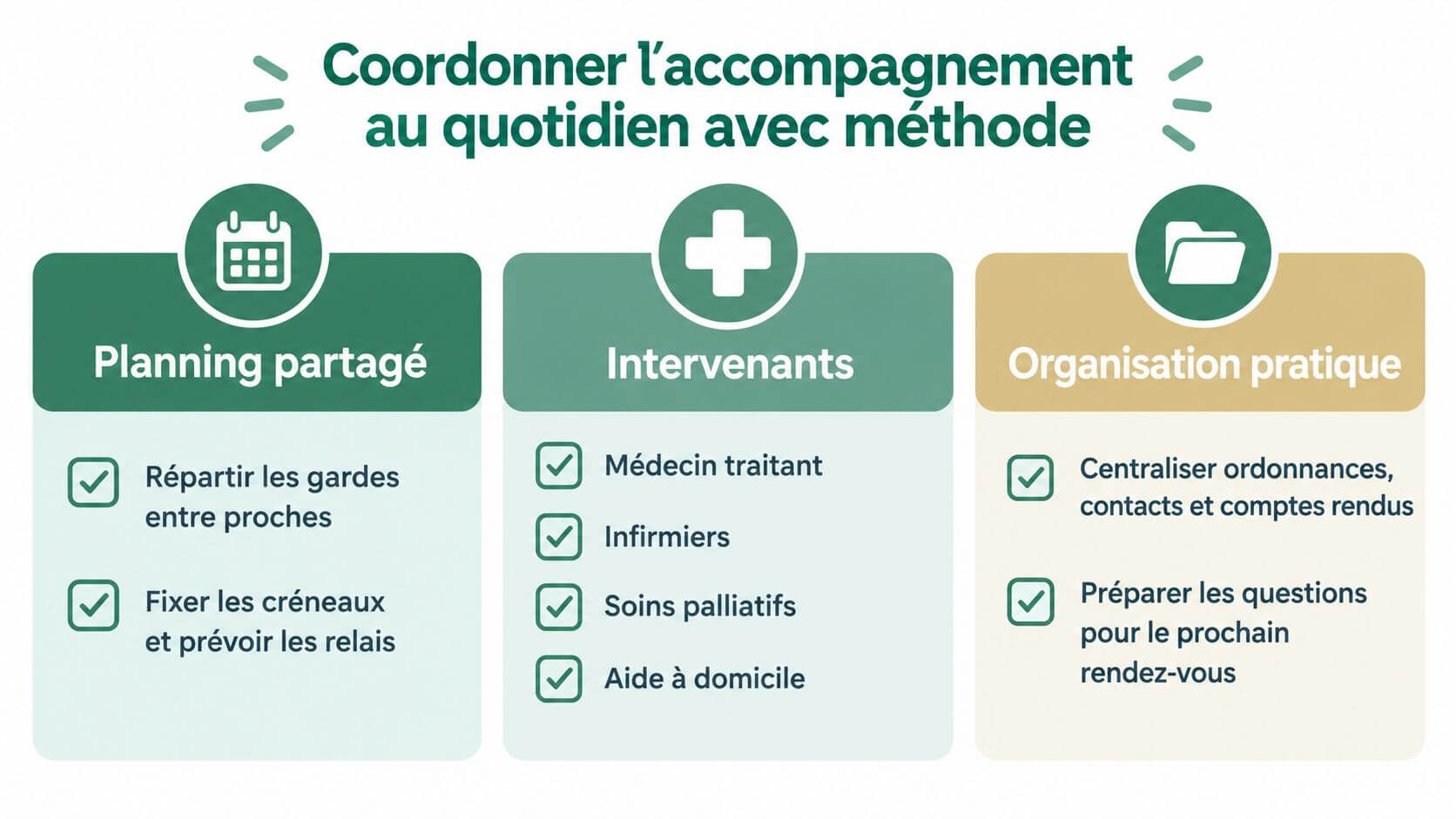
Start with a shared schedule. Enter attendances, appointments, nursing passes, races, medical calls, and pending tasks. Each responder must see who is coming, what time and what remains to be done.
Share the roles before the emergency. A relative can follow medical questions, another can follow up with the employer, the CAF or the CPAM, and a third can follow up on purchases and logistics. This distribution prevents the employee on leave from carrying all the coordination alone. To structure follow-up, see the Home Care Coordination Guide.
Keep a useful track
A logbook collects symptoms, treatments, physician questions, and unusual events. Add an emergency record with contact details, contact details of the attending physician, and instructions validated by the health care team. Dated information reduces forgetfulness and facilitates exchanges when several people relay.
Tribulys can centralize planning, transmissions, tasks, documents and messages between authorized relatives and professionals. The tool does not replace the doctor. It provides a common space to transmit useful information to people who actually participate in the accompaniment.
Identify the need for relays
Disturbed sleep, retreat, persistent irritability or difficulty in deciding indicate that a relay becomes necessary. Ask for concrete help from the family, home professionals or social service, even for a short period of time.
If you need to apply for family solidarity leave, prepare the medical certificate, inform the employer in writing and distribute the relays at home. To centralize information, documents, tasks and planning, discover Tribulys and create your coordination space.
Put this organisation into practice with Tribulys
Keep your care journal, shared calendar, tasks, medication tracking and emergency information together. Start for free and invite the relatives and professionals involved in your loved one’s care.