
You go to work with your head already full, then the phone rings, or it's the morning appointment, or the pharmacy you have to call before noon. When you help a parent who loses autonomy, you don't first look for an administrative device, you look for air, time, and a way not to put his job in jeopardy.Daily Allowance of the Near Helper makes sense, because it helps to compensate for an absence or a reduction in activity when home help can no longer wait.
The problem is that the rule soon seems to be dense. Between the leave, the demand, the ceiling of days, the half-day, the CAF or the MSA, many caregivers feel that they have to learn a new language at the same time as they are already exhausted. So this guide moves forward as a social worker in the interview, with simple markers, concrete examples and a very practical red thread, organizing the 66 days without losing control of everyday life.
Contents
- Introduction to understand the allowance without losing you
- Understanding the daily allowance of the caregiver
- Who can benefit from the allowance and under what conditions
- Duration and taxation of the allowance in 2026
- How to apply for a step-by-step allowance
- Practical examples for planning your days of help
- Frequent errors employment consequences and advice Tribulys
Introduction to understand the allowance without losing you
Clara works full-time. Her father still lives at home, but he needs help with procedures, meals, medical appointments, and days are less and less alike. One morning, Clara has to leave without knowing if she can do so without putting her salary and position in trouble. It is precisely in this kind of situation that she has to leave without knowing if she can do so.Daily Allowance of the Near Helper exists, to give a little air to the caregiver when the family organization is no longer enough.
This is not a reward, nor is it a help to the task in the broad sense. replacement income for persons who temporarily reduce or cease their activity in order to help a relative in loss of autonomy or in a situation of disability, with a payment insured by the CAF or MSA by situation Daily Allowance of the Near Helper. It relies on caregiving leave, which means that we are not only talking about money, but also about organized absence and co-ordination at home.
The most useful thing for a caregiver is not to retain an abstract definition. It is to understand how this support fits into the real life, a schedule of appointments, passages at home, medicines, rest to be preserved, and sometimes several relatives to follow at the same time. That is why the right reflex is not only to ask for the right, but to ask for the right, but also for the right. planning.
When you accompany someone on a daily basis, the real subject is not just the amount, it is the way to avoid every absence becoming a last-minute improvisation.
Understanding the daily allowance of the caregiver
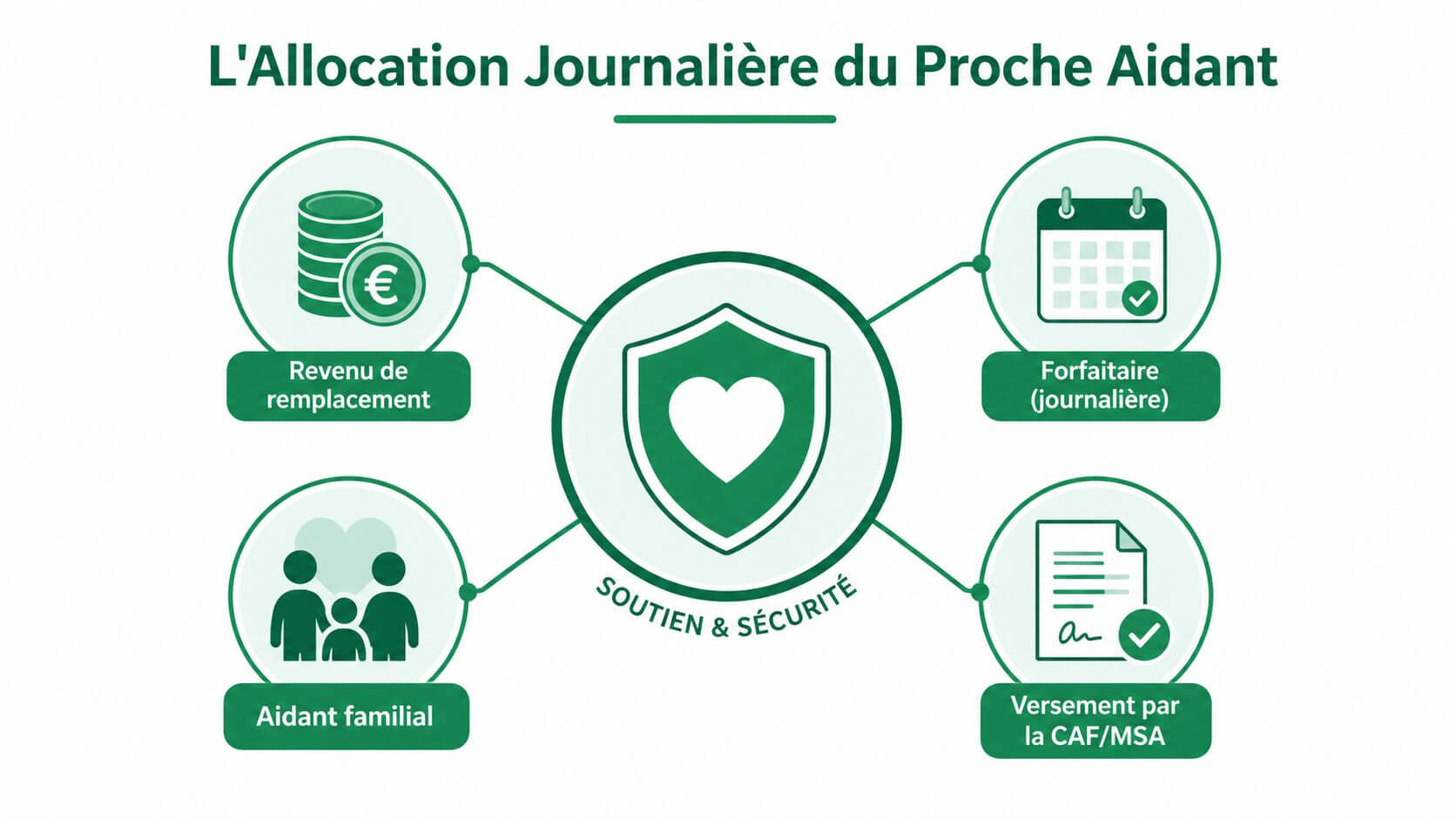
I-I-IDaily Allowance of the Near Helper works as a partial salary replacement. When a person temporarily interrupts or reduces his or her activity to help a relative, this allowance smooths the loss of income during the period of absence. The idea is simple, if you leave your work aside to help a loved one at home, the device helps you not to stay without any resources during this time.
A logic of replacement income
The important word here is replacement. The AJPA is not a care budget or a attendance premium, it is a lump sum benefit linked to the cessation or reduction of activities in the context of the caregiving close leave, with a payment by the CAF or MSA Daily Allowance of the Near Helper. It can be taken Daily or half-day, which is useful when home help is not properly divided into full days.
It can be seen as a plaid placed on a financial cold zone. It does not heat the entire house, but it avoids that balance jumps from the first absence. This image is useful because it helps to understand why the allocation is thought of for very concrete needs of coordination, not to finance the entire burden of a long-term helper.
Practical rule. The more fragmented the aid is in the week, the more meaningful half-day splitting becomes to keep a clear record of absences.
Why she's related to caring leave
The device is Supported by the Caregiver Leave. This means that it does not trigger itself, independently of work, but within the framework of an employment-related right. The caregiver temporarily reduces or ceases to be employed and then asks for the allowance to compensate for this decline in income, making the AJPA a tool for the transition between working life and close contact.
This logic also explains his interest in the home. When an assisted person needs care, supervision, prepared meals or relays for steps, the problem is not only the availability of a loved one. Coordination between appointments, helpers, absences of the assisting employee and times when the family takes over. The AJPA therefore serves as much to secure the cash flow as to make the organization more readable.
Who can benefit from the allowance and under what conditions
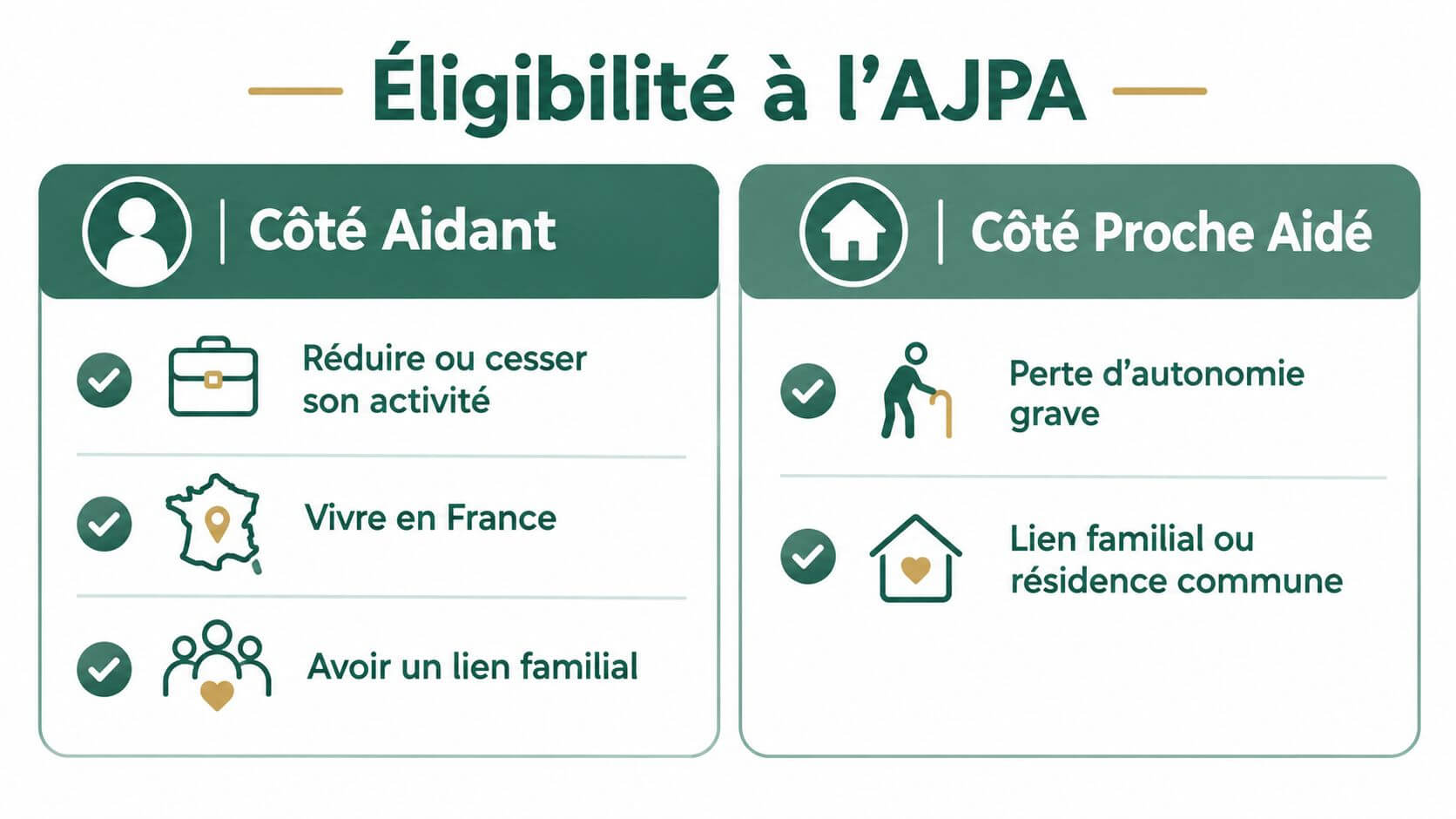
The eligibility is divided into two columns, that of the caregiver and that of the caregiver. If one of the two sides is missing, the demand becomes fragile. The right reflex is therefore to check first whether the family and professional situation is well within the framework of the carer's leave, then whether the person receiving care falls into the category provided for by the scheme.
The first question on the aiding side is the activity
The caregiver must reduce or temporarily cease its activity to accompany a loved one. This is the starting point, because the allowance compensates for a drop in income due to this increased availability. The link with the caregiver's leave is essential, since the allowance is not separated from this logic of organized absence.
In practice, this applies to people who can no longer maintain their usual rhythm without adjustment. The important thing is not to look for an ideal situation, but to check whether your professional schedule really needs to be arranged to continue to help properly. That's also why the steps gain to be prepared early, before fatigue and emergencies take full place.
The situation must be related to disability or loss of autonomy.
The next of kin must be in situation of disability or loss of autonomy. The scheme is therefore aimed at situations where daily help is not a mere occasional help, but a regular and necessary support. It is this criterion that justifies the use of an income compensation solution.
To identify yourself, one must think in terms of real need at home. the person receiving care must require a presence, organization or relay sufficient to ensure that the absence of the caregiver is compensated by a specific right, rather than by a simple informal arrangement. If you hesitate about your place in this context, a useful benchmark is the distinction between one-time help and structured support, this distinction is at the heart of the recognition of the role of caregiver, as the detail this marker on the status of close helper.
Mental checklist before filing the file
- Your activity is really changing, you temporarily reduce or stop your work.
- Caregiver leave is mobilisedThe AJPA does not live outside this framework.
- The loved one needs regular help, and not just a one-time service.
- The situation is related to disability or loss of autonomy, which structure the demand.
- You can link home needs to planned absenceswhich will facilitate follow-up.
A solid file is not a complicated file. It is a file where the life situation and the supporting documents tell the same story.
Duration and taxation of the allowance in 2026
The 2026 scale provides a clear basis for organising daily assistance without losing it. 66,64 € per day and 33,32 € per half day Daily Allowance of the Near Helper. For a caregiver, the real question is often more practical than accounting, how to allocate these days within the month, and how to keep a clear view of the rest of the available right.
The ceiling is not only in days, but in organization
The device is capped at 22 days per month and to 66 days per assisted personwith a total limit of 264 days when there are up to four relatives assisted Daily Allowance of the Near Helper. In real life, it looks like a relay schedule at home. Each day compensated must correspond to an absence or a useful presence, otherwise the meter runs out too quickly.
| Period | Amount per day | Amount per half day | Monthly and total ceiling |
|---|---|---|---|
| To the creation in 2020 | Variable depending on situation | Variable depending on situation | Entitlement ceilings in force under the original framework |
| As at 1 January 2022 | 58,59 € | Not specified in source | Harmonised scale for all beneficiaries |
| In 2026 | 66,64 € | 33,32 € | 22 days per month, 66 days per assisted person, until 264 days |
This table is mainly used to visualize the logic of the law. The AJPA has been upgraded over time, while remaining a framed usage device, with a follow-up of the days to be kept with care historical scale and upgrading. To put this aid in all possible support, you can also consult this benchmark on the financial assistance of the caregiver.
Taxation and net disposable income
The AJPA is a replacement income subject to CSG, CRDS and income tax. The amount paid therefore does not correspond exactly to what remains available for the month's expenses. The point to keep in mind is simple, the advertised gross helps to calculate, but the actual net is used to build the budget.
A good method is to treat the AJPA as temporary support, not as full pay. If you have to make several absences in the month, you have to integrate this tax from the start, then check how the compensated days align with the needs of the home. This way of doing so avoids the gaps between the aid schedule, the family relays and the amount actually mobilised.
How to apply for a step-by-step allowance
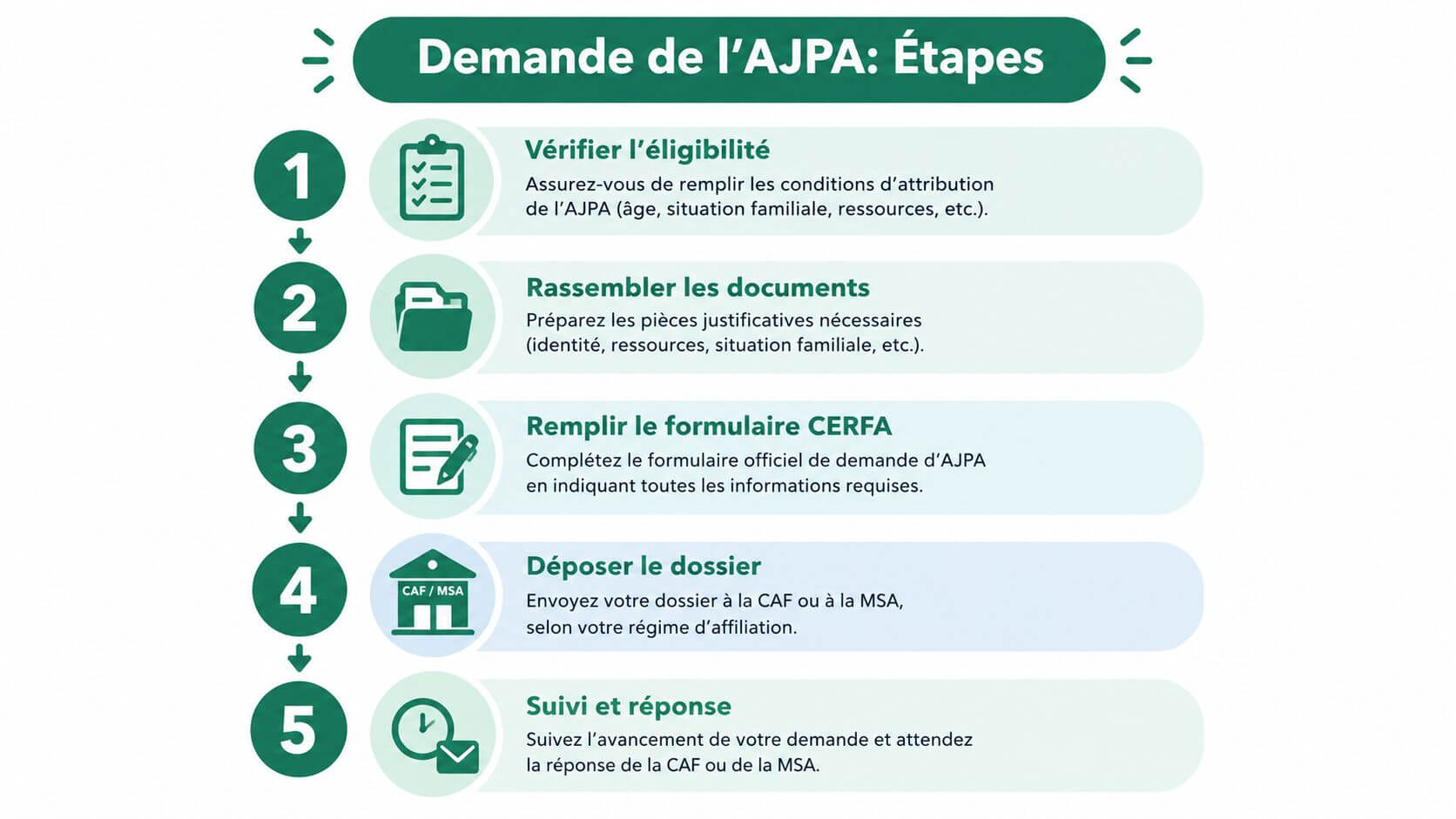
An AJPA application looks like a well-classified care file. If each room is in its place, the set becomes easier to read for the CAF or MSA. The right reflex is to move forward in order, first gather the supporting documents, then fill in the form, then send a clear file. For an employee, the process often begins with the employer's agreement on caring leave, before sending the allowance file.
Documents to be assembled without improvising
First, gather the evidence that describes the situation of the loved one and yours. You need the vital records of the assisted relative, his social identification, as well as the official proof of his or her loss of autonomy or disability, as recalled in the government documentation. allocate AJPA. A paper or digital list helps to avoid oblivion at the time of sending.
- Identity of the assisted loved one, surname, first name, date of birth and element of social identification.
- Justification of disability or loss of autonomy, depending on the recognized situation.
- Proof of your relationship and role as a caregiver, when requested by the organization.
- Application form, completed with care and without ambiguous areas.
- Elements related to close care leave, if your professional situation requires it.
The real trap, often, is not the absence of a document. It is their dispersion between the papers of the show, the mails, the photos taken in haste and the messages received over the course of the appointments. A centralized tool like Tribulys can then serve as a single file to consolidate coins, deadlines, transmissions and reminders, without multiplying media.
Drop the folder and follow the pace
When everything is ready, the file goes to the CAF or MSA. The online or mail filing depends on your situation, but the logic remains the same, a complete and coherent file is read more easily. It is also necessary to keep in mind that the AJPA is counted in day or in half day, therefore the declared calendar must stick to your actual organization at home.
The simplest is to note each absence in a single calendar, with medical appointments, family relays and days already taken. This method works as a house plan, each room has its place, each move has a reason. When the days are planned in advance, it becomes easier to know what is consumed, what remains available and what should be kept for the more busy periods. It is this precise follow-up that avoids finding out too late that a quota has been started without visibility.
Practical examples for planning your days of help
Sophie helps her mother three mornings a week, then resumes work in the afternoon. She does not need to wear all the help of a single block, but she must be able to follow her absences accurately. The half-day then serves as a basic unit, because she marries the rhythm of the home without exhausting the meter too quickly.
Case of an employee who splits over several months
Sophie places her absences in a shared calendar, with medical appointments, home help passes and her own days of work. To keep air in her schedule, she reserves days for the more busy weeks, as we keep a free place in a closet for unforeseen races. With this method, she visualizes what has already been used and what remains available, without finding out too late that she consumed her quota faster than expected.
Case of a caregiver accompanying two relatives
Karim helps her father and, more punctually, her aunt. The difficulty is not only emotional, it is also organizational, because the ceiling of 66 days per assisted person It requires a clear distinction between the periods dedicated to each. It therefore separates the ranges of presence, notes for which close each absence is taken, and keeps an overview to avoid mixing the meters.

When a caregiver follows several people, the main risk is not the lack of goodwill. It is to lose the thread of the days already taken, especially if the care is distributed among several relatives, several stakeholders and several places. A shared calendar, such as the one that can propose Tribulys in Family Coordination, helps to see who intervenes, when, and for what closeness.
Well, that's useful. The most difficult days are getting ready before fatigue, not at a time when everything gets complicated.
Frequent errors employment consequences and advice Tribulys
The most common error is to confuse leave and Allocation. Leave protects the organisation of work, the allowance compensates part of the income, and both respond without getting confused. When this difference is not clear, the caregiver may waste time, misdeclare his absences or underestimate the impact on his wages and social protection.
Another common error is to split without following the meter. Half-days are convenient, but they can give the impression that there is still a lot of margin as the quota decreases rapidly. We also have to think about taxation, since the AJPA enters into taxable income and is not just a neutral supplement.
If the file lacks parts or the days are poorly distributed, the consequences are quickly seen at work, in the budget and in the organisation of the home. The contract can be disorganized, the remuneration reduced more than expected, and the transmissions of information become blurred between relatives, professionals and employers. Tribulys for Caregiver Leave helps to keep documents, deadlines and transmissions in the same place, with traceability useful on a daily basis.
If you are accompanying a loved one and the AJPA begins to become your subject of the moment, rely on a single space to keep control of days, documents and transmissions. Tribulys This brings together the coordination of the home, the monitoring of the planning and the safe of the rooms useful to the life of a caregiver. Tribulys to see how to organize your steps and your daily life more calmly.
Put this organisation into practice with Tribulys
Keep your care journal, shared calendar, tasks, medication tracking and emergency information together. Start for free and invite the relatives and professionals involved in your loved one’s care.