
You may be managing appointments, recalls of medication, doctor's calls, and family messages while trying to keep your own work, sleep and personal life. When you help a parent, spouse or relative on a daily basis, you often end up doing all this without knowing if you have a real framework to recognize, protect and document it properly.
This is precisely where the Caregiver status In France, the DREES estimates that in 2021, 9.3 million persons who report providing regular assistance to a relative with disabilities or loss of autonomy, including 8.8 million adults and 0.5 million minors At least 5 years old, which shows that this reality is massive and lasting DREES, 2021. So you are not in an isolated case, you are in a very frequent situation, but still poorly read administratively.
The problem is that this status is not a unique label. It is a set of rights to activate according to your profile, your connection with the person receiving care, your professional situation, and your coordination needs. When the information is scattered, the rights remain theoretical. When they are traced properly, they become much simpler to assert.
Contents
- What does it really mean to be a caregiver today?
- The rights that make up the statute and how they are articulated
- What right to activate depending on your profile and situation
- Parts to be provided and financial feasibility of the AJPA
- Coordinate with employer and health care professionals without exhausting
- Conclusion: Centralizing coordination with Tribulys
What does it really mean to be a caregiver today?
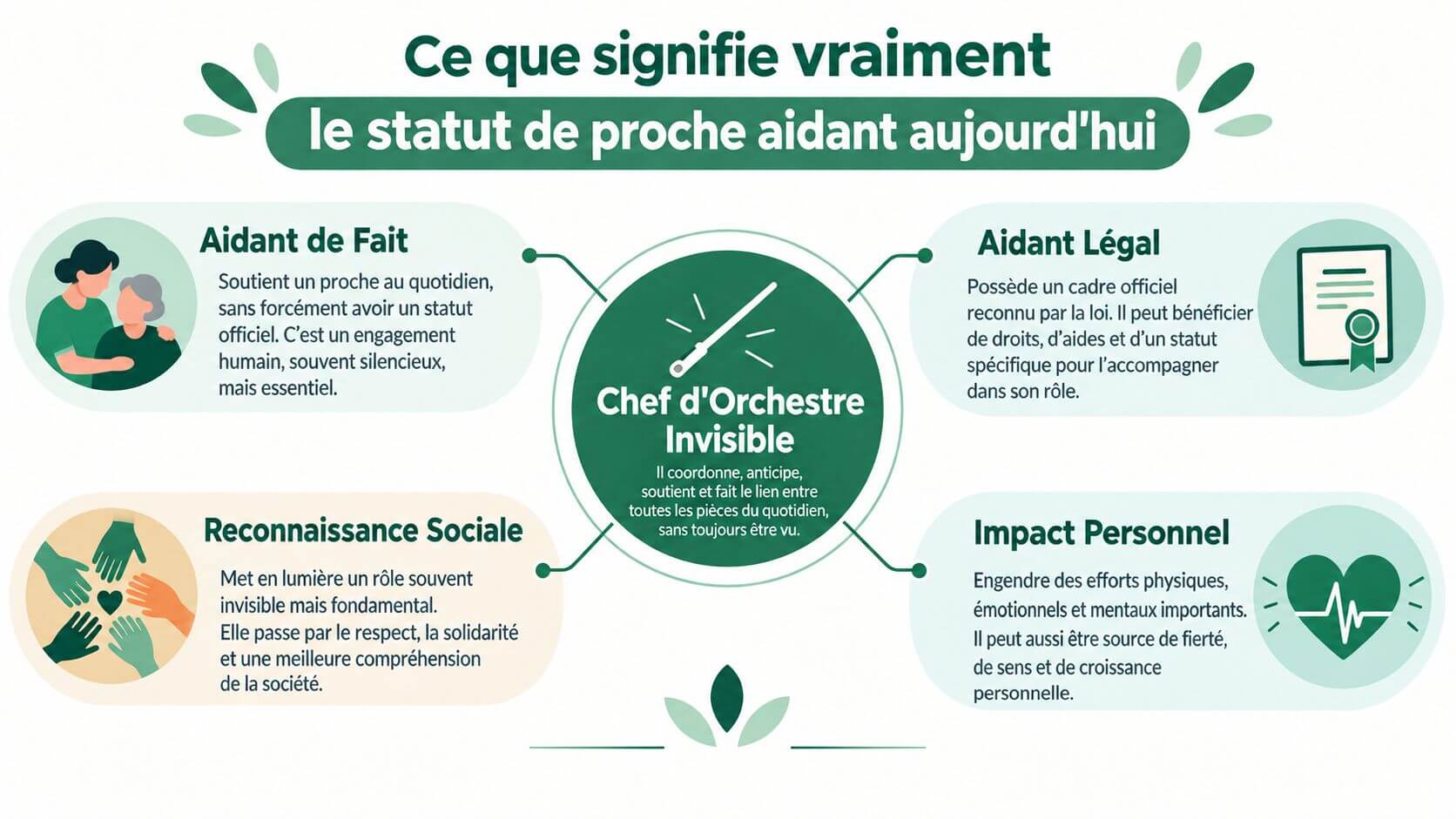
In practice, the Caregiver status works as a invisible conductor. It does not do everything, but it keeps together appointments, relays, information and steps to ensure that daily life does not get out of hand. The role can come back to a parent, a spouse, a child, a brother, a sister, or a close person who organizes without having planned it.
Aiding in fact, then activating rights
The starting point isde facto helper. Practical help is provided, through everyday gestures, moral support, and sometimes financial support. In other words, this topic is not covered because a form has been completed. We're going in because we're already wearing part of the organization. The benchmarks proposed by this dedicated resource of Tribulys help distinguish terms that are often similar.
Then come the activating rights. Legal recognition has progressed with Law No. 2019-485 of 22 May 2019, adopted to better recognize caregivers UNSA, based on DREES data. This counts, because the frame remains recent and is often read in pieces. It is discovered device by device, a bit like a dashboard where each light corresponds to a specific need.
The right reflex is not to look for a single block, but to identify which legal bricks correspond to your real situation.
A useful image for not getting lost
The Caregiver status looks like a toolbox. Depending on the time, you will activate a leave of absence, a temporary financial support, a right to respite, or a solution to organize a home helper. Official sources recall that there are several entry gates and criteria, depending on whether you are an employee, self-employed, job seeker or remote helper.
This layered logic is also what is illustrated byInfographic explaining the status of caregiver as an invisible conductor, encompassing legal and social aspects.(https://cdnimg.co/9fdbf6a3-742a-42cc-9dca-200e9138b251/ab29a92a-7e13-4760-9399-d4c9f3a0b2cf/caregiver-status-caregiver-roles.jpg). It shows that there is not a single check box, but several rights to link between them according to your profile.

The key point is there. The more clearly your situation is described, the easier it becomes to prove what you are already doing and to have the aids that go with it recognised. It is this traceability, especially digital, which turns a often invisible role into concrete rights.
The rights that make up the statute and how they are articulated
The real trap with the Caregiver status, it is to imagine it as a unique label. In practice, it looks rather like a dashboard with several lights, each corresponding to a specific need. Depending on your situation, you do not activate the same rights, nor at the same time.
Leave, allowance and respite do not meet the same need
The Caregiver leave The Labour Code provides that it may be opened without conditions of seniority, that it suspends the employment contract, that it is not paid by the employer, and that it may, subject to conditions, be entitled to the benefit of the employer.daily allowance of the caregiver Legislation. It's a tool to free up time, not a replacement salary.
I-I-IAJPA It does not replace a full income. France Work points out that it can be mobilised within the framework of close leave with assistance, with a ceiling of 66 days per loved one assistedIt is mainly used to make the break possible, not to erase the decrease in resources.
The right to respite meets another need, that of blowing without breaking the help. Remuneration for help via CESU Another logic is to delegate part of the tasks to a declared person. So we don't open the "status", we choose different levers depending on the fatigue, duration of the aid, the level of dependency and your own professional situation.
Why Generalist Content Unlocks Everything
The guides too fast align the aids without showing how they fit in. However, it is precisely this articulation that matters. A person may need the leave for a few weeks, the AJPA to keep financially, and then a relay organized at home to avoid exhaustion.
The resources near helper and helpers of Tribulys can serve as an entry point to visualize these combinations. This helps to move from a list logic to a usage logic.
Traceability also changes the way you prove your situation. A shared calendar, dated transmissions, proofs grouped in a digital space, all this creates proof that can be used by the employer, the administration or the professionals following the person receiving care. The more documented the journey, the easier it becomes to activate the right right at the right time.
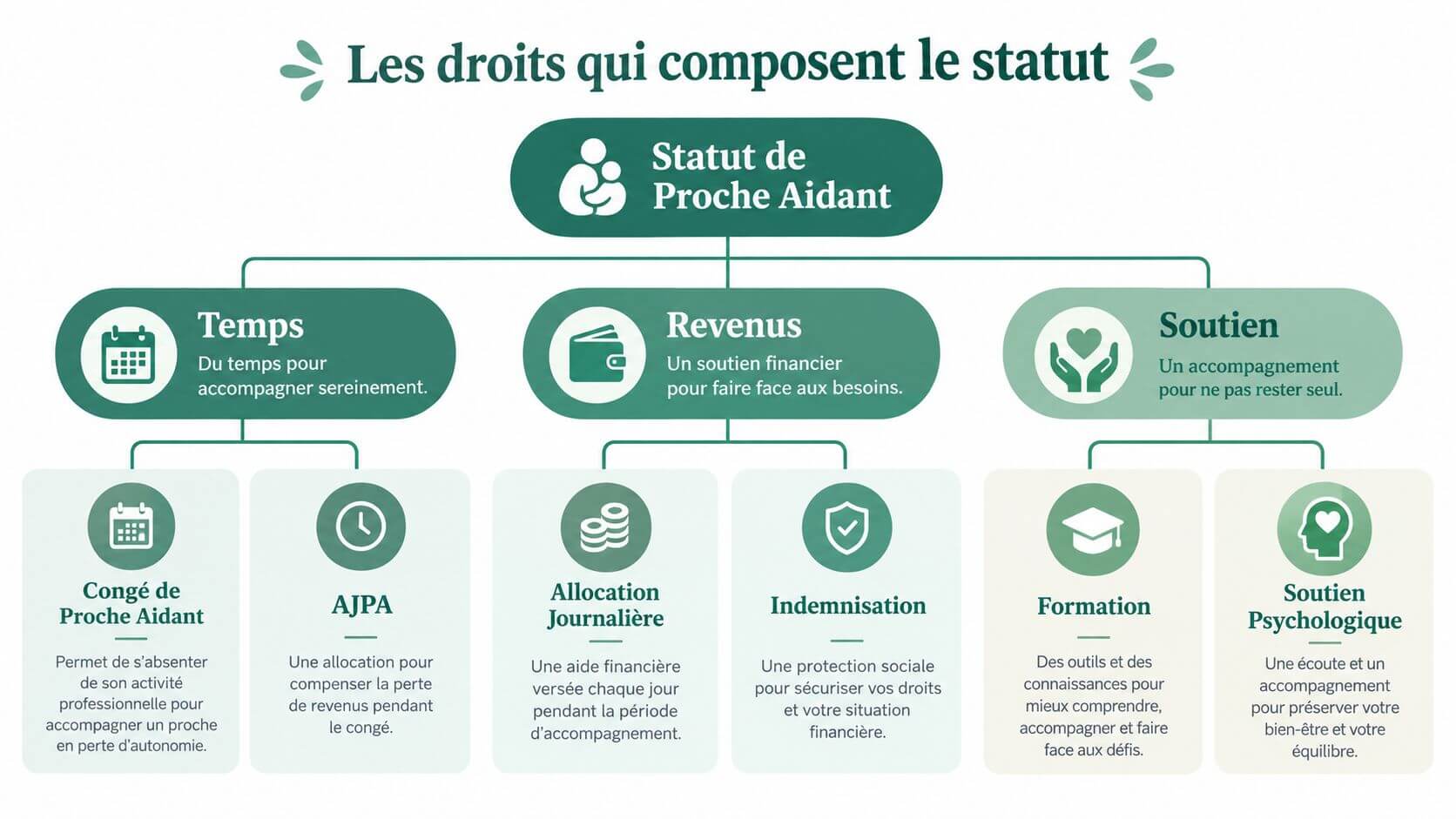
Useful rule: If your main need is time, look at the leave. If your main need is to hold on financially for a short time, look at the AJPA. If your main need is to relay, look at the possible coordination and compensation solutions.
What right to activate depending on your profile and situation
Two helpers can have very different rights. The right point of entry depends mainly on your Profile, your connection with the person helped and how you prove your situation. The close assisting status works as a folder with several drawers, you have to open the right one according to the need of the moment.
Simple decision matrix
| Profile | Priority right | Key condition | Attention |
|---|---|---|---|
| Private employee | Caregiver leave | Temporary need to withdraw from activity | Verify the organization with the employer and anticipate income decline |
| Staff member | Leave adapted to the situation | Need to Absent to Help | Look at the internal rules applicable to your administration |
| Self-employed | AJPA or organised relay | Absence of conventional wage suspension | Structure the help time without breaking all the activity |
| Job seeker | AJPA | Resuming or maintaining assistance during job search | Assess the impact on your budget and your approaches |
| Retired | Right to respite, coordination, remuneration via CESU | Prolonged daily assistance | Ensuring that the organization remains sustainable over time |
| Remote helper | Traceability, shared calendar, transmissions | Need to follow without being on site | Provide evidence and reporting useful to other stakeholders |
Choose without dispersing
The employee must first consider whether he or she needs time released. In this case, the caregiver's leave is the most direct lever. The idea is simple, like a switch that temporarily cuts off the professional pressure to allow to focus on the help.
The self-employed person cannot always press on a break. Instead, he must organize ranges of help, allocate tasks and maintain enough continuity so that his activity does not collapse. Here, the right right one often combines with a good method of organization.
The job seeker often needs an even more concrete answer. The AJPA can help to hold for a period of help, but the real challenge remains to make recognise what you really do on a daily basis. The device exists, it remains little used, and this under-utilization shows that the difficulty is also due to the legibility of the course, not just the opening of the right.
When several relatives take turns, the subject is not only who is entitled to what, but who leaves a trace, when, and for what purpose.
The remote caregiver rarely needs a leave of absence in the strict sense. Instead, he needs reliable transmissions, a shared calendar and dated markers to avoid repeated calls and misunderstandings. In this case, digital traceability becomes a useful proof, almost like a logbook that allows other players to follow the wire without having you repeat it every time.
To move towards a logic of compensation and budget, Tribulys Guide on Financial Assistance for the Caregiver helps to connect the real need to the right brick, without confusing punctual support with the bottom solution.
Parts to be provided and financial feasibility of the AJPA
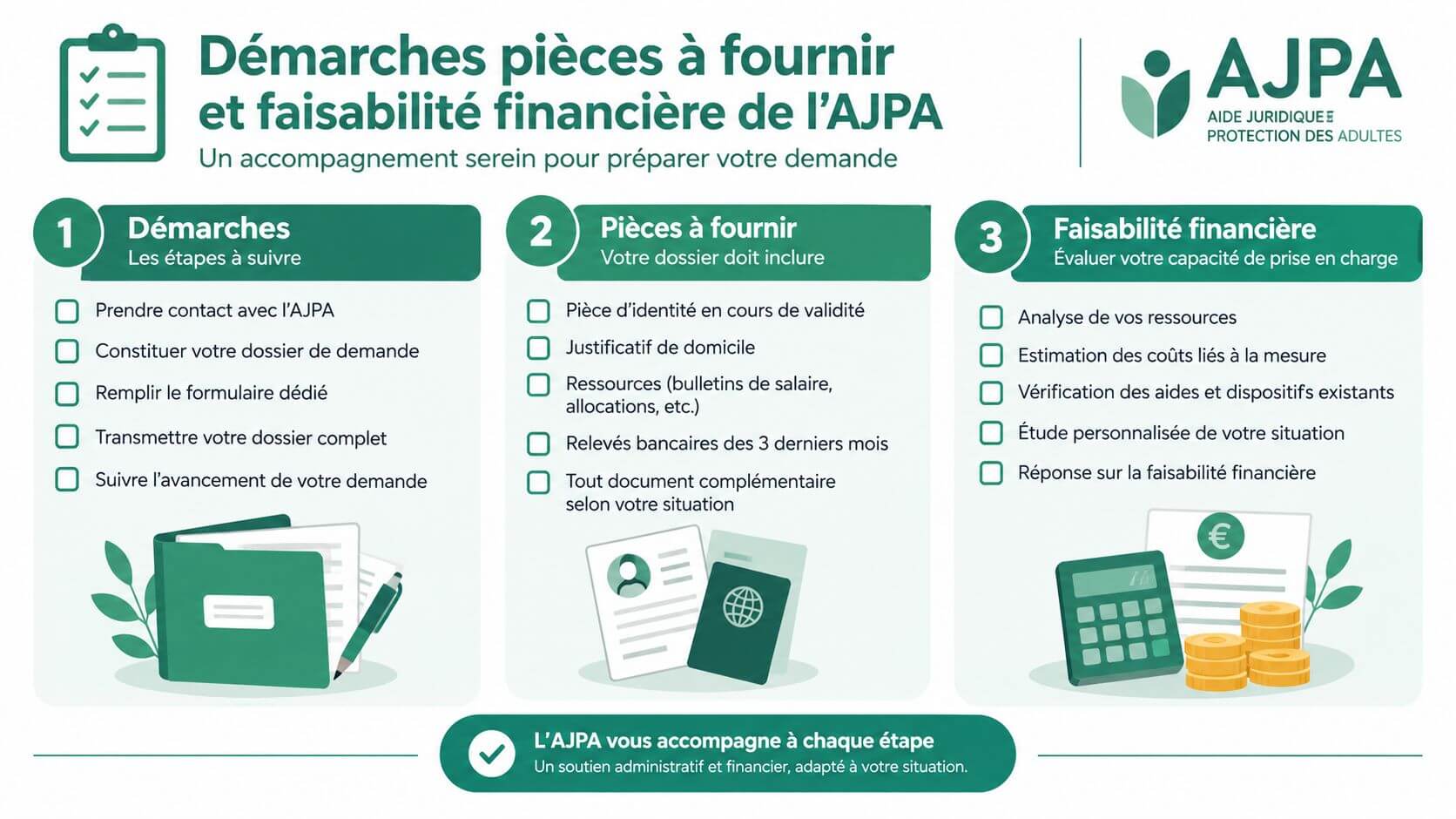
The steps seem heavy because they go through several doors at a time. In reality, you have to align three things, your situation, the pieces that prove it, and the right interlocutor. Once this thread is placed, the folder looks less like a puzzle than a series of steps.
The administrative path to follow
Start by having the person's situation recognized and your role with him/her recognized. Then, depending on your case, you talk to the employer for the leave, then to the caisse that educates the AJPA, CAF or MSA. The key point is to present a coherent file, not to send isolated supporting documents like scattered sheets.
The right reflexes are simple:
- Gather link and status proofs, because the right depends on your relationship with the person receiving care and his level of loss of autonomy.
- Preventing the Employer at the Right Time, since care leave suspends the employment contract and involves preparation upstream.
- Verify eligibility for AJPA, especially if you need to reduce your activity or cover a busy period.
- Keep track dated, because a clear history weighs more than a reconstructed narrative after the fact.
Digital traceability helps a lot here. A shared calendar, timed messages or reports classified over the water serve as concrete evidence when it is necessary to show who did what, and when. It is a little bit the dock record that avoids reexplaining everything to each new contact person.
The question that everyone is asking in silence
The AJPA helps to maintain, but it does not replace a full income. Rather, it plays the role of partial support during a period when the financial balance becomes fragile. That is why many caregivers need to combine several supports, leave, family relays, organization of time and, as the case may be, other compensation solutions.
The point of friction is often not the right itself, but the lack of legibility of the route. Situations where assistance remains scarcely used show above all that many people have not yet identified the right front door. When you know what to assemble and to whom to address it, the approach becomes clearer.
A good demand is rarely a perfect demand. It is above all a demand that is followed, dated and complete.
For compensation and cost-sharing aspects, you can also consult Tribulys resource on the financial assistance of the caregiver. The objective is to secure the critical period without exhausting you or putting you in administrative difficulty.
Coordinate with employer and health care professionals without exhausting
The most stressful moment, often, is not reading the texts. It is the announcement to the employer, then the coordination with caregivers, other family members, and sometimes home care workers. When each receives a different information, it is your mental load that serves as a sorting center.
The relationship with the employer requires clarity
Caregiver leave is open without seniority requirement and the employment contract is suspended, not broken. The employer does not have to pay him during this period, which requires preparing the organization upstream rather than relying on an improvised solution. The scope of the relatives assisted is wide, since it can include the spouse, partner, ascendants, descendants, collaterals up to the 4th degree and some people with a close and stable connection, as provided for in the code.
When you announce it, stay concrete. Indicate the period, the likely frequency, what you can still assure, and what will no longer be available. A clear request reassures much more than an emotional justification too long.
Co-ordination is changing the quality of relays
With healthcare professionals, the real subject is continuity. A forgotten oral transmission, an unrated change of treatment, or a poorly relayed appointment quickly creates unnecessary tensions. A dated link book, a unified schedule, confirmations of intake, and legible exports for the doctor reduce this risk.
Digital traceability then plays the role of a flight record. It keeps the memory of what has been said, validated or modified, and it produces a simple proof to be read again when a right, relay or decision has to be confirmed. For the leave, you can also consult Tribulys Resource on Caregiver Leave.
This is also what allows a coordination tool such as Tribulys, which centralizes the link book, the schedule, the transmissions and the follow-up of medicines, with differentiated access according to the roles, hosting in France and offline operation for certain functions. In practice, this helps to keep a clear record of what has been said, done or validated, without basing all coordination on your memory.

The simplest way to avoid exhaustion is to treat each exchange as a piece of the same puzzle. A dated message, a shared document, a visible validation. By force, coordination ceases to be a series of oblivions and becomes a continuous thread, easier to hold for you as for others.
Conclusion: Centralizing coordination with Tribulys
The simplest way is to treat the Caregiver status like a living folder, not like a single label. Depending on your profile, you activate a different brick, time, financial support, or a clearer organization with stakeholders. Like a trousseau, each right opens a specific door.
Start with the gesture that concerns you most, then keep a clear record of what you have transmitted, validated or requested. A dated message, a shared document, a visible confirmation. This digital traceability serves as evidence when you need to have a leave, relay or decision recognized.
If you already coordinate several people around a loved one, a tool like Tribulys can centralize the link book, schedule, transmissions and follow-up of medicines, with differentiated access according to the roles, accommodation in France and offline operation for certain functions. You gain in clarity without carrying everything in your memory.
The right reflex, on a daily basis, is to assemble the pieces of the same puzzle as they are done. Co-ordination becomes a continuous thread, easier to hold for you and easier to read for others.
Put this organisation into practice with Tribulys
Keep your care journal, shared calendar, tasks, medication tracking and emergency information together. Start for free and invite the relatives and professionals involved in your loved one’s care.