
In France, price of a home alarm is generally around 1 400 € for installation, with a wide range of 400 € to 3 500 € Depending on the configuration. Often add a subscription of telesurveillance around 30 €/month on average, and the real subject quickly becomes the total cost, not just the price displayed.
You may be looking at three quotes, all different, for the same house. One looks affordable, the other seems overequipped, and the third gives you the impression that you are being charged for tranquility at a high price. The right reflex is not to look for the cheapest quote, it is to understand what is included, what is missing, and what will still cost you in five years' time.
Contents
- Contents
- Why alarm quotes vary so much
- The three cost stations of a home alarm
- Budget alarm according to your type of accommodation
- Installation itself or by a professional
- Do you really have to pay for a telemonitoring subscription?
- Checklist to estimate your alarm budget
- Reducing the bill without sacrificing security
- Choose the system to suit your situation
Contents
- Why alarm quotes vary so much
- The three cost stations of a home alarm
- Budget alarm according to your type of accommodation
- Installation itself or by a professional
- Do you really have to pay for a telemonitoring subscription?
- Checklist to estimate your alarm budget
- Reducing the bill without sacrificing security
- Choose the system to suit your situation
Why alarm quotes vary so much
A landlord often shows me three quotes for the same house, with deviations that go from 600 € to 3 200 €. The first covers the essentials, the second adds a more complete installation, the third includes surveillance and connected options. Nothing absurd in there, just three very different security perimeters.
The price depends first on the protected perimeter
The more openings you have to secure, the more equipment climbs. A house with garden, bay window, garage and floor does not treat itself like a studio or a small pavilion. The number of sensors, sirens and accessories quickly changes the estimate.
The type of technology also changes the situation. A wired system requires more laying work, but it relies on a more stable architecture, while a wireless system installs faster and expands more easily.
Simple Rule, an alarm quote does not read as an overall price, it reads as an addition of technical choices.
Service weighs as much as equipment
In France, price of a home alarm is often presented around 1 400 € for installation, with a range of 400 € to 3 500 € according to the equipment level and configuration, according to the market guideObate. This amplitude exists because a self-installation kit, a connected solution and a system with remote monitoring do not meet the same need.
The market also focused on subscriptions. Some general public actors propose an entry-level 34,90 € tax incl. per month, others start around 37,90 € TTC/month with equipment from 799 € tax incl., according to the Point comparison. On the background, the estimate varies as much because one sometimes buys a product, sometimes a continuous service.
The three cost stations of a home alarm
The classic trap is to look only at the original kit. A serious estimate almost always cuts the budget in equipment, pose, and remote surveillance. If you do not separate these three lines, you compare incomparable offers.
Equipment, installation, subscription
The cost of a home alarm is divided into three posts, with equipment between 250 € and 1 900 €, a professional pose between 150 € and 600 €, and remote surveillance between 12 € and 50 €/month Based on W3cam. This reading by post avoids being hung up by an overly flattering call price.
The equipment consists of the plant, the detectors, the siren and sometimes the cameras. The installation depends mainly on the configuration of the housing, the passage of the cables and the time spent on site. The subscription, however, is not limited to the invoice of the month, it quickly becomes the heaviest post if you keep the service for several years.
For a clear budget, we must look at the Total cost of possession Five years. A non-subscription alarm with connected self-monitoring can cost more to purchase, then remain stable over time. A solution with remote surveillance may seem affordable at first, but monthly addition often exceeds the price of the equipment.
| Cost item | Low range | High range | Factors of change |
|---|---|---|---|
| Equipment | 250 € | 1 900 € | Number of sensors, cameras, sirens, connected options |
| Professional position | 150 € | 600 € | Complexity of the accommodation, wiring, time on site |
| Remote monitoring | 12 €/month | 50 €/month | Level of service, intervention, follow-up options |
Wired or wireless, it's not the same quote
A system wire usually cost more to install, with often estimated installation between 500 € and 1 400 € for this post according to Protect Home. This is the price of stability and wiring, not just the housing.
The wireless starts lower in general use and spreads faster. The professional pose often lies between 300 € and 800 € for this type of system, according to the same market benchmarks. In plain terms, you pay either more initially for a heavier architecture, or less expensive to install but with a more modular system.
What makes the bill go up
The presence of cameras, an external siren, or connected options pushes the quote upwards. The region also counts, because the observed hourly rate goes from 50 to 120 €/h. Two identical units can therefore give two different invoices simply because the installer does not intervene at the same rate or in the same area.
The right reflex is to ask line by line what is included. If the quote does not clearly isolate material, pose and service, you do not compare a real price, you compare a commercial packaging.
Budget alarm according to your type of accommodation
A fair budget depends first of all on housing, not on the catalogue. A continuously occupied apartment, a family home with a garden and a residence for an elderly person do not have the same risks or priorities. This is where many guides are wrong, giving an average without taking into account the actual use.
Small apartment in town
In an apartment, the main need often remains the protection of the entrance door and accessible openings. A compact, wireless and connectable system is often enough, especially if the occupant can monitor the alerts himself.
The budget is usually contained, because the area to be protected is reduced and the laying is simpler. If you target self-monitoring, the recurring cost can remain zero, which completely changes the equation over time.
Family house with garden
There, we change logic. Accesses multiply, sensors become more numerous, and the exterior siren makes sense. A house of this type more often justifies a higher budget, because we have to cover doors, windows and sometimes garage.
This is also the case where the subscription is most likely to defend itself. If the house is large or partially empty during the day, the telesurveillance provides a useful relay. But you have to look at the cumulative price, not just the first month.
Residence occupied by an elderly person
In a residence occupied by an elderly person, the right system is not limited to intrusion. One has to think about the simple alert, the readability of the device and the coordination with the relatives. A solution with shared alert and emergency call button can become more useful than an auction of sensors.
In this context, the organization counts as much as the technology. A well thought out system must remain simple to use on a daily basis. If you also coordinate visits, interventions or regular passages, a shared follow-up like emergency call button can supplement safety without increasing usage.
Installation itself or by a professional
The DIY attracts because it lowers the entry bill. The professional pose reassures because it limits investment errors, forgetfulness and sensors poorly configured. The real arbitration is not only the price, it is the reliability of what you put in place.
When home installation is enough
A simple installation can be suitable if you have few openings to protect, a wireless system and an easy to navigate home. You win on the installation, and you keep your hands on the configuration. It is also the right choice if you like to test, reposition and evolve your equipment in stages.
The reverse is that the responsibility rests on you. If a sensor is wrongly placed or the network configuration is banked, you will discover it at the worst time.
When it's better to pay an installer
As soon as there is wireline, several levels of access or a need for complete service, the pro becomes more relevant. The cost of laying is not a luxury, this is often what avoids an incomplete installation. A poorly protected home is not an economy, it is a false comfort.
The price differential must be compared to the time spent and the level of complexity. If you are uncomfortable with setting or wiring, the DIY gain melts quickly. An hour of bad setting often costs more than a clean setting from the start.
My opinion, if your accommodation has more than a few serious access points, have the pose encrypted. Today's small extra cost avoids the regrets after.
Do you really have to pay for a telemonitoring subscription?
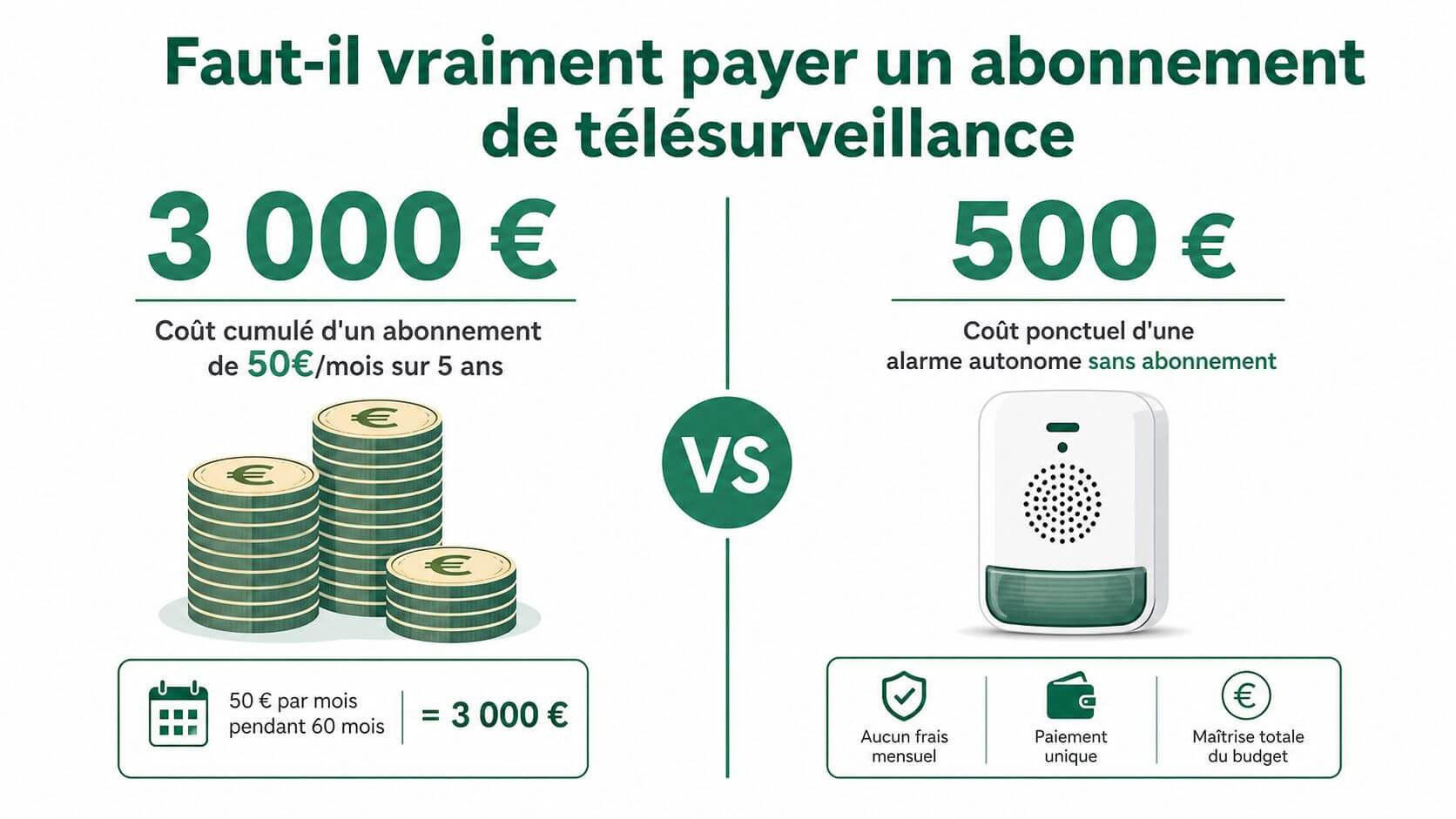
Yes, if your lifestyle justifies it. No, if you are only looking for expensive peace of mind while a self-monitoring connected In the budget of a home alarm, subscription is the item that changes the total cost of possession, not the equipment.
Cumulative cost changes everything
In the field, I see above all a mistake, looking at the purchase price and ignoring what is being paid every month. Market comparisons cite subscriptions that range from about €7.99/month for stand-alone cloud surveillance at more than 50 €/month for remote surveillance with intervention of agents, with a average market value of 42,50 €/month In a comparison relayed by UFC-Que Choisir. Over five years, the gap quickly becomes heavy, especially if you have already paid for the equipment.
A connected alarm without subscription can turn to 0 €/month in self-monitoring, while professional telemonitoring often starts around 37,90 €/month and may exceed 50 €/month, according to the panorama presented by Sector Alarm. If you keep the same service over several years, the real question is no longer the comfort displayed in the estimate, it is the total cost of use.
When the subscription is worth its price
The subscription makes sense for a secondary residence, an isolated home, or a home that can't deal with an alert quickly. There, the service pays time, a human relay and a continuity of surveillance that you won't always have in-house. It's useful when no one can immediately verify what's going on.
It becomes less interesting for a continuous dwelling occupied by people able to receive and process notifications. In this case, the connected self-monitoring keeps the budgetary advantage, provided that it is really followed. A system installed and then forgotten does not serve any purpose, with or without subscription.
The right criterion is not the monthly price
The right arbitration is the ability of the home to react to alerts itself. If you are often absent, on the move or difficult to reach, the subscription defends itself. If you are present, organized and already equipped with a smartphone, it can quickly become a recurring charge without clear return.
Also look at how long you're going to keep the system. The longer you keep the subscription, the more it crushes the entry price. At this level, an evolving system with no recurring fees often becomes more rational than a telemonitoring contract that is paid out of habit.
Checklist to estimate your alarm budget
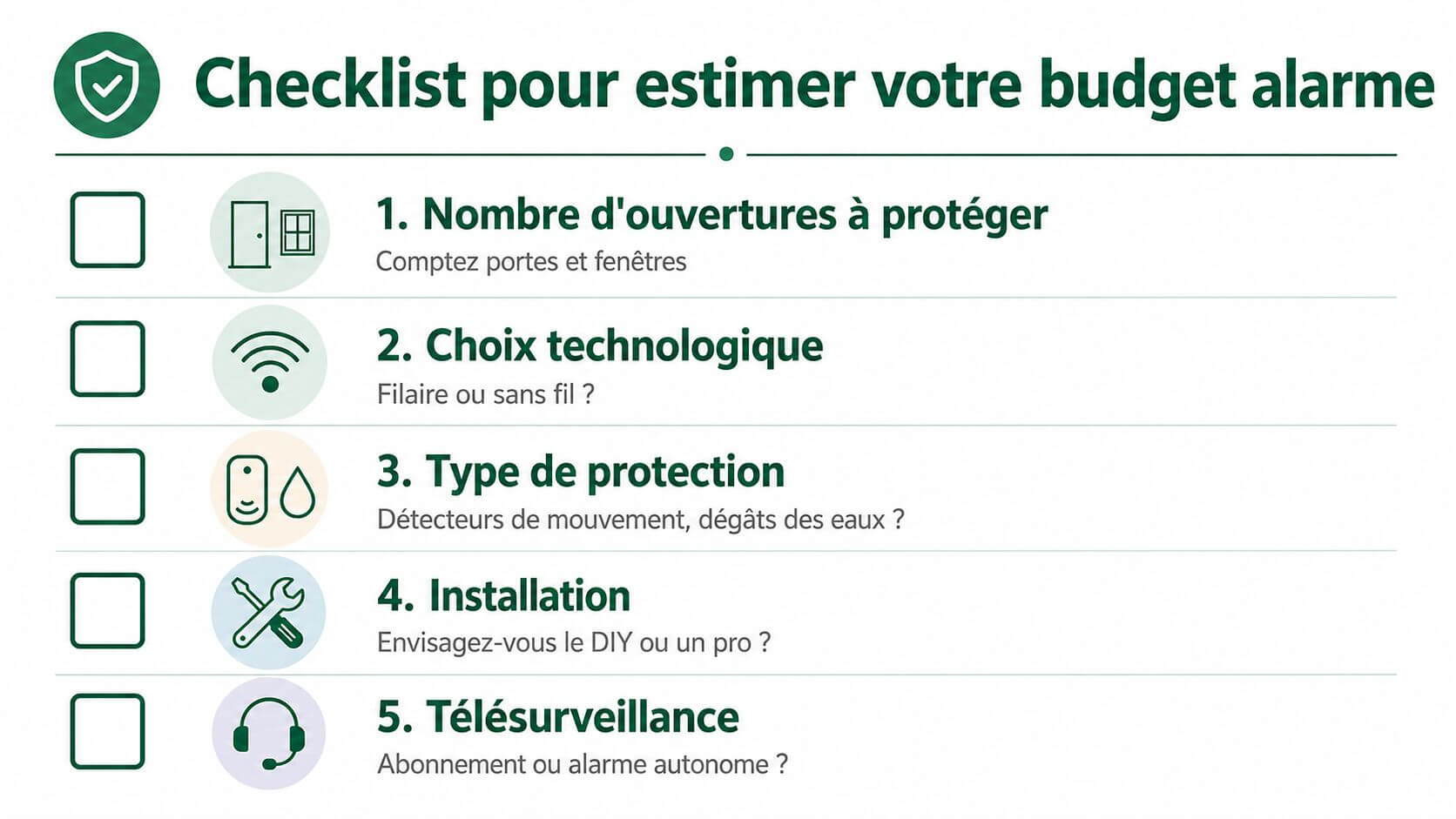
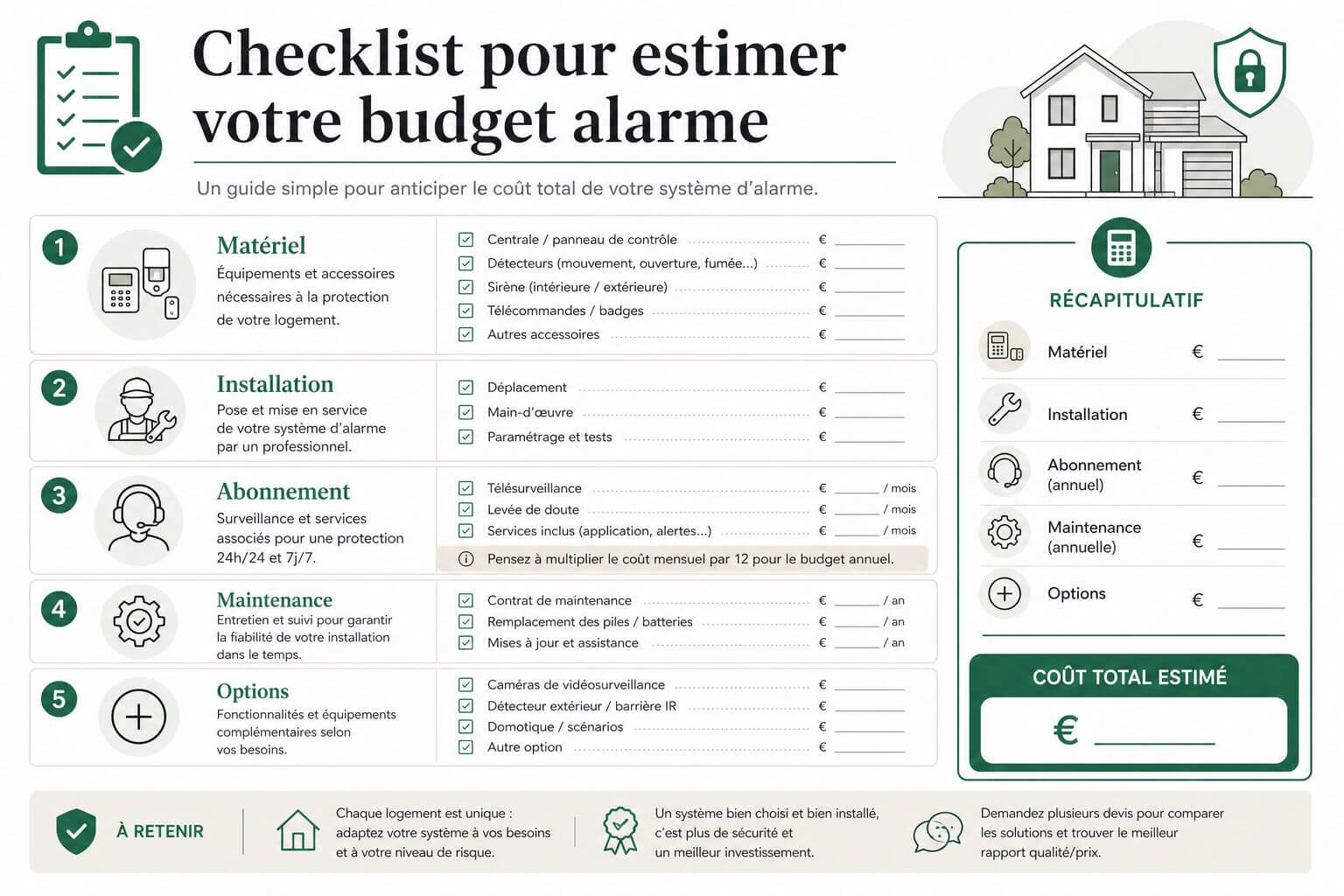
The right budget is calculated by adding up concrete decisions, not starting from a vague average price. You have to count what you protect, how you install it and who monitors alerts. Otherwise, you may underestimate the invoice from the first estimate.
The five issues to be decided
- How many openings do you need to protect? The more accessible doors and windows, the more equipment climbs.
- Wired or wireless? The wireline costs more to install, the wireless simplifies installation and evolution.
- Which sensors are really useful? Movement, opening, camera, or only critical entry points.
- Who installs the system? The DIY reduces the pose position, the professional reduces the errors.
- With or without a subscription? Self-monitoring can remain at 0 €/monthtelemonitoring adds a significant recurring cost.
The costs we forget too often
The replacement batteries return to wireless systems sooner or later. Maintenance is not always visible in the estimate, but it is part of the actual cost of use. And if you go on a subscription, the terms of termination must be read before signing, not after.
When you add these positions together, the decision becomes clearer. A cheaper system for purchasing can be more expensive in the long term if the subscription weighs heavily. Conversely, a kit a little better thought from the start can avoid repeated fees.
Practice, keep always three separate lines in your calculation, hardware, pose, subscription. This is the only way to see the real cost.
Reducing the bill without sacrificing security
The best economy is to buy fewer unnecessary options and more useful protection. Homes pay too often for gadgets before they have secured the most exposed entry points. This is the opposite.
Prioritizing real access
Start with the doors and windows that really matter. A protection well placed on critical accesses is better than equipment scattered everywhere. You can then complete if the housing changes.
Choosing a modular system also helps smooth the expense. You start with the useful base, then you add camera, siren or other modules only if the need arises.
Compare quotes as a serious buyer
Always ask what is involved in the equipment, laying and service. If two quotes seem close but one includes continuous monitoring and not the other, they do not play in the same category. This is often where the deviations are hidden.
Do not let yourself be locked in the idea that a complete offer is necessarily the best. Sometimes, a self-supervised connected solution is enough, especially if you can respond quickly to alerts. To understand the insurance component around break-ins, look also forced door and insurance, owner or tenant.
Buy for the right use, not for the brochure
A well-selected consumer kit can be more relevant than a poorly-adapted premium pack. The right system is the one that fits your life pace, not the one that displays the most logos. Effective security does not need an inflated budget, it needs a clear perimeter.
Choose the system to suit your situation
The right choice depends on three things: your accommodation, your home presence, and your risk tolerance. If you have a small, continuously occupied apartment, a connected solution without a subscription can be enough. If you have a house with multiple accesses and regular absences, the remote surveillance takes on more meaning. If you manage the home maintenance of a loved one, you have to think about coordination, alerts and ease of use, with complementary tools like a Drop detector.
The trick to avoid is to confuse tranquillity and protection. A subscription does not replace a well-placed system, and a large budget does not compensate for a bad perimeter. Choose the system that leaves you a real control, or really delegate surveillance, but don't stay between the two.
Tribulys helps families to better coordinate the daily lives of a loved one at home, with tools designed for alerts, tasks and shared exchanges. home alarm rate is also part of a logic of global security and daily monitoring, go see Tribulys to organize life at home more simply.
Put this organisation into practice with Tribulys
Keep your care journal, shared calendar, tasks, medication tracking and emergency information together. Start for free and invite the relatives and professionals involved in your loved one’s care.