
You come in, the key doesn't turn as usual, the door has a game, and you immediately see that something forced the entrance. The heart rises, because between the shock, the security of housing and the question of reimbursement, the wrong decision costs. On a file of door forced insurance owner or tenant, you have to cut quickly, without improvising.
The rule is simple, and it does not change according to the anxiety of the moment, Proven break-in on one side, neglect or lack of evidence The other. It is this pivot that determines who pays for the door, the lock, the frame, and who is only responsible for his personal property. If you need a clear course, here, with the steps to be taken, the pitfalls to be avoided and the reflexes that really speed up compensation.
Contents
- You go home and the door is broken.
- The legal framework that separates owner and tenant
- The guarantees that actually cover the forced door
- Proof of break-in, the real pivot of compensation
- Steps to be taken in order to be compensated
- The exclusions and received ideas that fill the file
- Mail models and reflexes to speed up reimbursement
- What to remember and the under-expertized case of the forced door without burglary
You go home and the door is broken.
You push the door, it resists, then you see the twisted lock, the damaged frame, sometimes the pulled handle. It's not only a material damage, it's an intrusion into your daily life, and you have to react as if the file were going to be read word for word by the insurer.
The reflex that avoids wasting time
Do not touch anything, throw nothing away, do not make immediate repair until you have photographed and seen the exact state. The right reflex is to secure, documentthen declare. If you are a tenant, landlord or landlord, the logic remains the same, only the contract changes.
Practical rule, The more clean the file is from the first hour, the less arguments the insurer will have to slow down the take-over.
In a rented dwelling, the first sorting is clear. The door, lock and damage to the building are not the same as the tenant's personal property. That's precisely why the question door forced insurance owner or tenant treats without hesitation, but with solid evidence.
The point to never miss is the distinction between a door actually forced and a door simply damaged without a clear context. A broken lock is not always enough on its own, it is necessary to establish what happened, and by whom. If the proof is not clear, the backrest quickly switches into a grey area where each returns to the other.
What you need to remember right now
- If break-in is proven, the repair of the frame follows the owner's logic.
- If the damage comes from an external third party, the tenant is not supposed to pay for this third party.
- If the evidence is missing, the insurer will ask for concrete elements before indemnification.
- If you're a landlord, the management of the building usually depends on your adapted insurance.
- If you are a tenant, your insurance is mainly used for your property and certain damages covered by the contract.
The right mindset is to prepare a defensible case, not to discuss responsibility immediately with the neighbour, guard or locksmith. You will save time by treating the sinister as evidence, not as a mere domestic incident.
The legal framework that separates owner and tenant
French law does not mix everything. It separates infringements of the built of the United Nations movable property, and that's exactly what slices into a forced door folder. A door, a lock, a frame, it's not the same as a TV, a computer or clothes.
Built on one side, furniture on the other
When the entrance door is forced, the damage first affects the building or the dwelling itself. In practice, this applies to the door, the lock, the door lock and the damaged accesses. Personal property remains in another box, that of the occupant who owns it.
The useful principle is simple. Proven break-in, the lessee is not liable for damage caused by an outside third party. Conversely, if the origin of the damage refers to negligence, lack of maintenance or a lack of precaution due to the occupant, the reading changes completely.
Accountability table by situation
| Situation | Tenant | Owner |
|---|---|---|
| Proven breakage with fractured door | Do not pay the damage caused by the external third party | Supports real estate repair via its insurance or adapted coverage |
| Simple negligence or lack of evidence of forced entry | The responsibility can be attributed to him | Can challenge if damage is not covered by the insured structure |
| Degradation related to housing itself | May be concerned if the interview is his or hers | Intervention for the frame, according to the contract and context |
| Stolen or deteriorated personal property | Declare own losses | Does not indemnify these objects, except in very special cases provided for in the contract |
The heart of the matter is that the characterization of the sinister orders everything else. In a lease, the owner normally supports the real estate repair when the break-in is proven, while the tenant looks rather on the side of his personal property and his own guarantees. It is not an opinion, it is the logic of distribution that structure the serious files.
If you keep one idea, keep this one. Proof of break-in negates the tenant's liability vis-à-vis the outside party. Without proof, the record becomes much more fragile, and the insurer is much more demanding.
The guarantees that actually cover the forced door
On paper, many contracts are similar. In reality, they do not cover the same thing, and that is where mistakes are expensive. The tenant's HRM does not play as an insurance of the built, and the Lender's NOC does not have the same logic as a classic home insurance.
What the tenant covers, what the landlord covers
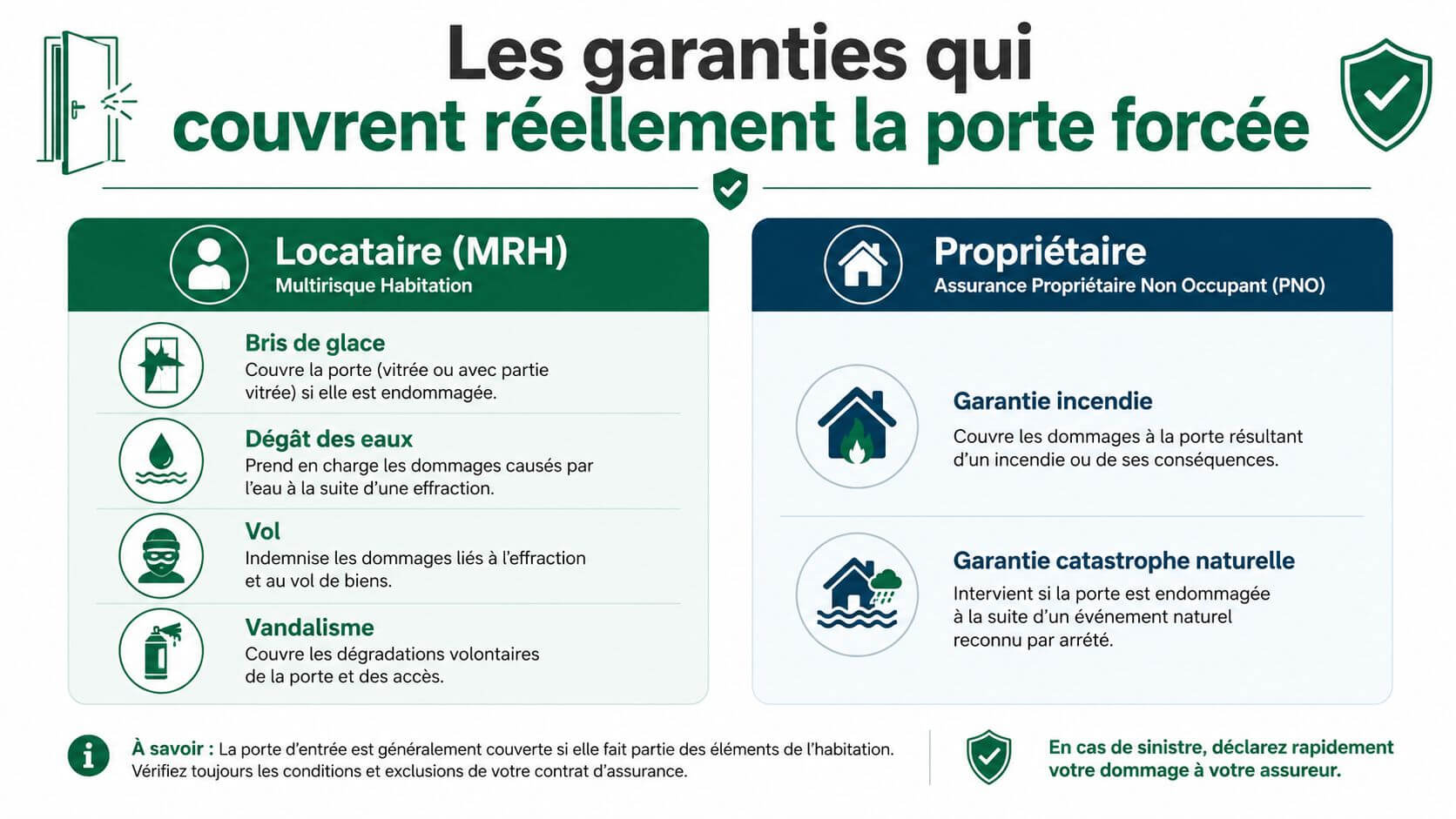
The tenant's multi-hazard home is primarily used to protect the tenant's movable property. It can also incorporate useful guarantees such as theft or vandalism, but it does not replace the owner's insurance for the door itself. The tenant must not count on it to redo an entrance door damaged by break-in.
On the other hand, the occupant owner uses his home insurance, and the lessor often relies on a PNO. It is it which carries the repair of the structure, door, lock or similar elements, according to the terms of the contract. The repairs of the entrance door are in principle borne by the owner, or reimbursed by his home insurance or PNO if he is a lessor.
Contracts to look at without mistake
- The tenant's HRMfor personal objects and guarantees of theft or vandalism if provided for.
- Home insurance of the occupant owner, for the dwelling he occupies himself.
- Lender's NOC, for rented accommodation, building and certain damage according to formula.
- Condominium insurance, if the door concerned is part of the common areas.
- Theft and vandalism guarantee, to check line by line, as it almost always depends on traces of break-in.
The classic trap is to believe that a "multi-risk" contract covers everything by default. No. You have to look at who is insured, what good is covered, and under what condition the guarantee plays. On a forced door, the presence of physical traces remains decisive, otherwise the guarantee may not activate.
At this stage, the idea is brutal but useful. The right contract is not enough, it needs the right contract in the right name, and with the right proof. Without that, the file is wasting time, and sometimes compensation.
Proof of break-in, the real pivot of compensation
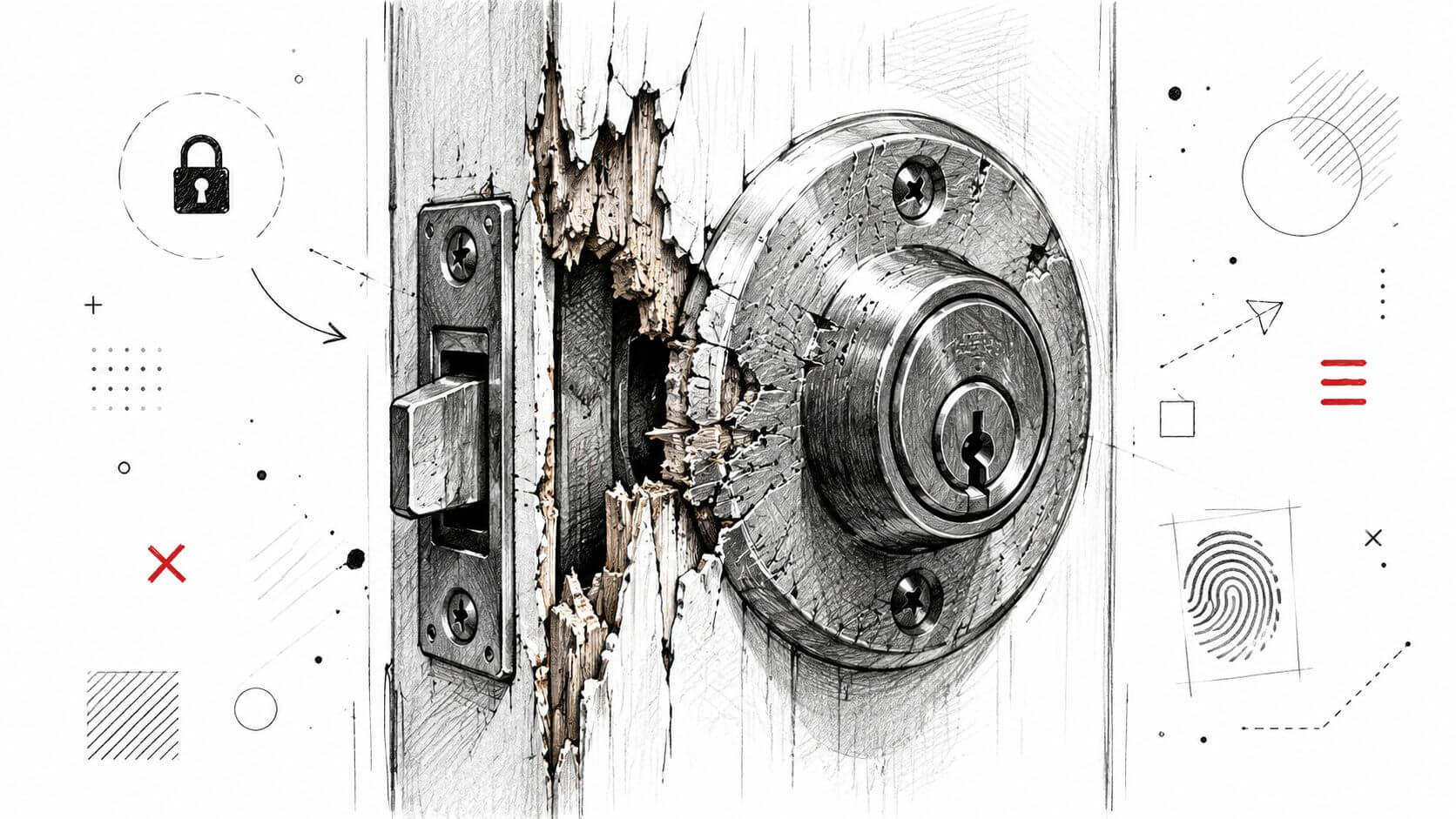
The insurer does not reimburse an impression, it reimburses an established claim. That's why the proof of break-in is not an administrative detail, it is the centerpiece of the file. Traces on the lock, broken-up, broken door, broken glazing, tool marks, everything that shows a material intrusion weighs heavy.
The pieces to be assembled right away
Take some photos dated from several angles, before any restoration. Add the damage report, the Invoices doors or locks if you have them, and a Inventory property affected or stolen. The filing of a complaint then serves as a formal basis for the declaration, and should be kept on file.
File a complaint before discussing quotes. Without this document, many insurers slow down the processing process.
The most effective is to think like a file technician. You need to show what has been damaged, where, how, and with what effect on housing. A simple voice message or a blurred photo is not enough if the insurer asks for a net file.
The particular case of the search
When a door was forced during a search, the framework changes. The owner may claim compensation from the State, but 10 % of the total reclamation costs remain at his expense for the abnormality of the injury, as recalled by the Senate in this parliamentary question. This point clearly shows that there are different regimes depending on the author of the forcing.
For other situations, stay concrete. A solid proof is better than a long speech, and it is especially true when access to housing has been damaged without the theft being clearly documented. If the scene is confused, your first mission is to freeze the facts, not interpret them.
What to prove, without overloading
- Initial and post-disaster status, with sharp photos.
- The materiality of the infringement, lock, door, frame, glazing.
- The link with a break-inor at least with a credible attempt.
- Chronology, discovery, complaint, declaration, estimate.
- Proofs of purchase or replacement, if required by the contract.
To go further on the issue of the collection of evidence in the private environment, a useful point of methodology is recalled. in this file on the law and the surveillance cameras at work. The background remains the same, the evidence must be exploitable, not only available.
Steps to be taken in order to be compensated
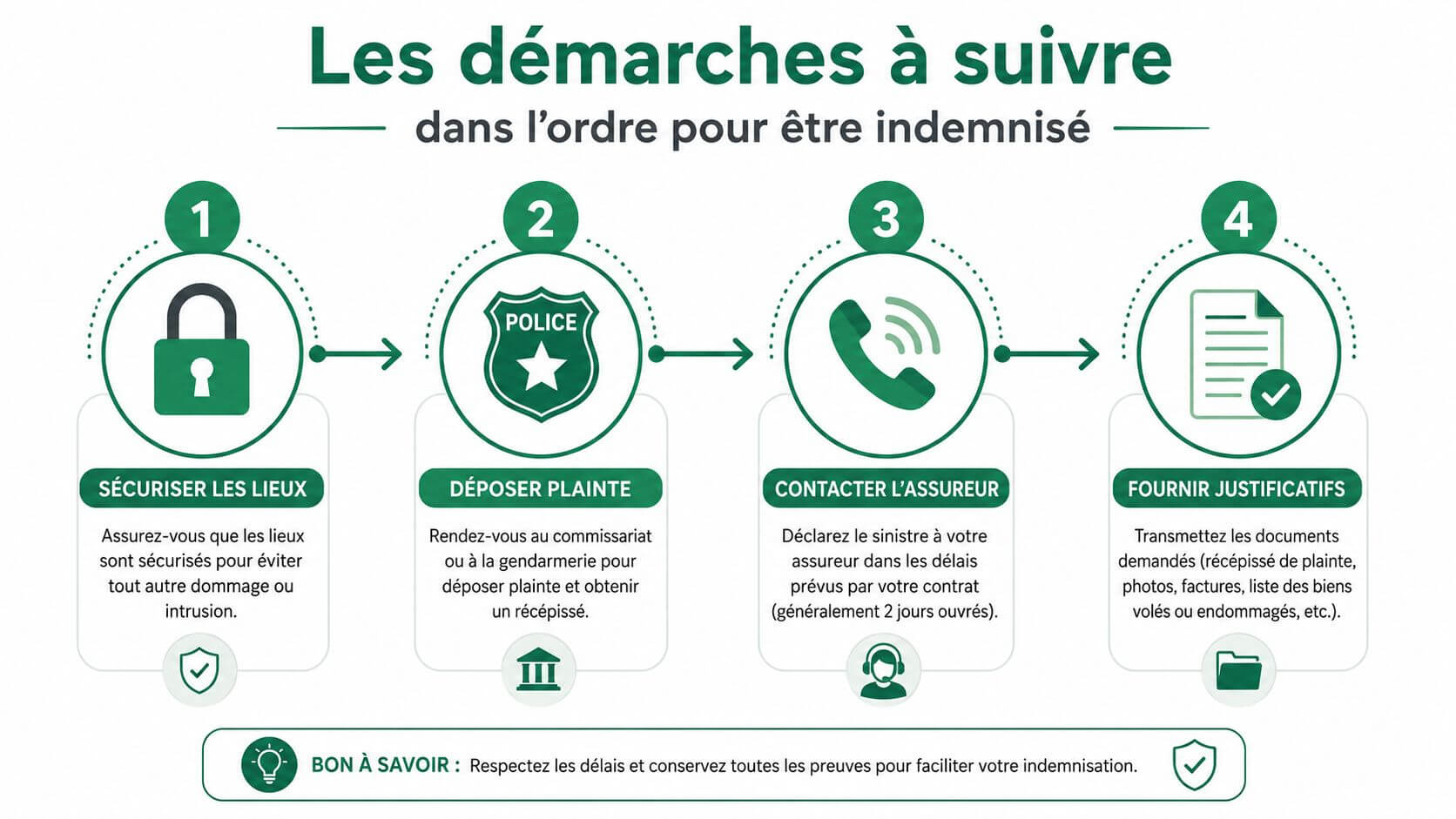
Don't start by calling the most expensive locksmith in the neighborhood. Start by freezing the scene, because the insurer will ask you what you saw, when you saw it, and what you did next. Good order avoids disputes about late reporting or insufficient evidence.
The Good Chain
First, secure the places without removing useful traces. Then take some photos and videos, then list what is affected, including small items that appear secondary. After that, file a complaint and keep the receipt.
The deadline for reporting to the insurer is short, 2 working days after the discovery of the burglary, with filing of complaint and retention of evidence according to insurers' reminders like this one. It is a deadline to be strictly observed, not a comfort board.
What you then transmit
- The complaint number, or the corresponding document.
- Photos and videosNo retouching.
- InvoicesIf you still have them.
- The repair estimate, for the door, lock or frame.
- The inventory of the goods concerned, if objects have disappeared or been damaged.
If the insurer sends an expert, prepare a clean file before the visit. The documents must tell the same story, without contradiction, otherwise the processing becomes longer. A net estimate, a clear complaint and consistent images often speed up the rest.
The reflex that simplifies everything
Don't put anything back on. Late files are the first to be challenged, especially when the door was repaired before being properly photographed.
The logic is the same as in a classic sinister, but with a stronger urgency. A broken door leaves little room for approximation, and every hour counts for proof as for declaration.
The exclusions and received ideas that fill the file
The rejected files are rarely played on a spectacular point of law. They are more often blocked on a wrong reading of the contract, on a proof of break-in too weak, or on a statement made too late. Damaged door, forced door, locked lock, the reflex must be the same, check what is guaranteed and what is excluded before initiating the repairs.
Three received ideas to be ruled out right away
First thought received, The door's still covered. It is not true if it has only been slammed, if there is no evidence of intrusion, or if the guarantee of theft and vandalism is not provided for in the contract. Second thought received, The tenant necessarily bears the burden of the damage. False when an outside third party has forced access, but the responsibility can go to the tenant if the problem comes from poor maintenance or negligence on his part. Third thought received, the deductible is secondary. It can significantly reduce actual compensation, and make it unnecessary to report an overly limited claim.
Exclusions to be monitored in the contract
- Failure to lock, if the accommodation has been left without suitable closure.
- Absence of prior declaration, especially when the deadline is exceeded.
- Door not in conformity with the contract, if the required level of protection was not present.
- Unoccupied housing for too long without supervisionaccording to the terms of the contract.
- Maintenance-related degradation, if the problem comes from the tenant or from the use.
In cases without burglarization, one must look at the raw facts. A forced door can come from vandalism, an attempt at intrusion, or a loss of keys followed by degradation, and the insurer will first check the proof of break-in. Without consistent traces, the guarantee jumps faster than expected. The distinction between break-in, vandalism and negligence becomes decisive.
If you are a landlord, a poorly read contract leaves you with a door to pay and endless exchanges. If you are a tenant, a blurred statement slows down your compensation and immediately complicates the relationship with the owner. The blind spot is often there, not in the lock.
Another thought received is "all or nothing". In practice, some contracts cover the building, others cover the furniture, and still others cover only part of the damage. The right reflex is to read what is excluded before starting repairs, and check in parallel the expected security measures, especially if you want to make a quote for home alarm.
Mail models and reflexes to speed up reimbursement
A good mail does not do the work of proof, but it avoids the waste of time. It must be short, precise and documented. The goal is not to move the insurer, it is to give him immediately what he expects.
Model for the owner's insurer
Object, claim declaration, forced door.
Madam, Sir, I would like to inform you that following a break-in found on [date], the front door of my dwelling at [address] has been broken. You will find attached the photographs, the complaint receipt, the damage inventory and the repair estimate. I ask you for the opening of the file, the recovery of the claim according to the guarantees subscribed and, if necessary, the appointment of an expert.
Model for the lessor
Object, immediate information on a forced door.
Madam, Sir, I would like to inform you that a break-in was found in the accommodation located at [address], with the deterioration of the entrance door and the lock. The complaint was filed and the first observations were photographed. I will provide you with the necessary information so that the repair of the building can be undertaken as soon as possible by the appropriate insurance.
The gestures that save time
- Ask for several quotes, to avoid dependence on a single craftsman.
- Keep all invoices, including small purchases related to security.
- Re-launch in writing, never just by phone.
- Ask for an advance if the relocation or rehabilitation creates an emergency.
- Store your pieces in a single, clean and dated file, as in a well-kept binder.
The key point is traceability. An insurer processes a readable folder faster than a folder scattered between text messages, emails and photos without a legend. If you want to reduce return journeys, send a complete folder from the start.
What to remember and the under-expertized case of the forced door without burglary
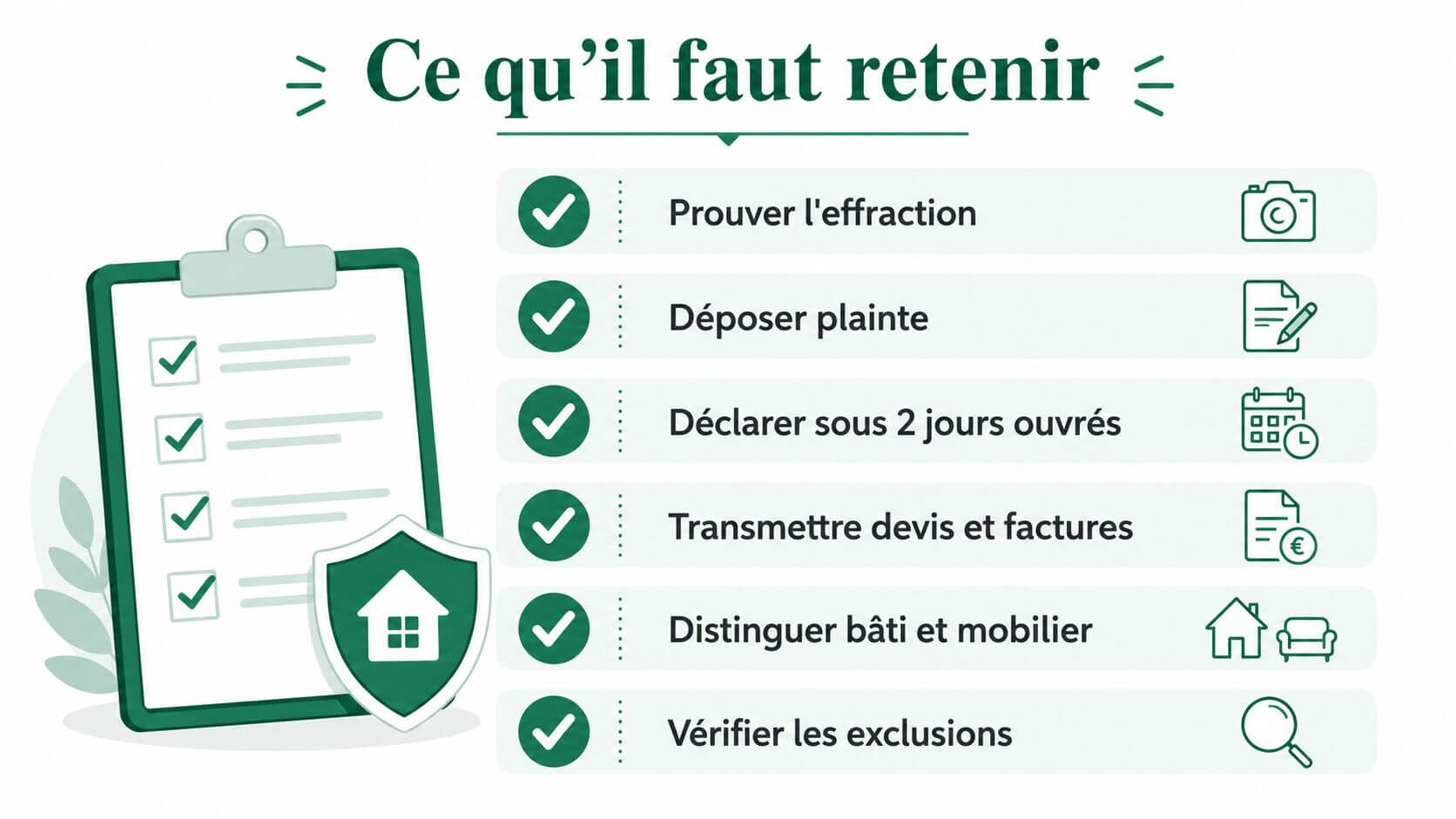
If you have to go straight to the point, keep this checklist. Prove the break-in, Make a complaint, declare within 2 working days, submit quotes and invoices, distinguish built and furniture, check exclusions. It is the base of a backrest that stands.
The case many articles miss
The real grey area is the forced door without proven burglary. Isolated vandalism, attempted break-in, damaged door without theft, lost key with degraded lock, neighbour who damages access, all this is not read in the same way. In these cases, the support depends on the occupier quality and Guarantees, and liability can switch to the tenant if the degradation results from a maintenance defect as the practical analyses of BailFacile recall.
That's where the files are the worst dealt with, because people are looking for a culprit before looking for the evidence. Bad method. First you have to qualify the disaster, then only look at what contract is playing.
The right reading, without detour
- Demonstrated break-inThe logic of repayment is clear.
- No burglary proven, the guarantee depends on the clauses and the context.
- Renter, owner, condominium, everyone looks at their real perimeter.
- Low evidence, fragile file.
- Net folder, repayment more fluid.
The right reflex is to document immediately any damage to the entrance, even when the flight is not obvious. It is often this rigor that makes the difference between a file that drags and a file that moves forward.
If you are handling a forced door accident, sort it out now, gather your evidence and put your parts in the right order. Then ask for a structured review from Tribulys, to keep your documents, exchanges and next steps clean, readable and ready to be transmitted.
Put this organisation into practice with Tribulys
Keep your care journal, shared calendar, tasks, medication tracking and emergency information together. Start for free and invite the relatives and professionals involved in your loved one’s care.