
You may already look at your phone more often than usual. A parent lives alone. He says everything is fine. But you know that a fall does not prevent, and that the real danger is not just the fall itself. It is time spent on the ground, without being able to call.
This is often where the search for a Drop detector. Not out of taste for technology, but to answer a very simple question: if something happens, who will be warned, and soon enough?
The subject is wider than it seems. Between bracelet, pendant, connected watch, sensors in housing, tele-help subscription, financial aids and family organization, many caregivers feel quickly lost. The right choice is not the most modern one. It is the one that your loved one will accept to wear, that you will really understand, and that will fit into a clear human response.
Contents
- Fear of falling, a shared anguish
- Understanding the operation of a fall detector
- The different types of detection systems
- How to choose a detector for a loved one
- Costs, financial aid and regulatory aspects
- Fall alert at the heart of carers' coordination
- Purchase checklist and frequently asked questions
Fear of falling, a shared anguish
A caregiver doesn't always say, "I'm afraid of a fall." Instead, he says, "I call her at night to check," "I leave the phone on at night," "I worry when she doesn't answer right away." Fear takes that form. She settles into the habit.
This concern is not overstated. the main cause of accidents among people over 65 years of age, about 3 million falls reported each year, and 40% of seniors who fall and stay on the ground more than 20 minutes without assistance experience severe medical complications, as recalled this article on the detection of falls in the elderly.
The problem for families is that you often think about the time of the fall, while the most distressing is the next. Will your loved one be able to get up? Will he have his phone at hand? Will he think about pressing a button if it is ringed, painful or disoriented?
A good home retention solution is not only used to launch an alert. It must also reduce the time of uncertainty.
The fall detector responds precisely to this grey area. It does not replace the human presence, the layout of the housing or the visits. On the other hand, it adds a safety net when no one is there, especially at times when one feels the most powerless at a distance.
For many families, this is not a technical purchase. It is a way to make the home a little less fragile. And often it is also a relief for the elderly person himself. She knows that in case of malaise or fall, she will not necessarily have to deal with everything alone.
Understanding the operation of a fall detector
A fall does not look like a simple false step or a sudden gesture to a sensor. The device is looking for a very precise sequence of events. This allows it to distinguish, as far as possible, a worrying situation from an ordinary movement of the daily.
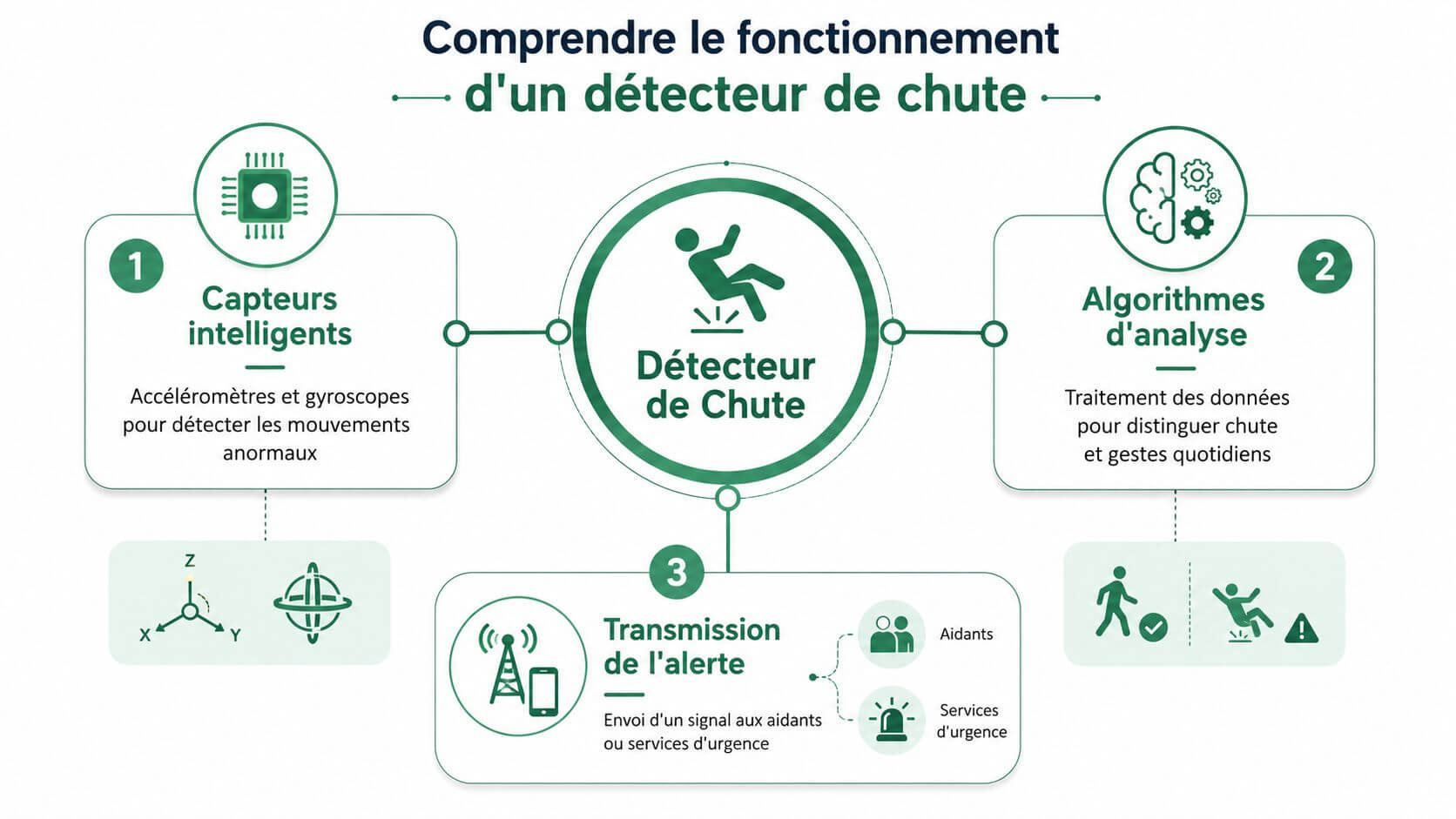
What the device detects in practice
Inside, there are usually two sensors. The accelerometer measures motion variations. The gyroscope The body's position in space is identified. Together, they analyze three clues which, at the end, evoke a fall.
The operation often follows this logic. First, the device identifies sudden movement or shock. Then he finds a change of position, e.g. the rapid transition from a vertical posture to a ground posture. unusual immobility for a few seconds. This last stage counts a lot. A person can sit heavily, lean quickly or suddenly lay his arm. On the other hand, if the movement is followed by an abnormal position and then a lack of reaction, the alert becomes more likely.
In other words, the system does not react to a single signal. It crosses several clues, a bit like a careful caregiver who looks at both the gesture, the posture and what happens next.
- Rapid acceleration : a shock or rapid variation is detected.
- Loss of verticality The sensor shows that the body is no longer in a normal position.
- Prolonged immobilizability : the device checks that the scene does not correspond to a common movement.
Automatic detection and manual call
This distinction helps a lot when choosing. Call button serves when the person can still act himself. He supports, speaks, asks for help. automatic detector intervenes in other situations, for example if she is disoriented, sounded, painful or unable to reach out to her medallion.
The two functions therefore do not meet the same need. If you want to clarify this difference before comparing the models, this guide on the operation of an emergency call button for the elderly Can help you.
It is also necessary to keep a practical vision. No detector perfectly identifies all situations. Slow slides, some controlled descents to the ground or certain discomforts without frank shock can be more difficult to recognize. This does not disqualify the tool. This reminds us above all that a good choice is not only made on a commercial promise. It is made by looking at the real daily life of your loved one, his mobility, his habits, his possible omissions and his acceptance of the device.
What happens after detection
This is often the point that families discover too late. Detecting a fall is only the first step. A useful alert must then arrive to the right people, in the right order, with a clear instruction.
According to the services, the detector can trigger a call to a tele-assistance, send a notification to a relative, or launch an alert chain. This is where the question of "and after?" takes its place. If several caregivers intervene, one must avoid cross-calls, missed messages and uncertainty about the person who is moving. A platform like Tribulys offers a very concrete answer to this problem by centralizing information within the tribe of caregivers. The alert no longer arrives in a vacuum. It is part of a shared organization, with a more legible relay between the family, trusted neighbours and professionals.
For a caring loved one, it changes a lot. We are not only looking for a device capable of detecting. We are looking for a device that integrates into a coordinated, humane and fast response.
The different types of detection systems
There is not a single fall detector, but several families of solutions. The right reflex is not to ask "what is the best model?". It's best to start with "what kind of system is the daily life of my loved one?".
Here's an overview to find you.
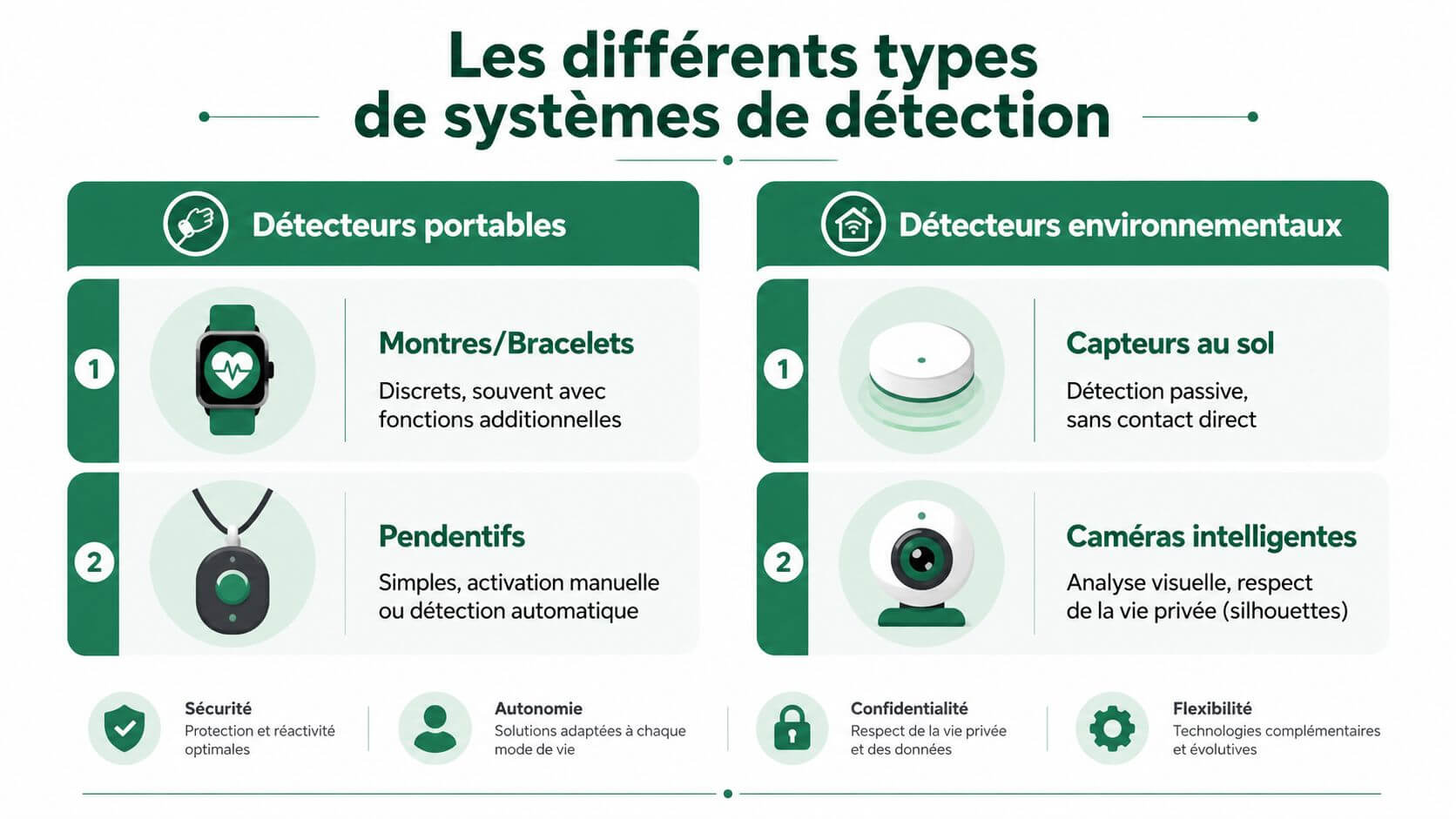
Portable devices
These are the best known solutions. Bracelet, pendant, medallion, sometimes shows. The idea is simple: the person carries the device on it, which allows either manual call, or automatic detection, or both.
Their main advantage is clear. They accompany the person on his or her journeys, including from one room to another, and sometimes outside according to the service chosen. They are suitable for those who are still active, who come out, garden or often move in their accommodation.
Their weakness is just as simple: wear them really. An excellent device on paper is of no use if it remains on the night table.
To complete this point, you can also read this guide on the Emergency call button for the elderly, which helps distinguish between manual warning and continuous safety.
Some typical profiles:
- The Pendant Often fits people who want a simple gesture and a reassuring presence around the neck.
- The bracelet can be better accepted if the relative refuses to have an old man's medallion, according to a formula that is often heard in the family.
- The connected watch attracts by its more modern side, but its use depends a lot on the ease of the person with the charging, settings and screen.
A short video demonstration helps visualize what these devices are changing every day.
Environmental sensors
Here, logic changes completely. Instead of asking the person to wear something, we equip the housing. Presence sensors, ground sensors, systems that detect unusual activity or abnormal immobility in some rooms.
The great asset is membership. For people who forget everything, refuse the bracelet or often remove it, this approach can be more realistic. It is also interesting when the family wants to monitor routine signals, not just a sudden fall.
On the other hand, these systems depend on the place. They protect the home, not necessarily the outside. They also require a more structured installation and a reflection on the rooms to be covered.
When a relative does not agree to wear a device, the best system is not the most sophisticated. It is the one who will remain active every day, effortlessly on his part.
Camera systems
They raise a lot of questions, often because they affect the intimate. Some devices use the image to spot an abnormal fall or posture. Others promise to further preserve privacy, for example with limited silhouettes or visual treatments.
Their strength is the wealth of analysis. Their difficulty is acceptability. Many elderly people refuse the idea of being observed in their living space, even if the technology is presented as discreet.
In reality, these solutions are not suitable for all households. They call for a frank dialogue on dignity, psychological comfort and the limits that must not be crossed.
The three families can be summarized as follows:
| Type of system | Main high point | Main limit | Adapted profile |
|---|---|---|---|
| Portable | Follow the person | Must be worn | Senior mobile |
| Environmental | No port required | Covers the home | No one who forgets the bracelet |
| Camera | Rich analysis | Difficult acceptance | Very specific situations |
The right choice is therefore not only technological. It depends on the cooperation of the loved one, his housing and the way in which you want to organize the response behind the alert.
How to choose a detector for a loved one
The classic mistake is to compare technical data sheets before you have observed the real life of the person. In home maintenance, you always leave the daily life. Not the catalogue.
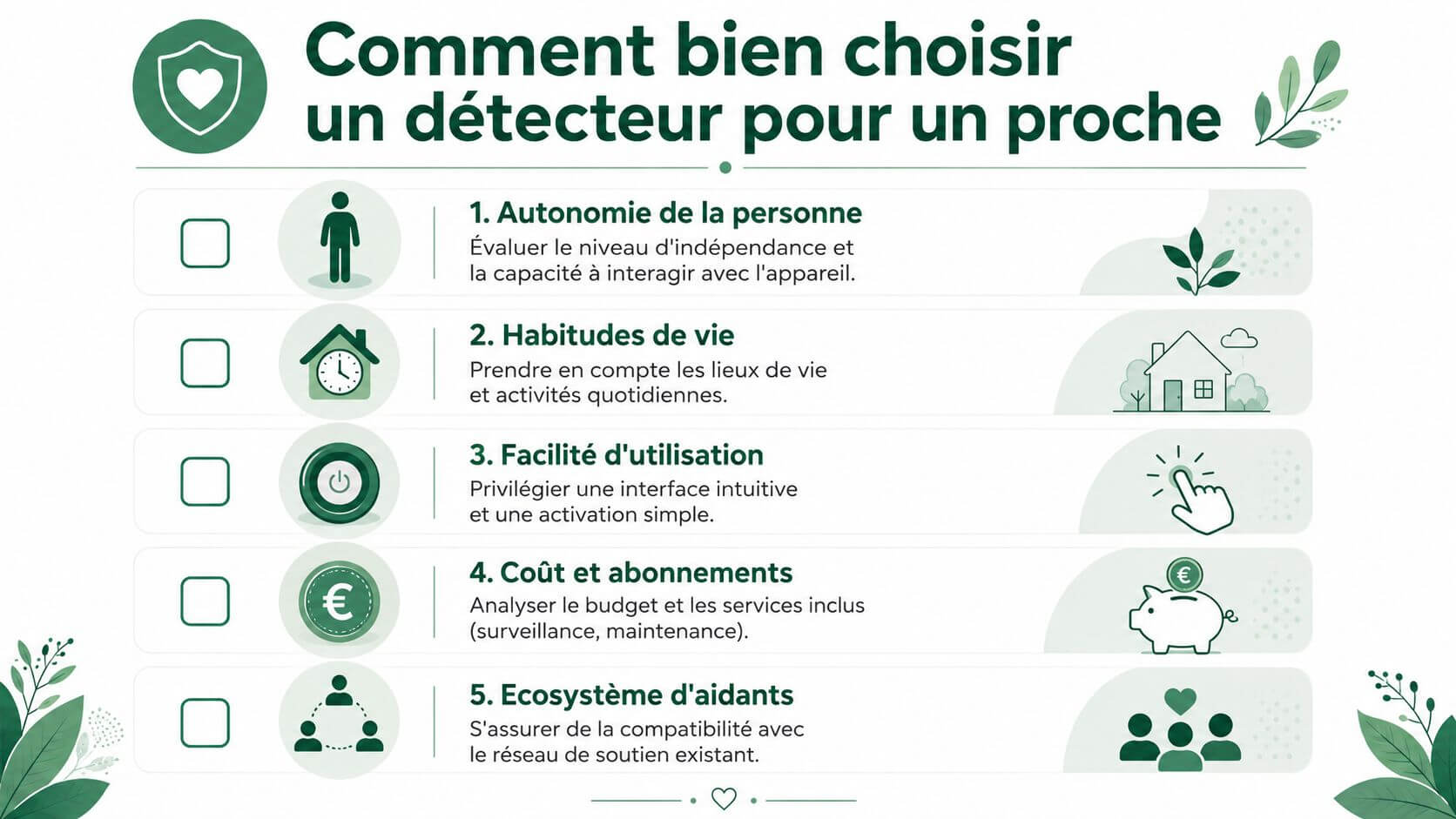
From the person and not from the catalogue
Start by looking at how your loved one lives, without idealizing the situation.
Does he go out often? Does he ever forget his glasses, his phone or his keys? Does he easily accept an object visible on him? Is he comfortable with charging a device? Is he used to wearing a watch? These questions seem simple, but they avoid a lot of bad shopping.
Let us take two very different examples.
A person who is still self-sufficient, shopping and going down to the mail alone, will often need a portable device. Conversely, a very cassanian person, who forgets to hand over his bracelet after the shower, will benefit more from a logic of home equipment.
The choice must also respect the character. Some people want something discreet. Others prefer a large button clearly visible. A elegant but complicated solution will be less protective than a very simple device, clearly understood and accepted.
Criteria that avoid a bad purchase
When comparing offers, I advise families not to get lost in secondary details. There are some really decisive criteria.
- Daily acceptance If your loved one already says, "I'll never wear this," take this objection seriously.
- The simplicity of use : a clear button, easy logic, few manipulations.
- Water resistance This is a major practical point, because many risk situations occur in the water rooms.
- Autonomy and charging : a device often unloaded is a false sense of safety.
- The quality of the response behind the alert : one must understand who receives the alert, how, and with what delay of escalation.
Another point counts a lot. The housing itself.
A compact apartment, where the distances are short, does not call for the same choices as a house with floor, basement or garden. If the person falls into an outdoor space or in a sparsely covered area of the home, the device must remain relevant in this specific context.
Field advice: Always ask the claimant to describe the exact scenario. A fall occurs. Alert leaves. Who calls who? In what order? What happens if no one answers right away?
You can also use this small decision grid:
| Question to be asked | If yes | Probable orientation |
|---|---|---|
| My loved one often forgets to carry his objects | Common | Home sensors to consider |
| He goes out alone regularly. | Yes | Preferable portable device |
| He refuses any stigmatizing apparatus | Yes | Discreet bracelet or watch according to profile |
| He's not comfortable with screens. | Yes | Simple remote assistance solution |
| He lives alone long hours | Yes | Automatic Priority Detection |
The best fall detector is the one that integrates without conflict into the person's life. If it creates constant reminders, complicated reloads or a feeling of poorly experienced surveillance, it will often end up abandoned.
Costs, financial aid and regulatory aspects
A fall detector is not just a purchase. For a family, it is often a decision taken in the calm urgency of everyday life. We want to protect a loved one without opening a new item of expenditure poorly understood.
However, a detailed analysis of expenditure and aid makes the decision clearer.
What You Really Pay
The invoice is divided into two blocks. On the one hand, there is the device. On the other, there is the service that processes the alert. The price of a device alone and that of a monthly subscription vary according to the options and the level of support, as recalled this guide on the mistakes to avoid when buying an anti-fall bracelet.
This is a point that often creates confusion.
Two bracelets may seem close on one photo, then give a very different experience to use. One includes a listening center available at any time, maintenance and replacement in case of breakdown. The other leaves to the family a large part of the practical management. In other words, you do not only pay for an object. You also pay the response time, the quality of the tracking and the reliability of the organization behind the alert.
Before comparing offers, ask for full encryption. It must show the equipment, the subscription, the installation, the maintenance, the cancellation fees, the cost of a replacement, and the conditions if the health condition of the loved one changes.
The aid to be applied for
The remainder can be reduced by several devices. Depending on the situation of your loved one, there may be a tax credit, participation via the APA, or assistance related to the adaptation of housing such as MaPrimeAdapt'.
The most useful thing is to look at these aids as a whole, not as separate boxes. A family that already finances hours of home help, security equipment and accommodation facilities has better look at the overall budget. To prepare this work without forgetting anything, you can consult this summary of support for family carers.
Keep this simple logic in mind:
- The tax credit Sometimes lowers the actual cost of service.
- APA may contribute to funding according to the level of loss of autonomy and the aid plan.
- MyPrimeAdapt concerns a broader reflection on housing, for example if the fall is part of a problem of home planning.
This overall view counts a lot. A fall detector provides a useful response, but it is often more relevant when it fits into an already coordinated home maintenance plan.
Regulatory and quality benchmarks
At the time of signing, check the claimant's guarantees of seriousness. NF Home Support Teleservice is one of the known landmarks. It helps distinguish a simple commercial promise from an organized service with identified requirements.
Ask some very specific questions:
- Who gets the alert first?
- What happens if no one answers?
- Are the presence or activity data retained?
- Who can access it?
- Does the contract specify the time limits, the limits of the service and the conditions for termination?
These issues protect the elderly as well as the family.
This is also where the subject of the "and after?" reappears. A good regulatory framework and a good contract secure the tool. But an isolated alert is not always enough if the information circulates poorly between relatives, home care workers, nurses and other stakeholders. In practice, the real cost of a poorly chosen system is not only financial. It is time lost, uncertainty, and sometimes an unorganized response when everyone needs to know what to do.
Fall alert at the heart of carers' coordination
The fall detector solves a first part of the problem. It triggers the alert. But for many families, the disorder starts precisely at that time.
The real problem starts after the alarm
You may know the scene. The call center tries to reach a relative. The relative calls his sister. The sister thinks the home care worker is already there. The nurse learns the incident later. Meanwhile, no one has a complete vision.
This is not a problem of good will. It is a problem of organization of information. Family caregivers often work with text messages, missed calls, paper notes and partial memories. When the alert is serious, this mode of communication becomes fragile.
A useful alert should not only warn someone. It should open a clear response circuit: who has been contacted, who is involved, what has been observed on the spot, should the doctor be informed, should home visits be adapted within the following days?
Switching from an isolated alert to an organized response
This is where a coordination logic changes everything. When a family uses a shared space to track the next of kin, the alert becomes the starting point of a structured collective action, instead of an improvised chain.
In concrete terms, the incident can be traced in a shared link book. Family members see the same information. The professionals concerned know that an event has taken place. The suites are noted. The history remains accessible.
For caregivers who want to set up this organization, this is the case. guide for coordination between carers shows how to centralize important transmissions instead of allowing information to disperse.
A fall is not only a one-time incident. It is often a signal. If the information circulates badly, the family manages the emergency but misses the opportunity to warn the next one.
The important idea is "and after?". After the alert, you need a common memory, a prioritization, and a simple way to avoid duplicates or omissions. Without this, even a good fall detector remains an isolated device. With clear coordination, it becomes the first link in a more serene response.
Purchase checklist and frequently asked questions
Before signing, keep a simple rule: a good device must be worn or active, including, and linked to a reliable responseIf only one of these three elements is missing, the protection remains partial.
The checklist before signing
Check these points when comparing:
- The device matches the way of life from your loved one, not from an advertisement.
- The person agrees to wear it or the accommodation is equipped effortlessly on its part.
- The alert scenario is clear for the whole family.
- Reloading or maintenance remain simple to manage.
- The service can be reached continuously And you know who's involved.
- The total cost includes any aid included.
- Personal data are treated seriously.
- A Test Period or a demonstration is possible before long engagement.
Frequently Asked Questions
Does the detector work outside?
This depends on the type of system. Portable solutions are the most suitable if your loved one comes out regularly. Housing-related devices protect especially at home.
What happens in case of a false alarm?
Above all, it is necessary to check how the service manages this situation. An occasional false alert is dealt with better than a total absence of alert. The real subject is the clarity of the protocol.
Can a connected watch replace a dedicated bracelet?
It's tempting, especially if the person is already wearing a watch, but you have to be careful. a lack of recent data comparing the reliability of Apple Watch-type connected watches with dedicated tele-assistance bracelets in the French domestic context, which leaves a real uncertainty for caregivers, as pointed out Apple documentation cited on this issue of fall detection. Clearly, a watch may be useful in some cases, but it does not automatically replace a solution designed for remote assistance.
Should we choose a hybrid system?
Often, yes, at least in thinking. When a loved one sometimes forgets his portable device, complementing with a home organization or better coordination of caregivers can enhance overall safety.
If you are looking not only to receive an alert, but also to better organize what happens next between family and professionals, Tribulys It is often this shared organization that transforms a diffuse concern into a truly more soothing follow-up. It can help you to centralize the link book, agenda, medicines and important transmissions around a loved one kept at home.
Put this organisation into practice with Tribulys
Keep your care journal, shared calendar, tasks, medication tracking and emergency information together. Start for free and invite the relatives and professionals involved in your loved one’s care.