
You may be looking at a seeder on the kitchen table, with the medicine boxes next door, and wondering if everything is really in the right place. One day, a box is empty. Another day, someone doubts whether they have already taken the morning tablet. At home, the problem is almost never the good will, it is the shared memory, between the close carer, the IDEL, the pharmacist and the cared person.
When coordination cracks, a medicament pharmacy It is a visual marker, a concrete support point and, when well used, a way to reduce the hesitations of everyday life. In the city pharmacy, the logic of traceability already exists in the city pharmacy. Pharmaceutical dossier, which keeps the history of the medicines over specified periods, 4 months for conventional medicines, 3 years for Biologicals and 21 years for vaccines under CNIL control (CNIL). It is the same need for continuity that we seek to prolong at home, with a physical object and shared follow-up.
This guide starts from the ground, not from the jargon. It helps to understand, choose and fill a semainier without being wrong, while linking the pharmacy's gesture to the book of liaison, alerts and digital history. For the helpers as for the IDELs, the stake is simple, to circulate the right information, at the right time, without carrying all the load in his head.
Contents
- Contents
- Why a worker changes the lives of caregivers
- Understanding what a medicine pharmacy is
- The three families of workers and their uses
- How to choose your pharmacy semainier
- Three user profiles for the same week
- Regulatory framework and digital catch monitoring
- Weekly Routine to fill and synchronize its semainier
- Final checklist and good reflexes to last
Contents
- Why a worker changes the lives of caregivers
- Understanding what a medicine pharmacy is
- The three families of workers and their uses
- How to choose your pharmacy semainier
- Three user profiles for the same week
- Regulatory framework and digital catch monitoring
- Weekly Routine to fill and synchronize its semainier
- Final checklist and good reflexes to last
Why a worker changes the lives of caregivers
A girl calls her mother at 7:00 p.m., she wants to know if the evening treatment has been taken. The mother hesitates, the brother thinks that yes, the IDEL will pass the next day, and no one dares to decide. This type of scene is nothing exceptional. It shows above all that at home, the real problem is not the existence of treatment, it is the absence of a common medium that makes the take visible to everyone.
The Semainer as a Shared Memory
A well-chosen seeder reduces blurred exchanges. Instead of asking "did you take it?", we look at a box, we check an alert, we note an observation in the transmission logbook. This small difference changes a lot, because it moves the discussion of memory to observable fact.
Practical rule. The more co-ordination is based on oral memory, the greater the risk of duplication, oblivion and family tension.
For the caregiver, the benefit is immediate. He must no longer mentally repeat all the planning at each call. For the IDEL, the passage becomes more fluid, because the semainier gives a quick state of the place, almost like a dashboard. For the cared person, the object reassures, because it makes the day more readable.
Why this support also changes the care relationship
The seeder is not there to watch the loved one. It is used to make the care less burdensome to wear for everyone. When the shots are better organized, the conversations can become human again, and no longer only corrective. We talk about fatigue, appetite, side effects, not just forgotten case.
In home care, this simplicity counts enormously. A clear object avoids repeated calls, contradictory messages and reinterpretations. It also prepares the ground for consistent digital tracking, because one cannot permanently synchronize something blurred. The semainier thus serves as a material base, and digital prolongs this base without replacing it.
Understanding what a medicine pharmacy is
One medicament pharmacy, it is a calendar of catches in material form. Each box corresponds to a specific time of day, such as an appointment between the person being treated and his/her treatment. It does not store medicines at random, it is ordered taken so that the gesture is simpler and safer.
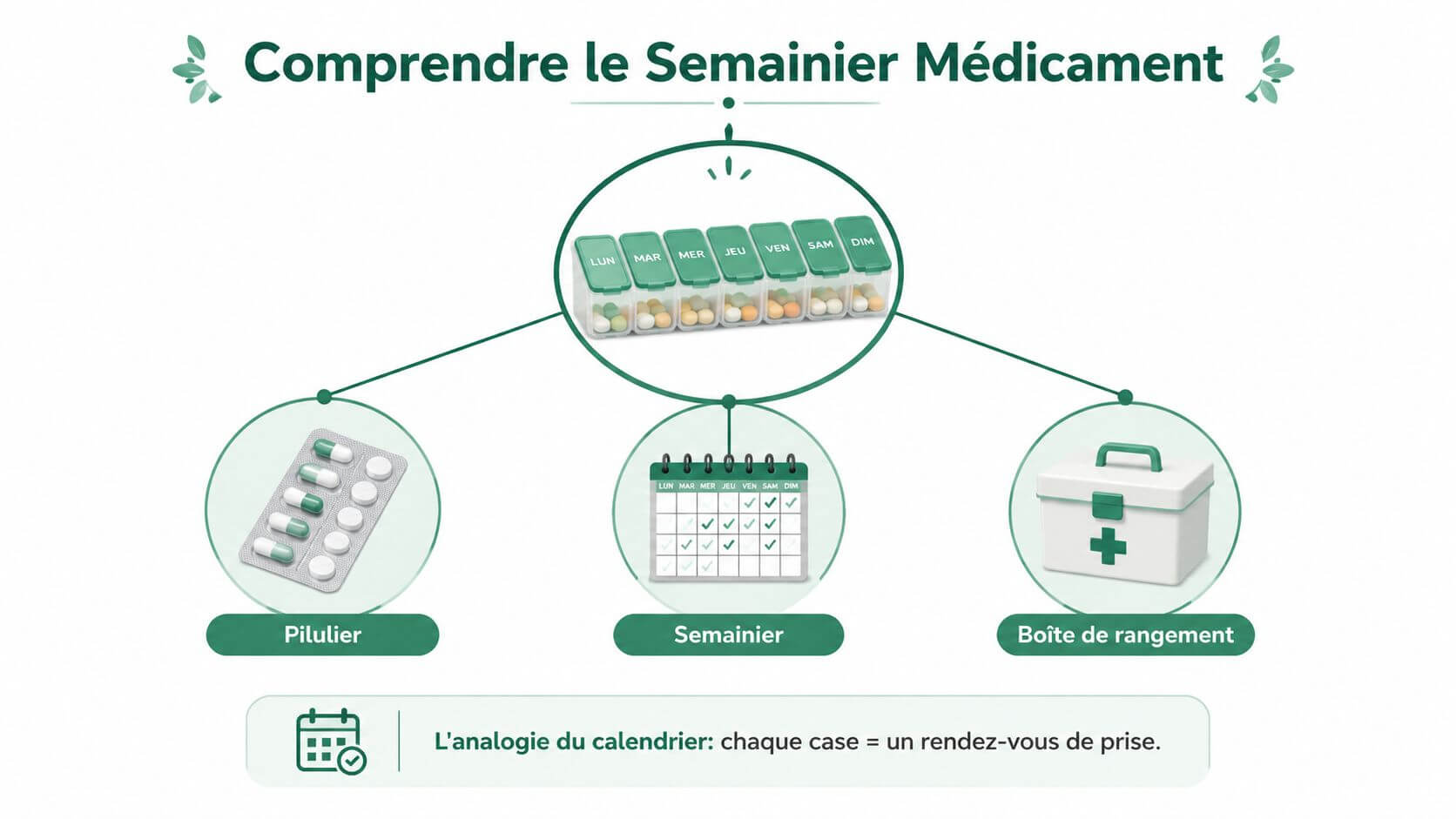
Pillow, semainier and storage box do not play the same role
The word "pilulier" is often used for everything, but it quickly creates confusion. Pillier refers to the general idea, the container that helps organize drugs. Weekend structure this organization over a week, with several boxes per day. storage box, she, stores without finely organizing the catch.
This difference is not just a vocabulary detail. It changes the level of readability, ease of control and risk of error. A storage box is used mainly for storage. A seeder helps prepare and verify. A pillar may refer to one or the other in the current language, but in practice it is necessary to know exactly what tool one is talking about.
The three logics of cutting
The most common model remains the weekly classic, often thought on 7 days with 2 to 4 daily doses, typically 14-28 compartments according to the models (OMEDIT Centre). This granularity is well suited for chronic treatments, because it makes the day visible with one look. There are also individual day shifters, useful when moving a lot or when you need a box a day. Finally, some models are electronic, with alarm or opening detection.
A good weekday doesn't do more than that, it makes the reading more clear.
The pharmacy storekeeper also serves as a point of support for digital coordination. When an IDEL or a helper fills the physical support, it can then report the sockets in a link book, an alert or a history, as found the principle of a stacker morning and evening in the concrete organisation of the home. The manual gesture and the written follow-up complement each other, a little like a key and its double. One prepares the catch, the other keeps track.
A regulatory point must be clear from the start. In practice, the preparation of a workshop is the responsibility of a modification of the primary packaging of the medicine and is similar to a manufacturing act, not to a simple logistical storage (Canton of Vaud). That is precisely why traceability matters. We are talking not only about a practical accessory, but about a dispensation device that requires a rigorous organization.
If coordination is based on oral memory, the semainier takes on even more value. It helps stabilize harvests, minimize confusion, and provide caregivers and caregivers with a common benchmark, simple to control at home.
The three families of workers and their uses
Not all seeders meet the same need. The right model depends on mobility, level of autonomy, number of intakes and degree of coordination around the patient. So it's not a competition for sophistication, it's a choice of suitability.
Compare by actual use
| Criterion | Standard weekly | Individual newspaper | Alarm electronics |
|---|---|---|---|
| Security | Readable, but dependent on human vigilance | Good for an isolated day | Reinforced by reminder and sometimes locking |
| Capacity | Adapted to chronic treatments | Low, thought for short term or transport | Variable according to model, but often oriented repeated |
| Ergonomics | Simple, visual, easy to control | Very convenient on the move | Depends on interface and settings |
| Labelling | Clear if the days and slots are well marked | Very readable for a given day | Can be more technical, with screen and settings |
The weekly weekday It is the most intuitive for many families. It prepares once a week, controls itself with one look and is well suited to a stable routine. individual day work week is used more for temporary use, for example when travelling or in a context where each day has to be isolated. Electronic week-end, he, adds a useful warning layer when the memory of the moment becomes fragile.
What each family brings, and what it does not solve
The classic model reassures by its simplicity, but it assumes that someone is thinking about checking for oblivion. The individual daily helps to separate days, but it requires a more frequent organization. Electronics protects against distraction, sometimes from premature access, but it is necessary to accept the charge of adjustment and charging.
This is why it is not necessary to choose only on the basis of price or technology. A patient who lives alone, but who remains very autonomous, does not have the same need as a relative assisted daily by an IDEL. Another, on a trip or temporary accommodation, will gain in comfort with a daily support. The good weekday is the one that reduces the risk gestures, not the one that impresses on the label.
For families who already coordinate several stakeholders, the organisation's follow-up around the harvests can also be centralized in a coordination tool such as Pillier morning night, which avoids each person keeping their own version of the week.
How to choose your pharmacy semainier
The right purchase starts before the shift. The pharmacist needs the current prescription, the number of medications per dose, and the real life of the patient, not just theoretical schedules. A worker who ignores the habits of morning, lunch or bedtime often ends up badly used.
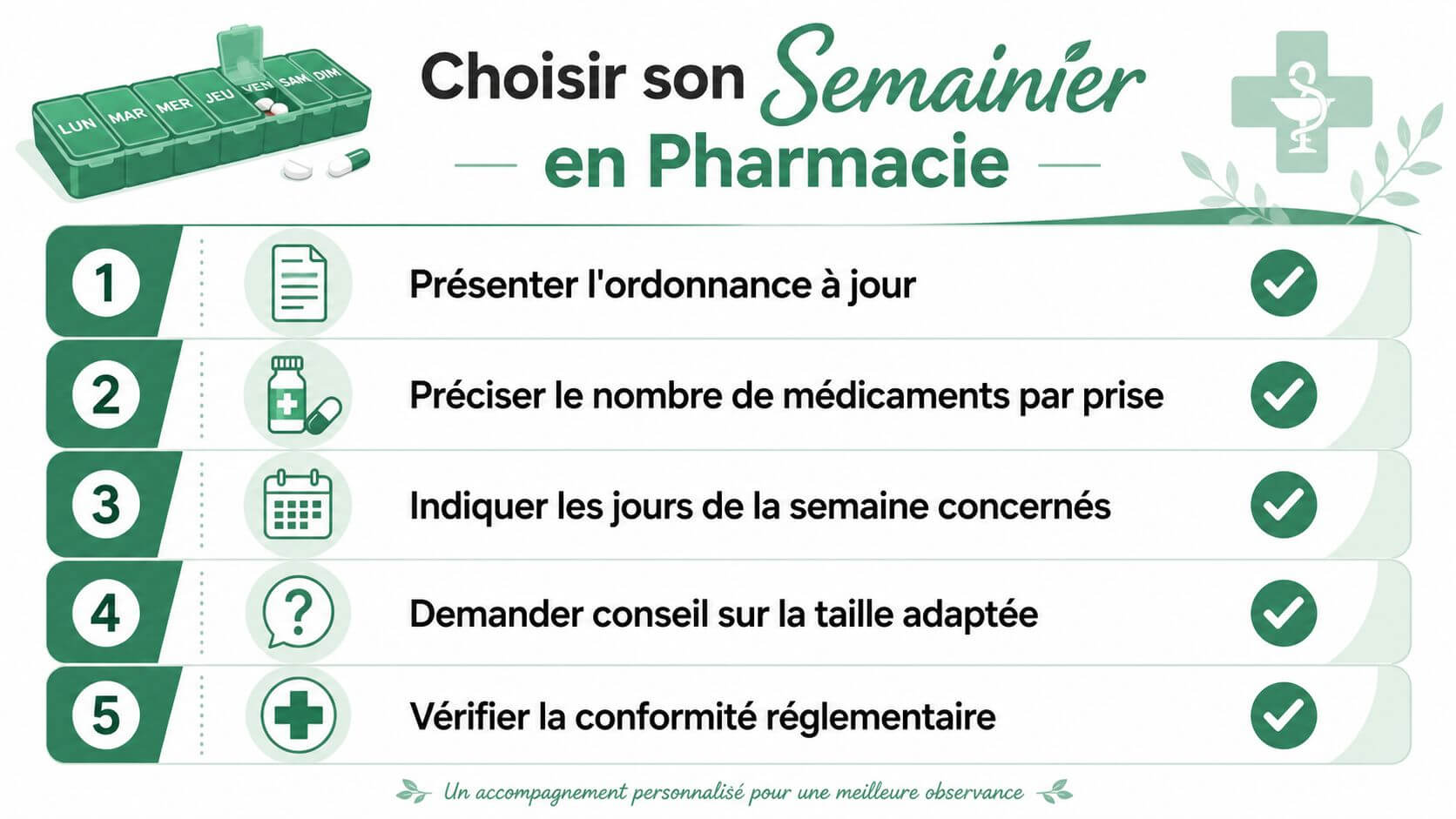
The questions to ask at the counter
Ask if the format allows you to store the tablets or capsules without breaking them. It is a simple but essential point, because a too narrow compartment pushes into unnecessary manipulations. Also report visual or grip difficulties, because an easy-to-open lid is better than a beautiful design impossible to handle.
Good reflex. The right week is the one that the patient can use without excessive effort, even on a day of fatigue.
Check the label as well. The days of the week must be legible, the intake times understandable, and the opening clear enough to avoid hesitation. If the patient lives with difficulty in handling, prefer a system that requires little strength and limits fine gestures.
What it is better to avoid
An unlabelled seeder creates confusion as soon as there are several boxes in circulation. A too small model sometimes forces to fragment the tablets or force storage, which is not a good solution. You also need to be careful about the conformity of the product and avoid objects whose medical status is not clear.
In pharmacy, a good discussion is better than a quick purchase. Bring the prescription, describe the actual schedules, mention any home helpers and have the consistency between the capacity of the seeder and the amount of tablets checked. You will leave with a suitable tool, instead of a simple "nearly practical" container.
Three user profiles for the same week
A girl who lives far away from her mother does not use it as an IDEL, and an independent patient does not look at her in the same way as a caregiver. The same object therefore serves three different realities, with three ways of deciding, verifying and transmitting information.
Family Helper at a Distance
The girl fills the semainier during her weekend visit. She then photographes the preparation, notes what has been stored and shares information with her brother to avoid duplication. The semainier then becomes a common visual base, and no longer an object that only one person manages in his corner.
In this configuration, the most useful is not sophistication, but regularity. If the same ritual comes back every week, the caregiver gets less tired and exchanges become more precise. The mother knows what to stick to, which reduces the feeling of losing her hand on her medication.
IDEL on tour
The Independent nurse passes through, looks at the boxes, confirms the catches and notes the observations in the coordination tool. She does not need to redo all the history at each visit, as the worker already gives an immediate mark. This limits the calls for clarification to the family and secures the passages.
The role of the IDEL is not to turn each visit into an audit, but to check what matters. A clear weekday helps to identify gaps, inconsistencies or changes in order. It then becomes a medium for dialogue between home and official.
The self-contained polymedic patient
Some patients maintain a good autonomy, but need a sound or visual reminder to avoid missing a niche. They then use an electronic model that does the memory work for them, especially when the sockets are spread over several moments of the day. The object does not remove responsibility, it makes it easier to hold.
In all three cases, the logic remains the same, but the main user changes. Semainier is not only used to classify drugs, it is used to harmonize different uses around the same reference. This makes it a coordination tool, not a simple storage.
Regulatory framework and digital catch monitoring
In practice, the French framework recalls one simple thing, traceability does not start at home, it is already being built officially. Pharmaceutical dossier keeps useful information about the drug route, in a logic of continuity of care and control of access. This shared memory helps to avoid blind spots when several practitioners, family, pharmacist, Independent nurse or doctor, follow the same person with different markers.
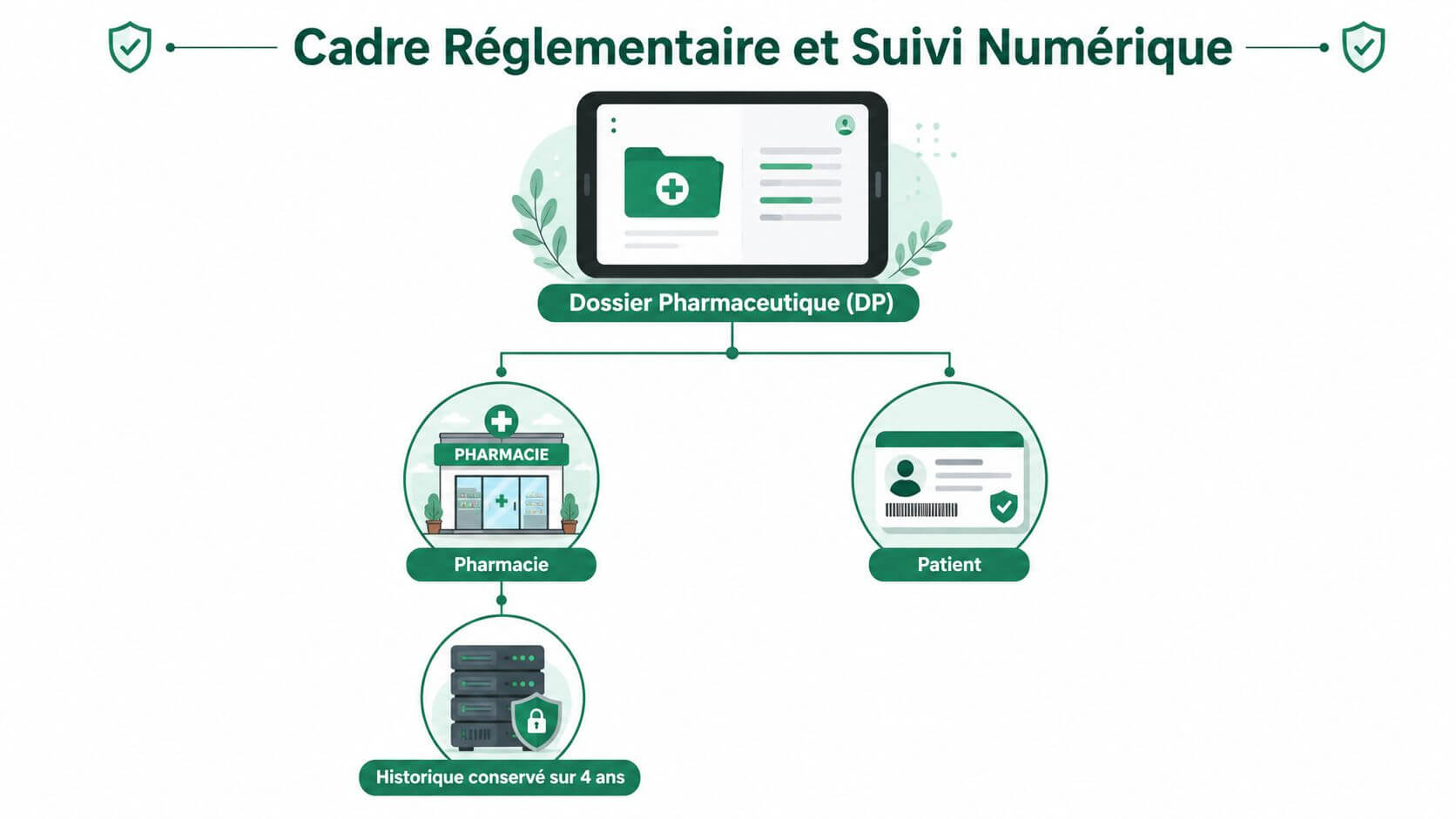
From physical gesture to shared information
The seeder makes visible what has been prepared, box after box, as a dashboard placed on the table of the home. It shows the material of the care, but it does not tell to itself what has been taken, forgotten, moved or modified. The digital tracking adds this invisible layer, with the confirmations of take, the oblivion alerts and the history of events useful to both caregivers and IDELs.
The switch to digital makes sense when the seeder and the follow-up markers tell the same story. A caretaker can see an empty box without knowing whether the dose was taken elsewhere in the day. A relative may believe that a take has been forgotten while it has been shifted. A shared trace avoids this kind of misunderstanding and leaves less room for assumptions.
This is also why a tool such as application not to forget its medicines becomes useful in coordination. It does not replace the pharmacist or the pharmacist, it connects what everyone observes to their level. The pharmacy prepares, the home executes, the application keeps a common thread.
Officine, domicile and digital tracking do not have the same role
The pharmacy remains the place of secure dispensation. It checks the consistency of the preparation, compliance with the prescription and useful changes to report. Digital is used to track over the days, transmit an alert or keep a readable history without having to re-explain everything at each exchange.
This difference is important because the same medication is not managed in the same way depending on where you are located. At the official, you secure the preparation. At home, you see the actual intake. In the follow-up tool, you keep a shared memory that can be reread later by the family or by the passing caregiver.
Good coordination comes from a clear chain between preparation, take and transmission.
In this way, digital helps if it remains simple to read. A helper must quickly see if a catch has been confirmed. A professional must find the useful information without searching through scattered messages. The physical keeper then takes more value when connected to a coherent digital circuit, and not when operating alone in his corner.
Weekly Routine to fill and synchronize its semainier
The right rhythm is better when it is fixed. Many families choose a stable moment at the beginning of the week, to check the order, control the stock and leave on a clean basis. This routine avoids tinkering at the last minute.
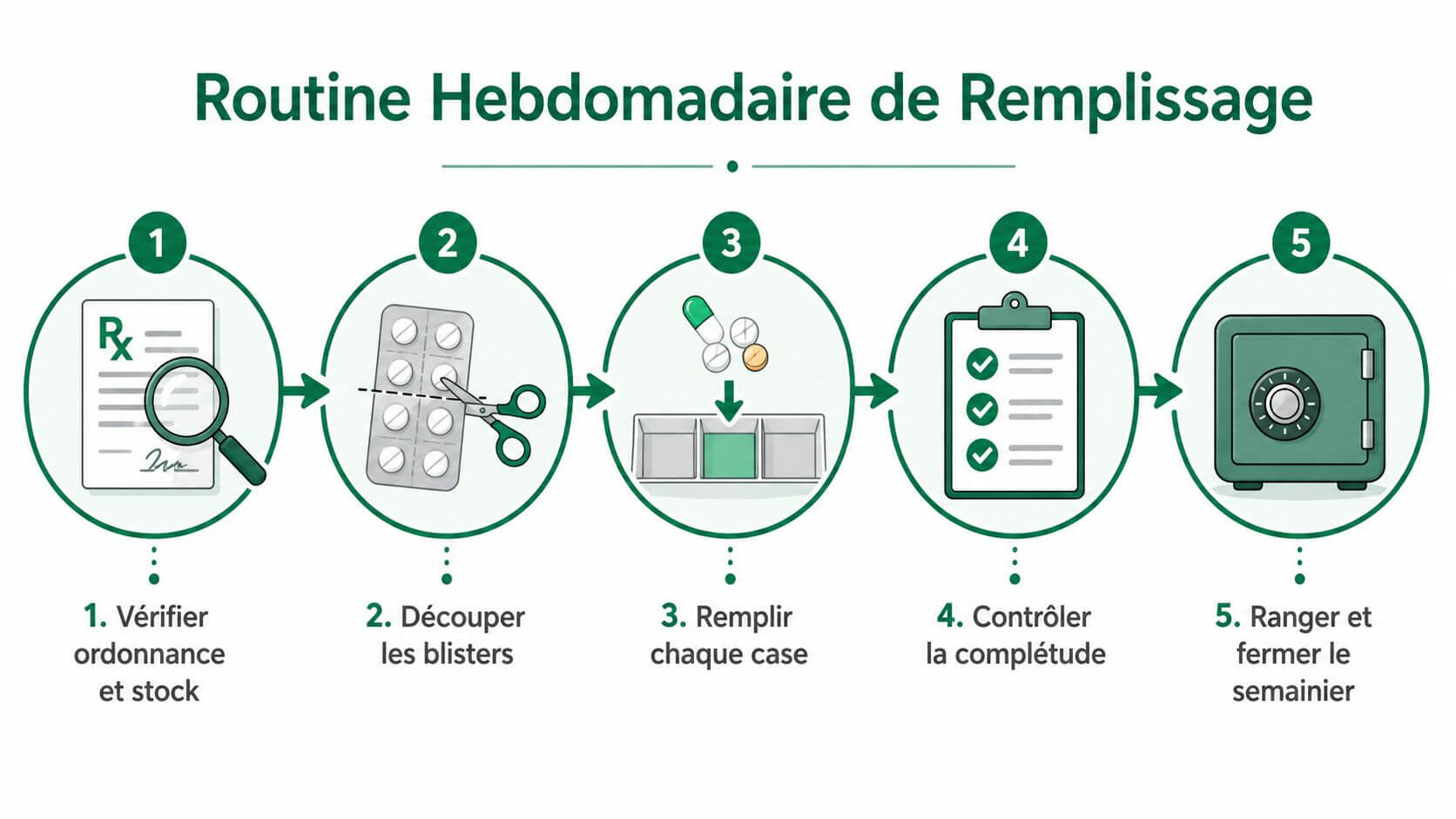
Five gestures that secure the week
- Check prescription and stock. Look what's left, what's changed and what's missing.
- Prepare the seed by the pharmacist. This passage secures traceability when the preparation is the responsibility of the official.
- Visually check each box. A quick check avoids distribution errors.
- Report the passages and go back to the shared calendar. The weekday and the calendar must tell the same week.
- Enable take alerts and confirmations. Useful information should flow to caregivers.
The ideal moment is the one that everyone really respects. If the routine changes every week, it quickly becomes fragile. If it remains stable, it turns into a habit of security.
What to do when the order changes during the week
A modification must never be integrated in haste without verification. First, you isolate what needs to be removed, you identify what needs to be added, and then you update the shared tracking. Digital coordination is then used to prevent other people involved, instead of multiplying the versions.
If the patient is followed by several professionals, the rule is simple. A single reference source, then consistent confirmations around this source. Otherwise, the physical seed, messages and memories of each one end up telling three different stories.
Final checklist and good reflexes to last
A good seeder does not solve everything, but it already lightens a lot. Before adopting it sustainably, check six simple points. Adapted format, Pharmaceutical preparation, visual inspection, shared calendar, active alerts, up-to-date emergency report.
The real success is not to have a beautiful object on the shelf. It is to have a coordination that holds without the caregiver carrying everything in mind. When the reader, the link book and the digital tracking tell the same story, the home becomes more readable and less tiring to manage.
Tribulys centralizes the care journal, drug tracking, shared calendar and emergency card so that caregivers and caregivers keep the same information in the same place. If you are looking for a concrete way to connect the daily week with a shared follow-up, you can visit Tribulys and see how the organization around the sockets can be simplified without weighing down the routine.
Put this organisation into practice with Tribulys
Keep your care journal, shared calendar, tasks, medication tracking and emergency information together. Start for free and invite the relatives and professionals involved in your loved one’s care.