
You are probably already in this very concrete moment, the phone rings, your loved one says that he took his medication, then you doubt five minutes later. Or the other way around, he assures you that he hasn't forgotten anything, but you know that between meals, the passages of the IDEL and the boxes that accumulate, a tablet can easily go to the hatch. In a family, this blur always ends up using everyone.
The right reflex is not to look for a "magic" alarm. application not to forget its medicines who do three things at a time, recall, confirm, and leave a clear trace for the caregiver. In France, this logic of traceability and continuity of care is already in place in health tools, as shown by the Pharmaceutical dossier searchable on 3 years for medicines, 5 years for Biologicals and 23 years for vaccines, as well as the solutions described by Cyclamed around reminders, history and information sharing.
The decisive point is not to think "application alone". safety net. The digital reminder serves the patient, the human relay covers oblivion or bad settings, and sharing history reassures the family as well as professionals.
Contents
- Contents
- The day-to-day life of a caregiver in the face of forgotten medicines
- What really is a drug recall application?
- Features to be required before installing an application
- Installing and configuring the app for a close home
- Three concrete scenarios to adapt the application
- GDPR, hosting and health data security
- Choosing well and adopting the correct application on a sustainable basis
Contents
- The day-to-day life of a caregiver in the face of forgotten medicines
- What really is a drug recall application?
- Features to be required before installing an application
- Installing and configuring the app for a close home
- Three concrete scenarios to adapt the application
- GDPR, hosting and health data security
- Choosing well and adopting the correct application on a sustainable basis
The day-to-day life of a caregiver in the face of forgotten medicines
Doubt often comes through a message sent at the end of the day. "Did you give him the evening tablet? "Behind this sentence, there is a close relative at a distance who refuses to monitor at all times, a patient who wants to remain self-sufficient, and a chronic treatment that does not support the close.
The right reflex is not to stack calls. It requires a simple, readable, and especially shared device. A useful tool must clearly show the intended catch, signal the oblivion, then leave a trace that the family can consult without searching through scattered messages. That's also why a solution such as application of family caregivers should be thought of as concrete support for coordination, not as a gadget.
Three situations come back all the time
An independent patient can use the application alone very well, provided that the interface remains clear and alerts fall at the right time. A patient accompanied at home needs a visible display, confirmation of intake, and quick access to what has been done or forgotten. A remote caregiver must receive a clear signal as soon as a dose is not validated.
The real problem arises when the messages go in all directions. The son receives a text message, the daughter another, and the home helper does not have the same information at the same time. Everyone thinks they have understood the situation, but no one holds the same version of the treatment. In this case, the coordination is fragmented and the contact covers multiply for a single forgotten take.
Practical rule, if the application does not tell who took what, and when, it is not enough to keep at home.
The point is not only to recall a catch. Above all, you need to know what to do when the reminder is not enough. Without confirmation, without shared trace and without human relays, the alarm gives an impression of control that evaporates from the first forgetfulness.
In real life, a family needs a tool that supports coordination, not an isolated artificial memory. The loved one who prepares the drugs, the IDEL that passes in the morning, the doctor who adjusts the prescription, everyone has to see the same information at the right time. Otherwise, everything still rests on scattered text messages, cascade calls and approximate memories.
What really is a drug recall application?
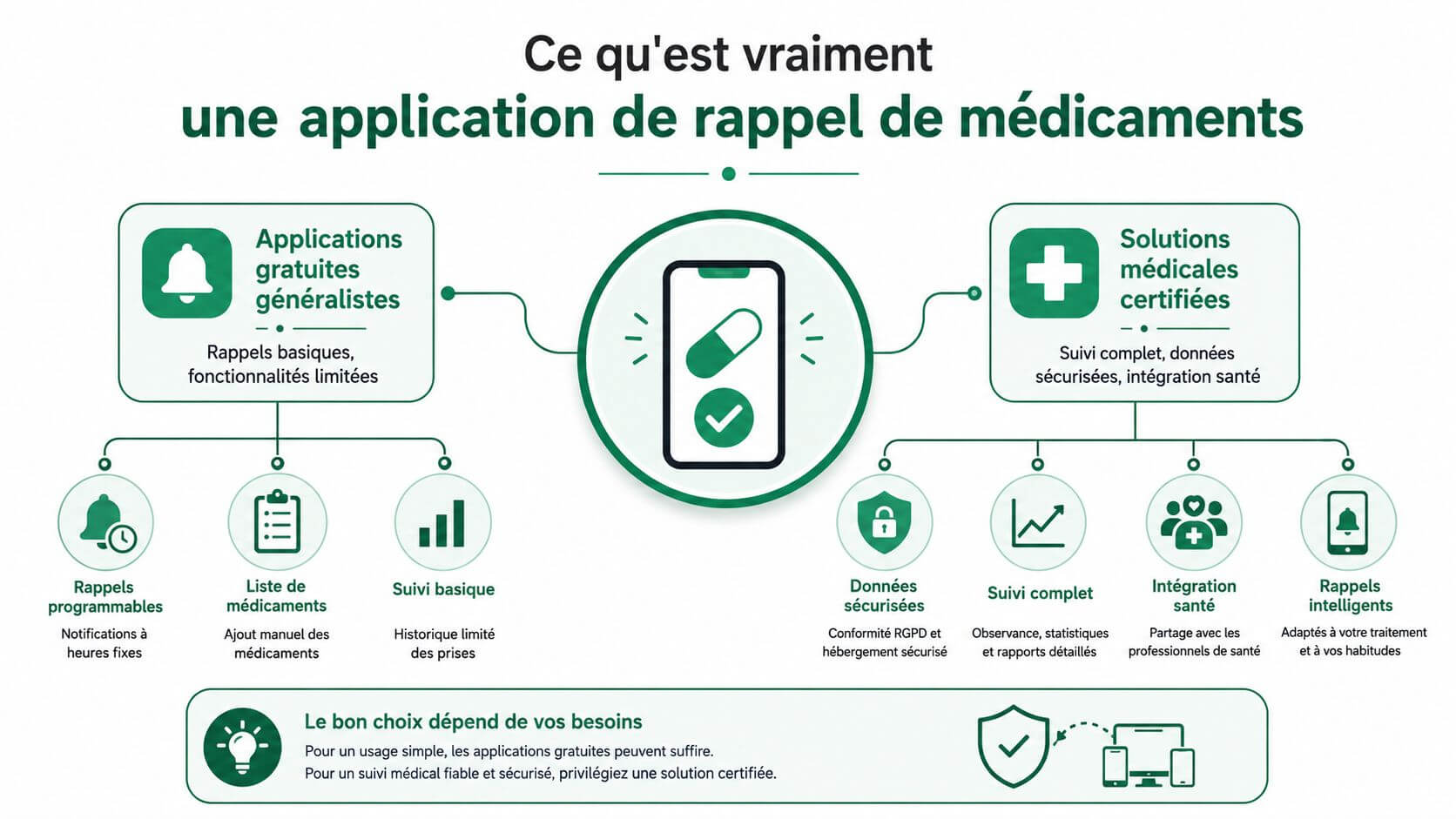
One drug recall application serves much more than ringing at the right time. She records a treatment, program each dose, asks for a validation, then keeps a history that the family and caregivers can read again. It is this chain, reminder, confirmation, trace and sharing, which makes the difference for a loved one kept at home.
Three families of tools coexist
The generalist free apps do the strict minimum. They recall a catch and sometimes display a simple list. It's useful for light processing, but it quickly becomes insufficient as soon as you have to manage several schedules, a processing that often changes, or a person who doesn't always have the reflex to open his phone. Solutions related to a connected stacker add hardware support, convenient when handling the smartphone remains difficult.
The coordination platforms go further. They combine reminder, historical record of catches, sharing with relatives, and sometimes coordinating with professionals. They are mainly used to avoid the dispersal of information, not only to sound an alert. This is also the logic put forward by Preskri, with functions of notification, voice call, confirmation and stock tracking.
The word to remember here is Compliance. It's not just about thinking about taking a tablet. The aim is to follow the treatment correctly over time, with confirmed doses, missed sightings, and useful information for the doctor or pharmacist.
This complementary guide on family organization around caregivers shows why coordination matters as much as recall. A good application must therefore do two things at a time, prevent and share information without creating confusion.
In practice, beware of apps that do not manage roles. If everyone sees everything, the reading becomes confused. If no one sees anything, the tool remains isolated and still relies on one person. The right choice must allow to share just what is necessary, with access adapted to each family member and, if necessary, to a remote helper.
Features to be required before installing an application
A reminder application is worth nothing if it is not resistant to the actual daily life. For a close friend at home, you need a tool that manages forgetfulness, treatment changes, absent confirmations and the relay to a helper. Ergonomics matters, but it never replaces a useful function at the right time.
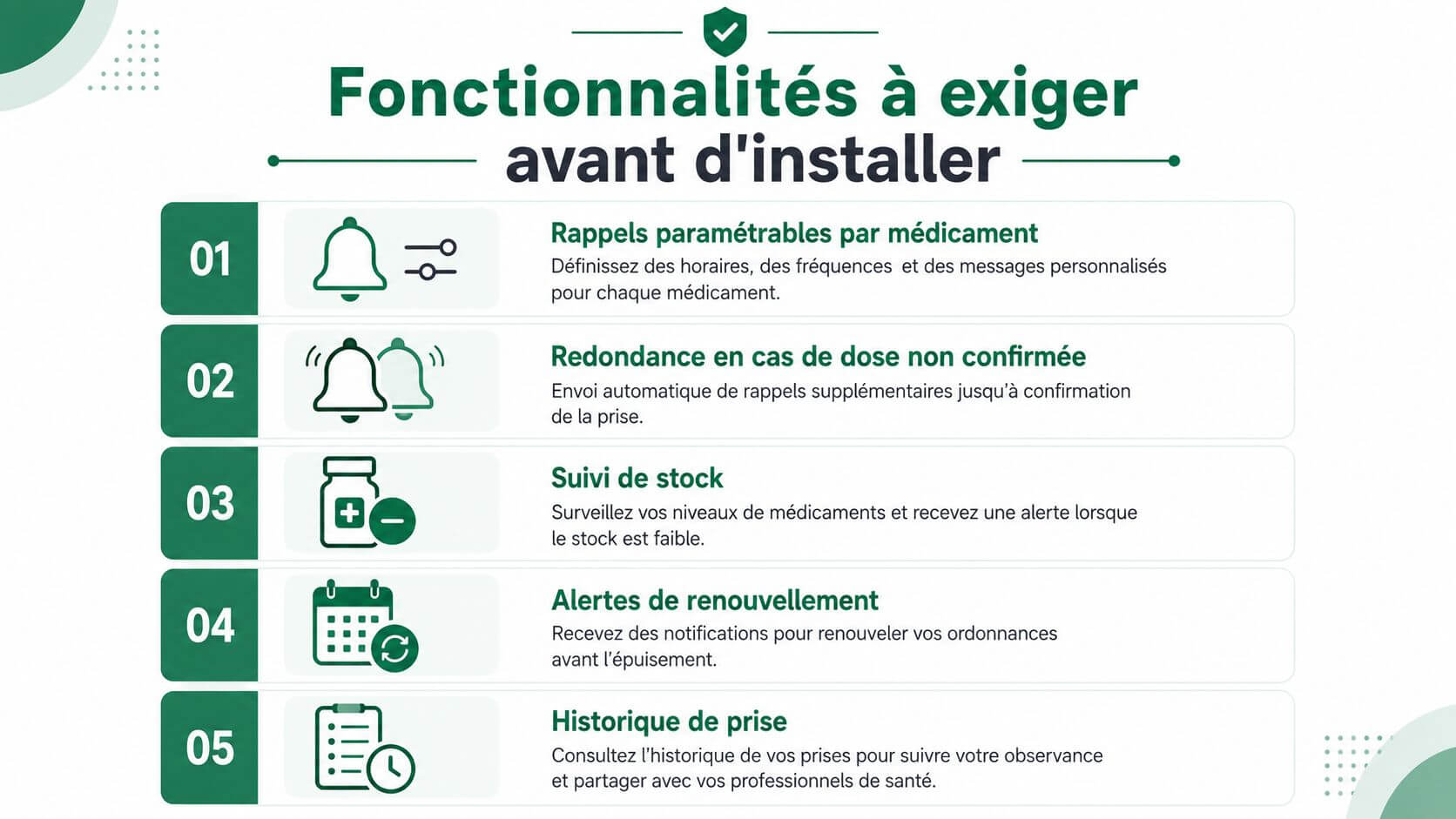
The checklist I recommend without hesitation
- Parametric reminders per drug. A morning antihypertensive, evening anticoagulant and ad hoc treatment do not settle in the same way. Without fine tuning, everything ends at the same time, and the family no longer knows what take has actually been made.
- Redundancy if dose is not confirmed. A single signal can be lost in a noisy room, in a silent phone or in a busy day. If the socket is not validated, the application must restart the alert to prevent an oversight from going unnoticed.
- Stock tracking. Without stock follow-up, the family discovers too late that there is only a few days left of treatment, sometimes when the box is already empty. The application must notify before the rupture, otherwise the recall arrives too late and the treatment stops.
- Renewal alerts. They avoid running after a prescription that comes to an end. Without this recall, we realize the problem on the day the pharmacy can no longer deliver the drug.
- Exportable history. The doctor and pharmacist need to see what has really been taken, not only what was planned. Without exploitable history, each appointment starts from scratch and adjustments are made blindly.
What's critical, not just comfortable
The sharing with caregivers and professionals must be at the centre of the choice. Without this sharing, the tool remains individual, and the slightest important information is lost between messages, calls and mental notes. A family needs a space where you can quickly see if the take has been confirmed, if a box is missing, or if a change has been reported by a caregiver.
The Offline mode Also counts, especially for a close little at ease with digital. If the application depends on a permanent connection, it becomes useless at the wrong time, for example when the network is missing or the phone is not connected. The same requirement for emergency report, which must remain simple to open and useful immediately.
If an application cannot warn a loved one when a socket is not confirmed, it remains a comfort app, not a real tracking tool.
Finally, monitor the management of updates. An application can work properly at the start and become a source of errors if the order changes without checking the list. After each adjustment, you have to resume the treatments one by one, correct the schedules, and then check that the reminders, history and sharing follow the new version.
Installing and configuring the app for a close home
The best application in the world fails if it is poorly configured. The installation must start from the person, not from the product. Open with its actual treatments, its actual schedules, and the way it lives at home, otherwise you will tinker with a system that will not hold.
Let's take a simple case. A patient takes an antihypertensive in the morning, an antidiabetic at midday and an anticoagulant in the evening. The IDEL passes in the morning, the primary caregiver lives elsewhere, and the family wants to know if the evening take has been made. This is exactly the kind of configuration where the application should be accurate.
How to fill in the patient file without making a mistake
Start by seizing each drug separately, with its schedule, name, and role in the day. Then activate the confirmation of take for each sensitive dose. Where relevant, add a redundant alert if the socket is not validated after the chosen time. For family use, the right reflex is to avoid too complex settings.
Day-to-day coordination must also be visible in a care journal or a shared space. If the ELDI reports a change in treatment, the remote caregiver must see it without waiting for the next call. This is where a clean history is better than ten scattered messages.
Recommended settings based on patient profile
| Patient profile | Reminders to be activated | Confirmations | Access sharing |
|---|---|---|---|
| Independent patient | Reminders per drug, renewal alerts | Simple validation after taking | Family or doctor if necessary |
| Accompanied patient at home | Reminders + recovery alert | Mandatory confirmation, visible history | Senior Helper, IDEL, useful relatives |
| Polymedic patient | Differentiated recalls, stock, renewal | Confirmation and recovery in case of forgetfulness | Access segmented by role |
In practice, the important thing is not to delegate everything to the patient's phone. If a relative manages the coordination, he must receive the alerts that really matter. A well-thought-out system avoids unnecessary check calls and keeps discussions for real problems.
Three concrete scenarios to adapt the application
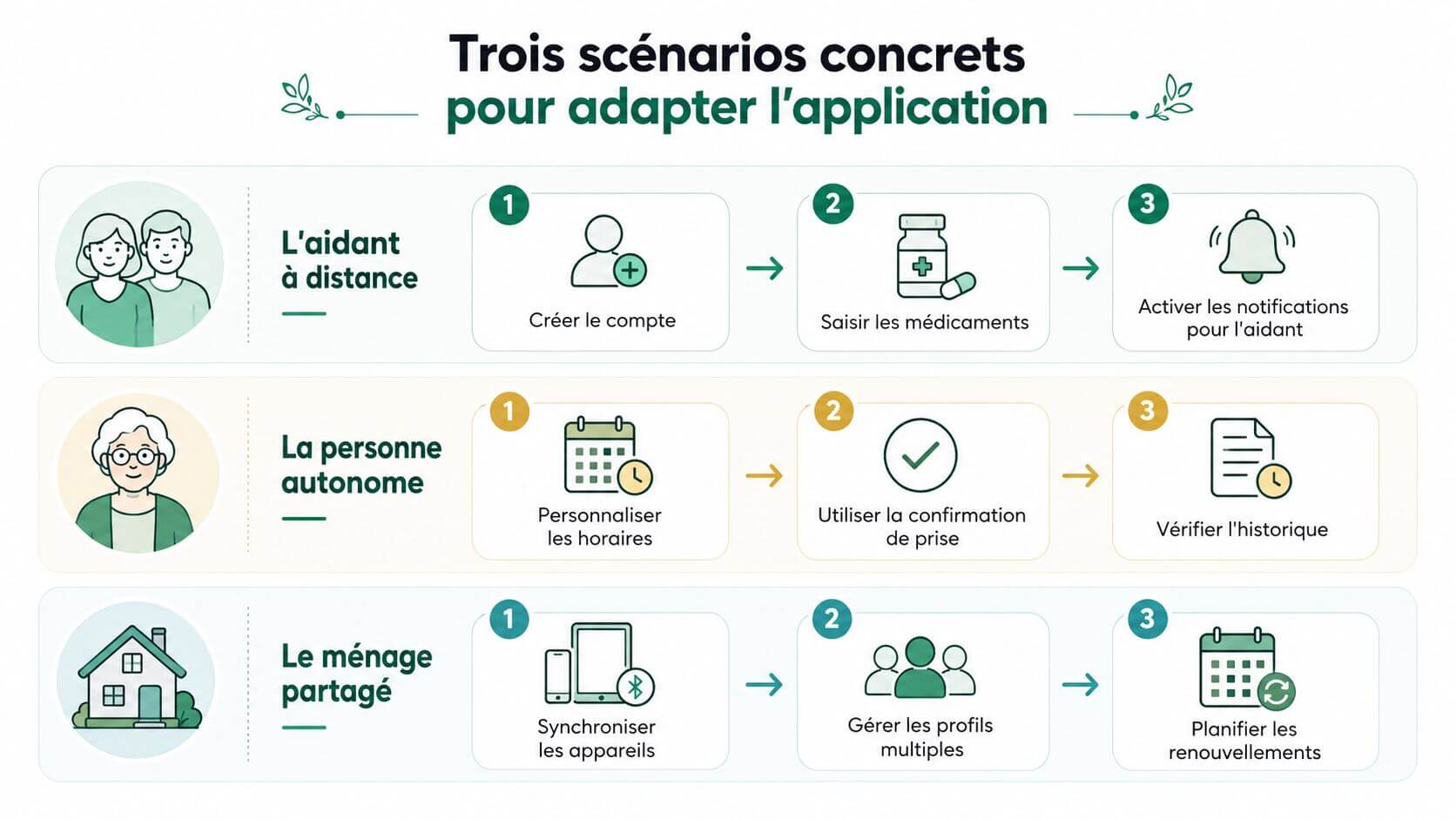
The right setting depends on the context of life, not the logo of the application. A frozen tool always ends up hindering routine. A well-defined tool supports a real organization, with a digital reminder, a human relay and a readable history for everyone.
The Helper at a Distance
The relative is not on the spot, so you have to go straight to the goal. He looks at an alert, checks if the catch has been validated, then acts only if something is missing. The setting must remain simple, with useful notifications and a history that allows you to decide without recalling for nothing.
Self-employed person
Here, the person keeps control. He sets his schedules, confirms the catch, then consults the history when he wants to check a doubt. The right choice is sober, with few annoying reminders, otherwise the application quickly loses its value and ends up ignored.
Shared household
When more than one person intervenes, the application must distribute the roles without blurring the marks. The same person can manage the reminders, another monitor the renewals, a third keep an eye on the stock. If each one acts on his side, the duplicates appear quickly and the coordination deteriorates.
In the case of the IDEL, one must think about transmission, not just notification. The dialogue is simple, and it must be. The IDEL notes what it has done, the close one reads what matters, then the family adjusts the follow-up without waiting for a check call.
The important thing is the clean trace after the visit. A useful application is not just alerting. It leaves a shared history, easy to read, and a care journal digital that avoids scattered messages. In this logic, This comparative approach helps and follows up at home helps to see how a routine of taking is actually coordinated between the person, the caregiver and the caregiver.
GDPR, hosting and health data security
Processing data are not simple personal notes. It is health information, therefore sensitive data. If an application exposes them poorly, it creates a problem that far exceeds the recall of medicines.
What to check without jargon
Look first where the data is hosted. For a close relative at home, I recommend choosing the solutions that advertise hosting in France or in EU, with a clear compliance policy GDPR. Then check that the application manages the roles and access. The family must not necessarily see the same information as a caregiver.
The Nominal invitations are a real plus, because they avoid blurred sharing by simple transferable link. right of erasure It also counts, especially if the family changes the tool or stops the follow-up. Offline mode protects access to critical information when the connection is missing.
Who can see what
This is the right question to ask, rather than discussing abstract law. If a remote caregiver sees a catch history, it is useful. If he also sees medical notes that do not concern him, the tool becomes too open. A serious platform must segment access, because this segmentation reduces the leak of information and clarifies the responsibility of everyone.
The French logic already goes in this direction. The compliance tools mentioned above emphasize sharing with relatives and professionals, without confusing all profiles. It is the right direction, because a home health system is based on trust, but also on clear boundaries.
A useful health tool is not the one that shows everyone everything, it is the one that shows the right person the right information.
Choosing well and adopting the correct application on a sustainable basis
The right choice is not the richest application. It's the one the family will still use in a month. Start with a test on the current treatments, see if forgetfulness decreases, then keep what works and remove the rest. If the tool complicates life, it needs to be reconfigured immediately.
The weak point of the reminder alone is obvious in people who are uncomfortable with digital. In this case, the phone is not enough. human relay, a helper, an IDEL, an auxiliary, and a searchable history that plays the role of safety net. This is also why the most robust solutions combine notifications, sharing and traceability.
To compare options, look for four things without negotiating, accommodation France/EU, Name roles and invitations, shared calendar, and Off-line emergency card. If you want to go further, the weekly summary becomes very useful for families that coordinate with several. The right tool does not replace the family, it makes it more reliable.
This guide to comparison of home-based monitoring apps can be used as a basis if you hesitate between several solutions. The real final criterion remains simple, the application must reassure the loved one, facilitate the caregiver, and give the caregiver usable information without wasting time.
If you want to structure this home follow-up with an application designed for family coordination, test Tribulys and check if his shared notebook, his access roles, his offline emergency card and his catch tracking match your actual organization.
Put this organisation into practice with Tribulys
Keep your care journal, shared calendar, tasks, medication tracking and emergency information together. Start for free and invite the relatives and professionals involved in your loved one’s care.