
You may have experienced this scene this morning. The phone rings. Your mother hesitates in front of her kitchen table and asks you if the white tablet was good for the evening, or if she has already taken it. You mentally look for the prescription, you try to reconstitute the day, and the doubt settles.
For many caregivers, the difficulty is not just to think about medicines. secure each socket, without being there at every moment. When treatments come back morning and evening, the routine seems simple. In reality, this is often where mistakes start. A forgotten box, a staggered hold, a box left in another room, and all day becomes a source of uncertainty.
The right reflex is to make the treatment visible, concrete and verifiable. Pillier morning night. Well chosen and well used, it simplifies the life of the loved one helped and lightens your mental load. And when several people intervene around the patient, a digital follow-up can complete this physical benchmark to prevent information from being lost.
Contents
- The anxiety of the medicine forgotten a reality for millions of caregivers
- What is a pilelier morning night and why is it essential
- Different models of stackers and how to choose
- Good practices to safely prepare and use a stacker
- The limits of the physical pile and the risks to be known
- Complete the stacker with a digital tracking like Tribulys
- Conclusion serenity goes through the combination of the right tools
The anxiety of the medicine forgotten a reality for millions of caregivers
The most tiring is not always the preparation of the treatment. That's the doubt. You have organized the tablets, recalled the schedules, left a visible word. Yet, at the end of the day, a question comes up again: Has the evening take been done well?
In an elderly relative, this doubt quickly takes up a lot of space. The person can be perfectly of good will, but be wrong between morning and evening, forget after an appointment, or hesitate in front of similar tablets. The caregiver, he, compensates with his memory, his calls and sometimes his guilt.
When Routine Becomes a Mental Charge
Let's take a very common situation. Your father takes his tablets at the rise and after dinner. The rhythm seems simple. But between the nurse's passage, a call from the kine, a prolonged nap and a dinner taken later, the evening take has nothing more automatic.
A well-followed treatment rarely relies on memory alone. It is based on clear benchmarks.
That's why many families are looking for a visible, stable, and easy to control system. The morning-night pillar responds to this very concrete need. It allows the helper to see what she has already taken, and to the helper to check more calmly.
If you are already accompanying a relative at home, you may know this discreet fatigue related to daily organization. The subject is well described in the Tribulys resources for family caregivers, which deal with the concrete coordination around a fragile close.
A simple answer, but not simplistic
The stacker doesn't solve everything. On the other hand, it sets order where memory alone is no longer enough. It turns an oral record into a physical reference point. And for many families, it is the first tool that lowers tension on a daily basis.
What is a pilelier morning night and why is it essential
One Pillier morning night, it's a compartmentalised box that separates the medications according to the time of dosing. Say otherwise, it's an agenda for medicines. Instead of keeping several boxes scattered in the house, catches are grouped into identified boxes.
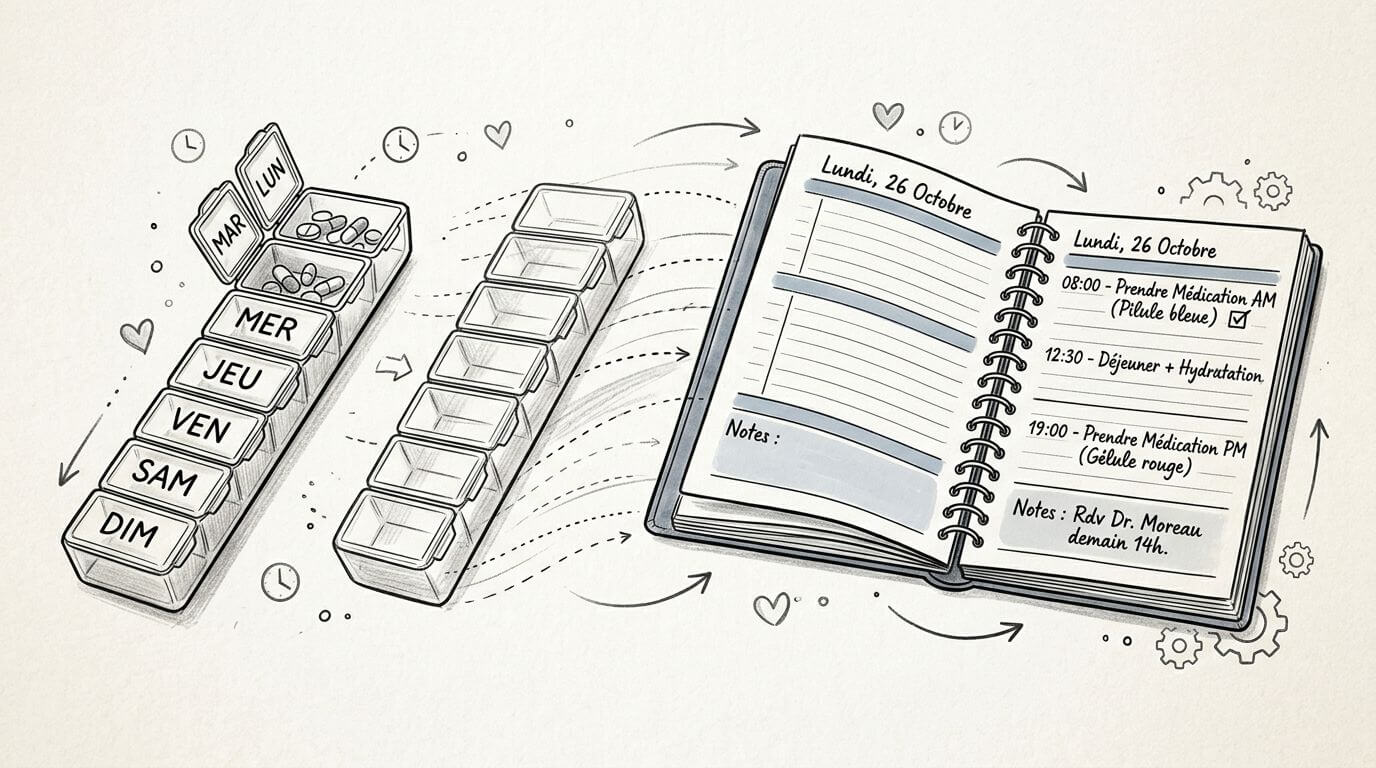
A visual agenda for medicines
Its main interest is immediate. The person can check at a glance whether the catch has been made. This is precisely what recalls this guide from Pharmacodel on the choice of the pill organiser, which explains that a pill organiser arranging doses for “morning, midday and evening” significantly reduces the risk of forgetting medication through this immediate visual reminder.
This point seems simple, but it changes a lot. When the box is still full, the person knows that he or she has not taken his or her treatment. When it is empty, he or she has a concrete marker. It is no longer a question of blurred memory.
Good health practices also retain an organization at times of the day, with clearly identified boxes. We often talk about morning, noon, evening, bedtime. Even if your loved one only takes two times a day, thinking in this logic helps avoid confusion.
Why this format so reassures
The benefit is not only practical. It is also psychological. Many patients feel more autonomous when they do not need to open multiple boxes, read the prescription at each dose or call a relative to confirm.
For the family caregiver, the gain is just as real:
- Quick check. A simple observation of the pill organiser already gives useful information.
- More stable routine. Catches are in keeping with the rhythm of the day.
- Less dispersion. Useful drugs at the same time are grouped together.
- Better-adapted markers. In elderly or visually impaired people, a clear organization reduces the risk of therapeutic error and supports overall compliance with treatment, as indicated by the same content of Pharmacodel.
Useful benchmark: The more visible the processing, the less it depends on a memory effort.
The morning pitillary then becomes a support of autonomy. It does not replace the prescription, nor the advice of the pharmacist, nor the vigilance of the entourage. But it creates a simple structure, which is often the first step to secure the taking at home.
Different models of stackers and how to choose
Not all piles meet the same need. The right model is not the most sophisticated. It is the one that the person will use without hesitation, without pain in the fingers, and without confusion at the time of taking.
The daily stacker for single or mobile days
The daily model is suitable when the patient often comes out, eats lunch outside or wants to take only the daily shots. It is a convenient format for people who need a simple marker, without handling a larger box.
It is also useful when treatment often changes, as it is only a short time to prepare. On the other hand, it gives the family less overall visibility. If you help at a distance, you can see less easily the whole week.
The weekly pillar for an overall vision
The weekly stacker is often the most comfortable for repeated treatment morning and evening. It offers an overview. The caregiver can prepare, check, and quickly spot a shift in the week.
It is often the best choice when the routine is stable. The person knows that every day has its duo of boxes. The habit settles more easily.
The electronic stacker for repeated oblivion
The electronic stacker adds active reminders. It can be suitable if the person often forgets despite good visual organization. The alarm then serves as a trigger.
His strong point is the reminder. His weak point is that the person must accept the device, understand it well, and know how to use it without stress. In some patients, a too technical model complicates more than it helps.
Here is a simple benchmark to compare.
| Type of stacker | Ideal for... | Benefits | Disadvantages |
|---|---|---|---|
| Daily pillar | Active or mobile people, outings, daily take-ups | Lightweight, discreet, easy to carry | Little visibility over the whole week |
| Weekly column | Regular home treatments, caregivers who prepare in advance | Overall view, readable routine, simpler control | More bulky, less convenient to take away |
| Electronic battery | Frequent oblivion, people living alone with need for recall | Useful alarm, more active time frame | Ask for a good grip, can be poorly tolerated |
How to decide without making a mistake
Ask yourself some very concrete questions:
- Does the person come out often? If so, the daily may be more convenient.
- Does she need a week-long benchmark? The weekly model will be more readable.
- The oblivion persists despite good storage? An audible reminder can help.
- Are the boxes big enough? Some treatments take place.
- Is the opening easy? Painful fingers or a drop in strength change everything.
If the opening is difficult, the best piler on the paper quickly becomes the worst in practice.
It is also necessary to think of situations that are a little less obvious. For example, some people take treatment morning and evening, but also have a daily contraceptive pill at fixed time. The organization becomes more delicate. public database of medicines for GESTODENE-ETHINYLESTRADIOL recalls that some pills require 28 consecutive days without interruption, with placebo tablet over the last few days. In this type of case, putting everything in the same drumsticks, without clear method, can cause confusion.
The most careful thing is to choose a stacker adapted to the main pace of treatment, and then ask the pharmacist how to integrate drugs that comply with a particular rule.
Good practices to safely prepare and use a stacker
A stacker is reliable only if its preparation is also reliable. An error in filling can be repeated several days. That's why the preparation must become a quiet little ritual, always done in the same way.
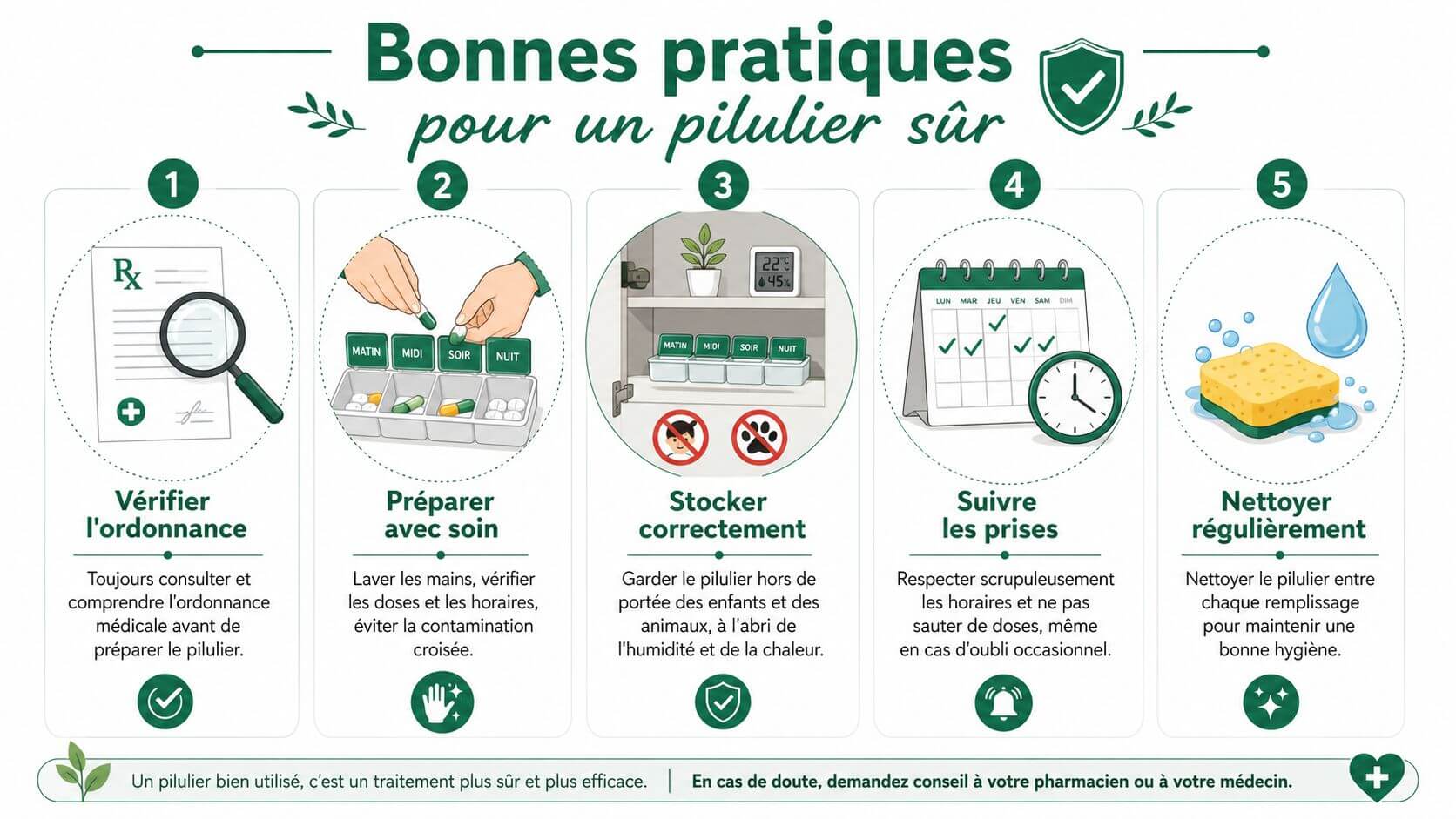
Before filling the stacker
Always start with the prescription or treatment plan at your fingertips. Never prepare your memory, even if you are familiar with the treatment. A recent change in dose, molecule or schedule is enough to create an error.
In France, good health practices recommend that: do not exceed 8 days of preparation in a pile for safety reasons, in particular in the event of treatment or dosage changes. This rule is recalled in the good practices in the implementation of piles in health facilities published by the OMEDIT Centre.
During preparation
Set up in a quiet, clean and well-lit place. Cut the distractions. No TV, no parallel conversation, no preparation between two things.
Keep in mind the rule of 5B, useful even outside the establishment:
- Good patient. Check that the stacker belongs to the right person.
- Good medicineRead each box before placing a tablet.
- Good dose. Respect exactly what is prescribed.
- Good way. The stacker refers to the intended catches as indicated.
- Good time.. Place each medication in the correct schedule box.
The OMEDIT document also reminds us of specific requirements for the identification of the stacker at home. The device must be identified with the common name, birth name, first name and date of birth of the patient. It is a simple but essential precaution if several people intervene.
Safety rules: Never mix the treatments of two people on the same table at the same time.
After preparation
Once the stacker is completed, check a second check box per box. This final check avoids many errors. Then store the stacker in a dry, stable place, out of reach of children and animals.
The follow-up does not stop at filling. The patient should note his or her intake times on the administration plan provided with the stacker when such a document accompanies the organization. This traceability is one of the best practices recalled by OMEDIT.
Here is a useful checklist for everyday life:
- Identify clearly Pillier with patient information.
- Prepare over a short period, without exceeding the recommended limit.
- Recheck each box before closing.
- Report any changes treatment without waiting until the end of the week.
- React in the event of a fall of the pill, because the medicines can mix.
For families that co-ordinate multiple stakeholders, shared instructions and communication support can avoid missing information. Aiders coordination guide proposed by Tribulys gives useful references to this collective organization at home.
The limits of the physical pile and the risks to be known
Pillier helps a lot. But he's got blind angles. It's important to know them so they don't ask him what he can't do.
The empty compartment does not tell the whole story
An empty box does not always prove that the medication was taken correctly. The tablet may have fallen. The patient was able to open the wrong box. Another person may have intervened without reporting it. And if the battery is overturned, the whole logic of storage can be compromised.
The main problem islack of actual traceability. Support shows an organization. It does not always confirm the actual administration. This is often where remote caregivers find themselves in difficulty.
You look at the pill organiser during a visit. The evening box is empty. You are tempted to conclude that everything is fine. Yet, you are not sure of the time, the exact gesture, or the possible hesitation that has preceded it.
The situations that trap families the most
Some situations deserve increased vigilance:
- Prescription changes during the week. An already filled pile can become partially false.
- Similar tabletsConfusion remains possible at the time of filling.
- People living alone. No one immediately sees an oversight.
- Helpers at a distance. Information goes back late, sometimes after several missed catches.
- Special fixed-time treatments. They don't fit in with a routine just a little late evening.
There are also very specific cases of confusion. Management of forgetfulness of birth control pills is a good example. Ministry of Health website on the proper use of oral contraceptives well distinguish the tolerance thresholds according to the type of pill. more than 12 hours for a combination or combination pill more than 3 hours for a levonorgestrel progestative pill exposes to a risk of pregnancy and requires additional precautions. The same content specifies thatAn ANSM survey showed that 28% of women did not know about this 3 hour threshold.. When this type of treatment coexists with a stacker morning evening, simplifications can become dangerous.
The more a treatment combines different rhythms, the less the physical pillar alone is enough.
The stacker organizes. It does not always call back, does not transmit information, and does not automatically coordinate people around the patient.
Complete the stacker with a digital tracking like Tribulys
When several relatives, nurses or practitioners take turns, the need is no longer just to organize the tablets. sharing reliable information. This is where digital tracking makes sense.

The right role of digital technology
Digital is not a replacement for the stacker. It adds a layer of security around it. The stacker remains the material tool of preparation and tracking. The application, on the other hand, is used to confirm the catch, hijack the information and make it visible to the right people.
In concrete terms, after taking the medication, the patient or the practitioner validates the action. If an expected dose is not confirmed, the doubt no longer waits for the next day to appear. The information becomes usable immediately.
What it changes every day
In modern home coordination, this operation brings several very practical benefits:
- Shared confirmation. The family no longer needs to multiply verification calls.
- Clear background. Follow-up of doses may be re-read in case of doubt or during a medical appointment.
- Useful alerts. A missed dose is not invisible.
- More fluid coordination. The nurse, caregiver and other stakeholders consult with the same information.
The tools designed to do so often also centralize the link book, the passage calendar and useful messages. For families who want to understand this type of solution, the page dedicated to Tribulys Family Caregiver App shows how shared follow-up can complement the physical landmarks of the home.
This point is particularly useful when the stacker is no longer enough to answer a simple question: who saw what, at what time?! Without this common memory, each person reconstructs the story with his own notes, SMS or memories. With shared tracking, the information remains in the same place.
Conclusion serenity goes through the combination of the right tools
The proper management of treatment at home is rarely based on a single medium. Pillier morning night provides a solid foundation. It makes the sockets visible, simplifies the routine and helps the person to locate themselves without rereading the entire prescription.
But to really secure everyday life, you also have to look at what's going on around the pill organiser. Who's preparing it? Who sees the changes in treatment? Who knows that a catch has been forgotten? Who can confirm the information without waiting? That's where the organization makes all the difference.
Retain a simple logic:
- A physical tool to prepare and visualize.
- Good practices to avoid filling errors.
- A digital safety net to share, confirm and trace the catches when several people accompany the same relative.
This approach does not preclude paper, box or application. It puts them at the service of the same objective: to make home care more readable, more serene and more secure for the patient as for those around him.
If you are helping, start modestly. Choose a suitable stacker, put in place a reliable preparation routine, and then add a coordination tool if the information circulates poorly within the family or between professionals. Often, it is these very concrete gestures that bring back anxiety.
Looking for a simple way to complete the stacker with shared follow-up of sockets, appointments and transmissions? Tribulys, a solution thought to coordinate close caregivers and professionals around a patient kept at home.
Produced via Outrank app
Put this organisation into practice with Tribulys
Keep your care journal, shared calendar, tasks, medication tracking and emergency information together. Start for free and invite the relatives and professionals involved in your loved one’s care.