
Since 1 January 2020, an RQTH can be awarded without any time limit when the disability is not likely to change favourably. In this case, the person no longer has to renew this recognition periodically, provided that the notification of the CDAPH explicitly mentions this absence of limit.
This evolution seems administrative, but its effects are very concrete. It can avoid repeated files, reduce the risk of interruption of rights and give more visibility to a person who is looking for a job, is already working or has to organize his working life around a lasting handicap.
Contents
- Introduction to a New Era for Disability Recognition
- Understanding the Medical and Administrative Criteria
- Step-by-Step Guide to Your Application
- The Advantage of Administrative Stability
- Real-World Workplace Implications
- Conclusion and Final Checklist
Introduction to a New Era for Disability Recognition
For a long time, RQTH was mainly a temporary logic. A person obtained recognition for a given period, then had to follow the procedure again, gather documents and wait for a new decision. 1 January 2020, this logic is no longer the only one possible. When the medical situation is not likely to change favourably, the QHR can be attributed without time limit, sometimes called RQTH "for life", in accordance with the implementation of the decree of 24 December 2018 and the law of 5 September 2018 (official text on the opening of rights without time limit).
The difference is important. A limited recognition requires monitoring a deadline and anticipating a new education. An unlimited recognition does not remove the disability or all the steps related to working life, but it removes a recurring administrative appointment from the calendar. For a person whose alteration is permanent, this duration better corresponds to the reality experienced.
To be noted: RQTH without time limits secures recognition, but it does not automatically transform other rights into permanent rights.
RQTH also needs to be distinguished from financial benefits. RQTH recognizes a long-term difficulty in accessing or retaining employment. It is not, on its own, an allowance. However, it can facilitate exchanges with employment actors and the search for suitable solutions, depending on the individual's needs.
When an employee is already required to coordinate care, appointments, documents or family support, avoiding unnecessary renewal can free up time and energy. The overall management of a situation of assistance can be organised with resources dedicated to the care of the family. assistance to the familywithout confusing these services with the official decision of the CDMH.
So the central question becomes less "when do I have to renew my RQTH? "that" does my situation meet the criteria for unlimited attribution, and how can this recognition support my career path? "
Understanding the Medical and Administrative Criteria
RQTH without a time limit is not granted simply because a disability exists or because it has lasted for a long time. The decision is based on an assessment of the situation and its consequences for access or retention in employment. The determining point is the character final alteration and the lack of a favourable outlook for development.
The application shall be considered by the CDMH, then the decision falls under the CDAPH. The duration may be limited, 1 to 10 years, or do not have a limit when the disability cannot evolve favourably, as recalled My Handicap course on the duration of the RQTH.
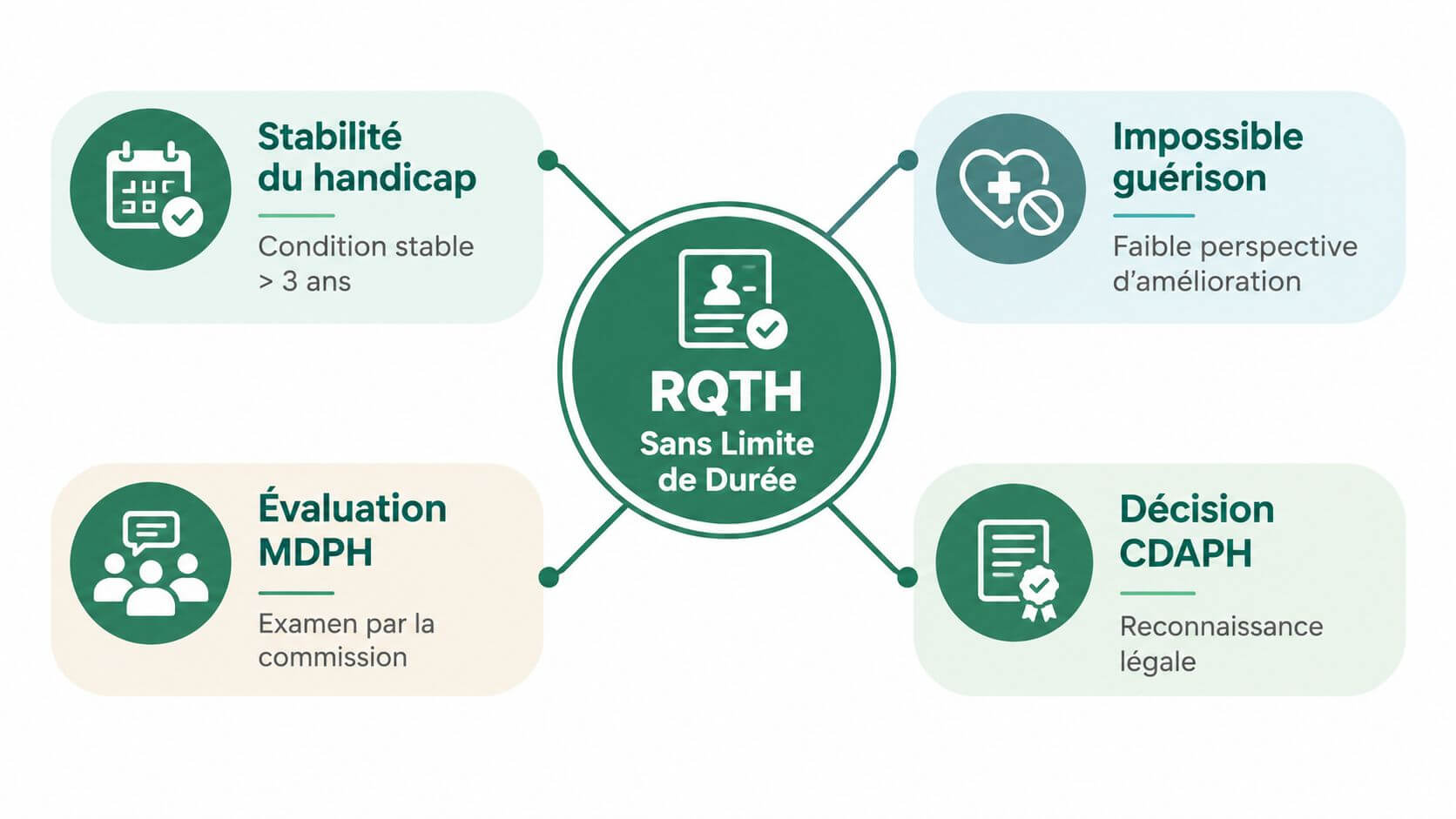
What a final situation means
The term "final" does not necessarily mean that the symptoms will be the same every day. A chronic disease may experience more difficult or favorable periods. What counts here is the overall evolution of the alteration and the reasonable possibility of an improvement that will make lasting changes to the occupational consequences.
The file must therefore describe the concrete limitations. A medical formulation that merely names a pathology risks leaving aside the essential question: what makes access to employment or retention in the position more difficult?
It is more useful to document, depending on the situation:
- Functional limitationse.g. fatigue, pain, sensory, cognitive, psychic or motor difficulties.
- The professional consequences, such as the difficulty of keeping certain schedules, concentrating, repetitive gestures or coping with a particular environment.
- Stability of disability, explaining why alteration is considered to be lasting or irreversible.
- Compensation requirements, if adaptations seem necessary to work in good conditions.
The respective role of the CDMH and the CDAPH
The CDMH receives the file and organizes its investigation. It analyses the medical, administrative and professional elements in order to prepare the assessment of the situation. The CDAPH then takes the decision and determines the duration of the recognition.
The notification is the document to be checked carefully. An RQTH without time limit must be stated explicitly. A decision that mentions a specific period remains a RQTH of limited duration, even if the disability is actually stable.
This distinction avoids frequent confusion: a person may have a lasting situation without obtaining unlimited recognition in the notification received. In this case, the decision should be read rather than deducting the duration from the diagnosis alone.
Practical rule: Your file must link three elements: the medical reality, the impact on work and the sustainability of this impact.
Step-by-Step Guide to Your Application
A well-built file can secure the continuity of your recognition and limit misunderstandings with the CDMH. It is not a question of claiming a precise duration by an all-made formula, but of showing clearly how your situation affects the work and why these effects fit into time.

Preparing an understandable file
Gather the MDHC application form, medical certificate and supporting documents requested by your departmental house. Add the reports that really inform your situation. A useful file works as a thread: each document must help understand your limitations, their evolution and their professional implications.
The medical certificate gains in accurately describing the functional consequences. Your doctor may indicate what you can do, what becomes difficult and what adjustments are needed. If several professionals accompany you, their observations must be complementary and remain consistent.
In the section devoted to your project or work, give observable examples. Explain that a full day worsens symptoms, that a job imposes special breaks or that a previously feasible task now requires help. These situations actually connect disability with the requirements of the job.
File the application and follow the decision
Send the file to the competent CDMH in accordance with the procedures prescribed in your department. Keep a complete copy, proof of deposit and the exchanges received. This will make it easier for you to respond if a supplementary document is requested and keep the history of your proceedings.
A relative or caregiver may participate in the preparation of the file. In this case, distinguish the medical documents from the elements describing daily life and the monitoring of difficulties. Family workers can facilitate the centralisation of practical information. However, they do not replace the medical certificate or the examination of the file by the CDMH.
Check notification
Upon receipt of the decision, check the following:
- The decision itself, to confirm the agreement of the RQTH.
- Duration, by seeking a statement indicating the absence of a limitation.
- Possible guidelines, if the CDAPH foresees.
- Dates and references, to be filed with your administrative documents.
If RQTH is limited, enter the deadline in your schedule and prepare for renewal early enough. Service-Public.fr indicates an anticipation of about four months. Time limits may vary depending on the department and the situation, making retention of supporting documents particularly useful.
The request for an RQTH without time limit does not guarantee a favourable decision. The CDAPH decides on the basis of the elements transmitted. Your responsibility is to document the definitive nature of the alteration, its effects on employment and the need for recognition that remains consistent with your career path.
The Advantage of Administrative Stability
A time-limited RQTH transforms administrative management into a sustainable benchmark. The person no longer has to monitor a deadline or periodically prepare a renewal for that recognition. It can thus devote its attention to employment, job search or retraining.
| Situation | Practical consequence |
|---|---|
| RQTH limited | A deadline must be followed and a renewal prepared |
| RQTH without time limit | No periodic renewal is required for this RQTH |
| Explicit notification without limit | The duration is identifiable in the official document |
| Other rights or limited arrangements | Their own deadline continues to apply |
The Service-Public.fr sheet dedicated to the RQTH states that an assignment without limitation of duration is possible when the alteration is definitive and the disability is not likely to change favorably. The notification of the CDAPH must clearly indicate this absence of limit.
What stability brings to everyday life
The main benefit is a continuity of recognition. The notification becomes a reference document that the person can keep and present to the relevant interlocutors, according to his/her professional needs. The approach looks like a core file that is always available, rather than a justification that should be regularly reconstructed.
This continuity also reduces administrative disruptions in the event of a change of situation. A job opening, a conversion or a period of job search already requires the collection of information and coordination of several exchanges. The RQTH does not have to be renewed at the same time, which makes the timetable more readable and limits the risk of forgetting a deadline specific to this recognition.
However, stability does not mean that all rights become permanent.
Point of vigilance: an RQTH without time limit does not automatically extend an allowance, card or aid granted separately.
Each device shall retain its conditions and period of validity. A simple table allows to follow the name of the decision, its end date where it exists, the competent body and the next action expected. For families who also coordinate home helpers, this follow-up can be part of a wider organisation, particularly in relation to the resources allocated to the close helper.
Real-World Workplace Implications
The RQTH without time limitation can bring concrete stability to the work, while leaving control over the information communicated to everyone. A person does not have to announce his or her disability to his or her entire team or to give notice to each contact person. He or she may choose to speak to the employer, human resources or to the occupational doctor, as needed.

Scenario of an employee requesting an adjustment
Take the case of an employee whose limitations are lasting. It may retain its notification and transmit only the elements necessary for the consideration of an adaptation. The occupational physician helps to link the difficulties observed to the occupational needs, without making the diagnosis a collective subject.
The exchange may relate to schedules, working environment, equipment or the distribution of certain tasks. The request is based on the concrete effects of the situation in the position, rather than on the detailed disclosure of medical data.
The unlimited duration brings a useful continuity in this journey. The employee does not have to worry that the recognition itself will soon expire, which facilitates exchanges when taking up a job, a change or a more difficult period. However, she must report a change in her needs and follow the steps specific to the requested accommodation.
Scenario of a person who prefers to remain discreet
An employee may keep his or her RQTH confidential. Public sources recall that the RQTH does not provide a financial benefit and does not oblige to inform the employer, as explained in the Handicap in the Loire-Atlantique on the confidentiality and effects of RQTH.
This decision may change over time. A person may remain discreet for a period of time and then request an interview when his or her position becomes more difficult to hold. The absence of a deadline for the RQTH gives him or her time to choose the right time, without having to act under the pressure of a close renewal.
Confidentiality and support are not opposed: You choose what you reveal, to whom you reveal it and for what professional need.
The family situation may also change the organization of work, particularly when combined employment and the role of the employer are involved. close helper. Sometimes it is necessary to coordinate appointments, stakeholder passages and professional obligations. Tribulys can be used to centralize a shared calendar, a care journal, tasks, documents and reminders for authorized members of the same aid organization. This tool does not replace the QHRT, but can facilitate daily coordination around a loved one.
The permanence of the RQTH therefore does not make the arrangements automatic. Each solution depends on the position, the needs identified and the exchanges with the competent interlocutors. The recognition provides lasting administrative support, while the layout is built according to the working situation.
Conclusion and Final Checklist
The RQTH without time limit provides a valuable administrative continuity when the disability is permanent. 1 January 2020The CDAPH may grant such recognition without delay if the medical situation is not likely to change favourably. The application remains filed with the CDMH, and the notification must clearly specify the absence of limitation.
This stability concerns the RQTH itself. Allocations, maps, guidelines and other aids sometimes follow different rules, with their own durations and renewals. A permanent decision therefore simplifies the follow-up related to recognition, without replacing the verification of other rights.
The checklist to keep
- Medical statusIs the alteration described as definitive and not likely to change favourably?
- Professional impact, does the file explain the practical difficulties of access or retention in employment?
- CDMH fileAre forms, medical certificates and supporting documents complete and consistent?
- Decision CDAPHDoes the notification explicitly indicate the absence of a time limit?
- Other rights, what deadlines remain limited in time?
- Working life, which contact person should an arrangement become necessary?
- Family organizationAre the information and responsibilities accessible to the people who accompany you?
This list is used as a control point prior to dispatch and then after the decision. It helps to identify what is stabilized and what still requires action.
Permanent RQTH does not resolve all work difficulties. It provides a long-term basis for requesting adaptation when the position changes, symptoms worsen or the organization becomes less compatible with your abilities. This allows you to devote your energy to the present needs, rather than repeating the same request for recognition.
Reread your notification, gather the elements describing your limitations and apply for the CDMH if your situation has several components. If a relative participates in the coordination of care, appointments and documents, Tribulys can help centralize information, allocate tasks and share communications with authorized members of your tribe.
Put this organisation into practice with Tribulys
Keep your care journal, shared calendar, tasks, medication tracking and emergency information together. Start for free and invite the relatives and professionals involved in your loved one’s care.