
You are in front of the computer, the CAF or the MSA opened in one tab, the APA file in another, and a message from the doctor who still asks for proof. Meanwhile, your salary drops, your journeys accumulate, and no one in the family really knows who has to pay what. In this fog, the real question is not just what help do I get? how to secure an income, avoid cumulation errors and keep proof clean.
Contents
- Understanding the landscape of financial support for caregivers
- National financial compensation schemes
- Choosing the right fit according to your family situation
- Building a solid record with the right evidence
- Centralize your evidence and transmissions with Tribulys
- Avoiding pitfalls and misconceptions about financial aid
- Your action plan for obtaining financial support
Understanding the landscape of financial support for caregivers
A family often finds itself at the same point without having anticipated it. A parent loses autonomy, a child becomes the administrative interlocutor, the spouse makes appointments, and each one ends up advancing money or time without knowing which device can compensate what. This is precisely where the subject of the financial assistance It is no longer theoretical and becomes a question of budgetary survival.
In France, DREES estimated that in 2021, 9.3 million of people 5 years of age or older reported providing regular support to a relative, including moral, material and financial support, which shows how informal support structures family life (DREES study). This figure says the essential, you are not in a marginal situation. The public system has therefore built several responses, but they are not all used at the same time or for the same profiles.
Three logics not to be confused
The first logic is that income compensation- I'm sorry.AJPA is used to amortize a decrease or a stoppage of activity when you take a caregiver's leave, with a payment by the CAF or the MSA. The second logic is that compensation for human aid, via PCH, when the family caregiver gives practical and regular help. The third logic is that financing of services for the person receiving care, especially via theAPA, which reduces the logistical and financial pressure on the family.
Simple rule, do not first look for the best help. Look first if you compensate for your own loss of income, if you are compensated for your time, or if you finance services to ease the family burden.
This is where a well-ordered file makes the difference. Families that centralize documents, transmissions and supporting documents save time and avoid holes in the file. If you want to leave on a clear basis, keep this handy marker on hand, resources on support for family caregivers, then return to the official devices with a sorting logic, no dispersion.
National financial compensation schemes
Families are often mistaken because they mix aids that meet different needs. The right method is to look at each device as a specific tool, with its role, ceiling and audience. This is the only way to avoid disappointments when the expected money does not arrive as expected.
AJPA, PCH and APA, three distinct mechanisms
I-I-IAJPA is the most direct national response to the loss of income related to caregiving leave. As of 1 January 2026, its amount is set at 66,64 € per day and it is paid within the limit of 66 days on the whole career of the caregiver, with the possibility of payment per half-day (public service dedicated to AJPAIt is used to compensate for a decline in activity, not to replace a full salary.
The PCH The official scale mentioned in recent sources announces that it is not working. €4.78 per hour aid, or €7.16 per hour where the caregiver reduces or ceases to be employed (detail PCH for family caregivers). Here, we talk about hourly compensation for human aid. This is useful when the aid is regular, documented and clearly identified.
I-I-IAPAFinally, it finances technical services and aids for persons aged 60 and over classified in IRM 1 to 4. In 2026, its monthly ceiling varies from €811.52 in GIR 4 to €2 080.33 in GIR 1 (APA Guide 2026). For the family, this is often the most underestimated lever, because it reduces the burden of coordination, home organization and the use of unpaid time.
| Device | Amount 2026 | Ceiling | Beneficiary |
|---|---|---|---|
| AJPA | 66,64 € per day | 66 days on career | Caregiver on leave |
| PCH | 4,78 € or 7,16 € per hour | Boxed time scale | Family helper compensated |
| APA | Up to 2 080.33 € per month according to GIR | GIR ceiling 1 to 4 | Elderly Helped |
To go further on the logic of ABS and its role in home care, see this detailed benchmark on ABS. Keep a simple idea in mind, the APA relieves the person receiving care, the AJPA compensates for your loss of income, the PCH pays or compensates for the aid rendered.
Choosing the right fit according to your family situation
The real subject is not "do I have the right to help?", but "what legal installation protects me without blocking my rights". This is where families make mistakes, especially when several relatives intervene, when one works part-time, or when the family relationship changes the rule of the game. The spouse, child, parent and outside caregiver are not treated the same.
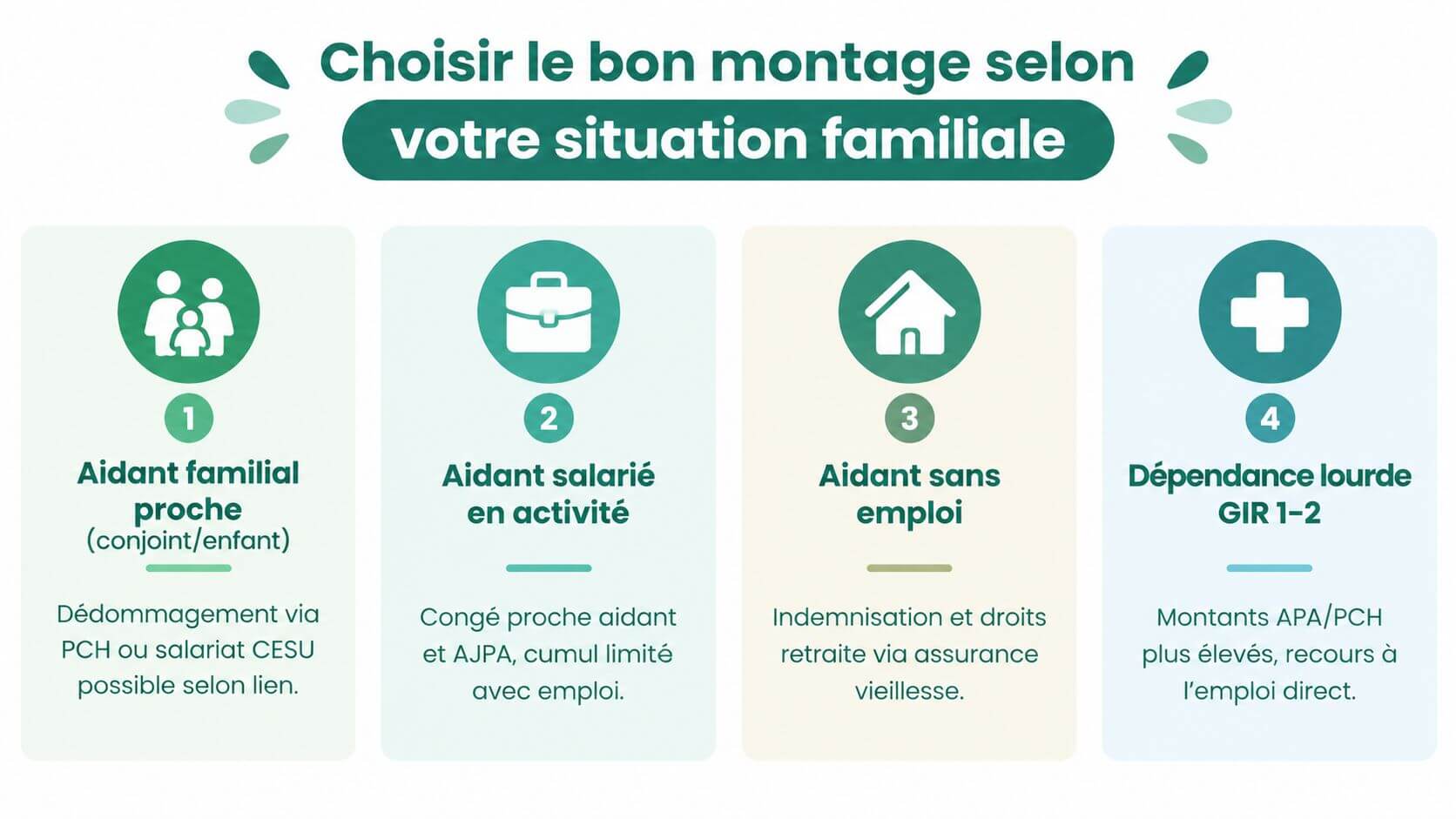
Family link changes eligibility
The Ministry of Health recalls thatAPA may pay a caregiver in the assistance plan, other than the spouse, ACAP partner or partner, while the PCH may also compensate a family caregiver according to different rules (Ministerial page on carers). This distinction must guide your strategy from the outset. If you are a partner, do not assume that all doors are open, but that is not the case.
The other point that counts is the day management.AJPA. The device is capped to 66 days and it is designed for one-off disengagements, not for continuous support (AJPA public service) In 2025, the announced perimeter also evolved with compensation up to 4 different relatives during the course of the career, which requires thinking of the use of days as a rare resource, to be distributed with method (guidance page for carers).
Part time, several relatives, retirement, you have to decide properly
If you work part-time, the AJPA does not replace your entire income. It mitigates the loss of earnings, but does not cover full pay, so your budget must remain calculated on the actual net. If you help several people, do not mix periods and proofs, otherwise you will create inconsistencies in the file.
My field advice, Choose a main scenario, then document it. A family that wants to cumulate everything without hierarchy often ends up with a fragile file.
The retirement perspective must not be forgotten either. When paid employment declines, social protection must be looked at in parallel with financial assistance. The right set-up is rarely the most advantageous on paper, it is the one that remains defensible, traceable and compatible with your real situation.
Building a solid record with the right evidence
A good file is not based on good will. It is based on dated, consistent and easy-to-read pieces by an agent who does not know your family history. If you send a fuzzy file, you let the administration guess, and it never guesses in your favor.
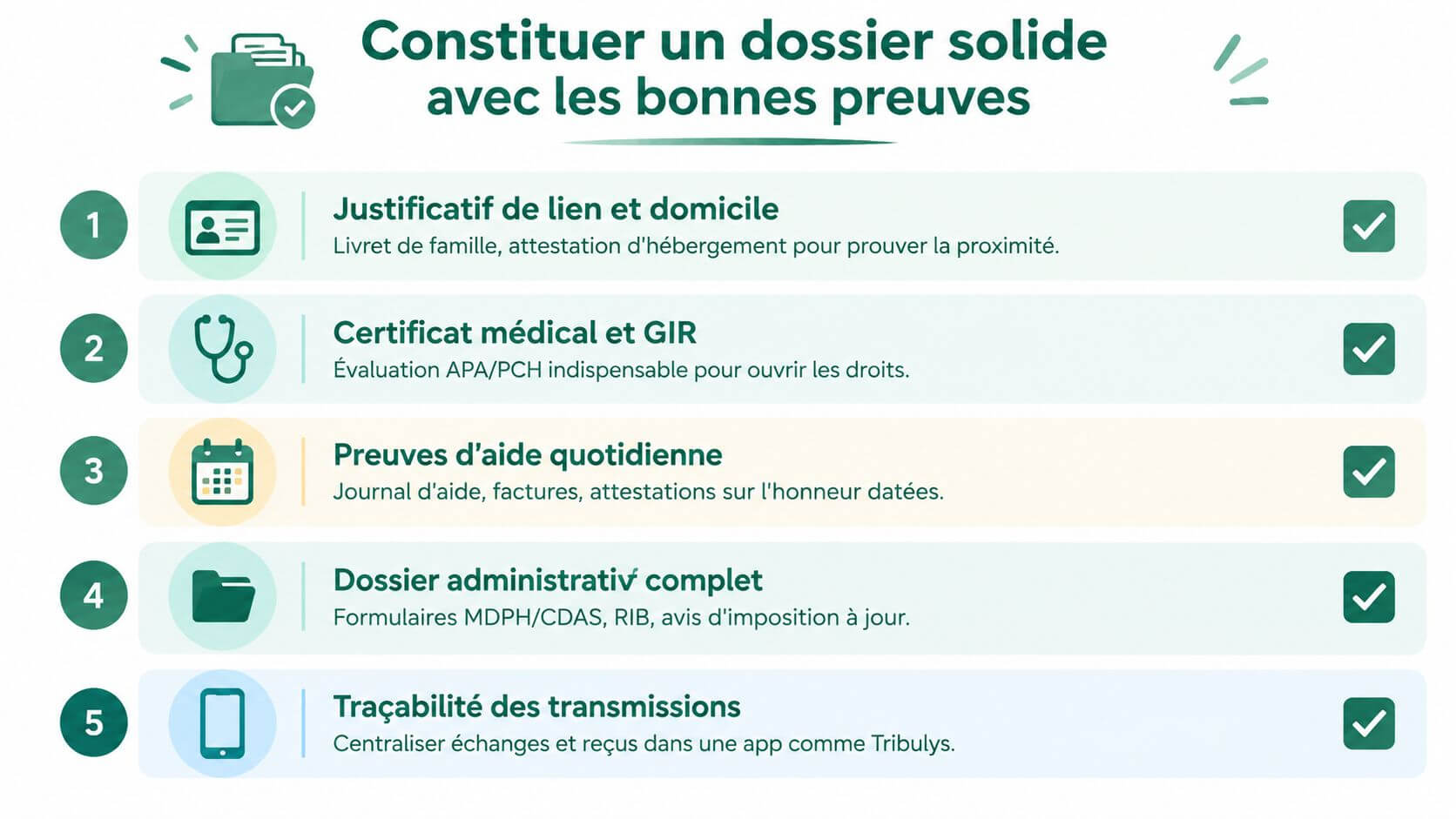
The pieces to be assembled without delay
Start with the link and domicile. Family book, accommodation certificate, proof of common address, everything that shows the useful proximity to the file must be stored in the same place. Then add the medical or evaluation element, because the opening of rights very often requires a recognized level of dependency.
The file must also contain proof of daily help. A help journal, invoices, dated certificates of honour, written passages are concrete evidence. The services rarely ask for family poetry, they ask for verifiable facts.
The following checkpoints should not be overlooked:
- Identity and domicile justifications, to prove proximity and family environment.
- Medical evaluation or IRM, to link the aid to a recognised situation.
- Written traces of the aid, to show the regularity and nature of gestures.
- Complete administrative file, with forms, RIB and up-to-date parts.
- Transmission history, to avoid contradictions between relatives and professionals.
To whom to send what
The CAF and the MSA manage the AJPA components. departmental council deals with the ABS. CDMH is involved in disability situations and related rights. If you mix the interlocutors, you waste time and multiply the revivals.
The biggest trap is improvisation when the administration is asking for a supplement. Also prepare a readable version of your transmissions and your family exchanges, as it helps to respond quickly when a room is missing. To structure this part, this guide on the transmission book gives you a useful ranking logic in everyday life.
Centralize your evidence and transmissions with Tribulys
The financial aid file often fails for a very simple reason, the evidence is scattered. One part is in the SMS, another part in a paper book, the rest in the mails of a relative, and no one knows who noted what. When it is necessary to justify the actual aid provided, this dispersion becomes a handicap.
A unique, exploitable and shareable trace
Tribulys centralizes the care journal, the follow-up of medicines, the agenda and transmissions for family caregivers and home professionals. The practical interest is clear, the entries are Timed and identified, which facilitates the rereading of a file, the continuity of care and the preservation of useful exchanges. For a family that wants to prove its regularity, this structure is much better than an accumulation of scattered messages. More information is available on Tribulys.
The documentary safe and theexport PDF In addition, you can consolidate concrete elements without reconstructing everything at the last minute. You keep a legible history of visits, medication and shared tasks. In an administrative context, it is exactly the type of traceability that avoids holes in the family story.
Why it secures aid applications
The funding agencies want to understand three things, which helps, when, and within what framework. If your transmissions are dated, signed and searchable, you answer these questions without improvising. This is particularly useful when several stakeholders relay, because a structured journal limits contradictions.
Keep a basic rule, if information counts for a request for help, it must not remain in someone's head.
Tribulys does not erase administrative obligations, but it reduces the mental burden of collecting. For a family, it is a concrete change, you no longer look for evidence in the emergency, you keep it running. This is often what makes the difference between a file that is being used and a file that is holding.
Avoiding pitfalls and misconceptions about financial aid
Many caregivers are trapped by three misconceptions. The first is to believe that an aid is automatic. The second is to assimilate compensation, wages and simple compensation as if it were the same thing. The third is to think that one can stack the devices without looking at the incompatibilities.
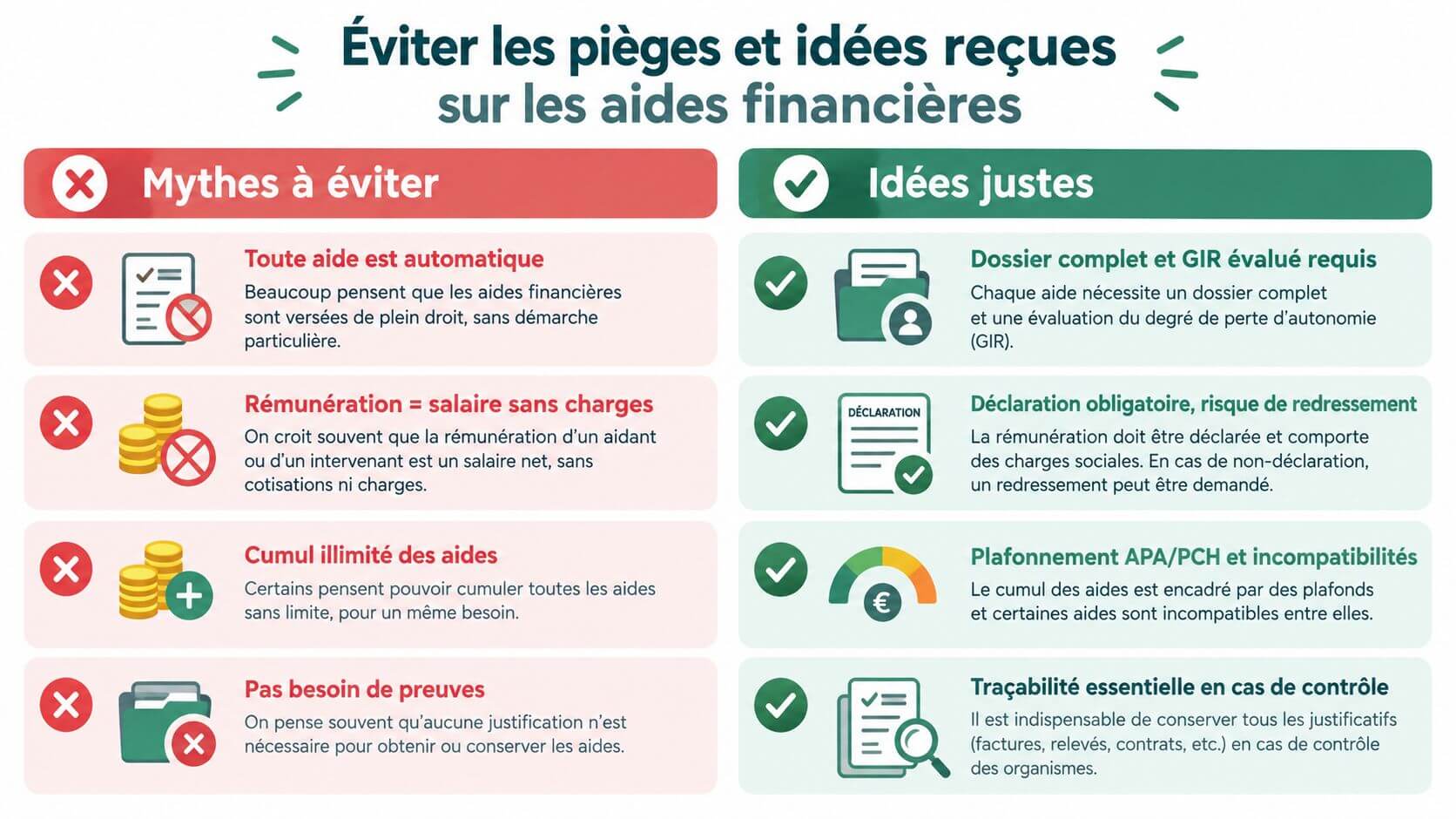
What most often blocks
One remuneration AJPA compensation does not have the same effect as AJPA compensation. The reporting rules are not the same, and an assembly error can create a posteriori control. As soon as a relative intervenes in several settings, the vigilance must rise by one step.
Another classic mistake, to forget that the family link influence the accessible device. The spouse, ACAP partner or partner is not treated as any helper in the APA assistance plan, while the PCH follows other rules (Ministerial page). If you choose the wrong frame, you may waste time and expose your file to refusal or correction.
Three reflexes to stay clean
- Declare everything that needs to be, even if the amount seems modest.
- Separate periods of aid, especially if several relatives intervene.
- Keep track, because the lack of evidence almost always ends up against you.
Retirement, social rights and disposable income must be looked at together. The mistake is to choose a help by isolating a single criterion, while the actual file depends on the whole assembly. If you want to avoid bad surprises, assume that an unmarked file is a fragile file.
Your action plan for obtaining financial support
Start with a brutal sorting. Identify first if you are in a logic of loss of income, of compensation for the aid or financing of services. Then attach your situation to the correct contact, CAF, MSA, departmental council or CDMH, without mixing the circuits.
Then prepare a clean file. Consolidate family link proofs, medical items, daily help marks, administrative forms and bank details. If you have several helpers, designate a reference, otherwise the conflicting versions will ruin the readability of the file.
Also think of the calendar. The AJPA is designed for one-time periods, the APA acts on the daily at home, the PCH follows a logic of compensated human aid. You save time when you know from the start what you are looking for, and not when you try to adjust the file after a refusal.
Finally, keep a continuous log of what is happening. Requests for assistance progress better when transmissions are dated, archived and centralized exchanges. This is precisely where a coordination tool such as Tribulys can serve as a working basis for tracking transmissions, documents and history that are useful in your efforts.
If you want to secure your file without getting lost in the papers, go see Tribulys and now centralize your transmissions, documents and evidence. You will gain readability in front of the CAF, the MSA or the departmental council, and you will know exactly what to get out on the day a proof is missing.
Put this organisation into practice with Tribulys
Keep your care journal, shared calendar, tasks, medication tracking and emergency information together. Start for free and invite the relatives and professionals involved in your loved one’s care.