
You may already have this painting in front of you. A quick message received, a missed call from the nurse, a prescription placed on the kitchen table, and someone in the family who asks, almost at the same time, "who's going through tomorrow?" In a family assistance In everyday life, the problem is not just to do, it is to know who did what, when, and with what instructions.
When a loved one stays at home, everything is intertwined quickly. There is the reassuring presence, the shopping, the meal, the medication, the appointments, then the transmissions between brothers and sisters, neighbour, auxiliary of life and caregiver. Without a common setting, the day looks like a bag of knots, with pieces of information everywhere and person who sees the whole.
Contents
- An ordinary day around a loved one at home
- What is really covered by family support
- How France Recognized Caregivers
- The three faces of human aid, care and coordination
- Financial assistance, leave and legal framework
- Good practices for reliable daily monitoring
- Tribulys, a unique space to coordinate the tribe
- Moving from individual reflex to true family coordination
An ordinary day around a loved one at home
One Tuesday morning, 52-year-old Marie opens her phone before her coffee. Her sister left a text message late the night before, the nurse called while she was in a meeting, and the sheet where she notes her father's appointments slipped under a magnet in the fridge. Nothing is dramatic in isolation, but all together is already creating tension.
At 8 a.m., check that his father got up without difficulty. At 9 a.m., the kine is expected. Between the two, you have to go to the pharmacy, call back a catch order, answer the cousin who wants to know if it's better, then pass on to the rest of the family what the home helper observed the day before.
Three types of actions that mix
The first level ishuman aid. It understands the presence, the help for the races, the meals, the dressing, sometimes just staying there to avoid a person being alone at the wrong time. The second level is the care, with gestures supervised by health professionals.
The third level, often invisible, is the Coordination. Who calls who. That notes the mood change. Who knows if tomorrow's visit is maintained. It is this level that prevents others from contradicting each other.
When the exchanges remain in SMS and calls, each person's memory becomes the tracking system. It is fragile, especially as soon as there are several speakers.
The most difficult thing for a loved one is not always physical fatigue. It is dispersal. The good news is that we can clarify the roles, see what really falls within the scope of family support, and organize a follow-up that does not depend on a single memory or a saturated mailbox.
What is really covered by family support
I-I-Ifamily assistance First of all, it refers to the assistance given, in a non-professional capacity, by a relative, a member of the neighbourhood or someone around him to an elderly person, sick person or person with a disability. 8.3 million of persons over 15 years of age regularly assisting a relative in a reference survey taken up by PREVOR, and then recent summaries around 9.3 million caregivers, almost one in five Frenchmen (who are the caregivers).
This reality is not limited to a single profile. The aids can be one-off or regular, discreet or very structured, and they take very different forms depending on the situation. A girl who does the shopping, a spouse who monitors health, a neighbour who passes once a week, all enter this field when it comes to helping a relative to stay at home.
Caregiver is not alone
The classic mistake is to believe that everything is based on the caregiver. In practice, family support consists of a Assembly. The loved one brings intimate knowledge, daily attention, moral support. Professional caregivers take over specialized tasks, such as toilet help, care, or planned passages.
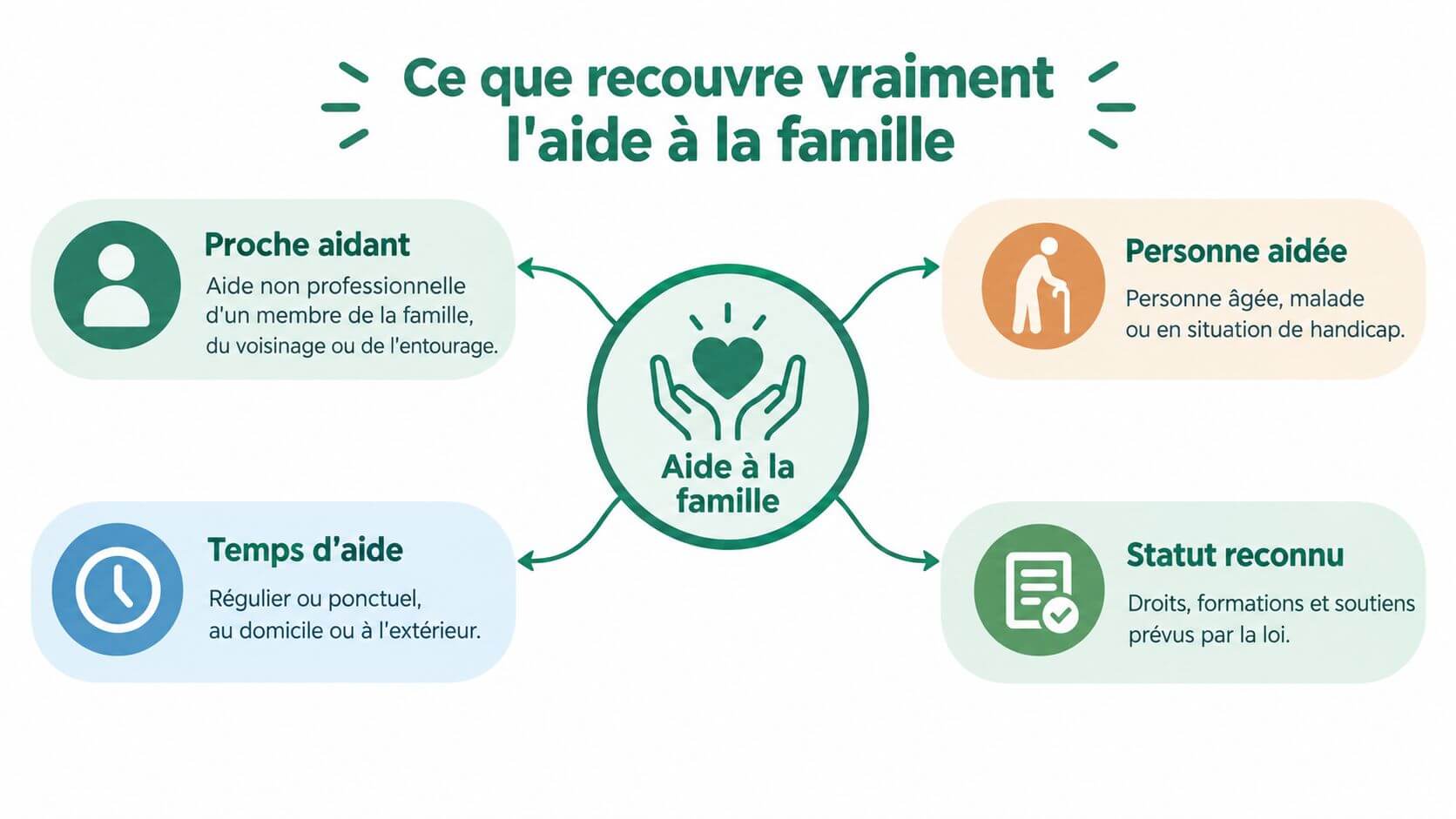
It is also necessary to distinguish between the helper himself, the helper, and the helper time, which can be regular or punctual. family presence, care and Coordination, while the three overlap daily.
The useful question is not "who helps?", but "what do we need, when, and with what relay".
This guide therefore talks about the coordination around a close relative kept at home in France. It is a social, concrete subject, and often much wider than a simple administrative file.
How France Recognized Caregivers
In many families, the role first exists without name. We help, we organize, we compensate, then one day we have to put words on what is going on. The recognition of the carers was thus built, in stages, in law as in public practices. HPST law of July 2009 marked a turning point by mentioning them explicitly, then the National Caregiver Day was created in 2010 (DREES data and institutional summaries).
From then on, the subject has ceased to be only moral. Rights at the respite, the carer's leave and various accompanying arrangements have given a more concrete form to this family role. For a relative, this changes the reading of daily life, like a dashboard that turns a blurred impression into useful benchmarks.
What it changes in real life
A recognized status is not merely an administrative wording. This makes it possible to take time, to make its place heard in the next of kin's journey, and to speak more clearly with the employer or social services. It also helps to understand why a caregiver may need leave, temporary relay or one-time support.
The main purpose of legal recognition is to make visible what already existed in families.
This scoping is also found in the field of thefamily assistance. To understand the Caregiver statusa useful landmark is available here, Caregiver status. The common point remains the same, the family is not next to the system, it is part of it. Institutional benchmarks on carers also show that the subject is part of a broader set of professions, rights and relays, with detailed data in the DREES 2024 report already cited.
The three faces of human aid, care and coordination
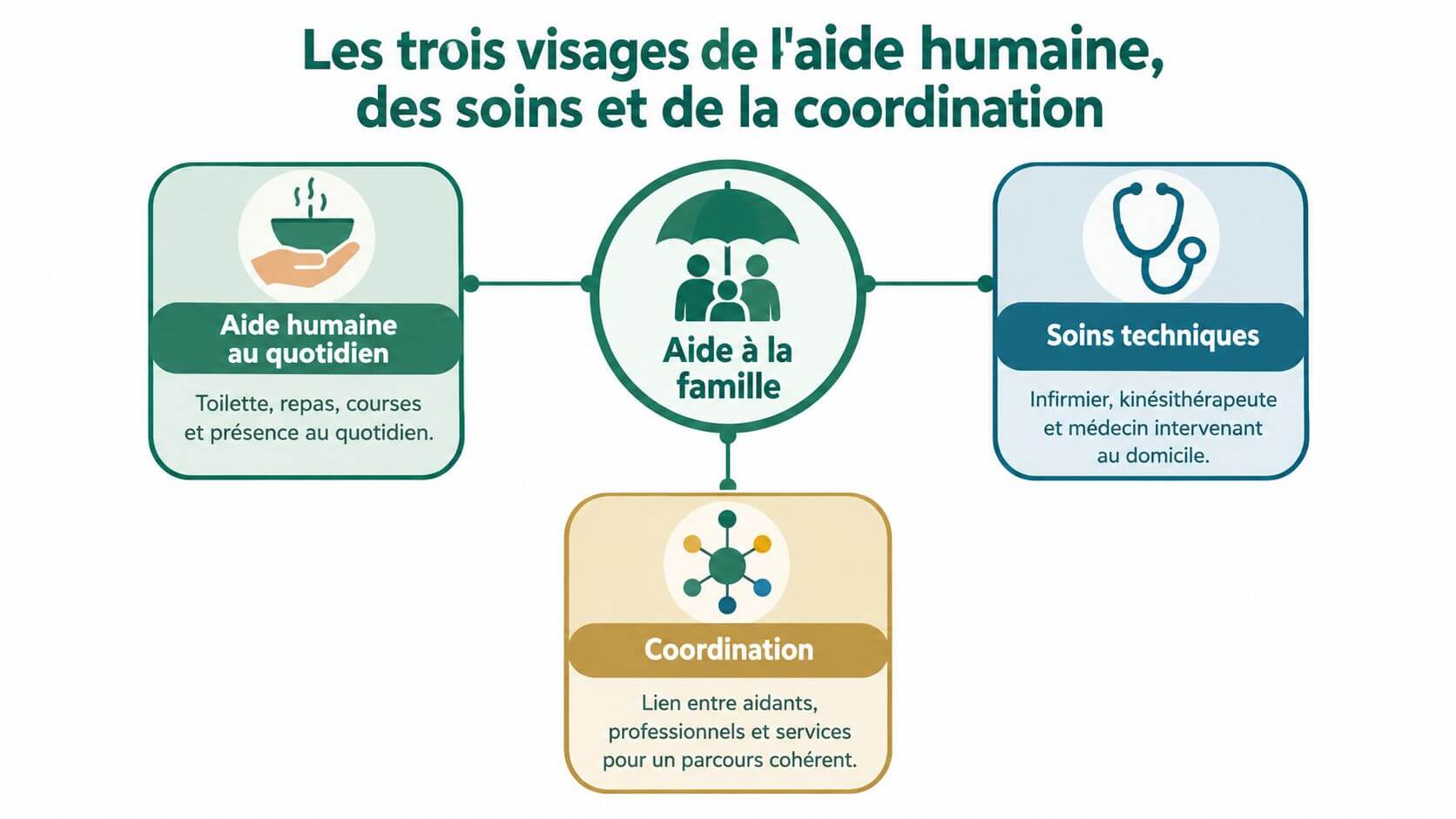
In a house, three things have to hold together. If one lacks, everything becomes unstable. Human aid avoids daily deterioration, technical care treats what is the responsibility of the medical, and coordination connects the two so that no one walks in the wrong way.
Human aid in everyday life
I-I-Ihuman aid supports ordinary actions that become difficult, such as toilets, meals, shopping or mere presence. A life helper who sees that a person eats less can report it, which avoids waiting for a problem to settle down.
Technical care
The technical care health professionals, such as the nurse or physiotherapist. After hospitalization, for example, an IDE can adjust the stacker or recheck a prescription, while the kine works mobility and endurance. The physician coordinates the whole when more complex follow-up is required.
Coordination
The Coordination This prevents two workers from arriving with two different instructions. A shared schedule prevents a home helper and a kine from crossing at the wrong time, or an appointment is forgotten because it has been noted in a single phone. It is the invisible layer of the care, but it is often it that determines whether everything is standing.
Good coordination does not replace care, it makes it consistent.
To deepen the organization of home care, a useful benchmark is available here, coordination of home care. The logical follow-up concerns funding, leave and the legal framework, because a good path must also be sustainable for the family.
Financial assistance, leave and legal framework
When a family looks for air, the right questions are not only "what device exists?", but "what is it actually for?". The idea is not to stack up acronyms, it is to know what help pays for hours, what else protects a job, and which secures decisions.
| Device | Practical purpose |
|---|---|
| APA | Solvailing hours of home help |
| PCH | Finance equipment or development |
| ASH | Help to enter Ehpad when home maintenance is no longer possible |
| Caregiver leave | Freeing time without losing your job |
| Parental leave | Allowing a parent to stay with a seriously ill child |
| Donation of days | Receive rest time from a colleague |
| Future protection mandate | Anticipate the protection of a vulnerable adult |
| Family empowerment | Acting for a loved one without immediately going through a heavy judicial measure |
I-I-IAPA is mainly used to buy human time. PCH can help when it is necessary to adapt the housing or finance useful equipment on a daily basis.ASH takes over when the home is no longer tenable despite the help. In terms of employment, caring leave and the donation of days allow you to blow without breaking everything into your working life.
Which avoids blockages
Legal protection measures are often misunderstood. future protection mandate Lets you anticipate.family empowerment can simplify certain approaches when a relative is no longer able to decide alone. These tools are used to protect a vulnerable adult without waiting for the situation to deteriorate too much.
For families who want to link funding and organization, this starting point is useful, financial aid for a caregiver.
A CASC or sector social worker can often save weeks by helping to assemble compatible devices.
Good practices for reliable daily monitoring
The real risk is not just the oblivion. It is the oblivion that turns into a missed decision, a poorly passed dose or a missed appointment because the information did not reach the right person at the right time. An SMS received at 11 pm is not a file. A paper note lost between two visits is not a history.
Five habits that change the situation
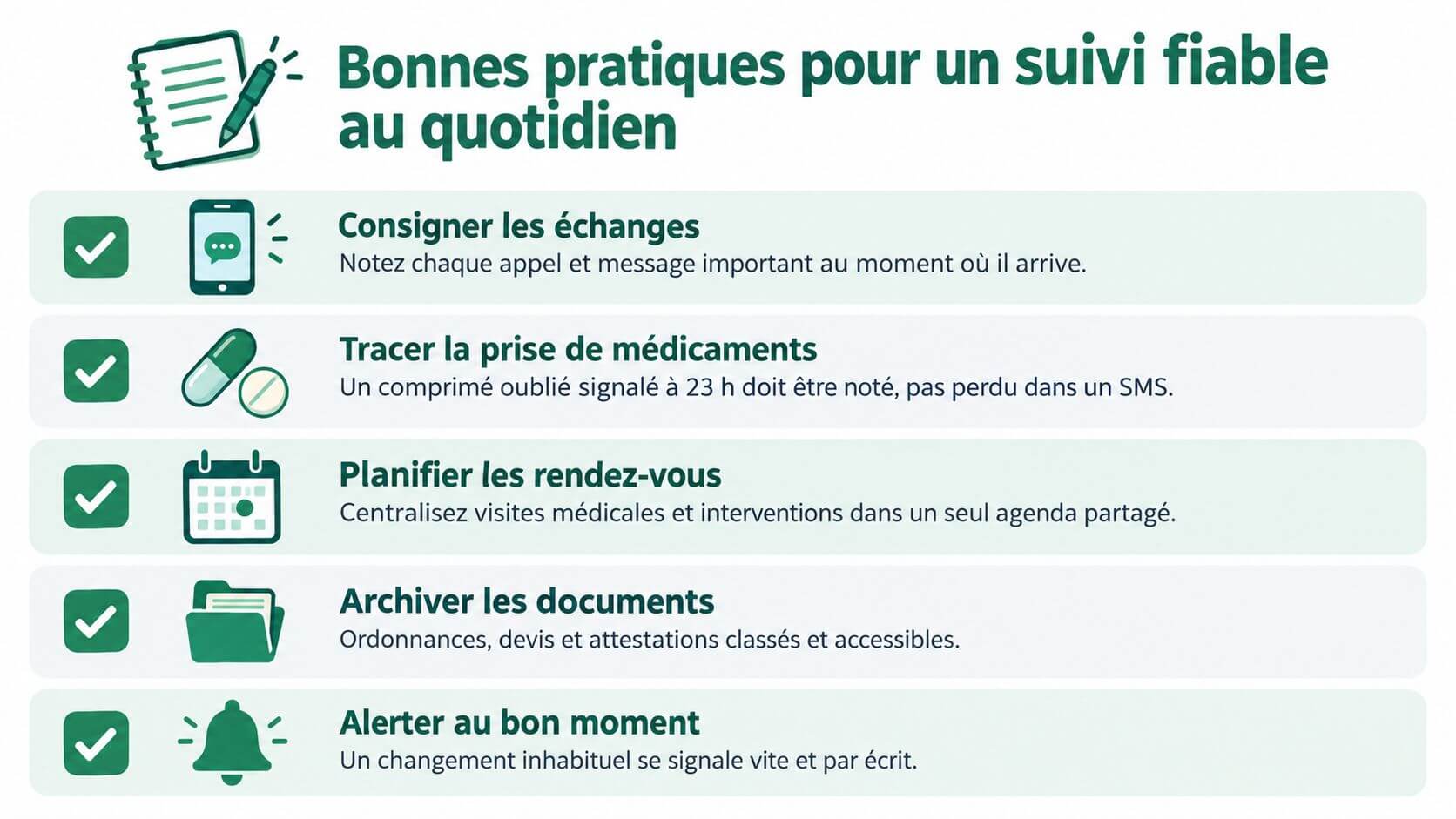
- Record trade. Note every important call or message as soon as it happens avoids the I thought it was you when a change of direction was given to the oral.
- Trace the use of medicines. When a tablet is forgotten, the report must not be stuck in a text message. It must be found in the same place as the rest of the follow-up.
- Schedule appointments. A single shared calendar reduces gaps and double reservations.
- Archive Documents. Orders, quotations and certificates must remain accessible, not buried in a pile of papers.
- Alert at the right time. If a weight, sleep, pain or morale changes, the rapid writing of the fact makes it possible to spot the signal earlier.
Every habit seems simple. Together, they prevent the family from becoming an improvised telephone standard.
The right tool does not replace attention. It avoids attention being lost.
It is also for this reason that a centralized space becomes useful as soon as several people intervene around the same close. When everything is in the same place, the follow-up ceases to be an information hunt.
Tribulys, a unique space to coordinate the tribe
When a family organizes itself in several directions, the problem is not the lack of good will. It is fragmentation. A message in a group, a reminder in a calendar, a prescription in an email, a note in a notebook, and in the middle of all that, decisions to make quickly.
Tribulys gathers in one environment the centralized profile of the person receiving care, multi-stakeholder agenda, Follow-up log, internal messaging, the Document management and reminders of tasks. The platform is accessible on web and mobile, with a logic of invitation that allows to integrate a child at a distance, a home helper or a independent nurse without circulating information between SMS and post-it. Its coordination model is presented with accommodation in France, a GDPR compliance and an approach where access is limited to authorised members, with traceability of actions.
Concrete uses are easy to relate to the needs of a family. The link book helps to keep track of the observations, the shared calendar aligns the passages, and the documents remain in the same place instead of being scattered. To see all the features, the detail is available here, Tribulys features.
A gathering point, not a replacement
Tribulys does not remove anything from the human judgment of the carers. It serves as a gathering point for the bricks already mentioned, human aid, care and coordination. The relatives keep the decision, the professionals keep their role, and the tool avoids that the information leaves in all directions.
Centralizing does not mean dehumanizing. It means that everyone finds history instead of reconstructing it with each call.
This is precisely where shared space becomes useful, because it supports continuity without asking a single relative to carry everything alone.
Moving from individual reflex to true family coordination
Family support is not an isolated matter of patience. It is teamwork, with different roles, different constraints and a common need, to keep a clear view of the everyday life of the loved one.
A shared space like Tribulys does not remove the load, it makes it transmissible. It protects from transmission errors, it reduces forgetfulness, and it helps the family to no longer depend on a single phone or person to hold the wire. The right reflex is to tool coordination before fatigue makes it all more fragile.
If you are looking to structure the help around a loved one at home, Tribulys brings together the transmissions, planning and documents in the same space. You can find out how it works on Tribulys and see if this organization helps you move from a series of messages to real family coordination.
Put this organisation into practice with Tribulys
Keep your care journal, shared calendar, tasks, medication tracking and emergency information together. Start for free and invite the relatives and professionals involved in your loved one’s care.