
You may have seen the scene in your home, a parent's home, a tablet of metformin well stored in the drumstick, then nausea, diarrhea or loss of appetite that settle without a clear explanation. One quickly thinks of a small digestive disorder, whereas the central question is often simpler, what effect of the treatment is manifesting itself, and which really demands to react.
Among caregivers and caregivers at home, this distinction counts immediately. Metformin remains a widely used drug, but its side effects follow a precise logic, with frequent symptoms, others more discreet, and a serious risk that remains very rare but must be recognized quickly. When you know what to observe, what to note and when to call, you avoid both unnecessary anxiety and delay in management.
Contents
- Contents
- Understanding how a close person under metformin feels
- How metformin works and why it causes digestive effects
- Effects classified by frequency according to French sources
- Vitamin B12 deficiency, an often underestimated angle
- Lactic acidosis, the serious but avoidable effect
- Drug interactions and daily risk situations
- Building a home surveillance that really changes the situation
- When to worry, who to call and what to note
Contents
- Understanding how a close person under metformin feels
- How metformin works and why it causes digestive effects
- Effects classified by frequency according to French sources
- Vitamin B12 deficiency, an often underestimated angle
- Lactic acidosis, the serious but avoidable effect
- Drug interactions and daily risk situations
- Building a home surveillance that really changes the situation
- When to worry, who to call and what to note
Understanding how a close person under metformin feels
A caretaker often notices things before everyone else. Dinner passes badly, the patient leaves half of his plate, he complains of a belly, barboiled, then the bathroom becomes a repeated passage in the evening. With metformin, this type of painting is nothing exceptional, and the French sources describe precisely from very common digestive effects, especially in the start of treatment.
The right reflex is not to panic, but to classify. Is it an discomfort that begins after the drug is introduced, a dose increase, or a new fragility like infection, dehydration, or a very reduced meal? This chronology helps a lot, because a side effect is not only read in the symptom, it also reads in the moment it appears.
Practical rule. If the disorders begin after initiation or dose increase, immediately note them in the binding book, with time taken, appetite, transit and general condition.
This simple follow-up avoids fuzzy discussions of the type it goes better, it goes less well. It allows the doctor to distinguish a expected digestive effect from a more serious signal. This is also where the home carers play a decisive role, because they see the reality of meals, sleep and stools, not only the prescription.
For symptoms such as tingling, pain or discomfort in the legs, a useful benchmark is not to attribute everything from the outset to aging. Additional lighting on this point is available in this article on tingling in legs and feet, useful when trying to separate a simple discomfort from a neurological sign to be monitored.
How metformin works and why it causes digestive effects
Metformin does not act like a pill that forces the pancreas. It works mainly by reducing glucose production by the liver and changing intestinal function. This presence at the digestive level explains why the intestines sometimes react before the rest of the body.
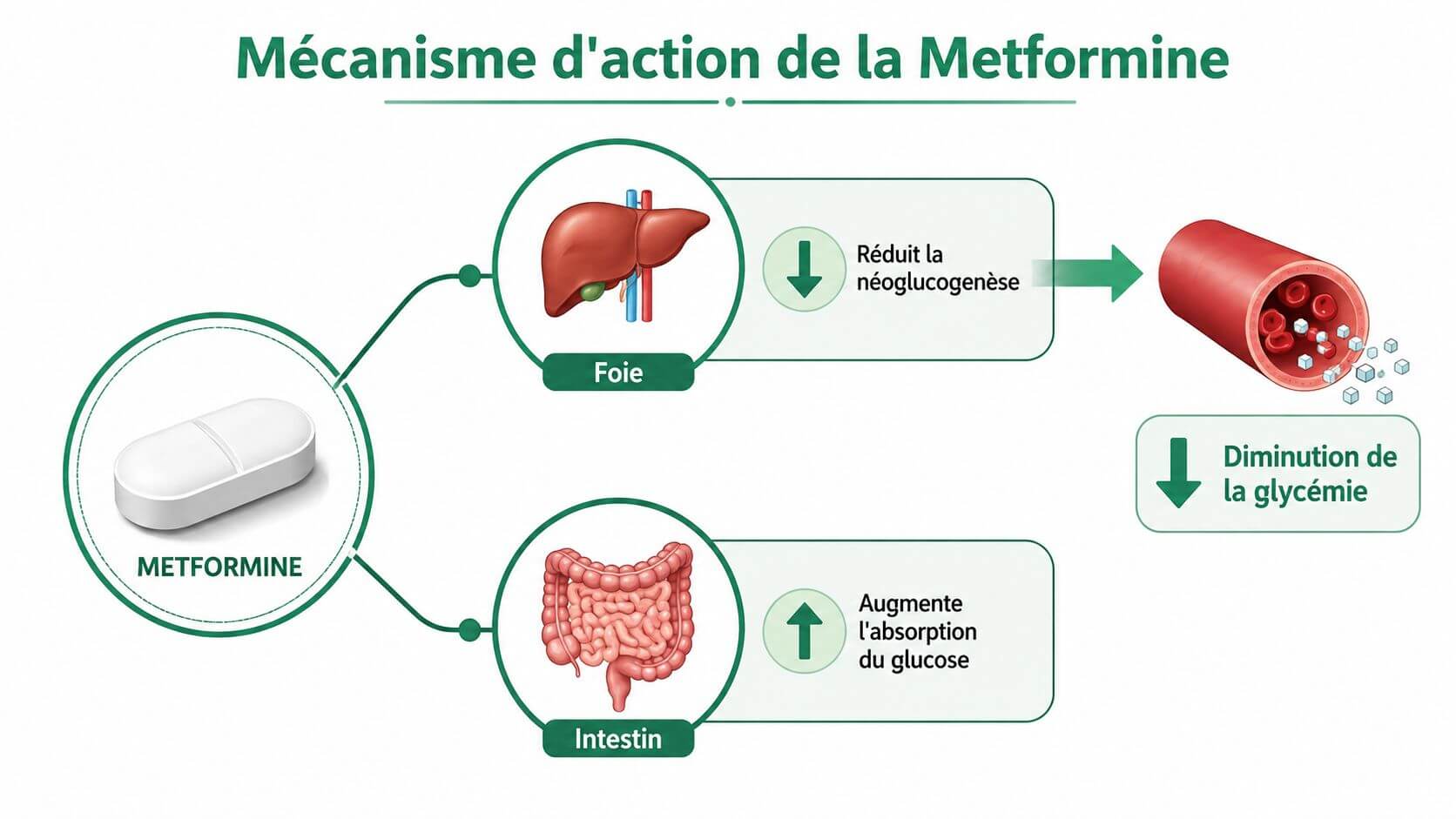
It can be imagined as a medicine that works on two jobs at a time, the liver and the intestine. When the intestine is directly concerned, it is not uncommon for the body to express its adaptation by means of nausea, diarrhoea, abdominal pain or loss of appetite. This is why these symptoms often appear from the outset and then decrease in many patients.
The French records classify this frequency logic with very useful benchmarks. Very common means observed in more than 10% of patients, common in 1 to 10% of patients, followed by the rarer categories. The French metformin summary states that digestive side effects are very common, while dysgueusia, this famous metallic taste, and the decrease of vitamin B12 are commonThe Vidal sheet of the metformin specialty goes in the same direction, with a coherent hierarchy between digestive symptoms and long-term effects (Vidal, metformin EG).
The catch during or after meals and distribution in 2 to 3 taken daily are recommended to limit digestive symptoms, because the stomach better cashes the treatment when it arrives with food.
It is a rule of the field more than a theory. In the home, it translates into a simple gesture, associating the intake with a stable meal, and checking that it is well understood by the person and by all the relays of care.
Effects classified by frequency according to French sources
Read a drug package leaflet becomes much easier when you understand the frequency categories. French sources use this grid to help the patient, the caregiver and the caregiver know what is expected, what is worth monitoring, and what is an emergency. With metformin, reading is particularly meaningful, because the most visible effects are not the same as the most serious ones.
The simple grid to keep in mind
| Frequency | Definition | Effects observed with metformin | Action for the Helper |
|---|---|---|---|
| Very common | More than 10% of patients | Nausea, vomiting, diarrhoea, abdominal pain, loss of appetite | Observe, note, check with meals, prevent if this persists |
| Common | 1 to 10% of patients | Metallic taste, decreased vitamin B12 | Report to physician, monitor fatigue, tingling and feeding |
| Rare | Less common than previous category | Skin or biological effects mentioned in the French leaflets | Do not trivialize if symptom sets in, ask for medical advice |
| Very rare | Exceptional | Lactic acidosis | Respond quickly, especially if signs of alert or fragile terrain |
The key point is not just the number. It is the way the effect changes daily life. An effect very common It is not necessarily serious, but it can cause food to stop, destabilize an elderly patient, or hinder adherence to treatment. very rare must never be ignored if the signs are compatible.
Know how to read what frequency means
A common symptom is not normal, expected. This means that it must be anticipated, traced and transmitted. A very rare effect is not a theoretical curiosity, it becomes important as soon as the context sticks, for example a degraded kidney function or an infectious episode.
In practice, caregivers have an interest in asking three simple questions. Is the symptom digestive, is it new after starting treatment, and is it accompanied by an alteration of the general condition? If the answer is yes, vigilance goes up a little bit. This reading avoids overinterpreting a common disorder, while keeping an eye on what can become serious.
Vitamin B12 deficiency, an often underestimated angle
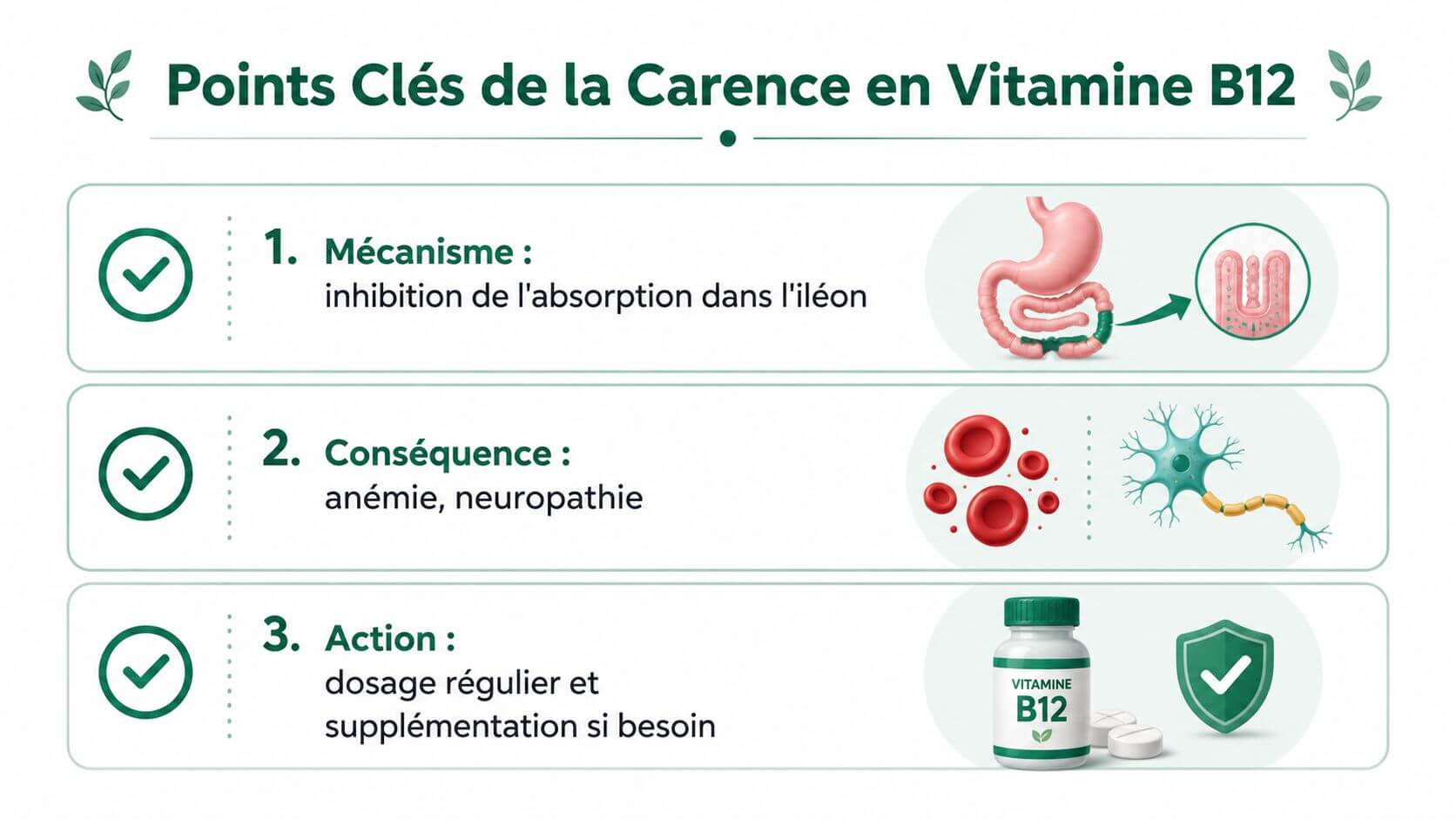
The subject is often missed because it makes no noise. The digestive disorders attract attention, while the vitamin B12 malabsorption However, French sources point to the fact that the number of people treated with metformin for a long period of time may be more discreet. B12 decreased blood levels is one of the known side effects, with a risk ofMegaloblastic anaemia in protracted situations (Vidal, metformin substance).
In an elderly patient, the trap is classic. Fatigue is attributed to age, the tingling of the legs to poor circulation, memory to age progression. However, these symptoms can also point to a B12 deficiency, especially if metformin treatment lasts for a while. This is where the caregiver has a real clinical value, because it detects the change in profile, not only the isolated symptom.
What to watch on a daily basis
- Unusual fatigue which lasts and does not resemble the usual variations.
- Furnishings in the feet or legs, especially if they settle down.
- Memory disorders or unusual slowness in exchanges.
- Loss of appetite persistent, which can also worsen the general condition.
The biological logic is simple to remember, vitamin B12 is less well absorbed over the long term in some patients on metformin, and the body eventually lacks an element useful for the manufacture of blood cells and for the proper functioning of the nervous system. In France, the notices recommend special vigilance in prolonged treatment, making the B12 dosage a follow-up point to remember.
Alert point. In an elderly person on metformin, persistent fatigue or tingling should not be placed too quickly in the --normal. They should be transmitted, dated and discussed.
To keep this vigilance in a simple care routine, a useful benchmark is to link the symptoms to the diet and blood balance. Anemia and what you can eat can also help family members to better understand the nutritional dimension of follow-up.
Lactic acidosis, the serious but avoidable effect
Lactic acidosis is the great subject that worries, sometimes too much, sometimes not enough. French sources describe it as very rare, with an estimate of 0.03 cases per 1,000 patient-years, or about 3 cases per 100,000 patient-years (European document taken from France). This figure should not mask the essential, the risk becomes especially important when the clinical situation deteriorates.
ANSM recalls that this risk is preventable whether contraindications and risk contexts are taken into account (ANSM, lactic acidosis and metformin) In practice, the most worrying situations are: impaired renal function, the cardio-respiratory disease and sepsis. In other words, the medication is not the isolated problem, it is the patient's condition that can make it more dangerous.
The warning signs described in the public drug database are concrete, not abstract. It is necessary to think of an emergency if significant and persistent vomiting, abdominal cramps, unusual intense fatigue, difficulty breathing, rapid and deep breathing, hypothermia or general malaise (Public database of medicines, metformin extract). In an elderly or fragile person, this table requires a rapid reaction, especially if renal function is already known to be fragile.
If the digestive symptoms are similar to those of the beginning of treatment but are accompanied by a very altered general state, it is necessary to think of metabolic urgency, not simple intolerance.
The right reflex is therefore not to minimize, nor to dramatize. It is to spot the context, to check the hydration and to call without delay if the patient shows respiratory signs, great weakness or an impairment of consciousness.
Drug interactions and daily risk situations
At home, metformin never lives alone. It is in addition to other treatments, infectious episodes, scheduled examinations and times when the person drinks less or eats less. It is this reality that changes the level of vigilance, more than the tablet itself.
The most important situations to be identified are known to the health care teams. iodized contrast products impose a temporary stop according to medical opinion, because they can degrade renal function and make metformin more risky.alcohol It also increases caution, as it can promote metabolic imbalance. ANS and Diuretics they can contribute to dehydration or decreased functional renal function, especially in elderly patients.
The questions to ask before each new treatment episode
- New examination with iodized contrastHas the doctor planned the temporary cessation of metformin?
- New infection or feverDoes the patient drink and eat normally?
- Diarrhoea or vomiting. Does the person keep his medication and liquids?
- New order. Is there an NSAID, a diuretic or another antidiabetic that changes the general balance?
Severe infections, prolonged fasting and episodes of gastroenteritis deserve special attention. In these contexts, the priority is not to hold the treatment at all costs, but to avoid dehydration and to warn the doctor of follow-up. The logic is simple, if the body is weakened or lacks water, the tolerance to treatment changes.
A good home rule, before any acute digestive examination or episode, one always wonders if metformin should be maintained, suspended or re-evaluated by the doctor.
This check is very useful for caregivers, because it avoids dangerous forgetfulness. It also structures the dialogue with the medical office, the IDEL and the pharmacist, especially when several treatments cross.
Building a home surveillance that really changes the situation
Home follow-up becomes effective when it is simple and regular. It does not need to be sophisticated, it only has to capture what really changes the patient's condition. For metformin, this means monitoring three levels, digestive tolerance daily, biological checks over time, and constants when an alert appears.
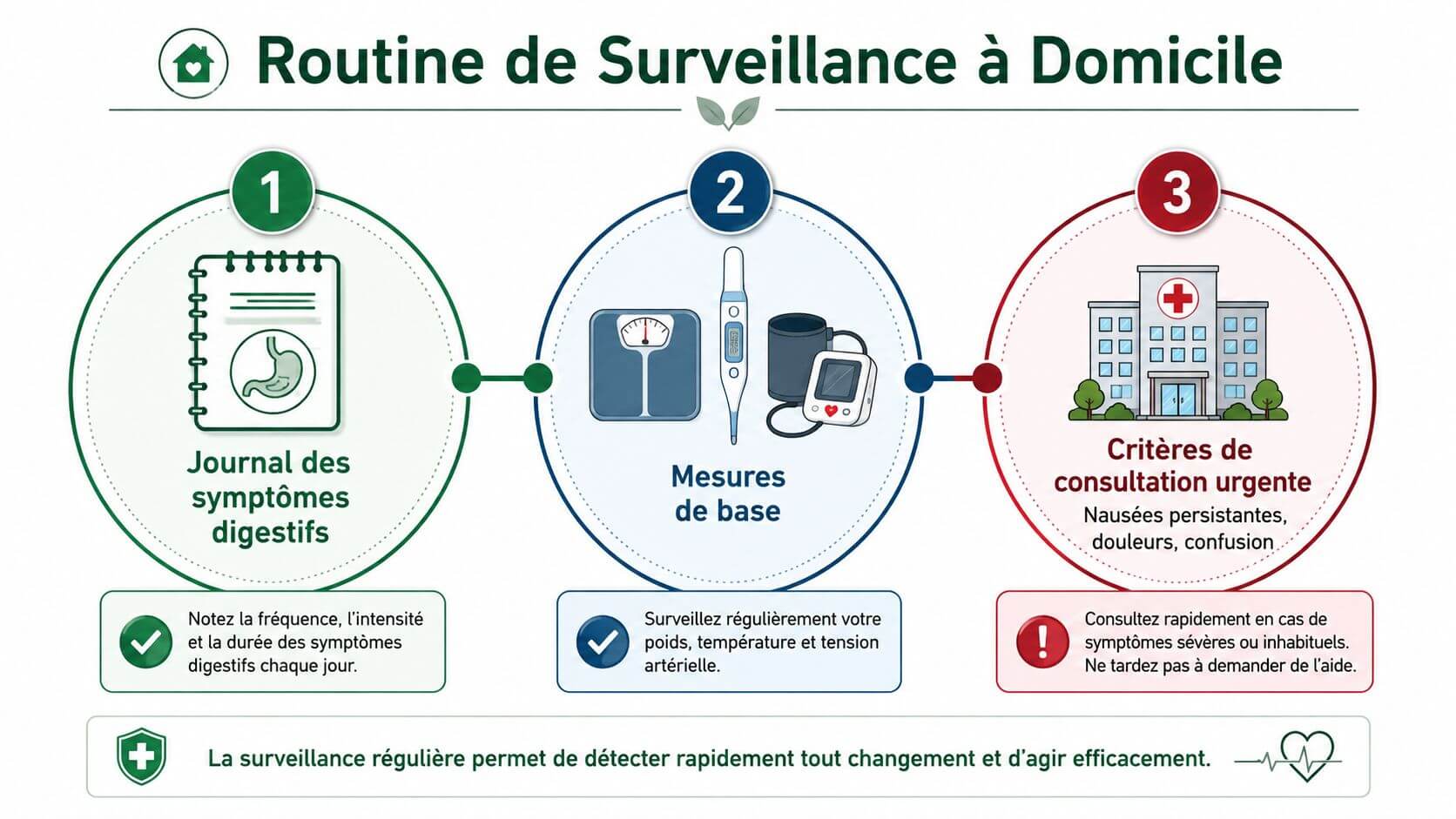
The first level is the daily one. We note the appetite, nausea, transit, the presence or not of abdominal pain, and the way the meals pass. The second level is the biological one, with the controls of diabetes, renal function and vitamin B12 according to the planned medical follow-up. The third level is the alert, when we monitor weight, hydration, temperature and breathing to see if the situation deteriorates.
What a caregiver can trace without complicating life
- Treatment regimens. Time, forget, if any, taken with the meal or not.
- Digestive symptoms. Intensity, duration, trigger possible.
- General signs. Fatigue, confusion, decreased appetite, hydration.
- Data useful to the doctor. Last take, infectious context, treatment changes.
For teams that coordinate with many, a shared tool helps mainly to avoid holes in the racket. Confirmation of catch, dating of constants and structured transmission between relatives and caregivers reduce the risk of lost information between a call, SMS and a paper book. This is exactly the type of situation where a stacker and a shared calendar become more than comfort, they become a security support, as also recalled. this article on the morning-night pillar.
When to worry, who to call and what to note
The most useful is to reason in three levels. At the first level, we observe and note to talk about it to the doctor at the next appointment. This concerns the digestive disorders that persist, the new fatigue, or the tinglings that do not disappear.
On the second level, we contact the doctor or the IDEL during the day. severe diarrhoea, of vomiting, signs of dehydration, a infection in progress, or forgotten / double socket. Here, the goal is not to wait for it to pass, but to put the frame back on before the general condition deteriorates.
At the third level, we call the 15 immediately. Signals are the rapid and deep breathing, the unusual somnolence, the intense abdominal pain, the hypothermia, malaise with sweat, especially if renal failure is known. These are signs that suggest a serious situation, and we must not waste time looking for a reassuring explanation.
The information to be transmitted quickly
- Name of treatment and the dose of metformin.
- Time of last catch.
- Other medicines in progress, especially diuretics, NSAIDs, insulin or other antidiabetic agents.
- The recent contextdiarrhoea, vomiting, fever, fasting, contrasting examination, decreased hydration.
- Recent constants if noted, temperature, breathing, weight, tension if available.
This way of speaking to the emergency department saves time. It helps the team understand whether the problem is like a simple digestive intolerance, a long-term nutritional complication, or a metabolic emergency.
If you are co-ordinating a relative on metformin at home, Tribulys can help you centralize take, symptoms, constants and transmissions between caregivers. Tribulys to organize this follow-up more simply, with a space designed for families who want to keep a clear and responsive record on a daily basis.
Put this organisation into practice with Tribulys
Keep your care journal, shared calendar, tasks, medication tracking and emergency information together. Start for free and invite the relatives and professionals involved in your loved one’s care.