
You may be in this situation tonight. A parent tells you that his feet are "floating", that he feels like he has tingling in the calves, or that a leg becomes numb after sitting for a long time. Sometimes it goes through in a few minutes. Sometimes it comes back at night, several days in a row, and anxiety rises.
These sensations are common, but they remain difficult to interpret. Many families hesitate between two opposing reactions. Either minimize it by saying that "it's nothing." Either imagine a serious problem right away. The right approach is in the middle. It is necessary to observe, describe precisely, and then to evaluate whether the episodes are repeated, intensified or accompanied by other signs.
The tingling in legs and feet have a medical name, paraesthesia. This word can impress, while it simply refers to a symptom. In other words, a message sent by the body. This message may come from a transient nervous compression, a circulatory disorder, diabetes, a deficiency, or from another cause that only a health professional can relate to the right context.
When helping a loved one at home, an additional difficulty arises. At the time of the appointment, you rarely remember everything. Was it the right foot or both feet? At night only? After walking? Since exactly when? These details matter a lot for diagnosis.
Contents
- Introduction
- Understanding tingling or paraesthesia
- The main causes of tingling in the legs and feet
- When to consult a doctor
- The diagnosis of paraesthesias the medical approach explained
- Treatments and solutions for relieving tingling
- The essential role of the caregiver in the monitoring of symptoms
Introduction
A leg that "falls asleep" after a long drive, toes stinging in the evening, a feeling of light burn in the feet at bedtime. Many people have already experienced this. The problem is that the same symptom can be commonplace in one situation and important in another.
In an elderly person, in a close diabetic, or in someone who stays seated for a long time, these episodes often deserve more than just "we will see tomorrow". In France, chronic venous insufficiency, which is the most common cause of these sensations, affects about 20 to 25 million people and training more than 3 million annual medical consultations, according to reported data on venous insufficiency and paraesthesia.
This does not mean that every tingling is serious. This means that you have to learn to read it correctly. A short symptom after a bad posture does not have the same meaning as a tingling that comes back every night, on the same side, with a decrease in sensitivity or pain.
Simple benchmark: occasional tingling can be mechanical and passenger. Repeated, intense tingling, or associated with other symptoms requires medical advice.
The role of the caregiver is often decisive. It is he who sees the episodes repeated, who notices a change of course, who hears the same complaint several nights in a row. With good notes, he helps the doctor to reconstruct a clear clinical history instead of relying on blurred memories.
Understanding tingling or paraesthesia
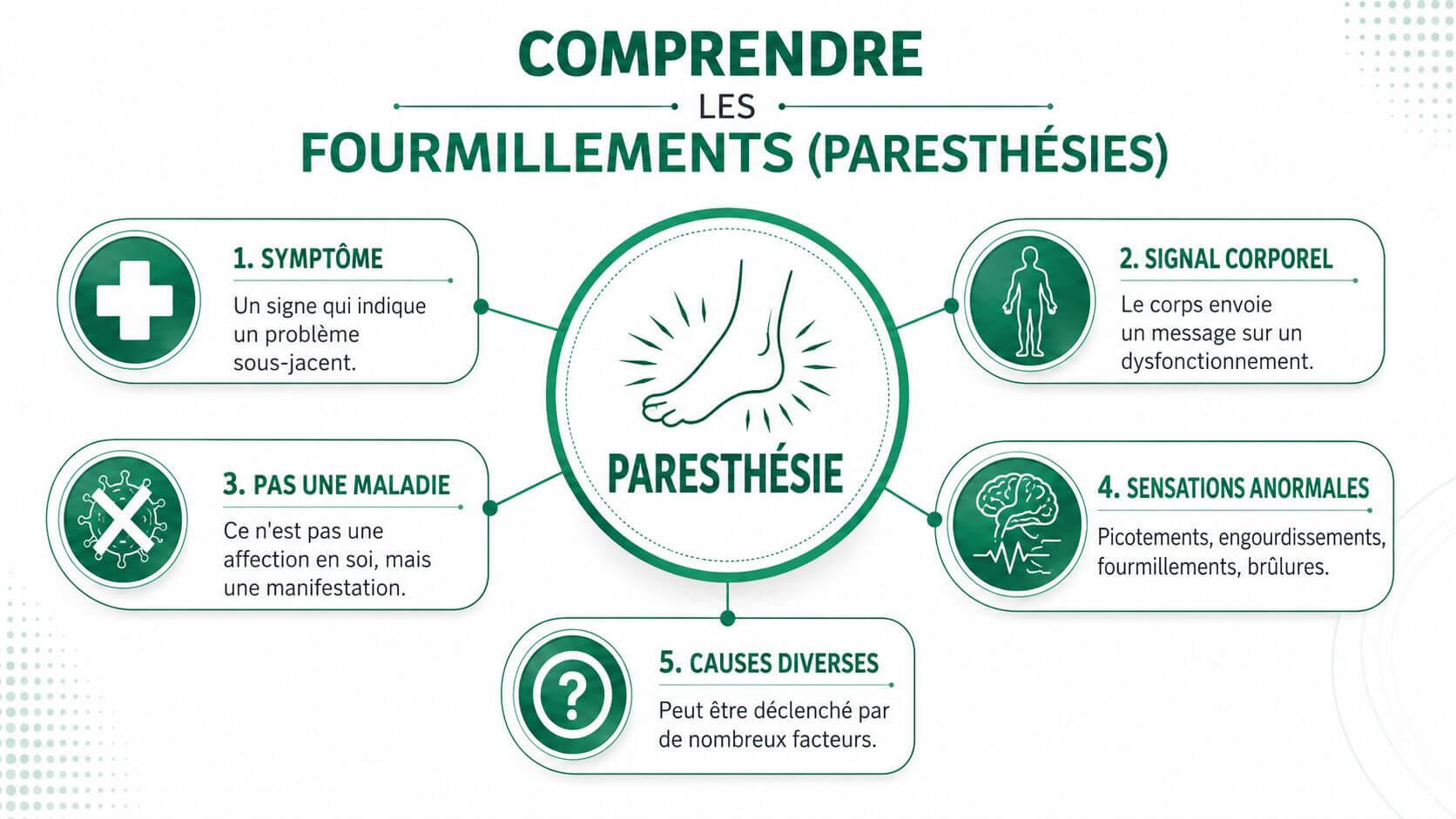
The word paraesthesia This can be tingling, numbness, a feeling of light discharge, sometimes a feeling of hot or burning. It is not a disease in itself. It is a disease that is not a disease. body signal.
The most common dual mechanism
To understand simply, imagine two circuits.
The first one is blood circulation. If a vessel is compressed, the blood circulates less well for a while. Nervous system. If a nerve is compressed, the sensory message goes wrong. In both cases, the brain receives an unusual signal, and you feel tingling.
That's what I'm saying. this article Doctissimo on tingling feet and when to consult, which indicates that paraesthesias of the legs and feet are mostly of vascular origin by compression of the vessels or nervous by compression of nerve fibers. The same source specifies that a serious pathological cause is primarily suspected when symptoms are intense, recurrent, associated with motor or sensory disorders, or occur in a person at risk.
What is passenger and what is less passenger
The best known case is simple. You sit down for a long time, with your legs crossed, and then when you get up you feel "ants" in your foot. You change position, you walk a little, and it disappears. This type of episode is often transient.
On the other hand, there are certain details that need to be considered:
- Frequent repetition. The episodes come back for no obvious reason.
- Unusual duration. The sensation does not disappear quickly after moving.
- Same affected areaAlways the same foot, the same leg, or at night.
- Other associated signs. Weakness, pain, loss of sensitivity, imbalance.
When a symptom returns to the same place, under the same circumstances, it ceases to be a mere incident. It becomes a useful clinical information.
A simple reading grid for families
Even before the consultation, four concrete questions can be asked:
| Question | Why she's helping |
|---|---|
| When does this happen? | In the evening, after walking, at awakening, after a prolonged position |
| Where exactly? | Shoulders, sole of foot, calf, leg or both |
| How long? | A few minutes or much longer |
| With what else? | Pain, heavy leg sensation, weakness, discomfort to walk |
This small grid avoids frequent confusion. Many patients say "I often have ants", but without being able to specify the context. However, the context often helps as much as the symptom itself.
The main causes of tingling in the legs and feet
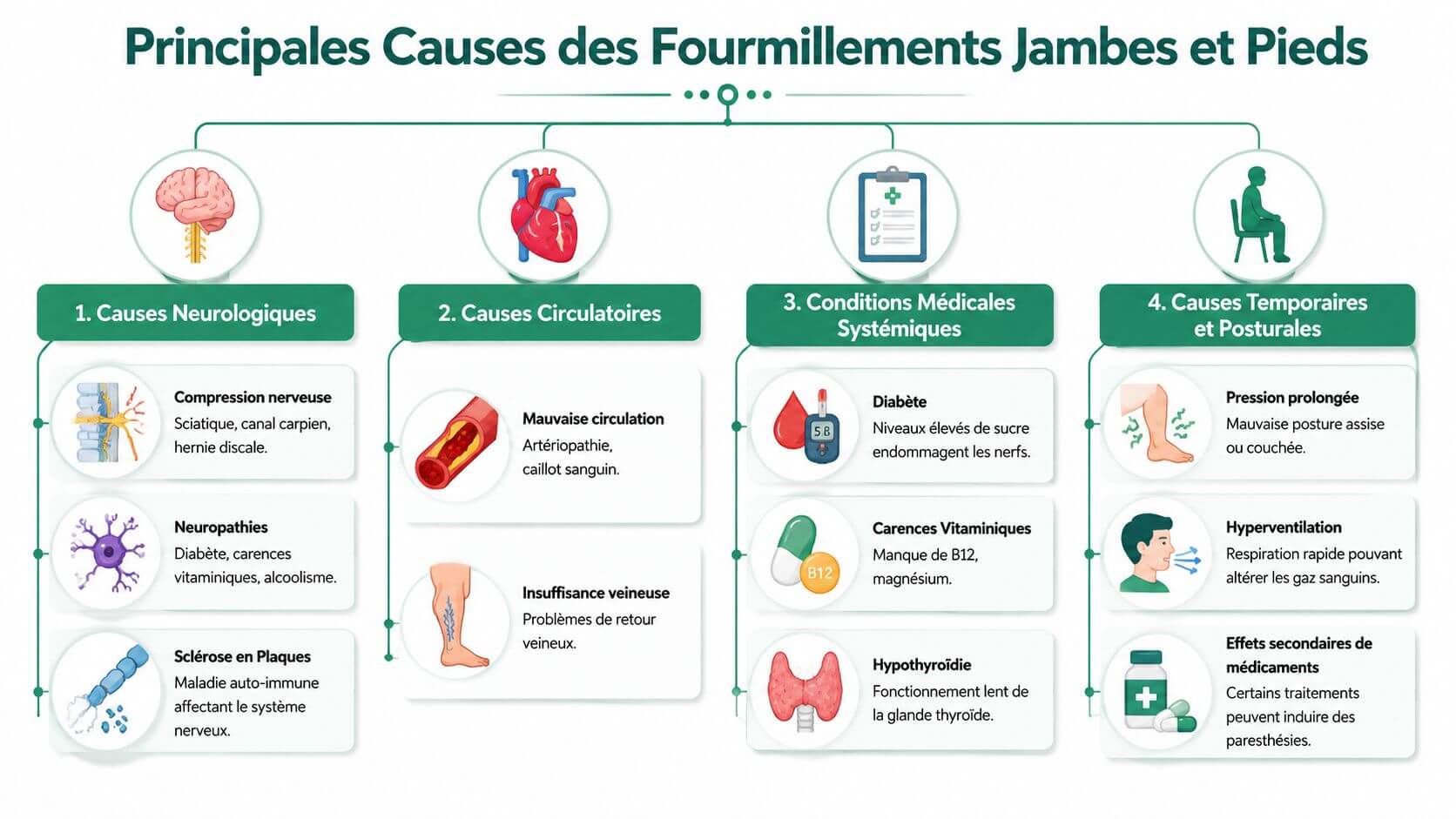
The tingling does not have a single origin. For a caring loved one, the most useful is to classify this symptom as one sorts pieces of a puzzle. The location, the moment of appearance and the associated signs refer to one family of causes rather than another. It is often this sorting that helps the doctor to ask the right questions from the first consultation.
A circulatory cause
Sometimes the problem comes mainly from venous circulation. Blood is more difficult to climb from the legs to the heart, a bit like a return journey that takes place in slow motion. The result is not always a clear pain. These are often diffuse sensations, with tingling, heavy legs, heat, discreet swelling of the ankles or discomfort at the end of the day.
This track is common in people who stay standing or sitting for a long time, in elderly people, or after a day with little walking. The detail useful for the caregiver is the context. If the close friend says it gets worse in the evening and gets better when he walks a little or lifts his legs, this information counts.
A few benchmarks may suggest this origin:
- More marked symptoms in the evening
- Feeling heavy or heavy
- A little swollen.
- Improvement with raised movement or legs
A local nerve cause or on the nerve path
The nerves transmit sensations like cables that carry a signal. If they are compressed, irritated or weakened, the message becomes blurred. This can cause tingling, a feeling of numbness, sometimes discharges, sometimes an area of the foot that seems less sensitive.
In this case, the description is often more precise. The relative can show an exact place, for example the toes, the outer edge of the foot, the calf or the back of the thigh. He can also describe a journey. This notion of journey helps a lot, because it evokes a nerve rather than a circulatory disorder.
A temporary compression also exists in everyday life. A prolonged posture, too tight shoes or repeated support may suffice. If episodes become frequent, always in the same place, it should be noted. Regular observation in a tracking tool such as Tribulys avoids notes scattered on a notebook corner, in the telephone or in family messages. At the consultation, the doctor then gains a clear chronology rather than an approximate memory.
Diabetes and peripheral neuropathy
Diabetes is one of the important causes, because it can gradually damage the small nerves of the feet. The French Federation of Diabetes recalls that diabetes is a common disease in France and that it exposes to nerve complications affecting the extremities, especially the feet, with loss of sensitivity, tingling or pain on its information page on complications of the diabetic foot.
The profile is often quite speaking. Feelings start in the feet, sometimes touch both sides, then become more regular. Some people say walking on cotton, others talk about burns or night discomfort.
For the caregiver, the issue is not limited to the symptom itself. A less sensitive foot is less marked by a light bulb, a small wound or a rubbing shoe. Daily follow-up becomes concrete:
- look at the skin condition,
- Note if symptoms affect one or both feet,
- identify the time of appearance,
- report any loss of sensitivity or injury.
Deficiencies and other general causes
The body also needs certain nutrients to make the nerves work properly. Vitamin B12 deficiency can cause sensory disorders, especially tingling, numbness or less stable walking. The MSD Manual explains this in its page on Vitamin B12 deficiency, which describes possible neurological impairments when the lack lasts in time. https://www.msdmanuals.com/en/accueil/nutrition-related disorders/carence-en-vitamins/carence-en-vitamin-b12.
This cause is often less visible to families because nothing can be seen at first sight. Symptoms can settle slowly. That's why a dated history helps a lot. If the caregiver can show that tingling has gradually appeared, that they now touch both feet and that they are accompanied by a new fatigue or a new awkwardness, the doctor has more useful clues.
Other general diseases may also come into play, depending on age, history and treatment taken. Therefore, it is important not to reduce the problem too quickly to traffic alone or to a poor position.
The temporary causes of daily life
Many episodes remain benign and mechanical. A position held too long, cold, tight shoes, unusual effort or a long period of inactivity can be sufficient to cause ants in the legs or feet.
This type of episode usually disappears after a few minutes, when you move or change your support. What needs to attract the attention of the caregiver is not an isolated episode. It is the repetition of the same scenario, in the same area, at the same time of the day.
A vague note like "still ants " helps little. A precise note helps much more. For example: "Tuesday evening, left foot, sole of foot, 20 minutes, after dinner, pain free, improved after walking". This is exactly the kind of information that turns a blurred impression into a exploitable clinical history. Tribulys takes all his interest here, as the tool gathers these observations in a single legible thread for the family and for caregivers.
When to consult a doctor
The most common question is not "what is the cause? " It's more like "do you need to consult now? " To answer this, one must look at the intensity, the repetition and the associated signs.
Situations requiring rapid consultation
Some paintings must not wait.
- Sudden appearanceA brutal tingling, without obvious cause, deserves a quick assessment.
- Very intense symptom. The more unusual the intensity, the more careful you have to be.
- Associated motor or sensory disorders. Weakness, awkwardness, net loss of sensitivity.
- Injuries in a person at risk. Elderly person, diabetic, or with a significant medical history.
- Recurrence. The same episode comes back in close proximity.
Useful reflex: If the complaint is accompanied by difficulty in walking, loss of strength, speech disorder, sudden imbalance or rapid expansion of symptoms, medical assistance must be sought without delay.
The caregiver can have a key role here. He does not have to make a diagnosis. However, he can see that it is no longer a simple numbness passenger.
Which can wait for a scheduled appointment
Other situations are rather a matter of non-emergency consultation, but to be organised.
For example, a relative who describes tingling especially in the evening, regularly, without any sudden sign or loss of strength, must still talk to his doctor. The same applies if the episodes last longer and longer, disturb sleep, or add to other complaints such as a feeling of heavy legs or an obstacle to walking.
The right marker is not only the immediate gravity. It is also the persistence. A symptom that lasts in time deserves an explanation, even if it does not look like an emergency.
The diagnosis of paraesthesias the medical approach explained
The first purpose of the consultation is to transform a vague sensation into a well-described medical problem. It is rarely a diagnosis made in one sentence. The doctor assembles clues.
What the doctor is looking for first
The first step is interviewing. The professional will ask where exactly the tinglings are, when they appear, how long they last, whether they touch one side or both, and whether they are accompanied by pain, weakness or a decrease in sensitivity.
Then comes the clinical examination. The doctor can test the sensitivity, muscle strength, reflexes, balance or how to walk. For the patient, this may seem simple. For the practitioner, these details guide a lot.
A frequent obstacle is memory. At the appointment, many families say "this happens often", without being able to specify more. A structured survey changes everything. shared transmission book for the home helps to record episodes with the date, time, context and associated signs.
Examinations that may be proposed
The doctor does not prescribe the same tests for everyone. He chooses according to the symptoms and according to the field of the patient.
The most common exams are:
| Review | What it helps to verify |
|---|---|
| Blood test | Deficiency, diabetes, or other general imbalance |
| Echo-Doppler | Quality of blood circulation in the legs |
| Electromyogram | How nerves transmit messages |
| Other targeted reviews | Based on clinical context and history |
Diagnosis of paraesthesia often resembles a logical triage. The doctor first eliminates urgent causes, then refines according to the profile of the symptoms.
This may take a little time. It's normal. The goal is not to go fast at all costs, but to link the right symptom to the right cause.
Treatments and solutions for relieving tingling
The same symptom may call for very different answers. Fluting due to poor circulation does not relieve itself in the same way as tingling due to deficiency, diabetes or nerve irritation. That is why treatment follows the cause, not the word "paraesthesias".
Treatment depends on the cause
If the doctor retains a venous origin, he may propose Contention stockings, measures to promote venous return, and sometimes appropriate medication treatment. The Sickness Insurance explains the principles of managing venous insufficiency, in particular the low restraint and other possible treatments.
If a deficiency is found, the priority is to correct it. If diabetes plays a role, relief often involves better glycemic control and regular attention to the feet. In case of nervous compression, management may include physiotherapy, posture advice, adaptation of activities, or other solutions chosen by the doctor.
For a caregiver, the key idea is simple. Useful treatment is the one that corresponds to the mechanism in question.
Useful gestures in everyday life
While waiting for the full assessment, some actions can reduce discomfort. They do not replace consultation, but they often help to better live episodes.
- Change position regularly. Staying seated or motionless for a long time can maintain some discomfort.
- Walk a few minutes several times a day If the person's condition allows it. The movement acts as a small pump for the legs.
- Wear adapted shoes. An overtight shoe can increase the pressure on the foot.
- Identify the time when symptoms appear. After a journey, in the evening, at the rise, during the walk or at rest.
- Raise the legs if advised by the doctor. In some people, this reduces the feeling of heaviness or numbness.
- Avoid repeated self-medication without medical advice, especially if episodes become more frequent.
The organization of treatments also counts. When a person cumulates several prescriptions, one Pillier morning night to secure daily intakes helps the helper to check what has been taken, when, and to find more easily an oblivion or an annoying effect reported after a dose.
To visualize a few simple relief gestures, this video can help understand the practical measures of everyday life:
What a caregiver can watch at home
Home follow-up is used to make symptoms more legible. It's a bit like moving from a loose puzzle to a sharper picture.
Some benchmarks are particularly useful to note:
- The exact moment. At night, after a meal, after a sitting time, at waking up.
- The affected area. One foot, both feet, calf, sole of foot.
- Duration. A few minutes, an hour, several episodes in the day.
- What changes the embarrassment. Walking, rest, light massage, lifting legs.
- The associated signs. Pain, feeling heavy legs, weakness, loss of balance, difficulty laying foot.
For the family, these notes have a real practical utility. They help to see if episodes remain stable, if they become more frequent, or if they appear in a specific context. With a coordination tool like Tribulys, these observations do not remain scattered between a notebook, a message and an approximate memory. They become a clear, shared history, and much easier to pass on to the doctor at the right time.
The essential role of the caregiver in the monitoring of symptoms
When a doctor looks for the cause of paraesthesia, he works from a narrative. If this narrative is blurred, the diagnosis becomes more difficult. Therefore, the caregiver can bring something very concrete. Not a medical interpretation, but well observed facts.

Why vague memories complicate diagnosis
Saying "he often has ants in his legs" helps little. Saying "Tuesday at 10:30 p.m., tingling in his right foot after two hours sitting, with difficulty walking for twenty minutes" helps much more. The difference is not administrative. It is clinical.
Caregivers often underestimate the value of their observations. Yet, they are the ones who see the episodes in real life. They know whether it comes back in the evening, after an exit, after a long rest, or on the contrary during the walk. They also notice whether the loved one complains more, sleeps less well, or changes his way of laying foot.
To better understand this daily place, families can consult the resources dedicated to the close helper.
A short, dated and precise note is better than an approximate memory told three weeks later.
What to rate after each episode
Follow-up doesn't have to be complicated, it just has to be regular.
Here is a simple format that works well:
| Note item | Concrete example |
|---|---|
| Date and time | Monday night, after dinner |
| Area concerned | Left foot, toes and plant |
| Intensity felt | Light, moderate, strong |
| Background | After a prolonged sitting position |
| Which relieves or worsens | Soft walk, change of position |
| Associated symptoms | Heaviness, pain, weakness, disturbed sleep |
A coordination tool mainly changes one thing. It avoids scattering. Instead of having information lost between a paper book, text messages, a phone note and everyone's memory, the whole story can be centralized, timed and easily recovered. For a doctor, this continuity is valuable. For a family, it reduces the mental burden.
It also changes the role of the caregiver. It does not "watch blindly". It documents usefully. And it can save real time when directing the balance sheet.
If you accompany a relative with repeated tinglings, Tribulys can help you centralize observations, treatments, appointments and transmissions in a shared space with family and professionals. Instead of scattered notes, you have a clear, dated and usable history to better prepare for consultations.
Put this organisation into practice with Tribulys
Keep your care journal, shared calendar, tasks, medication tracking and emergency information together. Start for free and invite the relatives and professionals involved in your loved one’s care.