
You've just prepared a simple plate, but the person in front of you eats little, sorts their food or pushes back the meal because they feel exhausted. In this context, the question anaemia than eating It is not just a choice of iron-rich foods. It consists mainly of ensuring that the iron present in the plate is actually used by the body, meals after meals, at the right time of the day.
Contents
- Why diet plays a central role in anaemia
- Heminic iron and non-Heminic iron explained simply
- The best foods rich in iron and cofactors
- Compose meals that maximize iron absorption
- Ideas received and limits of diet alone
- Coordinate meals and follow-up between caregivers
- When to consult and what to pass on to the doctor
Why diet plays a central role in anaemia
One evening, a caregiver prepares a dinner for a person who says he's "weary all the time". The reflex is often to remove a list of foods, as if the problem were solved with one dish. In reality, French-language reference points point to the fact that food is acting on two additional levers: increase iron intakes and improve its absorption (WHO, anemia profile).
This nuance changes everything. A meal may contain iron, but the body only recovers part of it, especially if the menu is poorly combined. That's why the French councils insist both on foods rich in heminic iron, on those that bring non-heminic iron, and on foods that promote or hinder its passage into the blood.
A question of plate, but also timing
In everyday life, this means that the same ingredient does not produce the same effect depending on what comes with it. Lentils with a vitamin C-rich fruit do not have the same interest as a bowl of lentils taken just after a large glass of milk or coffee. vegetables and fruits rich in vitamin C to optimize the use of iron by the body (WHO, anemia profile).
Practical rule. The right marker isn't just what you eat, it's also what you eat with, and when.
This logic is particularly useful at home, because a helper does not only control cooking. It can also organize meals of the day, prepare snacks, and avoid tea, coffee or cocoa coming at the wrong time.
Food iron does not act alone
The French-speaking recommendations also point out that anemia affects mainly people exposed to the iron deficit, but not only. Needs vary greatly according to age and sex, with benchmarks that do not read as a single recipe for everyone (mythrapyapp.com, foods rich in iron and anaemia). In infants, prevention must even begin at an early stage, which shows that a single home may have to compose several meals adapted to several profiles.
The diet therefore helps to build a solid basis, but it does not replace the diagnosis. If fatigue persists despite better compound meals, one must think of a balance sheet, not a culinary failure.
Heminic iron and non-Heminic iron explained simply
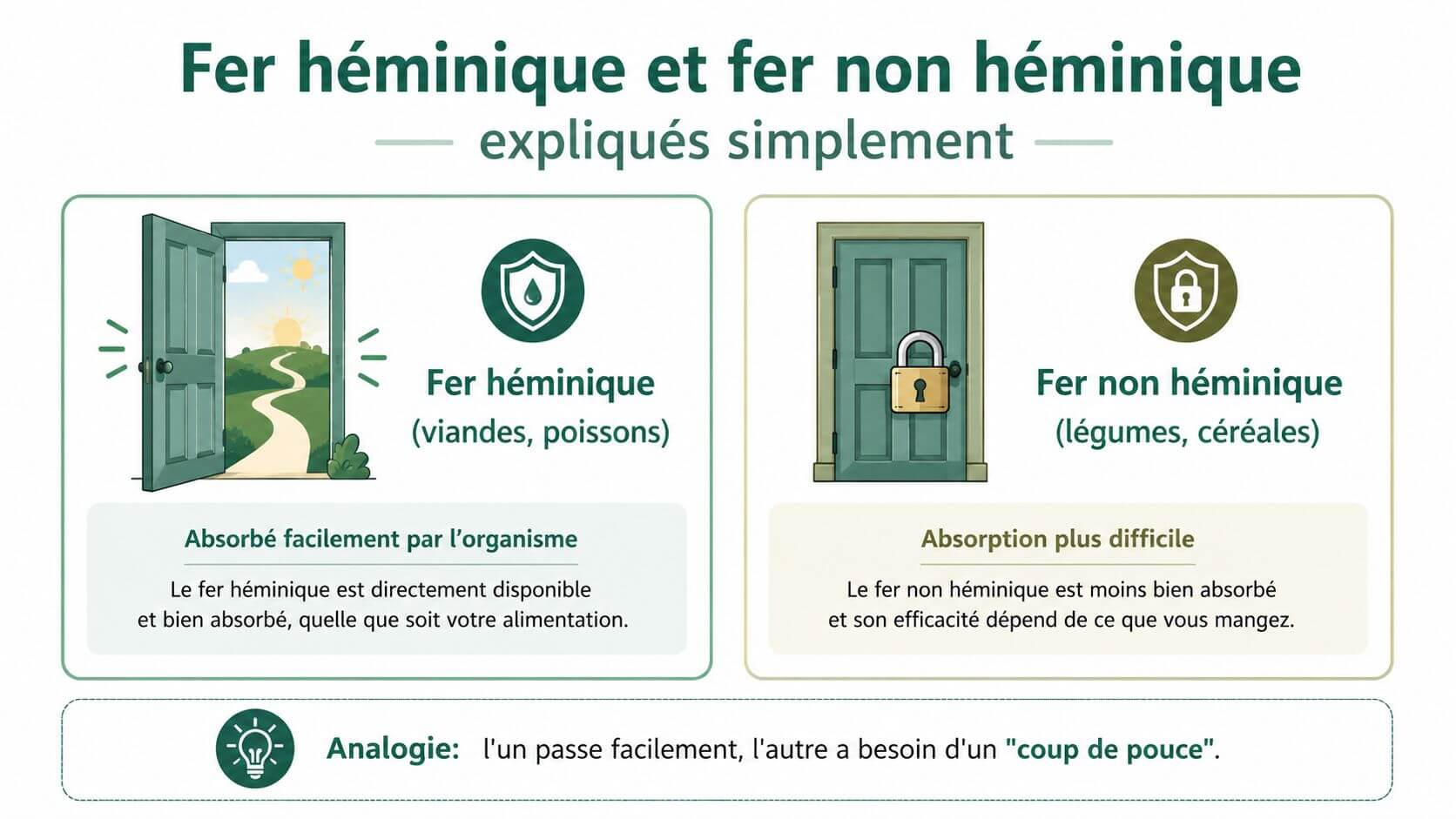
The simplest way to understand food iron is to imagine two doors. The first door is closed, the iron passes easily. The second door is locked, and it takes a stroke to get better into the body. This image corresponds to the difference between Heminic iron and non-Heminic iron.
Why animal sources are more effective
The heminic iron is mainly found in the lean red meats, the poultry and fish. It is better absorbed by the organism, with an absorption of about 25 % according to the WHO card (WHO, anemia profile) On the other hand, non-Heminic iron, present in the legumes, the enriched cereals and dark green vegetables, is often absorbed at less than 5 % (WHO, anemia profile).
This difference explains why a vegetal menu needs to be thought out more precisely. It is not a question of quality or moral value of food, it is a question of bioavailability. A well-built vegetarian dish can help, but it requires more attention to the composition of the meal.
What it changes for caregivers
When you organize meals at home, this distinction helps to choose the right reflex. If the person eats meat or fish, the iron already arrives in a more usable form. If it eats mainly vegetable, you have to help the meal with food. vitamin C, and limit what hinders absorption to the same meal.
Here's the logic to keep in mind:
- Heminic iron. Easier to use, useful when appetite is limited.
- Non-Heminic iron. Very interesting too, but it requires a better composition of the meal.
- Vitamin C. It serves as a support for vegetable iron, which makes the meal more efficient.
The right menu is not the one that ticks a box on the iron, it is the one that helps the body to capture it.
This distinction becomes even more important when several people prepare meals. One can buy lentils, the other fruit, a third serve coffee at the wrong time. Without common reference, the benefit of the meal can be diluted.
The best foods rich in iron and cofactors
Foods to be preferred are divided into simple groups. On the one hand, the most effective sources of iron, especially lean red meats, poultry, fish and seafood. On the other hand, useful plant sources, such as legumes, the enriched cereals and dark green vegetables (MedecinDirect, anaemia) Francophone landmarks also add the interest of vitamins B12 and folates, which participate in the formation of red blood cells (MedecinDirect, anaemia).
Food to be given priority
In practice, shopping can revolve around very concrete products, easy to cook at home. An evening meal can rest on a fish, a lunch on a poultry, and several meals of the week on lentils or chickpeas well associated. Green vegetables are not the only angle to remember, but they provide a useful basis in a regular diet.
| Daily Iron Requirements by Profile | Iron intake (mg/day) |
|---|---|
| Adult male | 10 |
| Female aged 10 to 50 | 10 |
| Women over 50 | 27 |
| Infant 0 to 6 months | 0,27 |
| Foodstuff 7 to 12 months | 11 |
These benchmarks, drawn from a Francophone source, show that a meal adapted to anaemia is not built in the same way in everyone (mythrapyapp.com, foods rich in iron and anaemia). A caregiver can therefore adapt the contents of the plate to the person concerned, without falling into the family copy-paste.
Compose a useful shopping list
A coherent shopping list can include products that complement each other instead of competing. Think of simple associations, not complicated menus.
- Animal base. Steak minced lean, chicken white, sardines, colin, turkey.
- Plant base. Lentils, chickpeas, beans, enriched cereals.
- Nutritional support. Oranges, kiwis, peppers, broccoli, parsley, green vegetables.
- To be watched. Milk, cheese, tea, coffee, cocoa, sound, depending on the time of the meal.
The right choice also depends on the clinical context. Iron requirements are not the only ones to count. The French-language benchmarks point out that in case of anemia installed, medical accompaniment may be necessary, because feeding is not always enough (MedecinDirect, anaemia).
Compose meals that maximize iron absorption
The key point is not to eat iron at every bite. It is to organize the meal so that the iron arrives with what helps its passage, and away from what hinders it. In close caregivers, this organization sometimes changes more than the raw content of the plate.
The simple rule to remember
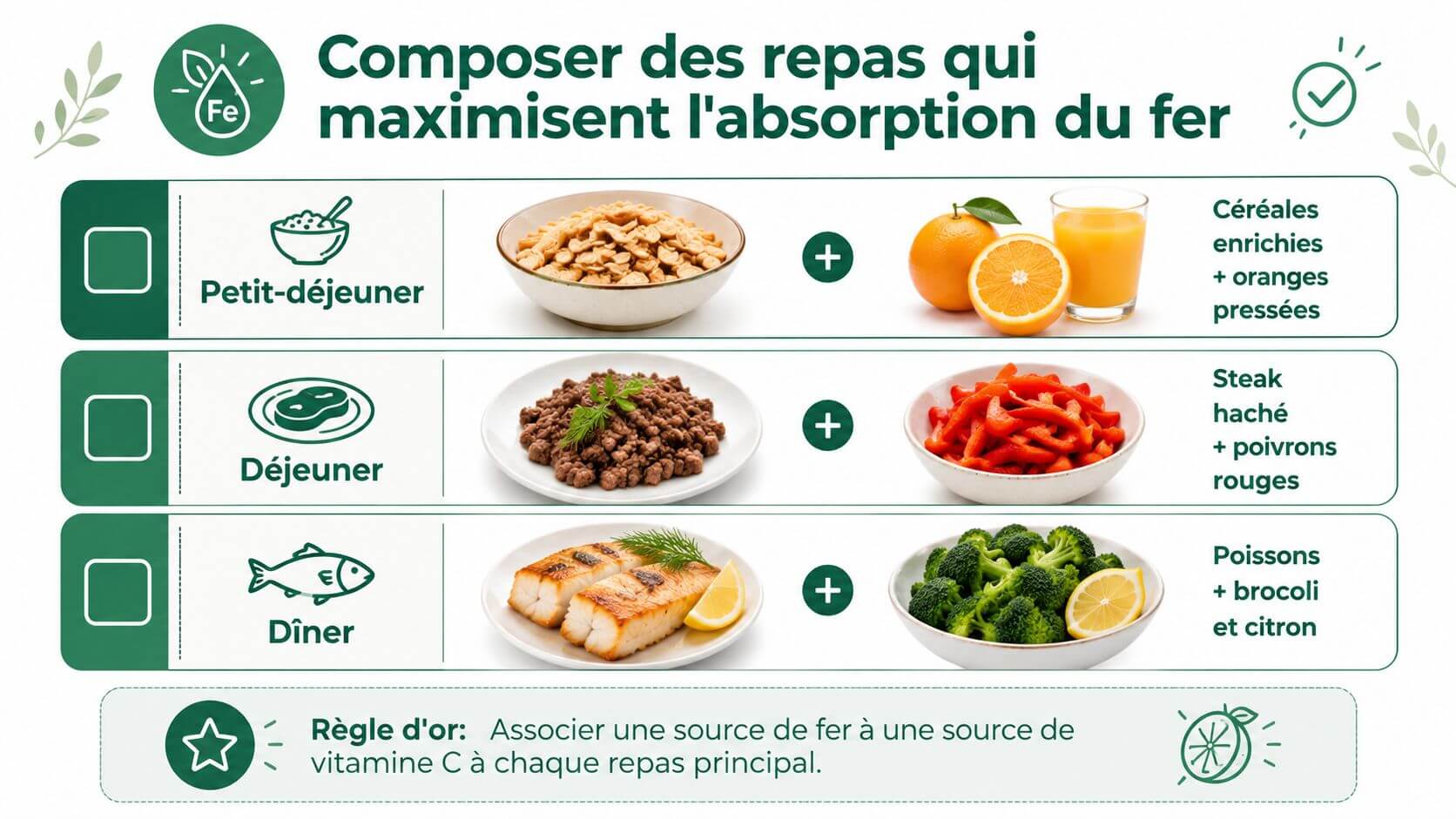
Associate an iron source with a source of vitamin C in the same main meal. This is the most useful logic for a daily home, especially with the more fragile plant sources at absorption (WHO, anemia profile). A fish fillet with broccoli and lemon, a beef pan with peppers, or lentils with orange quarters work better than an isolated food.
Drinks also count. Tea, coffee, cocoa, sound and calcium can slow absorption if they are taken at the same meal (WHO, anemia profile). This does not mean that they should be banished, but that they should be placed at a distance from the moment when iron is to be preferred.
Well, that's useful. Separate the coffee from the iron-rich breakfast, and keep the milk for another time if the main meal is centered on iron.
Very concrete examples over a day
At breakfast, enriched cereals can be accompanied by oranges or kiwi. At lunch, a lean chopped steak with red peppers ticks the right combination. At dinner, a fish with broccoli and lemon remains simple to prepare and goes in the right direction.
For a vegetarian menu, vigilance must be greater, because non-heminian iron requires more support. A bowl of chickpeas, tomatoes, parsley and lemon juice remains more interesting than a legume dish served alone with tea just after.
Organize meals without complicating the kitchen
The most useful coordination is often due to small habits:
- Breakfast. Put iron on the menu with a fruit rich in vitamin C.
- Lunch. Keep the drink warm for later if the meal is centered on iron.
- Dinner. Place on an iron-rich protein and a coloured vegetable.
- Collation. Place dairy products away from the main meal if necessary.
The meal then becomes a support tool, not a suite of interdicts. It is all the more important when several relatives take turns, because each can follow the same logic without having to learn a complicated protocol.
Ideas received and limits of diet alone
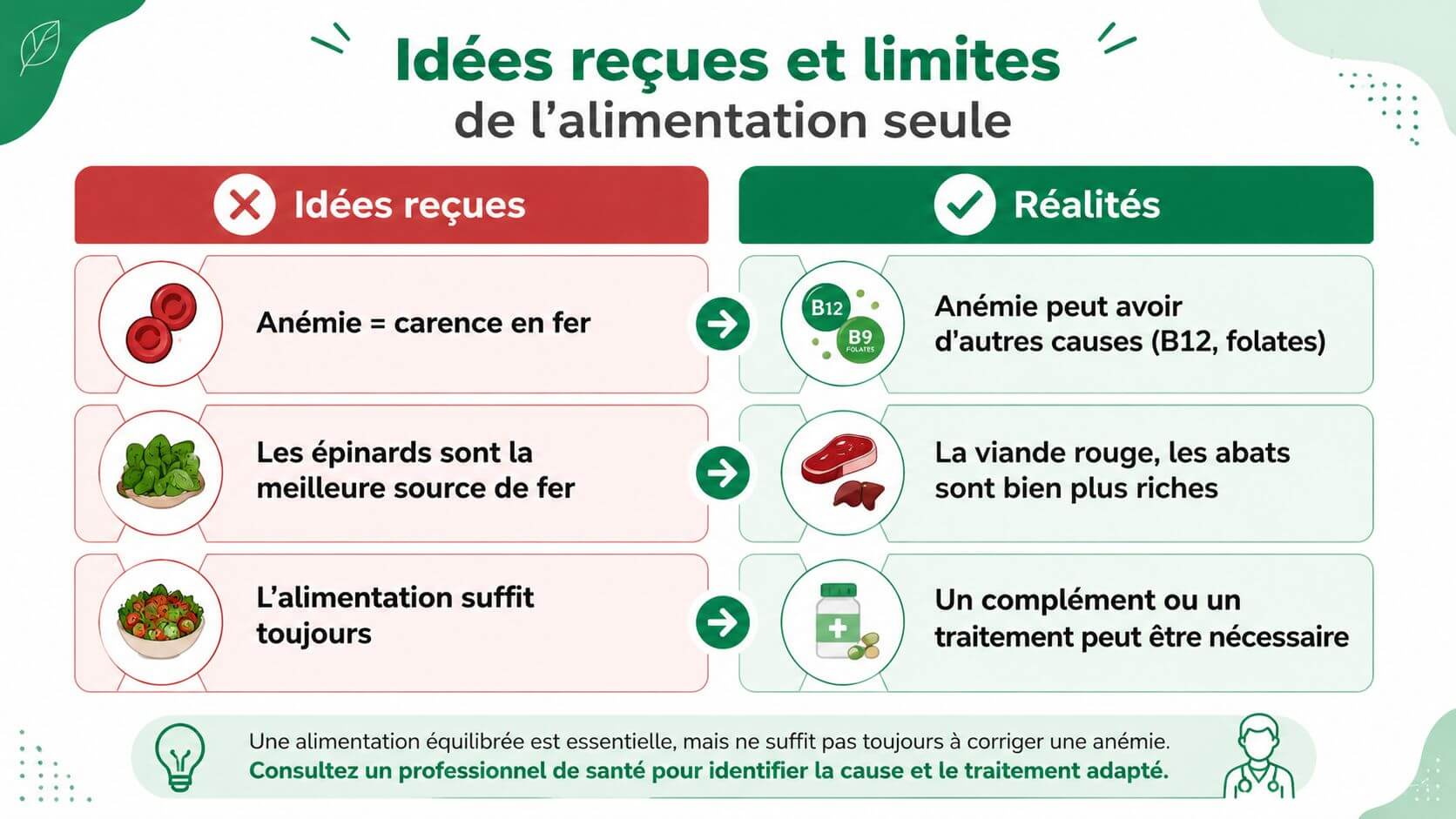
Many families speak of anemia as if it were necessarily the same as an iron deficiency. This shortcut is misleading. The French records recall that anemia may also require injections of iron. folates and in vitamin B12, not only in iron (MedecinDirect, anaemia).
Three ideas that often come back
The first mistake is to believe that anaemia is always corrected with a better plate. In reality, a well-thought-out diet helps a lot, but it does not replace a diagnosis if the deficiency is installed. The second mistake is to believe that spinach is the best source of iron, while animal sources are richer and more directly usable.
The third mistake is to think that a supplement is taken to feel. On the contrary, French sources point out that a medical opinion is necessary if the situation exceeds the simple dietary adjustment (MedecinDirect, anaemia).
Profiles that deserve more vigilance
Some people are more exposed to the iron deficit, including the women with abundant menstruation, the vegan persons, the Older persons and patients with chronic diseases (CCPSC, a practical record for feeding when anaemic). In them, cooking is not always enough to explain persistent fatigue or associated signs.
If fatigue persists despite a correct diet, consider the balance sheet, not just the menu.
For caregivers, this nuance avoids two pitfalls. The first is to trivialize symptoms that settle. The second is to believe that a good meal by itself cancels an underlying medical cause. If you wonder about signs like tingling, another useful landmark is available here, with simple elements to monitor.
Coordinate meals and follow-up between caregivers
At home, the problem is not only to know what to cook. It is also to know who prepared what, what was eaten, and whether the meal really followed the correct logic. When several relatives relay, the information is quickly lost between a message, a call and a post-it on the fridge.
What to keep in common
A shared link book allows you to keep a simple and legible trace. You can note the meal served, the drinks taken around the meal, any forgets, and the remarks of the person on his appetite. This history avoids duplicates, like two caregivers who would revive the same supplement or serve the same food at the wrong time.
Coordination is particularly useful for meals that need to be spaced with tea, coffee or a dairy product. If a person eats breakfast late, then a light lunch, then a richer dinner, the information circulates better when it is written and dated.
Useful follow-up for caregivers
Professionals also need concrete elements. Knowing that a ill-eating patient is less useful than knowing the meals actually taken over a few days, the symptoms observed and the times when the shots were forgotten. Caregivers can thus convey a more accurate picture of the situation, without having to reconstitute everything at the time of the appointment.
To structure this transmission, a tool of type transmission logbook remains very practical. It helps to circulate information without distorting it, especially when visits are alternated between family, nurse, home care worker and treating physician.
How to avoid oblivion in everyday life
The same principles apply to supplements, meals and appointments. A shared picture or a dedicated application may indicate that a meal has been skipped, that a supplement has not been confirmed, or that a home visit has been modified. This rigour does not replace the care, but it supports continuity.
A good organization also keeps track of drugs and medications. A tool like a pilelar morning night may be useful to avoid confusion when several treatments coexist with diet.
When to consult and what to pass on to the doctor
There are signs that food self-management should be lifted and consulted. Persistent fatigue despite better balanced meals, unusual shortness of breath, marked paleness or dizziness deserve medical advice, especially if the person is already fragile. Anemia is not only judged at the table, it is confirmed with a balance.
The items to note before the appointment
The doctor will be better armed if you bring precise facts. Prepare the history of meals over several days, the supplements taken, the drinks consumed around meals, and the biological checks already made if they exist. The list of symptoms, with their evolution, also helps to make the difference between ordinary fatigue and the situation that requires treatment.
Here are the most useful points to convey:
- Typical food. Which is eaten at breakfast, lunch and dinner.
- Let's drink around the meals. Tea, coffee, cocoa, milk, depending on the moment.
- Symptoms. Fatigue, shortness of breath, paleness, dizziness, decreased appetite.
- Background. Abundant rules, plant diet, chronic disease, advanced age.
Why this sharing changes the sequence
A doctor does not rely on a general impression, but on a set of clues. When caregivers note what was actually served and actually eaten, the balance sheet is clearer and the treatment adjustment becomes simpler. It also helps to distinguish a feeding fatigue from a problem that requires more specific treatment.
If you need to prepare this appointment quickly, the most effective remains to centralize the information in a single space, then resume it calmly with the professional. To go further in this organization, a structured link book can facilitate sharing between relatives and caregivers.
If you are coordinating a loved one at home and want to make the follow-up of meals, take-ups and transmissions more reliable, discover Tribulys. This can help you keep a simple, shared and dated record of what has been given, eaten and reported, to ease the mental burden of the entire family.
Put this organisation into practice with Tribulys
Keep your care journal, shared calendar, tasks, medication tracking and emergency information together. Start for free and invite the relatives and professionals involved in your loved one’s care.