
You may already have this very concrete reflex, compare three offers, find a price that seems reasonable, then ask yourself if it really covers your home, your habits and the risks of your neighbourhood. This is often where the doubt arises, because a quote for home alarm It's not a simple total at the end of a table. It's a commitment on hardware, laying, sometimes telemonitoring, and especially on the real cost that you're going to bear in the long term.
In France, the subject has become very structured. domestic security market a achieved EUR 1.2 billion at the end of 2022 and progresses by about 10% per year according to data reported in France, while 45.2% of respondents declare that they are equipped with a Anti-intrusion alarm in this synthesis published in France. In other words, we are no longer talking about a marginal purchase, but about a mass market where offers are standardised, therefore comparable, provided we know what to look at.
Contents
- Contents
- Why an alarm quote is more than just a price line
- Prepare your request for a fair and accurate estimate
- Decrypt a quote for home alarm line by line
- Essential criteria for comparing several offers
- The decisive questions to ask the installer
- Template of request for quote and next steps
Contents
- Why an alarm quote is more than just a price line
- Prepare your request for a fair and accurate estimate
- Decrypt a quote for home alarm line by line
- Essential criteria for comparing several offers
- The decisive questions to ask the installer
- Template of request for quote and next steps
Why an alarm quote is more than just a price line
A home rarely seeks an alarm because of pleasure. Most often there is a diffuse impression of vulnerability, frequent absence during the day, a little visible neighbourhood, an easy garage, or simply the need to protect relatives and property. At that time, the first reflex is to ask for a price, but the right reflex is to ask for a price. protection architecture.
The difference is important, because quote for home alarm does not only say how much you will pay today. It also says what level of service you buy, how the system reacts in the event of an alert and what you will have to settle later. That's precisely why the market has professionalised, with offers that range from the simple standalone kit to the solution connected with supervision in a market now well established.
A security purchase, not a equipment purchase
An alarm system has value only if it is suitable for housing. A single storey house, a condominium apartment, a secondary residence or a house with dependency do not call for the same answer. The correct estimate therefore reflects your real context, not a standard formula out of the catalogue.
Practical rule. The more the quote looks like a generic offer, the more the risk of misunderstanding on the final cost increases.
The presence of an alarm also has a concrete deterrent interest. According to a study cited in France, it can reduce the 13 % the risk that a house will be chosen by burglars and lower by 58 % the probability that a burglary will succeed according to Generali. It is not a magic promise, but it reminds one thing simple, the cost of installation must be weighed against the protection actually provided.
For a home where security must also protect the continuity of daily life, some readers also look at the principles of home organisation, as would be the case for a family coordination system, e.g. via this resource dedicated to home care. The logic remains the same, not just a tool is chosen, a working framework is chosen.
Prepare your request for a fair and accurate estimate
Before calling an installer, you must already know its land. Many quotes are unclear because the individual has not sufficiently described his accommodation. The more precise the request, the more comparable the offers received will be and the less surprises you will have at the time of pose.
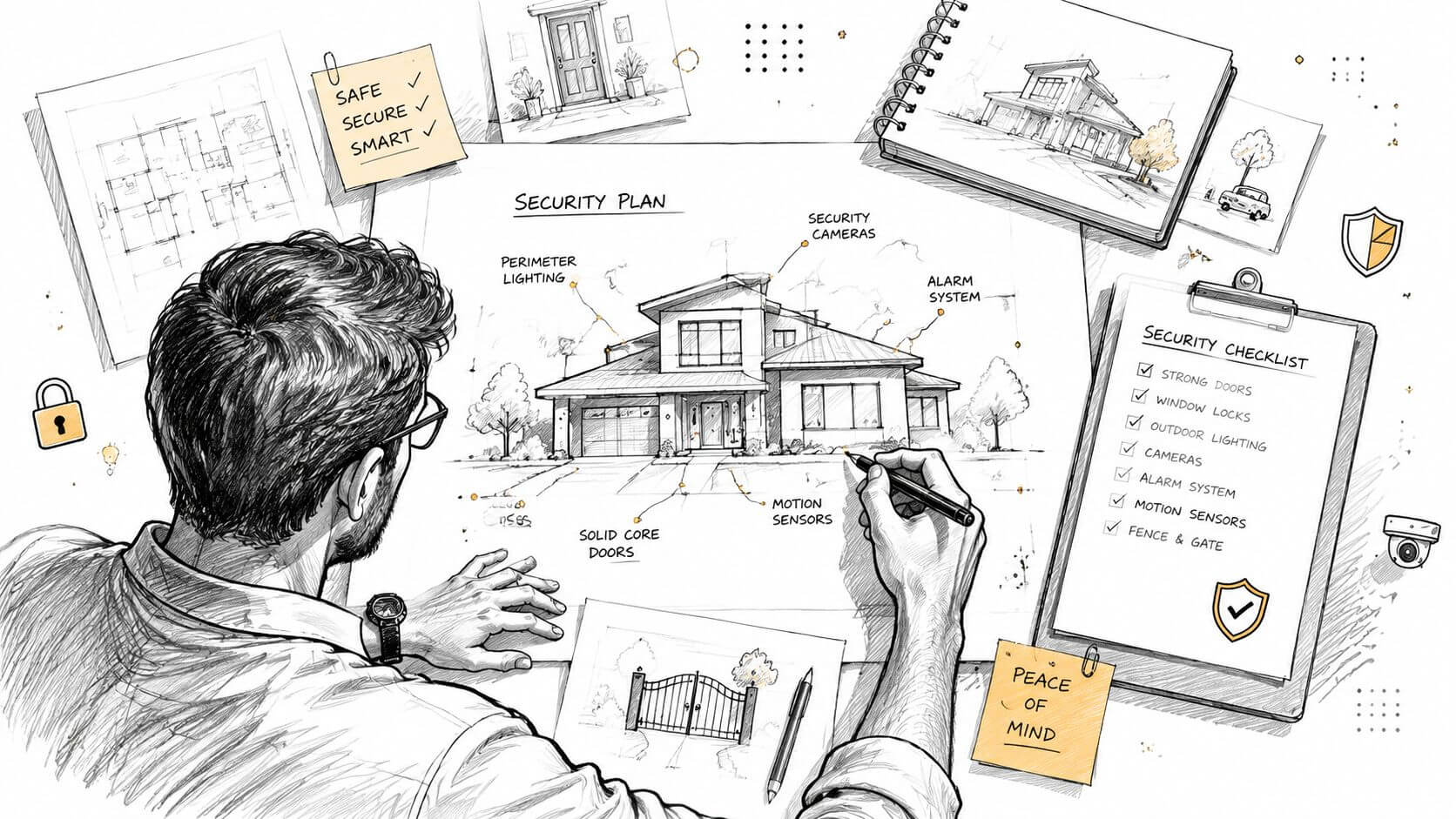
What needs to be noted before asking for a price
Start by noting the elements that really change the encryption. No need for a technical file, but a clear view of access and usage.
- Area and organization of housing. Note the levels, corridors, annexes and areas of passage.
- Access points. Count the doors, windows, windows, garage access and possible secondary openings.
- Presence of animals. This is essential to avoid poorly adjusted detectors and false alarms.
- Living habits. Telework, regular absences, variable hours, secondary residence, everything changes the logic of protection.
- Complementary needs. Smoke detection, outdoor siren, remote control, or raised doubt.
This preparatory work is not bureaucratic, it is used to build a coherent estimate. When you know what you are protecting, you can ask for a targeted response rather than a sale of accessories.
Why this preparation improves the estimate
A well thought out alarm does not need to be oversized to be useful. The data relayed in France show that it can reduce the risk of selection and the probability of the outcome of a burglary according to the study cited by Generali. This makes sense for a precise diagnosis, because the quality of placement and setting counts as much as the presence of equipment.
In practice, a serious professional is interested in access, traffic within the house and areas that are really vulnerable. The more structured your request, the more detailed the estimate will be, and not only the equipment sold.
Decrypt a quote for home alarm line by line
One quote for home alarm Readable must separate three blocks, hardware, installation and services. It is only at this level that you can compare two offers honestly. Otherwise, you may compare a naked kit with a complete installation, which distorts everything.
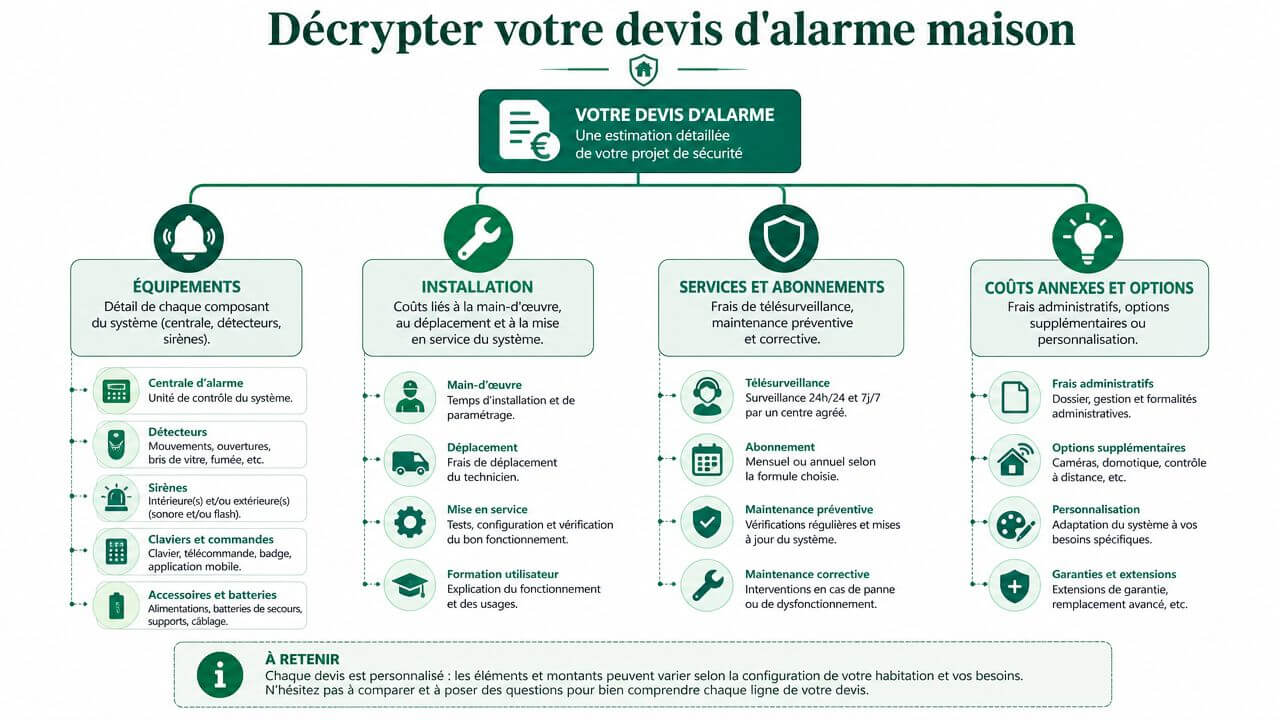
The material doesn't say everything.
The first visible line often concerns the power station, the detectors and the siren. It is the easiest part to display commercially, but it does not yet give the actual cost of the installation. French price guides indicate that the total cost of a standard configuration lies between 400 and 1 600 €, with a labour force which may represent 300 to 1 500 € by surface and complexity according to Works.com.
What we often forget is that the equipment alone does not necessarily cover the needs of installation, configuration, testing and parameterization. If the estimate only mentions a kit without specifying the installation, it is incomplete.
The situation changes considerably the budget
The labour force is not a detail. The same French price guides place the technical service around 50 to 120 €/h, and the overall cost of installation depends on ease of access, wiring and technical configuration according to Works.com. A more complex house, with several levels or difficult passages, takes more time and costs more.
For an individual, the classic trap is to ask for a price without specifying the constraints of the dwelling. The professional then encrypts a "standard" installation, then adjustments appear later.
Point to watch. A vague quote on the laying often ends up costing more than expected, even if the starting price seemed attractive.
Recurring services change the real cost
When there is telemonitoring, the estimate must specify the subscription. The ranges found in France often mention 20 to 40 €/month in the market prices synthesized by Travaux.com. This item is decisive, because it adds to the initial cost and turns the purchase into a sustainable expenditure.
This is also why a quote must be read with a logic of Total cost of possession. The material may seem accessible, but the installation, the services and the duration of engagement completely change the equation. Many naive comparisons stop at the kit, while the useful invoice starts after.
The same logic can be found in home helpers or follow-up solutions, as with this practical guide on the fall detector, where the device alone does not say anything about the actual use. For an alarm, it is the same, the system counts as much as its operation.
Essential criteria for comparing several offers
Comparing two quotes does not mean taking the cheapest price. You have to check what the offer covers, how it works and what it will cost you in the long term. At close prices, two systems can be very different in quality of use.
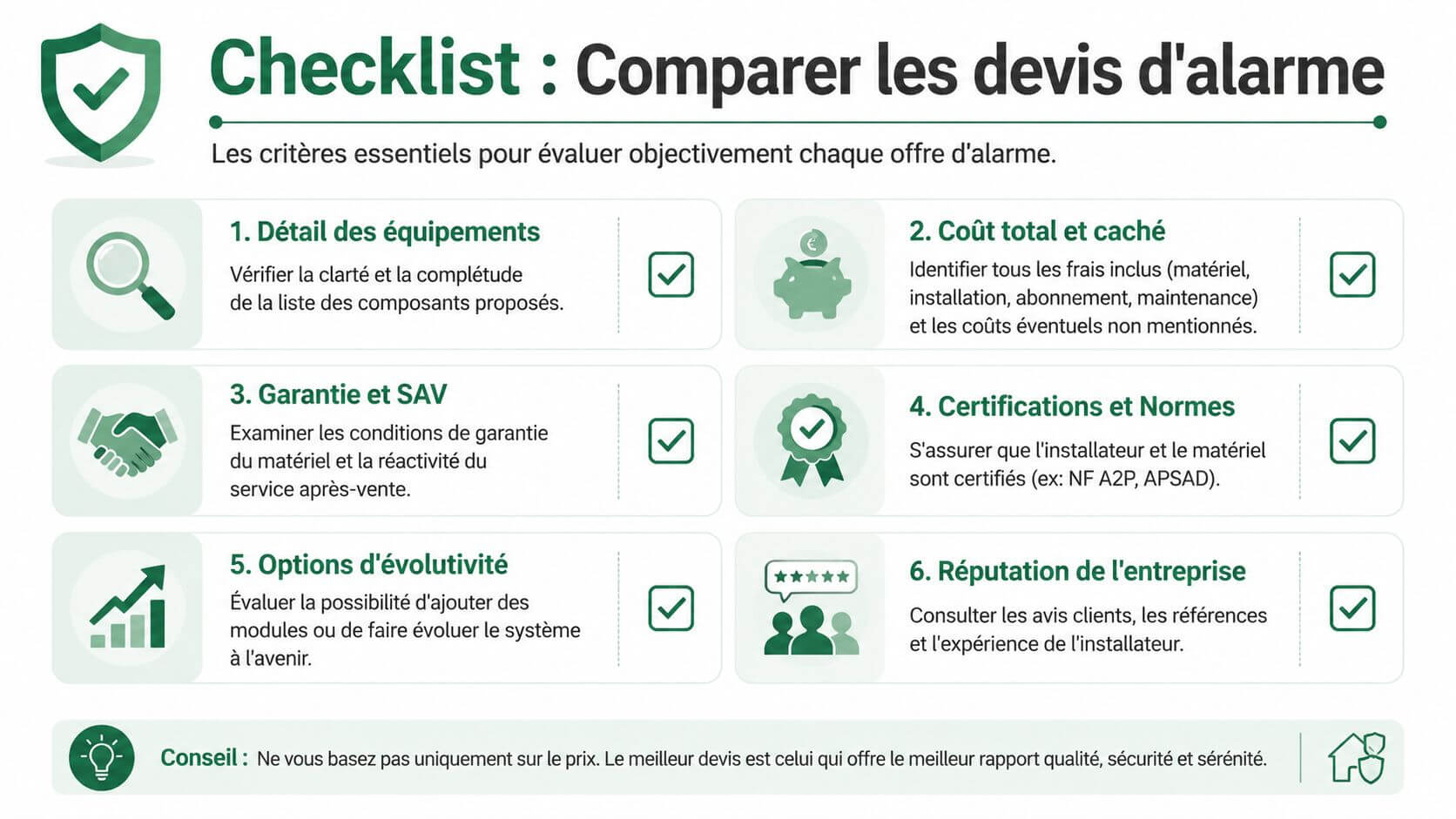
Technical composition
The first point to be checked is the nature of the system. Wired or wireless, it is not only a preference for comfort, it is a choice that changes the pose, scalability and sometimes maintenance. For a house of 100 m2, the market benchmarks indicate that a solution wireless often lies between 600 and 3 500 € installation included, with consumer kits that can start around 199 € but complete professional systems that quickly rise to 1 200 to 1 800 € according to Prix Pose.
The problem is not the displayed price of the kit, it is the lag with the system laid and usable. Compare only the purchase price can under-estimate the final budget of 30 to 60 % according to the same price benchmark.
The logic of supervision and service
A serious estimate must also say what happens after the alarm. Who receives the alert? What checks are made? What are the deadlines for intervention? These elements are not marketing, they condition the value of the contract.
You also need to look at the warranty, assistance and maintenance modalities. A lower price can hide a slower after-sales service or unannounced travel costs. The most interesting estimate is not the one that minimizes everything, it is the one that makes each post explicit.
Hidden costs to be identified
Before signing, look for missing lines as well as the lines present. A too short estimate may omit the commissioning, accessories, batteries, system evolution or even some transmission options. This is where the most expensive deviations slip.
- Detail of the equipment. Check the exact number of detectors, the presence of a siren and any communication modules.
- Total and hidden cost. Control pose, subscription, maintenance and any associated costs.
- Guarantee and VAS. Look at the duration, the perimeter covered and the announced reactivity.
- Evolutivity. Ask if you can add areas or accessories without replacing everything.
A good comparison does not only oppose two prices, it opposes two levels of clarity.
The decisive questions to ask the installer
The appointment with the installer must help you to lift the shadows, not to sign under pressure. A good professional answers simply, precisely, and without escaping the contractual subjects. A bad estimate often recognizes how certain questions are circumvented.
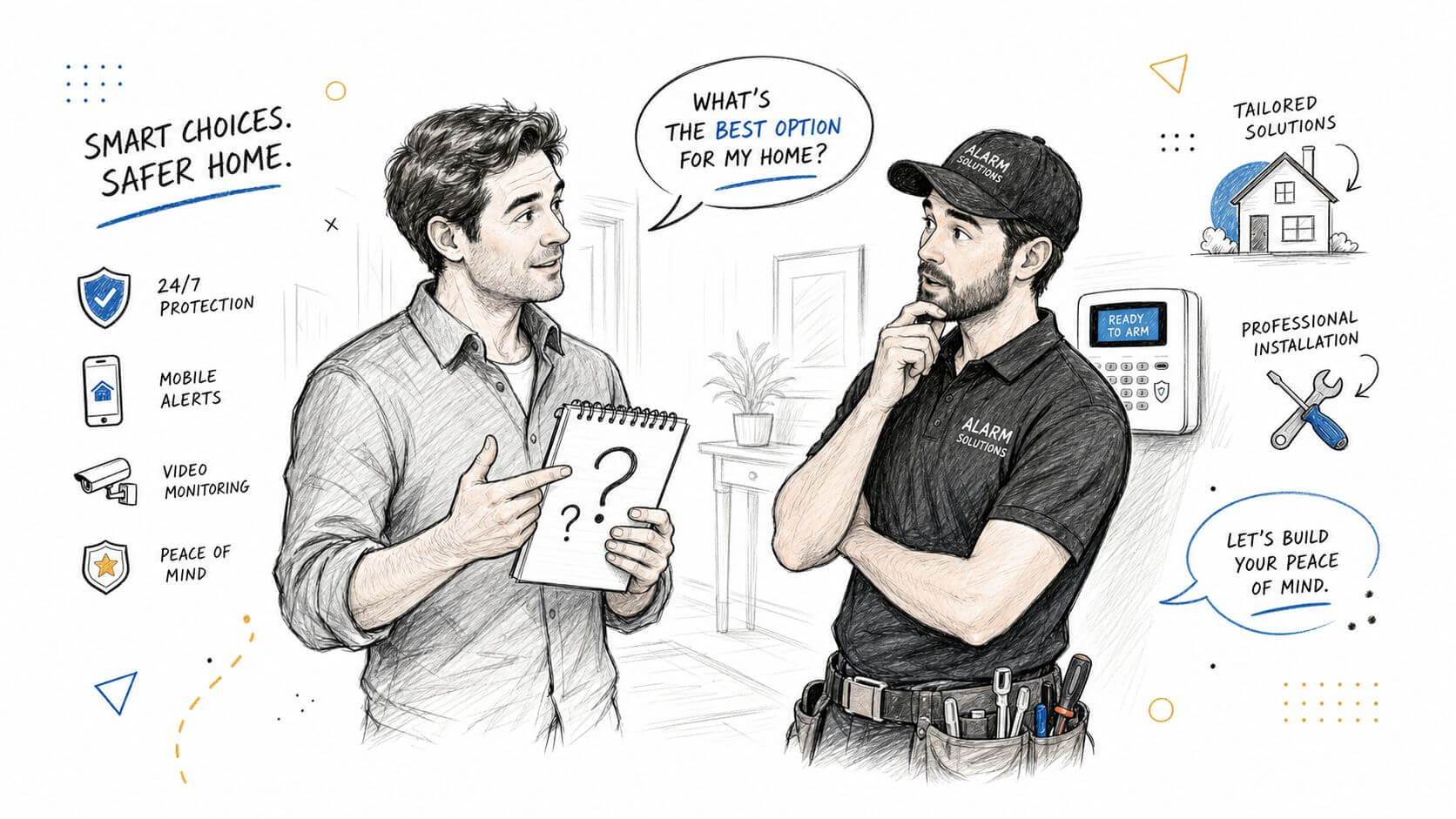
The questions that reveal the true cost
Start with the operating points. If there is a power or internet outage, what is still active? How does the system switch to a backup mode? Who is warned if a power outage is triggered, and in what order? These questions avoid bad surprises on days of failure.
Then ask what is included in the price. Are setting, testing, use training, initial assistance and any updates included in the service? If the answer is unclear, the estimate is also.
- Power or internet cut. What happens to alert detection and transmission?
- False alarm. What is the procedure, and who contacts you first?
- Maintenance. What does the annual fee cover, and what parts remain at your expense?
- Termination. What duration of appointment exists, and what fees apply in case of early termination?
Contractual clauses to be read before signature
The subscription may seem modest initially, but it must be included in the overall calculation. The French market guides recall that the real cost over several years includes equipment, installation, monthly subscription, maintenance, battery replacement and possible termination fees. according to Sector Alarm. This is exactly the type of point that too commercial a quote minimizes.
To go further on the logic of notification and rapid response, some households also look at usages around a emergency call button, because the question is not just to alert, but to trigger the right reaction at the right time.
A transparent installer does not fear questions about duration of engagement, maintenance or troubleshooting logistics. It is even a good sign if he asks you for as much information as you ask him.
Template of request for quote and next steps
A good initial message saves both parties time. It avoids too generic answers and pushes installers to encrypt on a comparable basis. The idea is to ask for a complete offer, not a call price.
Here is a simple model to copy and paste.
Hello.
I wish to receive a quote for home alarm for accommodation located in [city].
The property includes [surface], [number of levels] and the following accesses to be protected: [doors, windows, garage, bay window, outbuildings].
I would like a proposal that clearly details the equipment, installation, possible options and, if any, the telemonitoring subscription.
Please also indicate the guarantees, maintenance, duration of engagement and possible termination costs.
I want to compare several offers on an identical basis before making my decision.
Regrettably.
The three points to consider
First, always compare total cost, not just the price of the kit. Then, require a readable quote that separates material, pose and services. Finally, ask questions that reveal the hidden costs, because this is where the difference between a good offer and a bad surprise is played.
Prepare your need, ask for detailed quotes, then compare them over time, not on the label. If you want to structure your search and centralize useful information at home, Tribulys can help you organize this follow-up on Tributelys.fr.
Put this organisation into practice with Tribulys
Keep your care journal, shared calendar, tasks, medication tracking and emergency information together. Start for free and invite the relatives and professionals involved in your loved one’s care.