
The scene is often the same. A prescription slides under an invoice, the care journal stays in the kitchen, the medical report sleeps in a room drawer, and when the nurse asks a specific question, no one knows where to look.
For a close helper, this disorder is not only annoying. It fatigues, wastes time and can blur the transmission of important information. Storage cabinet This is a very concrete problem. It turns a fuzzy pile into a readable, searchable and shareable file at the right time.
When it is thought of for the home, it becomes more than an office accessory. It serves as a common point of reference between the family, the workers and the accompanied person. And if it is associated with a simple, physical and then digital method, it greatly reduces the feeling of having everything in the head.
Contents
- Introduction to the storage cabinet
- Understand the interest of the storage cabinet
- Explore materials and dimensions types
- Organize the inside of the binder effectively
- Choose the appropriate binder for each use
- Storage and maintenance tips
- Associate physical binder and digital tools
- Conclusion on the use of the storage cabinet
Introduction to the storage cabinet
A good binder doesn't start with rings. It starts with a simple question. What information should be found without hesitation?
At home, this question changes everything. It is not only classed to clean up. It is classed to find a prescription before an appointment, check a treatment, show a history of constants or pass a record on to another close friend. The storage cabinet then acts as a table of contents of daily life.
For a helper, the utility is immediate. Instead of keeping some of the information in the memory, another on the phone and the rest in scattered papers, we gather the essentials in a single point. The binder becomes a bit like a central station. The documents arrive everywhere, but they then leave by well-identified ways.
A useful binder is not the one that contains everything. It is the one that allows to find the important without searching.
This logic is particularly valuable when several people intervene. The spouse, child carer, home care worker, nurse and physician do not need the same level of detail. On the other hand, they all need reliable information, placed in the right place and easy to understand.
Understand the interest of the storage cabinet
Storage is not a marginal mania. 62 per cent of the population moves to storage and classification at least once a week, which shows how much these actions are part of the daily lives of households (data relayed by Decision Purchases). This reflex is even more valuable when the papers relate to health, administration or follow-up of a loved one.
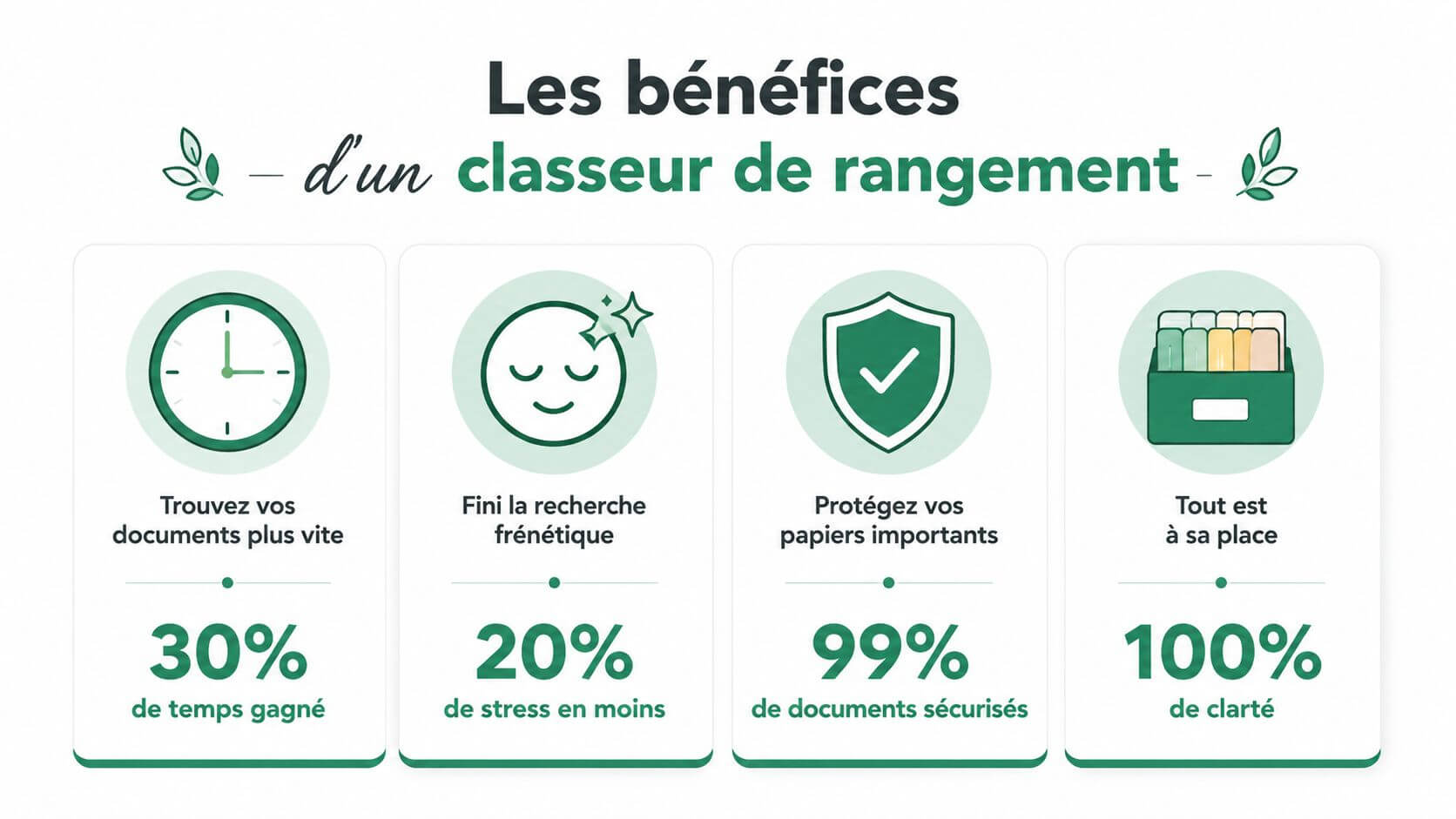
Find quickly instead of searching everywhere
Many readers still confuse store and organize. Stocking is stacking papers in a pouch or drawer. To organize is to decide a stable order. For example, orders on one side, reports on the other, and within each part a chronological classification.
This difference seems small. In reality, it changes the quality of the exchanges at home. When a document has a definite place, the answer comes faster and with less uncertainty.
Reduce mental load
The storage cabinet also relieves memory. You don't need to remember if the last balance sheet is in the blue shirt on the shelf or in the appointment bag. The rule replaces mental effort.
Here is what a well-thought-out binder allows:
- Centralizing the essentials to avoid dispersal between table, drawer, bag and telephone.
- Creating a common language between relatives and professionals, everyone knows where to look.
- Keep track of time useful for monitoring a situation over time.
- Preparing for emergencies with key documents accessible without connection.
Simple benchmark: If two different people do not place a document in the same place, the system is not yet clear enough.
For a helper, this point is decisive. The binder is not just an object. It is a visible method. And this visibility reassures, especially in times when information multiplys.
Explore materials and dimensions types
Not all binders do the same service. Some are for frequent consultation, others for archiving. Some support travel well, others remain more comfortable on a shelf. The right choice depends less on price than on the context of use.
Identify large families of binders
The ring binder is well suited to the documents consulted on a regular basis. It is easily added or removed. For an active tracking file, it is often the most flexible to live on every day.
The lever binder, on the other hand, inspires more archiving and stability. It welcomes a larger volume and keeps well in vertical storage. For completed files, balance sheets or complete administrative sets, it remains very practical.
Other formats useful at home can also be crossed:
| Type of workbook | Material | Format | Page capacity |
|---|---|---|---|
| Ring binder | Rigid or plastic cardboard | A4 or A5 | Low to medium |
| Lever binder | Reinforced cardboard, plastic, metal for certain systems | A4 | Medium to strong |
| Classification box | Cardboard or plastic | A4 | Variable by thickness |
| Divided Document Holders | Flexible plastic | A4 | Low to medium |
This table gives a first sort. Then, you have to look at the real rate of consultation. A binder opened every day does not have the same requirements as a binder of old pieces.
Select the material according to the context
The reinforced cardboard works well for a quiet domestic use. It protects the leaves properly and gives a good readability on the shelf. On the other hand, it is less resistant to moisture and repeated manipulations.
The rigid plastic is often more tolerant when the binder moves from the room to the living room, then to the vehicle for an appointment. It is easily cleaned and better resists small incidents of everyday life.
The metal It can be seen mainly in mechanical parts or in more solid archiving solutions. It brings hold, but also increases weight. For a caregiver who transports the record, this detail counts.
Choose the material as you would choose a jacket. An elegant jacket to stay at home is not necessarily the best to go out every day.
Understand the width of the back
The width of the back is one of the most misunderstood points. Many buy a little wide in case of when, then end up with a bulky binder, poorly filled and difficult to flip. Conversely, a too thin back compresses the pockets and fatigues the mechanics.
For a fairer choice, one can rely on a concrete benchmark. 5 cm back is dimensioned for less than 250 pages, while a 8 cm back is appropriate for more than 400 pages (benchmark given by BJ Buro).
In practice:
- Small live volume. Routine follow-up with recent orders, some reports and a light administrative part can hold in a moderate back.
- Large historical record. If you keep balance sheets, reviews, binding sheets and old copies, a larger back becomes relevant.
- Mobile use. The thicker the binder, the more it weighs and the less it circulates easily.
Many families gain to separate into two blocks. An active binder for the present, an archive binder for what to keep without consulting it every week. This division avoids the entire cabinet effect in a single volume.
Organize the inside of the binder effectively
An empty binder is a shell. What makes it effective is the interior architecture. Without structure, even a beautiful model quickly becomes a stack of perforated sheets.
Create a simple and stable structure
In the school context, a proven method recommends starting with four or five interlayers and to devote 15 minutes every Friday night, or about 90 minutes per month, to keep the binder operational (method described by Superprof) This logic adapts very well to the home.
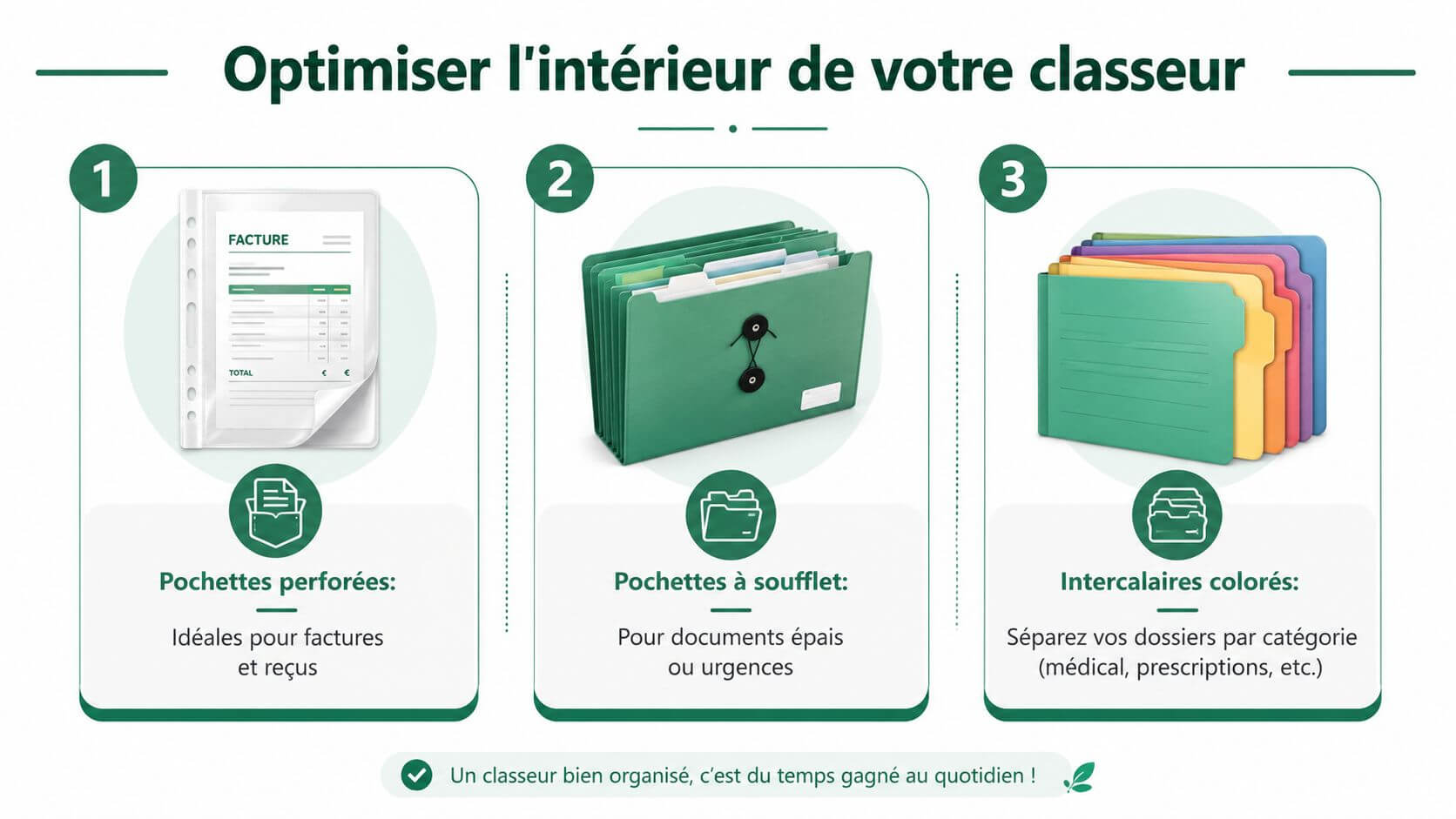
For a caregiver, a clear basis may look like this:
Emergencies
Here, insert the relevant form in case of an urgent call, the essential contacts and the documents to be shown immediately.Treatment and prescriptions
Consolidate current requirements, renewals and catch notes.Rendezvous and proceedings
Sort out reviews, reviews, specialist visits.Daily monitoring
Liaison diary, observations, constants, dated remarks.Administrative
Mutual, mail, aids, practical documents.
The key point is not to multiply the headings. It is to avoid blurred headings such as "various" or "classified", which quickly become fog zones.
Set up a short routine
The best storage is one that can be maintained even one evening of fatigue. A short routine is better than a large rare session.
Here is a realistic routine:
- Empty flying papers in the binder once a week.
- Remove duplicates Before they accumulate.
- Rank from oldest to most recent in each part to read the evolution without confusion.
- Label pouches using simple words. “Current prescriptions” works better than “Medical 2”.
For regular transmissions, some caregivers use a planning medium in parallel. One home help schedule can be used as a complementary reference to link paper documents to passages, tasks and appointments.
If you hesitate between two headings, choose the one where another person would spontaneously think about looking.
The perforated pouches are suitable for simple sheets such as invoices or prescriptions. The bellow pouches are useful for thicker documents, envelopes or pieces to be kept together. The coloured interlayers, on the other hand, play the role of indicator panels. They avoid reading each label one by one.
Choose the appropriate binder for each use
Many guides explain how to choose a binder for the school or office. They talk less about home maintenance. However, this framework imposes specific constraints. Bruneau, the lack of guidance on adapting storage cabinets to this context creates a real need for family caregivers faced with the dispersion of medical information.
Read the need before buying
Before you buy, ask yourself three questions.
The first concerns the nature of documents. Simple sheets, orders in several pages, thick pouches, documents to sign, results to keep for a long time. Not all occupy the same space or request the same frequency of access.
The second concerns the rate of use. A daily consultation binder must open easily, remain legible and support repeated manipulations. An archive binder can favor capacity and shelf holding.
The third touches on the mobility. If the file often accompanies a relative to appointments, the weight, closure and rigidity become more important.
A useful grid for home care workers
In the home, the most effective is often to evaluate the binder as a coordination tool, not as a mere supply.
Here is a practical grid:
| Criterion | What to observe | Why is it useful at home? |
|---|---|---|
| Quick access | Simple opening, visible interlayers | Allows several people to spot themselves quickly |
| Robust | Solid cover, stable rings | Supports repeated manipulations |
| Lisibility | Back label, clear sections | Reduces classification errors |
| Transport | Reasonable weight, good maintenance closed | Facilitates travel on an appointment |
| Customization | Easy addition of pouches and headings | Adapting to changing circumstances |
A good example. If you manage a daily follow-up with transmissions, drugs and appointments, an overly administrative file becomes difficult. Conversely, to store mostly past records, a very mobile model does not bring much.
To clarify what is involved in daily exchanges, many families find it useful to distinguish the documentary binder from a transmission logbook. The first one keeps the pieces. The second one is used to circulate the living information.
Attention: If your binder mixes archives, emergencies and notes of the day without clear separation, it becomes difficult to share.
The right choice is therefore not the greatest or the most resistant. It is the one that corresponds to the real gesture of the person who uses it.
Storage and maintenance tips
A well-organized binder can become less useful if it is poorly placed or poorly maintained. At home, the location influences both efficiency and internal structure.
Choose the right location
Home security studies show that 30% of accidents among seniors the storage area of the medical documents, in particular because of difficult access or poor organization (information taken by Aosom) This number recalls one simple thing. The binder must be accessible without becoming an obstacle.
Avoid places that are too low if the person with the attendant leans hard. Also avoid unstable batteries, radiator tops, window edges and congested furniture. A good location is legible, dry, stable and known to all useful stakeholders.
Some practical benchmarks:
- Near the coordination area. Often a dedicated table, entrance furniture or a quiet office.
- Outside wetlands. Kitchen and bathroom quickly weaken the papers.
- Simple height of accessNot too low or perched.
- Separated from unimportant papers. The tracking binder must not disappear in the middle of the advertising mail.
Maintain without complicating
The maintenance remains sober. Make sure the rings close properly, the pouches do not tear apart and the interlayers still hold their marker role. If a tab folds, replace it quickly. A small visual defect can slow everyone down.
Clean the exterior with a soft cloth slightly adapted to the material. For the inside, the main thing is to avoid accumulation. A storage cabinet works better when you regularly remove what is no longer useful in immediate access.
A worn binder does not only hinder aesthetics. It slows down gestures, especially when it is necessary to act quickly.
Also think about reviewing the content with every major change. New treatment, new provider, return to hospital, change of contacts. The binder must follow the reality, not an old version of the situation.
Associate physical binder and digital tools
The paper reassures because it sees itself. Digital helps because it circulates. The two together often form the strongest method at home.
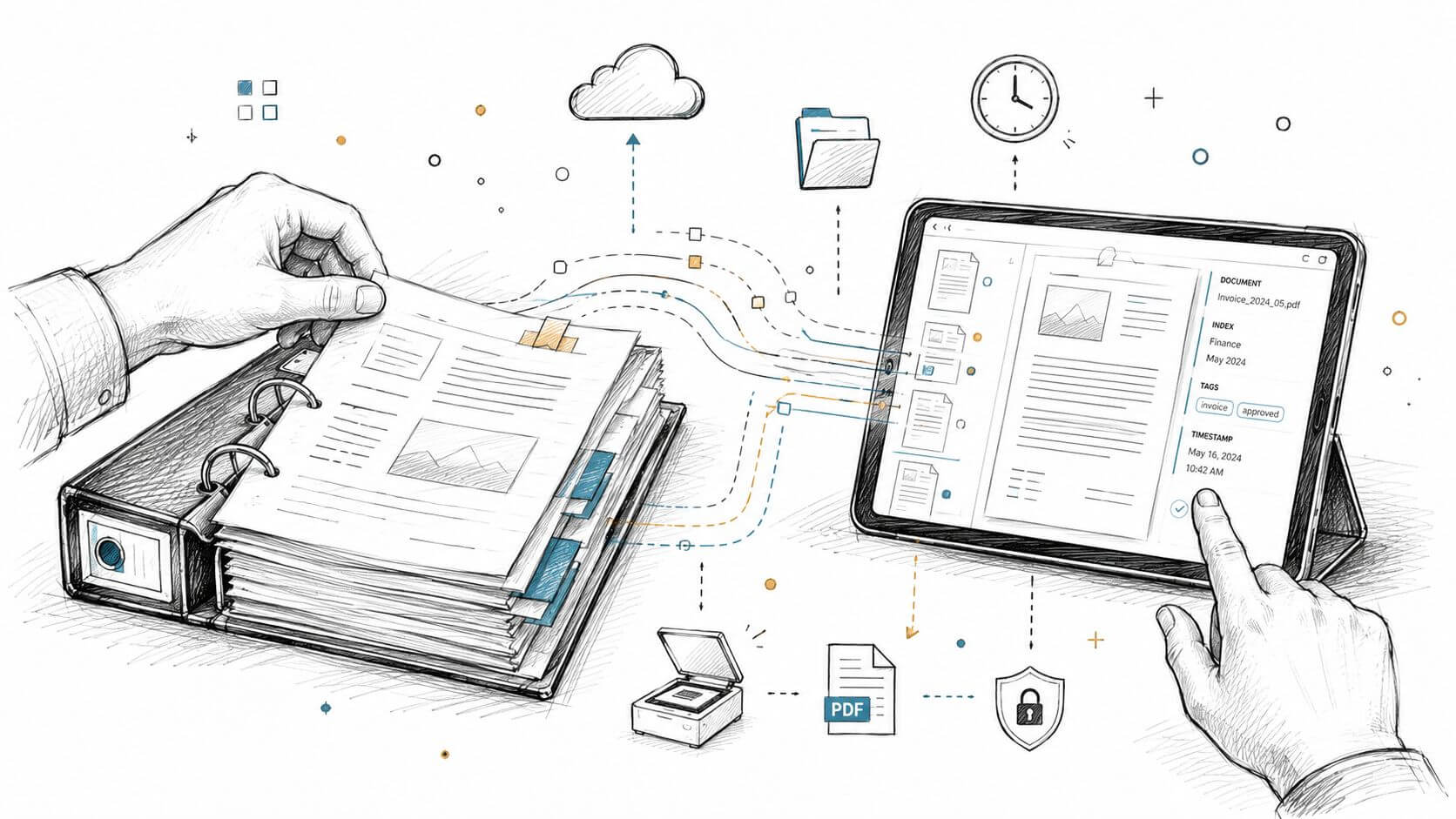
Create a paper screen duo
The simplest method is to make the physical binder the visible base, then digital shared memory. In concrete terms, you keep on paper the documents that must be consulted immediately at home, then you digitize those that must also be accessible remotely.
For example, a recent order may remain in the section "Treatments", while its digital copy joins a space shared with clear date and title. Same logic for a report, emergency record or important transmission.
This joint avoids two common pitfalls. On the one hand, the all-paper becomes difficult to share when a helper is at a distance. On the other hand, the all-digital can be less practical when a person present on the spot needs a document right away.
For collaborative follow-up, a digital care journal can complete the binder by giving continuity to observations, messages and dated traces.
Know what to keep on paper
Everything does not deserve a double presence. Keep in physical version what must remain available without delay or depending on a screen. First digitize what benefits from a sharing, history or remote consultation.
A simple rule can help:
- Priority paper for emergencies, exhibits to be shown on site, documents often manipulated.
- Priority Digital for history, exchanges, follow-up to be consulted by several people.
- Double presence for critical elements.
A visual demonstration often helps project this hybrid organization:
The decisive point is not technology. It is coherence. If paper and digital tell two different versions, the tool becomes a source of doubt. If both respond, the system becomes more reliable.
Conclusion on the use of the storage cabinet
The storage cabinet remains one of the simplest tools to regain control of scattered documents. Well chosen, well structured and regularly maintained, it helps to quickly retrieve useful information, communicate more clearly and alleviate the mental burden at home.
For caregivers, the real step forward is not to oppose paper and digital. The paper sets the benchmarks. Digital prolongs access, memory and coordination. Together, they form a concrete, reassuring and lasting method.
If you are looking to go further in this hybrid organization, Tribulys makes it possible to centralize care journal, medicines, calendar, documents and emergency card in a shared space designed for home maintenance.
Put this organisation into practice with Tribulys
Keep your care journal, shared calendar, tasks, medication tracking and emergency information together. Start for free and invite the relatives and professionals involved in your loved one’s care.