
You may be choosing the location of a camera, with a map of the premises in front of you, wondering if security is enough to justify the device. At the same time, an employee may already fear being filmed too widely, or a close home helper may wonder if a camera in a private dwelling crosses a red line. Law on Occupational Surveillance Cameras is not there to ban any protection, it imposes above all a simple rule, useful filming, not filming everyone all the time.
In fact, the difficulty comes not only from the installation. It also comes from the way the employer explains the device, limits the filmed areas, manages access to images and respects privacy in sensitive spaces. In France, CNIL recalls that video surveillance at work cannot be General and Permanent, that she must remain justified and Proportional for the purpose pursued, and that certain areas should not be filmed, such as toilets, changing rooms, break rooms and trade union premises CNIL.
Contents
- Contents
- Introduction to the legal framework
- Understanding the key principles of the law
- Obligations of information and consultation
- Limitations on monitoring and privacy
- Preservation and security of images
- Penalties and case law
- Specificities for Home Caregivers
- Practical checklist and templates for compliance
Contents
- Introduction to the legal framework
- Understanding the key principles of the law
- Obligations of information and consultation
- Limitations on monitoring and privacy
- Preservation and security of images
- Penalties and case law
- Specificities for Home Caregivers
- Practical checklist and templates for compliance
Introduction to the legal framework
An operating manager sometimes wants to avoid a flight, reassure his teams and protect a sensitive stock. The legal framework does not look at the intention alone. He asks for a clear justification, as if an additional lock were installed, not to monitor the entire house, but to protect a specific door. As soon as a camera is placed to continuously control a workstation, or when it is placed without prior information, the device changes its nature and becomes questionable.
French law is based on several texts, including: Labour Code, GDPR, Civil Code and Criminal Code. Their common point is simple, the protection of the person must remain compatible with the objective pursued. The CNIL recalls that, when a camera filmes a place not open to the public, no CNIL formality is required, but the device must still be included in the register of salaries. This benchmark is useful, as it clearly shows that the lack of formality does not exempt compliance.
The concrete starting point
In an SME, a camera may be eligible near an entry or storage area, and then become problematic as soon as it turns to a continuously occupied office. Home Caregiver. A camera intended to protect an access or property may seem logical at first, and then raise difficulties if it filmes without distinction a living space, a frequent passage or a place where the person receiving care expects to be able to move freely.
So the real question is not just, "can we install a camera?", but "why this one, in this place, with that range, and for how long?". A camera works like a projector. Well oriented, it illuminates a precise area. Poorly oriented, she turns the whole room on.
Basic rule. The more the place is associated with intimate activity, rest or daily life, the closer the justification must be. A camera placed without precise logic exposes the employer to immediate challenge.
For both an employer and a home helper, the classic mistake is to believe that safety allows everything. In practice, the purpose, scoping and information given to the persons concerned must be checked from the outset. A safety purpose is more easily defended than productivity monitoring, which is often the first to be challenged, because it is less like protection than permanent control.
Understanding the key principles of the law
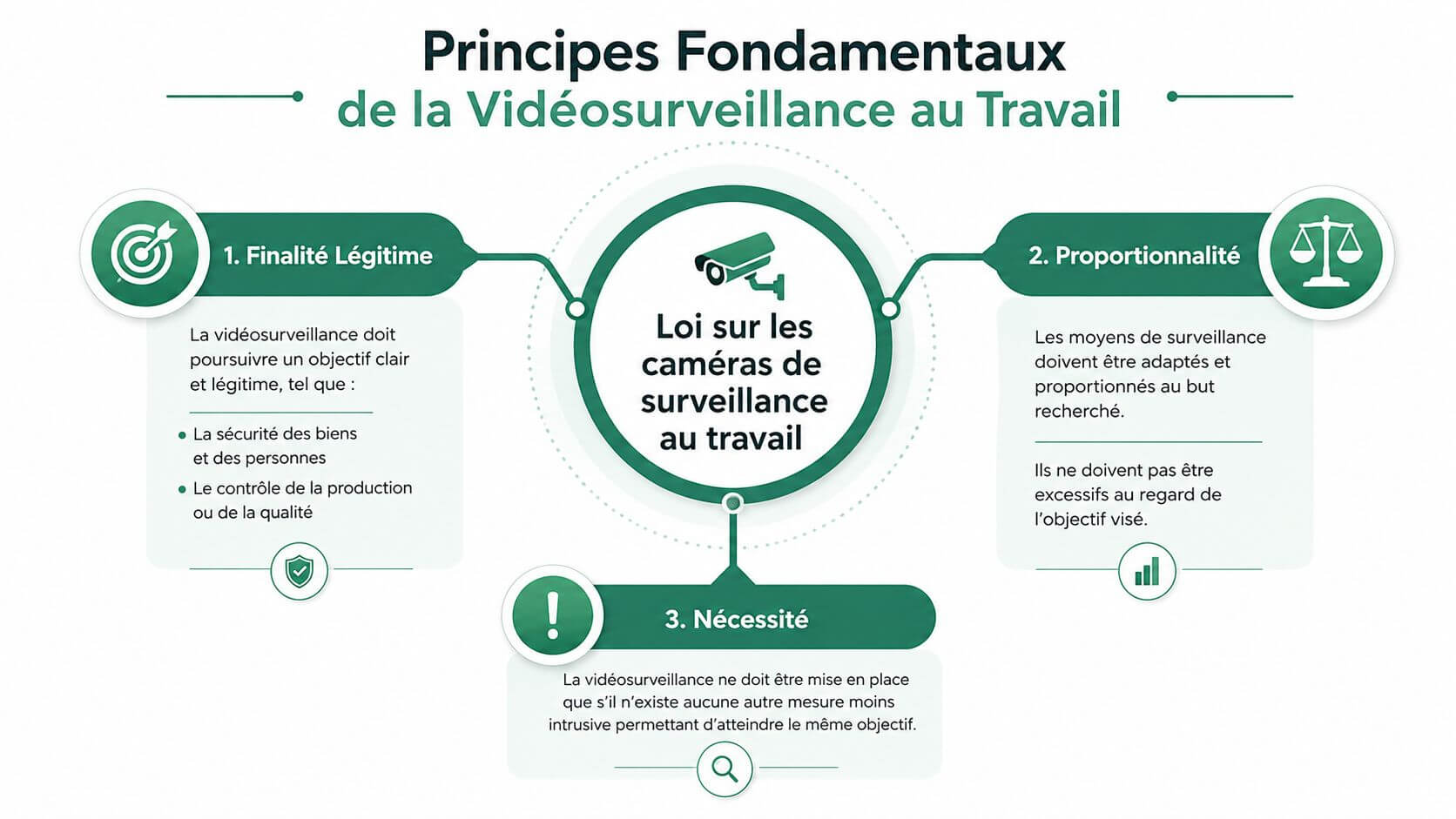
In a company as well as in the home of an assisted person, a camera is not justified because it exists, but because it meets a specific need. The regulation is based on three benchmarks which must move forward together: legitimate purpose, the proportionality and the need. Taken separately, they appear abstract. Together, they serve as a simple test, a little like a tricolor light that helps to know whether the device is going from green to red.
Legitimate aim
The first question to ask is direct, what is the purpose of the cameras? The purpose must be serious and identifiable, for example safety, prevention of theft or protection of sensitive information, as the sectoral framework referred to by Sector Alarm. A camera placed "to see what's going on" remains too vague. It's kind of like asking for a double key without explaining what door it needs to secure.
Proportionality
Proportionality requires keeping a reasonable relationship between the purpose pursued and the invasion of privacy. A camera directed to a caisse or access point can be consistent if it is used to limit a targeted risk. The same camera, if it covers an entire break room or a living space used by an employee or a caregiver, becomes much more difficult to defend. The idea is simple. The angle of view on the real need, not a desire to see everything.
Need
Necessity works as a common sense filter. If the risk can be reduced by a less intrusive measure, such as better access organization, suitable locking, or one-time human control, the camera must not become the default solution. This is often where folders become fragile, because a device may seem practical without being indispensable. home helperThis requirement is even more important, as a system designed to protect a good can quickly get into tension with normal circulation in housing, rest moments or everyday gestures.
Sensitive areas can be monitored more easily than ordinary spaces, but logic remains the same. What is filmed must be able to be explained, limited and justified.
CNIL also points out that sanitary facilities, changing rooms, rest rooms and, in principle, continuously filmed workstations should not be monitored. This border has nothing theoretical. It serves as a dividing line between targeted protection and control that encroaches too far on privacy, especially in places where the human presence is continuous or where privacy is most exposed.
Obligations of information and consultation
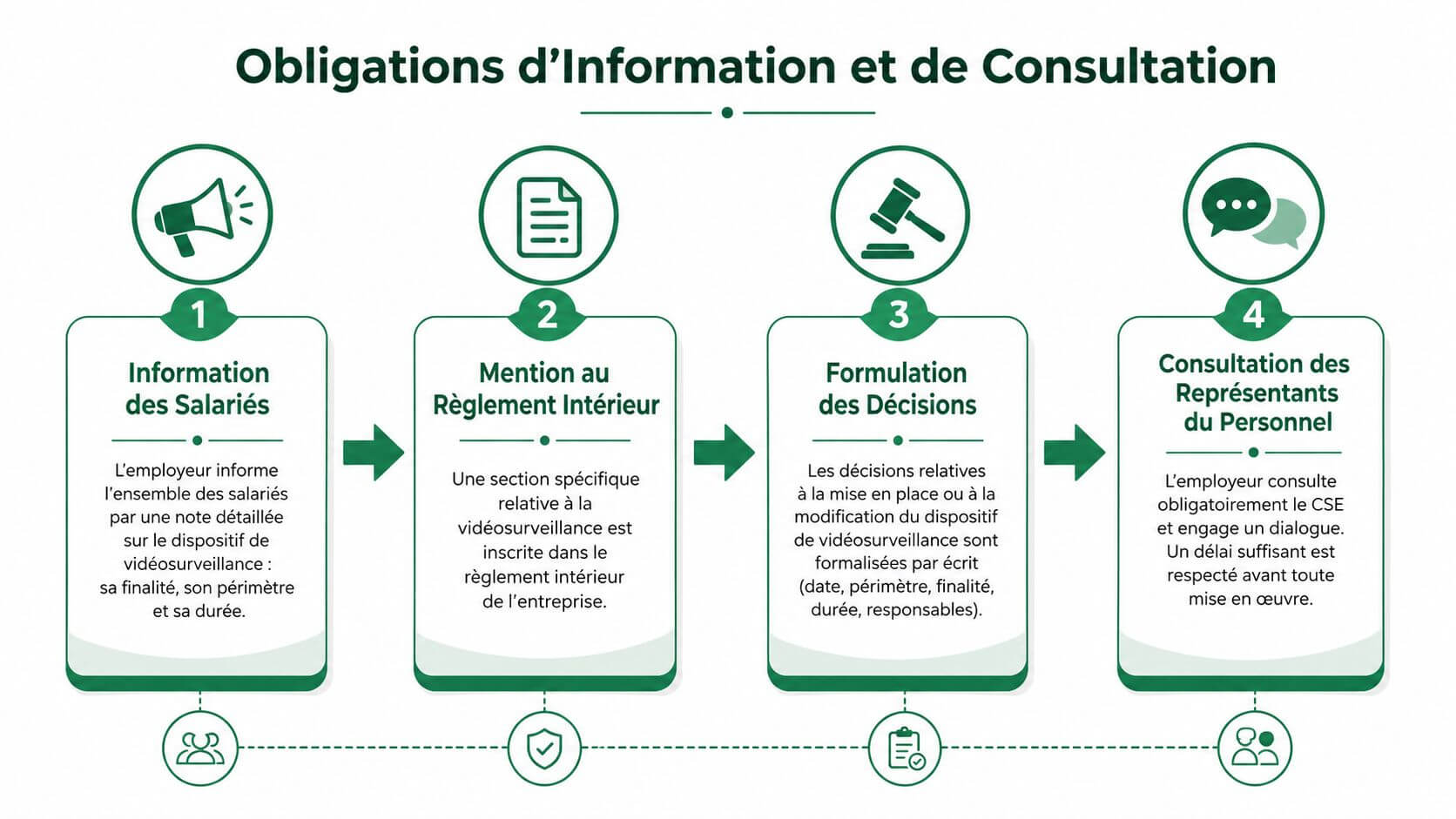
A video surveillance system can be well installed on a technical level and remain legally fragile if the persons concerned have not been properly notified. French law refuses the surveillance discovered at the last moment. It awaits prior information, clear and traceable, a bit like a safety notice that must be handed over before entering a risk zone, not later. It is this passage that makes a device subject to a measure that the employer can defend.
Inform before installing
The employer must notify employees before the installation of the device, with legible information on the purpose, the filmed areas and the rights related to the images. This information may take the form of a note, a display or a document given to the persons concerned, provided that it is understandable and given upstream.
A clear opinion may, for example, mention the following in plain language:
- Purpose, secure inventory or control accurate access.
- Responsible for the treatment, service or person identified in charge of the device.
- Filmed areas, entrance, hallway, reserve, or other defined perimeter.
- Shelf life, limited and announced in advance.
- Recipients of the images, only persons authorized to consult them.
- Right of access, with a procedure to request the viewing of images.
For a home helper, this is even more important, because housing serves both as a place of work and as a place of life. Too vague information can create confusion about what is filmed, when, and for what use. The right reflex is therefore to announce the device as one presents the rules of a shared space, with concrete benchmarks rather than a general formula.
Associate the SSC
The CSE must be consulted prior to the installation of the system, and this consultation must cover the purposes, areas covered, operating conditions, storage times and persons entitled to view the images Dairia Lawyers. If this step is missing, the problem goes beyond the mere procedural failure. The system can then be challenged, including its disciplinary use, because the starting point has not been correctly laid.
Formalize the right media
The good practice is to have three media coincide. First, an intelligible individual or collective information. Second, an update of the rules of procedure if the subject finds its place in it. Finally, a trace of the consultation and the decisions taken, in order to be able to show that the device was not installed in haste.
Practical advice. A well-described device is better than a device left in the blur. Judges and authorities look at the quality of the information, not just the presence of a sign.
For an employer, this sequence has an immediate interest, it limits challenges and shows that supervision meets a specific need, rather than giving a sense of general control of the people. It also facilitates dialogue with the teams. In home help situations, this framework is even more useful, because it avoids the camera becoming a subject of mistrust in a place where trust is already a working condition.
The subject of confidentiality therefore deserves separate treatment, with simple rules to explain to employees, relatives and caregivers. Practical Guide on Data Confidentiality can serve as a benchmark to structure this approach without unnecessarily complicating it.
Limitations on monitoring and privacy
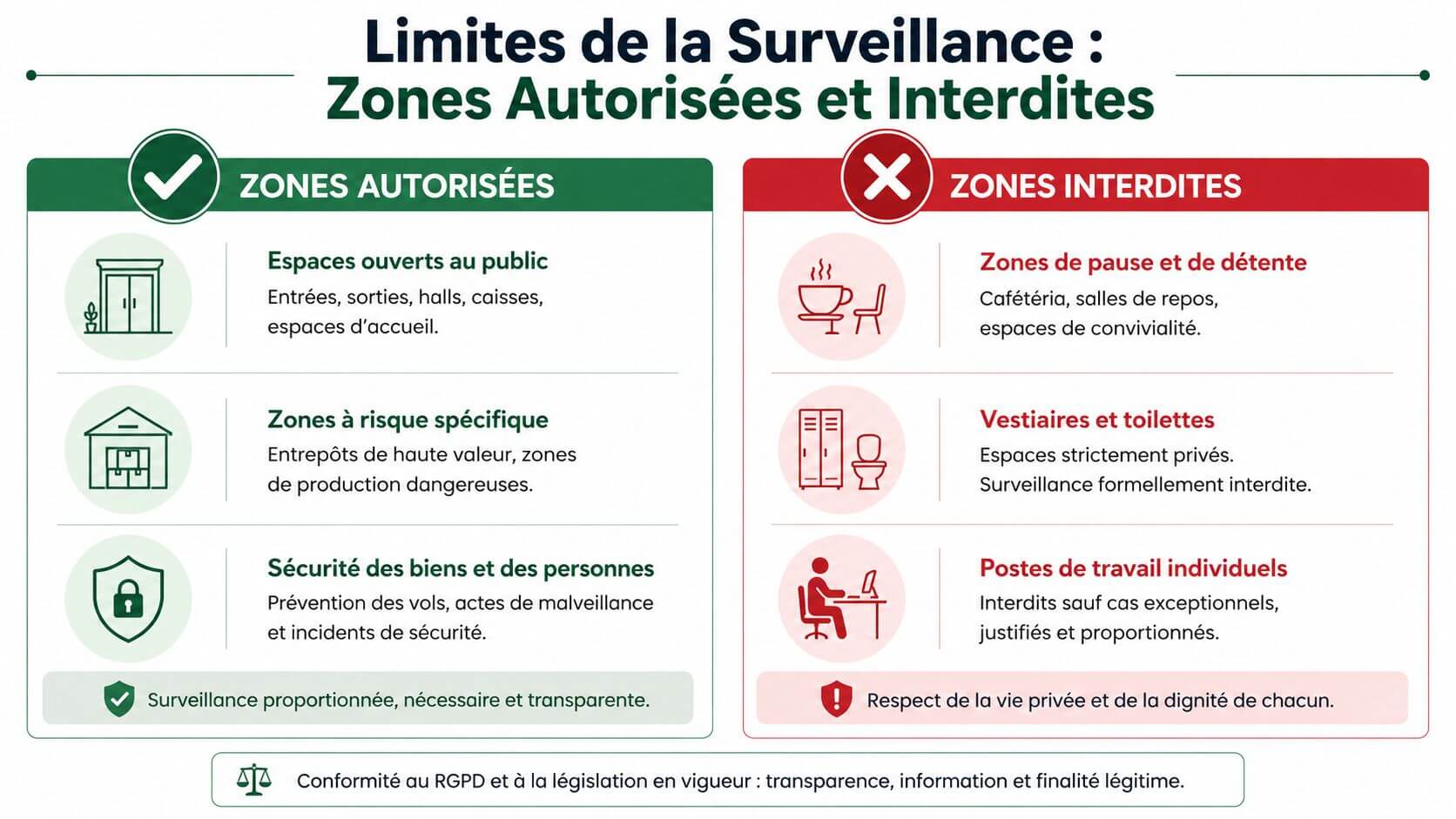
It is often understood that, when a place belongs to the company, it can be filmed freely. It is a misleading idea. The right does not stop at the walls, it looks above all at what is happening in the filmed space, the nature of the risk and the respect of privacy. A corridor of passage does not have the same scope as a changing room, and an entrance open to the public does not treat itself as a space of rest.
Areas not to be crossed
Toilets, changing rooms, break rooms and union premises must not be filmed. The employee must also not be placed under continuous supervision at his or her post, unless the situation is very special and strictly justified. In practice, the camera must play the role of a guard placed at the entrance of a building, not that of an observer installed in the middle of the room.
This limit is easy to understand if one thinks of the purpose of the device. Filming a workspace to protect goods or people does not allow to capture moments of relaxation, dressing or trade union exchange. As soon as the image enters the intimate, the device loses its legitimacy.
Places more easily defensible
Spaces open to the public and certain areas exposed to a particular risk can be more easily justified, especially when the safety of property or people is at stake. Logic remains framed, the camera must aim at the risk, not the person. Too wide an angle may suffice to derail a device that is acceptable at the outset.
It should also be kept in mind that the same place can mix several uses. A reception counter, a delivery passage or a traffic area do not call the same settings as a closed office. The more precise the framing is, the more the monitoring remains defensible.
The case of home helpers
The most often forgotten point concerns caregivers at home. Here, one is not in an office or in a warehouse, but in a private dwelling where family privacy, care and the presence of third parties coexist. Filming the whole space as if it were a professional space is a bad answer, especially when the person receiving care lives at home.
The right reflex is to distinguish the common spaces from the private spaces, then justify each angle of the camera by a precise purpose, not by a habit of control. The difficulty increases further when several speakers relay to the home. To keep a simple reference on the rules related to personal data, our privacy policy can be used as a basis for reading.
The camera must protect a defined space, not absorb the entire life of the place.
In home help, the risk is not only legal. It is also human. When the facility gives the feeling of entering into the privacy of the housing, the trust between the patient, the family and the workers becomes weakened. A sober configuration, on the contrary, can secure without transforming the home into a permanent surveillance zone.
Preservation and security of images
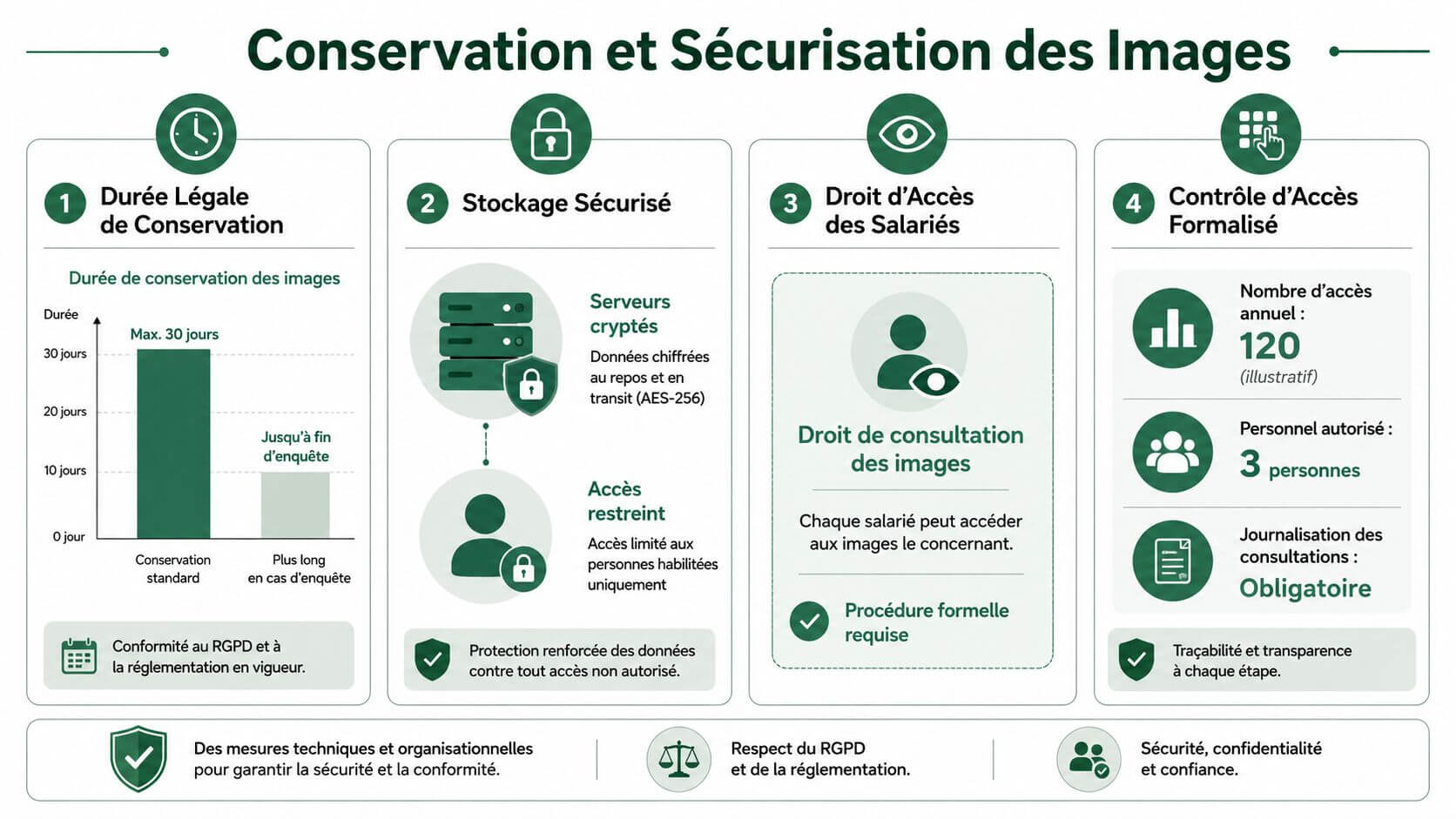
A poorly preserved camera poses almost as many problems as a poorly placed camera. Images are personal data, so their access, storage and reuse must be locked. This is often where systems become vulnerable, not when filming, but when someone opens the files.
Manage access to images
The Belgian data protection authority explicitly recalls that the worker has a right of access to images under the GDPR, and that the employer must inform about the Recipients, the access arrangements and the shelf life Belgian Data Protection Authority. For a French employer, the practical lesson is clear, access must never be diffused and improvised.
Secure storage
Storage must be protected from unauthorized access. In practice, this requires restricted rights, nominal identifiers and traceability of consultations. If several people can open images without clear rules, the device loses its consistency, and the evidence can become fragile in case of litigation.
Distinguish ordinary storage and probationary use
The images are not stored to be accumulated, but to meet a defined need. Longer retention is only justified if a procedure actually requires it, for example after an incident. Therefore, it is not the duration of comfort that counts, but the ability to link each preservation to a specific reason.
| Point to be checked | Good practice |
|---|---|
| Access to images | Restricted to authorized persons |
| Consultation | Traced and justified |
| Conservation | Limited to actual need |
| Re-use | Strictly framed |
A secure system must not only record, it must also prove who saw what, and why. It is this access log, more than the technology itself, that reassures in case of control or challenge.
Penalties and case law
An employer sometimes thinks that a lack of information is regulated later. In the area of video surveillance, this idea is dangerous. When the rules are not respected at first, the camera can produce disputed images, and the disciplinary record that relies on it becomes much more fragile.
In the current legal syntheses, three mistakes often come back. First, the lack of prior information for employees. Second, the capture of prohibited areas or a continuous workstation. Finally, the preservation or access to images without a clear frame. These failures are not isolated, they combine and weaken the entire device.
What the files hold in dispute
When an employee contests a dismissal or a sanction, the first question often concerns the regularity of the scheme. If the system has not been brought to the attention of the persons concerned or if it has filmed too widely, the argument of proof loses force. Vigilance must therefore begin before the incident, not after.
The most sensitive cases concern installations that are actually used to control daily activity rather than to secure a site. It is precisely this slippage that labour law seeks to avoid. A security camera is not a management tool.
Why the punishment hurts
The sanction is not only financial or disciplinary, it is also strategic. A mechanism deemed excessive may require the employer to review its architecture, remove images and reconstruct all its documentation. At this point, the discussion no longer focuses on technical detail, but on the credibility of overall compliance.
When images become the basis of a conflict, it is often the initial framing that is involved.
To avoid this scenario, you have to treat each camera as a stand-alone decision. Who is filmed? Why? Where? How long? Who has access to the images? If only one of these answers remains unclear, the employer faces a serious challenge.
Specificities for Home Caregivers
The home is not an office. This evidence changes everything. When a caregiver intervenes in an elderly person, a patient or a family, the place belongs to the private sphere, and the camera cannot be thought of as in a classic business. The consent of the patient or his or her family, the delimitation of spaces and respect for dignity become central.
A home helper must first distinguish between what is part of the common traffic and what is part of the intimate. The living room, the entrance or a room of passage do not have the same sensitivity as a bedroom or a bathroom. As soon as a camera targets a space where the person lives, cares for himself or herself, caution must go up a notch.
The right reflexes to adopt
The correct reasoning is sequential. First, identify the purpose, secure access, avoid intrusions, document an incident. Then, check if the camera is really necessary in this specific home. Finally, formalize who can see the images, how they are kept and who can request access.
For the professionals who coordinate the passages at home, the written record is decisive. It avoids misunderstandings between caregivers, relatives and caregivers, especially when several people take turns. A suitable coordination tool can help structure transmissions and access without mixing supervision and organization, as this useful benchmark, coordination and home rights points out.
In a private dwelling, the camera must remain the documented exception, not the implicit standard.
The link with medical secrecy and GDPR is direct. As soon as an image identifies a person in his or her care environment, treatment must remain sober, explainable and limited. For caregivers, compliance is not an abstract formality, it is the condition for maintaining the confidence of the patient and his or her surroundings.
Practical checklist and templates for compliance
A solid conformance is built like a well-kept file, piece by piece. It is not enough to place a camera and rely on common sense. It is necessary to be able to show, at any time, why the device exists, who accesses it, where it filmes and what it becomes after recording. For a home helper, this logic also avoids confusion between the protection of the work environment and the surveillance of the place of life.
Checks to be done before installation
- Written purpose. Note the exact reason for each camera, without vague formula. For example, a mention like, Secure access to the storage area of valuable goods.
- Areas defined. Identify the areas that are filmed and those that remain out of the field.
- Prior information. Prepare a clear note for employees and, where appropriate, staff representatives.
- Consultation organized. Formalize the exchange with the SSC prior to launch.
- Salary register. Enter the device when the place is not open to the public.
- Secure access. Limit the people who are allowed to see the images.
- Shelf life. Set a rule that is simple and consistent with the intended use.
- Access procedure. Prepare a procedure to respond to a request for access to images.
Example of Useful Mention
An internal mention may remain simple, as long as it is precise. It may indicate the purpose, authorized recipients, access modalities and duration of storage. The aim is not to produce a verbose text, but to write a medium that the teams really understand. In a home, this clarification also helps to distinguish what is involved in the organization of passages from what is under supervision.
Example of documentary logic
A good record keeps track of the decision, the information and the follow-up. This applies not only to the initial setting up, but also to any evolution of the device. If a camera changes its angle, area or use, the folder must be updated accordingly.
For a team that already manages multiple transmissions, schedules or crossings, this level of rigour is natural. A shared tracking tool, such as a transmission manual and organisation of information, can help structure information without confusing coordination and monitoring.
Having a compliant camera does not consist of checking a box. You must be able to explain, without hesitation, why it exists, who consults it and what it is not allowed to film. For home-based caregivers, this clarity protects both the accompanied person, the team, and the confidence around the home.
Put this organisation into practice with Tribulys
Keep your care journal, shared calendar, tasks, medication tracking and emergency information together. Start for free and invite the relatives and professionals involved in your loved one’s care.