
At 8:00 p.m., your phone is ringing. You're far from your mother's house and you don't know if she took her evening treatment. She answers that she thinks yes, but the tablet may still be on the table. You call a neighbor, who checks the pill organiser, then you wonder if this check will be done tomorrow, and who will tell her nurse if a dose is missing.
This uncertainty fatigues relatives, but it also complicates the work of professionals at home. The subject is not only to recall a take. what was planned, what was taken, what was not done, and what must then be done. This guide is intended for families, remote caregivers and caregivers who are looking for a more readable organization, without turning the accompanying person into a single performer.
You will start from the classic stacker, understand the functioning of an intelligent electronic stacker, and then examine its selection criteria and its integration into a shared coordination. The central question will remain concrete: Does the device actually relieve the load of the home, or does it simply move calls and checks to a relative? To put this reflection back in the overall organisation of home care, see also this guide to home care.
Contents
- What is a smart electronic stacker really
- How the confirmation and alert reminder loop works
- Choose your smart electronic stacker without making a mistake
- Integrate the pill organiser into a coordination with Tribulys
- Practical use scenarios at home
- Points of vigilance safety compliance and autonomy
What is a smart electronic stacker really
A classic semainier is a Organized container. His boxes indicate a day or a moment of the day, but the box does not work. He does not recall anything, does not know whether the box has been opened and cannot warn a caregiver. He only gives to see an organization prepared in advance.
A battery with alarm adds a signal. At the scheduled time, it can ring or turn on, but the person still needs to identify the right box, take the medication and avoid opening other compartments. To review the differences between traditional models, you can consult this marker on the weekday morning noon evening.
The Intelligent electronic stacker adds a third dimension, that of the trace. It recalls the catch, records the event and can transmit the information remotely. The passage is therefore from a passive object to a device that participates in a care organization.
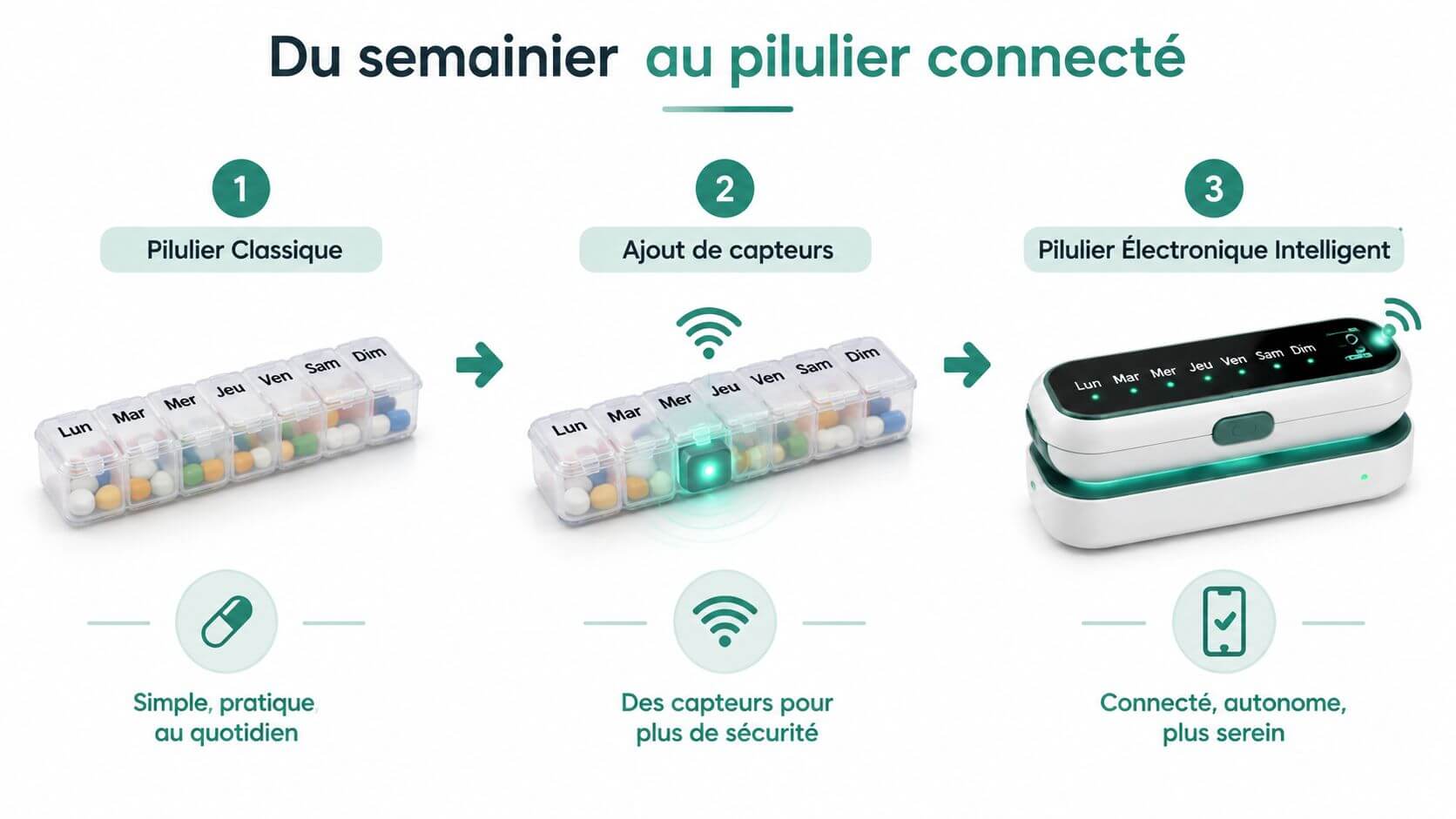
The three bricks to distinguish
To avoid being guided by the word "connected", look at three functions separately:
- The reminder, sound, visual or sometimes vibratory, attracts attention at the given time.
- Distribution, depending on the model, limits access to the scheduled dose or indicates the cell to be opened.
- Traceabilityrecord the time of the event and make the statement searchable by authorized persons.
A device can have an alarm without producing real follow-up. Conversely, a system can record events without ensuring that the person has swallowed the medication. The technology usually measures an observable action, such as opening or distribution, not the intention or complete adherence to the treatment.
Simple benchmark: An intelligent stacker does not replace clinical judgment. It turns a hard-to-check catch into a documented event, which the team can then interpret.
How the confirmation and alert reminder loop works
The value of the device appears when you follow a catch from beginning to end. At the expected time, the stacker draws attention with a light, audible signal or other alert. The person opens the indicated cell or recovers the distributed dose, then the system records the event.
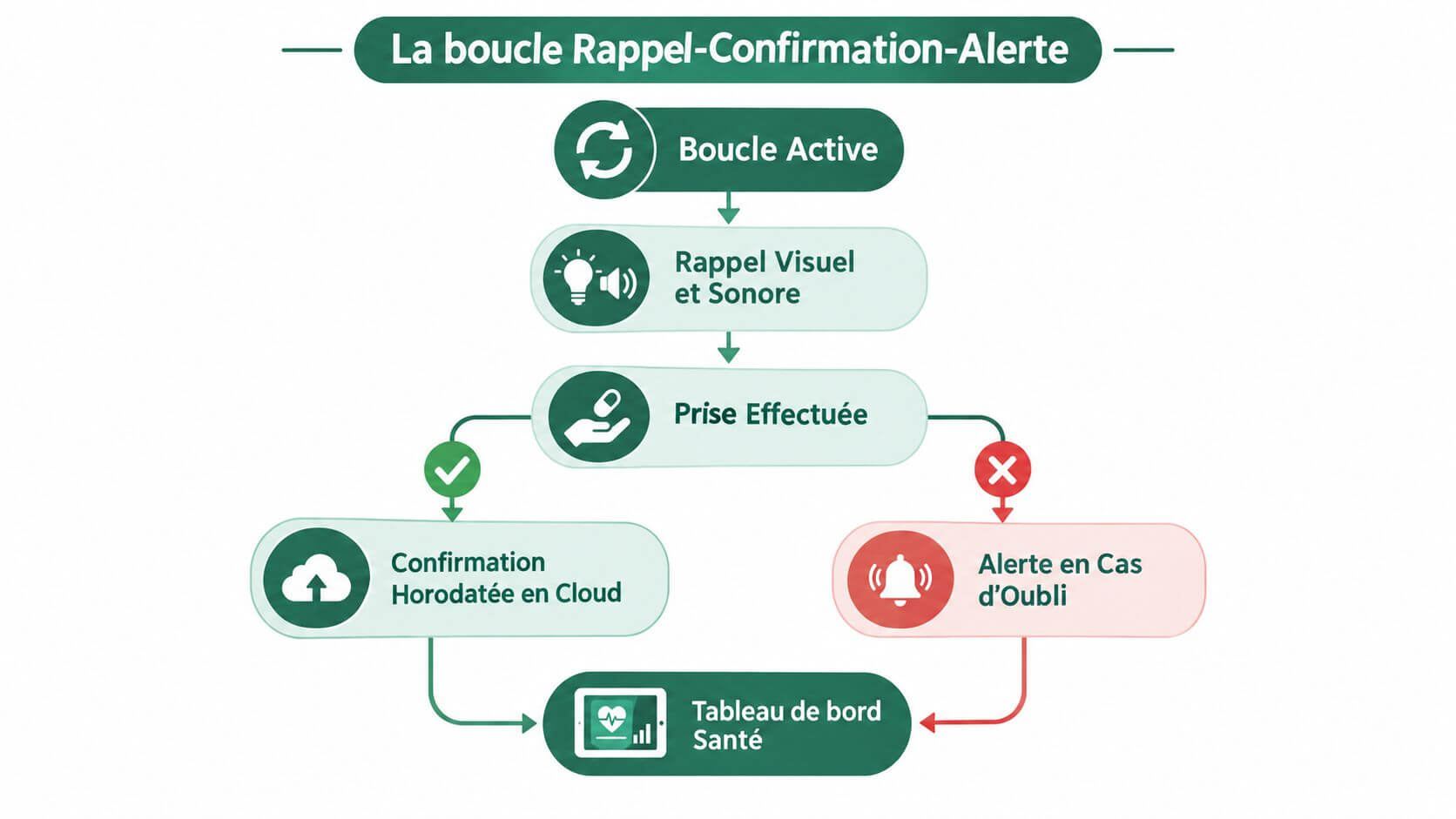
A logic comparable to a signal light
The loop can be read as a traffic light. The light or sound indicates that the expected action begins. The opening or distribution provides a confirmation. The absence of confirmation triggers an alert, which gives the caregiver usable information.
This sequence counts more than just an isolated reminder. Without confirmation, the loved one receives only a planned intention. With a timed event, he knows that a stage of the course has been recorded, even if he still has to keep a reserve on the actual ingestion.
I-I-INational Academy of Pharmacy described connected piles as devices capable of recalling the dose, recording its time and producing records useful for monitoring compliance, as recalled in his report on the observance of medication treatments in France.
With or without the Internet
Some devices can provide a reminder without the Internet. The device then retains its local function, then transmits events remotely via a GPRS-type connection or a connected platform. This architecture can limit tracking failures when the home network is unavailable.
However, the operation must be checked prior to installation. Ask what remains active without a connection, what is recorded locally and what will be synchronized after the network returns. A system that alerts the person but does not transmit forgetfulness does not offer the same level of coordination as a system capable of raising the event.
What the trace actually allows
An observation record helps to identify a repetition, a staggered catch or a lack of confirmation. It also prevents each speaker from reconstructing the story from different memories, scattered calls or conflicting messages.
The professional publication devoted to the choice of a connected stacker These include models where a sign indicates the cell to be opened, where the intake is recorded, and where a text message can alert a patient or caregiver in the event of a failure to take. This trace must then be linked to a clear action. An alert without a designated official only adds one more notification.
Choose your smart electronic stacker without making a mistake
At home, the right choice depends first of all on the difficulty observed. A person who forgets the time taken does not have the same need as a person who confuses doses, opens several boxes or follows a often modified prescription. Similarly, the caregiver present every day will not look for the same device as the relative who lives far away.
Describe precisely the situation: forget the moment, dose error, double dose, change of treatment or absence of a person to prepare the medication. This step avoids paying for unnecessary connectivity or holding an alarm too low in the face of a risk of poor distribution. To deepen the question of forgetfulness, see this application to keep in mind its medicines.
Decision table
| Criterion | Simple option | Advanced Connected Option | To be preferred when |
|---|---|---|---|
| Dose organization | Manually prepared boxes | Distribution or indication of the intended cell | Treatment has several times to take |
| Background | Local audible or visual signal | Local reminder associated with remote alert | Caregivers should be informed of non-confirmation |
| Access to medicines | Accessible compartments | Controlled compartment or limited access according to model | The risk of double taking should be taken into account. |
| Connectivity | None or one-time synchronization | Transmission to a platform or software | Several stakeholders need to consult the same history |
| Monitoring | Visual verification | Timed events and compliance records | Forgets must be objectified in time |
| Maintenance | Cleaning and filling | Filling, power supply, network and maintenance | A relative or a professional can ensure the routine |
| Cost | Limited purchase or service | Apparatus and possible subscription | The family compares the total cost, not just the initial price |
Questions to ask before signing
Ask how many sockets can be programmed, how the device reacts to a prescription change, and who will fill the compartments. Please specify what happens in the event of a breakdown, a low battery, a loss of network or a change of caregiver. The question therefore concerns not only the recall, but also the person who will verify the event and how they will pass it on to other stakeholders.
Evaluate the cost over time. file published by TribuSante on the digital pillar refers to subscriptions of 25 to 60 euros per month, with a possible eligibility for the tax credit of 50 % where the service is approved. These conditions must be verified with the provider and the administration, as they depend on the exact nature of the service.
Finally, test the acceptability with the person concerned. Does it understand the signal? Can it manipulate the cell? Does it accept that a relative receives an alert? A complete device technically, but refused in daily life, will not secure the treatment. Filling, charging and checking alerts must also find a realistic place in the routine, otherwise the device relieves a step while moving the load on the caregiver.
Integrate the pill organiser into a coordination with Tribulys
A catch event becomes useful only when it joins the right information circuit. If the device sends an alert to the son, the nurse receives another information and the doctor sees nothing, the family keeps the initial problem, with more messages to cross-check.
Coordination begins with a simple rule: an alert must have a recipient, a response time and a planned conduct. The relative can check by telephone, the assistant can observe the situation during his visit and the nurse can report a clinical difficulty. The distribution depends on the role of each person, the consent of the person and the instructions of the care team.
From the isolated signal to the shared folder
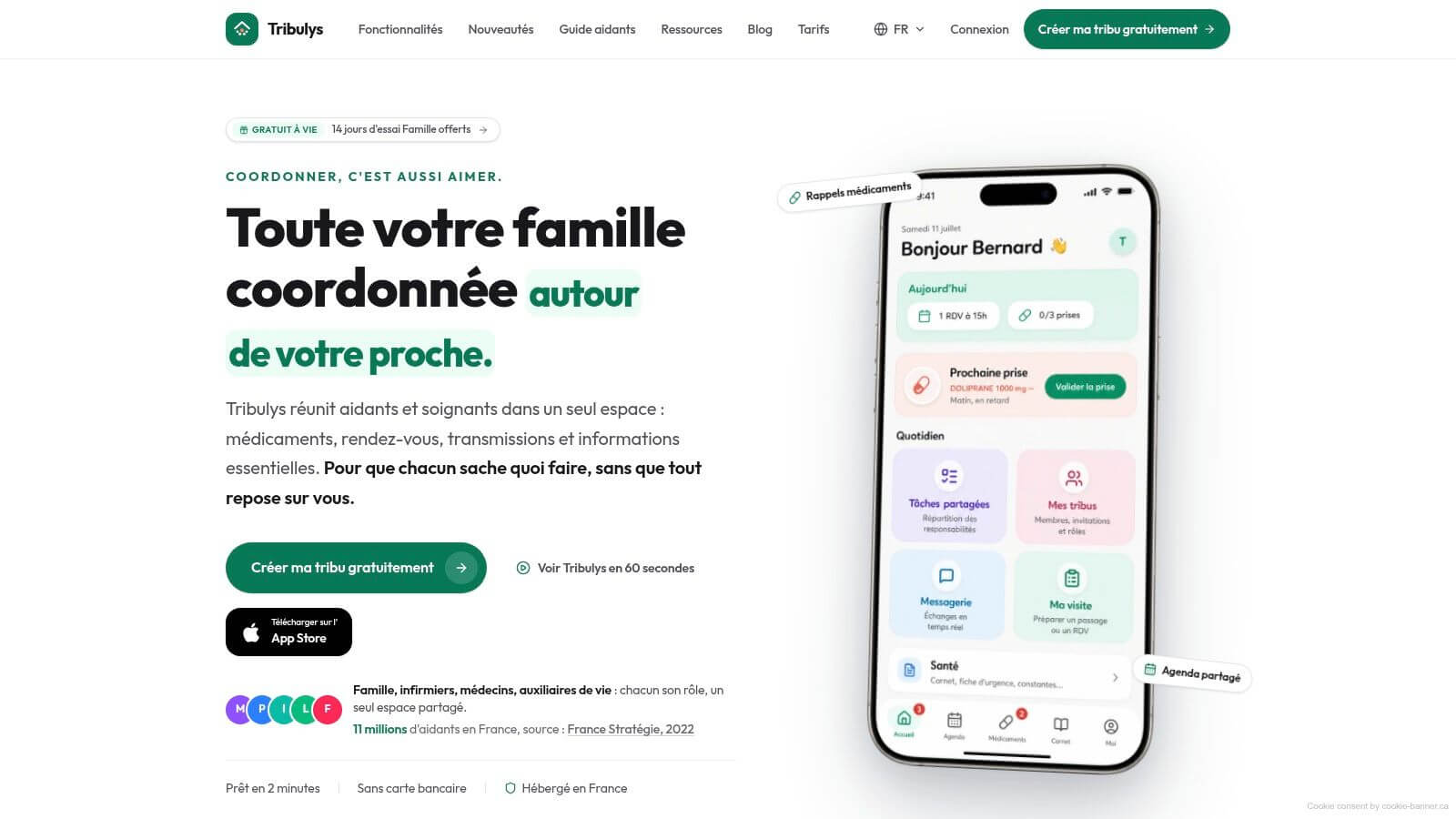
A coordination application such as Tribulys can combine catch confirmations, oblivion alerts, transmissions and assigned tasks. The information becomes searchable according to the roles, with dated and identified entries, rather than scattered between calls, SMS and notebooks. The solution also indicates offline operation for certain functions, with synchronization at reconnection, which can support transmissions during a networkless visit.
The stacker remains the sensor of the event. The shared space gives the context: change of treatment, expected absence, reported difficulty, passage of a professional or intervention already performed. This distinction avoids confusing a technical alert with a medical emergency.
To frame responsibilities, use a guide for coordination between carers. It is necessary to define who consults the history, who calls the person, who warns the referring professional and who documents the sequel. Traceability protects especially when it makes the roles visible, not when it accumulates the notifications.
Practical use scenarios at home
In a polymedic elderly person who lives alone, the problem can begin with a hesitation. She recognizes her tablets, but no longer knows if she took them after breakfast. The electronic stacker tells her the expected box, records the opening and prevents her from browsing all available doses.
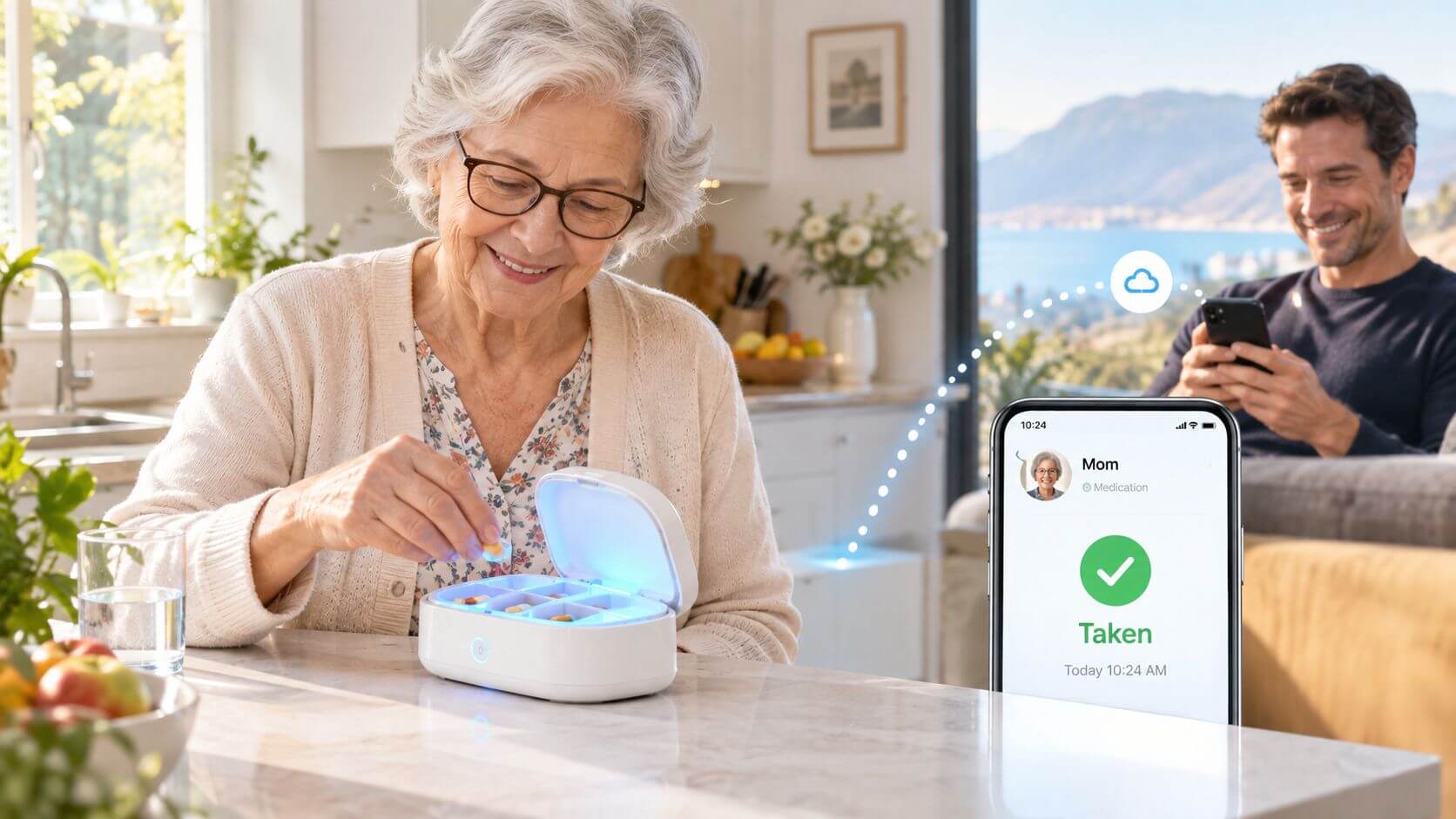
The relative must not interpret each silence as a disaster. He can first call, check if the person has heard the alert or encounters a practical obstacle, and then transmit the information if the situation repeats. The device then relieves memory and reduces uncertainty, but it does not replace the relationship.
The Helper at a Distance
A son or daughter who works away from home can use alerts to target his attention. Instead of asking several times a day, did you take your medication? It intervenes when confirmation is missing or when an unusual pattern appears.
The charge, however, moves if no one has defined the follow-up. An alert received during a meeting, at night or during a trip must be covered by a relay. The family may provide for a secondary person, a call instructions and a return to the appropriate professional.
A visual medium can help explain the operation to the person accompanied:
The nursing tour
During a home visit, the nurse can compare the history of the attacks with what the person reports and with the organization of the treatment. If a prescription change occurs, it is essential to provide for the correct resumption of the pile, the information of the family and the verification of the first cycle.
The device becomes useful when it is inserted into the tour, instead of creating a parallel table. The nurse should not be the automatic recipient of all technical alerts if the caregiver can perform the first check. A written, shared and revised statement with the team avoids this overload.
Points of vigilance safety compliance and autonomy
An intelligent electronic stacker does not answer all compliance problems. It helps especially when a person Forget it., disorganizes or risks a double take. It is not enough when she intentionally refuses treatment, no longer understands her indication or presents a clinical difficulty that requires an evaluation.
The professional sources of home help indicate that it is carried out in coordination with the family, the SSIAD or the nurse, depending on the situation and the skills of each, as indicated in the report. Home Help Reference.
The safeguards to be imposed
- Consent of the person, explain what is recorded, who receives the alerts and why.
- Distribution of rolesname the first contact, relay and professional to be notified.
- Management of exceptions, predict absences, hospitalizations, prescription changes and medications taken on an ad hoc basis.
- Data security, check the hosting, access, permissions and deletion of unused accounts.
- Maintenance, organize filling, feeding, cleaning and response to breakdowns.
- Regular evaluationstop or adapt the device if it becomes anxiogenic, infantilizing or too heavy for the loved ones.
The cost-benefit must be looked at with the same lucidity. In France, the problem of compliance among older people has long been documented: an article of the 2013 referred to 30 to 50 % elderly people taking ill or forgetting their medicines, and about one million hospital days of these oblivions, with a device presented to about EUR 39 per month, not reimbursed at the time, according to this article from BFMTV. These historical benchmarks do not promise a return on investment for each family. Rather, they show why forgetfulness, calls, errors and coordination time must be measured before and after installation.
The pillar becomes a real support when it clarifies the following action. If it only adds an alert to an already dispersed organization, it can move the load to the relatives instead of reducing it.
Tribulys centralizes catch tracking, oblivion alerts, transmissions and roles of caregivers and professionals in a shared space. To structure a more legible coordination around your smart electronic pile, discover Tribulys and set up an organization adapted to the real needs of the home.
Put this organisation into practice with Tribulys
Keep your care journal, shared calendar, tasks, medication tracking and emergency information together. Start for free and invite the relatives and professionals involved in your loved one’s care.