
You're in the kitchen, it's Sunday night, and the phone rings again. One sister reads the prescription, the other opens the boxes, and both try to fill the same weekday morning noon evening Without walking on it. The father will say tomorrow morning that he may have already taken his tablet, while the IDEL will pass with its own routine, its own look, and sometimes information not quite up-to-date.
The real subject is not the plastic box. Coordination. When several caregivers intervene at a distance, the pill organiser becomes either a point of shared truth, or a trap with duplicates, oblivion, and i thought it was done. The good use is the one that allows us to know who filled, who checked, who confirmed the catch, and who changed what after a change of order.
In France, the organization of working time also shows why routines with fixed time slots work so well, with 80 % professional time concentrated between 9 a.m. and 7 p.m., and a diurnal concentration reaching 84% of women and 77% in men according to the INSEE, which illuminates the logic of a cutting morning, noon, evening for repeated and easy-to-control gestures (INSEE) In the same country, the use of oral treatments remains massive, with sales of Progestative pills alone multiplied by three between 2010 and 2024, while the combination oestroprogestative pills have declined by about 48 %, according to ANSM (ANSM). In other words, daily drugs are always there, and the question is not whether to organize, but how to do it without leaving room for blur.
Contents
- Sunday night, the pill organiser becomes a family affair
- Choose the right format for everyday life
- Fill the seeder without making a mistake
- Safety, labelling and medicines not repackaged
- Coordinate the carers around the pilelier
- When 3 sockets are not enough
- Your weekly checklist of the well-coordinated stacker
Sunday night, the pill organiser becomes a family affair
On Sunday evening has a very simple way to reveal the faults. One sister says she has already prepared the morning boxes, the other thinks she has filled the evening boxes, and no one really knows whether the midday tablet has been put twice or not at all. That's where the midday tablet was put. weekday morning noon evening change of status, it no longer serves only to store, it serves to Show what's true.
The moment when doubt begins
In this kind of kitchen, the phone stays in the speaker while the boxes open and close. The first mistake is not the dose, it is the lack of coordination. When several people intervene, the stake is not just to prepare, it is to ensure that the preparation is visible, Date and verifiable by all.
Simple rule, if two people can touch the same treatment without leaving any trace, the system is already fragile.
The father can be in bed, the IDEL can spend the next day, and a neighbor can drop off the breakfast without knowing what has already been given. In this context, the pill organiser must not stay the box on the table. common benchmark. The family is not looking for a prettier object, it is looking for an object that cuts short of assumptions.
The question we always end up asking ourselves
Which fills. Who checks. Who announces that a change has taken place. Who confirms the take when the person is alone. These four questions decide everything, much more than the color of the plastic or the size of the boxes.
This is also why Sunday evening is often the right time. It creates a ritual, it flatens the week, and it allows you to immediately detect oblivions, duplicates and new prescriptions. A well-used pillar is not an accessory of order, it is an accessory of order. point of change between family, caregiver and proof of take.
Choose the right format for everyday life
The right model is not the one that has the most boxes. It is the one that sticks to the real rhythm of the person. weekday morning noon evening works very well when the sockets are stable, when the tablets are easy to identify, and when someone can reread the filling without fighting with small openings. As soon as the daily life becomes more mobile, more confused or more fragmented, the format has to change.
The three families we really meet
Format 3 catches remains the most legible when the day revolves around three clear markers, morning, noon, evening. 4 catches becomes more relevant when taking the bed really counts, or when a treatment requires a thinner cutting. daily It is used primarily to transport a day out of the home, or to separate a specific day from the rest of the week.
The choice also depends on the person who opens the box. A trembling hand, visual disturbances, osteoarthritis of the fingers or reduced dexterity completely changes the deal. A large wall semainier can be very good at home and frankly painful as soon as you have to slip it into a bag or use it between two family trips.
What to look at before you buy
- Stable diagram or not. If the prescription often changes, take a format that is easy to update, not a spectacular system that detachs itself from the first change.
- Real dexterity. If the person struggles to open the boxes, choose clear visual markers, contrasting numbers and a simple opening.
- Size of the tablets. A large capsule does not forgive a tiny compartment.
- Life out of home. If the person often lunches elsewhere, the fixed seeder is not the main tool, it becomes a preparation medium.
- Confusion on days. When the days mix, the big landmarks are better than an elegant design.
For many households, the right reflex is not to look for a universal model, it is to choose the one that reduces the number of errors at the real time of the take.
Electronic alarm models can help when oblivion is common, but I keep them as a last resort solution if the family can already secure preparation and confirmation. Most often, a simple, readable and well-coordinated seeder is enough, provided that it is not treated as an isolated box.
Fill the seeder without making a mistake
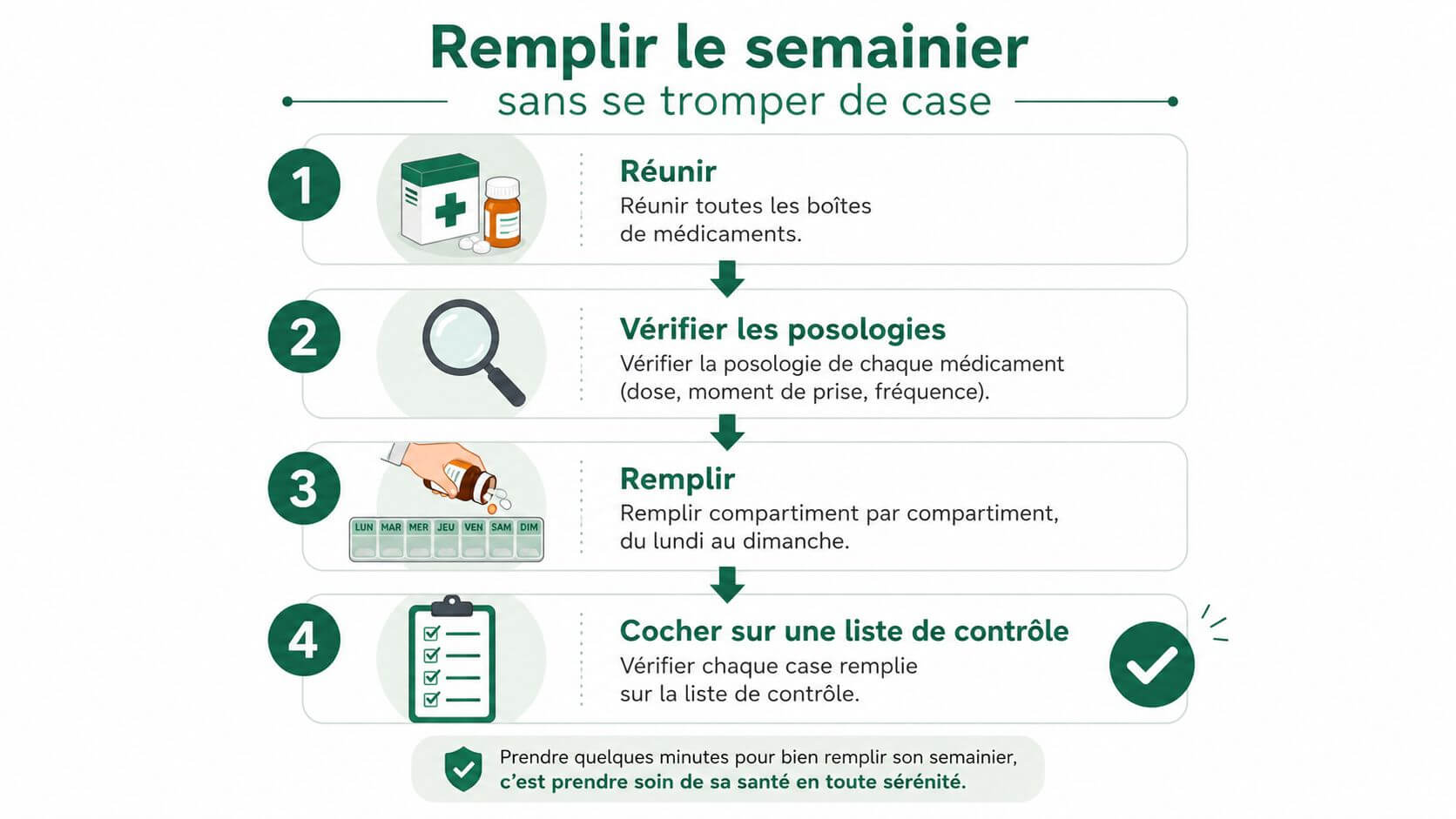
Reliable filling is nothing magical. It follows a strict order, and this order avoids confusion when several molecules coexist. The best method remains the same, filling medicinal product per medicinal productthen take moment by take moment, instead of making a full day at once. This choice seems slower at first, but it protects very well against oblivion of a substance in the middle of a more heavy treatment, as evidenced by the principle of preparation recommended for Pilbox 7 (Pilbox 7).
The workstation that avoids nonsense
It takes a clean table, an up-to-date prescription, a list of medications actually taken, a frank light and, frankly, a telephone to take a picture before closing the session. The biggest trap is the boxes that are still a bit of a stick while they are no longer clearly on the prescription of the day.
The filling must remain calm. No background noise discussion, no television, no going-and-coming between the kitchen and the living room. When someone cuts you at the wrong time, you start checking again from the beginning, because it is precisely the interruptions that create the box errors.
The double control that changes everything
The first passage is visual. You are looking for empty boxes, ill-placed tablets, color or size anomalies, duplicates that jump to the eye. The second passage is numerical, you recount the compartment units per compartment by comparing with the prescription or follow-up sheet.
- Start with the most numerous molecules. They are the easiest to forget if you keep them for the end.
- Check half-doses right now. A tablet cut, badly stored or forgotten in the tablet cutter creates false safety.
- Separate similar forms. Two capsules close visually, this is often where the error slips.
- Keep out of the seeder what doesn't fit clearly. Drops and syrups should not be forced into a system designed for dry and stable units.
I prefer a slightly longer filling and a net pilelet to a quick preparation which then forces the whole family to guess. The regularity of the ritual also counts, filling every week on the same day, often on Sunday evening, makes the gesture almost automatic.
Safety, labelling and medicines not repackaged
The drumstick reassures, but it must never forget the basic safety. Some medicines must remain in their original packaging, because preservation, light, moisture or traceability count as much as having them under the hand. Others simply do not lend themselves to clean deconditioning, and it must be accepted without seeking to fix the system.
What needs to stay out of the market
If a treatment has a fragile form, a sensitivity to the environment, or a use that is too variable to be anticipated, it remains apart. It is also the case of the intakes if necessary, because they do not always follow the same pattern as the fixed intakes. And as soon as a medicine is to be stored in its blister, the seeder becomes a partial support, not a total solution.
Prescription changes must be resumed immediately. A return from pharmacy, a consultation, a new generic, a change of schedule, all this requires a quick update. Otherwise, the pill organiser gives an impression of continuity while the treatment has already changed.
The label that avoids conflicts between caregivers
A well-managed pillar carries the patient name, the date of filling, and the trace of the last change of treatment. I always add a paper list of the medicines contained, slipped next door, because in case of doubt, no one wants to recompose the week of memory. Hygiene also counts, hands washed, surface cleaned, fingers dry, especially if you handle uncoated tablets that don't support moisture.
- Note the day of the change. The moment when the prescription has moved must remain visible.
- Avoid confusion of generics. A different color does not mean a different molecule, and the opposite is true too.
- Never mix two people. Even in the same family, a seeder is not interchangeable.
- Refresh after each pharmacy passage. The reflex must be systematic, not casual.
The transmission book It remains useful to understand why shared writing avoids memory gaps between passages. What matters is that the trace is readable by all, without interpretation to be repeated on the phone at 10:00 p.m.
Coordinate the carers around the pilelier
The biggest flaw of the classic contents on the pile is that they talk about the box and very little about the people around it. However, at home, the problem is almost never the absence of a container. The problem is the flow of information between the one who prepares, the one who passes in the morning, the one who calls at a distance and the caregiver who returns later.
Who does what, and how to make it visible
The first step is to assign the filling to a specific person, not to the family. A named task, dated, with expiry on Sunday evening, avoids the blur that ends in double preparation. The second step is to have the take confirmed as soon as it is given, especially when the person is alone in the early morning or at lunch.
The third step is to trace the treatment changes in the same place so that everyone sees the same change. A timed and signed entry is better than a message lost in a thread of discussion. The treating physician, the IDEL and the family all save time when they don't have to reconstruct the script from scattered memories.
Here is a simple logic, to keep in mind when the tribe is distributed.
| Moment | Main action | Who does it often | Traceability tool |
|---|---|---|---|
| Sunday night | Fill the stacker | Close main helper | Shared task, picture of the seeder |
| Morning | Confirm take | Patient, attendant, IDEL | Timed confirmation |
| After consultation | Update the boxes | Responsible Helper | Shared Link Book |
| In case of doubt | Check the week | Remote helper | Readable history and comments |
The real advantage of taking confirmation
When the catch is checked, everyone stops assuming. A girl at 300 km doesn't need to call three times, a neighbor can see what has been done, and the IDEL who spends the evening knows whether the morning has been confirmed or not. It's not abstract comfort, it's a concrete way to reduce the effect of anyone has seen.
Simple practice, if the morning dose does not appear at the expected time, the problem is not only the missing tablet, it is the silence around the tablet.
The shared follow-up also serves the doctor, because a clean history is always better than an oral report reconstructed after the fact. In this type of organization, the digital tool does not replace the box, it makes it readable remotely. For a wider coordination of caregivers, the guide on coordination Caregivers gives a good working environment.
When 3 sockets are not enough
I'll be straight. weekday morning noon evening is not a universal solution, even if it remains excellent in many homes. As soon as the treatment becomes too fragmented, too variable or too dependent on the exact moment, the standard seeder starts showing its limits.
Signs that must alert you
An empty take, an after-dining take, a very fixed time take, a treatment to be constantly renewed, all of which already requires more vigilance than a simple morning-midday-evening trio. If the person has conditional drugs "if necessary", the single seeder quickly becomes insufficient, because it mixes the fixed and the punctual. And if several medicines have to stay in their original packaging, the reconditioning loses its interest.
The right reflex is to look at the proportion of drugs that don't really fit into the system. When a large part of the treatment escapes the day-to-day, it's better to stop forcing the format. So you have to keep a secondary pillar, keep certain treatments in blister, or move on to a more fragmented system.
The choice between 4 sockets, electronic or blister
Format 4 catches is useful when taking the bed is a real working area, not a decorative box. The electronic alarm piler becomes relevant in an isolated person who has no one to confirm the socket, but it brings another constraint, programming, battery, learning. It is also necessary to accept that a device that depends on a good configuration remains fragile if no one maintains the setting.
This application guide to keep your medication in mind is useful if you are looking to complete a physical support with a stricter follow-up. But the rule does not change, the correct format is the one that corresponds to the real schema, not the one that gives the impression of being practical.
The classic seeder remains the spine in many situations. I keep it as long as the preparation can be clear, the confirmation can be traced, and the non-reconditionable drugs remain identified apart. As soon as one of these three pillars gives way, the structure must be reviewed, not stubborn.
Your weekly checklist of the well-coordinated stacker
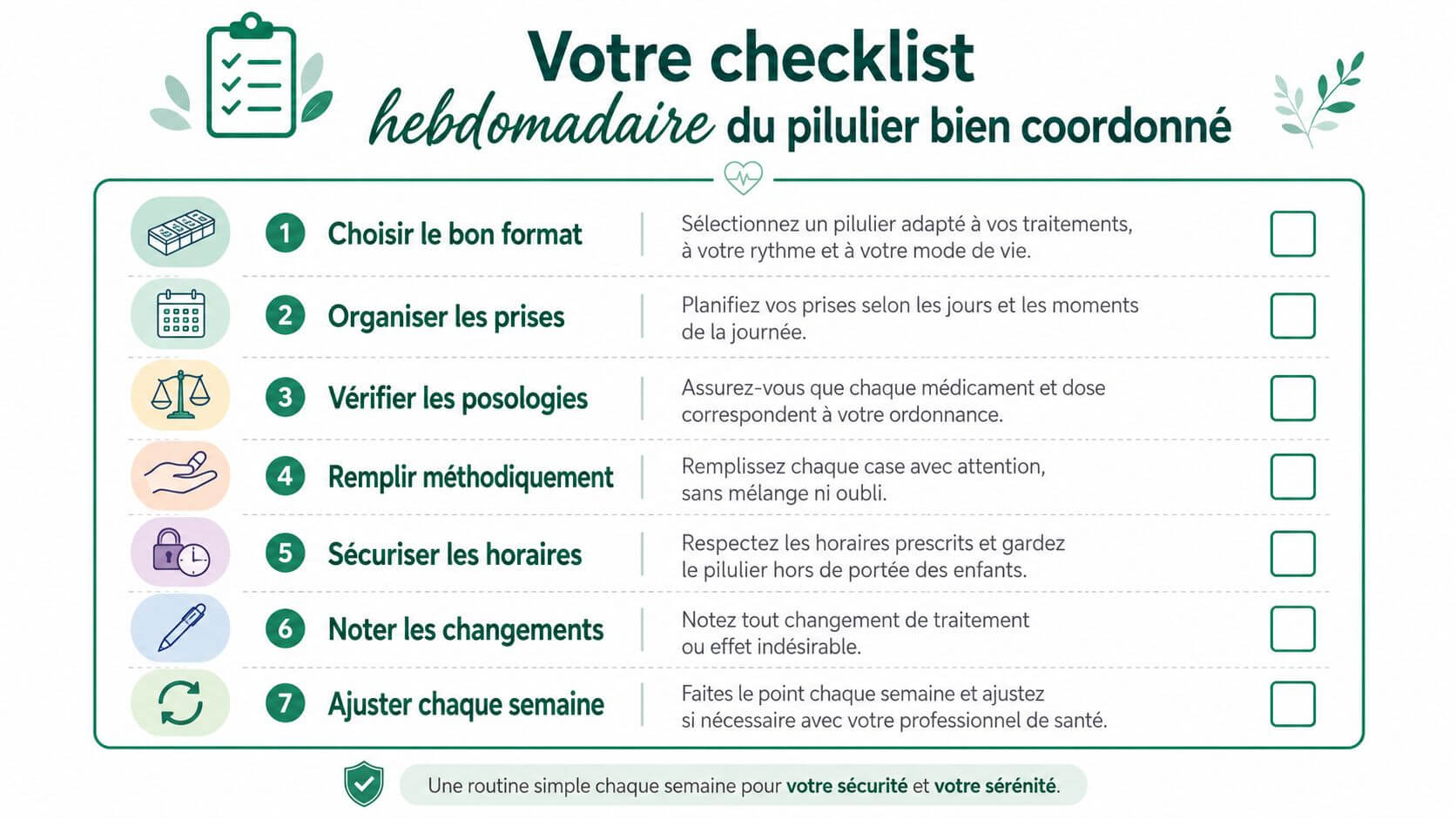
The checklist doesn't matter much, but each one counts. Choose the right format, prepare medicinal product by medicinal product, double check, clearly label, Let out of the seeder what must remain, confirm each dosethen review the week with the doctor when the prescription moves.
If you want it to be tenable to many, assign each gesture to a specific person. The pillar is not an isolated box, it is the center of a family and caring organization that must remain readable, especially when everyone is not in the same room.
If you want to stop the repeated calls and the doubts of the type, did he take it, Tribulys helps you centralize the liaison care journal, plugs and passages of the carers in a single clear space. It's exactly the kind of tool that transforms a weekday morning noon evening in a reliable coordination system, without weighing down the routine. Start with the free Essential Plan, then build around the pilelar a follow-up that the whole family can finally read in the same place.
Put this organisation into practice with Tribulys
Keep your care journal, shared calendar, tasks, medication tracking and emergency information together. Start for free and invite the relatives and professionals involved in your loved one’s care.