
You may have experienced this stressful moment before. An elderly person returns from an outing, the evening box is empty, and no one knows if the luncheon took place. Pocket stacker It can become a very concrete point of support for a more secure organization between home, family and caregivers.
Contents
- Contents
- One Sunday night, three shots and a doubt
- Understand what a pocket pillar is
- Who really is a pocket pillar?
- Choosing your stacker well according to your needs
- Fill, clean and use your pill organisery every day
- Articulate the pilelier with a digital tracking like Tribulys
- Limitations, risks and good practices to remember
Contents
- One Sunday night, three shots and a doubt
- Understand what a pocket pillar is
- Who really is a pocket pillar?
- Choosing your stacker well according to your needs
- Fill, clean and use your pill organisery every day
- Articulate the pilelier with a digital tracking like Tribulys
- [Limitations, risks and good practices to remember](#limits-risks-and-good-practices-not-to-forget)
One Sunday night, three shots and a doubt
The scene is trivial. A girl passes between work, pharmacy and her mother's house, and she finds on the table an open bag, a folded prescription, and boxes opened. Her mother thinks she's taken her treatment, but no one can confirm the afternoon.
That's exactly where a Pocket stacker It makes sense. Not as a simple case, rather as a visible marker that helps hold the thread of the sockets when the day breaks between exits, home calls and quick phone calls. So the question is not just where to store the tablets, but how to avoid every caregiver working with a different version of reality.
Practical rule. A useful pill is not the one that contains medicines, it is the one that makes the intake verifiable by the whole family.
In families, the real problem is not always total oblivion. It is often the doubt, with its very concrete consequences, a reassured helper wrongly, a second who gives back a dose, or a professional who does not know what has already been taken. That is why one must think of the pill organiser as a piece of a coordination loop, not like an isolated object.
This logic becomes even more useful when connected to a shared follow-up. A physical medium, a human check, and then a digital tool to trace and report, it is often this trio that makes daily life more readable for everyone.
Understand what a pocket pillar is
One Pocket stacker It is used to keep the plugs legible when the day moves. It is slipped into a bag, pocket or kit, then distributed according to the time they are taken. For a loved one who helps everyday, the interest is simple, you immediately see what has been prepared, what must remain in its original packaging, and what can be checked later with a shared tracking tool like Tribulys.
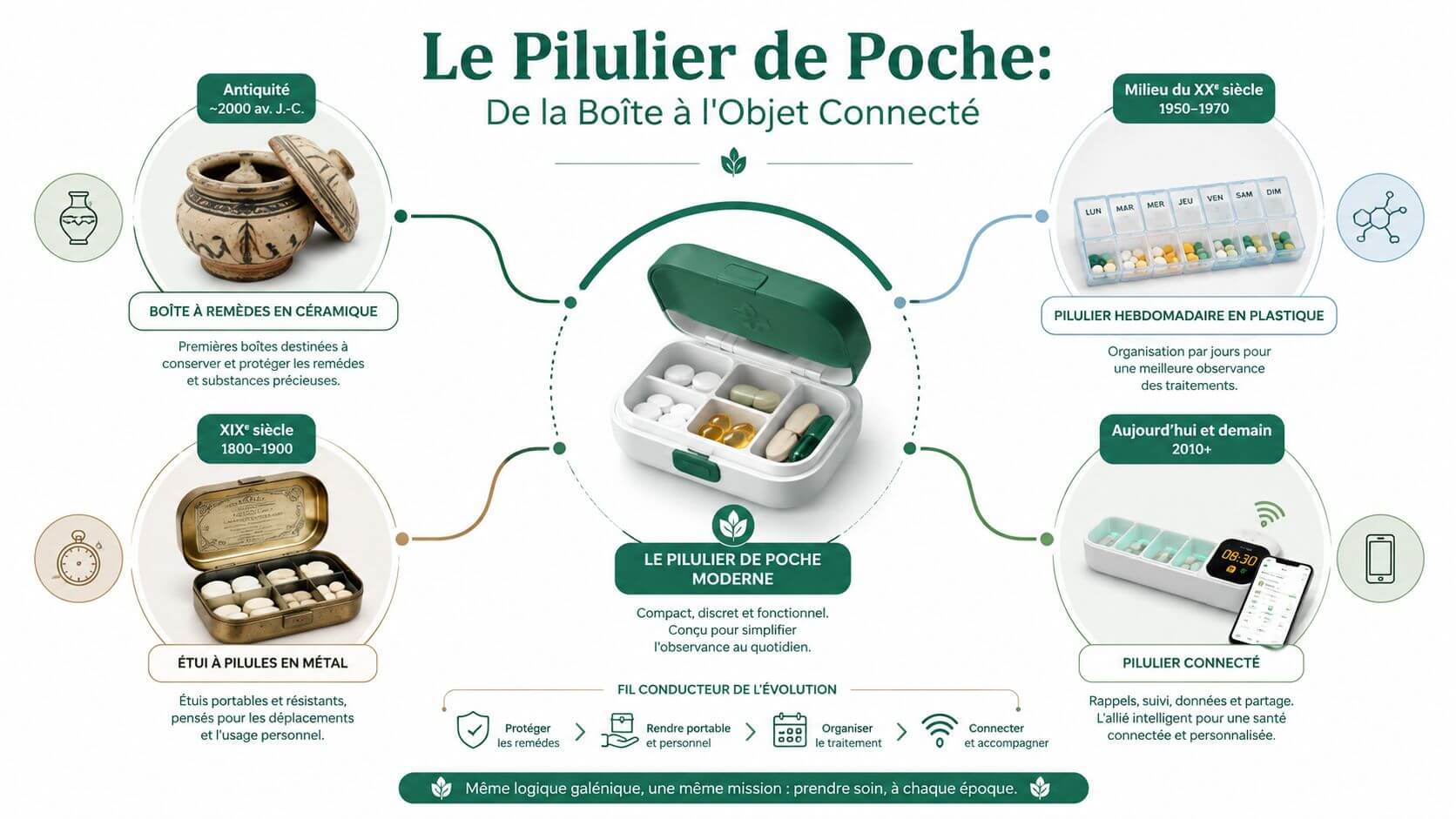
Its history is not recent. In France, it is part of a long evolution in the delivery of unit doses, with historical sources that still evoke in 1641 the use of a board, the tabula, to roll and then cut out the preparations, while the pile as we know it today is described and represented in the eighteenth century, at Diderot in 1763 and Baume in 1766, as recalled by a historical source of reference on the subject (Persia) The word Pilula In fact meant "small ball", which directly connects the object to the Galenic form itself.
Two families of objects, two logics
The simplest model is Liabilities. It presents itself with daily compartments, often in pocket format, to keep on yourself the catches of a day or a short sequence. The role of the container is then clear, it cuts the processing into visible time ranges, a bit like a paper calendar helps not to mix appointments.
The other family is active. It adds alarms, a vibrator, a backlit screen, sometimes an anti-doubt system, and in some cases a history of the sockets. There, the pill organiser no longer serves only to store, it participates in the recall and control of the rhythm. It is useful for a person who can be interrupted, tired, or distracted by the movements, because the recall no longer depends solely on the memory of the moment.
Why this difference counts
The distinction is simple, but it changes the way you work. A passive container helps to prepare and visualize, an electronic model helps to call back in time. If the person forgets mainly because he or she comes out, runs the activities, or does not keep the same pace from day to day, the reminder function takes on more weight than simple storage.
The right model is not the most sophisticated, it is the one that corresponds to the way the person forgets.
The most often ignored point of vigilance is elsewhere, in the content itself. Not all medicines should be removed from their original packaging, especially when identification, storage or safe intake might be complicated. That's why a pocket pillar should be thought of as a link in a set, with careful preparation by the caregiver or the next of kin, and then a check shared over the course of the day.
The most useful, in practice, is often coordination. Physical support shows the preparation, human exchange confirms what has been given, then digital monitoring can keep a clear record for the family or for a professional at home. So the pocket pillar is not only a small box, it helps to hold the medicine together, the memory of the caregivers and the safety of the intake.
Who really is a pocket pillar?
The Pocket stacker It does not have the same interest for everyone. It becomes really relevant when the person has to manage several sockets, often exit, or when several relatives relay without sharing the same memory of events. For the family as for the healthcare team, it then serves as a concrete support point, a bit like a logbook that holds in the pocket, with simple markers instead of relying on the memory of each one. The French data on compliance reminds moreover that the subject is not marginal, with 6 in 10 chronic patients who would not faithfully respect their treatment, more than EUR 9 billion of annual cost for sickness insurance, approximately 130,000 hospitalizations and more 10,000 deaths Each year, especially after 65 years, according to figures reported for France (Pharmaceutical tips).
Profiles that earn the most
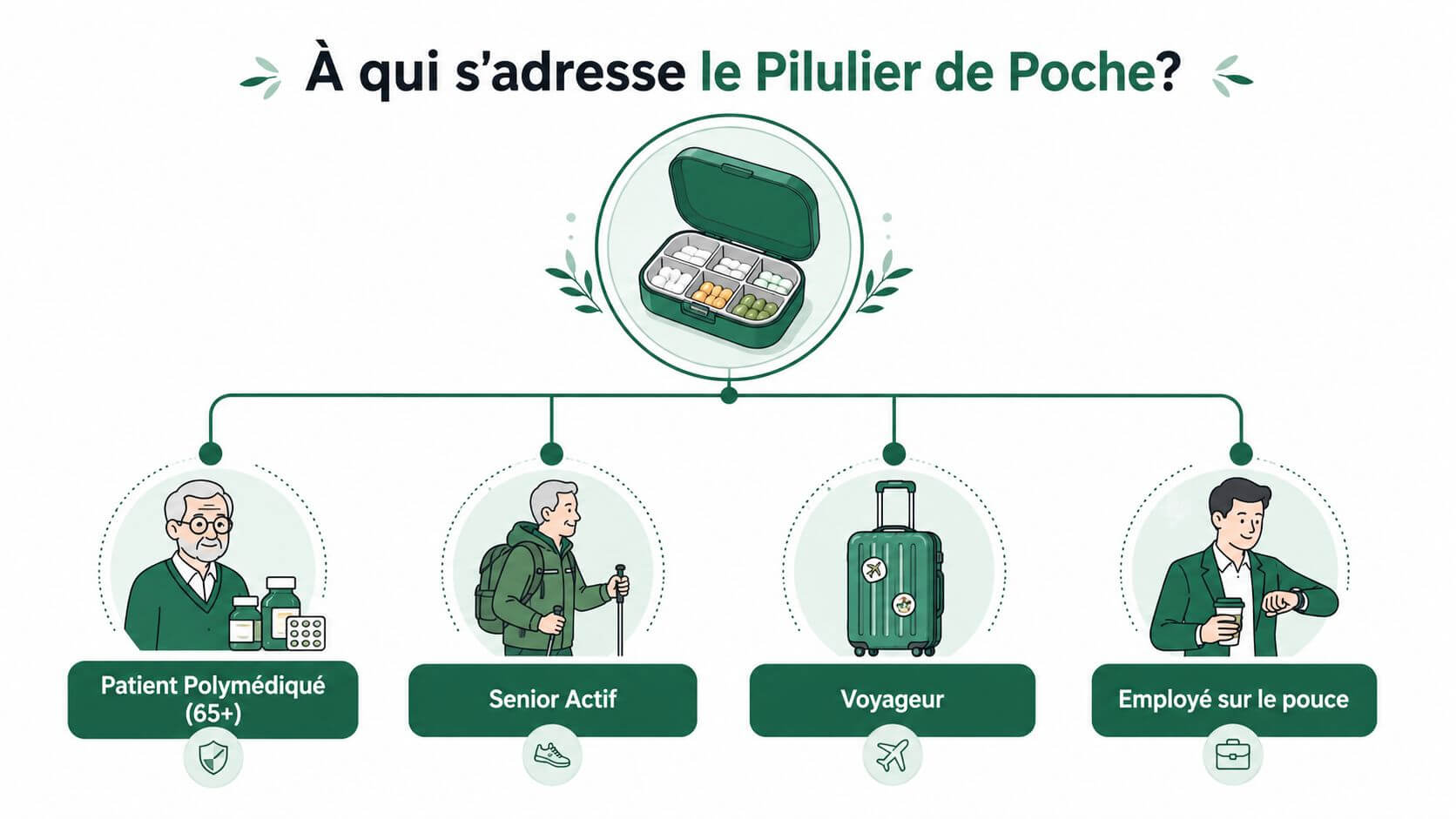
- Polymedic patient. When you have to follow multiple treatments at a time, the pocket format helps to separate the sockets at times of the day, without multiplying the boxes in the bag.
- Senior active. A person who goes out, walks, travels or lunches outside needs a light format, easy to take away, without depending on the furniture of the kitchen.
- Helping from a distance. When a parent lives at home, the pill organiser becomes a shared marker between the one who prepares and the one who checks later.
- Home health professional. IDELs and caregivers use it mainly as a preparation medium, not as an absolute proof of take, which avoids confusing storage and compliance.
A point often counts as much as the number of doses, it is the way the day is organized. A very stable person, who takes his medication at the same place and at the same hours, can get away with it in a simpler format. When the schedules change, when the outputs go on or when several speakers take turns, the pocket format responds better to the reality of the land than a large box left at home.
How to Recognize Good Use
The proper use is also read in the daily life. If the stacker is only used to store, there is still a container. If it helps the person, the relative and the caregiver to check what has been prepared, given and followed, it becomes a useful link in a digital tracking like Tribulys, with a trace easier to share in case of doubt.
The context of oral contraception also recalls the gap between theoretical efficacy and actual use, with a so-called "typical" dose associated with 4-7 pregnancies per 100 women per yearagainst 1 per 100 in correct use, according to WHO included in the data provided (Pharmaceutical tips). Without transposing this figure to all treatments, the message remains the same, reliability depends as much on the tool as on actual use.
Choosing your stacker well according to your needs
The choice is made on very concrete criteria. Before looking at color or design, you have to look at the capacity, the closure, the readability of the compartments and the level of help with the reminder. A pocket piler that turns over, opens too easily or becomes illegible in a bag does not help anyone. The right question is simple, does the piler follow the person's life, or does it complicate it as soon as you have to get out of home?
Compare what really changes
| Criterion | Passive mechanics | Alarm electronics | Hybrid / connected |
|---|---|---|---|
| Transport | Light and simple | More bulky | Variable according to model |
| Background | None, or very indirect | Audible, visual or vibratory signal | Reminder + traceability |
| Compartment | Daily, often by time zones | Daily, sometimes reinforced | Often thought for shared follow-up |
| Anti-doubt | No | Sometimes present | Sometimes integrated into digital tracking |
| Catch monitoring | No | Sometimes traced | Possible background |
| Ideal use | Self-employed and stable | Frequent forgetfulness, need for alert | Coordination between relatives and caregivers |
This table is mainly used to avoid a frequent misunderstanding. A simple model can be very suitable for a self-employed person, as long as the schedules are regular and the stacker remains visible and easy to control. As soon as you have to prevent an oversight, reassure a relative or keep a shared trace, the need changes.
Criteria to be considered as a priority
For mobile use, you must first check the Size, weight and the strength of the closure. A too fragile clip or a flexible hinge loses the tablets at the bottom of the bag. Watertightness also counts, especially if the stacker accompanies frequent movements or if it remains in an outer pocket.
The materials also deserve attention. transparent helps to see what remains, and materials suitable for food contact reassure the daily. If the person needs an active reminder, the models with 5 daily alarms, vibration and repetition in the event of non-take-off provide a level of safety higher than a simple passive container (Capital).
The decisive point often remains the actual use. A pocket pile is not only a small box, it is an object of coordination. It must be able to be understood by the person, read by a close helper and, if necessary, integrated into a digital tracking like Tribulys to keep a consistent record of catches and omissions.
Thinking budget without losing meaning
The electronic versions referred to in French sources remain poorly reimbursed and are often proposed between 50 and 180 € according to the functions (Identities). This point must be weighed against the real need, not the perceived comfort. If oblivion is mainly due to a lack of visibility, a simple model may suffice. If the problem comes from time and interruption, the alarm becomes more logical.
To compare a larger weekday format with a compact format, you can also consult this handy benchmark on the weekday morning noon evening.
Fill, clean and use your pill organisery every day
The filling must remain simple, but it must never be done in haste. The safest way is to prepare the stacker in a quiet moment, with the prescription before the eyes and the original boxes at hand. When a close helper takes care of it, a rereading by a second person is useful if the treatment has just changed.
The gesture looks like a small control circuit. We check first, then we sort it out, then we confirm that nothing has been forgotten.
Steps that reduce errors
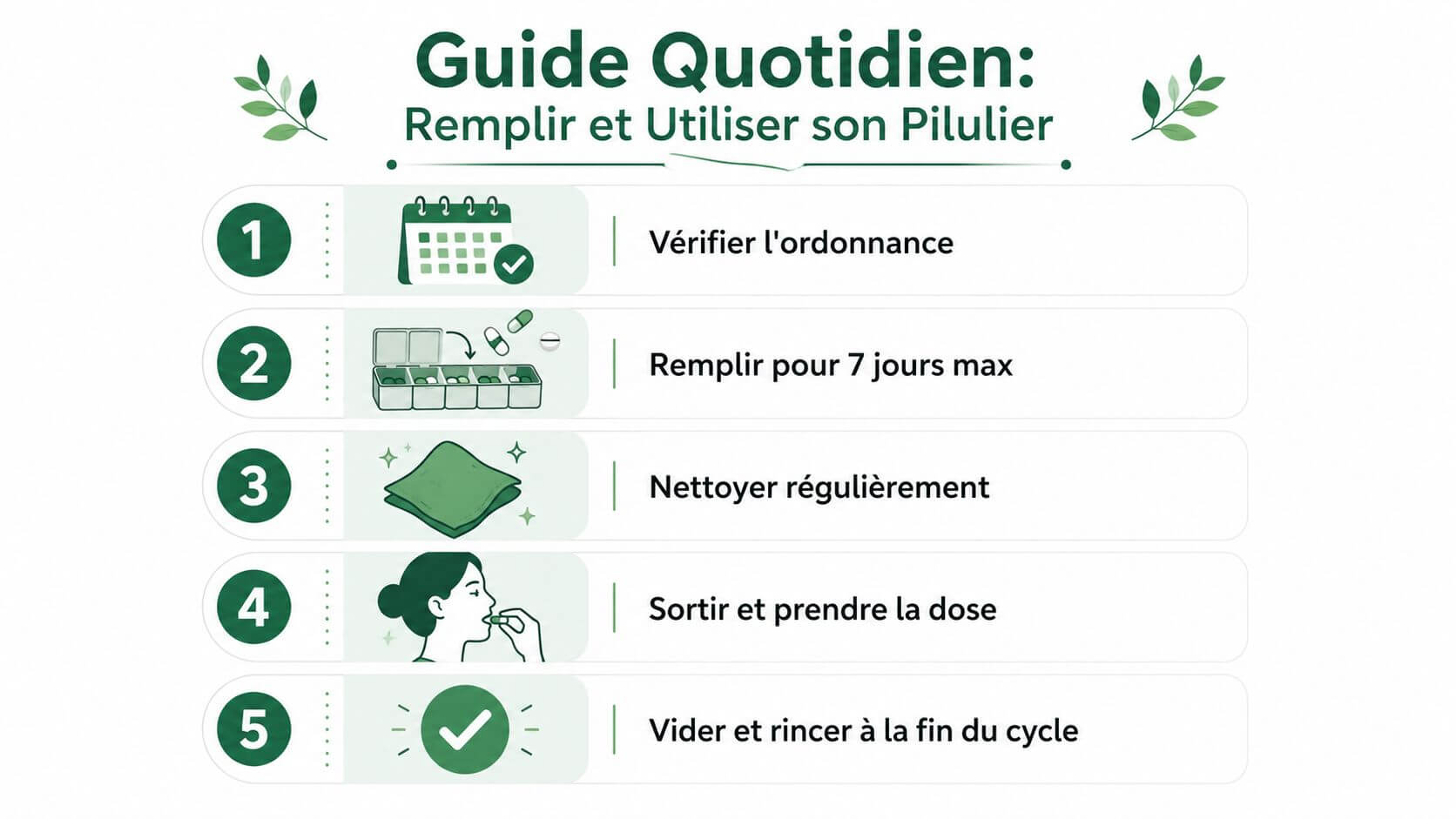
- Check the prescription. We compare each medication, dose, schedule and galenic form before transferring anything.
- Fill for a short time. The OMEDIT Centre recommends favouring short-term, ideally no-exceeding, ready-made piles 8 days (OMEDIT Centre).
- Visually control. A transparent or compartmentalized stacker helps to identify any forgetfulness of filling prior to departure.
- Clean regularly. Gentle washing and complete drying avoid residues, especially in pocket sizes exposed to bags and pockets.
- Back to the original boxes. If a treatment should not be transvased, it should be left aside, even if it makes the organization a little more difficult.
Security rule. If a drug is in doubt, it is better to keep it in its original packaging than to force it into the pile.
Drugs that should not be moved without verification
The most important guideline concerns the treatments that must remain in their initial packaging until they are taken. French reference sources recall that certain medicinal products must not be transfused, and that in case of doubt they must be kept separately rather than put in the stacker (OMEDIT Centre). This is particularly important to limit errors related to light, humidity or a form that does not support storage off-box.
A medicine apart is not an oblivion, it is sometimes the right organization. For a caregiver, this separation also avoids mixing the tablets to be prepared and the tablets to be left intact.
When the preparation is well done, the daily use becomes more fluid. You take the pill, take the dose at the right time, then check that there is nothing left in the wrong compartment. This simplicity rests on a rigorous preparation, and it also reassures the person who helps, because he knows where to look in case of doubt.
The video reminder below illustrates the basic gesture in everyday life.
For a very concrete guide on compartments and day-to-day organisation, this marker can also help, with the weekday morning noon evening.
Articulate the pilelier with a digital tracking like Tribulys
The Pocket stacker Reassuring because he puts the catch in the right place, in front of the eyes. He does not say alone who prepared the dose, who checked the contents, or whether the dose was confirmed. For a family that organizes itself to several, the real subject is there, linking the object of daily life to a shared follow-up to avoid the shadow zones.
Coordination that remains legible for all
The simplest diagram looks like a chain of control. A relative fills the stacker for the coming period, a second look checks the compartments, then each socket is noted in a common space. If an forgetfulness appears, everyone sees it faster than with an isolated call or a message lost in the day.
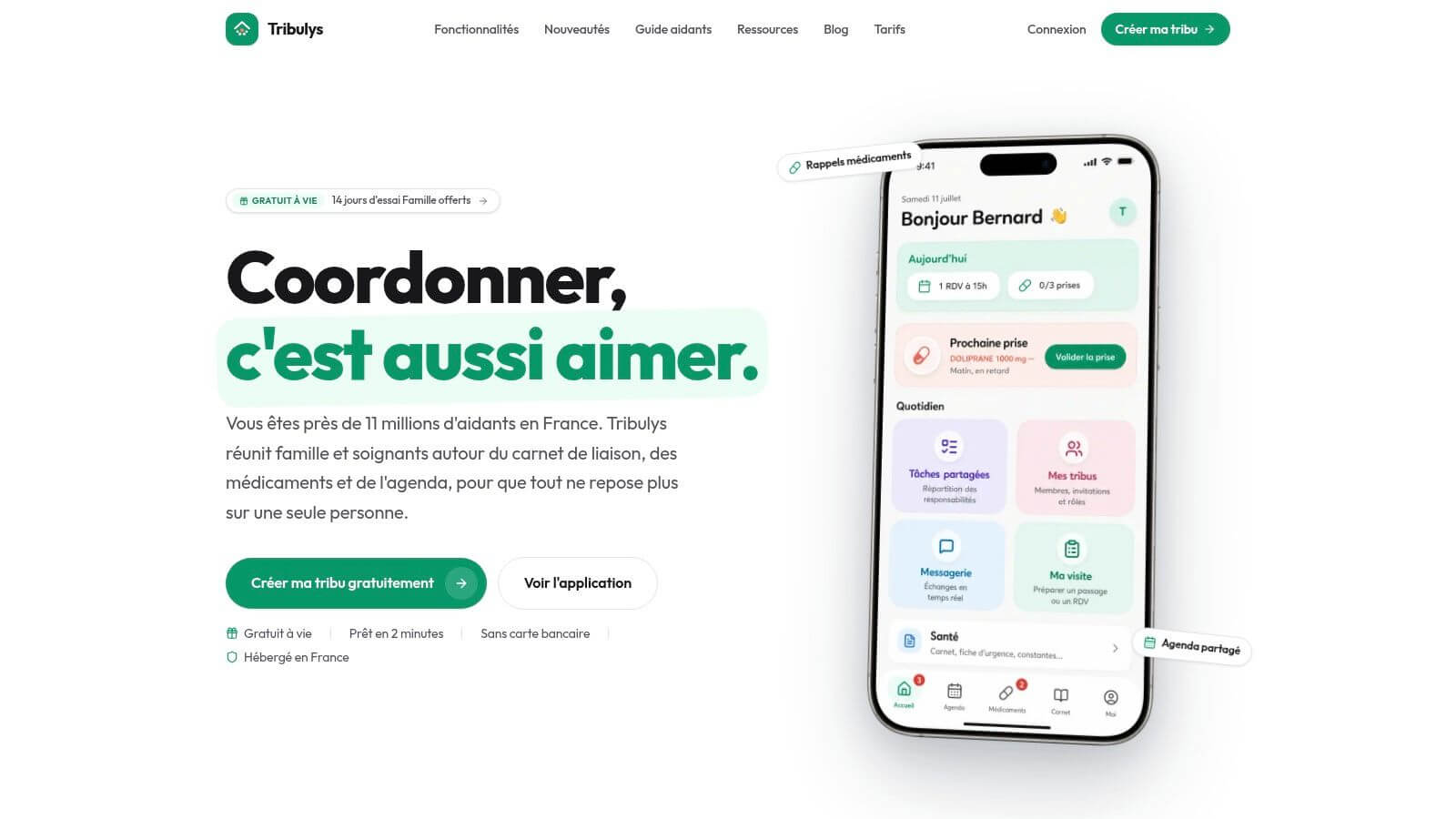
This is also the logic of the follow-up of Tribulis treatments, which gathers the confirmation of the catches, the alert in case of forgetfulness, the shared notebook and the private messaging. For a helper, this amounts to keeping the pilelier in the hand and the dashboard next, like two faces of the same gesture, one material, the other relational.
What digital adds to paper gesture
Digital is not a substitute for the pill organiser, it secures what surrounds it. When the passages of an IDEL, a physiotherapist or a home care worker are to be articulated, finding the calendar and takings in the same place avoids scattered instructions. The disconnected emergency statement in Tribulys remains useful in times when basic information needs to be quickly transmitted, for example if a person's condition changes or if a relative takes over.
A good follow-up does not need to be complicated, it must above all be shared at the right time by the right people.
For the attending physician, the value is very concrete. A history of takings and observations helps to understand what has really been done between two consultations, especially when the family takes over. When several caregivers succeed each other, a common trace avoids conflicting versions, a bit like a logbook that you don't have to reconstruct memory.
The shared notebook can also centralize the doctor's meals, mood and instructions. The information related to the treatment no longer disperse in several conversations, and everyone knows where to look before asking a question. It is in this type of coordination around the home that Tribulys makes sense, with a readable follow-up from morning to evening, a shared notebook and notifications when to react.
Limitations, risks and good practices to remember
The Pocket stacker help, but it doesn't neutralize all the risks. If the order changes in the course of the week, an already filled compartment may become false overnight. It also does not detect drug interactions, nor does it replace the vigilance of the pharmacist or physician.
It is also necessary to accept its physical limits. A lost piler, forgotten in a car or closed too quickly can cause a break in the grip. Electronic models help recall, but they can create a false sense of safety if no one actually confirms what has been taken.
When you have to prefer something else
- Very unstable order. Better is a shorter format or a daily check than too advanced a fill.
- Sensitive medicines. The original packaging remains preferable when there is doubt about the preservation or shape.
- Need strong traceability. A dose bag prepared by the pharmacist or a shared tracking tool may be more suitable.
- Helping little present. A simple phone alarm can be enough if the person already knows how to handle his sockets alone.
The good judgment is therefore nuanced. The pocket pillar fits very well when it is used to make the sockets visible, mobile and easy to verify, but it must never mask a confused prescription, poorly explained treatment or a need for broader coordination. When the context is complex, one must think system before thinking box.
If you want to structure all this without multiplying calls, manual reminders and flying sheets, Tribulys centralizes the liaison logbook, the follow-up of medicines, the agenda and exchanges in the same space. For a close helper, it is a concrete way to connect the Pocket stacker the rest of the home coordination, with a more reliable and easier shared track to follow on a daily basis.
Put this organisation into practice with Tribulys
Keep your care journal, shared calendar, tasks, medication tracking and emergency information together. Start for free and invite the relatives and professionals involved in your loved one’s care.