
41 pill boxes sold every minute in France, this represents about 21.8 million boxes per year. It's not a small pharmacy accessory, it's a daily tool for millions of shots, checks and appointments at home.
Contents
- Contents
- How many pill boxes are sold in France
- What is a pill box and how it works
- The types of piles and their characteristics
- Criteria of choice for the elderly and caregivers
- Practical use and safety tips
- Alternatives to the classic stacker
- Integrate Tribulys to make medication use more reliable
Contents
- How many pill boxes are sold in France
- What is a pill box and how it works
- The types of piles and their characteristics
- Criteria of choice for the elderly and caregivers
- Practical use and safety tips
- Alternatives to the classic stacker
- Integrate Tribulys to make medication use more reliable
How many pill boxes are sold in France
In France, pill box It is part of a very concrete health history. The mass spread of oral contraception after the Neuwirth Act 1967 changed usages, then the pill became the first contraceptive in the country at the end of the 20th century. The use of oral contraception then declined in the 21st century, with a shift from 50% to 41% between 2010 and 2013, then an additional decrease of about 9% between 2013 and 2016 source.
A common object, a daily responsibility
In the field, these figures do not look like an abstract curve. They take the form of a girl who fills her mother's pilelar on Sunday night, a spouse who checks the doses before breakfast, or a caregiver who answers three different messages to know if the evening tablet has been taken. The pill box is only a visible medium, but it reflects a broader organization, often shared between several people and several habits of taking.
The real subject is not the container, it's coordination. The box becomes useful only if it is integrated into a stable, readable and verifiable routine.
This is why a guide on the pill box It should never be limited to the choice of a model. It is necessary to talk about readability, catch segmentation, transport, organization of out-of-box processing and digital solutions when several people intervene. Shared notebooks, phone reminders and tracking tools such as Tribulys have a concrete place, because they secure the flow of information between caregivers. The box alone can reduce visible omissions. The rest of the system is used to avoid errors of coordination, duplicates and shadow zones.
The right reflex, for a helper, is therefore to look at the box as a visible point of a wider system. If the box is badly chosen, everything else becomes more fragile. If it is chosen well, it simplifies life, but it does not replace coordination around care.
What is a pill box and how it works
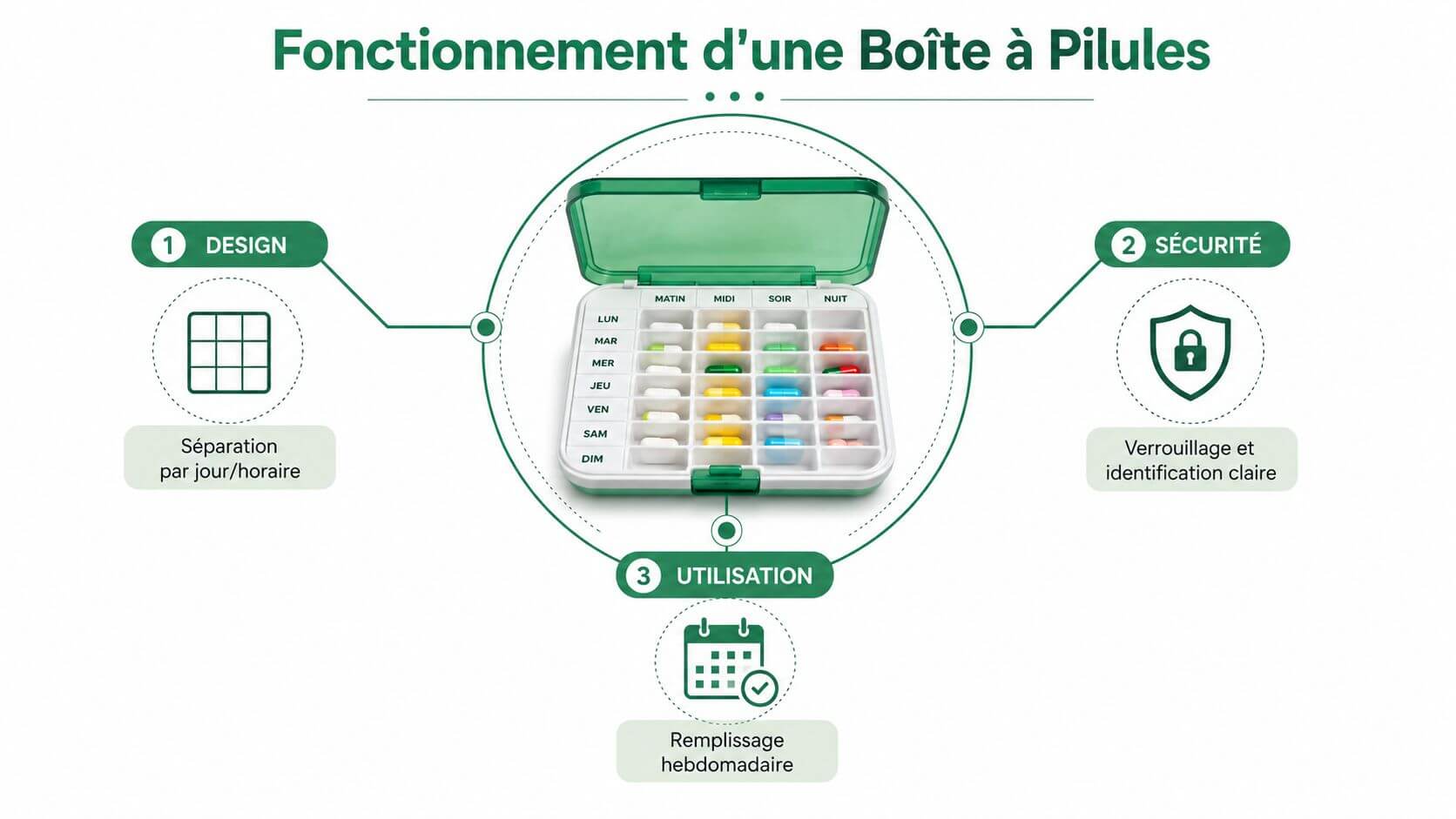
One pill box is used to make a treatment readable on a daily basis. It transforms abstract instructions into concrete boxes, with days, moments of capture, sometimes transport or control markers. In homes where several people are involved, it does not replace the organization. It makes it visible, which helps to spot a missed dose, duplicate or incomplete preparation faster.
Visual logic, not just storage
The operation is based on a simple idea, separating each socket in a separate compartment. Depending on the model, the distribution is done by day, by day or by combination of the two. A well-filled piler allows to check at a glance whether the treatment of morning, noon, evening or night has been prepared as planned. source.
This quick reading counts as much as storage itself. It reduces hesitation at the time of taking, especially when the person manages several medications or when a caregiver takes over from home. The pillar then works as a verification medium. It helps to reread what has been prepared, without asking for additional memory.
The formats and materials you really encounter
Common models often use light and easy-to-manipulate materials, such as Polypropylene (PP), appreciated for its resistance to repeated use and simple maintenance. We also find more compact formats, designed for transport, and larger boxes, useful when the preparation has to cover several sockets in advance source. The choice of material does not change the basic logic. It plays mainly on weight, gripping and durability over handling.
The format must be consistent with how to prepare the medicines at home. Too small a piler quickly becomes difficult to fill when the treatment is complex. A too large model can take place without bringing real gain if the person has only a few take to organize. The good arbitration is therefore made between readability, stability and actual use in the routine of the home.
The pill box works as a work point. It does not regulate the coordination of care alone, but it gives a concrete control point in the house. This is often what makes the difference between a simply memorized take and a really followed one, especially when several people have to align themselves with the same treatment.
The types of piles and their characteristics
The choice of a pill box First, it depends on the level of coordination to be maintained on a daily basis. An independent senior who follows a stable treatment does not need the same format as a home where several relatives share preparation and verification. The right model is judged on three points, the capacity, readability and how it fits into the control of the catch.
The most used formats
| Type | Format | Capacity | Ideal for |
|---|---|---|---|
| Standard weekly | 7 days, compartments morning noon night | Preparation over one week | Self-employed/principal helper |
| Daily bar drawer | 7 daily bars with 4 boxes each | Fine separation of catches | Multi-aiders and nursing relays at home |
| Mini portable box | Compact pocket format | Only a few shots | Travel, outings, isolated day |
| Unit Distribution in Pharmacy | Prepared doses | Individualized dispensation | Complex treatments, when manual preparation becomes risky |
The Classic weekly stacker remains the easiest to check at home. It allows to prepare all week in one time, then to check at a glance what has been taken or not. The drawer model with 7 bars daily, each with 4 boxes, better suited when several people are involved in the same treatment or when schedules have to remain very precise. In this type of configuration, the pill organiser is no longer only a box, it is a point of coordination visible in the organization of care, as also shown in this article on the coordination of care and the choice of a suitable tool.
Which really changes from model to model
The difference is not only due to the external format. A compact model facilitates transport, but it quickly limits the number of sockets to be arranged. A large weekly stacker gives a clearer overview, but it requires more space and regular preparation. The material also counts. Polypropylene supports repeated manipulations and remains easy to maintain, which explains its frequent presence in everyday models source.
The choice is therefore made between portability, storage capacity and Ease of verification. A caregiver who prepares treatments for several days will often take a larger format. A person who travels often will be interested in using a smaller secondary box, without making it the only tracking system.
| Point of comparison | Compact format | Weekly format | Drawer format |
|---|---|---|---|
| Quick reading | Good | Very good | Excellent |
| Transport | Very good | Medium | Low |
| Long-term preparation | Low | Good | Good |
| Multi-career use | Limited | Correct | Very good |
The most important thing remains to align the type of stacker with the actual number of catches and with the way the family organizes the follow-up. A good pillar is not the most sophisticated, it is the one that is filled without hesitation and that can be controlled effortlessly every week.
Criteria of choice for the elderly and caregivers
The good one pill box It is not chosen for its form, but for the daily work it makes possible. In houses where several people are involved, the pill organiser becomes a coordinating point as much as an object of storage. If it is misconceived, it adds checks, hesitations and sorting covers.
The first criterion is legibility. Benchmarks must remain clear at first glance, with comprehensible boxes without turning the object in every direction. Days, time ranges and markings must reduce ambiguities, not create them. A useful model is one that a helper can check at a glance, even when the preparation is done in an already loaded context.
The segmentation counts as much as the external aspect. A simple treatment can remain legible in a weekly organization, but as soon as the catches multiply in the day, the separation morning, noon, evening, night helps to reduce confusion. It is not a question of sophistication, it is a question of the rhythm of life and the real number of catches.
The solidity of the material weighs quickly in the balance. Polypropylene well designed supports repeated openings and frequent manipulations, making it a common choice for domestic use. When the box passes in several hands, timekeeping and ease of maintenance count as much as internal organization.
What to look at before you buy
A helper saves time by testing the box as a work tool. Do the compartments open easily, without being too loose? Do the inscriptions remain easy to read, and does the format fit where it really needs to be used, on a night table, in a bag or in a preparation closet?
A practical pillar is a pillar that can be reread effortlessly. If the person has to hesitate before each box, the model is already too complicated.
For shared use, one must also think about the coordination of care around the right tool. A pillar can be very clear for one person, then become a source of error as soon as a relative, a home helper and a caregiver take turns. In this case, the right criterion is not only the storage capacity, but the ease of control between stakeholders, as this guide recalls on thinking about the coordination of care around the right criteria.
The real trade-off is made between readability, organization of outlets and place available in the daily life. A pocket model remains useful for exits, but it does not replace a main system at home. A more structured model helps more when monitoring must remain reliable despite multiple passages.
Practical use and safety tips
The security of a Pillier It depends less on the object itself than on the ritual that surrounds it. A filling made at the speed on a congested table creates errors of dosage, especially when several treatments are similar or move in several hands. A calm preparation, always at the same time of the week, gives much better results in practice.
The routine of preparation that holds in time
The most effective is to reserve a fixed niche, with the prescription in front of the eyes and, if possible, a printed paper list of the current treatments. Each drug is checked before being placed in the corresponding compartment. This discipline avoids relying on memory or an old sorting done head-on.
It is also necessary to keep in mind a point too often overlooked, the management of expiry dates Once the drugs have been removed from their original carton. The subject becomes sensitive when the stacker becomes the single point of storage. In this case, a plasticized inventory with expiry dates remains a simple and useful solution, as it keeps visible what usually disappears as soon as the blister is separated from its carton.
Errors that often come back
- Too much to fill in a box. An overflowing compartment looks like a complete preparation, but it often masks a sorting error.
- Mix several treatments without clear reference. When the original boxes disappear, confusion increases rapidly.
- Let the pill organiser become the only memory. The stacker organizes the catch, it does not replace the traceability of the treatment.
- Prepare in the emergency. A box filled between two calls is more exposed to oblivion and inversion.
The identification must remain legible as far as possible, especially when the treatment is reconditioned. This is exactly what reduces daily confusion, especially if the person receiving care, a relative and a caregiver take turns with different habits.
Good reflex. If a medicine comes out of its original packaging, immediately note its name, dosage and expiry date in a separate medium. Waiting for "later" is almost always a bad idea.
A pillar remains safer when it fits into a coordination set, not when it serves as a single point of reference. In homes where several people are involved, the physical box gains to be supplemented by a simple written trace, and, for families who need more responsive follow-up, by a tool like an application not to forget its medicines. This reduces oblivion without forcing to abandon the manual gesture.
Finally, it is better that the pill box is never the only organizational tool. It works well when it remains integrated into a stable method, with a regular check and a support that everyone can read without hesitation.
Alternatives to the classic stacker
The Classic pile It is still useful, but it is not always enough. As soon as the treatment becomes complex, several people intervene, or the oblivion of a dose becomes critical, you have to look at the other available solutions.
Three possible routes depending on level of need
- Distribution pouches. The pharmacy prepares doses in advance, which limits manual sorting. It is suitable when home preparation becomes too risky or too heavy.
- Flakes connected. Digital tracking adds reminders, sometimes alerts when a dose is forgotten. This is relevant when vigilance needs to be strengthened without changing the entire treatment.
- Dispensation service. The preparation is assumed by the pharmacist, which simplifies the patient's daily life and reduces domestic manipulation.
The choice depends mainly on the place that one wants to leave to the manual gesture. Some homes want to keep a direct control with a physical box. Others prefer to delegate part of the sorting or recall to reduce the daily load. The right arbitration is not theoretical, it depends on the number of drugs, the level of autonomy and the number of caregivers present around the person.
A digital tool can also complement the stacker without replacing it. For families who want to avoid socket oblivion, a shared reminder system is often more useful than a simple reminder on an individual phone, especially when several people follow the same close friend, as in this approach dedicated to drug recalls.
The key point is simple. The pillar remains very effective for the overall view, but as soon as coordination becomes multi-stakeholder, it takes an extra layer of follow-up. This is where the solutions of dispensation, recall or information sharing take on their full meaning.
Integrate Tribulys to make medication use more reliable
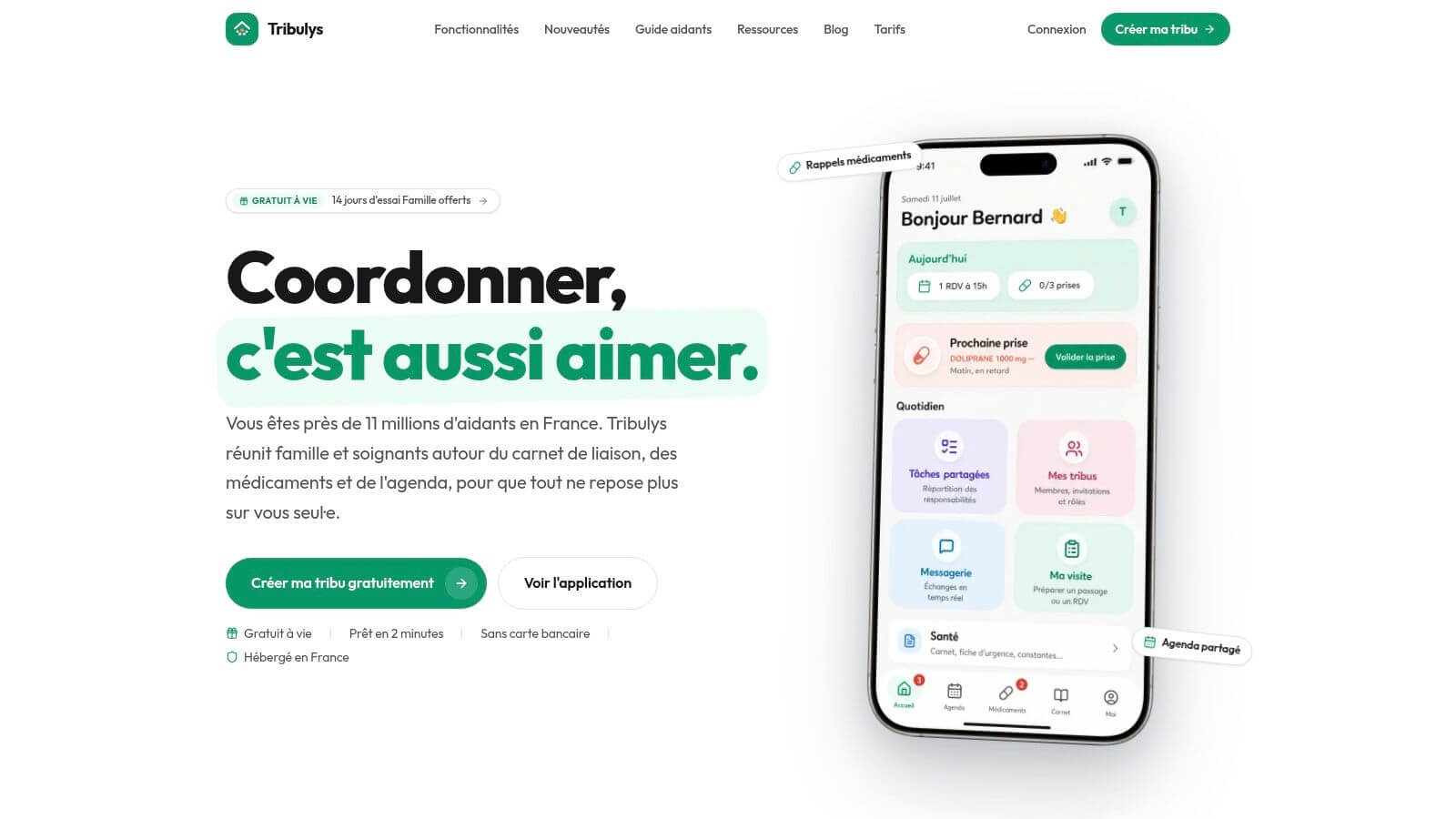
One pill box becomes really reliable when it relies on a clear coordination around the sockets. Tribulys brings this layer shared with a Timed link book, follow-up of medicinal products with confirmation of each dose, Common agenda and one emergency sheet accessible offline with essential information such as allergies and ongoing treatments.
For a family, the interest is very concrete. The messages are no longer dispersed in several groups, the passages are better traced, and the memory of the care is no longer based on a paper book difficult to consult at a distance. free life plan up to 5 members, a hosting of data in France and the EU, and a start-up without a credit card, the tool fits into a home organization without burden.
To coordinate a stacker with reminders, a shared notebook and real visibility for the whole family, Tribulys centralizes the information in the same place. If you manage the take of a loved one at home, see how the application can reduce forgetfulness, duplicates and repeated calls.
Put this organisation into practice with Tribulys
Keep your care journal, shared calendar, tasks, medication tracking and emergency information together. Start for free and invite the relatives and professionals involved in your loved one’s care.