
Sophie has just learned that her mother will start chemotherapy next week. She wants to accompany her, but her question remains very concrete: Can one accompany a patient in chemo, and above all, what must be done before, during and after the session ? Being present in the care room counts, but this is only part of the work.
In France, almost 372,500 people were treated with chemotherapy in 2022, according to key chemotherapy figures published by the National Cancer Institute. Behind each session, there is often a relative who organizes the transport, notes the instructions, monitors the general condition, prepares the return home and transmits the information to the healthcare team.
The right approach is to consider accompaniment as a simple, written and shared coordination. You don't have to become a nurse, but you need to know who does what, what information to write down, when to call and how to pass the relay.
Contents
- Accompanying a loved one in chemo what it really means
- A typical day around a chemotherapy session
- Recognize side effects and know when to alert
- Communicate effectively with the medical team
- Arrange appointments for medicines and transport
- Coordinate several caregivers without losing information
- Final checklist and signals to ask for help
Accompanying a loved one in chemo what it really means
To accompany a patient with chemotherapy is not only to sit next to him during an infusion. It is to help the person to go through a day that can start with an appointment, continue with a wait and end with significant fatigue, nausea or a need for calm. Your role changes according to the days, protocol and condition of the patient.
The attendance during the sessions depends on the functioning of the institution and the patient's agreement. League against cancer recommends the presence of a relative at several sessions, particularly to reduce anxiety and to better understand the course of care. The relative can listen, remember the names of the responders, record the instructions and direct any questions to the nurse or physician.
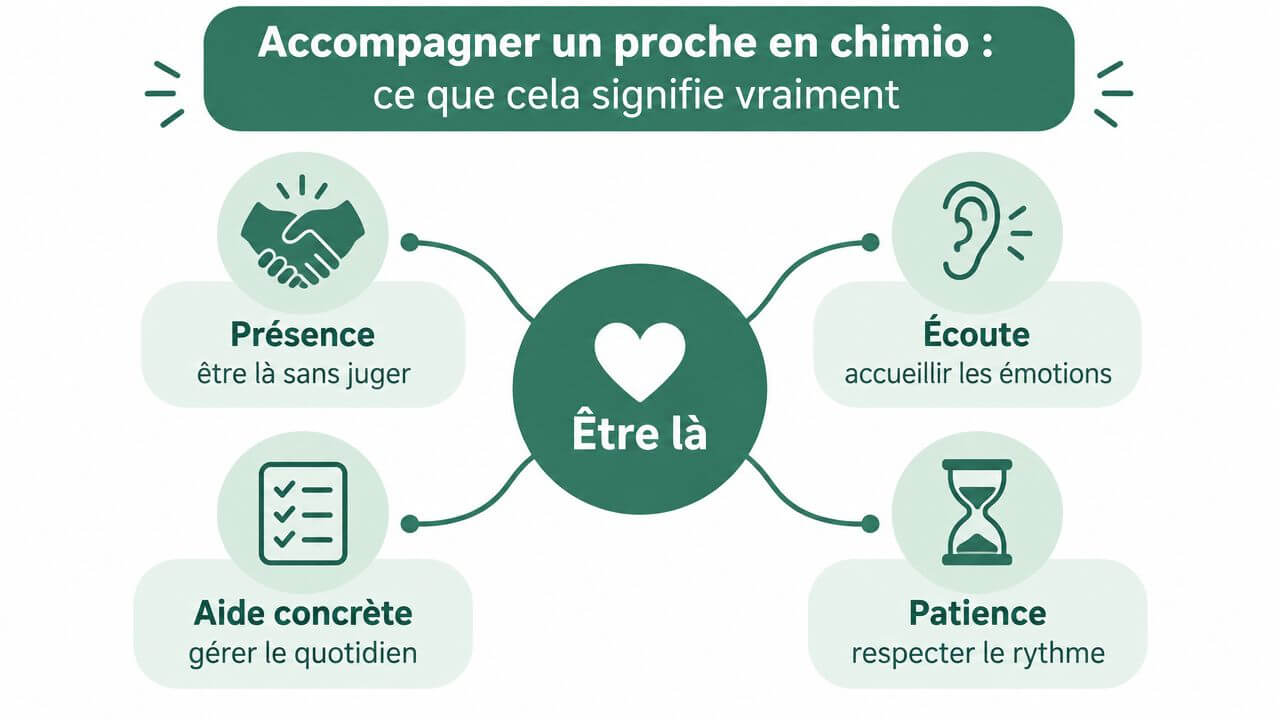
A presence that respects the patient's place
The spouse, a relative, a friend or a professional caregiver may accompany. family helper intervenes under his personal relationship and can take care of the organization, the races, the meals, the travels or the exchanges with the family. A paid professional is involved in a defined mission, such as toilet aid, house maintenance or some home relays.
Do not confuse support with care. You can recall a prescribed treatment, rate a symptom, or transmit information. You should not change a dose, interpret a result alone, or decide to stop taking without medical instructions.
French law provides for arrangements for close relatives, in particular Caregiver leave and mechanisms of support or respite depending on the situation. However, the right to the presence of an accompanying person depends on the regulation of the establishment, the organization of the service and the patient's will. Ask the center for the rules before the session, rather than discover the response at the reception.
Practical rule: Your mission is not to do everything. It consists of making information reliable, daily easier and alerts faster.
A typical day around a chemotherapy session
The day before, Sophie prepares a small bag for her mother. She puts in the papers requested by the service, the updated list of treatments, the useful contact information, a bottle of water and a snack that her mother tolerates. She also checks the time of the appointment and the transport, because a morning of chemotherapy can be short or occupy a large part of the day according to the protocol and the organization of the day hospital.
In the morning, do not try to impose a heavy meal. A light breakfast, chosen according to the habits and instructions of the team, is enough. The relative must above all check that the person is ready, that he or she has his or her glasses, documents and medicines authorized to take before departure.
Upon arrival, transmit before reassuring
At the reception, the caregiver does not need to tell the whole family story. He must pass on the recent facts: an unusual temperature, vomiting, new pain, difficulty drinking, a fall, a forgotten medicine. Note these elements in the care journal, then report them to the nurse.
During the infusion, some patients want to talk, others prefer to sleep or stay alone. Respect this choice. Your presence becomes essential if the patient is very anxious, if he or she has difficulty understanding the instructions or if no one else can rate the decisions made during the consultation.
The shared calendar of the family must contain appointments, journeys and the person responsible for the return. a shared calendar to coordinate loved ones prevent two people from organizing the same transport while none of them provides for the next.
On the way back, place the patient in a quiet place. Help with meals, water and medications prescribed on the way out, without improvising treatment. The evening serves to observe and note, not to multiply family calls.
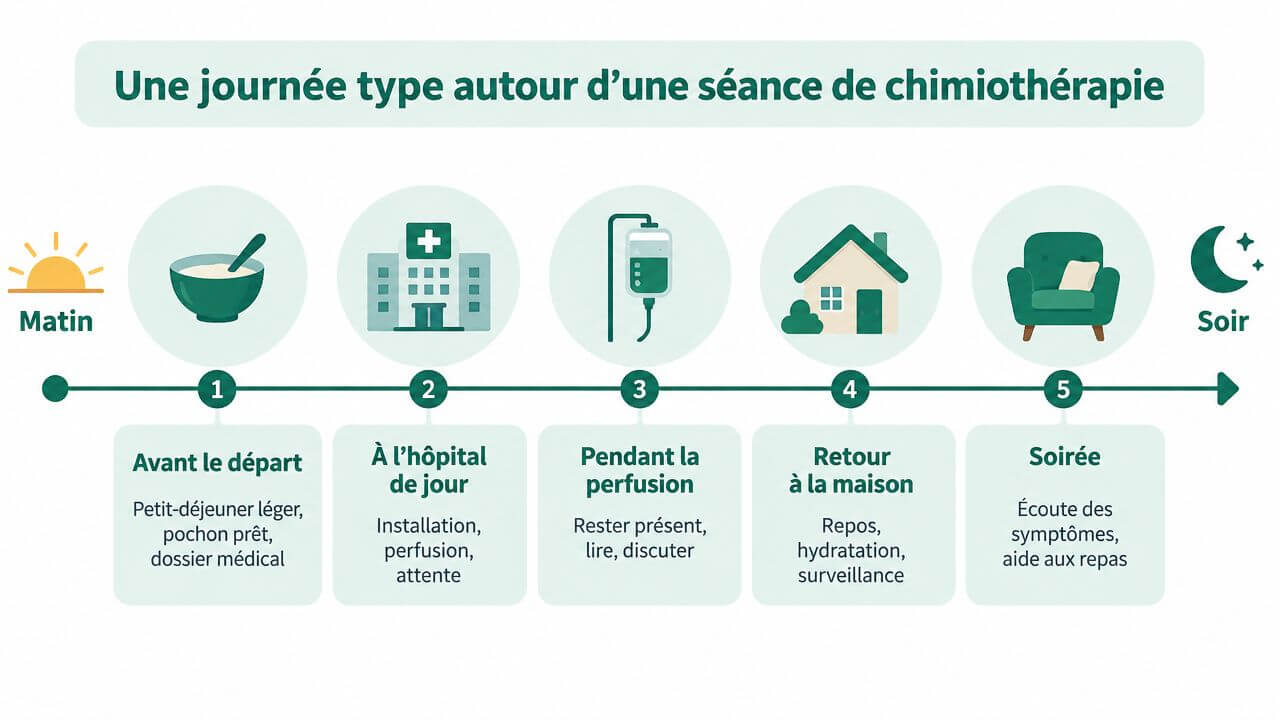
Here is an additional video support to visualize the organization of a treatment day.
Recognize side effects and know when to alert
Do not manage an unusual symptom alone. The effects vary depending on the protocol, and the team that follows the patient knows the particular risks of his or her treatment. Your job is to observe, measure, if possible, record the time and call with clear information.
During the infusion, immediately notify the nurse if there is chill, pain at the injection site, malaise or unusual reaction. In the following hours, nausea, vomiting and fatigue may occur. If vomiting prevents the person from drinking, call the service instead of waiting for the situation to worsen.
| Secondary effect | Time of apparition | Threshold to alert |
|---|---|---|
| Unusual reaction, chills or pain at the injection site | During infusion | Immediately prevent the nurse |
| Nausea or vomiting | After the meeting | Call if vomiting prevents drinking or persists |
| Fever | After the session or between courses | Call the team over 38 °C |
| Diarrhoea | Between meetings | Call if it lasts more than 24 hours |
| Constipation or abdominal pain | Between meetings | Ask for advice if the symptom persists or becomes important |
| Hematoma or unusual bleeding | At any time | Early warning of the health care team |
| Shortness of breath, chest pain or confusion | At any time | Call on 15 Emergency |
The book transforms an impression into information
Write down the temperature, the intensity of the pain, the number of vomiting or the duration of a digestive disorder. Add context, e.g. after a meal, after taking a drug or when waking up.
Keep the oncology department's call number at hand. In case of a vital emergency, dial the 15. The next of kin must also know where to find the list of treatments, allergies and the last delivery by the team.
Do not mask a fever with a medicine until you have asked for advice. The team must know the symptom as it appeared to assess the course to be followed.
Communicate effectively with the medical team
A medical appointment passes quickly, especially when the patient is tired or moved. three to five questions prepared, written in order of priority. This preparation avoids leaving with an essential question remaining in the bag.
Ask for the name of the protocol, the expected duration of the session, the possible effects within the next few days and the medications to be taken at home. Also ask the team about interactions with the usual treatments, supplements and self-medication. For oral chemotherapy, coordination with the pharmacist is particularly important, as the observation and continuity between the hospital and the official must be followed.
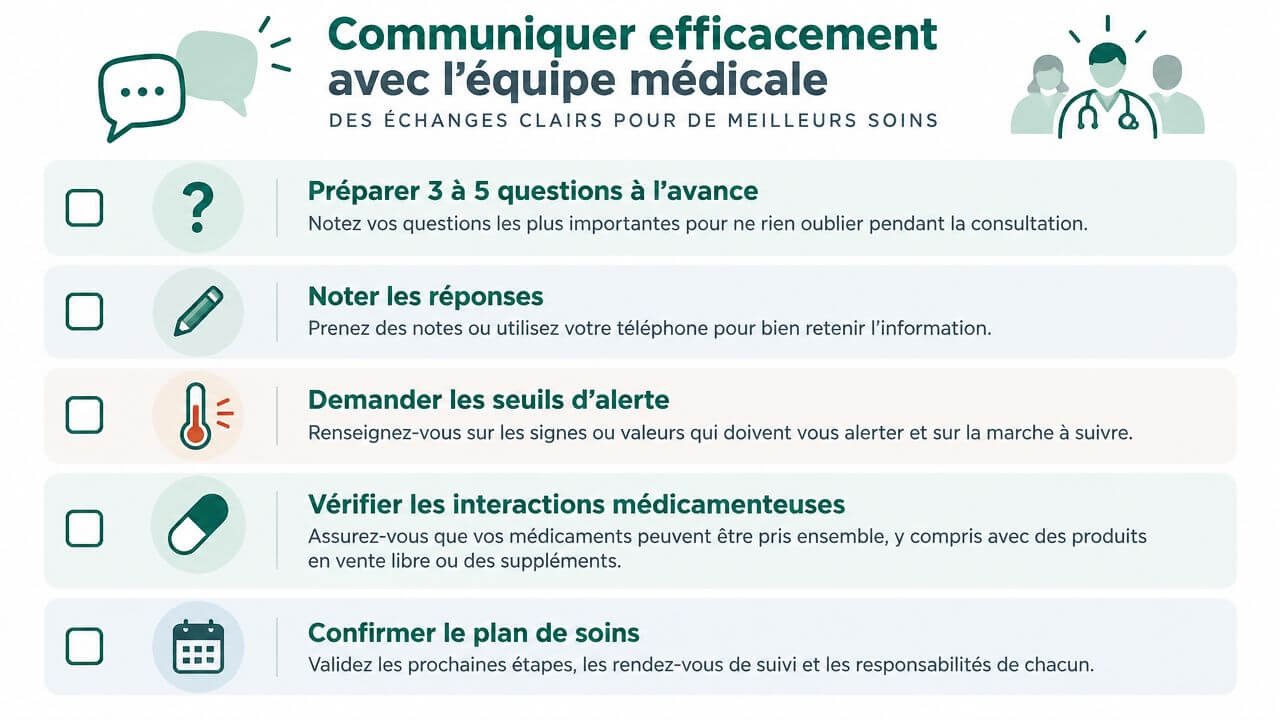
Reformulate, then check
At the end of the consultation, reformulate the instructions aloud. Say for example: "If the temperature exceeds the indicated threshold, I call the service, and if the condition becomes urgent, I call 15. Is that it? "
The useful question is: "From what temperature should I call tonight?" Avoid general formulations like "What do we do if it's wrong? " They leave too much room for interpretation.
Always note:
- Treatmenthis name, dose and timing.
- Possible delayed effects, with the deadline to be monitored.
- Useful numbersincluding the periodic penalty payment and the secretariat.
- Next date, the examinations requested and the documents to be provided.
- The person responsible for monitoring, doctor, co-ordinator or pharmacist.
The link book remains the reference medium between the home and the institution. For sensitive digital exchanges, use a secure health messaging adapted to healthcare exchanges, never a succession of messages scattered in several family conversations.
The caregiver has the right to request an explanation. He must also verify that the patient accepts the sharing of information and that the professionals know who is authorized to receive the instructions.
Arrange appointments for medicines and transport
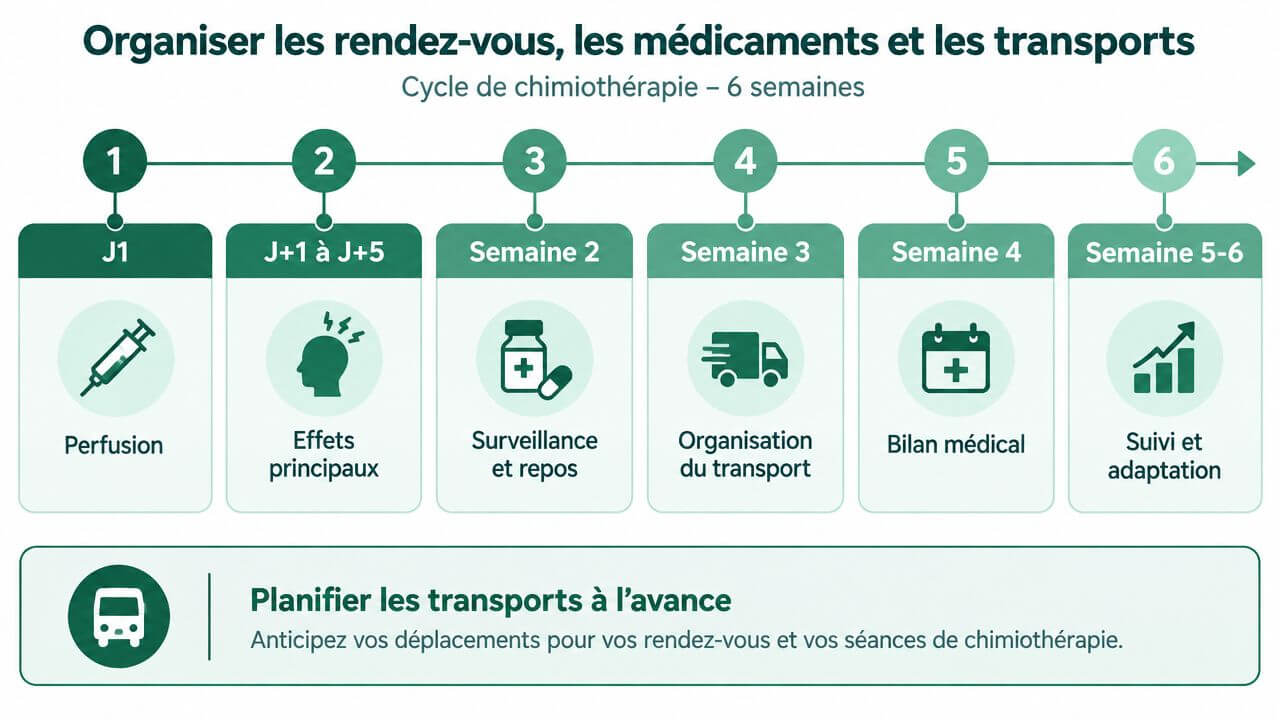
The organization becomes easier when you cut the cycle into periods. The day of infusion is the main benchmark. The following days are used to observe the effects announced by the team, then comes a period when the person gradually recovers before the balance sheet or the next session.
Do not complete the schedule with medical assumptions. Note what the center has confirmed, then add practical tasks: book a transport, get a prescription, check the available medicines, call the next of kin who will take over.
A family calendar that indicates a person in charge
Each event must have an identified person in charge. "Mother's transport" is not a sufficient task. Write "Paul reserves the transport and accompanies to the center", then indicate who ensures the return if the session continues.
For medications, keep the prescription up to date and prepare the dosage according to the instructions received. Do not mix unused medications with regular cartons, and do not discard a pack until you have checked with the pharmacist or team.
A stacker can help, but it does not replace the prescription. To reduce the oblivion, associate each catch with one hour and one person responsible. Intelligent electronic stacker may be used as a reminder medium, provided that its content corresponds exactly to the validated treatment.
Transport must not be improvised
Depending on the situation, transportation can be arranged with a relative, a VSL, an ambulance or other solution offered by the institution. Ask the service and the Sickness Insurance what applies to the patient, as the conditions of care depend on the prescription and the state of health.
Prepare a short emergency sheet, kept in the wallet and family file:
- Contacts, oncology service, periodicity and person to be notified.
- Treatment, requirements in progress and last administration.
- Allergies, useful background and special instructions.
- Documents, order, recent report and rights card.
For care between sessions, the entourage can be relayed by a Independent nurse, an IADS, a nursing centre or a HAD as needed and the organization selected. Sickness Insurance describes the pharmaceutical accompaniment of oral cancer patients, while the ARC Foundation presents home helpers and respite devices. The relative must request these relays before exhaustion, not after.
Coordinate several caregivers without losing information
Being present is no longer enough as soon as several people intervene. A sister accompanies the appointments, a neighbour brings the meals, an adult child calls in the evening and a nurse goes to the home. Without a common rule, each one has a piece of information, but no one has a reliable view of the situation.
Start with three roles.Principal Helper centralizes decisions and remains the preferred contact.Secondary helper regularly takes a defined relay.replacement aid intervenes if the first one is sick, works or cannot move. These roles must be written, even in a welded family.
A transmission identical to each shift
At each turn change, note the same elements: mood, appetite, sleep, transit, medications taken, new symptoms and call made. This routine makes transmissions comparable and avoids blurred phrases like "it wasn't good".
You can use a home notebook, a Kanban table shared in Trello or Notion, or a WhatsApp group dedicated to practical information. The focus group must not become the medical file. Set rules: no diagnosis, no treatment modification, important information must be copied into the common medium.
Also designate a Single Spokesperson for exchanges with the medical team. Other relatives can ask questions to this person, who then sends the answer. This organization avoids conflicting versions and repeated calls to service.
A guide to co-ordination among caregivers It can help formalize responsibilities, transmissions and relays. A short family meeting every fortnight eliminates an unnecessary task, strengthens a relay or asks for professional help before fatigue becomes unmanageable.
Final checklist and signals to ask for help
From the first session, adopt these reflexes:
- The day before, prepare the bag, documents, list of treatments and contact information.
- Before the appointment, write questions and recent symptoms.
- Morning, check the transport and the shared calendar.
- During the sitting, write down the instructions and ask for the warning thresholds.
- Upon return, provide rest, drink and help with meals.
- Each rotation, transmit the facts in the same medium.
Moderate fatigue, nausea controlled by prescribed treatment or mild constipation can sometimes be followed at home, if the team has given you this instruction. You should call the service quickly in case of fever above 38 °C, chills, persistent vomiting, diarrhoea for more than 24 hours, unusual bleeding or inability to drink.
Call him. 15 In case of chest pain, shortness of breath, confusion, severe discomfort or inability to urinate. Outside of the opening hours, use the oncological frequency number given by the centre. Always note the time, symptom, intensity and medications already taken before the call.
Asking for a home nurse, a HAD, a home helper, social support or a family relay is not a failure. It is a responsible decision that protects the patient and the caregiver.
To centralize transmissions, medication intakes, schedule, tasks and the emergency card, discover Tribulys and create a space shared with your family and the professionals who work at home. Start before the next session, first adding the contacts, appointments and instructions validated by the healthcare team.
Put this organisation into practice with Tribulys
Keep your care journal, shared calendar, tasks, medication tracking and emergency information together. Start for free and invite the relatives and professionals involved in your loved one’s care.