
When a loved one comes out of the appointment, the phone already vibrates. A text message to the doctor, a call to the Independent nurse, a note scratched on a paper placed near the kettle, then another message in a family group. At the end of the day, no one has the same version of the instructions, and everyone has the feeling of having done the best without really securing the information.
This is often where the Secure health messaging becomes a real concrete subject, not a technical notion reserved for IT teams. It responds to a simple reality, exchanges around a sick person should not depend on a text feed, a missed call or a forgotten notebook at the bottom of a bag. For family caregivers as well as for independent nurses, the need is the same, conveying the right information, at the right time, to the right person, without unnecessarily exposing sensitive data. To compare public communication practices and medical monitoring tools, see also this benchmark dedicated to WhatsApp and medical follow-up.
Contents
- Contents
- Why your health exchanges deserve better than text messages
- Understanding Secure Health Courier and its Regulatory Framework
- The gap between equipment and actual use
- Practical use cases for caregivers and professionals at home
- Criteria for choosing an appropriate secure messaging
- Good practices for successful adoption
- Take action with simplified coordination
Contents
- Why your health exchanges deserve better than text messages
- Understanding Secure Health Courier and its Regulatory Framework
- The gap between equipment and actual use
- Practical use cases for caregivers and professionals at home
- Criteria for choosing an appropriate secure messaging
- Good practices for successful adoption
- Take action with simplified coordination
Why your health exchanges deserve better than text messages
A helper often ends up becoming the center of a small logistics network. You have to warn the kine, confirm the passage of the IDEL, keep track of a change of treatment, and not forget what the attending physician asked at the last consultation. The problem is not the lack of goodwill, it is the dispersion.
A text message is fast, but it is quickly lost in a family conversation. A classic e-mail goes astray in a saturated inbox. A voice message reassures at the moment, then disappears without exploitable trace. When it comes to health, this loss of context can create duplicates, oblivion or contradictions between speakers.
What's lost in everyday tools
The general public channels have a common weakness, they do not organize information around the care. They mix the recall of races, photos of children, organizational messages and medical instructions in the same space. For a blood pressure, a wound, an oblivion of taking or a post-visit instruction, this mixture does not help anyone.
Simple rule. If a message is to be found in three days by someone other than the sender, it deserves a channel designed for coordination, not a generalist thread of discussion.
The Secure health messaging just take the opposite foot of this dispersion. It introduces a framework, a clear identification of professionals, and a useful trace logic for monitoring. For a caregiver, this means less repetition. For a caregiver, this means less going back and forth to check who saw what and when.
The issue is therefore less technological than practical. We are not looking for a "more modern" tool, we are looking for a tool that avoids repeating the same transmission three times because the first message was seen, then forgotten, and then transmitted orally. It is a difference that changes the mental load in everyday life.
Understanding Secure Health Courier and its Regulatory Framework
The Secured Health Messaging, MSHealth, works as a confidence bubble. Only authenticated actors who belong to this space can exchange health data within the network. The idea is simple, we do not let clinical information circulate anywhere, we pass it through an identified and secure circuit.
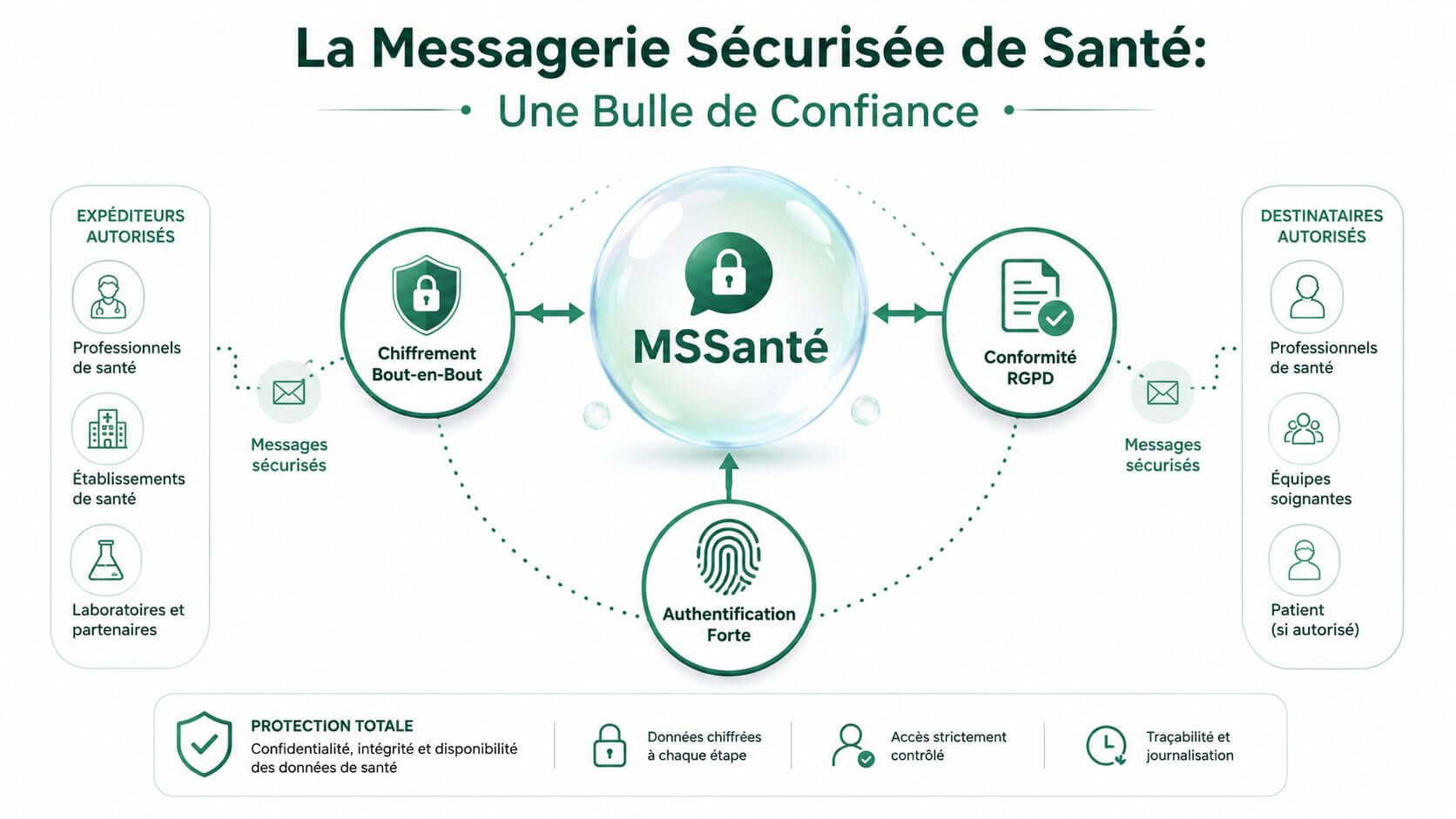
The simple language confidence bubble
Think of a building with access control. An ordinary mailbox remains at the foot of the street, accessible to all passers-by. In MSSanté, the correspondents are within an identified perimeter, with common rules, a shared health directory and operators allowed to exchange between them. The architecture limits address errors outside the perimeter and secures the circulation of messages.
This logic is not based on a single closed software, but on a single network of interoperable services within the same trust framework, allowing different structures to exchange without leaving the secure space. In practice, this is what allows professionals who do not use the same solution to exchange in a consistent way.
Why the regulatory framework really matters
The framework is not there to complicate the lives of teams, it protects patients and professionals. GDPR framework personal data,HDS hosting secures the storage of health data, and the traceability of exchanges helps to know who has transmitted what. The NSA also recalls that MSSanté allows secure exchanges, with encryption, HDS certified hosting and access reserved to professionals authorized by law, in compliance with the Public Health Code and the GDPR, while the MSSanté page of the NSA details the operation of the trust area and its authorized operators on the national MSHealth strategy.
A classic e-mail can circulate out of frame, be transferred without control or remain stored on services not adapted to medical data. A message sent via MSSanté is part of an environment where the identity of the transmitter, the delivery and the recipient are designed for the exchange of health. It is not just a question of comfort, it is a concrete guarantee of confidentiality and continuity.
The gap between equipment and actual use
Having an MSSanté address does not mean using it every day. It is even the heart of the problem. In France, the HAS estimated in 2023 that 80% of health facilities and almost 50% of liberal doctors had an active MSHealth address, but the Digital Health IPG indicated that less than 25% of city-hospital exchanges actually passed by MSSanté according to this usage panorama.
This shift shows a very concrete thing, technical equipment is not enough to create a habit. A tool can be available, compliant and activated, then stay on the margin because it requires an extra effort at the wrong time. That's exactly what happens when you have to look for the correspondent's address, check which system it is in, and then exit the usual workflow to transmit information.
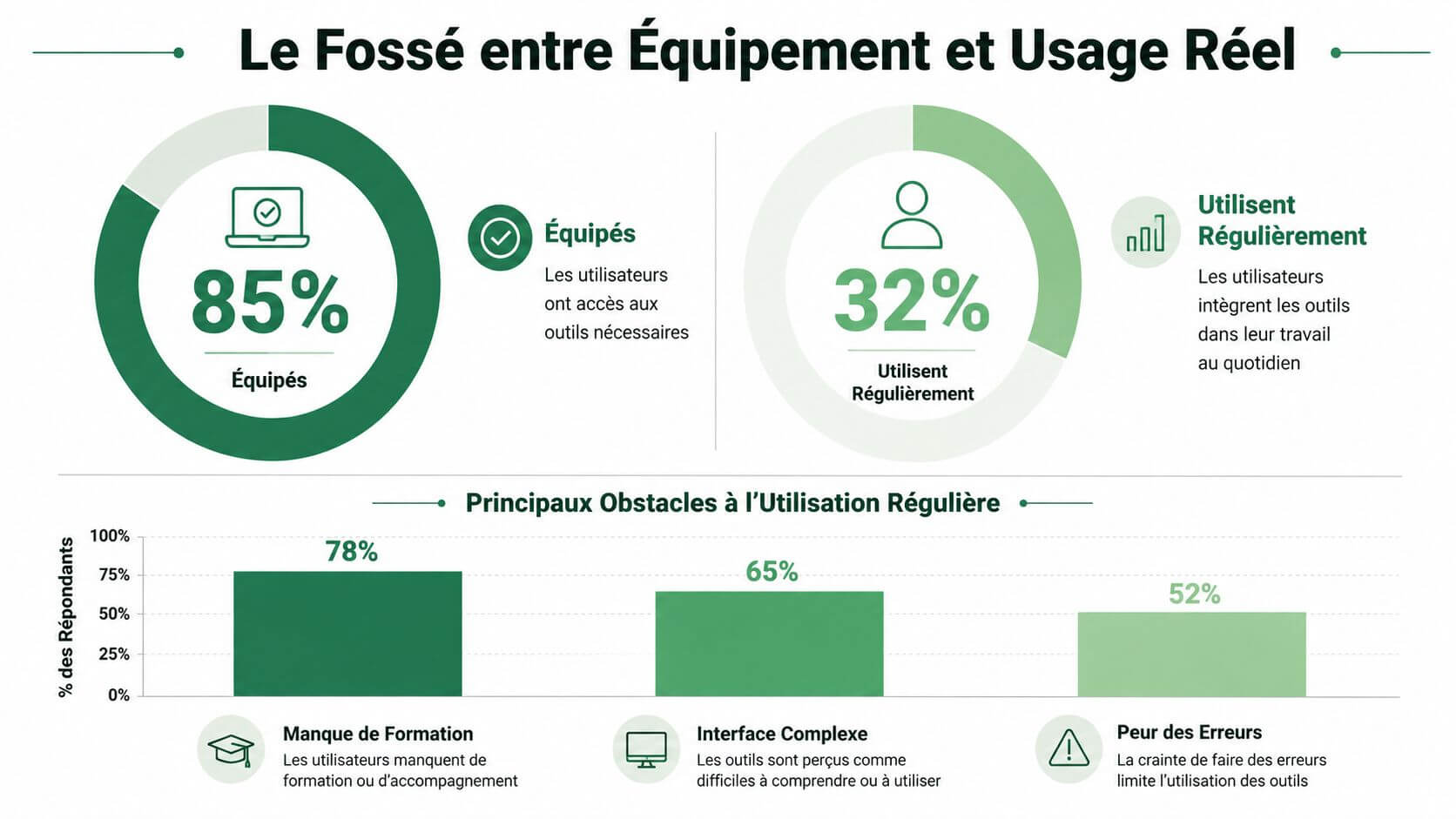
Why actual use stays below availability
Obstacles are often ground-to-earth. You have to find the right person's address, which takes time when you don't have it in hand. You also have to deal with systems that don't always fit in the same way in the daily lives of the offices, institutions and the home.
The other brake is psychological. When the phone and SMS seem faster, the professional spontaneously returns to his reflexes. Secure messaging becomes a "more" tool rather than an integrated tool. In this case, use decreases even if the equipment is there.
The real competitor of MSSanté is not another courier, it's the habit.
What this fracture changes for caregivers and IDELs
For a caregiver, this fracture is seen when instructions are given to a caregiver, but does not arrive at the right time to the next person. For a Independent nurse, she sees herself when a transmission remains blocked in a channel that a doctor consults little. In both cases, the subject is not the existence of a secure service, it is her presence in the gesture of work.
This is why a useful solution must reduce friction, not just check the compliance box. The tool must help to find the right contacts, keep the history, and remain accessible at the time the transmission is due to leave. Without this link, the messaging remains available, but not adopted.
Practical use cases for caregivers and professionals at home
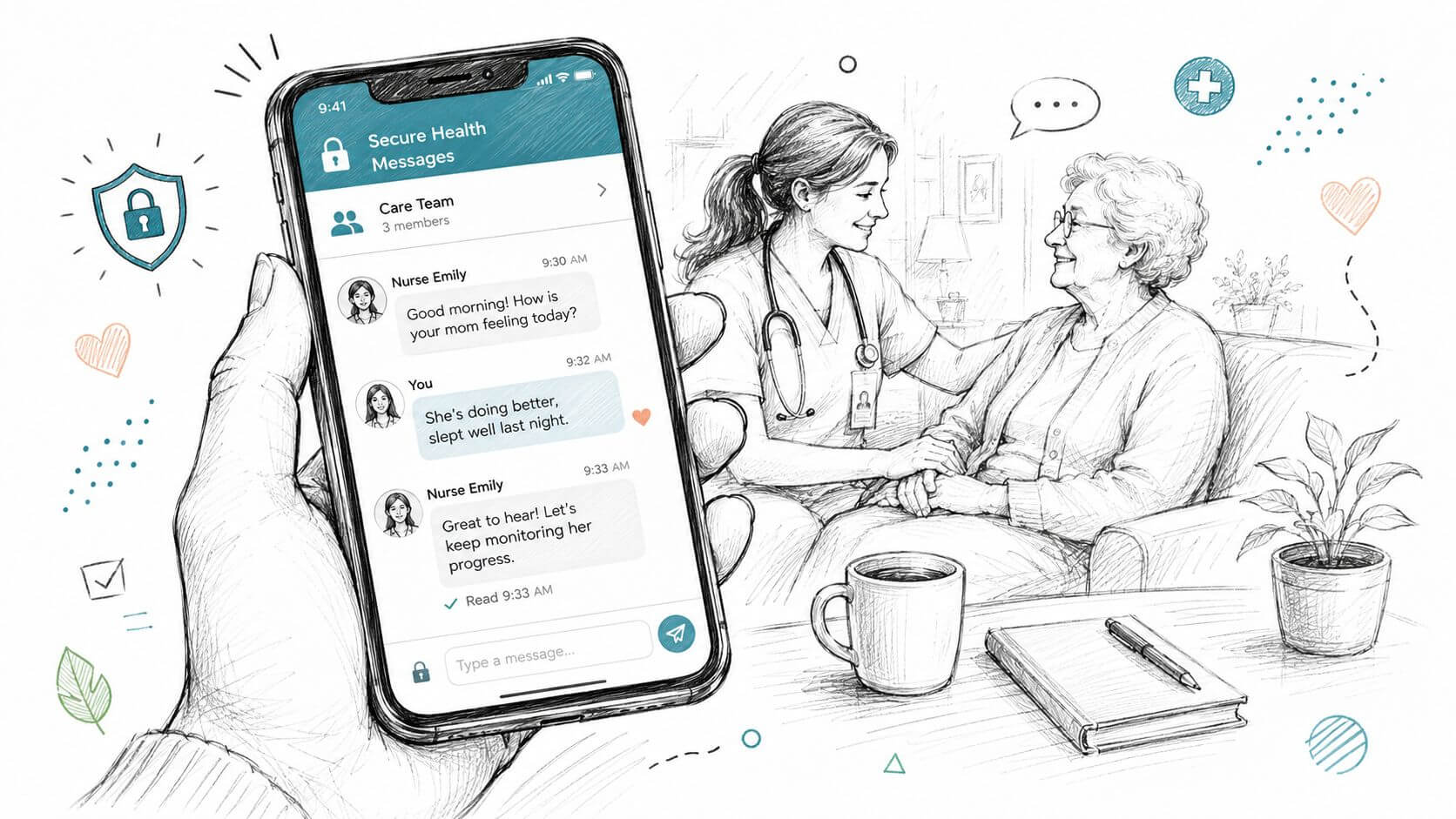
When an elderly person stays at home, coordination quickly resembles a relay. The caregiver transmits, the IDEL observes, the kine adjusts, the doctor referee. If each one works with his personal notes and scattered messages, continuity becomes fragile.
A helper who coordinates home passages
A girl who organizes her mother's care records appointments on the fridge, keeps instructions on her phone and answers calls when she can. In the morning, she learns that a pain occurred, in the afternoon, she has to check if the dressing was done again, then in the evening, she wonders if the doctor saw the message sent earlier.
In a secure messaging environment, the transmission is no longer drowned in a family group. It goes to the right professional, remains historic, and can be reread without having to ask for everything again. For relatives who live far away, this traceability also removes some anxiety, because the information no longer depends solely on a call taken on the fly.
A Independent Nurse who transmits after his tour
An IDEL completes a visit, observes a clinical evolution and must notify the attending physician. If it passes through the phone, it depends on the immediate availability of its correspondent. If it passes through a secure message, it can transmit more structured information, more readable, and stored in a coherent circuit.
The benefit is simple, the follow-up is no longer based on the memory of a call. The transmission note remains available, and the team can refer to it at the appropriate time. It is particularly valuable when several stakeholders relay around the same patient.
A Dispersed Family That Keeps the Head
When children live in several cities, coordination quickly becomes asymmetrical. One calls, the other worries, a third discovers the information too late. A well-used secure messaging allows to limit contradictory versions, especially when decisions are based on concrete medical elements.
Good reflex. Centralizing sensitive transmissions in a single space prevents everyone from producing their own version of their loved one's health.
The above video illustrates what families are looking for, clearer exchanges, fewer repetitions, and a flow of information that follows the reality of care. When messaging is part of everyday life, it does not replace human exchanges, it makes them more reliable.
Criteria for choosing an appropriate secure messaging
The right choice isn't just "is it secure? " It is also important to consider whether the tool really fits into home coordination, because isolated messaging quickly loses value. This is where the comparison between standard MSHealth and an integrated platform makes sense, especially for field uses.
The point of departure remains compliance. GDPR,HDS hostinginteroperability with MSSanté and the ability of the tool to be used by untechnical people. Then comes the question of everyday life, can we find the messages, link the transmissions to an agenda, keep a trace usable and avoid double seizures.
Comparison table
| Criterion | MSHealth Standard | Integrated platform (Tribulys) |
|---|---|---|
| Security and compliance | Secure health messaging framework | Security and compliance integrated into coordination |
| Main use | Exchange of clinical messages | Email plus notebook, calendar, tracking and transmissions |
| Simplicity for a Caregiver | Often depends on the context of use | Thought for family and field uses |
| Global vision | Focus on message | Centralizes several coordination bricks |
| Continuation of follow-up | Trade history | History of exchanges and shared monitoring |
| Home integration | Variable according to the business tool | Designed for home coordination circuits |
What needs to be looked beyond compliance
A useful secure courier must be readable for a family, not just for a computer service. The right questions are very concrete. Do you find the right correspondent easily, do you know who saw the information, does the transmission fit into a schedule, a care journal or a follow-up of the medicines?
For carers, the interest of an integrated platform appears as soon as the exchanges are no longer separated from the rest of the organization. The message is no longer an isolated object, it becomes a piece of the puzzle. To go further on the family organization and accompanying practices, see this practical guide on the application for family caregivers.
Good practices for successful adoption
Secure messaging often fails for a simple reason, no one knows exactly when to use it. If teams keep the phone for the emergency, SMS for speed and messaging for "later", adoption remains fragile. Therefore, it is necessary to make the tool obvious, visible and useful in times that matter.
Start small, but with clear rules
First choose a small circle of participants. A primary caregiver, an IDEL, a treating physician, possibly a physiotherapist. With this group, define what goes through the courier, what stays on the phone, and who is allowed to read or transmit.
- Define roles. Everyone knows if it is a reader, transmitter or simple recipient, which limits the exposure of sensitive data.
- Keep the history. Useful information must be able to be found without searching old conversations.
- Use notifications with measurement. The alert must warn, not saturate, or the teams eventually ignore them.
- Structure transmissions. A clear note, with the context and the action expected, is better than a brief but ambiguous message.
- Provide access in a complicated situation. Off-line mode and then synchronization are useful when network coverage is not ideal.
Bring the tool into the rhythm of the field
The good practice is not to add a layer of work, but to replace the repetitions. A well-written message avoids a reminder call. A hijacked transmission avoids asking the same detail again in the next passage. A shared calendar avoids double appointments and missed crossings.
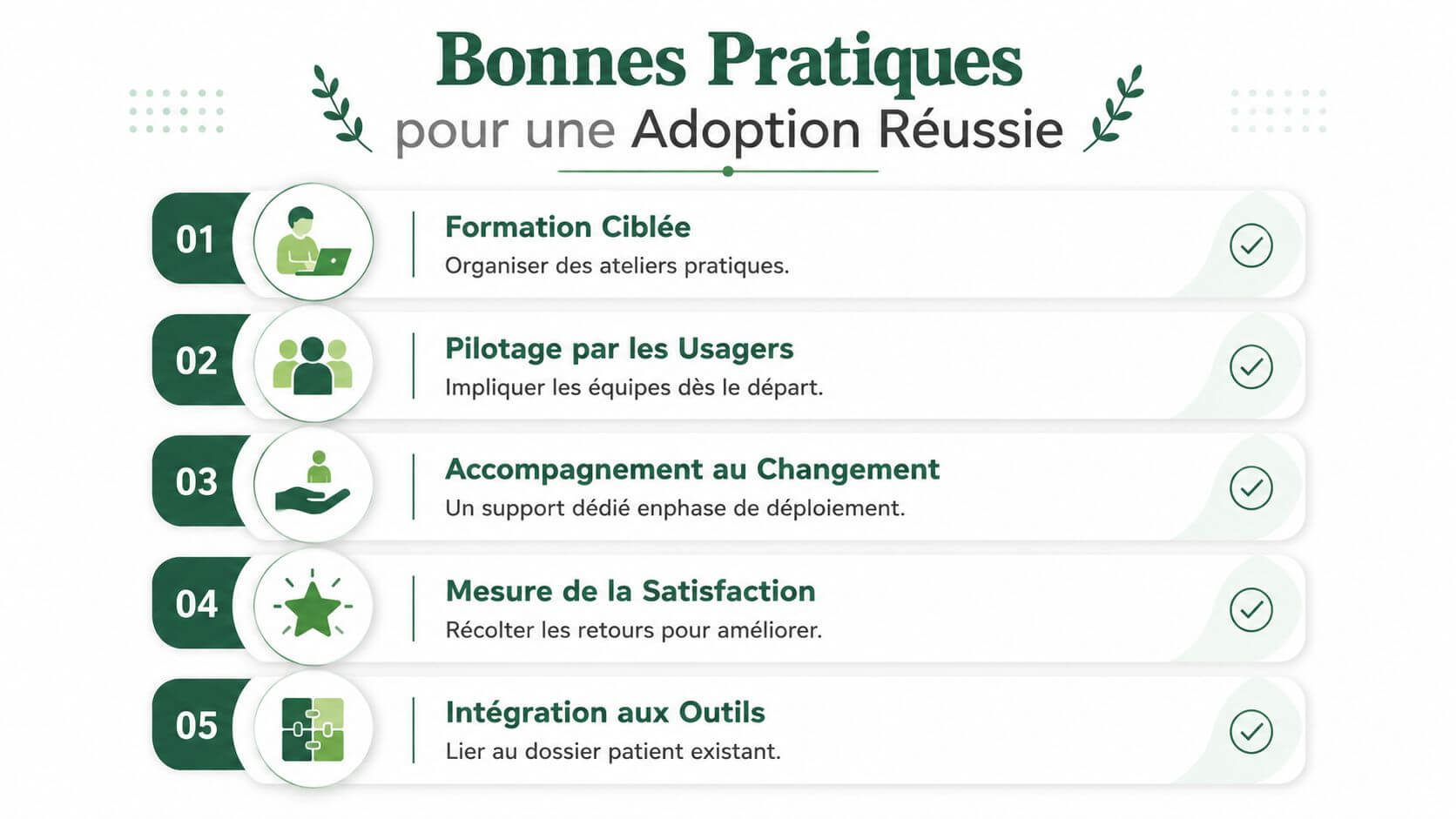
Reticent professionals often make a very simple argument, "I go faster over the phone". They must then be shown the hidden cost of reminders, oblivions and transcripts. When the tool really fits into everyday life, it stops being an extra effort and becomes a reliable shortcut. For structured transmission methods, see also this reference on the transmission book.
Take action with simplified coordination
The Secure health messaging It's not just a regulatory response. It's a way to circulate health information without losing it in scattered channels, while keeping a trace useful for families and caregivers. Where the subject gets caught, it's almost never theoretical safety, it's real use at the time of care.
The most effective is based on concrete needs. Who should receive the information, at what time, in what form, and with what level of history? Then, one has to choose a tool that does not separate the messaging from the rest of the coordination, because it is often this separation that breaks adoption.
Start with a small group, formalize simple rules, and then observe what really reduces repeated calls, oblivions and messages. If the goal is to lighten the mental load while securing exchanges, the right solution will be the one that follows the daily lives of caregivers and professionals, not the one that asks them to reinvent it.
Tribulys centralizes messaging, care journal, calendar and follow-up to simplify home coordination. If you are looking for a clearer way to organize exchanges between caregivers and professionals, visit Tribulys and see how the platform can be integrated into your daily monitoring practices.
Put this organisation into practice with Tribulys
Keep your care journal, shared calendar, tasks, medication tracking and emergency information together. Start for free and invite the relatives and professionals involved in your loved one’s care.