
Your sister thinks the physical therapist is coming on Tuesday morning. Your brother noted Wednesday in his personal agenda. The home helper sent a text message to inform about a change, but no one relayed it to the IDEL. In the meantime, the medical appointment remains written on a Post-it near the phone.
This is how families become exhausted. Information circulates between SMS, WhatsApp groups, calls, personal agendas, and hallway conversations. An appointment disappears, two caregivers show up at the same time, a task is not confirmed, and a family member learns about a hospitalization several days later.
A shared family agenda thus serves not only to display dates. It must organize a chain of responsibility among the family, IDEL, the physical therapist, the home helper, and the doctor, with appropriate rights, useful notifications, and a clear record of each action. Here’s the method to stop overlapping messages and lost appointments.
Table of Contents
- Why your family needs a shared agenda
- What a shared family agenda really is
- Create the tribe and define access rights
- Enter appointments and visits without creating duplicates
- A concrete example of coordination that changes everything
- Notifications, confidentiality, and health data
- Final checklist to start your shared agenda
Why Your Family Needs a Shared Agenda
Your mother has a medical appointment tomorrow, the IDEL is supposed to come in the morning, and your brother thinks the home helper is coming in the afternoon. Each person holds part of the information. However, no one knows who confirms, who intervenes, and what needs to be transmitted.
In France, family caregiving concerns a very large population. The ministry officially reports a range of 8 to 11 million family caregivers, those who regularly assist a loved one who is losing autonomy, sick, or disabled, as recalled in the 2024 caregiver barometer. Coordination thus concerns many families, not just those helping a heavily dependent parent.
The DREES indicates that the number of family caregivers in daily life decreased by 6% between 2008 and 2022, while the assistance provided intensified. A sibling group may thus be smaller around the person being helped, while managing more visits, treatments, appointments, and transmissions.
The Real Problem Is Not the Calendar
A classic agenda answers the question "when?" Home care also imposes knowing who intervenes, to do what, and what has been transmitted.
An overlooked appointment quickly becomes a task without accountability. A change sent by SMS may never reach the IDEL. A medical instruction lost in a conversation creates a gray area between the family, the physical therapist, the home helper, and the doctor. The management of medication errors in general medicine reports, in a French study involving 4,712 consultations and 64 medication errors, that 39.1% of errors occurred at home and 17.2% led to serious clinical harm.
Field Rule: Any information regarding the person being helped must be entered in the shared space, never kept on one person's phone.
One Piece of Information for the Whole Tribe
Data from 2024 indicates that 25% of French people declare themselves caregivers, compared to 19% in 2022. The agenda must therefore bring together consultations, visits, absences, reminders, and assigned tasks, while leaving a trace of decisions and changes.
The effective method combines two tools in the same space: the calendar for planning, the care journal for transmission. Each event must have a responsible person, appropriate access rights, and, if necessary, a notification. Every observation or completed action must remain accessible to authorized individuals.
A family can also consult parallel educational resources to share a common information base, for example this guide Gepromed on pregnancy at 8 weeks. This resource does not replace the advice of a healthcare professional.
What a Shared Family Agenda Really Is
At home, a misplaced consultation can cause a visit to be missed, and an instruction kept in a phone can get lost. A classic family agenda is fine for birthdays or vacations. A shared calendar may suffice for meetings. The coordination of a supported loved one requires more, as it connects several people and responsibilities.
The shared family agenda dedicated to care brings together planning and transmission in the same space. It displays medical appointments, visits from the IDEL, the physical therapist, or the home helper, medication reminders, and tasks to be carried out. Each event must be assigned to a specific intervening party, then completed with a trace of the action carried out.
The Calendar Organizes, the Care Journal Secures
The calendar answers a simple question: who intervenes and when. The care journal documents what happened. It allows for the recording of an observation, an instruction, a difficulty, or an action completed, with the author and the time of the handover note.
The digital care journal recognized by home care services facilitates daily exchanges between caregivers, the person being assisted, and their family. It should complement the shared calendar within the same system, rather than becoming a secondary support that everyone consults in their own way.
The organization of home visits, presented by UDAMAD, also imposes practical guidelines: the name of the caregiver, day, time slots, purpose of the visit, and useful contact information. This information allows for the identification of overlaps before confirming the visit.
Each entry must answer three questions: who is intervening, what should they do, and what needs to be transmitted next? It is this chain of responsibility that transforms a calendar into a coordination tool among family, IDEL, physiotherapist, home care assistant, and doctor.
What to require before choosing
An appropriate tool should offer:
- An operational view, with the week for upcoming time slots and the month for distant appointments.
- Differentiated profiles, so that a doctor, a liberal professional, and a relative have suitable rights.
- Identified transmissions, with a date, time, and author.
- Targeted reminders, sent only to the relevant people.
- Data protection, suitable for health information and confidentiality rules.
Value does not come from merely sharing dates. It comes from the continuity between planning, assigning, notifying, and recording, without losing information between two caregivers.
Create the tribe and define access rights
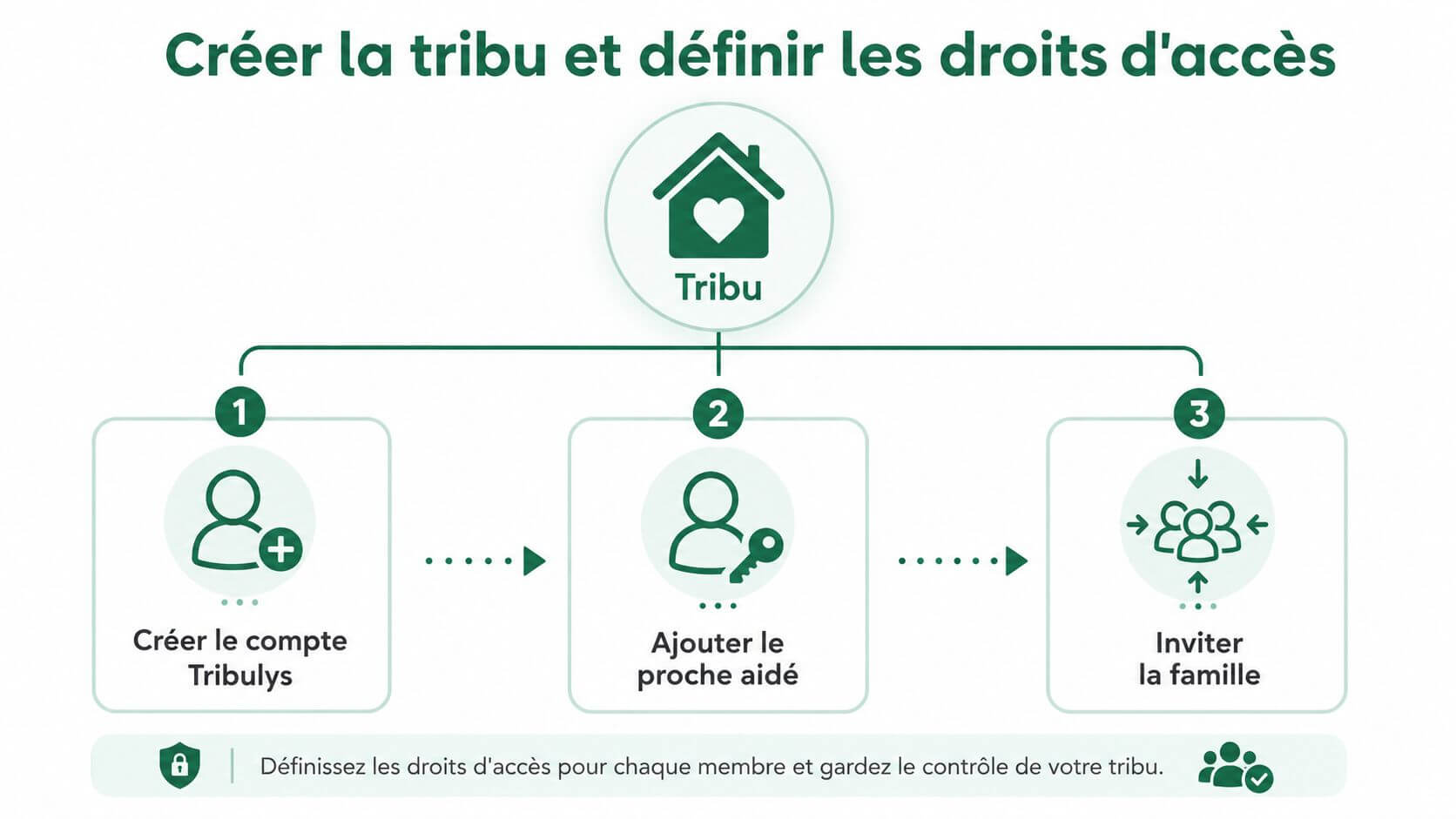
Start by creating the Tribulys account, then add the family caregiver as the main beneficiary. The tribe should represent the real circle of coordination, not an exhaustive list of everyone who knows the family.
Next, invite relatives who are actively involved in decisions or visits. Add concerned professionals, notably the IDEL, the physiotherapist, the home care assistant, and the attending physician, provided they agree to use the shared space. The caregiver coordination guide can serve as a support to organize this initial setup.
Assign rights based on responsibility
Do not give everyone the same powers. A person who consults the schedule does not necessarily need to alter treatment or reschedule a visit.
- Family Administrator, for one or two pivotal relatives who coordinate invitations, rules, and significant changes.
- Reader, for siblings who need to know about appointments and transmissions without modifying the schedule.
- Professional caregiver, with limited access to their time slots, tasks, and relevant transmissions.
- Doctor in read-only mode, to consult useful information before an appointment without altering daily organization.
This distribution prevents an event from being deleted by mistake or for a person to receive information irrelevant to their role. It follows a simple principle, to assign the necessary level of access, and nothing more.
Write the rules before the first appointment
Technology does not replace a family decision. Write a short usage charter and share it within the tribe:
- Who enters an appointment arranged by phone?
- Who can modify a visit created by a professional?
- Who validates a new treatment instruction?
- Who informs the family in case of emergency?
- Who checks the information every week?
Do not multiply administrators. Two pivotal relatives are usually enough to maintain the coherence of the schedule. For treatment changes, activate a double validation when the tool allows it, so that no single person changes sensitive information without oversight.
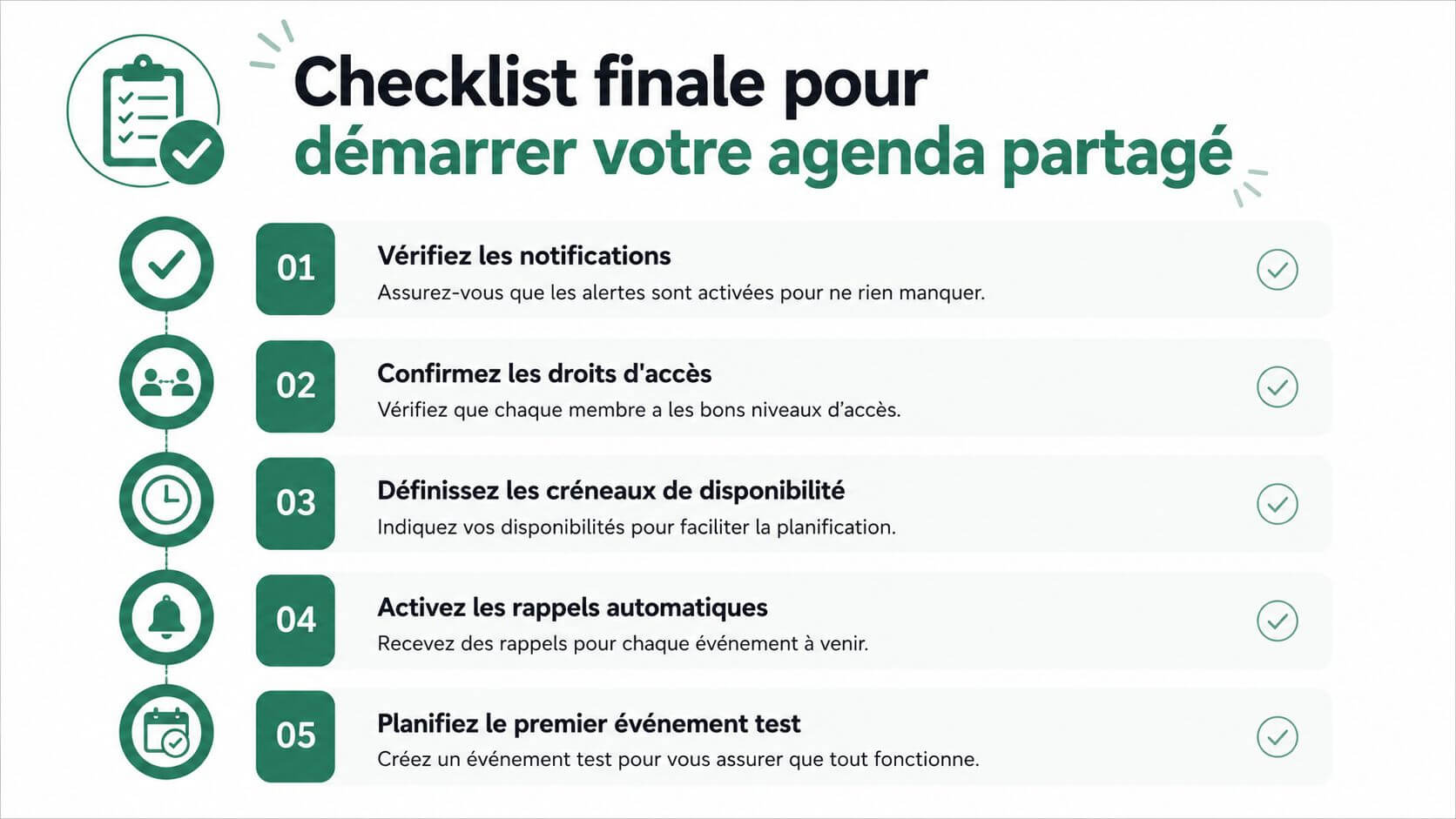
Before adding the first appointment, ensure that each member has received their invitation, selected the correct account, and activated their notifications. Conduct a test with a fictitious event, then ask each profile what they see and what they can modify.
Enter appointments and visits without creating duplicates
The rule is simple: the person who schedules the appointment should enter it immediately into the shared calendar. They do not merely transmit the information via SMS counting on another relative to record it.
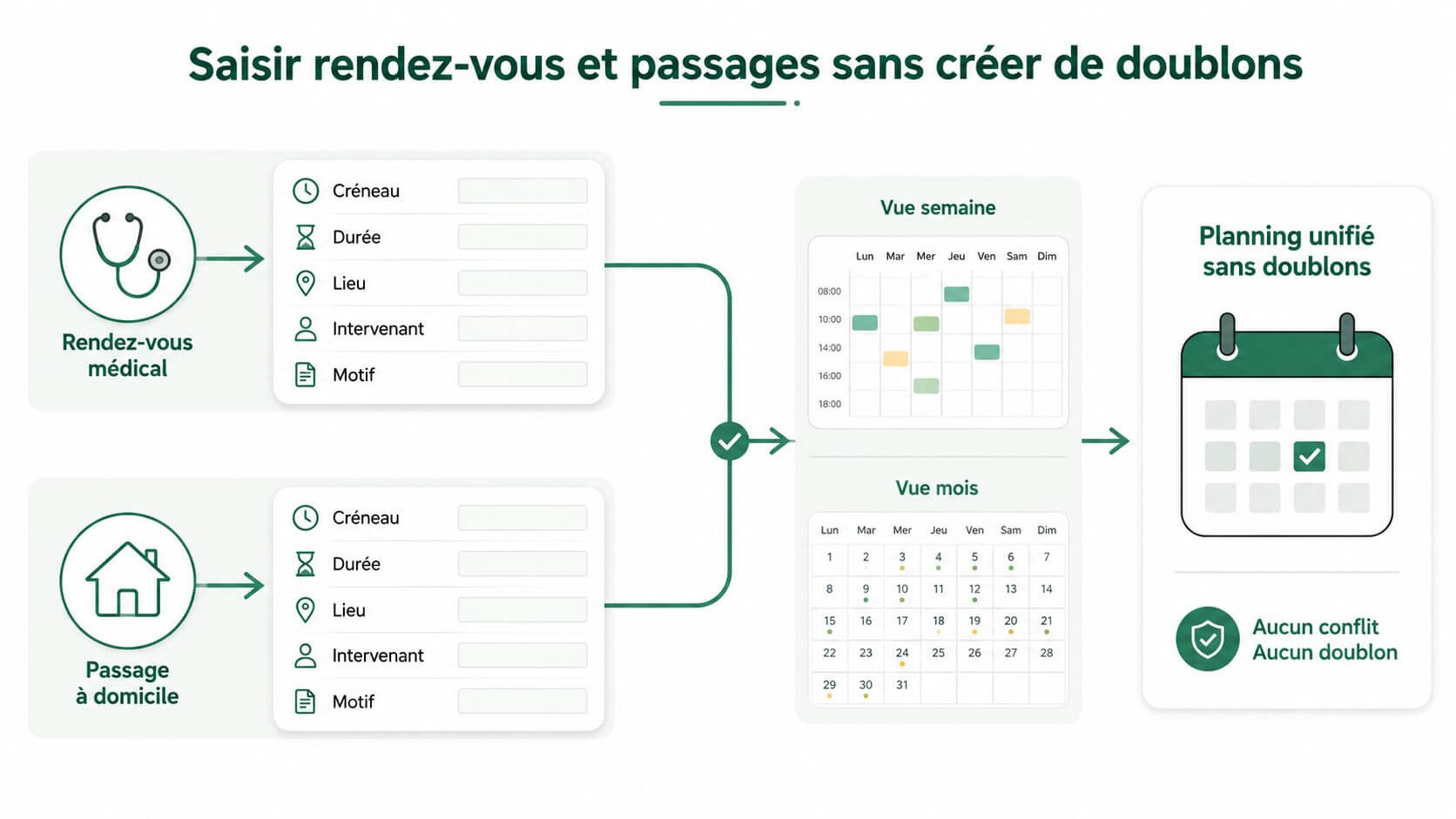
For a medical appointment, indicate the time slot, duration, location, professional, reason, necessary preparations, documents to bring, and the accompanying person. For a home visit, specify the caregiver, objective, expected actions, and useful resources, such as keys, medical records, or transportation.
Work first in weekly view
The weekly view is the most effective for coordinating daily visits. It allows for checking exact times and identifying overlaps between IDEL, the physiotherapist, the home care assistant, and relatives.
The monthly view is used to anticipate occasional consultations, specialized examinations, and absences. Use it to prepare for upcoming weeks, but always revert to the weekly view before confirming a new time slot.
The home care planning reminds us that a properly documented event must answer three questions: who, when, and why. This rule eliminates vague entries like "visit mom" or "doctor", which then force the family to search for context in another conversation.
Set reminders by recipient
Reminders must reach those who can act. A primary caregiver may receive a reminder of a hospital appointment. Brothers and sisters may receive a logistical notification. The IDEL must see the changes related to its passage.
You can organize the notification windows as follows:
- 48 hours before, for a hospital appointment requiring transport and documents.
- 24 hours before, for an IDE passage.
- 2 hours before, for a last minute reminder.
These deadlines are operational settings, not a management guarantee. To avoid errors, add a management confirmation and a searchable history when the event concerns a drug or a care directive.
A change of passage must always include a timed comment. The message "moved passage" is not enough. Write who requested the change, what time and what new organization was selected.
A concrete example of coordination that changes everything
Among the Martins, four brothers and sisters retaliated to their 84-year-old mother, followed at home with cardiac monitoring. Their organization was based on a WhatsApp group, a paper agenda at their mother's and three unsynchronized Google calendars. The family therefore had scattered information, without clearly visible responsibility for each appointment or passage.
One Tuesday, two IDE passages were scheduled following a change that one of the relatives had not transmitted. A few days later, transportation for a cardiology consultation was still not ordered. The appointment was missed.
The switch was made in several steps
The family created a tribe with the mother as the main beneficiary. She invited the four brothers and sisters, the reference IDEL, the kine and the attending doctor, and then seized the appointments of the month to leave a full calendar.
The reminders were settled at 48 hours for cardiology and to 24 hours for passages. The timed link book completed the calendar. Each event associated a person responsible for acting, a notification and a searchable transmission. The calendar indicated the appointment, while the book kept the record and the relay between the speakers.
The relay holds in a reading
According to the carers, the family did not know no missed appointments for the next three months, no overlap of passage, and the coordination time was divided by threeThis return concerns their organization and does not constitute a general statistic.
The clearest gain appears between the morning sister and the evening brother. 30 seconds in the shared family calendar allows them to check the next appointment, the last transmission and the task to be taken over. Before this method, they had to compare three sources.
The tool does not replace caregivers. It links planning and care journal, assigns each action to the right person and keeps track of changes. For a sibling, the goal is simple: that the IDEL, the kine, the assistant, the doctor and the family know what to do, without depending on a lost message.
Notifications, confidentiality and health data
A poorly configured notification may expose health information to a member of the tribe who does not need access to it. The recall must therefore indicate the action expected without displaying a detailed medical pattern on a locked screen. Set each alert according to its intended recipient, its role and the level of confidentiality required.
To coordinate care, always associate the calendar with the care journal. A notification indicates the event and the person responsible for acting. The transmission specifies the instructions, the relay and the status. Each modification must remain identifiable in the history, so that the family, the IDEL, the kine, the assistant and the doctor know who did what.
The confidentiality in social law Reminds us of the need to limit access to sensitive information according to responsibility. Apply the same rule to medical data, treatments, absences and health alerts. A relative who accompanies appointments does not automatically need to read all transmissions.
Separate rights without breaking coordination
| Profile | Rights granted |
|---|---|
| Family Administrator | Create the tribe, invite members, organize rights and manage common events |
| Professional speaker | Consult and inform its passages, access communications useful to its mission |
| Reading Only | Consult the authorized appointments and information, without changing the schedule |
Reserve to each professional the access related to his/her mission. The assistant can inform his/her passage, while the doctor or the IDEL accesses the transmissions necessary for his/her intervention. Do not give any publishing rights to each relative to save time. Limited profiles reduce planning errors and the exposure of the data.
Protect accounts and transmissions
Health data is the responsibility of the GDPR. For a notebook containing medical information, choose HDS compliant hosting in France or the European Union. Also enable two-factor authentication when the solution proposes it. Finally, check the content of the notifications, as a detailed reminder can be read by an unauthorized person.
The Digital Link Book for Home Coordination Completes the calendar without becoming a general conversation. Use the calendar to plan, the notebook to transmit and the history to find proof of an action or relay.
The HAS points out, in its analysis of serious undesirable events in home hospitalization, medication errors and failures in coordination between the city, the hospital, and home hospitalization, as presented in this analysis of the HAS report on serious undesirable events. Remember a simple rule: each handover must associate a responsible person, a clear instruction, an appropriate notification, and a consultable record.
Final checklist to start your shared calendar
A poorly communicated appointment is enough to disrupt a day of care. Before generalizing the tool, check that the calendar and the care journal form a single chain of coordination, from planning to the trace left after the visit.
Controls to perform before starting
- Enter recurring appointments, then verify exceptions, absences, transportation, and location changes.
- Add operational information, such as duration, preparation, documents to bring, and the expected accompanying person.
- Check each handover, associating with the visit the useful instruction, the expected person, and the handover note to consult.
- Archive a weekly summary before closing the week. Keep records of completed, canceled, or postponed appointments, as well as open tasks.
- Schedule a monthly meeting with all participants to identify duplicates, unrealistic time slots, and outdated instructions.
- Verify continuity in the event of absence, with a clearly identifiable replacement contact and the necessary information for resumption.
The routine should remain short. At the end of the week, a relative compares the schedule with the handovers and immediately signals any inconsistencies. At the monthly meeting, the family, the home nurse, the physiotherapist, the home care aide, and the concerned doctor correct together what is blocking.
Tribulys combines the appointment and visit agenda, the care journal, medication tracking, tasks, and notifications in a shared space with relatives and authorized professionals. Create your tribe and discover Tribulys to prepare for the next visit without duplicates or lost information.
Put this organisation into practice with Tribulys
Keep your care journal, shared calendar, tasks, medication tracking and emergency information together. Start for free and invite the relatives and professionals involved in your loved one’s care.