
At 7:30 a.m., a girl sends a text message to her brother to see if their mother has taken her treatment. A nurse leaves information in a notebook placed on the kitchen table. The attending physician is waiting for an e-mail report. Meanwhile, another relative calls to ask if the appointment has been confirmed. Everyone has some of the information, but no one sees it all.
This organization often relies on practical but dispersed tools. A text message can remain on the phone of a single helper, a discussion group can mix urgent messages with personal conversations, and a paper book is not accessible when the family is at a distance. So the difficulty is not just to communicate. What information is reliable, who has passed it on, who has consulted it, and what action remains to be taken.
A secure private courier responds to this need when it combines confidentiality, controlled access and shared history. It does not replace the judgment of a healthcare professional, but it provides the family and stakeholders with a common framework to transmit useful information without multiplying calls and duplicates.

Contents
- Introduction to secure private mail at home
- Understanding the fundamentals of truly private messaging
- The five pillars that ensure safety and compliance
- Good practices for safe exchanges between families and caregivers
- Specific home use cases and observed benefits
- How Tribulys implements secure private messaging
- Choose and deploy your secure private messaging with confidence
Introduction to secure private mail at home
The problem rarely starts with a computer attack
In the home, an error of coordination arises more often from a lost message than from a spectacular scenario of piracy. One person thinks he or she has warned the family, another does not know whether the order has been applied, and the next professional has to reconstruct the situation from different conversations.
This dispersal increases the mental load of caregivers. They need to memorize appointments, revive relatives, find an attachment and check if a treatment has been confirmed. Caregivers need a clear, contextualized and searchable transmission at the time of their intervention.
Simple rule: important information should not depend on the memory of a single person or be locked in an individual phone.
The first benefit of a common area is therefore organisational. The family can group the exchanges related to the accompanied person, while each participant has a coherent thread instead of searching in his or her SMS, e-mails or a generalist group.
A unique channel, without opening up all privacy
The word "private" does not mean that everyone sees everything. In well-organized coordination, a relative can have access to the family agenda, a nurse to the transmissions that concern her passages, and a doctor to the documents useful for follow-up. Confidentiality depends as much on the relevance of access as on the channel's secrecy.
Secure health messaging is already part of French professional practice. MSHealth, presented by the Health Digital Agency, account more 800,000 mailboxes open, more 300 operators and more 28 million messages issued in May 2025. The same source indicates that secure messaging is used, among other things, to transmit medical reports and information to the professionals involved.
For the home, the challenge is to adapt this requirement to a mixed team. Family, nurses, paramedics and doctors do not all work with the same tools, but they must be able to find the right information, at the right time, in a space whose rules are understandable.
Understanding the fundamentals of truly private messaging
A secure private courier is based on two different ideas. Private means that access is restricted to invited and authorized persons. Secured means that the service protects the data during transport, storage and consultation.
The analogy of the envelope helps to distinguish these notions. A closed envelope protects its contents during the journey, but the content can be read by the service that sorts or preserves it. The encryption goes further from end to end. The message is transformed on the sender's device and then becomes readable only on the recipient's authorized device, according to the architecture chosen.
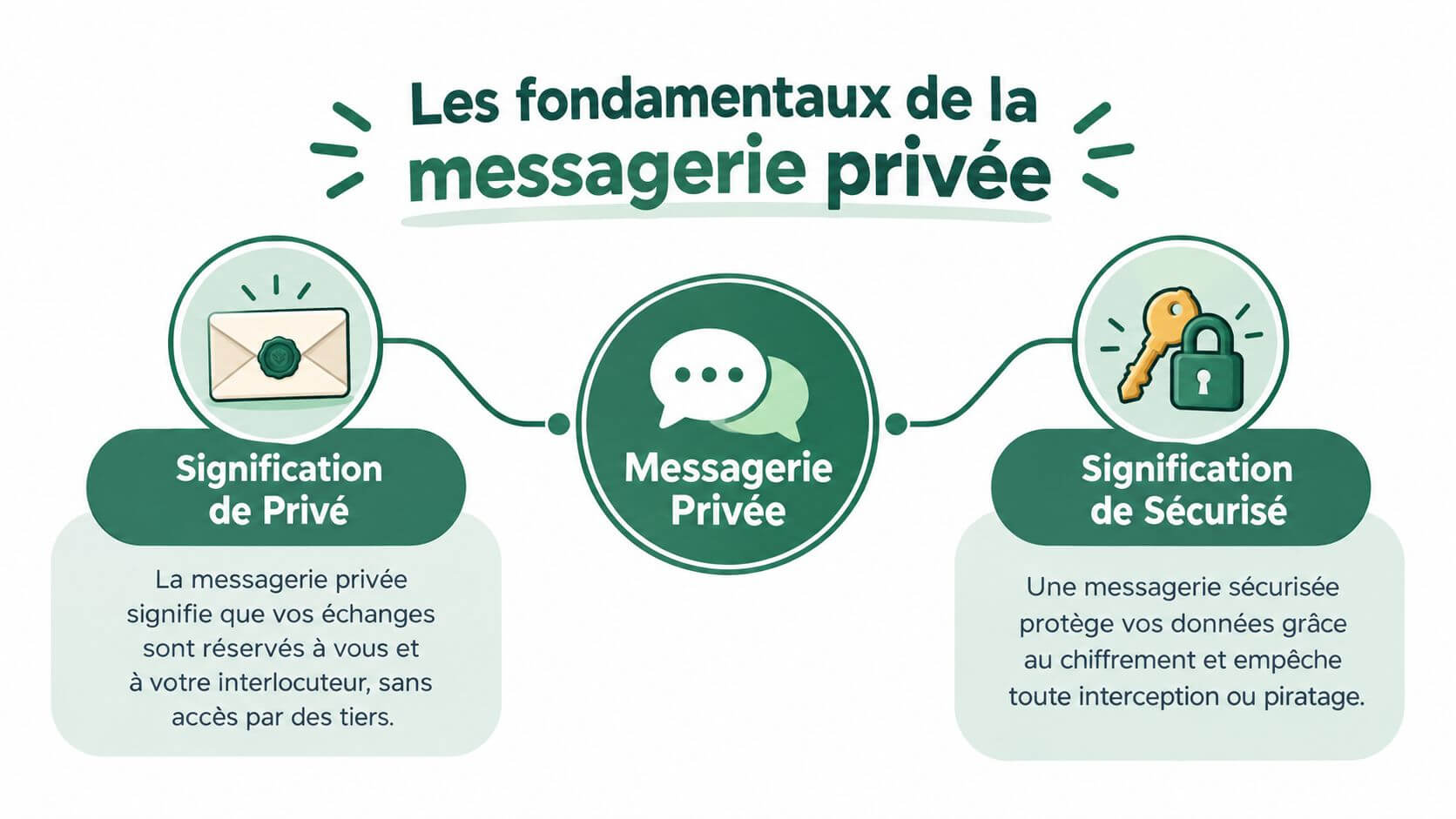
Three levels not to be confused
General public messaging generally favours simplicity, speed and interaction with a wide circle of contacts. It can be practical to warn a loved one, but its group functions are not necessarily enough to manage professional roles, medical documents or a history of transmissions.
Encrypted messaging protects the content from some intercepts. However, encryption does not automatically answer questions like "who can join the group? "who consulted the attachment? " or " how to remove access from a participant who no longer participates in the care ? "
A supervised health courier adds a governance logic. It must be able to limit access, keep track of actions and process personal data according to the principles of security and minimization. secure health messaging and its uses better situate this difference between a conversation tool and a coordination channel.
CNIL points out that e-mail and instant messaging are rarely a secure means of communicating personal data. It recommends, among other things, recognized algorithms, such as AES with an appropriate mode or ChaCha20-Poly1305, as well as effective solutions to protect passwords, such as Argon2, crypt, bcrypt or PBKDF2, in its doctrine on the security of trade with the outside world.
The five pillars that ensure safety and compliance
Encryption is a basis, not a complete response. A solution to coordinate care must also protect accounts, devices, documents and decisions made as a result of exchanges.
Five questions to ask before choosing
1. Encryption. The data must be protected in transit with TLS and, where possible according to functional need, by end-to-end encryption. Messages and attachments must also be protected at rest. Without this layer, an intercept, an exposed backup or a compromised device can make the information readable.
2. Accommodation. Accommodation in France or in the European Union facilitates understanding of the applicable framework, but it is not enough to guarantee security. The architecture must also manage keys, backups, newspapers and administrative rights.
3. Authentication and access. Each user must have his or her own account. The roles must correspond to the reality of the home, with separate permissions for the family, nurse, doctor or assistant. A shared account prevents you from knowing who has done an action and complicates the removal of access.
4. Traceability. A history dated and associated with a user makes it possible to distinguish a recent information from an old one. This trace supports continuity, but it must remain legible, useful and proportionate.
5. GDPR. Compliance requires limitation of data, control of recipients, protection of media and the organisation of responsibilities. The GDPR is not just an information banner. It must be translated into everyday settings and practices.
I-I-IIT hygiene recommended by ANSSI In particular, insists on TLS, the encryption of backups and the use of hardware protections such as Hardware Keystore or Secure Enclave to store cryptographic secrets.
| Criterion | Classic messaging | Secured private messaging compliant |
|---|---|---|
| Access | Group based on general invitations | Roles and permissions adapted to each stakeholder |
| Transport | Variable protection depending on the service | TLS configured and controlled |
| Documents | Attachments dispersed in conversations | Documentary box and contextualized access |
| Background | Research possible, but not coordinated | Dated, identified and searchable actions |
| Organization | Separate Messages, Calls and Tasks | Exchanges, transmissions and shares in the same space |
The logic applies to any service dealing with sensitive information. The principles of transparency and protection explained in this resource on the privacy of the solar simulator It should be recalled that an understandable policy must accompany technical measures. For healthcare transmissions, a Nurse transmission software must apply the same requirement to the concrete information journey.
Good practices for safe exchanges between families and caregivers
A secure channel can become unreadable if users drop everything, no matter how and without common rules. Operational security begins with a light discipline, compatible with everyday fatigue and emergencies.
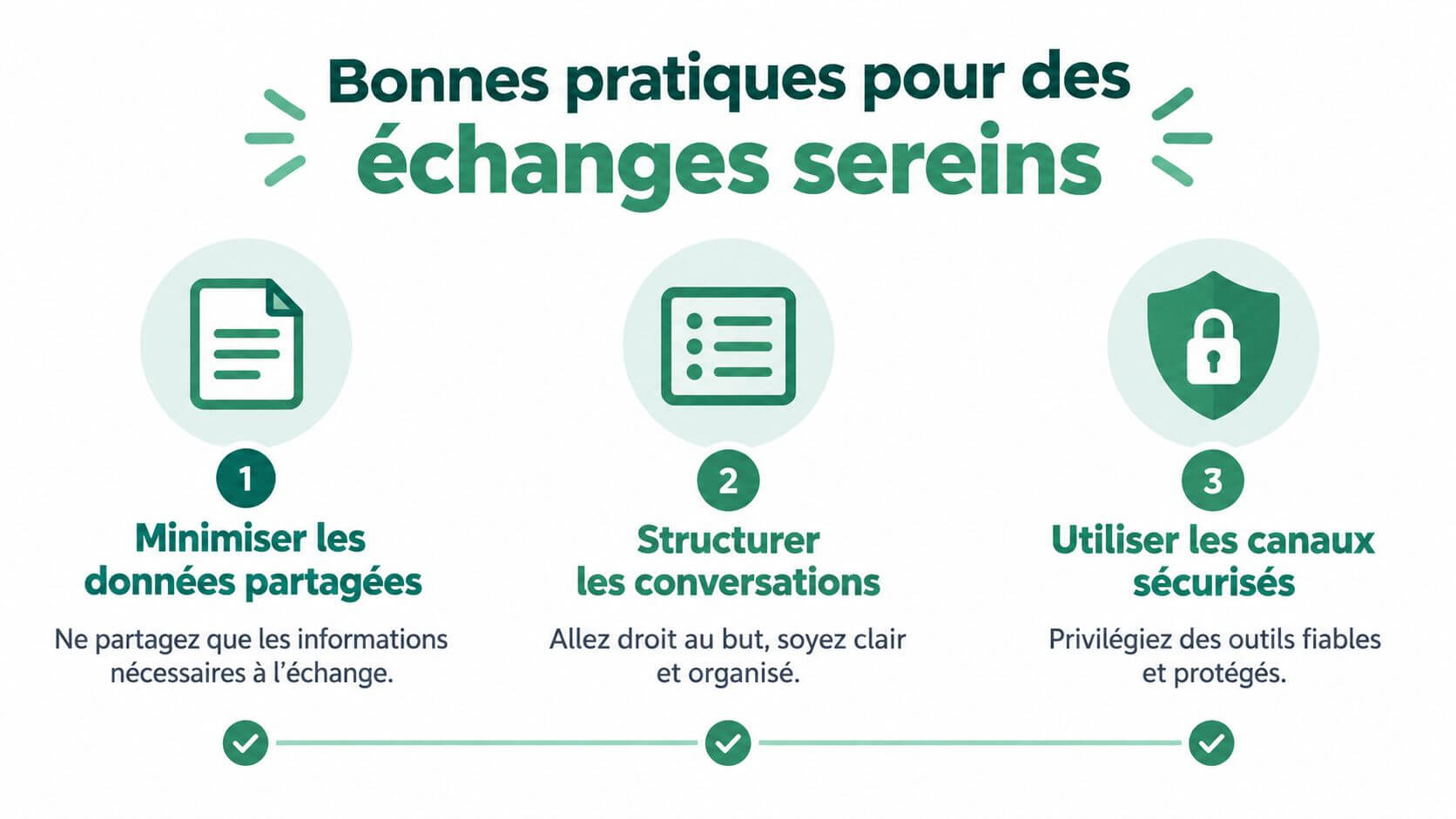
Three reflexes that avoid most confusion
Minimize shared data. Write down what is necessary for the action. A transmission may indicate an observed symptom, the time, the person concerned and the expected follow-up, without copying the entire medical record. This sobriety reduces the exposure of the data and facilitates reading.
Structure conversations. Reserve a wire to an identifiable situation or subject. Start with a clear title, then separate observation, action performed and request to the next speaker. A message such as "take confirmed at noon, lack of pain, check the temperature during the next passage" is more exploitable than a succession of phrases without context.
Use secure channels. SMS can be used to say "see the coordination space", but not to detail a treatment or to attach a medical document. CNIL considers that electronic and instant messaging is rarely safe to transmit personal data, which must guide the habits of the entire tribe.
Governance of access, on a daily basis
When a new participant joins the support, invite his/her personal account and assign him/her the appropriate role. When he/she leaves, withdraw his/her access. This action seems administrative, but it avoids that an old person retains unnecessary visibility on the exchanges and documents.
Notifications also merit careful adjustment. A message preview displayed on a locked screen may reveal sensitive information to a person present in the room. A notification can therefore signal a new transmission without displaying all its content.
Good practice: the person who reads a transmission must be able to identify the author, the date, the priority and the action expected without searching several conversations.
Finally, establish a rule for emergencies. Messaging helps coordination, but must not become the only way to contact emergency services or report immediate distress. The emergency information sheet, key contacts and instructions for seeking help must remain accessible, including when there is no internet connection.
Specific home use cases and observed benefits
The needs become easier to assess when following an ordinary day. Three scenes show how secure private messaging transforms isolated information into coordinated action.
Ignorance of catch
Before that, the attendant noted that a drug was still on the table. She sent a text message to the girl, who called her brother. She answered later, without knowing if the nurse had already been notified. Several people were looking for an answer, but none had a common condition.
After that, the speaker reported oblivion in the shared space. The person in charge received a notification, consulted the history and indicated the follow-up given. The other members saw that the situation was handled, without multiplying the messages.
Transmission after a visit
Before, the nurse notes his observations in the notebook. A close photograph the page and sends it to a family group, while another keeps a different version in his notes. The transmission exists, but it is not structured.
After that, the professional closes her visit with the useful elements, the tasks to follow and any alerts. The next speaker finds the same information, with his author and his context. e-care journal to coordinate stakeholders precisely addresses this need for continuity between passages.
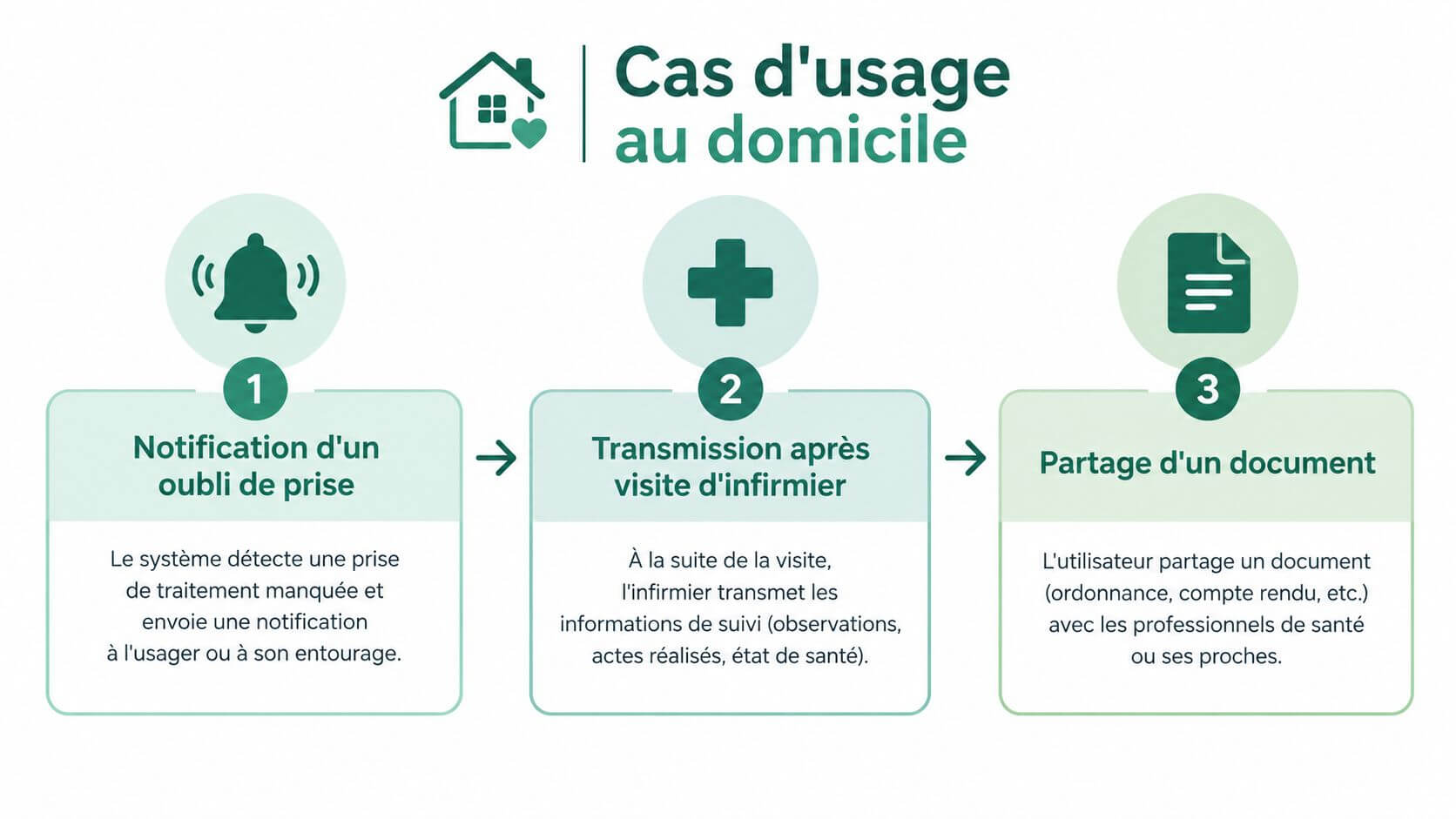
The sensitive medical document
Before, a report is sent to a personal address and then transferred to several recipients. The family no longer knows which version is the correct one and the document remains present in different inboxes.
After that, the file is deposited in a protected documentary space. Authorized people consult it since the coordination, and the doctor can find the useful room without browsing private exchanges. The goal is not to keep everything indefinitely, but to keep the correct version in the right place.
The benefits are concrete, even without promising an improvement in figures. Caregivers know where to watch, caregivers reduce repetitions and distant relatives can participate without constantly asking for an update. The video below illustrates this shared tracking logic.
How Tribulys implements secure private messaging
Tribulys assembles messaging, transmissions and tasks in the same coordination for family caregivers and home care professionals. Exchanges between families and caregivers remain associated with the accompanying person, instead of dispersing between SMS, calls and generalist groups.
Permission adapted to each role
The platform provides differentiated access for the family, nurse, physician and assistant. This separation allows for the sharing of relevant information without giving each member indistinct visibility throughout the file. Actions are associated with users, which makes history more understandable when you have to pick up the thread of a situation.
The care journal brings together the timed and signed entries, comments and priority alerts. Tasks can be assigned to a person with a deadline and a tracking state. Thus, a message is not only informative. It can become an identifiable action, the realization of which is visible to the tribe.
A flow that continues despite the constraints of the home
Push notifications on mobile and on the web signal new transmissions without forcing relatives to call to check. Drug tracking can record confirmations of taking and trigger an alert when an oversight is reported. The unified schedule brings together appointments and passages, limiting divergent interpretations.
Off-line operation is essential in a home where the network is not always available. The functions "My visit" and notebook can be used without connection, then synchronized when the network returns. The emergency card also remains offline, in order to make available the essential information when the situation does not allow to wait.
The medical documents are grouped in a safe with the possibility of exporting the file and the transmissions in PDF. The data are hosted in France, within the GDPR framework announced by the solution. This location does not replace the technical measures, but it gives a readable framework to the governance of the data.
The decisive point: operational security appears when access, action, notification and history remain in the same path.
Choose and deploy your secure private messaging with confidence
The right choice is not just the presence of the word "encrypted" on a presentation page. Ask how the service protects the data, but also how it organizes users when the support evolves.
A family-friendly decision grid
Start with hosting and responsibilities. Identify the host country or area, subcontracting terms and rules applied to backups. Then check whether each member has a personal account and whether the roles can be changed without recreating all the coordination.
Examine traceability with a simple question. After a visit, can you find the author, the time, the order and the person in charge of the follow-up? If the answer depends on a manual search in several applications, the solution may reproduce the dispersion it had to reduce.
Also test the real conditions of the home. A notification must remain discreet, an attachment must be protected, and a transmission must remain possible when the network disappears temporarily. Continuity off-line is not a comfort reserved for exceptional situations. It can determine whether a stakeholder properly completes his visit or needs to reconstitute his notes later.
Deploy without creating a new load
Start with a limited scope. Invite people who are actually involved in the coordination, define each person's role and agree on a common writing rule. A message must specify the context, action and next step, unless urgent needing another channel.
Also prepare a starting procedure. When a professional stops intervening or a relative no longer needs access, his or her account needs to be removed quickly. This governance is as valuable as technology, as solid encryption does not correct permission left active.
For families looking for benchmarks before starting, a application dedicated to family caregivers can help compare functions that are actually useful at home. The important thing is to choose a tool that family members and caregivers can use regularly, with understandable history and controlled access rules.
Secure private messaging becomes relevant when it reduces uncertainties without adding complexity. The channel protects exchanges, governance protects people, and traceability protects the continuity of the journey.
Tribulys brings together private messaging, care journal, tasks, schedule, medical documents and treatment monitoring in a shared space between caregivers and caregivers. To replace scattered SMS with confidential, traceable and usable coordination even off-line, visit Tribulys and discover the solution adapted to your family organization.
Put this organisation into practice with Tribulys
Keep your care journal, shared calendar, tasks, medication tracking and emergency information together. Start for free and invite the relatives and professionals involved in your loved one’s care.