
The tour often starts before the day has really taken its pace. A caregiver sent a text message, the doctor left a message, the paper book remained on the kitchen table, and the nurse must already know what happened in the previous patient, what to watch, and what changes the next passage. When the information flows between telephone, paper, general messaging and memory of each, the coordination is mainly due to the habit, not to the reliability.
This is precisely where a Nurse transmission software Makes sense. It does not replace the care relationship, it avoids that an important observation is lost between two passages, or that a relative tells three times the same thing to three different people. At home, where several actors take turns around the same patient, transmission is not a digital comfort, it is a tool of continuity.
Contents
- The daily life of a home tour and the need for transmission
- What really is a nurse transmission software
- Key features decrypted one by one
- Practical benefits for nurses and caregivers
- Guided path of a transmission in Tribulys
- What criteria to check before deploying a transmission software
- Regulatory framework and compliance
- Assessment checklist and conclusion
The daily life of a home tour and the need for transmission
At Mrs. R., 82, the morning can begin with a tension noted in haste, then a call from the son asking if the evening treatment was taken. Ten minutes later, at Mr. B., diabetic, the nurse read a helper text, compared with a scanned prescription, then tries to remember the detail left the previous day by a colleague. Each one has a piece of the puzzle, but no one always has the overall view.
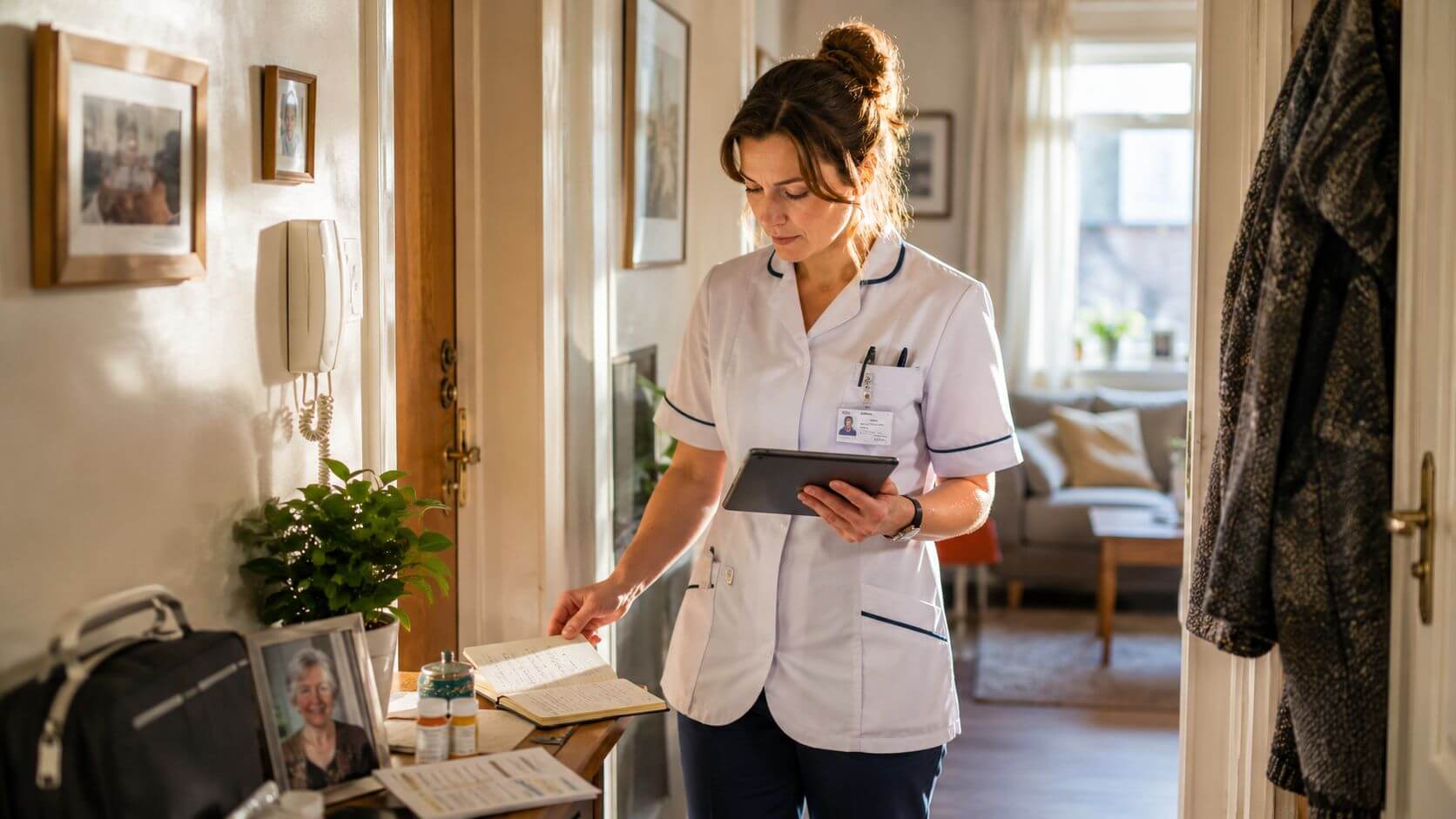
This fragmentation is not only annoying, it creates oblivion, duplication and delays. At home, the flow of information often depends on media that do not speak the same language, paper for one, SMS for the other, the photo for a third. A transmission tool then brings a unique conductor wire, where each passage leaves a trace legible, dated and usable by the next person.
The need is not abstract. nurse transmissions are used to quickly rebuild the patient's condition, especially when the family is coordinating, a doctor is waiting for a clear return, and a professional has to decide without wasting time. For further reading on the field-side transmission book, the handout in practice helps to understand why dispersed supports end up saturating teams.
Point in the field. At home, the right information is not the one that exists somewhere, it is the one that the right actor finds at the right time.
What really is a nurse transmission software
One Nurse transmission software It is a business application designed to circulate care and organizational information between people who intervene around a patient at home. It is not limited to storing notes, it structures what has been observed, what has been done, and what needs to be transmitted to the next passage. It is this logic of relays that makes its value.
What he's not
It should not be confused with a simple paper link book. The paper leaves a trace, but it does not guide the structure or access, and it quickly becomes fragile as soon as one has to read a history or manage several stakeholders. Nor should it be confused with a hospitalized patient file, which responds to a logic of episode of care, not a home tour with successive passages, close, caregiving and different professionals.
The most eloquent analogy is that of a shared dashboard. Each actor sees what concerns him, writes what he knows, and finds what others have left without having to reconstruct everything. The interest is not to show everyone everything, but to circulate the right information with the right rights.
What it's for every day
In practice, it serves three very concrete purposes. forwarding an observatione.g. pain, redness, changes in appetite or unusual behaviour. Next follow treatment, to know what was taken, what was forgotten, and what should be monitored. coordinate passages, so that the nurse, caregiver and physician do not work by assuming a different version of the file.
In the field, it is almost always used in mobility, smartphone or Tablet. This detail changes everything, because a transmission is only valid if it can be written at the right time, not several hours later of memory.
Key features decrypted one by one
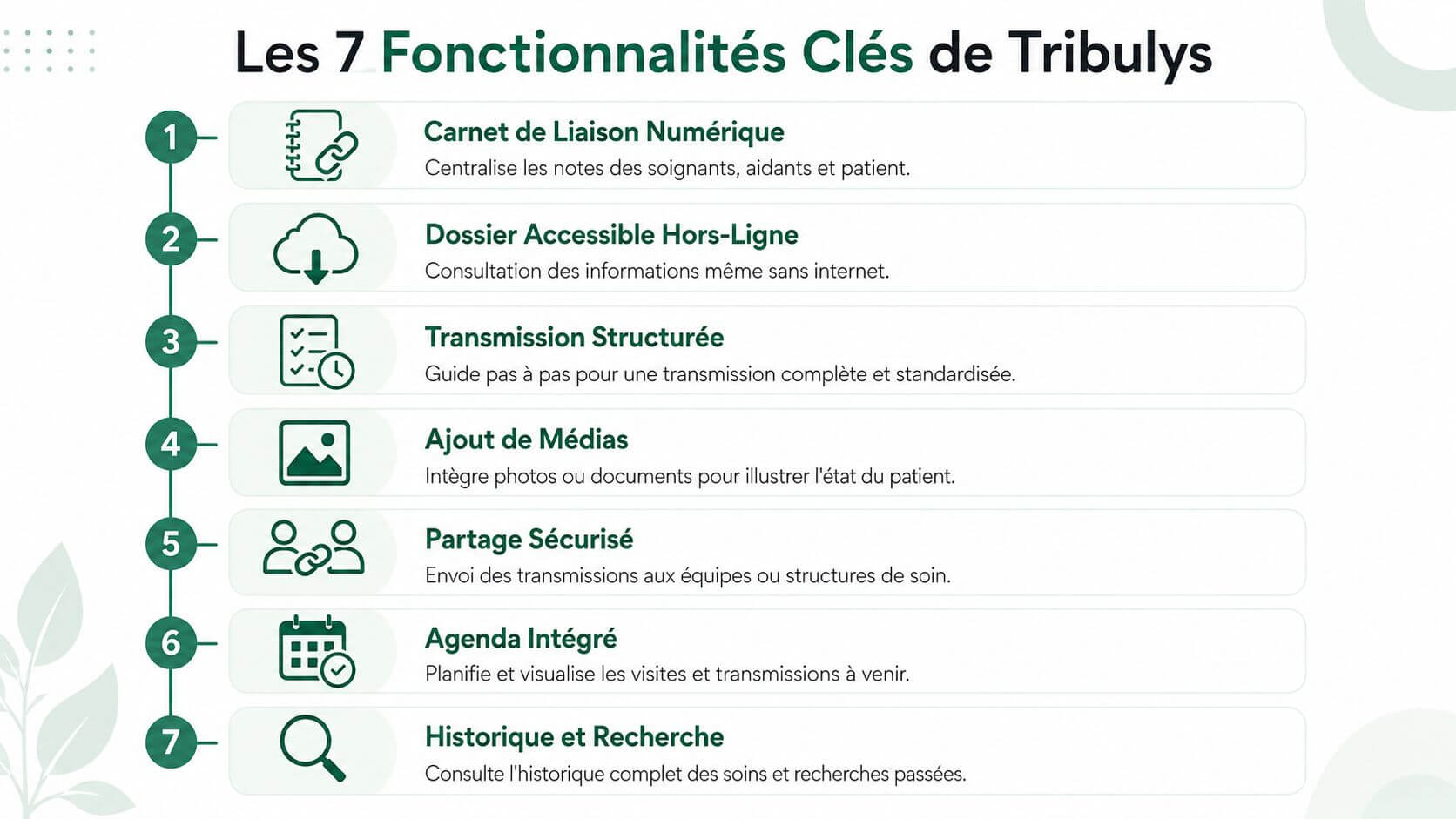
The digital link book
The first block is the digital care journal. It replaces the stacking of notebooks, scattered messages and handwritten notes on different media. Everyone writes in the same place, which reduces the repetitions and contradictions.
Structured transmissions
Then come the structured transmissions, with standard fields for pain, constants, wound, behavior or general condition. This formalism makes the information comparable from one passage to the other, and it helps above all to remember nothing in the fire of the tour. The French recommendations on DAR targeted transmissions recall the interest of a chaining Data, Actions, Results, because it improves the continuity and traceability of care, and the ANFH stresses that this method promotes support and care ANFH, targeted transmissions and continuity.
Treatment monitoring
The third block is the treatment follow-up. It allows you to record a dose, report an oversight, or record an adverse reaction observed by a professional or caregiver. This is particularly useful when several people take turns and avoid double administrations, especially in the home where group memory often replaces a shared document.
The shared calendar
Fourth brick, shared calendar. It looks at nursing passages, home help visits, medical appointments and family constraints. A coordinating family gains a simple reading of the highlights of the week, while the health care team reduces the risk of passing at the wrong time or discovering a program change too late.
Roles and permissions
The fifth element is the role management and permissions. It is here that the difference between a really professional tool and a simple space of notes is played. The right software must say precisely who sees what, who can write, who can only read, and who can consult a sensitive history.
Practical rule. A useful home transmission tool protects secrecy better when it limits access than when it promises total sharing.
Offline mode
The sixth function is: Offline mode. It allows you to capture the transmission even without a network, then synchronize to the reconnection. This capacity is essential as soon as you leave the well-covered areas, because a visit without a connection should never mean a visit without a trace.
Timed traceability
Finally, the Timed traceability and the immutable history give the software its continuity value. In France, nursing transmissions in the liberal must be formal, dated, signed and recorded in a patient file, with the time of care and the name of the professional, to ensure reliable traceability Liberal nursing transmissionsThis logic meets the requirements of the home, where chronology counts as much as content.
Practical benefits for nurses and caregivers
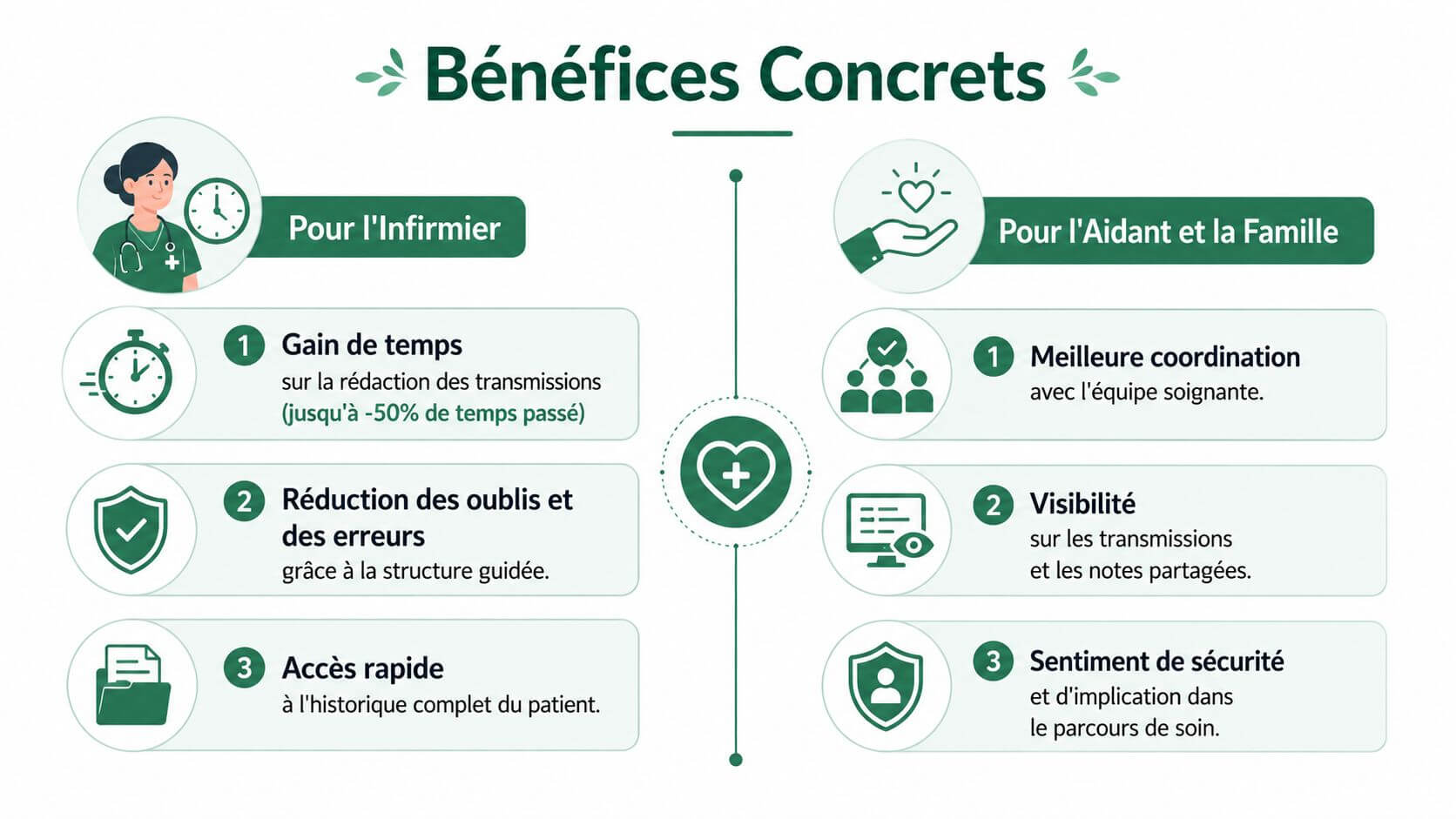
Nurse side
For the Independent nurse, the main interest is simple, there is less reselection, fewer calls to find information, and less time to reformulate what has already been observed. Pre-structured transmissions, voice dictation, and models by clinical situation make writing easier, especially when the tour goes on quickly. The circulation of a readable note at the right time also helps to secure decisions, especially when a relay is made by another IDEL.
Traceability brings another benefit, more discreet but decisive. When a note is timed and attributed to its author, it is easier to find who saw what, and at what moment. This clarity reduces the misunderstandings between cabinet, home and coordination.
Caregiver and family
For the caregiver, the gain is mostly mental. A readable link book avoids holding the messages in the head or running after the right person. The shared calendar makes the passages visible, which reduces the forgetfulness of appointments and repeated questions to the entire team.
The difference is even more noticeable when the family coordinates at a distance. A good tool shows it the essential without exposing it to details that do not concern it, which reduces the confusion and reinforces the feeling of being included in the journey. This is also where the governance of rights becomes concrete, because a loved one does not need to see everything to accompany well.
Guided path of a transmission in Tribulys
At home, the path of effective transmission follows a very simple logic. The nurse opens his visit from the day's schedule, finds the patient file and the synchronized care journal, then consults what was noted by the caregiver or previous professional. The care can then start without having to reconstitute the history from scattered messages.
During the passage, she captures a structured transmission, with the elements useful for follow-up, the care done, the condition of the day and the instructions for the next relay. When you have to illustrate a situation, a photo of a time-bound wound can complete the note. The interest is not to multiply the fields, but to keep a quick and understandable writing.
In practice, the value of Tribulys is also due to its organization of roles, alerts and relays between actors. A point of vigilance can warn the referring caregiver, while the history remains visible to the next passage for the person who takes over. For a more detailed presentation of the operation of the digital link book, the electronic link book shows this logic of continuity at home.
What the next visit sees
The next person does not need to read everything again. She identifies the essentials, understands the context, and resumes the tour with a clear picture of what has changed. This is often where the quality of home coordination is played, in the ability to transmit without slowing down the care.
What criteria to check before deploying a transmission software
The choice of a Nurse transmission software Starts on the ground. In a home tour, the tool must remain usable even when the network flicks, and then resynchronize as soon as the connection returns. Without this continuity, the team ends up returning to the paper or scattered messages.
The second point is that governance of rights. Helper, nurse, physician and coordinator do not have the same level of access, nor the same need to write in the file. The software must therefore clearly separate reading, input and modification, like a door with several keys, not a single opening for everyone. For a wider analysis of the specificities of the Independent Nurse Software, see Independent Nurse Software.
Then comes compliance. HDS in France or in the EU, documentation GDPR A clear and time-bound traceability of each action provides a credible framework for coordination. This is all the more important when several stakeholders share health information at home.
The comfort of use remains to be looked at with the same attention. Models by type of care, voice recognition, shared calendar, configurable alerts and assistive application reduce unnecessary manipulations. The PDF or structured export also helps to reinject the information into the existing one without resuscitating everything.
Concrete deployment
- Mapping the actors. List who actually intervenes at home, and who should read, write or only follow.
- Set Folder Creator. A single rule avoids duplications and transmissions that are lost.
- Training carers quickly. A short grip is better than a long setting that nobody uses.
- Allow a period of double writing. Paper and digital may coexist a limited time to secure the transition.
- Check compatibility with existing. MSI, shared folder and secure messaging must be able to work with the chosen tool.
A software may seem simple on the screen, but without Offline reliable accommodation HDS, it exposes coordination to preventable breaks. At home, the right solution is the one that lasts, without complicating the relay between the actors.
Regulatory framework and compliance
Health data requires a specific framework. The software must be hosted by a provider. HDS, with a register of treatments, explicit purposes and a proportionate shelf life. The patient must also be informed, and his or her agreement must guide the use of shared information, especially when the file is used for coordination between several stakeholders.
The professional secrecy of nurses translates into very concrete technical rules. access loggingThe CNIL points out that only authorized persons must be able to access health data, with checks by role, a register of treatments and controlled storage, and a clear separation of roles and the possibility of exporting data if requested by an authority or patient. CNIL and access to health data.
| Regulatory obligation | Technical functionality required |
|---|---|
| HDS Hosting | Accommodation certified in France or EU |
| Explicit purpose | Linkbook and coordination settings |
| Access limited to authorized persons | Fine Role Management and Permissions |
| Professional secrecy | Journalization of consultations and changes |
| Proportional storage | Purge or archiving according to a documented policy |
| Right of access or export | PDF or structured folder export |
| Patient information | Clear legal notice and traceability of the agreement |
At home, the right compromise is to keep a paper fold possible, without making it the main function. The refusal of digital must remain respected, but the chosen tool must be able to secure the usual use without scrambling the responsibilities.
Assessment checklist and conclusion
Before choosing, a demonstration must answer simple questions, ideally printed next to you. The idea is not to measure the number of buttons, but to check that the tool really follows the rhythm of the home. A software that convinces on screen must also hold on a real tour.
- Transmission. Are the notes dated, attributed to an author, and readable by the next relay, yes or no?
- MobilityDoes offline mode really work, yes or no?
- Synchronization. Do the data automatically return to reconnection, yes or no?
- RolesCan we limit precisely the rights of each actor, yes or no?
- ComplianceAre HDS hosting and GDPR documentation provided clearly, yes or no?
- Ergonomics. Can the nurse seize a transmission quickly in the patient's bed, yes or no?
- Accompanying. Does the publisher help with deployment and first use, yes or no?
Useful threshold. If synchronization is slow, the hosting is unclear, or the roles remain unclear, deployment will be fragile in the first few weeks.
In a field logic, Tribulys This type of organisation is illustrated with a shared link book, timed transmissions, a follow-up of medicines, a unified agenda and differentiated rights for the actors of the home. The interest, in essence, is not to digitize to digitize, but to make the succession safer and more readable for all.
Moving from a useful but scattered family care journal to structured digital coordination changes everyone's place. The nurse returns to the care, the carers come out of improvised memory, and the journey finally becomes easier to read than to guess.
If you are looking for a home coordination framework that structures transmissions, drugs, agenda and access by role, see Tribulys. You will be able to compare the organization of the transmission with your current usages and test whether the operation really fits your tour, before considering a wider deployment.
Put this organisation into practice with Tribulys
Keep your care journal, shared calendar, tasks, medication tracking and emergency information together. Start for free and invite the relatives and professionals involved in your loved one’s care.