
You're finishing work when a message arrives about your parent's appointment. Your sibling thinks it went well, but nobody knows whether the prescription changed. You check the family chat, find a photograph of an old medication box, and start calling around.
The hardest part isn't always being far away. It's trying to work out what happened, what still needs doing, and who's responsible without turning every evening into an investigation.
Table of Contents
- When You Care From Far Away
- Why Distance Changes the Care Problem
- Set Up One Shared Care Space
- Build a Weekly Check-In Routine
- Organise Medication, Appointments and Documents
- Plan Visits and Handle Emergencies From a Distance
- Common Questions About Long Distance Caregiving
When You Care From Far Away
Long distance caregiving often happens in the gaps between ordinary activities. You're arranging a delivery during lunch, wondering whether a neighbour visited, or checking your phone before bed because someone promised an update that never came.
None of those tasks looks especially large on its own. Together, they leave you mentally on call, even when there's nothing useful you can do until someone nearby answers.
Recognise the uncertainty behind the calls
Consider this hypothetical situation: your father says he collected his medication, your sister says she planned to collect it, and the pharmacy left you a voicemail. Everyone may be acting in good faith, but you still don't know whether the medication is at home.
Another phone call might resolve today's confusion. It won't resolve the underlying problem unless someone records the outcome and closes the task.
Practical rule: A reassuring conversation and a completed care task are different things. Make room for both.
A workable remote routine gives each kind of information a place. Appointments belong in a calendar, observations in a dated journal, and unfinished actions beside the name of the person handling them.
Keep the person receiving care involved
Start with what your loved one wants help with, not what relatives want to track. Ask which updates they're comfortable sharing, who should receive them, and which parts of daily life they'd rather keep private.
When care becomes more complex, involve professionals rather than expanding family surveillance. For someone exploring support in that location, Core Nursing Solutions Pty Ltd's information about palliative care services in Sydney is a relevant resource to discuss with the treating team.
The practical aim is less guessing, not more checking:
- Visibility: Know where to find the latest update.
- Ownership: Know who has accepted the next action.
- Boundaries: Know what requires a call now and what can wait.
You don't have to recreate being physically present. You need a dependable way to contribute from where you are, without making your loved one feel managed or leaving the nearby caregiver to answer endless requests.
Why Distance Changes the Care Problem
Distance changes the type of work a caregiver does. You may not help with dressing or meals, but you can still carry responsibility for bookings, invoices, prescription renewals and decisions that depend on somebody else's observations.
A systematic review of long-distance caregiving research estimated 5 million to 7 million long-distance caregivers in the United States, approximately 15% of caregivers in some national estimates, with 25% to 40% acting as the primary caregiver despite the separation. These are historical research estimates, not a current population count.
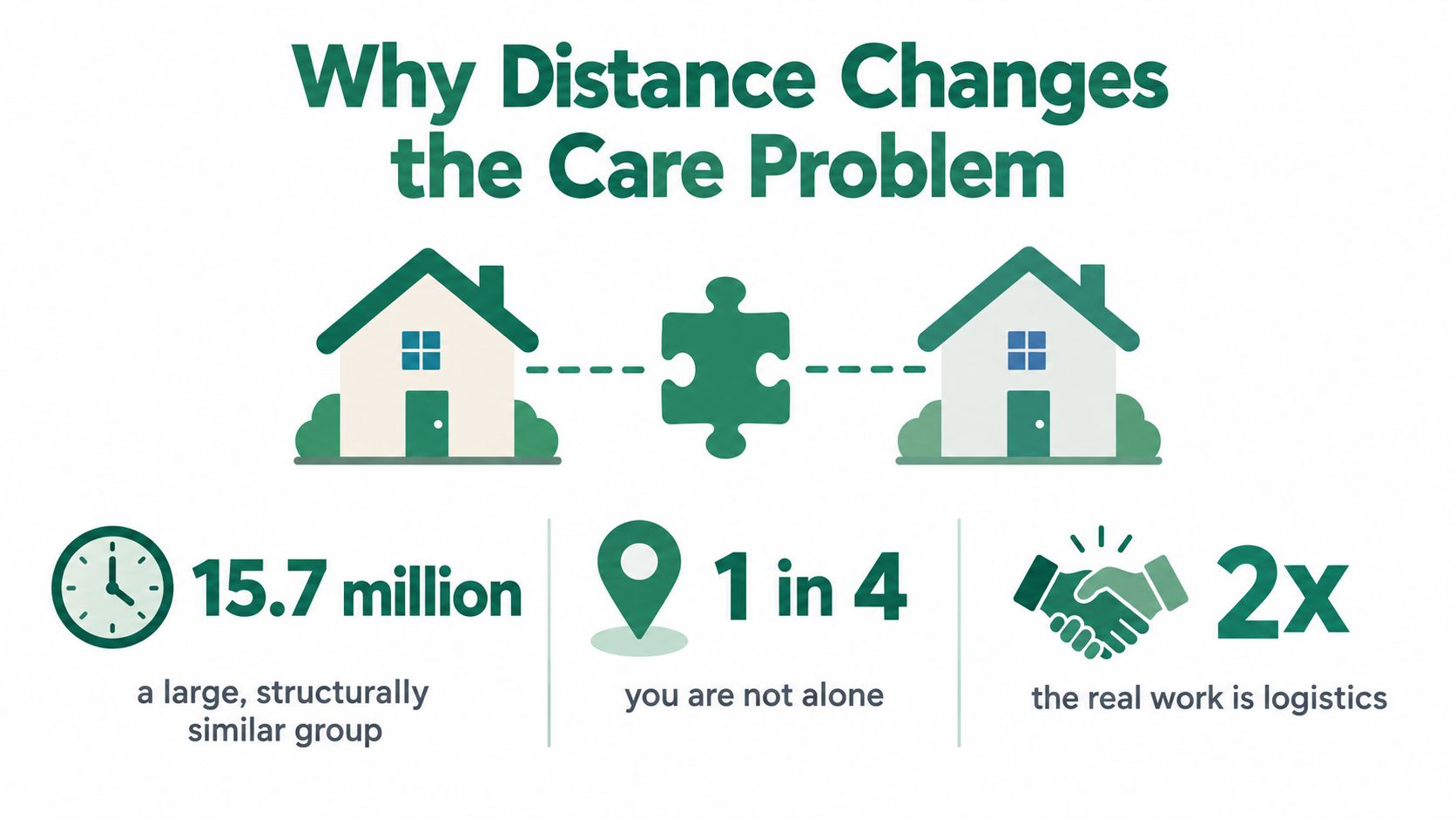
The visual below illustrates the coordination gap, but its numerical callouts aren't supported by the cited evidence and shouldn't be used as factual estimates.
The burden isn't measured only in visits
The American Psychological Association's family caregiving overview reports that a 2004 analysis found emotional stress among 47% of caregivers living farthest away, compared with 28% of those living nearby but separately; a later synthesis reported average annual caregiving expenses of approximately $8,728 for long-distance caregivers versus $4,570 for nearby caregivers.
Those findings help explain why fewer hands-on tasks don't necessarily mean an easier role. A remote relative may spend the day waiting for information, then have to make travel or spending decisions before the situation is clear.
Replace availability with an agreed role
Being reachable all the time isn't the same as being useful. Decide which work you can reliably handle and which decisions require someone local or a qualified professional.
For a separate discussion of coordination in a mental-health setting, reVIBE Mental Health's resource on Arizona care team coordination benefits offers a relevant starting point. Discuss the actual responsibilities with the providers involved rather than assuming that every service works the same way.
Use the accompanying video as an additional discussion prompt, not as a substitute for an agreed care plan.
The distinction matters: a family can exchange frequent messages while still leaving the pharmacy call undone. Coordination means someone accepts the action and reports its outcome.
Set Up One Shared Care Space
Choose a shared space that the people doing the work will use. A familiar calendar and access-controlled folder may suit a simple arrangement; a dedicated care application may fit a larger group that needs linked notes and responsibilities.
Don't choose solely for the most technologically confident relative. Ask the local helper to try adding a visit note from their phone before the family commits.
Give each record a clear home
The shared space should hold current information, not become an archive of unexplained screenshots. Use descriptive filenames, identify who maintains each record, and keep outdated versions separate from active instructions.
What to put in the shared care space
| Item | What goes there | Who updates it |
|---|---|---|
| Shared calendar | Appointments, visits, transport arrangements and renewal reminders | Whoever makes or changes the booking |
| Care journal | Dated observations, visit outcomes and unresolved concerns | The person who observed or carried out the activity |
| Documents folder | Current prescriptions, reports and relevant care instructions | A designated records lead |
| Emergency sheet | Key contacts, relevant conditions and agreed response instructions | The coordinator, with the person receiving care and relevant professionals |
| Task list | Specific actions, accepted owners and completion notes | The owner of each action |
Access should follow the task. A neighbour helping with shopping doesn't automatically need clinical reports, and a visiting professional may use their employer's records rather than a family application.
Keep passwords, banking credentials and unnecessary financial details out of the shared care space. Agree who can invite new members and remove access when someone's involvement ends.
Make participation practical
In a hypothetical example, a daughter in Lyon and her brother in Nantes invite a local neighbour and a home care worker into their shared arrangement, with their mother's agreement. The neighbour records shopping visits, the worker contributes agreed handover information where workplace policy permits, and the siblings handle administration.
They don't need everyone to copy every conversation into the system. They need decisions and outcomes recorded where the next person can find them.
The guide to organising home care coordination provides further context for setting up this kind of shared workflow.
During the initial setup:
- Ask permission: Agree what information will be shared and with whom.
- Test access: Have each participant find an appointment and add a note.
- Name maintainers: Assign responsibility for keeping documents and contacts current.
- Retire duplicate channels: Keep social chat, but move care decisions into the agreed space.
Build a Weekly Check-In Routine
Choose a rhythm that your loved one welcomes and the local caregiver can sustain. A predictable call, a concise written update and a review of outstanding actions are more manageable than a stream of unscheduled requests.
Agree on a regular day and a comfortable call length. If relatives live in different countries, check rates before calling abroad using BubblyPhone's guide, and choose a contact method your loved one already knows how to use.
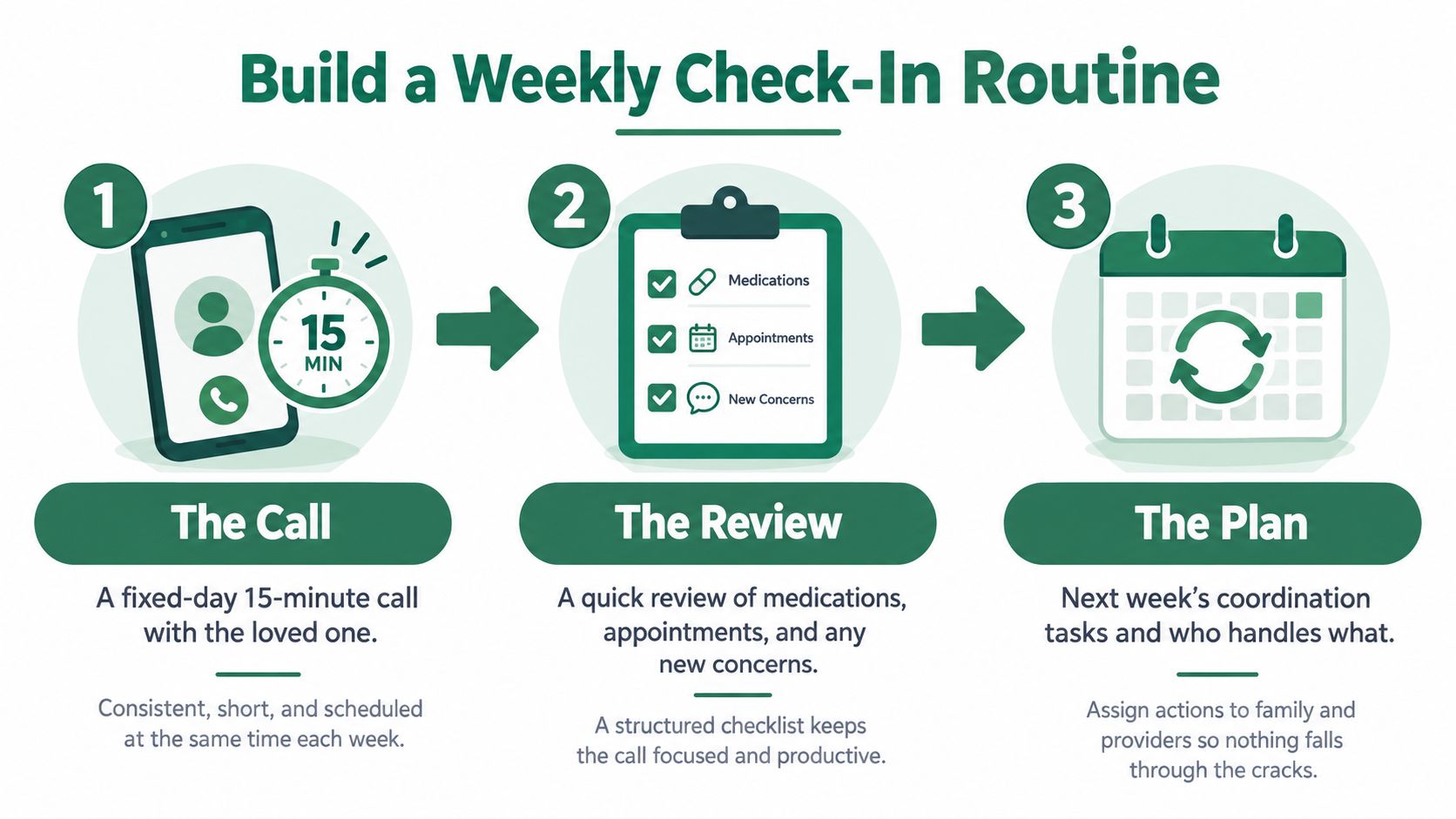
The visual below offers a simple routine; treat its suggested timing as an example, not a requirement.
Keep the call human
Start with something other than care administration. Ask about a television programme, a visitor, the garden or whatever your loved one enjoys discussing.
Then use open questions: what felt harder lately, what help would be welcome, and whether there's anything they want you to sort out. Avoid running through a checklist as though they're being examined, or asking them to reconcile every disagreement between relatives.
A family call should leave room for the person's life, not just the family's concerns.
Separately, ask the local helper for a brief update organised around what happened, what's planned and what needs attention. Let them distinguish a direct observation from something your loved one told them.
Review once and act selectively
In a hypothetical example, a daughter in Paris receives her sister's Sunday evening summary from Marseille. Their mother enjoyed a visitor, transport for the next appointment hasn't been confirmed, and a prescription renewal needs arranging.
The daughter takes the transport booking because she can handle it remotely. Her sister agrees to contact the usual prescriber, and neither needs to repeat the whole discussion during their mother's next call.
Keep the review focused:
- Close completed actions: Don't leave resolved items looking urgent.
- Clarify uncertainty: Ask a targeted question instead of requesting another full report.
- Assign follow-up: Put each remaining action beside an accepted owner.
- Respect quiet periods: Agree when routine messages will be read.
A missed update should trigger the agreed follow-up, not immediate assumptions about danger. Equally, silence isn't proof that everything is fine.
A routine won't remove guilt or loneliness. It can give you a stopping point: you've reviewed the available information, handled your part and know who's responsible for what remains.
Organise Medication, Appointments and Documents
Be precise about what you're coordinating. Arranging a prescription collection is an administrative task; deciding whether a dose should change is a clinical decision.
Remote relatives can make a substantial contribution by preparing information and following through on arrangements. They shouldn't be expected to interpret incomplete records or improvise treatment instructions.
Medication records need honest labels
Use the current prescription or clinician-approved medication list as the reference. Ask the pharmacist or treating professional to clarify discrepancies, and check any information extracted from a prescription against the original document.
Record who entered a dose confirmation and when. A recorded confirmation is a user entry, not independent proof that medication was taken. An empty entry can also mean somebody forgot to log it, so the family should clarify rather than assume.
If you use reminders or missed-dose alerts, decide who receives them and what that person should do. The response might involve contacting the person assisting locally or seeking pharmacist advice, according to the agreed plan.
Medication boundary: Don't turn a notification into a dosing decision. Ask a qualified professional what to do about a missed, uncertain or potentially incorrect dose.
Turn an appointment into a complete task
Booking is only part of the work. Specify who confirms the location, arranges transport, accompanies your loved one if wanted, and records the follow-up instructions.
For example, the remote caregiver might call the pharmacy about collection arrangements while a nearby sibling picks up the medication. A neighbour may agree to drive to an appointment, but shouldn't automatically inherit responsibility for explaining the consultation afterwards.
Prepare documents before the visit. The records lead can gather the latest prescription and relevant reports, while the remote relative helps draft questions for the clinician.
If a blood test report arrives, store it with its date and arrange for the treating professional to explain it. Don't present a family member's reading of the report as a diagnosis.
Write a handover someone can act on
A useful handover note distinguishes facts from interpretation:
- Visit details: Who attended and when.
- Observed changes: What the writer directly noticed.
- Reported concerns: What your loved one described.
- Instructions received: Which professional gave them and where the original is stored.
- Next action: Who accepted it and when follow-up is expected.
Write “appointment attended; follow-up letter pending” rather than “all sorted.” The first tells the next person what remains unknown without asking them to guess.
Plan Visits and Handle Emergencies From a Distance
Visits don't have to be frequent to involve substantial responsibility. Among 304 long-distance caregivers in a recent study reported in Innovation in Aging, 38% visited at least monthly and 53% several times per year; the median visit lasted three days, and half lived more than 500 miles away.
Make the trip serve your loved one's priorities as well as the care arrangements. Arriving with a long list of corrections can turn a welcome visit into an inspection.
Prepare without taking over
Before travelling, review the journal and separate tasks that need your physical presence from those you could handle remotely. Agree on the visit's purpose with your loved one and arrange a handover with the nearby caregiver if needed.
Use a short preparation checklist:
- Resolve questions: Identify gaps that require an in-person conversation.
- Coordinate timing: Confirm appointments and professional availability.
- Offer relief: Ask the local caregiver what would help.
- Protect connection: Leave space for an ordinary meal or shared activity.
Don't judge the local caregiver's whole routine from a brief visit. Ask why an arrangement exists before proposing changes.
Define urgent responses before they're needed
Create an escalation plan with the person receiving care and relevant professionals. Distinguish immediate danger, urgent clinical concerns and routine coordination problems, and identify a local responder and backup for each.
For immediate danger or suspected serious injury, contact local emergency services rather than waiting for a remote relative to decide. Travel is a separate decision; the person nearby needs instructions that don't depend on your arrival.
In a hypothetical scenario, a brother in Berlin receives a Saturday message from his sister about a fall. Following their previously agreed plan, she contacts the local GP for advice only if the circumstances fit that plan and there's no indication of an emergency; the brother coordinates information while she goes over.
If the situation appears serious or uncertain, they seek urgent assessment instead of treating the GP call as a universal response to falls. Their agreed roles help them respond without making the first decision about who catches a train.
When considering an alert device, use this guide to emergency call buttons to frame questions about who receives the alert and who responds locally. Afterwards, document what happened, the advice received and any changes needed in the plan.
Common Questions About Long Distance Caregiving
How often should you call?
Agree the frequency with your loved one rather than using contact as a measure of commitment. Some people enjoy frequent conversation; others prefer a scheduled catch-up and messages they can answer when convenient.
If you're calling mainly to settle your own anxiety, use the agreed update routine before requesting another check. Extra calls may be appropriate when circumstances change, but explain why you're asking.
When should you involve professionals?
Ask the usual GP or treating team for guidance when care needs change, medication questions remain unresolved, or the family can't confidently support everyday activities. A geriatrician or home care service may be relevant depending on the person's needs and local referral arrangements.
Seek help with a concrete description of what has changed. Don't wait until relatives have exhausted every informal workaround.
How do you recognise overload?
Pay attention when you or a nearby caregiver can't switch off, repeatedly lose sleep, become persistently irritable or struggle to keep up with necessary tasks. Those experiences deserve support, not another expectation to organise better.
Ask the person receiving care about overload too. They may find repeated calls and requests for updates tiring, even when everyone means well.
How can you balance care with paid work?
Around 70% of working-age caregivers are employed, and half of working caregivers report arriving late, leaving early or taking time off because of caregiving, according to the 2025 Caregiving in the US report.
Before requesting workplace flexibility, document recurring care tasks, interruptions and appointments, then identify the specific adjustment you need. Batch non-urgent administration where possible, but don't assume every worker controls their schedule.
Ask for help before you're running on exhaustion. Redistributing a task or bringing in local support isn't withdrawing from care; it's making your contribution sustainable.
Tribulys offers a private shared care space with a care journal, calendar, medication records, documents and assigned responsibilities for relatives and professionals supporting someone at home. Visit to explore it as an option for your care circle, and start by agreeing who will record local updates and who will handle remote follow-up.
Put this organisation into practice with Tribulys
Keep your care journal, shared calendar, tasks, medication tracking and emergency information together. Start for free and invite the relatives and professionals involved in your loved one’s care.