
You may already be helping in small, messy ways. One sibling checks the calendar, another answers the nurse, and you're the one trying to remember which prescription was changed, who was supposed to call back, and whether the home helper came this morning. That's the point where home care coordination stops being a vague idea and becomes a real job, even if nobody has formally named it yet.
At home, the problem usually isn't goodwill. It's that information, decisions, and follow-up get split across people who each know only part of the picture. The safest way to think about coordination is simple, one shared place for observations, medications, appointments, and responsibilities, plus a clear answer to two questions, who owns this, and what happens if it's unclear. If you want a broad overview of what families often need to organize, the in-home care management guide is a useful companion while you set up your own system, and Tribulys also has a related guide to home care coordination.
Table of Contents
- What Home Care Coordination Actually Means
- Who Is Involved and Who Should Lead
- The Core Building Blocks of a Coordination Setup
- Two Common Scenarios in Practice
- A Practical First 72 Hours at Home Protocol
- Legal and Privacy Baseline for France
- Comparing Coordination Approaches
- Checklist and Next Steps
What Home Care Coordination Actually Means
Home care coordination is the deliberate organisation of people, information, and tasks around one person living at home. It's not just helping out, and it's not just sharing chores. It's the part that makes sure everyone is looking at the same facts, following the same plan, and passing the right information to the right person at the right time.
A family group chat can feel coordinated because everyone is talking. That's different from coordination with a structure. In a real setup, someone records what happened, someone else confirms what changed, and someone decides whether the change stays with the family or moves to a clinician for action.
The difference between help and coordination
A daughter can book transport, a son can buy groceries, and a neighbour can check in after lunch. Helpful, yes. Coordinated, only if the tasks are linked to a shared record and a named person is watching for gaps. Without that, one person may assume the prescription was renewed, another may think the nurse already heard about the swelling, and nobody is sure who should act next.
Practical rule: if three people can reasonably interpret the same situation differently, the family needs a coordination process, not more messages.
A simple example makes the difference clear. A daughter arranges her father's nurse visits, her sister stays with him in the evening, and a neighbour brings groceries. If the nurse says the wound looks different, the sister needs to know whether that is just a note for the journal or a change that should reach the doctor. Good intentions are useful. A clear source of truth is what turns them into care.
Who Is Involved and Who Should Lead
The circle around a person at home usually includes a spouse, adult children, siblings, maybe a long-distance relative, plus a nurse, physiotherapist, home care worker, and the treating doctor. The mistake many families make is assuming the closest relative should automatically coordinate everything. In some situations that works. In others, it creates a burden nobody can sustain and leaves clinical questions sitting in the wrong hands.
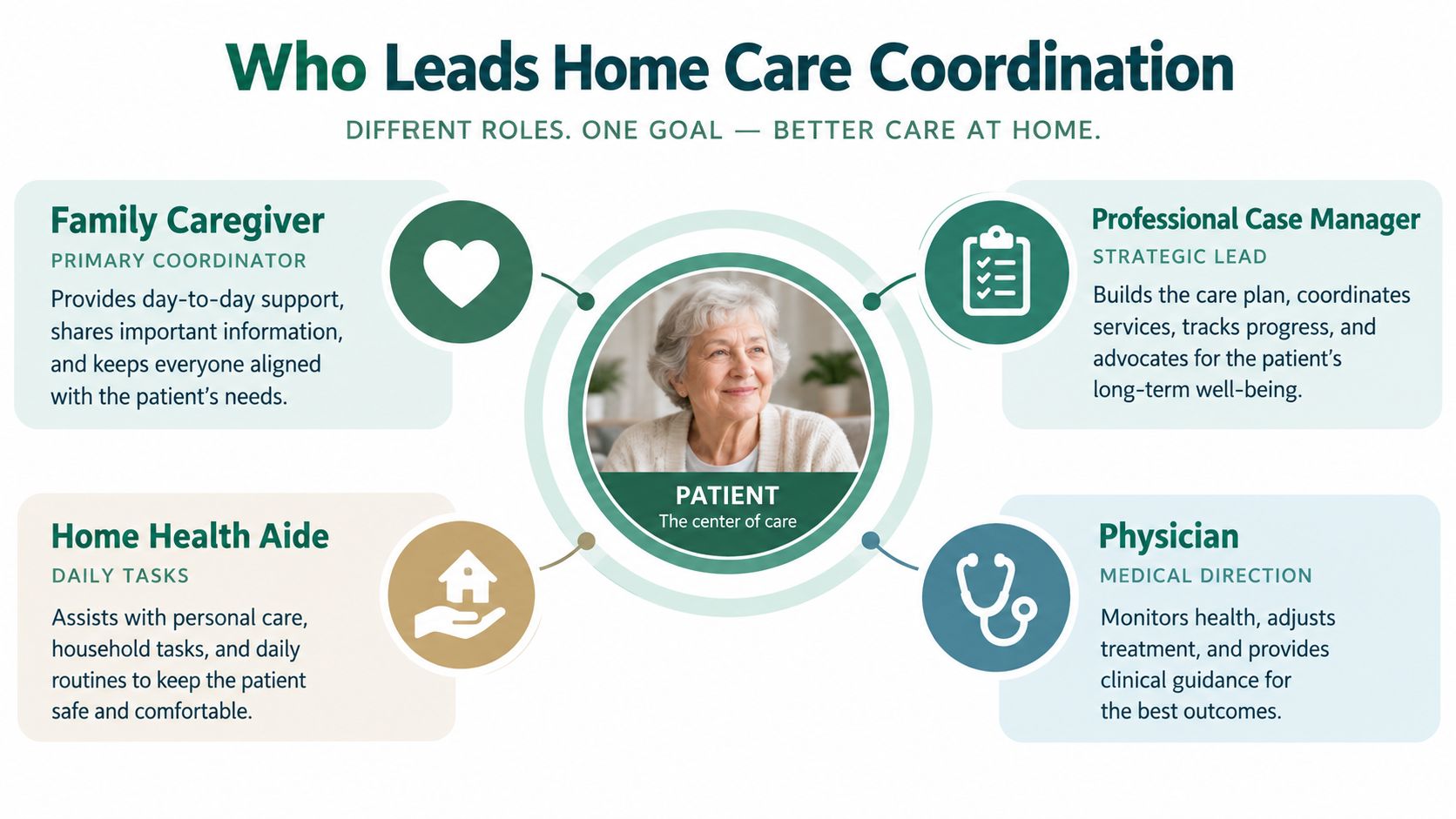
Name the lead before you need one
The person leading coordination doesn't have to be the same person doing the hands-on care. A family member can keep the calendar, collect updates, and make sure tasks don't disappear. But when symptoms change, conflicts appear, or clinical decisions are needed, that part belongs with a designated healthcare professional.
Research on rural home care in France points to the same structural issue, family caregivers are often left to coordinate professionals, even though coordination is better led by a named healthcare professional when one is available. The study also highlights advanced practice nurses as a useful reference contact because they can connect patients, families, and multiple providers while helping with access barriers, especially when physician home visits have become less common and distance makes the system harder to manage. The key lesson is not “families should do more.” It's that families need a clear boundary for what they can manage and what should move to a clinician.
Write the boundary down
A usable setup has four roles, not one vague responsibility.
- Primary coordinator: keeps the shared record current, checks that messages are answered, and tracks unresolved items.
- Backup coordinator: steps in when the primary person is unavailable, tired, or overwhelmed.
- Professional lead: reviews symptoms, updates care plans, and resolves medical conflicts.
- Family contributors: report observations, confirm tasks, and flag changes early.
A good escalation route is plain enough to explain in one sentence. If a message is non-urgent, the family waits for the agreed response time. If something seems clinically off, it goes straight to the professional lead instead of being discussed around the group. That way, the family is not improvising who decides what, and the clinician isn't finding out too late that several people saw the same warning signs.
If the family has to debate whether something is “important enough,” the system is already too vague.
The Core Building Blocks of a Coordination Setup
The simplest setup is the one people will really use. That usually means a few well-chosen tools, each with one job, rather than a large system that tries to do everything at once. The shared journal should sit at the centre because handovers, observations, and task changes are the part most likely to get lost when care is split between home and professionals.
For practical data exchange ideas, the practical steps for data exchange resource is a useful reminder that structured information works better than scattered updates.
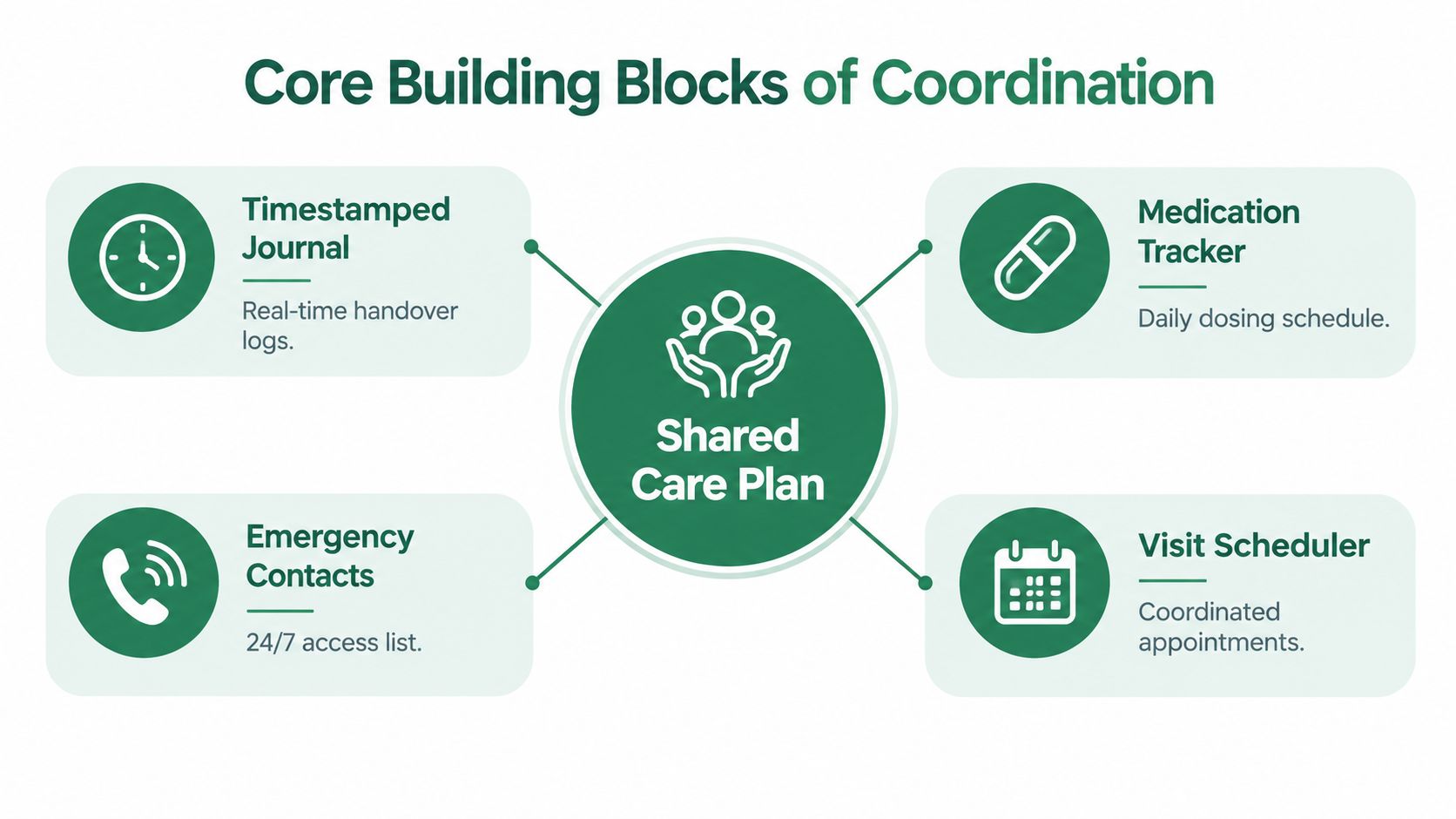
Build from the journal outward
A timestamped shared journal should capture what was observed, who saw it, and what was passed on. It should not be used for diagnosis. Keep it factual, short, and traceable. “Walked to the bathroom twice during the night” is useful. “Seems worse” only helps if someone can follow up.
A medication tracker should list the schedule, dose changes, and confirmations that a dose was taken or missed. It's there to organise uncertainty, not to replace the prescription or a clinician's review. The person updating it should be the person closest to the event, not whoever happens to be online.
A shared calendar is for appointments, visit times, family presence, and equipment delivery. That avoids the common problem where one person thinks the nurse is coming in the morning and another has already left the house. A calendar only works if someone owns updates, otherwise it becomes a pretty version of confusion.
An emergency sheet should hold essential contacts, key risks, and the most useful “what to do first” details. A documents folder can keep prescriptions, reports, and other records together, while a task list shows what's done, what's pending, and who is responsible.
Keep notifications selective
Notifications should surface what matters, not every minor edit. Too many alerts make people stop reading. That's why a good setup needs a clear rule for what triggers a message, what stays in the journal, and what goes directly to a professional. If every update is treated like an emergency, nothing feels urgent anymore.
Two Common Scenarios in Practice
A long-distance daughter and a post-discharge family often need the same structure for different reasons. In both cases, the care works better when the family decides in advance who writes things down, who responds, and who escalates. The difference is mostly where the pressure shows up first.
Long-distance caregiving
In one home, an adult child lives in another city and helps by phone, video call, and weekly visits. The parent has a daily home care worker, and one sibling lives nearby. The distant child should not try to manage every detail from afar. A better division is to make the nearby sibling or a trusted local contact the on-the-ground confirmer, while the distant child keeps the shared journal current and checks whether the right people have seen the latest updates.
If a visit is missed, the note goes into the journal first. If the missed visit affects medication, mobility, or safety, the family escalates to the clinician or home care agency using the agreed route. The point is not to flood everyone with messages. It's to keep the record clean enough that the right person can act quickly.
After discharge from hospital
In another home, a parent returns after a hospital stay with new prescriptions and equipment to set up. The family's first job is not to solve every possible issue at once. It's to confirm the essentials, who has the medicine, who is handling equipment, who is present that evening, and who is calling the nurse if something doesn't match the discharge summary.
The most useful setup after discharge is the one that keeps the family from guessing.
Both scenes use the same logic. One shared space. One named coordinator. One backup. One clear route for anything that needs professional judgment. The family doesn't need to become clinical experts. They do need a system that stops the important details from getting buried under good intentions.
A Practical First 72 Hours at Home Protocol
The first three days are when confusion usually shows up, so the protocol needs to be short, direct, and named. That is why a shorter, owner-based plan works better than a long packet nobody will read. The goal is simple, get the basics stable before the family starts improvising.
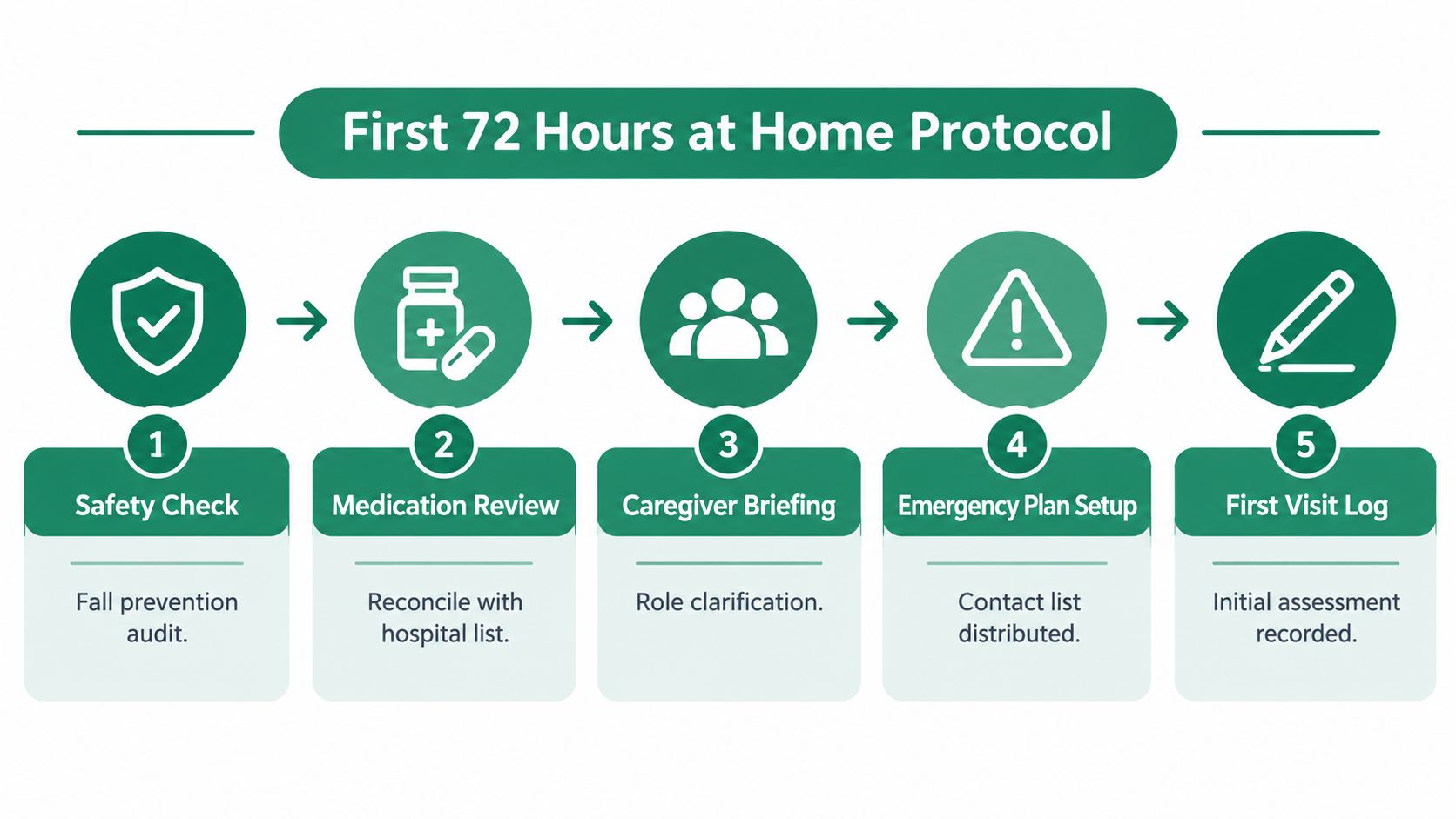
Day 0, Day 1, and Day 2
Day 0
- Verify prescriptions: one named person checks that the medications were obtained and match the discharge list.
- Confirm equipment: one person confirms delivery and setup of items such as a hospital bed or mobility aid.
- Record open questions: write down anything unclear, then assign it for follow-up instead of letting it circulate informally.
Day 1
- Review the medication list: compare what arrived at home with what the hospital intended.
- Contact the nurse or doctor if needed: only the coordinator should send the consolidated questions, so the family doesn't send duplicate messages.
- Divide presence: decide who covers daytime, evening, or overnight support, and who can step in if the main helper needs a break.
Day 2
- Confirm the first follow-up appointment: one person checks that the date and time are written in the shared calendar.
- Log the first observations: keep the notes factual and brief, then flag anything that needs professional review.
- Protect rest: the primary caregiver should have a real rest block, not just a promise to “take it easy later.”
The evidence on discharge-to-home coordination points in the same direction, earlier discharge planning, multidisciplinary coordination, family involvement, structured communication, home-based support, and quick follow-up work better than isolated calls or unclear handovers. It also suggests that effects aren't always sustained if the system falls apart after the first stretch, so the protocol should be treated as continuity infrastructure, not a one-time task list.
Legal and Privacy Baseline for France
A family coordination setup in France needs a clear privacy frame from the start. The shared space should be built around purpose, minimisation, access control, retention, escalation, and exit. In practice, that means only the people who need a detail should see it, and only the details needed to coordinate care should be stored.
A casual messaging group is often the wrong place for sensitive documents. Full identity numbers, intimate medical details, and photos that do not help with coordination should stay out of it. If someone leaves the group, access should be removed cleanly, and the shared record should still make sense for the people who remain.
For a quick check of how a service handles data, families can review the privacy practices before using any digital workspace for health-related information. In France, if a coordination tool stores health data, the hosting setup needs to follow the HDS framework, and GDPR principles still apply to how the data is shared and used. For an official starting point, Service-Public.fr and the ANS guidance explain the French baseline for health data hosting and privacy.
A simple family charter
- Purpose: what the shared space is for.
- Members: who is included.
- Access: who can see, edit, and receive alerts.
- Retention: what stays in the record and what gets removed.
- Escalation: when a note becomes a clinician issue.
- Exit: what happens if someone leaves the family group.
A private secure messaging space can help with access control and retention, which is why this guide on private secure messaging is useful when a family needs to move beyond an open group chat. It still does not replace clinical judgment, and it should not be treated as an emergency service.
If a family wants one shared place for the journal, medication tracking, calendar, documents, tasks, and emergency information, Tribulys is one option. It brings those pieces into a shared environment with hosting infrastructure in France certified under the HDS framework and stated GDPR compliance. Even then, the tool only supports coordination. It does not decide what care should happen next.
Comparing Coordination Approaches
The right setup depends on how many people are involved and how much can go wrong if one message is missed. A paper notebook may be enough for a small, stable routine. Once several family members and professionals are in the loop, the medium matters more because handovers need to be traceable.
| Approach | Traceability | Medication tracking | Handover quality | Privacy posture |
|---|---|---|---|---|
| Paper notebook at home | Strong if everyone uses it consistently, weak if it stays with one person | Basic, manual only | Good for one location, weaker for remote relatives | Private if stored safely, but easy to lose or misread |
| Family messaging group | Low to medium, messages get buried | Poor for structured follow-up | Fast, but messy when several people reply | Depends on phone habits and group control |
| Shared spreadsheet or drive | Medium to strong if someone maintains it | Better than chat, still manual | Better for records, less natural for quick updates | Better access control, but setup takes discipline |
| Dedicated caregiver coordination tool | Strong when used well, with timestamps and owners | Built for schedules, confirmations, and history | Strong for shared care plans and traceable handovers | Usually the most structured option if access is controlled |
A family with one nearby helper and one stable routine may not need more than a notebook. A discharge home with four relatives, a nurse, and a home aide usually does. The OECD data on long-term care shows why this matters, home-based support increasingly involves multiple contributors, and coordination gaps are common when informal help and formal services don't line up. The medium doesn't solve the care problem by itself, but it can make the handover either manageable or chaotic.
Checklist and Next Steps
A workable setup doesn't need to be complicated. It needs to be named, written down, and easy for tired people to use. If you're setting this up this week, start with one coordinator, one backup, one shared record, and one clear way to escalate a problem.
- Name a coordinator and a backup.
- Write the escalation route for non-urgent and urgent issues.
- Set up the shared journal with timestamps and authors.
- Create an emergency sheet with current contacts.
- Centralise medications and prescriptions in one place.
- Share the calendar for visits, appointments, and family support.
- Agree on a response time for routine messages.
- Document the family charter for access and exit.
- Schedule caregiver rest so one person doesn't carry everything.
- Review the setup monthly and update names, contacts, and tasks.
If you want one shared space that combines these pieces, Tribulys brings the journal, medications, calendar, documents, tasks, and emergency details into a private care circle for relatives, caregivers, and professionals. It's one option for families who want clearer handovers without turning home care into a stack of scattered messages.
If you want a calmer way to organise care at home, Tribulys gives families one shared space for updates, medications, appointments, documents, and responsibilities. It's built for the kind of handover work described above, so you can create structure without turning every message thread into a care plan. Visit it to see whether a private coordination space fits the way your family is already helping.
Put this organisation into practice with Tribulys
Keep your care journal, shared calendar, tasks, medication tracking and emergency information together. Start for free and invite the relatives and professionals involved in your loved one’s care.