
Your brother texts from the emergency department: Dad has fallen, the hospital is still assessing him, and no one knows whether he'll be discharged today. You're hundreds of miles away, trying to reach the right people while your family starts a group chat. Everyone wants to help, but nobody's sure who's doing what.
That's the reality for many families providing care across distance. A long distance caregiver can't check the kitchen, accompany a parent to an appointment at short notice, or see a change in condition firsthand. But distance doesn't remove responsibility. It shifts much of the work toward coordination, information, follow-up and deciding when someone nearby or a professional needs to act.
Table of Contents
- What Long Distance Caregiving Really Looks Like
- First 72 Hours of a Care Situation From Afar
- Communication and Handover Routines That Actually Stick
- Managing Medications and Appointments Remotely
- Delegating Without Losing Control of the Care
- Legal and Administrative Checks You Should Not Skip
- Planning Visits, Respite and the Discharge Window
What Long Distance Caregiving Really Looks Like
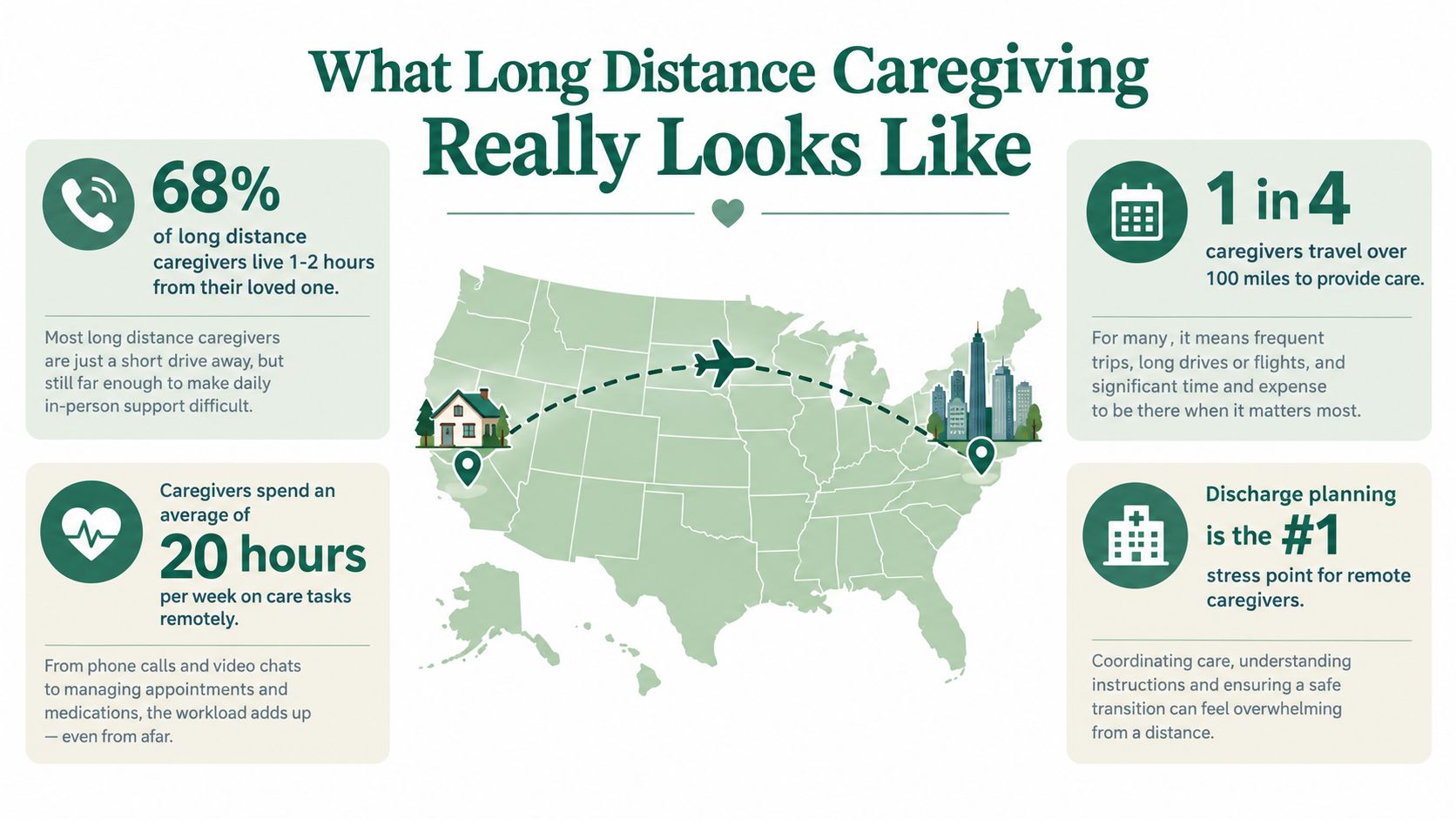
Start with the distance itself. In the United States, long-distance caregiving is commonly defined as unpaid support for someone who lives more than an hour away, though researchers have used different measures, including travel time and mileage. National estimates put the number of long-distance caregivers at approximately 5–7 million, or about 15% of family caregivers. The average long-distance caregiver has been reported to live roughly 450 miles, or about seven hours of travel, away from the person receiving care (Caregiver Statistics and Demographics).
Those figures describe very different practical situations. A relative living ninety minutes away may be unable to attend every appointment but able to drive over after work. Someone several hundred miles away may need to arrange a local visit, collect information by phone and plan travel well in advance. The issue isn't miles alone. It's whether distance makes it harder to visit, arrange transport, notice a change or respond quickly.
Consider an adult child who hears that a parent fell. The child may not be able to inspect the home or sit beside the parent during a medical conversation. They can still identify who is with the parent, find out what professionals have advised, gather relevant documents, arrange local help and make sure someone owns the next step. Those tasks can become a substantial part of the care, even when they don't look like hands-on assistance.
Distance changes the work, not the responsibility
Research in a national sample of caregivers found that those living at least an hour away did fewer hands-on health, daily-living and healthcare tasks, but proximity wasn't associated with differences in health-system logistics, advocacy or financial support (research on residential proximity and caregiving activities). In plain terms, distant relatives may do less direct care while still carrying substantial responsibility for keeping the arrangements moving.
That distinction is the foundation of a workable plan. Treat long-distance caregiving first as a coordination-and-authority problem, not a demand for more monitoring. The practical levers are clear: assess what's happening, assign owners, create a shared handover, coordinate medication and appointments, delegate by who can physically act, check legal access and authority, and plan visits and discharge transitions. Each lever answers the same questions: Who owns this? How will the update reach the right person? What happens if the plan changes?
First 72 Hours of a Care Situation From Afar
When someone calls with a concern, don't begin by sending questions to every relative. First establish what's happening now, then write down the work, then assign it. A shared record gives everyone the same starting point and keeps urgent calls from disappearing into a long thread of messages.
Assess, list, assign
Assess the immediate situation. Find out where your family member is, who is with them, what has already happened and whether a qualified professional is involved. If there's an emergency, contact the appropriate emergency service. A relative's message is useful context, not a substitute for an assessment by a clinician or emergency responder.
List what needs attention in the coming days. Separate urgent questions from tasks that can wait. For example, “Who is at the hospital now?” may need an immediate answer, while “Who can help with transport to a follow-up appointment?” can be put on the task list. Keep the list in one place that the people involved can access.
Assign each recurring task to a named owner and backup. “The family will call the clinic” isn't an assignment. “Maya will call the clinic, and Ben will take over if she hasn't confirmed by the agreed deadline” is. Write down deadlines and the channel where the result should be recorded.
Practical rule: Every open task needs one owner, a next step and a deadline. A group chat can help people talk, but it can't reliably assign work unless someone records the decision.
Minimum information to capture
Keep this first record short enough that a tired relative can update it:
- Current condition: What happened, what's known and what remains uncertain?
- Medications: What list or packaging is available, and who can confirm the current instructions?
- Recent changes: Note concerns the family has observed, without turning a relative's impression into a diagnosis.
- Local contacts: Record the nearby family member, neighbour, home aide or other person who can visit.
- Care setting: Capture the hospital or clinic contact details and the name of the professional responsible for follow-up, if known.
Review the list together, but don't wait for everyone to agree on every detail before naming owners. The goal is to create a reliable first handover and mark unanswered questions for follow-up.
Communication and Handover Routines That Actually Stick
A text thread is for conversation. A shared care record is for facts, actions and handovers. Keep those jobs separate, or the detail you need will be buried between a photo, a scheduling question and a message that says someone will “handle it.”
Create one durable record that shows who reported what, when they reported it, what action followed and who owns the next step. Family members, local helpers and professionals can contribute only where appropriate and with the person receiving care's permission. If you're coordinating home care responsibilities, use the same format for every handover so someone can pick up the thread without reconstructing it from memory.
A useful entry answers five questions
Write entries in a consistent order:
- Who: Name the person recording the update.
- When: Add the date and time of the observation or call.
- What: Describe what the person saw, heard or was told.
- Action: State what needs to happen next.
- Owner: Name the person responsible for that action and when they'll report back.
For example: “Jordan, Tuesday afternoon. The pharmacy said the refill isn't ready. Sam will call the prescribing clinic tomorrow morning and record the answer here.” That's more useful than “Medication issue, can someone call?”
Choose a cadence that matches the situation. When things are unsettled, a brief daily check-in can confirm what changed and what remains open. When care is stable, a weekly summary may be enough. Don't send every update to every person by default. Give each person access to the information they need for their role, and agree where questions belong.
If your family is comparing ways to manage conversations asynchronously, this guide to compare async communication platforms can help clarify what to look for. Whatever you choose, keep decisions and task ownership in the shared record, not only in a chat or a call. Silence doesn't confirm that everything is fine. A missed update should trigger an agreed check-in, not an assumption.
Managing Medications and Appointments Remotely
Medication records, appointments and paperwork form one chain. An appointment may change a prescription; a new prescription may require a pharmacy call; and the family may need a current list to prepare questions or arrange follow-up. If each piece lives in a different inbox, the remote caregiver becomes the person trying to reconcile conflicting versions.
Start with the current medication information, and record where it came from and when it was checked. Distinguish the intended schedule from a user-confirmed dose. A schedule says what is intended; a confirmation is an entry by a person who says they gave or took a dose. It isn't independent proof of administration. If an instruction is unclear or two records conflict, ask the appropriate clinician or pharmacist rather than guessing.
Run the chain with clear handoffs
Put renewals on the task list early enough for the responsible person to act before supplies become an immediate concern. Record who contacts the pharmacy or prescriber, what response they received and whether anything still needs clarification. Keep the current prescription or medication information alongside relevant medical documents, and check extracted or transcribed details against the original.
For an appointment, assign someone to gather the questions, confirm the time and location, arrange transport and decide who will accompany the person. If you can't attend, ask the person going to record the professional's instructions as accurately as possible, then have the remote coordinator note any follow-up tasks. A general resource such as the Sarasota illness guide may help families think through living with ongoing illness, but it doesn't replace advice from the care team.
Use a simple ownership table and adjust it to the care recipient's preferences and abilities:
| Task | Default owner | Cadence |
|---|---|---|
| Maintain the current medication record | Remote coordinator, with confirmation from the person managing medicines locally | Review when instructions change |
| Check refill status | Assigned family member or local helper | Before a supply becomes urgent |
| Prepare appointment questions | Remote coordinator, with input from the care recipient | Before each appointment |
| Arrange transport and accompaniment | Local contact, with remote coordination as needed | Before each appointment |
| File the visit summary and follow-up actions | Person who attended, then the coordinator checks for open tasks | After each appointment |
Don't assume a digital reminder means a task happened. Require a person to confirm completion, record uncertainty, and refer clinical questions to a qualified professional.
Delegating Without Losing Control of the Care
Divide work according to who can do it, not according to who feels most guilty or who lives closest in the family tree. A local relative may be able to check the home and accompany someone to an appointment. A distant sibling may be better placed to manage documents, scheduling and follow-up. The person receiving care should retain as much decision-making authority as they want and are able to exercise.
| Contributor | Best-fit responsibilities | What to record |
|---|---|---|
| Local family member or trusted contact | In-person visits, transport, practical checks and coordination with nearby helpers | What they observed, when, and what needs follow-up |
| Remote coordinator | Shared records, appointments, documents, questions and follow-up | Owner, deadline and status for each open task |
| Home-care worker or other professional | Tasks within their role and observations relevant to their work | Clear, dated handover through the agreed channel |
| Care recipient | Preferences, choices and consent wherever possible | Decisions and any support requested to carry them out |
One contact for routine clinical questions
Choose a primary family contact for routine communication with the clinic or care team, and name a backup. Other relatives can send that contact their questions or observations to combine into one clear message. If the matter is urgent, don't wait for the coordinator to relay it. Use the appropriate urgent-care or emergency route.
This simple rule reduces duplicate calls and contradictory instructions. It also gives professionals a clear point of contact, while keeping the wider family informed through the shared record. Keep side conversations from becoming a parallel system: if a call changes an appointment, task or instruction, the owner records the outcome in the agreed place.
A person who notices a problem can raise it. A named person must own the follow-up. Those are different roles, and families need both.
Legal and Administrative Checks You Should Not Skip
Good intentions don't automatically give a relative access to medical information or authority to make decisions. Don't wait for a crisis to find out what your family member has signed, who can speak with a professional on their behalf, or where important documents are stored. The exact rules depend on the country and situation, so families in France should check current official guidance rather than relying on an informal family understanding.
Confirm authority and access
Ask the care recipient, while they can take part, what they want documented and who should be involved. Review any power of attorney or equivalent arrangement, advance directives, insurance information, identity documents and permissions for sharing health information. Make sure the right people know where the documents are and how to access them securely. Keep decision-making with the person receiving care wherever possible.
A professional review is sensible when the family is unsure whether a document is valid, what authority it grants or how to handle disagreement. A notary or lawyer can advise on legal documents; a social worker may help identify practical support and the appropriate local service. Don't treat a relative's access to a shared app as legal authority to make health decisions.
For families in France, Service-Public.fr is a starting point for administrative and legal procedures, Assurance Maladie for health-insurance information, CNSA for autonomy and support resources, and HAS for guidance related to health and care. For shared health records, check the person's rights, consent and access arrangements. This overview of the Dossier Médical Partagé can help you understand the role of a shared medical record, but confirm current procedures with the relevant official service.
Also ask the employer or relevant public body about caregiver leave, workplace flexibility and benefits. Eligibility can depend on personal circumstances and current rules; get confirmation from the authoritative source before planning around a benefit. The family can organise its own contact list and document inventory, but questions about legal authority, eligibility or disputed decisions deserve qualified advice.
Planning Visits, Respite and the Discharge Window
Visits and hospital discharge are moments when a remote caregiver can do a lot of useful work, but only if the family decides in advance what the visit is for and who will confirm the return-home arrangements. Don't spend the whole trip trying to catch up with everyone verbally. Pick the unresolved issues that require your presence, then make sure someone local owns the follow-through after you leave.
Make the visit count
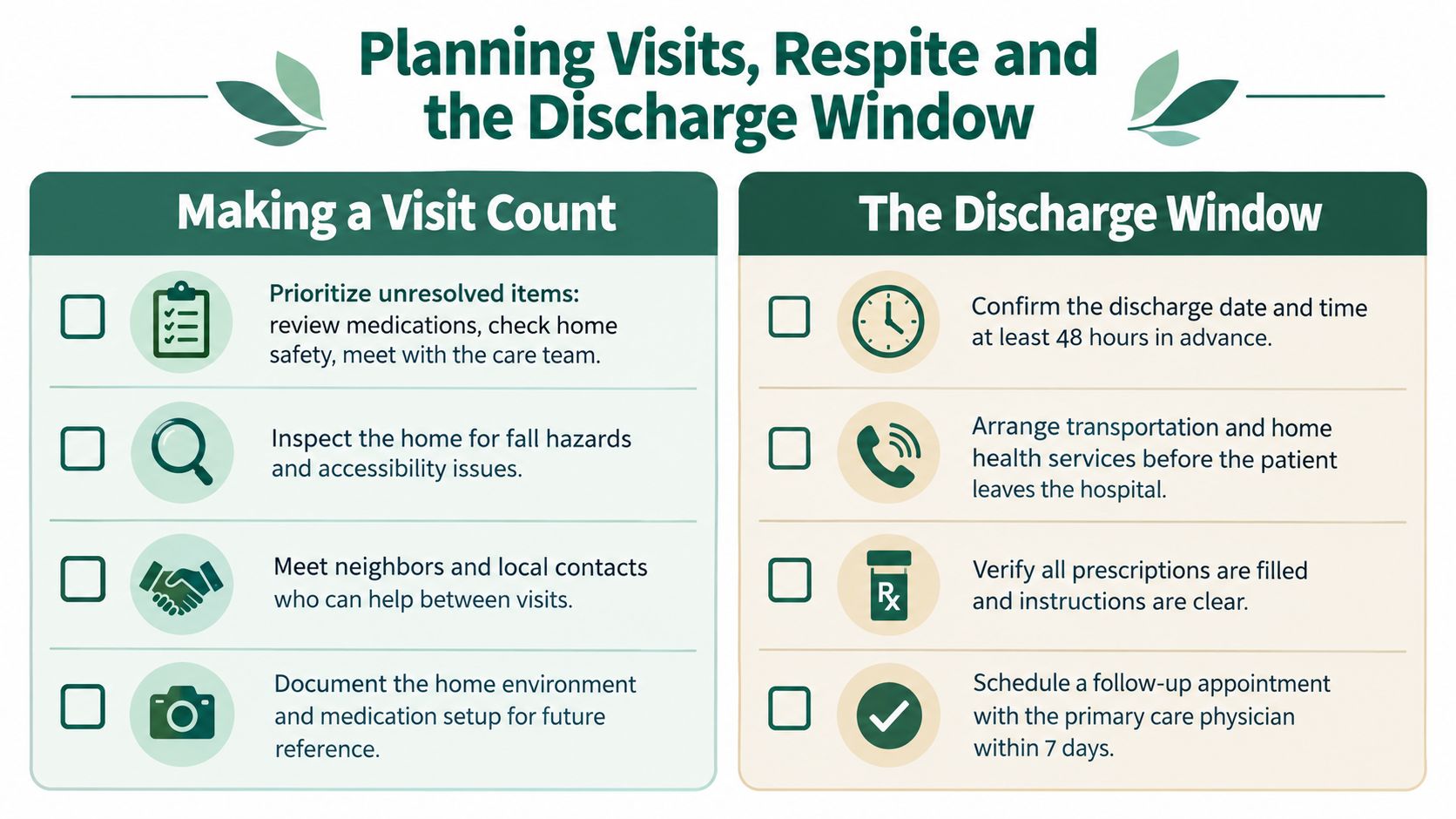
Before travelling, ask the local contact and the care recipient what remains unresolved. Prepare a short list of questions for the care team, identify any documents you need to review and agree which parts of the home or routine need an in-person look. During the visit, pay attention to things that remote calls can't reliably establish, such as whether the current setup works for the person and whether support is arriving as arranged.
- Prioritize open items: Review the medication information, appointments, unresolved questions and assigned tasks.
- Observe the practical setup: Notice obstacles in the home or routines that the care recipient wants help addressing. Raise health or safety concerns with an appropriate professional.
- Meet local contributors: Confirm how neighbours, relatives, home aides or other helpers can be contacted and what they've agreed to do.
- Record the handover: Note what changed, who accepted each next step and when the family will check back.
Plan respite for the person who provides regular hands-on support, too. Ask what would let them rest, then arrange a named person to cover the practical tasks during that time. A visit isn't restorative if the local caregiver spends it explaining every detail while still doing all the work.
Treat discharge as a transition, not a farewell
Hospital discharge should be planned before the person leaves, not after the car reaches home. Greater caregiver support before admission was associated with better perceived discharge preparedness in a 2025 cohort study of 443 internal-medicine patients; caregiver engagement during the hospital stay and discharge process helped explain that association (the 2025 study on caregiver involvement and discharge preparedness). For a long distance caregiver, preparation means identifying who can verify each local arrangement, not trying to verify everything by phone.
Before discharge, request the current medication and appointment information and record any questions that still need answers. Before the person arrives home, confirm transport, required equipment and which local person or service has accepted each task. During the first days at home, arrange a clear way for the local helper to report what they observe and for unresolved questions to reach the appropriate professional. A remote relative can help prepare and coordinate, but can't replace an in-person assessment or emergency service.
Pilot the shared workflow before expanding it
Choose any shared record for what it lets people do together, not for how many features it advertises. At minimum, the family needs identified authors, timestamps, task status, appointment details, document versioning and explicit fields for escalation. Medication records should distinguish the intended schedule from a user's confirmation, and they should never be presented as proof that a dose was administered.
Use a structured rollout:
- Establish a baseline: Write down the main sources of burden, family friction and work-care conflicts.
- Configure only essential tasks: Start with recurring items that currently get lost, such as appointments, handovers or refill follow-up.
- Train each participant: Agree what must be recorded, who will record it and how urgent concerns are escalated.
- Run a two-to-four-week pilot: Keep the trial focused so the family can see whether the routine works.
- Audit operations: Review update completion, response time, closed handovers, duplicate work and unresolved tasks.
- Revise before expanding: Fix unclear ownership and notification overload before adding more people or workflows.
A technology-supported care process can be feasible without proving that an app alone improves clinical outcomes. In a 2025 one-arm pre-post study of 40 long-distance caregivers living at least two hours away, the LDCare intervention reported 90% retention and 95% adherence, alongside immediate reductions in several caregiver-reported difficulties. Because the study had no randomized comparison group, those results don't establish that the intervention alone caused the changes (the LDCare study). Use technology to make responsibilities and handovers clearer, not to promise medical monitoring or clinical safety.
Tribulys is one option for keeping a shared journal, calendar, medication records, documents, responsibilities and emergency information in a private space. Test it, or any other system, against your family's actual handovers and follow-up needs. This week, choose one coordinator, write down the open tasks and assign each one an owner and backup.
If scattered updates and unclear handovers are making care harder to manage, Tribulys brings shared care information and responsibilities together in one private space. Start by setting up the tasks your family needs most, then invite the people who've agreed to own them through Tribulys.
Put this organisation into practice with Tribulys
Keep your care journal, shared calendar, tasks, medication tracking and emergency information together. Start for free and invite the relatives and professionals involved in your loved one’s care.